- describe the relationship between the structure of chloroplasts, as shown in diagrams and electron micrographs, and their function
- explain that energy transferred as ATP and reduced NADP from the light-dependent stage is used during the light-independent stage (Calvin cycle) of photosynthesis to produce complex organic molecules
- state that within a chloroplast, the thylakoids (thylakoid membranes and thylakoid spaces), which occur in stacks called grana, are the site of the light-dependent stage and the stroma is the site of the light-independent stage
- describe the role of chloroplast pigments (chlorophyll a, chlorophyll b, carotene and xanthophyll) in light absorption in thylakoids
- interpret absorption spectra of chloroplast pigments and action spectra for photosynthesis
- describe and use chromatography to separate and identify chloroplast pigments (reference should be made to $R_f$ values in identification of chloroplast pigments)
- state that cyclic photophosphorylation and non-cyclic photophosphorylation occur during the light-dependent stage of photosynthesis
- explain that in cyclic photophosphorylation: • only photosystem I (PSI) is involved • photoactivation of chlorophyll occurs • ATP is synthesised
- explain that in non-cyclic photophosphorylation: • photosystem I (PSI) and photosystem II (PSII) are both involved • photoactivation of chlorophyll occurs • the oxygen-evolving complex catalyses the photolysis of water • ATP and reduced NADP are synthesised
- explain that during photophosphorylation: • energetic electrons release energy as they pass through the electron transport chain (details of carriers are not expected) • the released energy is used to transfer protons across the thylakoid membrane • protons return to the stroma from the thylakoid space by facilitated diffusion through ATP synthase, providing energy for ATP synthesis (details of ATP synthase are not expected)
- outline the three main stages of the Calvin cycle: • rubisco catalyses the fixation of carbon dioxide by combination with a molecule of ribulose bisphosphate (RuBP), a 5C compound, to yield two molecules of glycerate 3-phosphate (GP), a 3C compound • GP is reduced to triose phosphate (TP) in reactions involving reduced NADP and ATP • RuBP is regenerated from TP in reactions that use ATP
- state that Calvin cycle intermediates are used to produce other molecules, limited to GP to produce some amino acids and TP to produce carbohydrates, lipids and amino acids
Photosynthesis
A-Level Biology · Topic 13
 8:58
8:58
Photosynthesis
Here is something strange about a tree. Almost none of it came out of the ground. The wood, the leaves, the fruit — nearly all of that mass was pulled out of…
English narration · English + 中文 subtitles burned in
13.1
The chloroplast

Syllabus
Source: Cambridge International syllabus
Photosynthesis 光合作用 happens inside the chloroplast 叶绿体. Its structure suits its two stages:
- inside are stacks of flat sacs called thylakoids 类囊体. A stack of thylakoids is a granum (plural grana 基粒). The thylakoid membranes hold the light-trapping pigments and are the site of the first stage.
- the fluid around the thylakoids is the stroma 基质, the site of the second stage.


Explore
Explore the chloroplast
Tap each part. The light-dependent stage runs on the thylakoid membranes (grana); the Calvin cycle runs in the stroma around them.
Vocabulary
Train
| English |
|---|
| photosynthesis/ˌfəʊtəʊˈsɪnθəsɪs/ |
| chloroplast/ˈklɔːrəʊplæst/ |
| thylakoid/ˈθaɪləkɔɪd/ |
| grana/ˈɡrɑːnə/ |
| stroma/ˈstrəʊmə/ |
13.1
The two stages of photosynthesis

Photosynthesis has two linked stages:
- the light-dependent stage 光反应阶段 happens in the thylakoids. It uses light energy to make ATP and reduced 还原 NADP.
- the light-independent stage 暗反应阶段, also called the Calvin cycle 卡尔文循环, happens in the stroma. It uses the ATP and reduced NADP from the first stage to build complex organic molecules from carbon dioxide 二氧化碳.
Vocabulary
Train
| English |
|---|
| light-dependent stage/laɪt dɪˈpendənt steɪdʒ/ |
| reduce/rɪˈdjuːs/ |
| light-independent stage/laɪt ˌɪndɪˈpendənt steɪdʒ/ |
| Calvin cycle/ˈkælvɪn ˈsaɪkl/ |
| carbon dioxide/ˈkɑːbən daɪˈɒksaɪd/ |
13.1
Chloroplast pigments
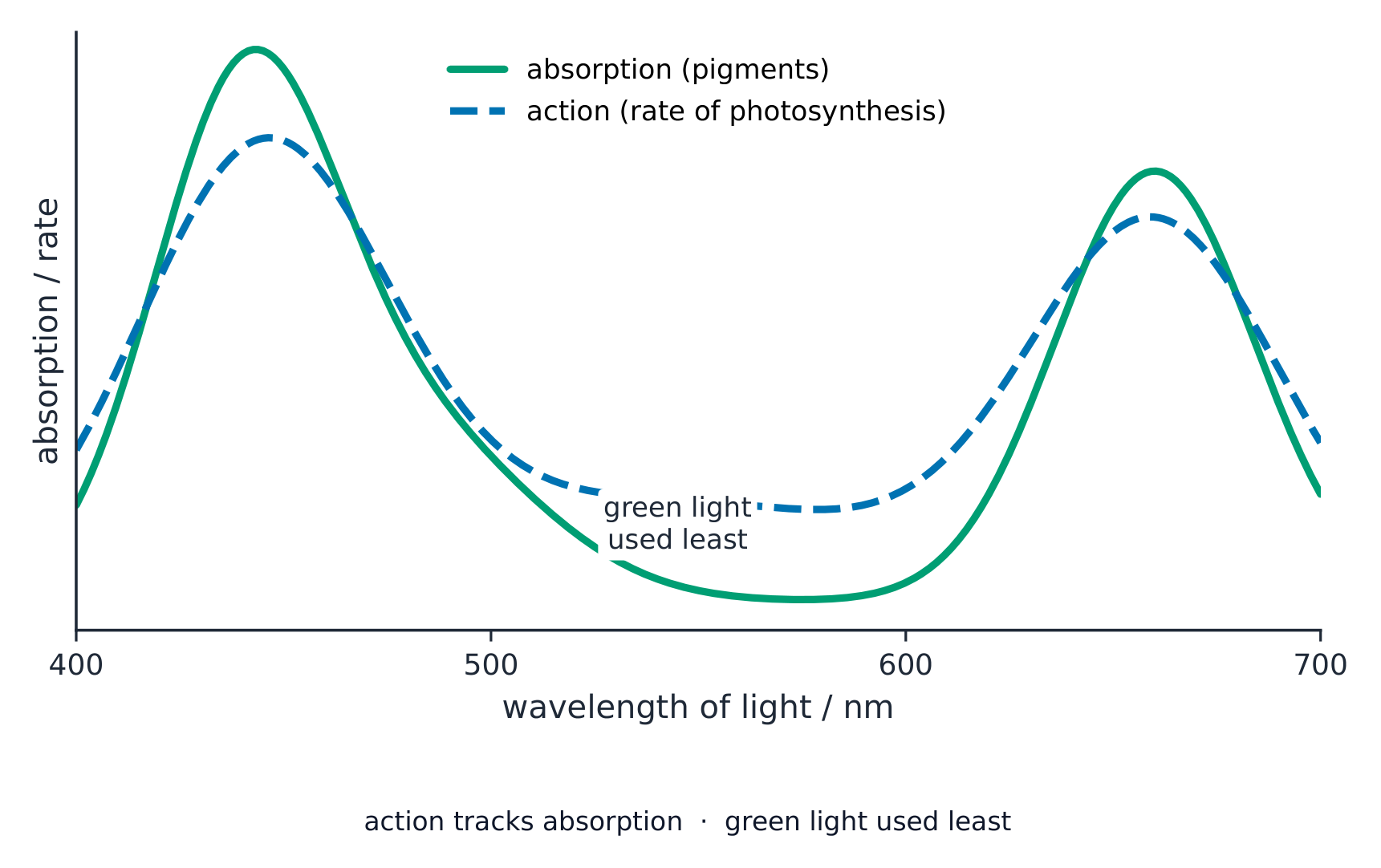
A pigment 色素 is a coloured substance that absorbs light. The thylakoids hold several pigments that work together to trap as much light as possible:
- chlorophyll 叶绿素 a and chlorophyll b (which absorb mainly red and blue light),
- carotene 胡萝卜素 and xanthophyll 叶黄素 (which absorb other colours and pass the energy on).
We study them with two graphs. An absorption spectrum 吸收光谱 shows how much light each pigment absorbs at each wavelength. An action spectrum 作用光谱 shows how fast photosynthesis goes at each wavelength. The two graphs match closely, which shows the pigments drive photosynthesis.
You can separate the pigments by chromatography 色谱法: the pigments travel different distances up the paper. Each pigment is identified by its Rf value 比移值 (the distance the pigment moved divided by the distance the solvent moved).

Vocabulary
Train
| English |
|---|
| pigment/ˈpɪɡmənt/ |
| chlorophyll/ˌklɔːrəʊˈfɪl/ |
| carotene/ˈkærəʊtiːn/ |
| xanthophyll/ˈzænθəfɪl/ |
| absorption spectrum/əbˈsɔːpʃn ˈspektrəm/ |
| action spectrum/ˈækʃn ˈspektrəm/ |
| chromatography/krəʊməˈtɒɡrəfi/ |
| Rf value/ˌɑːˈref ˈvæljuː/ |
13.1
The light-dependent stage

In the thylakoids, light is used to make ATP. This is photophosphorylation 光合磷酸化, and it comes in two forms.
In cyclic photophosphorylation 循环光合磷酸化:
- only photosystem 光系统 I (PSI) is used.
- photoactivation 光激活 of chlorophyll occurs (light boosts its electrons 电子 to a higher energy).
- only ATP is made.
In non-cyclic photophosphorylation 非循环光合磷酸化:
- both photosystem I (PSI) and photosystem II (PSII) are used.
- photoactivation of chlorophyll occurs.
- the oxygen-evolving complex 放氧复合体 carries out the photolysis 光解 (splitting by light) of water, which releases oxygen 氧气.
- both ATP and reduced NADP are made.
In both forms, energy is released in the same way:
- energetic electrons pass along an electron transport chain 电子传递链, releasing energy as they go.
- this energy is used to pump protons 质子 across the thylakoid membrane.
- the protons flow back into the stroma through ATP synthase ATP合酶, and this flow provides the energy to make ATP.
Explore
The light-dependent stage
Step through it. Light excites electrons and splits water; the result is ATP, reduced NADP and oxygen.
Vocabulary
Train
| English |
|---|
| photophosphorylation/ˌfəʊtəʊˌfɒsfɔːrɪˈleɪʃn/ |
| cyclic photophosphorylation/ˈsaɪklɪk ˌfəʊtəʊˌfɒsfɔːrɪˈleɪʃn/ |
| photosystem/ˌfəʊtəʊˈsɪstəm/ |
| photoactivation/ˌfəʊtəʊˌæktɪˈveɪʃn/ |
| electron/ɪˈlektrɒn/ |
| non-cyclic photophosphorylation/nɒn ˈsaɪklɪk ˌfəʊtəʊˌfɒsfɔːrɪˈleɪʃn/ |
| oxygen-evolving complex/ˈɒksɪdʒn ɪˈvɒlvɪŋ ˈkɒmpleks/ |
| photolysis/fəʊˈtɒləsɪs/ |
| oxygen/ˈɒksɪdʒn/ |
| electron transport chain/ɪˈlektrɒn ˈtrænspɔːt tʃeɪn/ |
| proton/ˈprəʊtɒn/ |
| ATP synthase/ˌeɪ tiː ˈpiː ˈsɪnθeɪs/ |
13.1
The Calvin cycle

The light-independent stage builds sugars in three main steps:
- fixation 固定 — the enzyme 酶 rubisco joins carbon dioxide to a 5-carbon molecule, RuBP (ribulose bisphosphate). This makes two molecules of a 3-carbon compound, GP (glycerate 3-phosphate).
- reduction — GP is reduced to TP (triose phosphate) using reduced NADP and ATP from the light-dependent stage.
- regeneration — most of the TP is used to regenerate 再生 the RuBP (using more ATP), so the cycle can keep running.
Some TP leaves the cycle to make useful molecules. GP can be used to make some amino acids 氨基酸, and TP can be used to make carbohydrates 碳水化合物, lipids 脂质 and amino acids.
Explore
The Calvin cycle
Step around the cycle. CO₂ is fixed onto RuBP, reduced to sugar using the light-stage's ATP and NADP, and RuBP is regenerated.
Vocabulary
Train
| English |
|---|
| fixation/fɪkˈseɪʃn/ |
| enzyme/ˈenzaɪm/ |
| regenerate/riːˈdʒenəreɪt/ |
| amino acid/əˈmiːnəʊ ˈæsɪd/ |
| carbohydrate/ˌkɑːbəʊˈhaɪdreɪt/ |
| lipid/ˈlɪpɪd/ |
13.2
Limiting factors

Syllabus
- state that light intensity, carbon dioxide concentration and temperature are examples of limiting factors of photosynthesis
- explain the effects of changes in light intensity, carbon dioxide concentration and temperature on the rate of photosynthesis
- describe and carry out investigations using redox indicators, including DCPIP and methylene blue, and a suspension of chloroplasts to determine the effects of light intensity and light wavelength on the rate of photosynthesis
- describe and carry out investigations using whole plants, including aquatic plants, to determine the effects of light intensity, carbon dioxide concentration and temperature on the rate of photosynthesis
Source: Cambridge International syllabus
A limiting factor 限制因素 is the one in shortest supply that holds back the rate of photosynthesis. The three main ones are light intensity 光照强度, carbon dioxide concentration 浓度, and temperature 温度.
- raising light intensity speeds up photosynthesis, until some other factor becomes limiting.
- raising carbon dioxide concentration speeds it up, until some other factor becomes limiting.
- raising temperature speeds it up, but only to an optimum; too high and the enzymes denature.
You can measure the rate of the light-dependent stage with a redox indicator 指示剂 such as DCPIP or methylene blue and a suspension of chloroplasts: the dye loses its colour as the chloroplasts work, and you can test different light intensities or light wavelengths 波长. With a whole aquatic plant 水生植物 you can count the bubbles of oxygen given off to compare rates under different conditions.
Worked example. A plant photosynthesising steadily is suddenly deprived of carbon dioxide. What happens to the levels of GP and RuBP? Follow the cycle one step at a time. Carbon dioxide is fixed when RuBP combines with it, catalysed by rubisco, to make GP. Remove the carbon dioxide and that reaction stops, so GP is no longer being made - yet GP continues to be used up, reduced to TP using ATP and reduced NADP. So GP falls. Meanwhile RuBP is still being regenerated from TP but is no longer being consumed, so RuBP rises. The method never changes: find the reaction that stops, then ask of each substance whether it is still being made and still being used. Removing the light instead gives the mirror image: with no ATP or reduced NADP, GP cannot be reduced, so GP rises and RuBP falls.
Explore
What limits photosynthesis
Change light and CO₂. The rate is set by whichever factor is in shortest supply — raising the others won't help.
Vocabulary
Train
| English |
|---|
| limiting factor/ˈlɪmɪtɪŋ ˈfæktə/ |
| light intensity/laɪt ɪnˈtensɪti/ |
| concentration/ˌkɒnsənˈtreɪʃn/ |
| temperature/ˈtemprɪtʃə/ |
| indicator/ˈɪndɪkeɪtə/ |
| wavelength/ˈweɪvleŋθ/ |
| aquatic plant/əˈkwætɪk plænt/ |
13.2
Exam tips
- Separate the two stages: light-dependent (thylakoid — photolysis, ATP, reduced NADP, O2) and the Calvin cycle (stroma — CO2 fixed by rubisco, GP → TP).
- Read limiting-factor graphs: the plateau is where a different factor (light, CO2 or temperature) limits the rate.
- Interpret chromatography with the $R_f$ value to identify pigments.
- Link chloroplast structure to function (thylakoid stacks for the light reactions; stroma for the Calvin cycle).
Interactive lessons on this topic
Work through it step by step, with instant-check exercises.