Energy and ATP
Introduced| English | Meaning |
|---|---|
| energy currency/ˈenədʒi ˈkʌrənsi/ | energy currency |
| respiration/ˌrespɪˈreɪʃn/ | The chemical reactions in cells that release usable energy from nutrient molecules. |
| active transport/ˈæktɪv ˈtrænspɔːt/ | The movement of substances across a cell membrane against their concentration gradient using energy and carrier proteins. |
| anabolic/ˌænəˈbɒlɪk/ | Describing metabolic processes that build larger molecules from smaller units and require energy input. |
| phosphorylation/ˌfɒsfɔːrɪˈleɪʃn/ | The addition of a phosphate group to a molecule. |
| chemiosmosis/ˌkemɪəzˈməʊsɪs/ | The movement of ions, commonly protons, down an electrochemical gradient across a membrane to drive a process such as ATP synthesis. |
The cell's energy currency 能量货币
- Cells need a steady supply of energy, which they get from respiration 呼吸作用.
- Energy powers active transport 主动运输, movement, and anabolic 合成代谢 reactions (building big molecules).
- The molecule that delivers it is ATP.
Which is a use of energy in a cell?
Difficulty 1/5 · 100 coins + a small bonus on first completion today
Energy from respiration drives active transport, movement (e.g. muscle), and anabolic (building) reactions.
ATP is re-made from ADP and a ______ group.
Difficulty 1/5 · 100 coins + a small bonus on first completion today
Respiration provides the energy to re-attach the phosphate to ADP.
The energy currency
- ATP is made from ADP + a phosphate; breaking that phosphate off again releases a small, usable burst of energy.
- It is the universal energy currency because it:
- releases energy quickly, in small amounts that match a cell's needs,
- is easily re-made over and over,
- is small and soluble, so it moves easily around the cell.
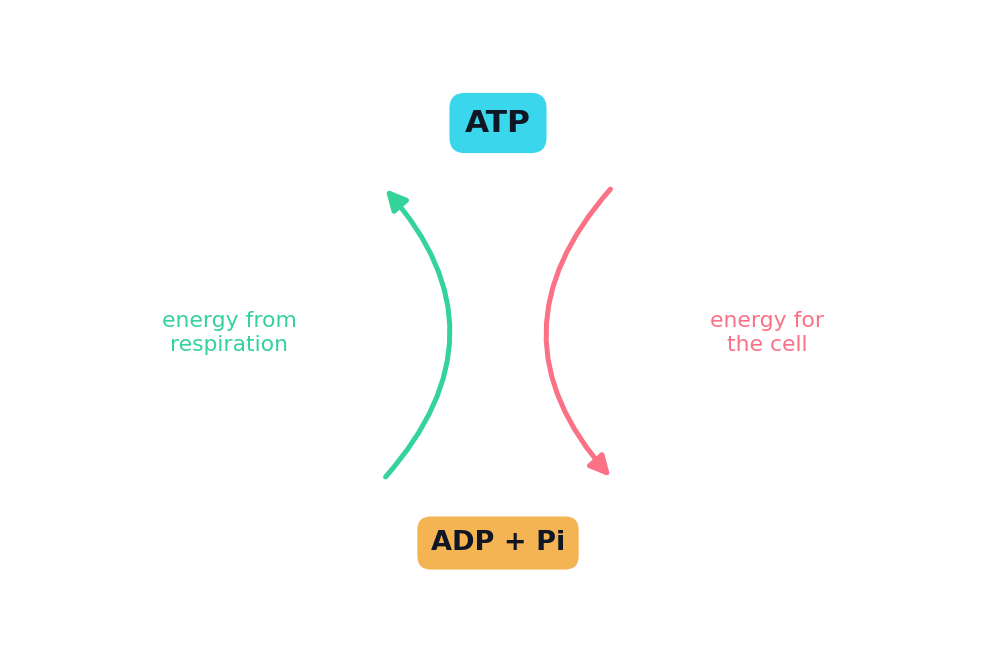
The ATP cycle
Step around the loop. ATP is split to release a small burst of energy, then rebuilt by respiration — over and over.
Why is ATP a good energy currency?
Difficulty 1/5 · 100 coins + a small bonus on first completion today
ATP gives small, quick bursts of energy, is re-made repeatedly, and is small and soluble so it moves easily.
ATP is made by adding a phosphate group to ADP, and broken down again by removing it.
Difficulty 1/5 · 100 coins + a small bonus on first completion today
Adding a phosphate to ADP stores energy as ATP; removing it (hydrolysis) releases that energy.
Match each term to its meaning.
Difficulty 2/5 · 140 coins + a small bonus on first completion today
ATP holds the energy; hydrolysis releases it (giving ADP + Pi); chemiosmosis is how most ATP is made.
How ATP is made
- by phosphorylation 磷酸化 — direct transfer of a phosphate group.
- by chemiosmosis 化学渗透 — across the membranes of mitochondria and chloroplasts.

During exercise, muscles need a constant supply of energy from respiration.
Chemiosmosis makes ATP using:
Difficulty 1/5 · 100 coins + a small bonus on first completion today
Chemiosmosis uses a proton gradient across the inner membrane to drive ATP synthase.
Why ATP, not glucose
- ATP releases a small, usable packet of energy exactly where it is needed.
- Glucose holds far more energy, but releasing it all at once would be wasteful and damaging.
Worked example. A muscle contraction uses ATP directly, not glucose. Respiration steadily re-makes ATP from ADP, so a tiny pool of ATP is recycled thousands of times a day.

Lipids release the most energy per gram, then proteins, then carbohydrates
You've got it
- energy (from respiration) powers active transport, movement, anabolic reactions
- ATP = ADP + phosphate; the universal energy currency (quick, small bursts; re-made; small + soluble)
- ATP is made by phosphorylation and chemiosmosis (across mitochondrial/chloroplast membranes)