Glycolysis and the link reaction
Introduced| English | Meaning |
|---|---|
| glycolysis/ɡlaɪˈkɒləsɪs/ | The cytoplasm. |
| link reaction/lɪŋk rɪˈækʃn/ | The matrix of the mitochondria. |
| Krebs cycle/krebz ˈsaɪkl/ | The matrix of the mitochondria. |
| oxidative phosphorylation/ˈɒksɪdətɪv ˌfɒsfɔːrɪˈleɪʃn/ | The inner membrane of the mitochondria. |
| pyruvate/ˈpaɪruːveɪt/ | A three-carbon product of glycolysis that can enter further respiratory reactions or fermentation pathways. |
| coenzyme/ˌkəʊˈenzaɪm/ | A small organic molecule that assists an enzyme, often by carrying electrons or chemical groups between reactions. |
| acetyl coenzyme A/ˈæsɪtaɪl ˌkəʊˈenzaɪm eɪ/ | acetyl coenzyme A |
Aerobic respiration: the first stages
- Aerobic respiration (with oxygen) runs in four stages.
- Each happens in a set place in the cell.
- We start with glycolysis 糖酵解 and the link reaction 连接反应.
Glycolysis takes place in the cytoplasm, and needs no oxygen.
Difficulty 1/5 · 100 coins + a small bonus on first completion today
Glycolysis is in the cytoplasm and is anaerobic; the later stages (Krebs, oxidative phosphorylation) are in the mitochondria.
Where each stage happens
| Stage | Location |
|---|---|
| glycolysis | the cytoplasm |
| link reaction | the matrix of the mitochondria |
| Krebs cycle 克雷布斯循环 | the matrix of the mitochondria |
| oxidative phosphorylation 氧化磷酸化 | the inner membrane of the mitochondria |

The four stages of aerobic respiration and where each one happens
Match each stage of aerobic respiration to where it happens.
Difficulty 2/5 · 140 coins + a small bonus on first completion today
Glycolysis = cytoplasm; link reaction & Krebs = matrix; oxidative phosphorylation = inner membrane.
Glycolysis
- In the cytoplasm, glucose (6C) is phosphorylated using 2 ATP, then split into two triose phosphate (3C) molecules.
- These are oxidised to two pyruvate 丙酮酸 (3C).
- Net result: a gain of 2 ATP and some reduced NAD (NAD is a coenzyme 辅酶, a helper molecule).
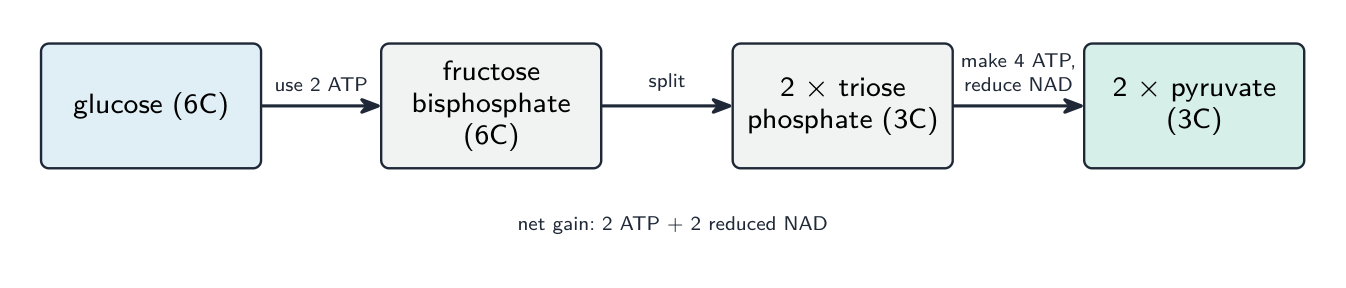
Glycolysis splits one glucose into two pyruvate, for a net gain of 2 ATP and reduced NAD
Glycolysis
Step through it. Glucose is split in the cytoplasm into two pyruvate, for a small net gain of ATP and reduced NAD.
The net yield of glycolysis is:
Difficulty 1/5 · 100 coins + a small bonus on first completion today
Glycolysis uses 2 ATP and makes 4, a net gain of 2 ATP, plus reduced NAD.
Glycolysis ends by splitting glucose into:
Difficulty 1/5 · 100 coins + a small bonus on first completion today
Glucose (6C) → 2 triose phosphate (3C) → 2 pyruvate (3C).
Glycolysis gives a net gain of ______ ATP per glucose molecule.
Difficulty 1/5 · 100 coins + a small bonus on first completion today
2 ATP are used and 4 are made — a net gain of 2 ATP (plus 2 reduced NAD).
Put the steps of glycolysis in order.
Difficulty 3/5 · 200 coins + a small bonus on first completion today
Phosphorylate → split → oxidise to pyruvate, for a net 2 ATP and 2 reduced NAD.
The link reaction
- When oxygen is available, pyruvate enters the mitochondrial matrix.
- Each pyruvate loses a CO₂ and becomes a 2-carbon acetyl group.
- Carried by coenzyme A, it forms acetyl coenzyme A 乙酰辅酶A; NAD is reduced.
In the link reaction, each pyruvate:
Difficulty 1/5 · 100 coins + a small bonus on first completion today
Pyruvate is decarboxylated (loses CO₂) to a 2C acetyl group, carried by coenzyme A as acetyl CoA.
You've got it
- aerobic respiration = 4 stages: glycolysis (cytoplasm), link + Krebs (matrix), oxidative phosphorylation (inner membrane)
- glycolysis: glucose → 2 pyruvate; net 2 ATP + reduced NAD
- link reaction: pyruvate → acetyl CoA (loses CO₂, reduces NAD)