Skip to content · ⁨ข้ามไปยังเนื้อหา⁩

Waves · ⁨คลื่น⁩

IGCSE Physics · ⁨Physics IGCSE⁩ · Topic 3 · ⁨หัวข้อ 3⁩

Video lesson for this topic · ⁨บทเรียนวิดีโอสำหรับหัวข้อนี้⁩ Open the video page · ⁨เปิดหน้าวิดีโอ⁩
17:11

คลื่น

หย่อนหินลงในบ่อ แล้ววงrippleจะขยายออกไป แต่ดูใบไม้ที่ลอยอยู่บนผิวน้ำ — มันจะขยับขึ้นลงเท่านั้น ไม่ได้เคลื่อนที่ไปกับคลื่น…

English narration · English + 中文 subtitles burned in · ⁨การบรรยายภาษาอังกฤษ · คำบรรยายภาษาอังกฤษ + 中文 ลอยตัวบนภาพ⁩

3.1

General properties of waves · ⁨คุณสมบัติทั่วไปของคลื่น⁩

Syllabus · ⁨หลักสูตร⁩
English
Core Supplement
1 Know that waves transfer energy without transferring matter
2 Describe what is meant by wave motion as illustrated by vibrations in ropes and springs, and by experiments using water waves
3 Describe the features of a wave in terms of wavefront, wavelength, frequency, crest (peak), trough, amplitude and wave speed
4 Recall and use the equation for wave speed $v = f \lambda$
5 Know that for a transverse wave, the direction of vibration is at right angles to the direction of propagation and understand that electromagnetic radiation, water waves and seismic S-waves (secondary) can be modelled as transverse
6 Know that for a longitudinal wave, the direction of vibration is parallel to the direction of propagation and understand that sound waves and seismic P-waves (primary) can be modelled as longitudinal
7 Describe how waves can undergo: (a) reflection at a plane surface (b) refraction due to a change of speed (c) diffraction through a narrow gap 9 Describe how wavelength and gap size affects diffraction through a gap
8 Describe the use of a ripple tank to show: (a) reflection at a plane surface (b) refraction due to a change in speed caused by a change in depth (c) diffraction due to a gap (d) diffraction due to an edge 10 Describe how wavelength affects diffraction at an edge
ไทย
แก่น เพิ่มเติม
1 รู้ว่าคลื่นถ่ายโอนพลังงานโดยไม่ถ่ายโอนสสาร
2 อธิบายความหมายของการเคลื่อนที่ของคลื่น โดยอ้างอิงจากการสั่นในเชือกและสปริง และการทดลองที่ใช้คลื่นน้ำ
3 อธิบายลักษณะของคลื่นในเชิง หน้าคลื่น, ความยาวคลื่น, ความถี่, ยอดคลื่น (crest/peak), ทรวงคลื่น (trough), แอมพลิจูด และ ความเร็วคลื่น
4 จำและใช้สมการความเร็วคลื่น $v = f \lambda$
5 รู้ว่าสำหรับ คลื่นตามขวาง ทิศทางการสั่นตั้งฉากกับทิศทางการแพร่กระจาย และเข้าใจ rằngรังสีแม่เหล็กไฟฟ้า คลื่นน้ำ และคลื่น S ของแผ่นดินไหว (secondary) สามารถจำลองเป็นคลื่นตามขวางได้
6 รู้ว่าสำหรับ คลื่นตามยาว ทิศทางการสั่นขนานกับทิศทางการแพร่กระจาย และเข้าใจว่าคลื่นเสียงและคลื่น P ของแผ่นดินไหว (primary) สามารถจำลองเป็นคลื่นตามยาวได้
7 อธิบายว่าคลื่นสามารถ undergo: (ก) การสะท้อน บนพื้นผิวเรียบ (ข) การหักเห เนื่องจากความเร็วเปลี่ยน (ค) การแทรกสอด ผ่านช่องแคบ 9 อธิบายว่าความยาวคลื่นและขนาดช่องมีผลต่อการแทรกสอดผ่านช่องอย่างไร
8 อธิบายการใช้ ripple tank เพื่อแสดง: (ก) การสะท้อนบนพื้นผิวเรียบ (ข) การหักเหเนื่องจากความเร็วเปลี่ยนซึ่งเกิดจากความลึกเปลี่ยน (ค) การแทรกสอดเนื่องจากช่อง (ง) การแทรกสอดเนื่องจากขอบ 10 อธิบายว่าความยาวคลื่นมีผลต่อการแทรกสอดที่ขอบอย่างไร

Source: Cambridge International syllabus · ⁨แหล่งที่มา: หลักสูตร Cambridge International⁩

English
Transverse vs longitudinal waves

A wave 波 carries energy 能量 from place to place without carrying matter. For example, a water wave makes a floating cork bob up and down, but the cork does not travel along with the wave. You can make a wave on a rope by shaking one end up and down, or on a long spring by pushing one end back and forth. In a ripple tank 波纹水槽 (a shallow tray of water with a light above it) you can watch water waves on a screen below.

Describing a wave

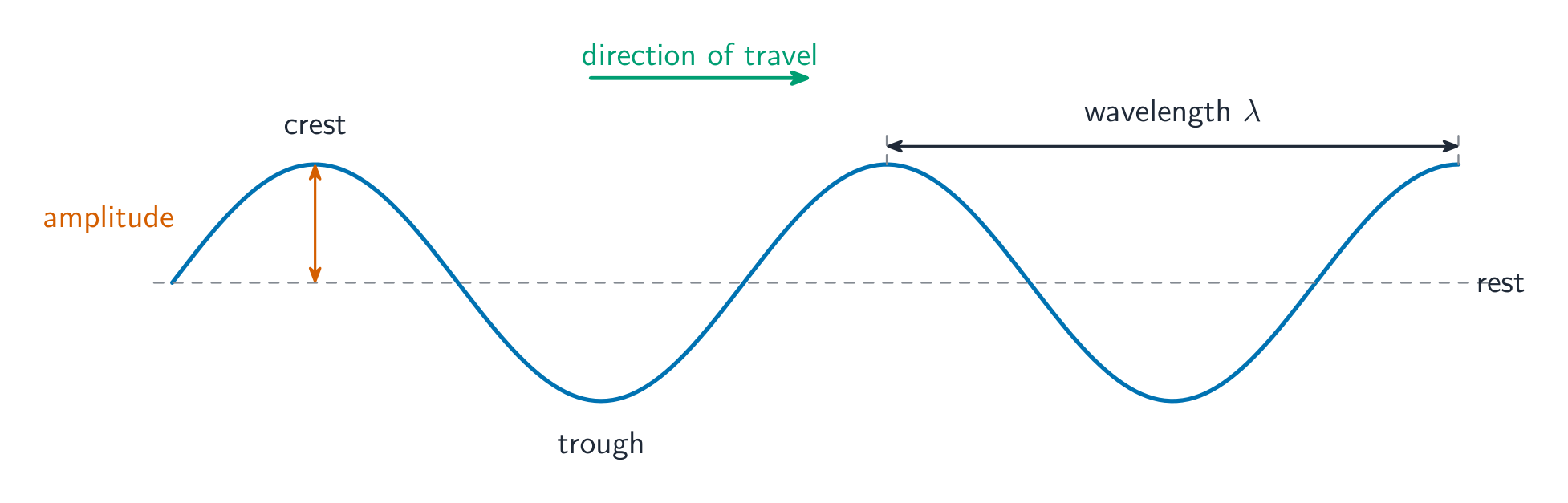
  • wavefront 波前: a line joining points on a wave that move together (for example, the top of one ripple)
  • wavelength 波长 ($\lambda$): the distance between two neighbouring wavefronts (one full wave)
  • frequency 频率 ($f$): the number of waves passing a point each second, measured in hertz (Hz)
  • crest 波峰 (also called the peak 峰, the top) and trough 波谷 (bottom)
  • amplitude 振幅: the largest distance a point moves from its rest position
  • wave speed 波速 ($v$): how fast a wavefront travels

These are linked by the wave equation:

$$v = f\lambda$$

Worked example. A sound wave travels at $340\ \text{m/s}$ and has a frequency of $170\ \text{Hz}$. Find its wavelength.

Rearranging $v = f\lambda$ gives $\lambda = \dfrac{v}{f}$:

$$\lambda = \frac{340}{170} = 2.0\ \text{m}$$

Two types of wave

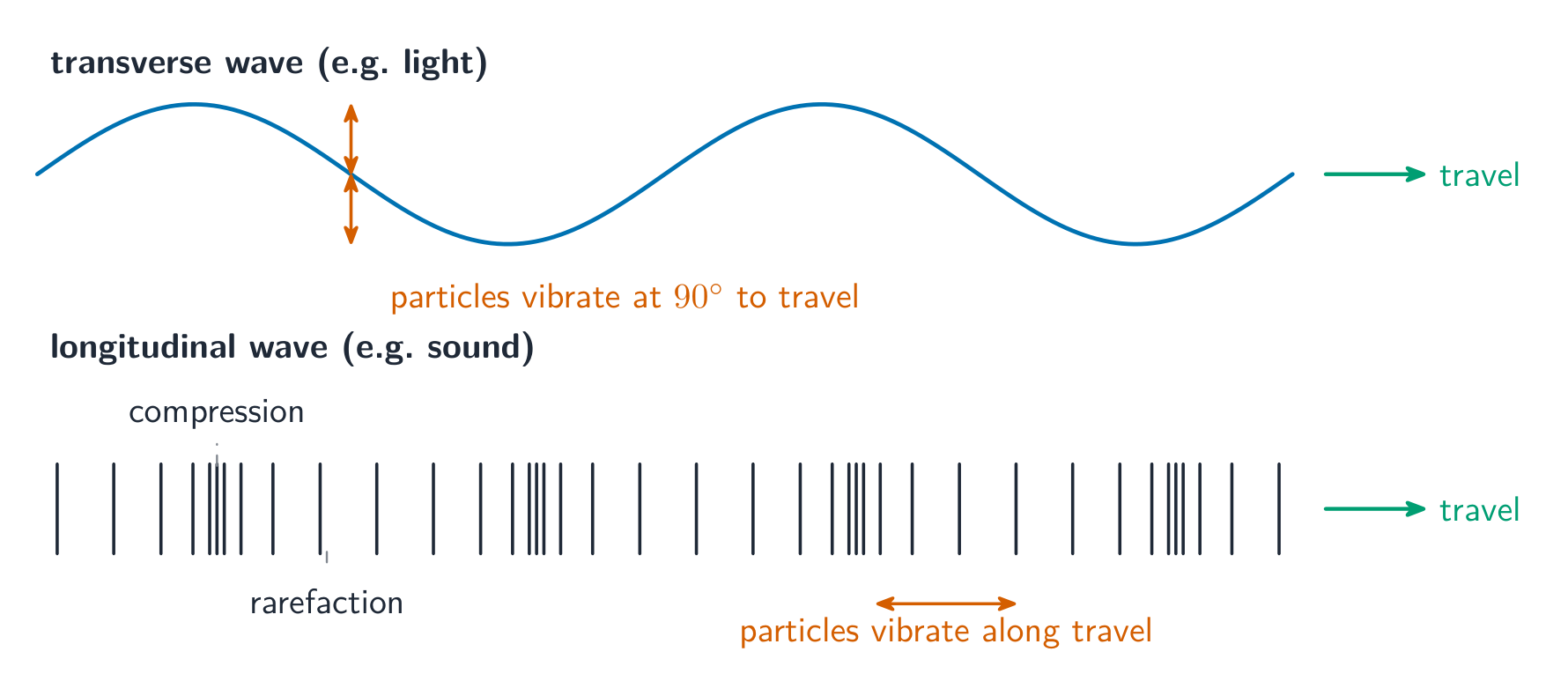
  • In a transverse wave 横波 the particles vibrate at right angles (90°) to the direction the wave travels (its propagation 传播). Light, water waves and seismic S-waves (the sideways shaking in an earthquake) are transverse.
  • In a longitudinal wave 纵波 the particles vibrate along the same direction as the wave travels. Sound and seismic P-waves are longitudinal.

Wave behaviour

All waves can show three behaviours, which you can see in a ripple tank:

  • reflection 反射: the wave bounces off a surface.
  • refraction 折射: the wave changes speed (and usually direction) when it enters a different material or depth.
  • diffraction 衍射: the wave spreads out after passing through a gap or around an edge. The spreading is greatest when the gap is about the same size as the wavelength.
ไทย
คลื่นขวางเทียบกับคลื่นยาว

คลื่น ทำหน้าที่ลำเลียง พลังงาน จากจุดหนึ่งไปยังอีกจุดหนึ่ง โดยไม่ ลำเลียงสสาร ตัวอย่างเช่น คลื่นน้ำทำให้ก้านคอร์กลอยน้ำเด้งขึ้นลง แต่ก้านคอร์กไม่เคลื่อนที่ตามคลื่น คุณสามารถสร้างคลื่นบนเชือกได้โดยการเขย่าปลายเชือกขึ้นลง หรือบนสปริงยาวด้วยการดันปลายสปริงไปมา ใน อ่างripple (ถาดน้ำตื้นที่มีไฟส่องด้านบน) คุณสามารถสังเกตคลื่นน้ำบนจอภาพด้านล่างได้

การอธิบายลักษณะคลื่น

  • หน้าคลื่น: เส้นเชื่อมจุดต่างๆ บนคลื่นที่เคลื่อนที่ไปพร้อมกัน (ตัวอย่างเช่น ยอดของคลื่นลูกเล็กๆ)
  • ความยาวคลื่น ($\lambda$): ระยะห่างระหว่างหน้าคลื่นสองหน้าติดกัน (คลื่นเต็มรอบหนึ่ง)
  • ความถี่ ($f$): จำนวนคลื่นที่ผ่านจุดหนึ่งต่อวินาที วัดเป็นเฮิร์ตซ์ (Hz)
  • ยอดคลื่น (เรียกว่า ยอด, ด้านบน) และ ร่องคลื่น (ด้านล่าง)
  • แอมพลิจูด: ระยะทางสูงสุดที่จุดหนึ่งเคลื่อนที่ออกจากตำแหน่งสมดุล
  • ความเร็วคลื่น ($v$): ความเร็วที่หน้าคลื่นเคลื่อนที่ไป
คลื่นที่มีความยาวคลื่น แอมพลิจูด ยอดคลื่น และร่องคลื่นระบุไว้
ส่วนของคลื่น: ความยาวคลื่น, แอมพลิจูด, ยอดคลื่น และห้วงคลื่น

สิ่งเหล่านี้เชื่อมโยงกันด้วย สมการคลื่น:

$$v = f\lambda$$
คลื่นขวางที่มีความยาวคลื่น แอมพลิจูด ยอดคลื่น ร่องคลื่น และทิศทางการเคลื่อนที่ระบุไว้
ความยาวคลื่นคือระยะห่างระหว่างยอดคลื่นสองยอด; แอมพลิจูดคือความสูงจากตำแหน่งสมดุลถึงยอดคลื่น

ตัวอย่างวิธีทำ. คลื่นเสียงมีความเร็ว $340\ \text{m/s}$ และมีความถี่ $170\ \text{Hz}$ จงหาความยาวคลื่นของมัน

จัดรูป $v = f\lambda$ ใหม่จะได้ $\lambda = \dfrac{v}{f}$:

$$\lambda = \frac{340}{170} = 2.0\ \text{m}$$

ประเภทของคลื่นสองชนิด

  • ใน คลื่นขวาง อนุภาคสั่นตั้งฉาก (90°) กับทิศทางที่คลื่นเคลื่อนที่ (การแพร่กระจาย) แสง คลื่นน้ำ และคลื่น S จากแผ่นดินไหว (การสั่นสะเทือนด้านข้าง) เป็นคลื่นขวาง
  • ใน คลื่นยาว อนุภาคสั่นไปในทิศทางเดียวกับที่คลื่นเคลื่อนที่ เสียงและคลื่น P จากแผ่นดินไหวเป็นคลื่นยาว
คลื่นขวางอยู่เหนือคลื่นยาว แสดงการเคลื่อนที่ของอนุภาคในแต่ละประเภท
ในคลื่นขวาง อนุภาคสั่นข้ามทิศทางการเคลื่อนที่; ในคลื่นยาว ониสั่นไปตามทิศทางนั้น ทำให้เกิดบริเวณหนาแน่นและบาง

พฤติกรรมของคลื่น

คลื่นทุกชนิดสามารถแสดงพฤติกรรมได้สามอย่าง ซึ่งคุณสามารถสังเกตได้ในอ่าง ripple:

  • การสะท้อน: คลื่นดีดกลับออกจากพื้นผิว
  • การหักเห: คลื่นเปลี่ยนความเร็ว (และมักเปลี่ยนทิศทาง) เมื่อเข้าสู่วัสดุหรือความลึกที่ต่างกัน
  • การแทรกสอด: คลื่นกระจายออกหลังจากผ่านช่องว่างหรือรอบขอบ กระจายมากที่สุดในเมื่อช่องว่างมีขนาดประมาณเท่ากับความยาวคลื่น
หน้าคลื่นตรงชนกำแพงที่มีช่องแคบแล้วแผ่ออกเป็นหน้าคลื่นโค้งด้านหลัง
คลื่นระนาบที่ผ่านช่องแคบจะแผ่ออกเป็นคลื่นโค้ง — การกระจายจะแรงที่สุดเมื่อช่องกว้างประมาณหนึ่งความยาวคลื่น
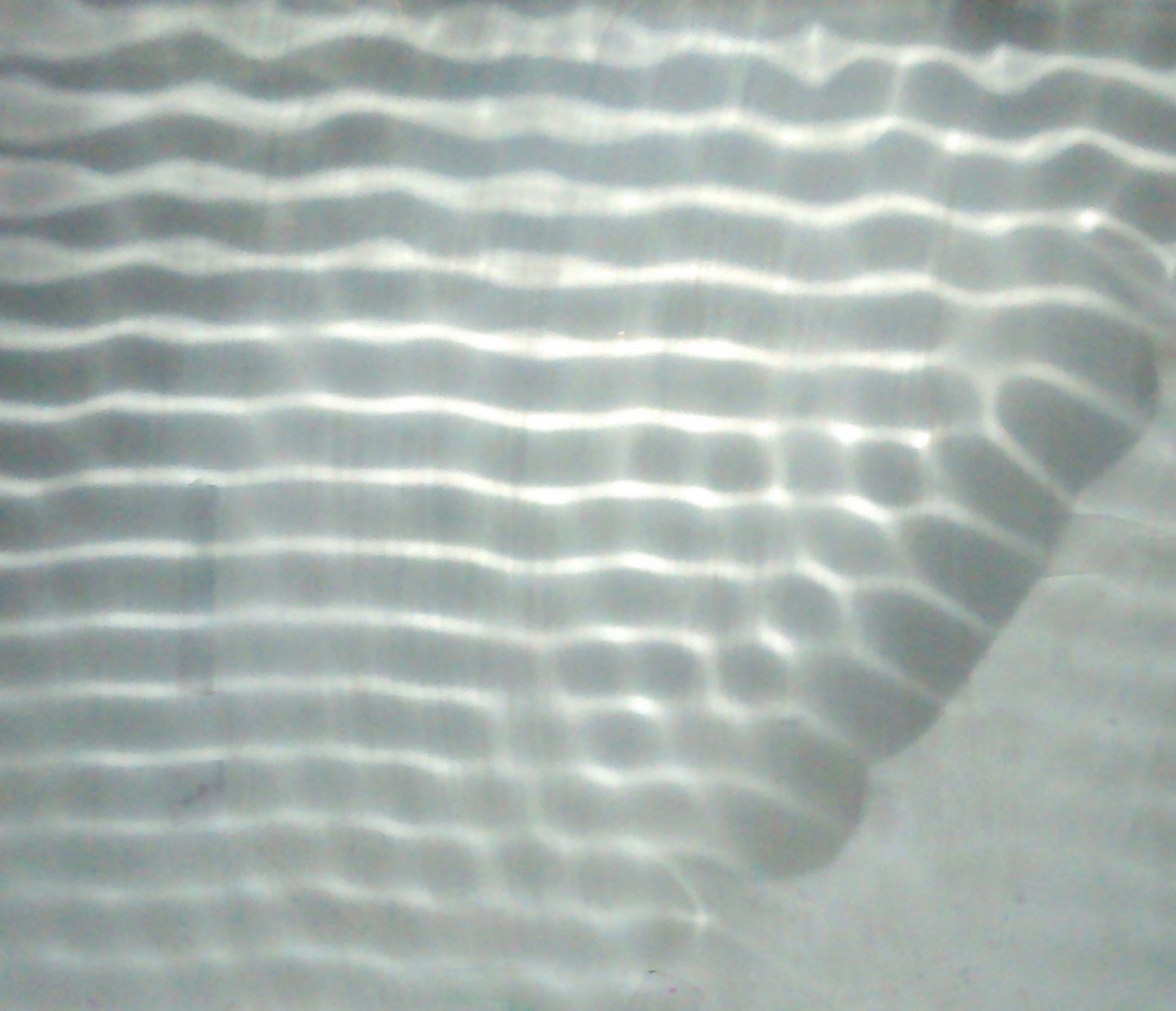
คลื่นน้ำระนาบในอ่างripple สะท้อนจากกำแพงตรง
คลื่นระนาบในอ่างripple สะท้อนจากกำแพงตรง: หน้าคลื่นที่สะท้อนออกไปจะออกจากกำแพงในมุมเดียวกันกับที่เข้ามา
Explore · ⁨สำรวจ⁩

Properties of waves · ⁨Properties of waves (波的性质) ⁩

y = a sin(bx + c)

A wave: a is amplitude, b sets the wavelength. · ⁨คลื่น: a คือแอมพลิจูด, b กำหนดความยาวคลื่น⁩

Explore · ⁨สำรวจ⁩

Transverse & longitudinal waves · ⁨Transverse & longitudinal waves (横波与纵波) ⁩

Flip between a transverse wave (particles bob up and down, like water and light) and a longitudinal one (particles slide back and forth, bunching into compressions, like sound). The wave moves; the particles stay put. · ⁨สลับระหว่างคลื่นขวาง (อนุภาคกระดกขึ้นลง เหมือนน้ำและแสง) กับคลื่นยาว (อนุภาคเลื่อนไปมา รวมตัวเป็นจุดอัดแน่น เหมือนเสียง) คลื่นเคลื่อนที่ แต่อนุภาคอยู่กับที่⁩

Explore · ⁨สำรวจ⁩

Two waves overlapping · ⁨คลื่นสองคลื่นซ้อนทับกัน⁩

Change the second wave. Where waves meet they add — sometimes reinforcing, sometimes cancelling. · ⁨เปลี่ยนคลื่นที่สอง. ที่คลื่นพบกัน they บวก — บางครั้งเสริมกัน บางครั้งหักล้างกัน⁩

Vocabulary · ⁨คำศัพท์⁩ Train · ⁨ฝึกฝน⁩
English ไทย
wave/weɪv/ คลื่น
energy/ˈenədʒi/ พลังงาน
ripple tank/ˈrɪpl tæŋk/ อ่างน้ำripple
wavefront/ˈweɪvfrʌnt/ หน้าคลื่น
wavelength/ˈweɪvleŋθ/ ความยาวคลื่น
frequency/ˈfriːkwənsi/ ความถี่
crest/krest/ ยอดcrest
peak/piːk/ ยอดสูง
trough/trɒf/ trough
amplitude/ˈæmplɪtjuːd/ แอมพลิจูด
wave speed/weɪv spiːd/ ความเร็วคลื่น
transverse wave/trænsˈvɜːs weɪv/ คลื่นขวาง
propagation/ˌprɒpəˈɡeɪʃn/ การ propagated (propagation)
longitudinal wave/ˌlɒŋɡɪˈtjuːdɪnl weɪv/ คลื่นยาว
diffraction/dɪˈfrækʃn/ 衍射
light/laɪt/ เบา / แสง
normal/ˈnɔːml/ เส้นปกติ
angle of incidence/ˈæŋɡl ɒv ˈɪnsɪdəns/ มุมตกรับ
angle of reflection/ˈæŋɡl ɒv rɪˈflekʃn/ มุมสะท้อน
plane mirror/pleɪn ˈmɪrə/ กระจกเงาเรียบ
angle of refraction/ˈæŋɡl ɒv rɪˈfrækʃn/ มุมหักเห
ray box/reɪ bɒks/ กล่องลำแสง
refractive index/rɪˈfræktɪv ˈɪndeks/ ดัชนีหักเห
3.2

Light 光 · ⁨แสง⁩

Syllabus · ⁨หลักสูตร⁩
English

3.2.1 Reflection of light

Core Supplement
1 Define and use the terms normal, angle of incidence and angle of reflection
2 Describe the formation of an optical image by a plane mirror and give its characteristics, i.e. same size, same distance from mirror, virtual
3 State that for reflection, the angle of incidence is equal to the angle of reflection; recall and use this relationship 4 Use simple constructions, measurements and calculations for reflection by plane mirrors

3.2.2 Refraction of light

Core Supplement
1 Define and use the terms normal, angle of incidence and angle of refraction
2 Describe an experiment to show refraction of light by transparent blocks of different shapes 6 Define refractive index, $n$, as the ratio of the speeds of a wave in two different regions
3 Describe the passage of light through a transparent material (limited to the boundaries between two mediums only) 7 Recall and use the equation
$$n = \frac{\sin i}{\sin r}$$
4 State the meaning of critical angle 8 Recall and use the equation
$$n = \frac{1}{\sin c}$$
5 Describe internal reflection and total internal reflection using both experimental and everyday examples 9 Describe the use of optical fibres, particularly in telecommunications

3.2.3 Thin lenses

Core Supplement
1 Describe the action of thin converging and thin diverging lenses on a parallel beam of light
2 Define and use the terms focal length, principal axis and principal focus (focal point)
3 Draw and use ray diagrams for the formation of a real image by a converging lens 6 Draw and use ray diagrams for the formation of a virtual image by a converging lens
4 Describe the characteristics of an image using the terms enlarged/same size/diminished, upright/inverted and real/virtual 7 Describe the use of a single lens as a magnifying glass
5 Know that a virtual image is formed when diverging rays are extrapolated backwards and does not form a visible projection on a screen
8 Describe the use of converging and diverging lenses to correct long-sightedness and short-sightedness

3.2.4 Dispersion of light

Core Supplement
1 Describe the dispersion of light as illustrated by the refraction of white light by a glass prism
2 Know the traditional seven colours of the visible spectrum in order of frequency and in order of wavelength 3 Recall that visible light of a single frequency is described as monochromatic
ไทย

3.2.1 การสะท้อนของแสง

แก่น เพิ่มเติม
1 นิยามและใช้ศัพท์ว่า แนวตั้งฉาก, มุมตกกระทบ และ มุมสะท้อน
2 อธิบายการเกิดภาพทางแสงโดย กระจกเงาเรียบ และระบุลักษณะของภาพ ได้แก่ ขนาดเท่ากัน, ระยะห่างจากกระจกเท่ากัน, เป็นภาพเสมือน
3 ระบุว่าสำหรับการสะท้อน มุมตกกระทบจะเท่ากับมุมสะท้อน; จำและใช้ความสัมพันธ์นี้ 4 ใช้การสร้างแบบจำลองอย่างง่าย การวัด และการคำนวณสำหรับการสะท้อนบนกระจกเงาเรียบ

3.2.2 การหักเหของแสง

แก่น เพิ่มเติม
1 นิยามและใช้ศัพท์ว่า แนวตั้งฉาก, มุมตกกระทบ และ มุมหักเห
2 อธิบายการทดลองเพื่อแสดงการหักเหของแสงผ่านบล็อคใสที่มีรูปทรงต่างๆ 6 นิยาม ดัชนีหักเห, $n$, sebagaiอัตราส่วนระหว่างความเร็วของคลื่นในสองบริเวณที่แตกต่างกัน
3 อธิบายการเดินทางของแสงผ่านวัสดุโปร่งแสง (จำกัดอยู่แค่ขอบเขตระหว่างสสารสองชนิดเท่านั้น) 7 จำและใช้สมการ
$$n = \frac{\sin i}{\sin r}$$
4 ระบุความหมายของ มุมวิกฤต 8 จำและใช้สมการ
$$n = \frac{1}{\sin c}$$
5 อธิบายการสะท้อนภายในและการ สะท้อนภายในทั้งหมด โดยใช้ตัวอย่างจากการทดลองและในชีวิตประจำวัน 9 อธิบายการใช้งานใยแก้วนำแสง โดยเฉพาะในการสื่อสารโทรคมนาคม

3.2.3 เลนส์บาง

แก่น เพิ่มเติม
1 อธิบายการทำงานของ เลนส์รวมแสง และ เลนส์กระจายแสง บางต่อลำแสงขนาน
2 นิยามและใช้ศัพท์ว่า ระยะโฟกัส, แกนหลัก และ จุดโฟกัสหลัก (จุดรวมแสง)
3 วาดและใช้แผนภาพรังสีสำหรับการเกิดภาพจริงโดยเลนส์รวมแสง 6 วาดและใช้แผนภาพรังสีสำหรับการเกิดภาพเสมือนโดยเลนส์รวมแสง
4 อธิบายลักษณะของภาพโดยใช้ศัพท์ว่า ขยายใหญ่/ขนาดเท่าเดิม/เล็กลง, ตั้งตรง/คว่ำ และ จริง/เสมือน 7 อธิบายการใช้เลนส์เดี่ยวเป็นแว่นขยาย
5 รู้ว่าภาพเสมือนเกิดขึ้นเมื่อรังสีที่กระจายถูกดึงย้อนกลับไป และไม่ได้สร้างภาพที่มองเห็นได้บนจอรับภาพ
8 อธิบายการใช้เลนส์รวมแสงและเลนส์กระจายแสงเพื่อแก้ไขสายตายาวและสายตาสั้น

3.2.4 การแยกสีของแสง

แก่น เพิ่มเติม
1 อธิบาย การแยกสี ของแสงที่แสดงด้วยการหักเหของแสงสีขาวผ่านปริซึมแก้ว
2 รู้ถึงสีดั้งเดิมเจ็ดสีของสเปกตรัมที่มองเห็นได้ในลำดับของความถี่และในลำดับของความยาวคลื่น 3 จำได้ว่าแสงที่มองเห็นได้ด้วยความถี่เดียวเรียกว่า แสงโมโนโครมาติก

Source: Cambridge International syllabus · ⁨แหล่งที่มา: หลักสูตร Cambridge International⁩

English
A converging lens forms an image
Total internal reflection

Reflection

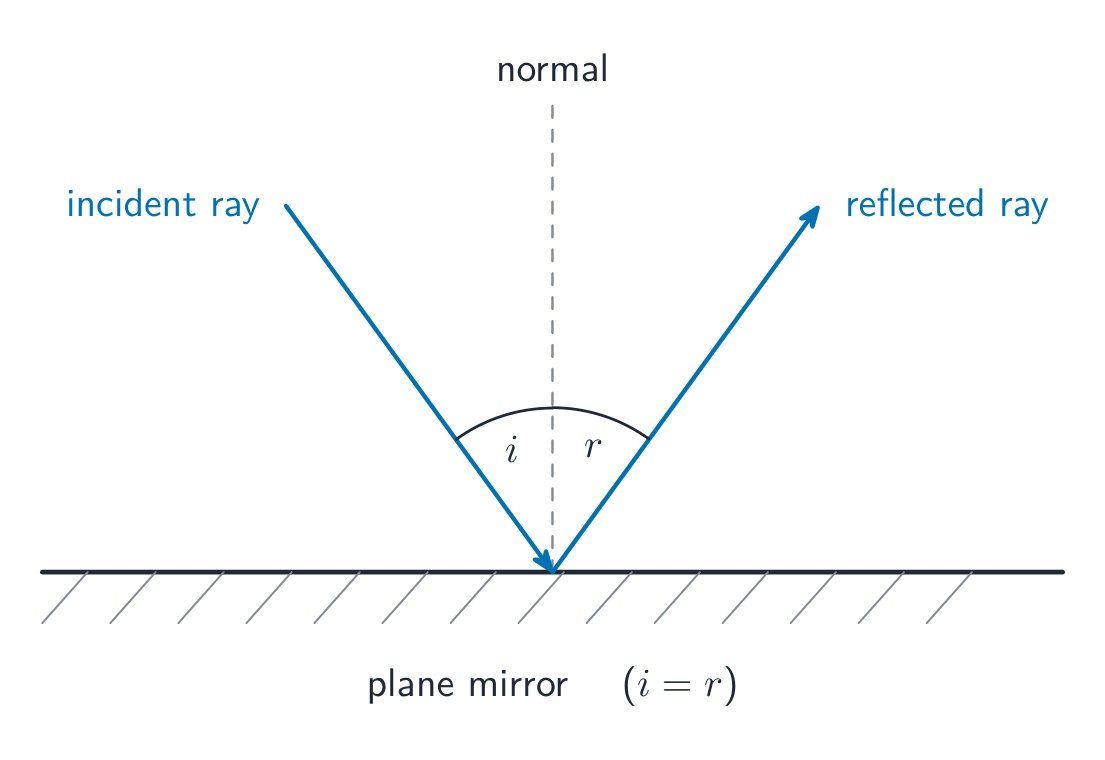
When light hits a mirror, it reflects. We measure angles from the normal 法线 (a line at 90° to the surface).

The law of reflection: the angle of incidence 入射角 equals the angle of reflection 反射角.

A plane mirror 平面镜 forms an image that is the same size as the object, the same distance behind the mirror, and virtual (it cannot be caught on a screen).

Refraction

When light passes from one material into another, it changes speed and bends. The angle in the second material is the angle of refraction 折射角.

Seeing refraction. Shine a narrow ray from a ray box 光线盒 into a rectangular glass block standing on paper. Mark the ray going in and the ray coming out, remove the block, and join the marks to draw the ray inside the glass. Draw the normal where the ray enters and measure the angle of incidence and the angle of refraction with a protractor. Repeat with a semicircular block or a prism: the ray always bends towards the normal on entering the glass and away from the normal on leaving.

The refractive index 折射率 $n$ compares the speed of light in the two materials:

$$n = \frac{\sin i}{\sin r}$$

Worked example. A ray of light passes from air into glass. The angle of incidence is 60° and the angle of refraction is 35°. Find the refractive index of the glass. (Take $\sin i = 0.87$ and $\sin r = 0.57$.)

$$n = \frac{\sin i}{\sin r} = \frac{0.87}{0.57} = 1.5$$

When light tries to leave glass or water and the angle is too large, it cannot get out and instead reflects completely. This is total internal reflection 全反射. It happens when the angle inside is bigger than the critical angle 临界角 $c$:

$$n = \frac{1}{\sin c}$$

This effect is used in optical fibres 光纤, thin glass threads that carry light signals for telephones and the internet.

Lenses

A converging lens 凸透镜 (fat in the middle) bends parallel rays inwards to a point called the principal focus 焦点. The principal axis 主光轴 is the straight line through the centre of the lens at right angles to it; the principal focus lies on this axis. The distance from the centre of the lens to the principal focus is the focal length 焦距. A diverging lens 凹透镜 (thin in the middle) spreads parallel rays out, as if they came from a focus on the incoming side.

A converging lens can form a real image 实像 (rays really meet; can be shown on a screen) or, when the object is very close, a virtual image 虚像 (rays only seem to come from it). Used close to the eye, a converging lens is a magnifying glass 放大镜.

Describe an image with three pairs of words: enlarged 放大的 or diminished 缩小的 (or the same size), upright 正立 or inverted 倒立 (upside down), and real or virtual. An object far beyond the focus gives a diminished, inverted, real image (as in a camera). An object between the focus and the lens gives an enlarged, upright, virtual image (a magnifying glass).

Correcting sight. A person with short-sightedness 近视 sees near things clearly but distant things are blurred: the eye focuses the light in front of the retina 视网膜 (the back of the eye). A diverging lens in front of the eye spreads the rays out first, so they focus on the retina. A person with long-sightedness 远视 sees distant things clearly but near things are blurred: the eye focuses the light behind the retina. A converging lens brings the rays together a little before they enter the eye.

Dispersion

A glass prism 棱镜 splits white light into the colours of the spectrum 光谱. This splitting is called dispersion 色散.

The order of colours is red, orange, yellow, green, blue, indigo, violet. Red light has the longest wavelength and the lowest frequency; violet is the opposite. Light of a single frequency (one pure colour) is monochromatic 单色.

ไทย

*เลนส์รวมภาพสร้างภาพ

การสะท้อนภายในทั้งหมด

การสะท้อน

เมื่อแสงตกกระทบกระจกจะเกิดการสะท้อน เราวัดมุมจาก แนวตั้งฉาก (เส้นที่ทำมุม 90° กับพื้นผิว)

กฎการสะท้อน: มุมตกกระทบ เท่ากับ มุมสะท้อน

กระจกแบน สร้างภาพที่มีขนาดเท่ากับวัตถุ มีระยะห่างจากกระจกเท่ากัน และเป็น ภาพเสมือน (ไม่สามารถรับบนหน้าจอได้)

รังสีตกกระทบและรังสีสะท้อนพบกันที่กระจก โดยมีมุมเท่ากันทั้งสองข้างของเส้นปกติ *ที่กระจกแบน มุมตกกระทบ $i$ เท่ากับมุมสะท้อน $r$ ทั้งคู่วัดจากเส้นปกติ

การหักเห

เมื่อแสงผ่านจากวัสดุหนึ่งไปยังอีกวัสดุหนึ่ง ความเร็วจะเปลี่ยนและเบี่ยงเบน มุมในวัสดุที่สองเรียกว่า มุมหักเห

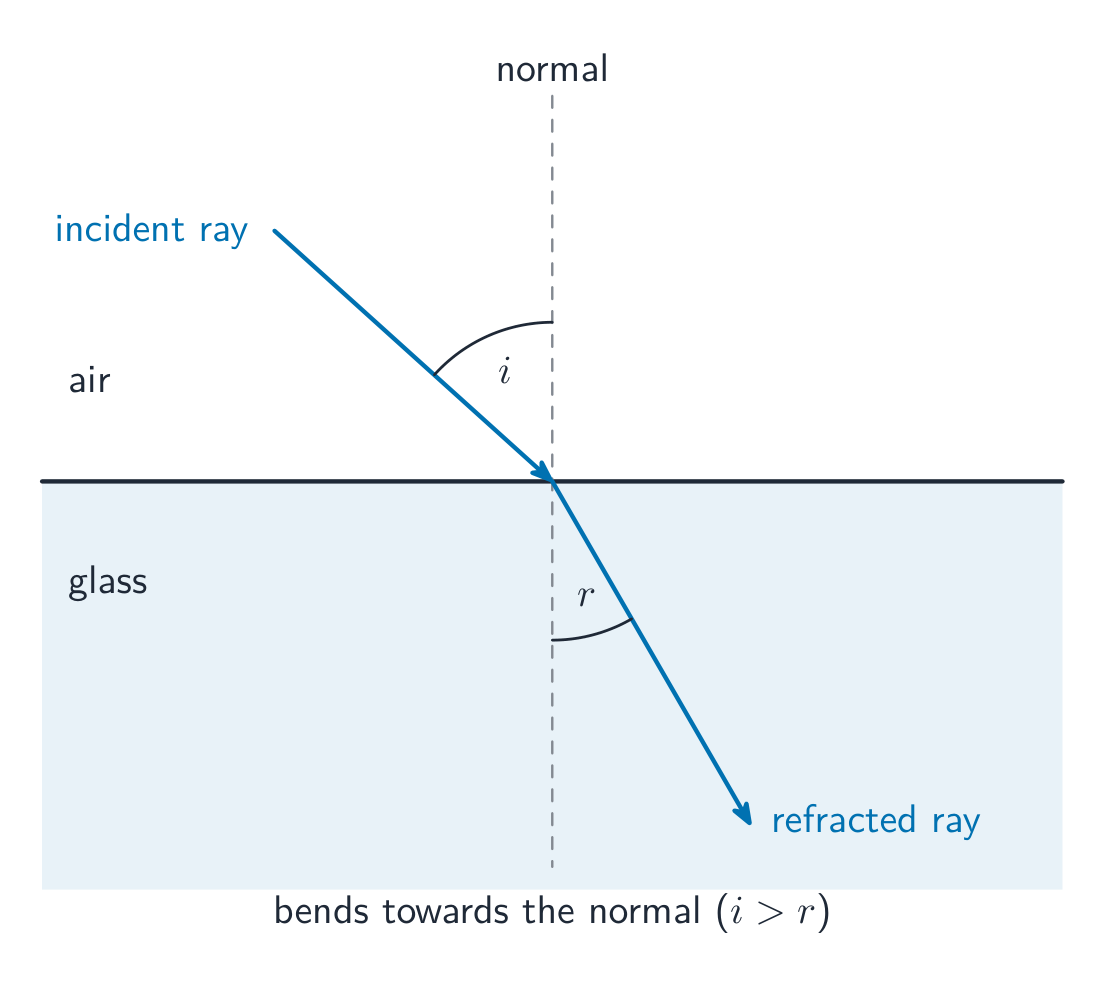
รังสีผ่านจากอากาศเข้าแก้ว เบี่ยงเบนเข้าหาเส้นปกติ *เมื่อจากอากาศเข้าแก้ว แสงช้าลงและเบี่ยงเบนเข้าหาเส้นปกติ ดังนั้น $i > r$

การสังเกตการหักเห. ส่องรังสีแคบจาก กล่องรังสี เข้าブロックแก้วสี่เหลี่ยมผืนผ้าที่วางอยู่บนกระดาษ ทำเครื่องหมายรังสีที่เข้าและรังสีที่ออกมา ลบblock แล้วเชื่อมเครื่องหมายเพื่อวาดรังสีภายในแก้ว วาดเส้นปกติที่รังสีเข้า และวัดมุมตกกระทบและมุมหักเหด้วยโปรTRACTOR ทำซ้ำกับblockครึ่งวงกลมหรือปริซึม: รังสีจะเบี่ยงเบนเข้าหาเส้นปกติเมื่อเข้าสู่แก้ว และเบี่ยงเบนออกจากเส้นปกติเมื่อออกจาก

ดัชนีหักเห $n$ เปรียบเทียบความเร็วของแสงในวัสดุทั้งสอง:

$$n = \frac{\sin i}{\sin r}$$

ตัวอย่างวิธีทำ. รังสีแสงผ่านจากอากาศเข้าแก้ว มุมตกกระทบคือ 60° และมุมหักเหคือ 35° จงหาดัชนีหักเหของแก้ว (ใช้ $\sin i = 0.87$ และ $\sin r = 0.57$.)

$$n = \frac{\sin i}{\sin r} = \frac{0.87}{0.57} = 1.5$$

เมื่อแสงพยายามออกจากแก้วหรือน้ำและมุมมีค่ามากเกินไป แสงจะไม่สามารถออกได้แต่จะสะท้อนกลับเข้าไปทั้งหมด นี่คือ การสะท้อนภายในรวม เกิดขึ้นเมื่อมุมภายในมีค่ามากกว่า มุมวิกฤต $c$:

$$n = \frac{1}{\sin c}$$
บล็อคแก้วสองก้อน: ในก้อนหนึ่งรังสีหักเหอ้ออกไป ในอีกก้อนหนึ่งเกิดการสะท้อนภายในรวม
ต่ำกว่ามุมวิกฤตแสงจะหักเหอ้ออกไป; เหนือมันแสงจะเกิดการสะท้อนภายในรวม

ปรากฏการณ์นี้ถูกนำไปใช้ใน เส้นใยนำแสง ซึ่งเป็นเส้นใยแก้วบางๆ ที่ส่งสัญญาณแสงสำหรับโทรศัพท์และอินเทอร์เน็ต

กลุ่มเส้นใยบางๆ จับอยู่ในมือ แต่ละเส้นสว่างไสวที่ปลายในห้องมืด
การสะท้อนภายในรวมทำให้แสงกระโดดไปมาตามเส้นใยจนส่องสว่างออกมาที่ปลาย

เลนส์

เลนส์รวมแสง (หนาตรงกลาง) จะหักเหรังสีขนานเข้าหาจุดหนึ่งเรียกว่า โฟกัสหลัก แกนหลัก คือเส้นตรงผ่านศูนย์กลางของเลนส์ในแนวตั้งฉากกับเลนส์; โฟกัสหลักจะอยู่บนแกนนี้ ระยะห่างจากศูนย์กลางของเลนส์ถึงโฟกัสหลักคือ ความยาวโฟกัส เลนส์กระจายแสง (บางตรงกลาง) จะกระจายรังสีขนานออก เหมือนว่ามาจากโฟกัสด้านฝั่งเข้ามา

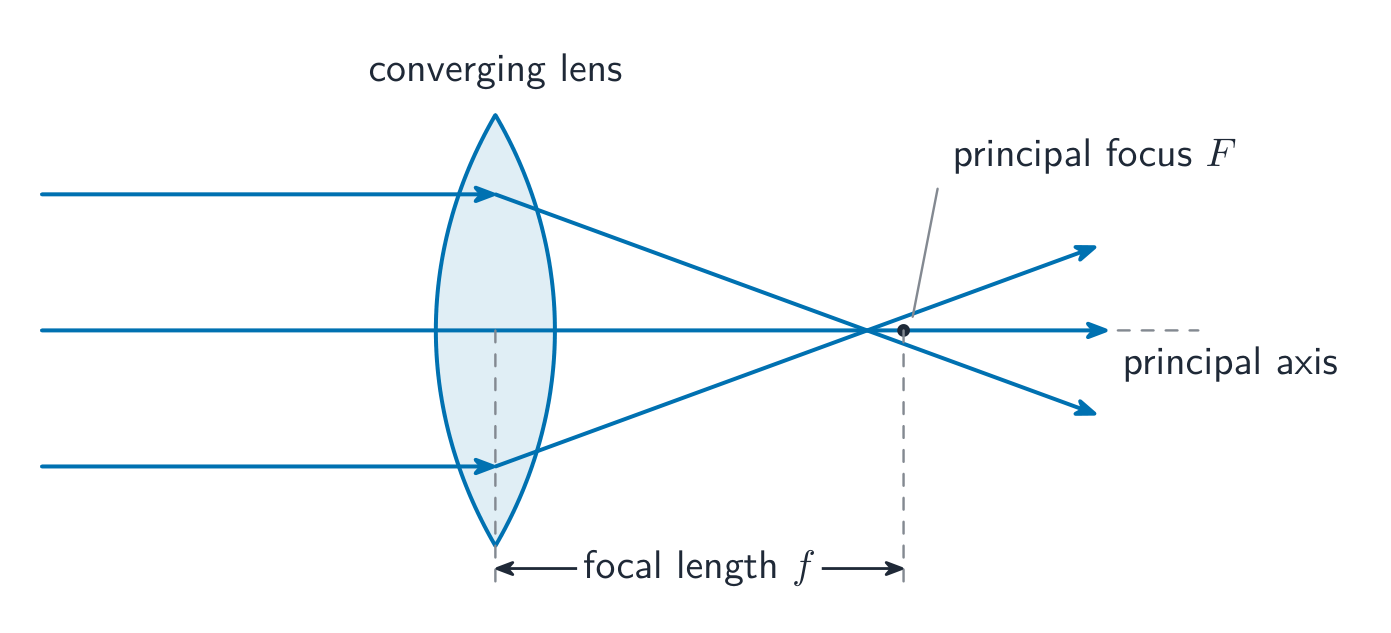
ลำแสงขนานผ่านเลนส์นูนและมาบรรจบกันที่โฟกัสหลัก
เลนส์รวมแสงหักเหรังสีขนานให้บรรจบกันที่โฟกัสหลัก; ความยาวโฟกัส $f$ คือระยะจากเลนส์ถึงโฟกัส

เลนส์รวมแสงสามารถสร้าง ภาพจริง (รังสีบรรจบกันจริงๆ; แสดงบนจอภาพได้) หรือ เมื่อวัตถุอยู่ใกล้มากจะเป็น ภาพลวงตา (รังสีดูเหมือนจะมา从那) ใช้ใกล้กับตา เลนส์รวมแสงคือ แว่นขยาย

อธิบายภาพด้วยคำสามคู่: ขยายใหญ่ หรือ ลดทอน (หรือขนาดเท่าเดิม), ตั้งตรง หรือ คว่ำ (หัวลง), และจริงหรือลวงตา วัตถุที่อยู่ไกลเกินโฟกัสจะให้ภาพลดทอน คว่ำ จริง (เช่นในกล้องถ่ายรูป) วัตถุระหว่างโฟกัสกับเลนส์จะให้ภาพขยายใหญ่ ตั้งตรง ลวงตา (แว่นขยาย)

การแก้ไขสายตา ผู้ที่มี สาย-myopia เห็นของใกล้ชัดเจนแต่ของไกลเบลอ: ตาจะโฟกัสแสงไว้หน้า จอประสาทตา (ด้านหลังตา) เลนส์กระจายแสงวางข้างหน้าตาจะช่วยกระจายรังสีออกก่อนเพื่อให้โฟกัสลงบนจอประสาทตา ผู้ที่มี สาย-hyperopia เห็นของไกลชัดเจนแต่ของใกล้เบลอ: ตาจะโฟกัสแสงไว้หลังจอประสาทตา เลนส์รวมแสงจะรวมรังสีเข้าด้วยกันเล็กน้อยก่อนเข้าสู่ตา

มือถือเลนส์นูนกลม ซึ่งบ้านอยู่ด้านหลังปรากฏคว่ำผ่านเลนส์
ถือห่างจากตา เลนส์รวมแสงจะสร้างภาพจริง – ที่นี่บ้านอยู่ด้านหลังเลนส์ปรากฏคว่ำ

การกระจายแสง

ปริซึมแก้วแยกแสงสีขาวออกเป็นสีต่างๆ ของ สเปกตรัม การแยกนี้เรียกว่า การกระจายแสง

 prism แยกลำแสงสีขาวออกเป็นสายรุ้งจากแดงไปม่วง
ปริซึมหักเหแสงสีม่วงมากที่สุดและแสงสีแดงน้อยที่สุด ทำให้แสงสีขาวกระจายออกเป็นสเปกตรัม

ลำดับสีคือ แดง ส้ม เหลือง เขียว น้ำเงิน ม่วง แดงมีความยาวคลื่นยาวนานที่สุดและความถี่ต่ำสุด; ม่วงเป็นตรงข้าม แสงที่มีความถี่เดียว (สีบริสุทธิ์หนึ่งสี) เรียกว่า แสงเดี่ยวความถี่

ลำแสงแคบของแสงสีขาวเข้าสู่ปริซึมแก้วและกระจายออกเป็นแถบสีรุ้งสว่างบนพื้นหลังดำ
แสงสีขาวเข้าสู่ปริซึมแก้วจริงจะกระจายออกเป็นสเปกตรัมสีเต็มรูปแบบ
Explore · ⁨สำรวจ⁩

Bend a light ray · ⁨Bend a light ray (弯曲光线) ⁩

Shine light into water, glass or diamond and change the angle. The ray slows and bends toward the normal — the denser the material (higher n), the more it bends. That bending is why a straw looks broken in a glass, and why diamonds sparkle. · ⁨ส่องแสงเข้าไปในน้ำ的玻璃 หรือเพชรแล้วเปลี่ยนมุม แสงจะช้าลงและหักเหเข้าหาเส้นปกติ วัสดุยิ่งหนาแน่น (ค่า n สูงขึ้น) ยิ่งหักเหมาก การหักเห inilahสาเหตุที่ทำให้ไม้จิ้มฟันดูเหมือนหักในแก้ว และทำให้เพชรแวววาว⁩

Explore · ⁨สำรวจ⁩

Image formation by a converging lens · ⁨การสร้างภาพโดยเลนส์รวมแสง⁩

Trace the three special rays from the object — where they meet is the image. Move the object closer than the focal point to flip it into a magnifying glass. · ⁨วาดเส้นแสงพิเศษสามเส้นจากวัตถุ — จุดที่ตัดกันคือภาพ เลื่อนวัตถุเข้าใกล้จุดโฟกัสจนเกินระยะเพื่อเปลี่ยนเป็นแว่นขยาย⁩

Vocabulary · ⁨คำศัพท์⁩ Train · ⁨ฝึกฝน⁩
English ไทย
reflection/rɪˈflekʃn/ สะท้อน
refraction/rɪˈfrækʃn/ หักเห
total internal reflection/ˈtəʊtl ɪnˈtɜːnl rɪˈflekʃn/ การสะท้อนกลับทั้งหมด
critical angle/ˈkrɪtɪkl ˈæŋɡl/ มุมวิกฤต
optical fibre/ˈɒptɪkl ˈfaɪbə/ ใยแก้วนำแสง
converging lens/kənˈvɜːdʒɪŋ lenz/ เลนส์แยกแสง (หรือเลนส์นูน)
principal focus/ˈprɪnsɪpl ˈfəʊkəs/ จุดโฟกัสหลัก
principal axis/ˈprɪnsɪpl ˈæksɪs/ แกนหลัก
focal length/ˈfəʊkl leŋθ/ ความยาวโฟกัส
diverging lens/daɪˈvɜːdʒɪŋ lenz/ เลนส์รวมแสง (หรือเลนส์เว้า)
real image/rɪəl ˈɪmɪdʒ/ ภาพจริง
virtual image/ˈvɜːtʃuːəl ˈɪmɪdʒ/ ภาพเสมือน
magnifying glass/ˈmæɡnɪfaɪɪŋ ɡlæs/ แว่นขยาย
enlarged/enˈlɑːdʒd/ ขยายใหญ่ขึ้น
diminished/dɪˈmɪnɪʃt/ เล็กลง
upright/ˈʌpraɪt/ ตั้งตรง
inverted/ɪnˈvɜːtɪd/ กลับด้าน
short-sightedness/ʃɔːt ˈsaɪtɪdnəs/ สายตาสั้น
retina/ˈretɪnə/ retina
long-sightedness/lɒŋ ˈsaɪtɪdnəs/ สายตาไกล
prism/ˈprɪzəm/ ปริซึม
dispersion/dɪˈspɜːʃn/ กระจายตัว
monochromatic/ˌmɒnəʊkrəʊˈmætɪk/ สีโทนเดียว
electromagnetic spectrum/ɪˌlektrəʊməɡˈnetɪk ˈspektrəm/ สเปกตรัมคลื่นแม่เหล็กไฟฟ้า
vacuum/ˈvækjuːm/ สุญญากาศ
radio waves/ˈreɪdɪəʊ weɪvz/ คลื่นวิทยุ
microwave/ˈmaɪkrəʊweɪv/ ไมโครเวฟ
infrared/ˌɪnfrəˈred/ อินฟราเรด
ultraviolet/ˌʊltrəˈvaɪəlɪt/ อัลตราไวโอเลต
X-rays/eks reɪz/ รังสีเอกซ์
gamma rays/ˈɡæmə reɪz/ รังสีแกมมา
artificial satellites/ˌɑːtɪˈfɪʃl ˈsætəlaɪts/ ดาวเทียมประดิษฐ์
low orbit/ləʊ ˈɔːbɪt/ วงโคจรต่ำ
geostationary orbit/ˌdʒiːəʊˈsteɪʃənəri ˈɔːbɪt/ วงโคจรจันทรา
analogue/ˈænəlɒɡ/ อะนาล็อก
digital/ˈdɪdʒɪtl/ ดิจิทัล
3.3

The electromagnetic spectrum 电磁波谱 · ⁨สเปกตรัมคลื่นแม่เหล็กไฟฟ้า⁩

Syllabus · ⁨หลักสูตร⁩
English
Core Supplement
1 Know the main regions of the electromagnetic spectrum in order of frequency and in order of wavelength
2 Know that all electromagnetic waves travel at the same high speed in a vacuum 6 Know that the speed of electromagnetic waves in a vacuum is $3.0 \times 10^8\text{ m/s}$ and is approximately the same in air
3 Describe typical uses of the different regions of the electromagnetic spectrum including: (a) radio waves; radio and television transmissions, astronomy, radio frequency identification (RFID) (b) microwaves; satellite television, mobile phones (cell phones), microwave ovens (c) infrared; electric grills, short range communications such as remote controllers for televisions, intruder alarms, thermal imaging, optical fibres (d) visible light; vision, photography, illumination (e) ultraviolet; security marking, detecting fake bank notes, sterilising water (f) X-rays; medical scanning, security scanners (g) gamma rays; sterilising food and medical equipment, detection of cancer and its treatment
4 Describe the harmful effects on people of excessive exposure to electromagnetic radiation, including: (a) microwaves; internal heating of body cells (b) infrared; skin burns (c) ultraviolet; damage to surface cells and eyes, leading to skin cancer and eye conditions (d) X-rays and gamma rays; mutation or damage to cells in the body
5 Know that communication with artificial satellites is mainly by microwaves: (a) some satellite phones use low orbit artificial satellites (b) some satellite phones and direct broadcast satellite television use geostationary satellites 7 Know that many important systems of communications rely on electromagnetic radiation including: (a) mobile phones (cell phones) and wireless internet use microwaves because microwaves can penetrate some walls and only require a short aerial for transmission and reception (b) Bluetooth uses radio waves because radio waves pass through walls but the signal is weakened on doing so (c) optical fibres (visible light or infrared) are used for cable television and high-speed broadband because glass is transparent to visible light and some infrared; visible light and short wavelength infrared can carry high rates of data
8 Know the difference between a digital and analogue signal
9 Know that a sound can be transmitted as a digital or analogue signal
10 Explain the benefits of digital signalling including increased rate of transmission of data and increased range due to accurate signal regeneration
ไทย
แก่น เพิ่มเติม
1 รู้ถึงภูมิภาคหลักของ สเปกตรัมแม่เหล็กไฟฟ้า ในลำดับของความถี่และในลำดับของความยาวคลื่น
2 รู้ว่าคลื่นแม่เหล็กไฟฟ้าทั้งหมดเคลื่อนที่ด้วยความเร็วสูงเท่ากันในสุญญากาศ 6 รู้ว่าความเร็วของคลื่นแม่เหล็กไฟฟ้าในสุญญากาศคือ $3.0 \times 10^8\text{ m/s}$ และมีค่าใกล้เคียงกันมากในอากาศ
3 อธิบายการใช้งานทั่วไปของแต่ละภูมิภาคของสเปกตรัมแม่เหล็กไฟฟ้า ได้แก่: (ก) คลื่นวิทยุ; การส่งสัญญาณวิทยุและโทรทัศน์, ดาราศาสตร์, ระบบระบุตัวตนด้วยคลื่นวิทยุ (RFID) (ข) คลื่นไมโครเวฟ; โทรทัศน์ดาวเทียม, โทรศัพท์มือถือ, เตาไมโครเวฟ (ค) อินฟราเรด; เตาย่างไฟฟ้า, การสื่อสารระยะสั้นเช่นรีโมทคอนโทรลสำหรับทีวี, ระบบเตือนภัยผู้บุกรุก, การถ่ายภาพความร้อน, ใยแก้วนำแสง (ง) แสงที่มองเห็นได้; การมองเห็น, การถ่ายภาพ, การส่องสว่าง (จ) รังสีอัลตราไวโอเลต; การทำเครื่องหมายความปลอดภัย, การตรวจหาธนบัตรปลอม, การฆ่าเชื้อน้ำ (ฉ) รังสีเอ็กซ์; การสแกนทางการแพทย์, เครื่องสแกนความปลอดภัย (ช) รังสีแกมมา; การฆ่าเชื้ออาหารและอุปกรณ์ทางการแพทย์, การตรวจหาและรักษาโรคมะเร็ง
4 อธิบายผลเสียต่อสุขภาพจากการได้รับรังสีแม่เหล็กไฟฟ้าเกินปริมาณ รวมถึง: (ก) คลื่นไมโครเวฟ; ความร้อนภายในเซลล์ร่างกาย (ข) อินฟราเรด; การเผาไหม้ผิวหนัง (ค) อัลตราไวโอเลต; ความเสียหายต่อเซลล์ผิวและดวงตา นำไปสู่โรคมะเร็งผิวหนังและโรคทางสายตา (ง) รังสีเอ็กซ์และรังสีแกมมา; การกลายพันธุ์หรือความเสียหายต่อเซลล์ในร่างกาย
5 รู้ว่าการสื่อสารกับดาวเทียมเทียมส่วนใหญ่ใช้คลื่นไมโครเวฟ: (ก) โทรศัพท์ดาวเทียมบางรุ่นใช้ดาวเทียมวงโคจรต่ำ (ข) โทรศัพท์ดาวเทียมและโทรทัศน์ดาวเทียมแบบส่งตรงใช้ดาวเทียมวงโคจรเชิงคงที่ 7 รู้ว่าระบบสื่อสารสำคัญหลายระบบขึ้นอยู่กับรังสีแม่เหล็กไฟฟ้า ได้แก่: (ก) โทรศัพท์มือถือและอินเทอร์เน็ตไร้สายใช้คลื่นไมโครเวฟเนื่องจากคลื่นไมโครเวฟสามารถทะลุกำแพงบางชนิดได้และต้องการเสาอากาศสั้นสำหรับการส่งและรับ (ข) บลูทูธใช้คลื่นวิทยุเนื่องจากคลื่นวิทยุสามารถผ่านกำแพงได้แต่สัญญาณจะอ่อนลงเมื่อผ่านกำแพง (ค) ใยแก้วนำแสง (แสงที่มองเห็นได้หรืออินฟราเรด) ใช้สำหรับ有线电视และ broadband ความเร็วสูงเนื่องจากแก้วโปร่งแสงต่อแสงที่มองเห็นได้และอินฟราเรดบางช่วง; แสงที่มองเห็นได้และอินฟราเรดความยาวคลื่นสั้นสามารถส่งข้อมูลได้ อัตราสูง
8 รู้ถึงความแตกต่างระหว่างสัญญาณ ดิจิทัล และ อนาล็อก
9 รู้ว่าเสียงสามารถส่งผ่านเป็นสัญญาณดิจิทัลหรืออนาล็อกได้
10 อธิบายประโยชน์ของการส่งสัญญาณดิจิทัล รวมถึงอัตราการส่งข้อมูลที่สูงขึ้นและระยะทางที่เพิ่มขึ้นเนื่องจากการฟื้นฟูสัญญาณที่แม่นยำ

Source: Cambridge International syllabus · ⁨แหล่งที่มา: หลักสูตร Cambridge International⁩

English

The electromagnetic spectrum is a family of waves that all travel at the same high speed in a vacuum 真空, $3.0 \times 10^8\ \text{m/s}$. In order from longest wavelength (lowest frequency) to shortest:

Region A typical use Danger from too much
radio waves 无线电波 radio and TV signals, astronomy, RFID tags —
microwaves 微波 mobile phones, satellite TV, cooking heating of body cells
infrared 红外线 remote controls, thermal imaging, grills, optical fibres skin burns
visible light seeing, photography —
ultraviolet 紫外线 sterilising water, checking bank notes skin cancer, eye damage
X-rays X射线 medical and security scans damage to cells
gamma rays 伽马射线 sterilising equipment, treating cancer mutation of cells

As you go from radio waves to gamma rays, the frequency rises, the wavelength falls, and the energy (and danger) rises. The speed of electromagnetic waves in air is almost the same as in a vacuum.

Satellites. Communication with artificial satellites 人造卫星 mainly uses microwaves, because they pass through the atmosphere. Some satellite phones use satellites in low orbit 低轨道, close to the Earth. Other satellite phones, and direct broadcast satellite television, use satellites in geostationary orbit 地球静止轨道, which stay above the same point on the Earth.

Digital and analogue signals

Radio waves and microwaves carry information as signals, and a signal is either analogue 模拟 or digital 数字. An analogue signal varies continuously and can take any value; a digital signal is a stream of just two values, on or off (1 or 0). Sound can be sent as either kind of signal: a microphone gives an analogue signal, which can be turned into a digital one.

Modern communication prefers digital signalling for two reasons the exam asks for:

  • a higher rate of data transmission;
  • a greater range: a weak digital signal can be regenerated back to a clean 1/0 exactly, because only two levels have to be told apart, so noise picked up along the way is removed. An analogue signal cannot be cleaned up this way, so its noise builds up.
ไทย

สเปกตรัมคลื่นแม่เหล็กไฟฟ้า เป็นครอบครัวของคลื่นที่เดินทางด้วยความเร็วสูงเท่ากันใน สุญญากาศ, $3.0 \times 10^8\ \text{m/s}$. เรียงลำดับจากความยาวคลื่นยาวที่สุด (ความถี่ต่ำสุด) ไปสั้นที่สุด:

พื้นที่ การใช้ทั่วไป อันตรายจากการได้รับมากเกินไป
คลื่นวิทยุ สัญญาณวิทยุและทีวี,ดาราศาสตร์,แท็ก RFID —
ไมโครเวฟ โทรศัพท์มือถือ, ทีวีดาวเทียม,การทำอาหาร การร้อนตัวของเซลล์ร่างกาย
อินฟราเรด รีโมทคอนโทรล, การถ่ายภาพความร้อน,เตาย่างไฟ,เส้นใยนำแสง ผิวไหม้
แสงที่มองเห็นได้ การมองเห็น, photographic —
อัลตราไวโอเลต การฆ่าเชื้อน้ำ,ตรวจสอบธนบัตร มะเร็งผิวหนัง,ความเสียหายต่อดวงตา
รังสีเอ็กซ์ X การตรวจทางการแพทย์และความปลอดภัย ความเสียหายต่อเซลล์
รังสีแกมมา การฆ่าเชื้ออุปกรณ์,รักษาโรคมะเร็ง การกลายพันธุ์ของเซลล์

เมื่อเราเคลื่อนจากคลื่นวิทยุไปยังรังสีแกมมา ความถี่จะเพิ่มขึ้น ความยาวคลื่นจะลดลง และพลังงาน (และความเสี่ยง) จะเพิ่มขึ้น ความเร็วของคลื่นแม่เหล็กไฟฟ้าในอากาศเกือบเท่ากันในสุญญากาศ

ดาวเทียม การสื่อสารกับ ดาวเทียมประดิษฐ์ ส่วนใหญ่ใช้ไมโครเวฟเนื่องจากทะลุชั้นบรรยากาศได้ บางโทรศัพท์ดาวเทียมใช้ดาวเทียมใน วงโคจรต่ำ ใกล้โลก โทรศัพท์ดาวเทียมอื่นๆ และโทรทัศน์ดาวเทียมแบบส่งสัญญาณโดยตรง ใช้ดาวเทียมใน วงโคจรจลน์คงที่ ซึ่งคงที่เหนือจุดเดียวกันบนโลก

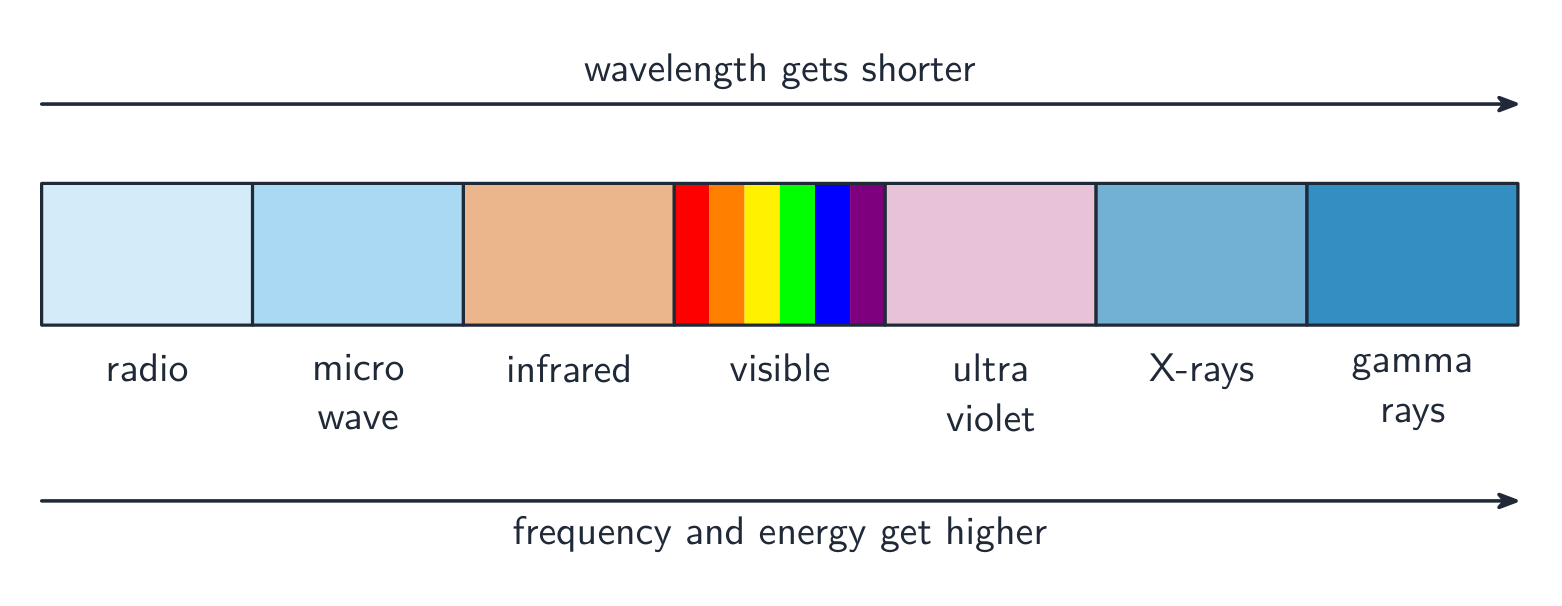
แถบสีของสเปกตรัมแม่เหล็กไฟฟ้าจากคลื่นวิทยุถึงรังสีแกมมา
จากคลื่นวิทยุไปยังรังสีแกมมา ความยาวคลื่นจะลดลงในขณะที่ความถี่และพลังงานเพิ่มขึ้น

สัญญาณดิจิทัลและอะนาล็อก

คลื่นวิทยุและไมโครเวฟส่งข้อมูลในรูปแบบสัญญาณ ซึ่งสัญญาณมีทั้งแบบ อนาล็อก และ ดิจิทัล สัญญาณอนาล็อก เปลี่ยนแปลง ต่อเนื่อง และสามารถรับค่าใดๆ ได้; สัญญาณดิจิทัล เป็นกระแสของค่าเพียงสองค่า คือเปิดหรือปิด (1 หรือ 0) เสียงสามารถส่งได้ในทั้งสองรูปแบบ: ไมโครโฟนให้สัญญาณอนาล็อก ซึ่งสามารถแปลงเป็นสัญญาณดิจิทัลได้

การสื่อสารสมัยใหม่ชอบใช้การส่งสัญญาณ ดิจิทัล ด้วยเหตุผลสองประการที่ข้อสอบถามถึง:

  • อัตราการส่งข้อมูลที่สูงขึ้น;
  • ช่วงความกว้างที่มากขึ้น: สัญญาณดิจิทัลที่อ่อนสามารถถูก สร้างใหม่ ให้เป็น 1/0 ที่สะอาดสนิทได้ เพราะมีเพียงสองระดับที่ต้องแยกออกจากกัน ทำให้สัญญาณรบกวนที่รับมาตลอดทางถูกลบออก สัญญาณอะนาล็อกไม่สามารถทำความสะอาดได้แบบนี้ ดังนั้นสัญญาณรบกวนจึงสะสมเพิ่มขึ้น
Explore · ⁨สำรวจ⁩

Slide across the spectrum · ⁨เลื่อนผ่านสเปกตรัม⁩

Radio waves, visible light and gamma rays are all the same wave — only the wavelength changes, and with it the frequency, photon energy and everyday use. · ⁨คลื่นวิทยุ แสงที่มองเห็นได้ และรังสีแกมมา ล้วนเป็นคลื่นชนิดเดียวกัน — เพียงความยาวคลื่นเปลี่ยนไป และตามด้วยการเปลี่ยนแปลงของความถี่ พลังงานโฟตอน และการใช้งานในชีวิตประจำวัน⁩

Vocabulary · ⁨คำศัพท์⁩ Train · ⁨ฝึกฝน⁩
English ไทย
spectrum/ˈspektrəm/ สเปกตรัม
3.4

Sound 声音 · ⁨เสียง⁩

Syllabus · ⁨หลักสูตร⁩
English
Core Supplement
1 Describe the production of sound by vibrating sources
2 Describe the longitudinal nature of sound waves 10 Describe compression and rarefaction
3 State the approximate range of frequencies audible to humans as 20Hz to 20000Hz
4 Know that a medium is needed to transmit sound waves
5 Know that the speed of sound in air is approximately 330–350m/s 11 Know that, in general, sound travels faster in solids than in liquids and faster in liquids than in gases
6 Describe a method involving a measurement of distance and time for determining the speed of sound in air
7 Describe how changes in amplitude and frequency affect the loudness and pitch of sound waves
8 Describe an echo as the reflection of sound waves
9 Define ultrasound as sound with a frequency higher than 20kHz 12 Describe the uses of ultrasound in non-destructive testing of materials, medical scanning of soft tissue and sonar including calculation of depth or distance from time and wave speed
ไทย
แก่น เพิ่มเติม
1 อธิบายการผลิตเสียงจากแหล่งกำเนิดที่สั่นสะเทือน
2 อธิบายธรรมชาติแบบ ตามยาว ของคลื่นเสียง 10 อธิบาย การอัดตัว และ การขยายตัว
3 ระบุว่าช่วงความถี่ที่มนุษย์ได้ยินโดยประมาณอยู่ที่ 20Hz ถึง 20000Hz
4 รู้ว่าจำเป็นต้องมีสื่อกลางในการส่งผ่านคลื่นเสียง
5 รู้ว่าความเร็วเสียงในอากาศมีค่าประมาณ 330–350m/s 11 รู้ว่าโดยทั่วไปแล้วเสียงเดินทางเร็วในของแข็งมากกว่าของเหลว และเร็วในของเหลวมากกว่าแก๊ส
6 อธิบายวิธีการที่ใช้การวัดระยะทางและเวลาในการหาค่าความเร็วเสียงในอากาศ
7 อธิบายว่าความเปลี่ยนแปลงของแอมพลิจูดและความถี่มีผลต่อ ความดัง และ ระดับเสียง ของคลื่นเสียงอย่างไร
8 อธิบาย เสียงสะท้อน ว่าเป็นการสะท้อนของคลื่นเสียง
9 นิยาม อัลตราซาวด์ ว่าคือเสียงที่มีความถี่สูงกว่า 20kHz 12 อธิบายการใช้งานอัลตราซาวด์ในการทดสอบวัสดุโดยไม่ทำลาย, การสแกนเนื้อเยื่ออ่อนทางการแพทย์ และโซนาร์ รวมถึงการคำนวณความลึกหรือระยะทางจากเวลาและความเร็วของคลื่น

Source: Cambridge International syllabus · ⁨แหล่งที่มา: หลักสูตร Cambridge International⁩

English

Sound is made by a vibrating object. It is a longitudinal wave: the air is squeezed into a compression 压缩 (particles close together) and stretched into a rarefaction 稀疏 (particles far apart).

  • Sound needs a medium 介质 (a material) to travel through, so it cannot travel through a vacuum.
  • Humans can hear frequencies from about $20\ \text{Hz}$ to $20\,000\ \text{Hz}$.
  • Sound travels much slower than light (about $340\ \text{m/s}$ in air), and faster in liquids and solids than in gases.
  • A larger amplitude makes a louder sound (greater loudness 响度); a higher frequency makes a higher pitch 音调. So a dolphin's rapid clicks are high-pitched, and a hard drum-hit (big vibration) is loud.

A reflected sound is an echo 回声.

Measuring the speed of sound. Two students stand a known distance apart, for example 500 m, measured with a tape or a trundle wheel. One bangs two blocks of wood together. The other starts a stopwatch when they see the blocks hit and stops it when they hear the bang. Light arrives almost at once, so the time measured is the time the sound takes, and speed = distance ÷ time. Repeat and take an average to reduce the reaction-time error. The echo method needs one person: clap at a known distance from a large wall and time the reflected sound, remembering that the sound travels there and back.

Worked example. A student stands 85 m from a large wall and claps once. The echo returns 0.50 s later. Find the speed of sound.

The sound travels to the wall and back, a distance of $2 \times 85 = 170\ \text{m}$, in $0.50\ \text{s}$:

$$v = \frac{s}{t} = \frac{170}{0.50} = 340\ \text{m/s}$$

Ultrasound 超声波 is sound above $20\,000\ \text{Hz}$ – too high for humans to hear. Its uses rely on reflection: sonar measures water depth, medical scanning images a baby or soft tissue, and non-destructive testing finds cracks inside metal without cutting it open. Like an echo, an ultrasound pulse travels there and back, so halve the total distance to reach the object.

Worked example. A sonar pulse returns from the seabed $0.10\ \text{s}$ after it is sent; sound travels at $1500\ \text{m/s}$ in water. The pulse covers $s = v\times t = 1500\times0.10 = 150\ \text{m}$ there and back, so the sea is $150/2 = 75\ \text{m}$ deep.

ไทย

เสียง เกิดจากวัตถุสั่นสะเทือน เป็น คลื่นตามยาว: อากาศถูกบีบอัดให้เป็น การอัดตัว (อนุภาคอยู่ใกล้กัน) และยืดออกให้เป็น การขยายตัว (อนุภาคอยู่ห่างกัน)

  • เสียงต้องการ ตัวกลาง (วัสดุ) ในการเดินทาง จึงไม่สามารถเดินทางผ่านสุญญากาศได้
  • มนุษย์สามารถได้ยินคลื่นความถี่ตั้งแต่ประมาณ $20\ \text{Hz}$ ถึง $20\,000\ \text{Hz}$
  • เสียงเดินทางช้ากว่าแสงมาก (ประมาณ $340\ \text{m/s}$ ในอากาศ), และเร็วในของเหลวและของแข็งมากกว่าในแก๊ส
  • แอมพลิจูดที่มากขึ้น ทำให้เกิดเสียงดัง (ความดัง มากขึ้น); ความถี่ที่สูงขึ้น ทำให้เกิด เสียงสูง ดังนั้นเสียงคลิกของโลมาที่รวดเร็วจึงเป็นเสียงสูง, และการตีกลองแรง (การสั่นสะเทือนใหญ่) ก็เป็นเสียงดัง

เสียงสะท้อนคือ เสียงก้อง

การวัดความเร็วของเสียง นักเรียนสองคนยืนห่างกันด้วยระยะที่ทราบ เช่น 500 เมตร วัดด้วยสายวัดหรือล้อวัดรอบหนึ่ง คนหนึ่งตบไม้两块เข้าด้วยกัน อีกคนเริ่มจับเวลาเมื่อเห็นไม้ชนกัน และหยุดเมื่อได้ยินเสียงตี แสงมาถึงเกือบทันที ดังนั้นเวลาที่วัดได้จึงเป็นเวลาที่ใช้ของเสียงและความเร็ว = ระยะ ÷ เวลา ทำซ้ำและหาค่าเฉลี่ยเพื่อลดข้อผิดพลาดในการตอบสนอง การวิธีเสียงก้องใช้คนเพียงคนเดียว: เปรียบมือในระยะที่ทราบจากกำแพงใหญ่ และจับเวลาเสียงสะท้อน โดยจำไว้ว่าเสียงเดินทางไปถึงและกลับมายังจุดเดิม

ตัวอย่างทำ นักเรียนยืนห่างจากกำแพงใหญ่ 85 เมตร เปรียบมือครั้งเดียว เสียงก้องกลับมาหลังจาก 0.50 วินาที จงหาความเร็วของเสียง

เสียงเดินทางไปยังกำแพงและกลับมา的距离 $2 \times 85 = 170\ \text{m}$, ใน $0.50\ \text{s}$:

$$v = \frac{s}{t} = \frac{170}{0.50} = 340\ \text{m/s}$$

อัลตราซาวด์ คือเสียงเหนือ $20\,000\ \text{Hz}$ – สูงเกินกว่าที่มนุษย์จะได้ยิน การใช้ประโยชน์ของมันขึ้นอยู่กับเสียงสะท้อน: โซนาร์ วัดความลึกของน้ำ, การสแกนทางการแพทย์ สร้างภาพทารกหรือเนื้อเยื่ออ่อน, และ การทดสอบโดยไม่ทำลาย พบรอยแตกภายในโลหะโดยไม่ต้องตัดเปิด เหมือนกับเสียงก้อง พัลส์อัลตราซาวด์เดินทาง ไปและกลับ, ดังนั้นแบ่งครึ่งระยะรวมเพื่อให้ได้ระยะถึงวัตถุ

ตัวอย่างทำ พัลส์โซนาร์กลับมาจากรอยต่อทะเล $0.10\ \text{s}$ หลังส่งออกไป; เสียงเดินทางที่ $1500\ \text{m/s}$ ในน้ำ พัลส์ครอบคลุม $s = v\times t = 1500\times0.10 = 150\ \text{m}$ ไปและกลับ ดังนั้นทะเลมีความลึก $150/2 = 75\ \text{m}$

ไมโครโฟนแปลงการสั่นสะเทือนของเสียงในอากาศให้เป็นสัญญาณไฟฟ้า
Explore · ⁨สำรวจ⁩

Sound · ⁨เสียง⁩

y = a sin(bt + c)

Louder = bigger amplitude; higher pitch = higher frequency. · ⁨เสียงดังขึ้น = แอมพลิจูด มากขึ้น; เสียงสูงขึ้น = ความถี่ สูงขึ้น⁩

Vocabulary · ⁨คำศัพท์⁩ Train · ⁨ฝึกฝน⁩
English ไทย
sound/saʊnd/ เสียง
compression/kəmˈpreʃn/ การอัดตัว
rarefaction/ˌreərɪˈfækʃn/ การกระจายตัว
medium/ˈmiːdɪəm/ ตัวกลาง
loudness/ˈlaʊdnəs/ ระดับเสียงดัง
pitch/pɪtʃ/ ระดับเสียง
echo/ˈekəʊ/ echo
Ultrasound/ˌʊltrəˈsaʊnd/ อัลตราซาวด์
3.4

Exam tips · ⁨ข้อแนะนำสำหรับการสอบ⁩

English
  • Learn $v = f\lambda$ and be ready to rearrange it. Measure all angles of incidence, reflection and refraction from the normal (the line at 90° to the surface), never from the surface itself.
  • Transverse waves vibrate across the direction of travel (light, water); longitudinal waves vibrate along it (sound). Sound needs a medium, so it cannot cross a vacuum; light can.
  • Total internal reflection happens only when light travels from a denser material to a less dense one and the angle inside is bigger than the critical angle.
  • Know the electromagnetic spectrum in order — radio, microwave, infrared, visible, ultraviolet, X-ray, gamma. All travel at the same speed in a vacuum; frequency and energy rise from radio to gamma.
  • Going into a denser material (air → glass) light slows down and bends towards the normal; leaving it (glass → air) light speeds up and bends away.
ไทย
  • เรียนรู้ $v = f\lambda$ และเตรียมพร้อมที่จะจัดรูปใหม่ วัดมุมตกกระทบ มุมสะท้อน และมุมหักเหทั้งหมดจาก เส้นฉาก (เส้นที่ตั้งฉากกับ 90° กับพื้นผิว) ห้ามวัดจากตัวพื้นผิวเอง
  • คลื่นตามขวาง สั่นสะเทือนข้ามทิศทางการเดินทาง (แสง, น้ำ); คลื่นตามยาว สั่นสะเทือนตามทิศทางนั้น (เสียง) เสียงต้องการ ตัวกลาง จึงไม่สามารถผ่านสุญญากาศได้; แสงสามารถทำได้
  • การสะท้อนกลับหมด เกิดขึ้นเฉพาะเมื่อแสงเดินทางจากวัสดุที่มีความหนาแน่นสูง到低密度 และ มุมภายในมีค่ามากกว่า มุมวิกฤต
  • รู้ลำดับของ สเปกตรัมแม่เหล็กไฟฟ้า อย่างถูกต้อง: วิทยุ, ไมโครเวฟ, อินฟราเรด, แสงที่มองเห็นได้, อัลตราไวโอเลต, รังสีเอ็กซ์, กามะชักรังสี ทั้งหมดเดินทางด้วยความเร็วเดียวกันในสุญญากาศ; ความถี่และพลังงานเพิ่มขึ้นจากวิทยุถึงกามะชักรังสี
  • เมื่อเข้าสู่วัสดุที่มีความหนาแน่นมากขึ้น (อากาศ → แก้ว) แสงช้าลงและเบี่ยงเบน เข้าหา เส้นปกติ; เมื่อออกจากมัน (แก้ว → อากาศ) แสงเร่งความเร็วและเบี่ยงเบน ออกจาก เส้นปกติ

Interactive lessons on this topic · ⁨บทเรียนเชิงโต้ตอบสำหรับหัวข้อนี้⁩

Work through it step by step, with instant-check exercises. · ⁨ทำทีละขั้นตอน พร้อมแบบฝึกหัดตรวจสอบผลทันที⁩

Past Papers · ⁨ข้อสอบย้อนหลัง⁩

More topics in IGCSE Physics · ⁨Physics IGCSE⁩ · ⁨หัวข้อเพิ่มเติมใน IGCSE Physics · ⁨Physics IGCSE⁩⁩

Log in or create account · ⁨เข้าสู่ระบบหรือสร้างบัญชี⁩

IGCSE, A-Level & AP