Sound
Introduced| English | Meaning |
|---|---|
| longitudinal/ˌlɒŋɡɪˈtjuːdɪnl/ | Describing a wave in which particle oscillations are parallel to the direction of energy transfer. |
| compressions/kəmˈpreʃnz/ | Squeezing an object or substance so that its size or volume decreases. |
| rarefactions/ˌreərɪˈfækʃnz/ | Regions of lower pressure or particle density in a longitudinal wave. |
| vacuum/ˈvækjuːm/ | A region containing no matter in an ideal model, or very little matter in practice. |
| echo/ˈekəʊ/ | A reflected sound heard separately after the original sound. |
Good vibrations
- Every sound starts with something vibrating — a guitar string, a drum skin, your vocal cords.
- In space films, explosions are silent for a real reason: sound needs a material to travel through.
- Let's see how sound moves.
Sound is a longitudinal 纵波 wave
- A vibrating object pushes the air into compressions 压缩 (particles squeezed together) and rarefactions 稀疏 (particles spread apart).
- This makes sound a longitudinal wave — the air vibrates along the direction of travel.
- Because it needs particles, sound cannot travel through a vacuum 真空 (empty space).
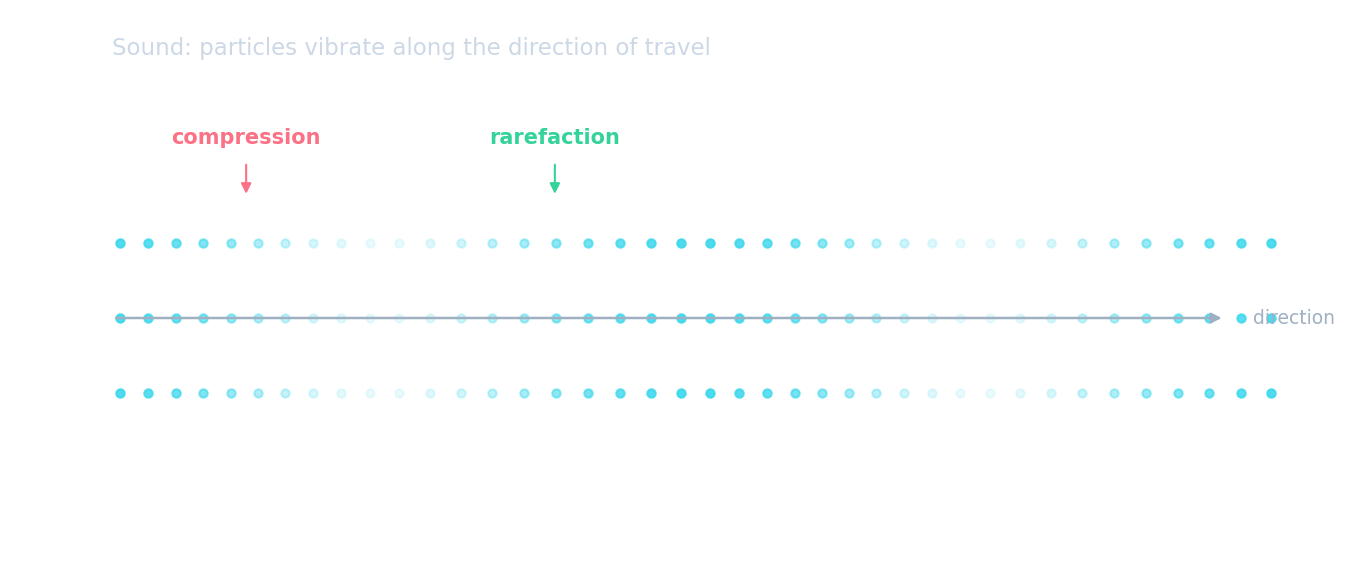
Sound as a longitudinal wave: particles vibrate back and forth, creating regions of high density (compressions) and low density (rarefactions).
Worked example. A ship sends a sonar pulse to the seabed $150\ \text{m}$ below. Sound speed in water $= 1500\ \text{m/s}$. The sound travels down and back ($300\ \text{m}$ total), so time $= \dfrac{300}{1500} = 0.2\ \text{s}$.
Sound is NOT like light. Light can travel through empty space (a vacuum); sound cannot. In space films, explosions are silent for a real physics reason — there are no particles to carry the vibration.
Sound
y = a sin(bt + c)
Louder = bigger amplitude; higher pitch = higher frequency.
Sound travels as a series of:
Difficulty 1/5 · 100 coins + a small bonus on first completion today
A vibrating source squeezes and stretches the air into compressions and rarefactions — a longitudinal wave.
Sound can travel through a vacuum (empty space).
Difficulty 1/5 · 100 coins + a small bonus on first completion today
Sound needs particles to pass the vibration along, so it cannot travel through a vacuum.
Speed and hearing range
- Humans can hear from about $20\ \text{Hz}$ to $20\,000\ \text{Hz}$.
- Sound travels at about $340\ \text{m/s}$ in air — far slower than light.
- It travels faster in liquids and solids than in gases, because their particles are closer together.

The parts of a wave: wavelength, amplitude, crest and trough
The approximate range of human hearing is:
Difficulty 1/5 · 100 coins + a small bonus on first completion today
Most people hear from about 20 Hz (very low) up to about 20 000 Hz (very high).
Sound travels fastest through:
Difficulty 1/5 · 100 coins + a small bonus on first completion today
The closer the particles, the faster the vibration is passed on — so sound is fastest in solids, slowest in gases.
Echoes 回声
- A reflected sound is an echo.
- You can measure the speed of sound by timing an echo over a known distance.
- The sound travels to the wall and back, so it covers twice the distance.
A boy shouts at a cliff $660\ \text{m}$ away and hears the echo $4.0\ \text{s}$ later. What is the speed of sound, in m/s?
Difficulty 2/5 · 140 coins + a small bonus on first completion today
The sound travels there and back: $2 \times 660 = 1320\ \text{m}$ in $4.0\ \text{s}$, so $v = \dfrac{1320}{4.0} = 330\ \text{m/s}$.
You've got it
- sound is made by vibrations and is a longitudinal wave (compressions + rarefactions)
- it needs a medium — no sound in a vacuum
- human hearing: about $20\ \text{Hz}$ to $20\,000\ \text{Hz}$; speed ≈ $340\ \text{m/s}$ in air
- an echo is reflected sound — remember it travels there and back