General properties of waves
Introduced| English | Meaning |
|---|---|
| wave/weɪv/ | A disturbance or oscillation that transfers energy without a net transfer of matter over the full cycle. |
| wavelength/ˈweɪvleŋθ/ | The distance between corresponding points on successive waves. |
| amplitude/ˈæmplɪtjuːd/ | The maximum displacement from an equilibrium position. |
| frequency/ˈfriːkwənsi/ | The number of complete cycles per unit time. |
| wave speed/weɪv spiːd/ | The rate at which a wave disturbance or a point of constant phase travels through a medium. |
| transverse/trænsˈvɜːs/ | Describing a wave whose oscillations are perpendicular to the direction in which the disturbance travels. |
| longitudinal/ˌlɒŋɡɪˈtjuːdɪnl/ | Describing a wave in which particle oscillations are parallel to the direction of energy transfer. |
| reflection/rɪˈflekʃn/ | The change in direction of a wave at a boundary so that it returns into its original medium. |
| refraction/rɪˈfrækʃn/ | A change in a wave's direction when it crosses a boundary at an angle and its speed changes. |
| diffraction/dɪˈfrækʃn/ | The spreading or redistribution of waves as they pass an edge or aperture. |
Energy on the move
- Drop a stone in a pond: ripples spread out, but a floating cork just bobs up and down — it does not travel along.
- A wave 波 carries energy from place to place without carrying matter.
- All waves — water, light, sound — share the same set of ideas.
A wave carries matter along with it from place to place.
Difficulty 1/5 · 100 coins + a small bonus on first completion today
A wave carries energy, not matter. A floating cork bobs up and down but does not travel with the wave.
Describing a wave
- wavelength 波长 ($\lambda$): the distance for one full wave (e.g. crest to crest).
- amplitude 振幅: the largest distance a point moves from its rest position.
- frequency 频率 ($f$): the number of waves passing a point each second, in hertz (Hz).
- wave speed 波速 ($v$): how fast a wavefront travels. These link by the wave equation:

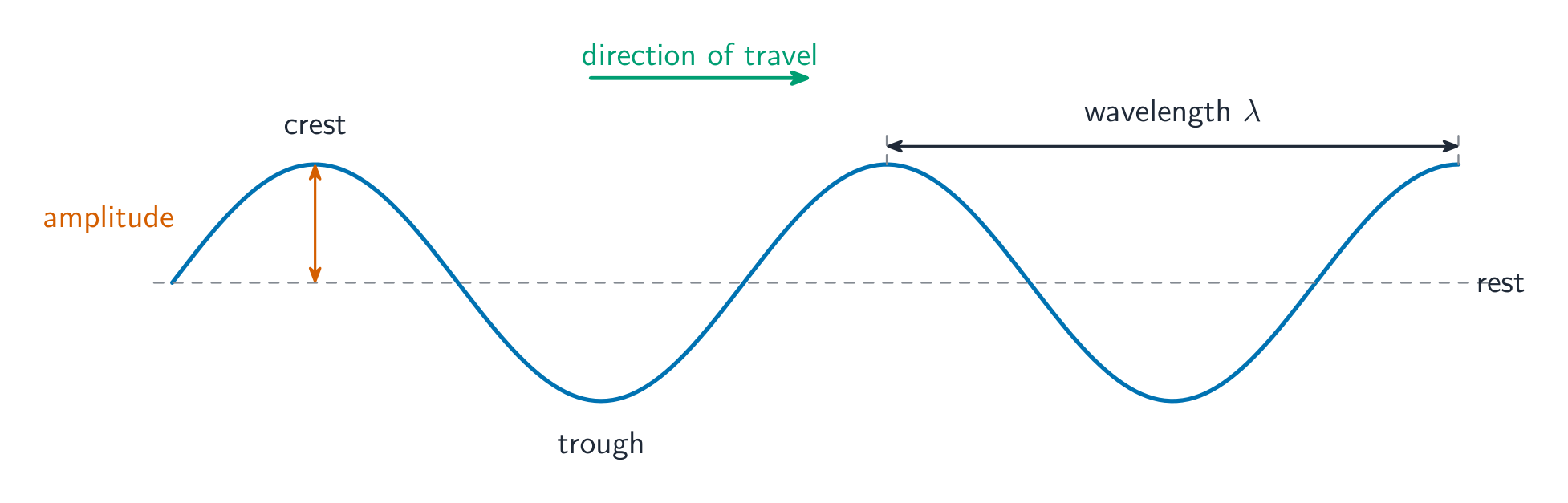
The parts of a transverse 横波 wave
Properties of waves
y = a sin(bx + c)
A wave: a is amplitude, b sets the wavelength.
Transverse & longitudinal waves
Flip between a transverse wave (particles bob up and down, like water and light) and a longitudinal one (particles slide back and forth, bunching into compressions, like sound). The wave moves; the particles stay put.
A wave has frequency $5.0\ \text{Hz}$ and wavelength $2.0\ \text{m}$. What is its speed, in m/s?
Difficulty 2/5 · 140 coins + a small bonus on first completion today
$v = f\lambda = 5.0 \times 2.0 = 10\ \text{m/s}$.
A sound wave travels at $330\ \text{m/s}$ with a frequency of $110\ \text{Hz}$. What is its wavelength, in m?
Difficulty 2/5 · 140 coins + a small bonus on first completion today
Rearrange $v = f\lambda$: $\lambda = \dfrac{v}{f} = \dfrac{330}{110} = 3.0\ \text{m}$.
The amplitude of a wave is:
Difficulty 1/5 · 100 coins + a small bonus on first completion today
Amplitude is the maximum displacement from rest. The crest-to-crest distance is the wavelength.
Two types of wave
- Transverse — the particles vibrate at right angles ($90°$) to the wave's travel. Light and water waves are transverse.
- Longitudinal 纵波 — the particles vibrate along the travel direction, making compressions and rarefactions. Sound is longitudinal.

Sound is which type of wave?
Difficulty 1/5 · 100 coins + a small bonus on first completion today
In sound, the particles vibrate along the direction of travel, making compressions and rarefactions — a longitudinal wave.
How waves behave
- All waves can do three things (easy to see in a ripple tank):
- Reflection 反射 — the wave bounces off a surface.
- Refraction 折射 — the wave changes speed (and usually direction) entering a new material or depth.
- Diffraction 衍射 — the wave spreads out through a gap or around an edge; spreading is greatest when the gap ≈ the wavelength.

Plane waves passing through a narrow gap spread out into curved waves — diffraction is strongest when the gap is about one wavelength wide
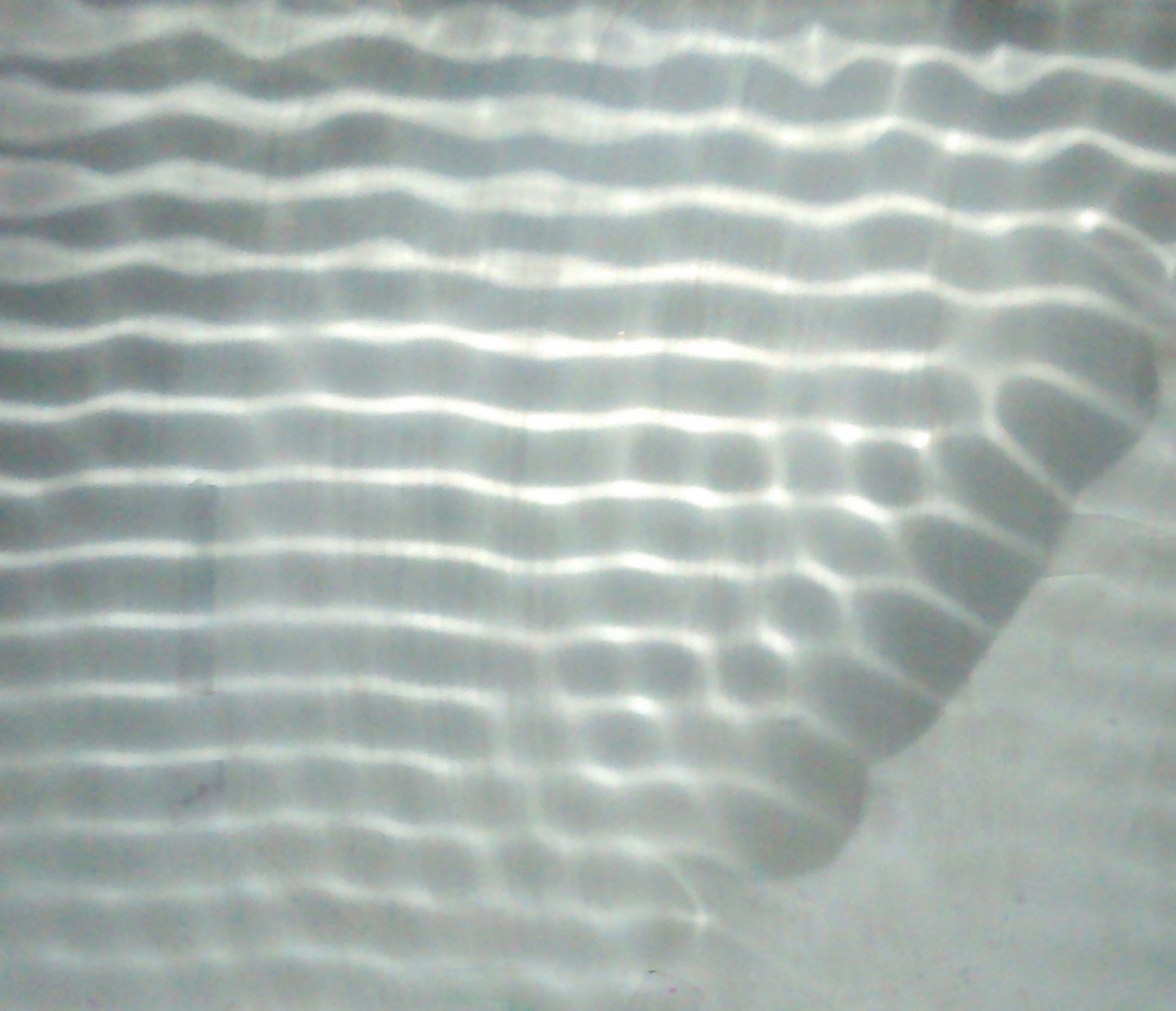
Two dippers in a ripple tank make overlapping circular water waves
A wave spreads out after passing through a narrow gap. This is:
Difficulty 1/5 · 100 coins + a small bonus on first completion today
Spreading out through a gap or around an edge is diffraction — greatest when the gap is about one wavelength wide.
You've got it
- a wave carries energy, not matter
- wave equation: $v = f\lambda$ (speed = frequency × wavelength)
- transverse (vibrate across travel) vs longitudinal (vibrate along travel; sound)
- waves can reflect, refract and diffract