The electromagnetic spectrum
Introduced| English | Meaning |
|---|---|
| electromagnetic spectrum/ɪˌlektrəʊməɡˈnetɪk ˈspektrəm/ | The complete range of electromagnetic radiation, ordered by frequency or wavelength. |
| radio waves/ˈreɪdɪəʊ weɪvz/ | Longest-wavelength electromagnetic waves, used for broadcasting and communication. |
| microwaves/ˈmaɪkrəʊweɪvz/ | Electromagnetic radiation in the microwave region, between radio waves of longer wavelength and infrared radiation. |
| infrared/ˌɪnfrəˈred/ | Electromagnetic radiation with wavelengths longer than visible red light and shorter than microwaves. |
| ultraviolet/ˌʊltrəˈvaɪəlɪt/ | Electromagnetic radiation with wavelengths shorter than visible violet light and longer than X-rays. |
| X-rays/eks reɪz/ | High-frequency electromagnetic waves used for medical imaging; ionising and hazardous. |
| gamma rays/ˈɡæmə reɪz/ | The highest-frequency electromagnetic waves, emitted by unstable nuclei; strongly ionising. |
One family of waves
- Radio, the warmth of a heater, the light you see, the X-ray at a hospital — all the same kind of wave.
- Together they make the electromagnetic spectrum 电磁波谱.
- They all travel at the same high speed in a vacuum: $3.0 \times 10^8\ \text{m/s}$.
The order of the spectrum
- From longest wavelength to shortest: radio waves 无线电波, microwaves 微波, infrared 红外线, visible light, ultraviolet 紫外线, X-rays X射线, gamma rays 伽马射线.
- As you go that way: the wavelength falls, the frequency rises, and the energy rises.
- Visible light is just a thin slice in the middle.
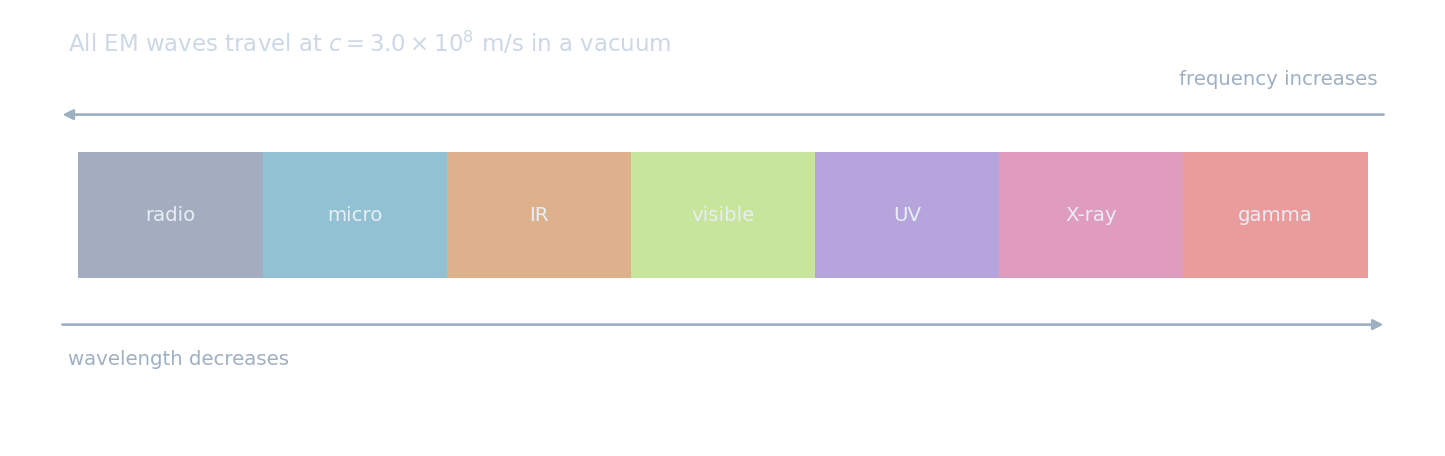
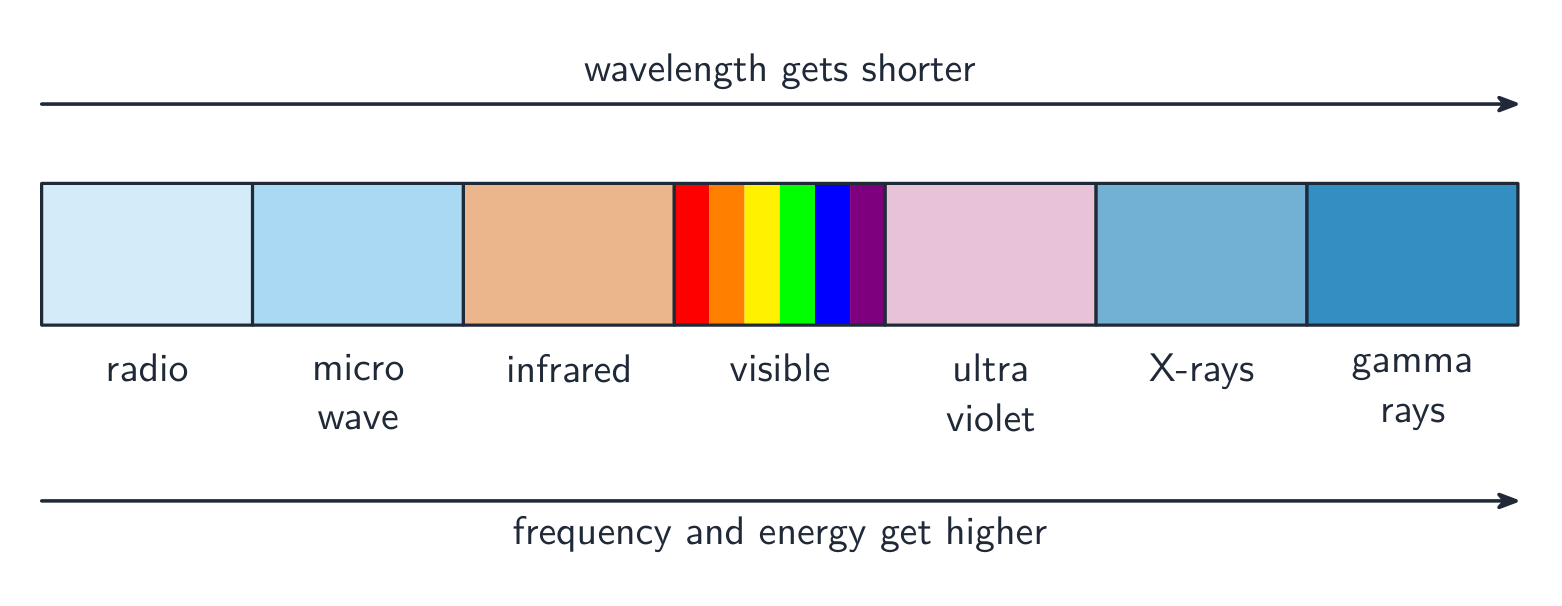
The electromagnetic spectrum
Slide across the spectrum
Radio waves, visible light and gamma rays are all the same wave — only the wavelength changes, and with it the frequency, photon energy and everyday use.
In a vacuum, how do the speeds of radio waves, light and gamma rays compare?
Difficulty 1/5 · 100 coins + a small bonus on first completion today
All electromagnetic waves travel at the same speed in a vacuum, $3.0 \times 10^8\ \text{m/s}$.
Put these EM waves in order of wavelength, longest first.
Difficulty 3/5 · 200 coins + a small bonus on first completion today
Radio waves have the longest wavelength and gamma rays the shortest: radio, microwave, infrared, visible, UV, X-ray, gamma.
Going from radio waves toward gamma rays, the frequency:
Difficulty 1/5 · 100 coins + a small bonus on first completion today
As wavelength falls (radio → gamma), the frequency and the energy both rise.
What each one is used for
- Radio waves — radio and TV broadcasts.
- Microwaves — mobile phones, satellite TV, cooking.
- Infrared — remote controls, thermal imaging, grills.
- Visible light — seeing and photography.
- Ultraviolet — sterilising water, checking banknotes.
- X-rays — medical and security scans.
- Gamma rays — sterilising equipment, treating cancer.

A glass prism splits white light into the colours of the spectrum
Match each wave to a common use.
Difficulty 2/5 · 140 coins + a small bonus on first completion today
Microwaves carry phone signals, infrared works remote controls, and X-rays image bones.
The dangers
- The shorter, higher-energy waves are the dangerous ones.
- Microwaves — heat the water in body cells.
- Infrared — skin burns.
- Ultraviolet — skin cancer and eye damage.
- X-rays and gamma rays — damage cells and cause mutations.
Too much of which wave causes sunburn and skin cancer?
Difficulty 1/5 · 100 coins + a small bonus on first completion today
Ultraviolet has enough energy to damage skin cells, causing sunburn and skin cancer.
You've got it
- all EM waves travel at $3.0 \times 10^8\ \text{m/s}$ in a vacuum
- order (long → short wavelength): radio · micro · infrared · visible · UV · X-ray · gamma
- going that way: frequency and energy rise, wavelength falls
- higher energy → more dangerous (UV cancer, X/gamma cell damage)