Skip to content · ⁨ข้ามไปยังเนื้อหา⁩

Thermal physics · ⁨ฟิสิกส์ความร้อน⁩

IGCSE Physics · ⁨Physics IGCSE⁩ · Topic 2 · ⁨หัวข้อ 2⁩

Video lesson for this topic · ⁨บทเรียนวิดีโอสำหรับหัวข้อนี้⁩ Open the video page · ⁨เปิดหน้าวิดีโอ⁩
14:24

ฟิสิกส์ความร้อน

ความร้อนคืออะไรกันแน่? หากขยายดูให้ลึกพอ ทุกสิ่งล้วนประกอบด้วยอนุภาคขนาดเล็กที่เคลื่อนที่ตลอดเวลา เมื่อให้ความร้อน อนุภาคจะเคลื่อนที่เร็วขึ้น และหากทำให้เย็นลง…

English narration · English + 中文 subtitles burned in · ⁨การบรรยายภาษาอังกฤษ · คำบรรยายภาษาอังกฤษ + 中文 ลอยตัวบนภาพ⁩

2.1

States of matter 物态 · ⁨สถานะของสสาร⁩

Syllabus · ⁨หลักสูตร⁩
English

2.1.1 States of matter

Core Supplement
1 Know the distinguishing properties of solids, liquids and gases
2 Know the terms for the changes in state between solids, liquids and gases (gas to solid and solid to gas transfers are not required)

2.1.2 Particle model

Core Supplement
1 Describe the particle structure of solids, liquids and gases in terms of the arrangement, separation and motion of the particles and represent these states using simple particle diagrams 6 Know that the forces and distances between particles (atoms, molecules, ions and electrons) and the motion of the particles affects the properties of solids, liquids and gases
2 Describe the relationship between the motion of particles and temperature, including the idea that there is a lowest possible temperature ($-273\,{}^{\circ}\text{C}$), known as absolute zero, where the particles have least kinetic energy
3 Describe the pressure and the changes in pressure of a gas in terms of the motion of its particles and their collisions with a surface 7 Describe the pressure and the changes in pressure of a gas in terms of the forces exerted by particles colliding with surfaces, creating a force per unit area
4 Know that the random motion of microscopic particles in a suspension is evidence for the kinetic particle model of matter 8 Know that microscopic particles may be moved by collisions with light fast-moving molecules and correctly use the terms atoms or molecules as distinct from microscopic particles
5 Describe and explain this motion (sometimes known as Brownian motion) in terms of random collisions between the microscopic particles in a suspension and the particles of the gas or liquid

2.1.3 Gases and the absolute scale of temperature

Core Supplement
1 Describe qualitatively, in terms of particles, the effect on the pressure of a fixed mass of gas of: (a) a change of temperature at constant volume (b) a change of volume at constant temperature 3 Recall and use the equation $pV = \text{constant}$ for a fixed mass of gas at constant temperature, including a graphical representation of this relationship
2 Convert temperatures between kelvin and degrees Celsius; recall and use the equation $T\text{ (in K)} = \theta\text{ (in }^{\circ}\text{C)} + 273$
ไทย

2.1.1 สภาวะของสสาร

แก่น เพิ่มเติม
1 รู้จักคุณสมบัติที่แตกต่างของ ของแข็ง, ของเหลว และ แก๊ส
2 รู้จักคำศัพท์สำหรับการเปลี่ยนแปลงสถานะระหว่างของแข็ง ของเหลว และแก๊ส (ไม่จำเป็นต้องทราบการเปลี่ยนแปลงจากแก๊สเป็นของแข็งและจากของแข็งเป็นแก๊ส)

2.1.2 โมเดลอนุภาค

แก่น เพิ่มเติม
1 อธิบายโครงสร้างอนุภาคของของแข็ง ของเหลว และแก๊ส โดยพิจารณาการจัดเรียง ระยะห่าง และการเคลื่อนที่ของอนุภาค และแสดงสถานะเหล่านี้โดยใช้แผนภาพอนุภาคอย่างง่าย 6 รู้ว่าแรงและระยะห่างระหว่างอนุภาค (อะตอม โมเลกุล ไอออน และอิเล็กตรอน) และการเคลื่อนที่ของอนุภาค ส่งผลต่อคุณสมบัติของของแข็ง ของเหลว และแก๊ส
2 อธิบายความสัมพันธ์ระหว่างการเคลื่อนที่ของอนุภาคกับอุณหภูมิ รวมถึงแนวคิดที่ว่ามีความต่ำสุดที่เป็นไปได้ ($-273\,{}^{\circ}\text{C}$) ซึ่งเรียกว่า ศูนย์สัมบูรณ์ (absolute zero) ที่อนุภาคจะมีพลังงานจลน์น้อยที่สุด
3 อธิบายความดันและการเปลี่ยนแปลงความดันของแก๊ส โดยพิจารณาจากการเคลื่อนที่ของอนุภาคและการชนกับพื้นผิว 7 อธิบายความดันและการเปลี่ยนแปลงความดันของแก๊ส โดยพิจารณาจากแรงที่อนุภาคกระทำเมื่อยึดติดกับพื้นผิว ซึ่งสร้างแรงต่อหน่วยพื้นที่
4 รู้ว่าการเคลื่อนที่แบบสุ่มของอนุภาคขนาดเล็กในสารละลายเป็นหลักฐานของโมเดลอนุภาคจลน์ของสสาร 8 รู้ว่าอนุภาคขนาดเล็กอาจถูกเคลื่อนย้ายได้โดยการชนกับโมเลกุลที่มีขนาดเล็กและเคลื่อนที่เร็ว และใช้คำศัพท์ correctly ว่าอะตอมหรือโมเลกุลต่างจากอนุภาคขนาดเล็ก
5 อธิบายและอธิบายการเคลื่อนที่นี้ (บางครั้งเรียกว่า การเคลื่อนที่แบบบราวเนียน) โดยพิจารณาจากการชนกันแบบสุ่มระหว่างอนุภาคขนาดเล็กในสารละลายและอนุภาคของแก๊สหรือของเหลว

2.1.3 แก๊สและสเกลอุณหภูมิสัมบูรณ์

แก่น เพิ่มเติม
1 อธิบายในเชิงคุณภาพ (โดยพิจารณาจากอนุภาค) ผลกระทบต่อความดันของแก๊สที่มีมวลคงที่ของ: (ก) การเปลี่ยนแปลงอุณหภูมิที่ปริมาตรคงที่ (ข) การเปลี่ยนแปลงปริมาตรที่อุณหภูมิคงที่ 3 จำและใช้สมการ $pV = \text{constant}$ สำหรับแก๊สที่มีมวลคงที่ที่อุณหภูมิคงที่ รวมถึงการแสดงกราฟแสดงความสัมพันธ์นี้
2 แปลงอุณหภูมิระหว่าง เคลวิน และ องศาเซลเซียส; จำและใช้สมการ $T\text{ (in K)} = \theta\text{ (in }^{\circ}\text{C)} + 273$

Source: Cambridge International syllabus · ⁨แหล่งที่มา: หลักสูตร Cambridge International⁩

English
Kinetic theory: gas pressure

Matter exists in three states: solid 固体, liquid 液体 and gas 气体.

State Shape Volume Particles
Solid fixed fixed close together, in a regular pattern, vibrating
Liquid takes the shape of the container fixed close together, no pattern, can move past each other
Gas fills the container changes far apart, fast, random motion

The changes of state are: melting (solid → liquid), boiling/evaporating (liquid → gas), condensation 凝结 (gas → liquid) and solidification 凝固 (liquid → solid). In condensation the gas particles slow down and come close together to form a liquid. In solidification the liquid particles lose energy and settle into fixed positions.

ไทย
ทฤษฎีจลน์: ความดันก๊าซ

สสารมีสามสถานะคือ ของแข็ง, ของเหลว และ แก๊ส

สถานะ รูปร่าง ปริมาตร อนุภาค
ของแข็ง คงที่ คงที่ อยู่ชิดกัน, เรียงรูปแบบเป็นระเบียบ, สั่นไหว
ของเหลว ตามรูปร่างภาชนะ คงที่ อยู่ชิดกัน, ไม่มีรูปแบบ, เคลื่อนผ่านกันได้
แก๊ส เติมเต็มภาชนะ เปลี่ยนแปลง ห่างกัน, เคลื่อนที่เร็ว, การเคลื่อนที่แบบสุ่ม

การเปลี่ยนสถานะมีดังนี้: การหลอมเหลว (ของแข็ง → ของเหลว), การเดือด/การระเหย (ของเหลว → ก๊าซ), การควบแน่น (ก๊าซ → ของเหลว) และ การแข็งตัว (ของเหลว → ของแข็ง) ในการควบแน่นอนุภาคก๊าซจะเคลื่อนที่ช้าลงและเข้าใกล้กันเพื่อสร้างเป็นของเหลว ในการแข็งตัวอนุภาคของเหลวจะสูญเสียพลังงานและจัดเรียงอยู่ในตำแหน่งที่แน่นอน

Vocabulary · ⁨คำศัพท์⁩ Train · ⁨ฝึกฝน⁩
English ไทย
states of matter/steɪts ɒv ˈmætə/ สถานะของสสาร
solid/ˈsɒlɪd/ ของแข็ง
liquid/ˈlɪkwɪd/ ของเหลว
gas/ɡæs/ แก๊ส
condensation/kɒndenˈseɪʃn/ การควบแน่น
solidification/səˌlɪdɪfɪˈkeɪʃn/ การแข็งตัว
kinetic particle model/kɪˈnetɪk ˈpɑːtɪkl ˈmɒdl/ แบบจำลองอนุภาคเชิงจลน์
2.1

The kinetic particle model 分子动理论 · ⁨โมเดลอนุภาคเชิงจลน์⁩

English

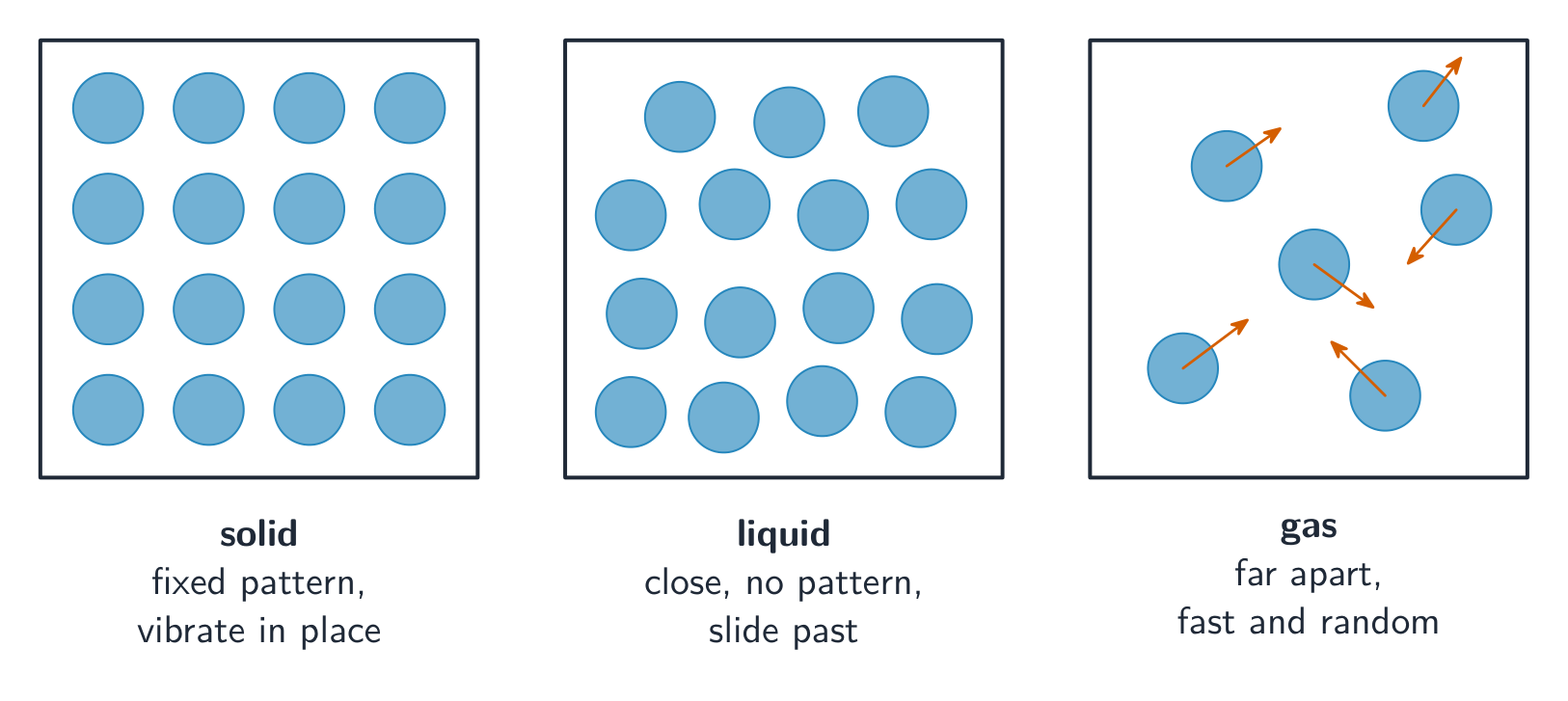
All matter is made of tiny particles 粒子 that are always moving. This is the kinetic particle model.

  • In a solid the particles only vibrate 振动 about fixed positions.
  • In a liquid they are still close but can slide past each other.
  • In a gas they are far apart and move quickly in random directions.

Temperature and particle energy

When you heat a substance, its particles move faster, so they have more kinetic energy 动能. Temperature 温度 is a measure of the average kinetic energy of the particles.

The lowest possible temperature is absolute zero 绝对零度, $-273\,{}^{\circ}\text{C}$. At this point the particles have the least possible energy.

Gas pressure

Gas particles hit the walls of their container. Each hit is a tiny push. The pressure 压强 of the gas is the total force of these hits per unit area.

  • Heating a gas (at constant volume) makes particles move faster and hit harder and more often, so the pressure rises.
  • Squeezing a gas into a smaller volume (at constant temperature) means more hits per second on each unit of area, so the pressure rises.

For a fixed mass of gas at constant temperature:

$$pV = \text{constant}$$

So if the volume halves, the pressure doubles.

Worked example. A gas has a volume of $200\ \text{cm}^3$ at a pressure of $100\ \text{kPa}$. It is squeezed to $50\ \text{cm}^3$ at constant temperature. Find the new pressure.

Since $pV$ stays constant, $p_1 V_1 = p_2 V_2$:

$$100 \times 200 = p_2 \times 50 \quad\Rightarrow\quad p_2 = \frac{20\,000}{50} = 400\ \text{kPa}$$

Brownian motion

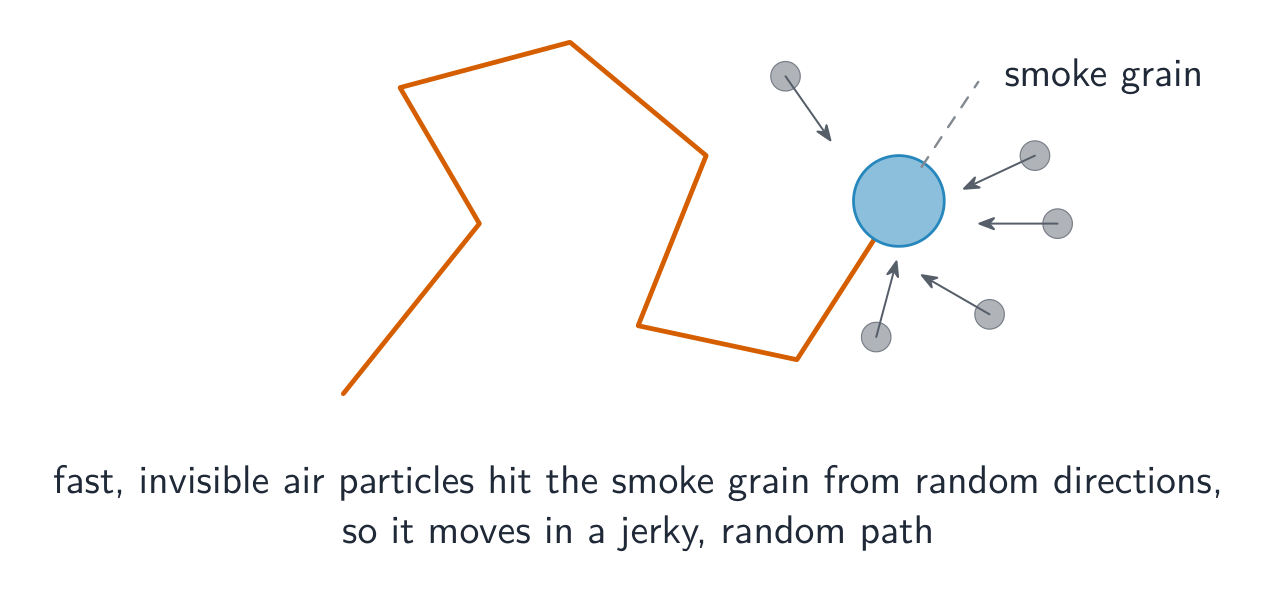
If you look at smoke in air under a microscope, you see tiny specks moving in a jerky, random way. This is Brownian motion 布朗运动. The specks are pushed by fast, invisible air particles hitting them. It is strong evidence for the kinetic particle model.

The kelvin scale

Scientists often use the kelvin 开尔文 (K) temperature scale, which starts at absolute zero. To convert:

$$T\text{ (in K)} = \theta\text{ (in }^{\circ}\text{C}) + 273$$

So $0\,{}^{\circ}\text{C} = 273\ \text{K}$.

Worked example. Convert $25\,{}^{\circ}\text{C}$ to kelvin, and $200\ \text{K}$ to degrees Celsius.

$$25 + 273 = 298\ \text{K}, \qquad 200 - 273 = -73\,{}^{\circ}\text{C}$$
ไทย

สสารทั้งหมดประกอบด้วย อนุภาค ขนาดเล็กที่เคลื่อนที่ตลอดเวลา นี่คือโมเดลอนุภาคเชิงจลน์

  • ในของแข็ง อนุภาคจะ สั่น อยู่เฉพาะในตำแหน่งที่กำหนดไว้เท่านั้น
  • ในของเหลว อนุภาคยังคงอยู่ใกล้กันแต่สามารถเลื่อนผ่านกันได้
  • ในก๊าซ อนุภาคอยู่ห่างกันมากและเคลื่อนที่ด้วยความเร็วในทิศทางสุ่ม
กล่องสามใบแสดงอนุภาค: ตารางที่มีระเบียบสำหรับของแข็ง, การรวมนานาชนิดที่แน่นหนาสำหรับของเหลว, และอนุภาคเคลื่อนที่เร็วจำนวนน้อยสำหรับก๊าซ
อนุภาคเดียวกันในสามสถานะ:静止และมีระเบียบในของแข็ง, ใกล้เคียงแต่ไร้ระเบียบในของเหลว, ห่างกันและเคลื่อนที่เร็วในก๊าซ

อุณหภูมิและพลังงานของอนุภาค

เมื่อให้ความร้อนกับสาร อนุภาคของมันจะเคลื่อนที่เร็วขึ้น จึงมี พลังงานจลน์ มากขึ้น อุณหภูมิ เป็นค่าวัดพลังงานจลน์เฉลี่ยของอนุภาค

อุณหภูมิต่ำสุดที่เป็นไปได้คือ ศูนย์สัมบูรณ์, $-273\,{}^{\circ}\text{C}$ ที่จุดนี้ อนุภาคจะมีพลังงานน้อยที่สุดเท่าที่จะเป็นได้

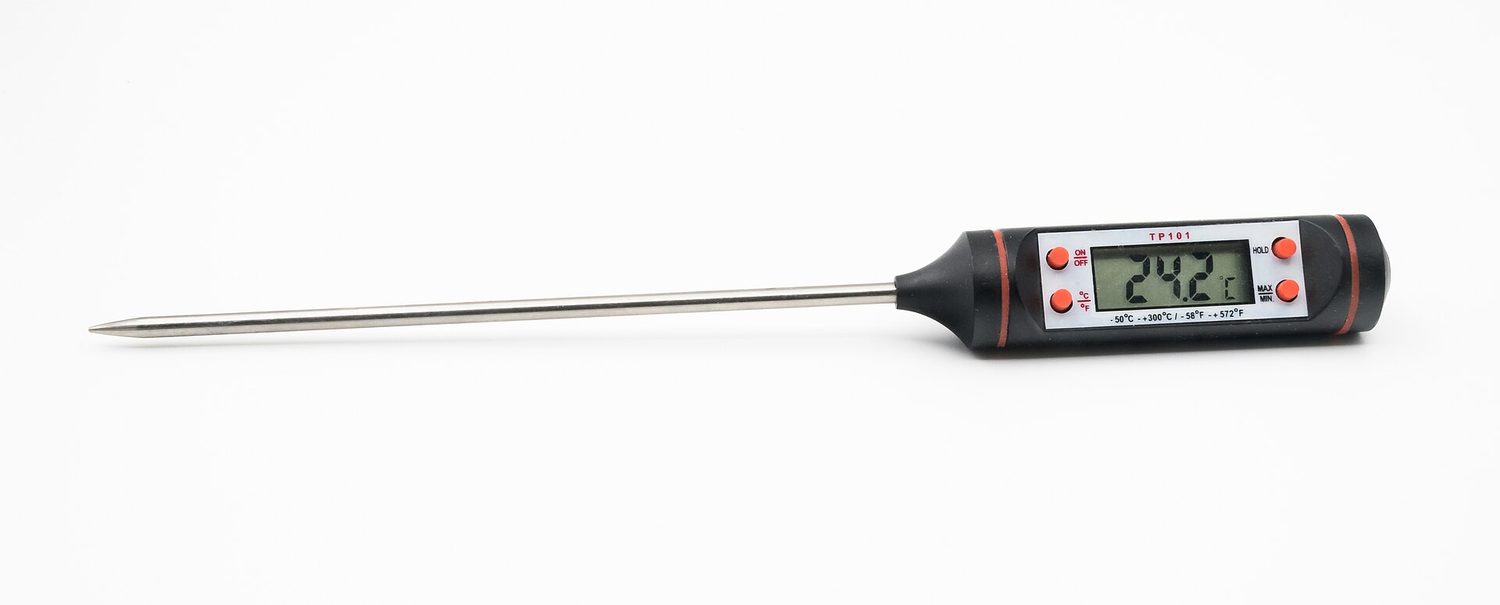
เทอร์โมมิเตอร์ดิจิทัลสีขาวพร้อมหัววัดโลหะยาวและหน้าจอขนาดเล็ก วางอยู่ข้างเคสเก็บของ
เทอร์โมมิเตอร์ดิจิทัลวัดอุณหภูมิโดยการตรวจจับพลังงานจลน์ของอนุภาคที่มันสัมผัส

ความดันของก๊าซ

อนุภาคของก๊าซชนกับผนังภาชนะของตน การชนแต่ละครั้งเป็นการผลักเล็กน้อย ความดัน ของก๊าซคือแรงรวมของการชนเหล่านี้ต่อหน่วยพื้นที่

อนุภาคแก๊สเคลื่อนที่ไปทุกทิศทางภายในกล่องและชนกับผนัง
ความดันของก๊าซคือแรงรวมจากการชนของอนุภาคจำนวนมหาศาลต่อหน่วยพื้นที่ของผนัง
  • การให้ความร้อนแก่ก๊าซ (ที่ปริมาตรคงที่) ทำให้อนุภาคเคลื่อนที่เร็วขึ้น ชนแรงขึ้นและบ่อยขึ้น ดังนั้นความดันจึงเพิ่มขึ้น
  • การบีบอัดก๊าซให้เข้าไปอยู่ในปริมาตรที่เล็กลง (ที่อุณหภูมิคงที่) หมายถึงมีการชนต่อวินาทีมากขึ้นต่อหน่วยพื้นที่ ดังนั้นความดันจึงเพิ่มขึ้น

สำหรับมวลของก๊าซที่กำหนดที่อุณหภูมิคงที่:

$$pV = \text{constant}$$

ดังนั้นหากปริมาตรลดลงครึ่งหนึ่ง ความดันจะเพิ่มขึ้นสองเท่า

กราฟความดันต่อปริมาตรที่ลดลงอย่างรวดเร็วแล้วค่อยๆ แบนลง พร้อมจุดที่แสดงว่าการลดปริมาตรลงครึ่งหนึ่งจะทำให้ความดันเพิ่มขึ้นสองเท่า
ที่อุณหภูมิคงที่ กราฟความสัมพันธ์ระหว่างความดัน-ปริมาตรจะเป็นเส้นโค้ง: ลดปริมาตรลงครึ่งหนึ่งแล้วความดันจะเพิ่มขึ้นสองเท่า ดังนั้น $pV$ จึงคงที่

ตัวอย่างวิธีทำ. ก๊าซมีปริมาตร $200\ \text{cm}^3$ ที่ความดัน $100\ \text{kPa}$ ถูกบีบอัดเหลือ $50\ \text{cm}^3$ ที่อุณหภูมิคงที่ จงหาความดันใหม่

เนื่องจาก $pV$ คงที่ ดังนั้น $p_1 V_1 = p_2 V_2$:

$$100 \times 200 = p_2 \times 50 \quad\Rightarrow\quad p_2 = \frac{20\,000}{50} = 400\ \text{kPa}$$

การเคลื่อนที่แบบบราวเนียน

หากคุณดูควันในอากาศภายใต้กล้องจุลทรรศน์ คุณจะเห็นจุดเล็กๆ เคลื่อนที่ในลักษณะกระตุกและสุ่ม นี่คือ การเคลื่อนที่แบบบราวียน จุดเล็กๆ เหล่านี้ถูกผลักโดยอนุภาคอากาศที่เร็วและไม่มองเห็นได้ซึ่งชนมัน เป็นหลักฐานที่แข็งแกร่งสำหรับโมเดลอนุภาคเชิงจลน์

เม็ดควันขนาดใหญ่เคลื่อนที่ตามเส้นทางซิกซากัก ล้อมรอบด้วยอนุภาคอากาศขนาดเล็กที่เคลื่อนที่เร็วและชนมัน
การชนจากอนุภาคอากาศที่เร็วในทิศทางสุ่มจะผลักเม็ดควันให้เคลื่อนที่ไปตามเส้นทางที่กระตุกและสุ่ม

สเกลเคลวิน

นักวิทยาศาสตร์มักใช้สเกลอุณหภูมิ เคลวิน (K) ซึ่งเริ่มต้นที่ศูนย์สัมบูรณ์ ในการแปลงค่า:

$$T\text{ (in K)} = \theta\text{ (in }^{\circ}\text{C}) + 273$$

ดังนั้น $0\,{}^{\circ}\text{C} = 273\ \text{K}$

ตัวอย่างวิธีทำ แปลง $25\,{}^{\circ}\text{C}$ เป็นเคลวิน และ $200\ \text{K}$ เป็นองศาเซลเซียส

$$25 + 273 = 298\ \text{K}, \qquad 200 - 273 = -73\,{}^{\circ}\text{C}$$
Explore · ⁨สำรวจ⁩

Squeeze a gas (Boyle's law) · ⁨บีบอัดแก๊ส (กฎของโบยล์)⁩

Slide the piston in to shrink the volume. The same particles get crammed into less space, so they hit the walls more often and the pressure climbs — while pressure × volume stays constant. · ⁨เลื่อนลูกสูบเข้าไปเพื่อลดปริมาตร อนุภาคเดียวกันถูกบีบอัดให้อยู่ในพื้นที่เล็กลง ทำให้ชนกับผนังบ่อยขึ้นและความดันสูงขึ้น — ในขณะที่ความดัน × ปริมาตรคงที่⁩

Vocabulary · ⁨คำศัพท์⁩ Train · ⁨ฝึกฝน⁩
English ไทย
particle/ˈpɑːtɪkl/ อนุภาค
vibrate/vaɪˈbreɪt/ สั่นสะเทือน
kinetic energy/kɪˈnetɪk ˈenədʒi/ พลังงานจลน์
temperature/ˈtemprɪtʃə/ อุณหภูมิ
absolute zero/ˈæbsəluːt ˈzɪərəʊ/ ศูนย์สัมบูรณ์
pressure/ˈpreʃə/ ความดัน
Brownian motion/ˈbraʊnɪən ˈməʊʃn/ การเคลื่อนที่แบบบราวนian
kelvin/ˈkelvɪn/ เคลวิน
thermometer/θɜːˈmɒmɪtə/ เทอร์โมมิเตอร์
insulating material/ˈɪnsjuːleɪtɪŋ məˈtɪərɪəl/ วัสดุฉนวน
melting/ˈmeltɪŋ/ การหลอมละลาย
2.2

Thermal expansion 热膨胀 · ⁨การขยายตัวด้วยความร้อน⁩

Syllabus · ⁨หลักสูตร⁩
English

2.2.1 Thermal expansion of solids, liquids and gases

Core Supplement
1 Describe, qualitatively, the thermal expansion of solids, liquids and gases at constant pressure 3 Explain, in terms of the motion and arrangement of particles, the relative order of magnitudes of the expansion of solids, liquids and gases as their temperatures rise
2 Describe some of the everyday applications and consequences of thermal expansion

2.2.2 Specific heat capacity

Core Supplement
1 Know that a rise in the temperature of an object increases its internal energy 2 Describe an increase in temperature of an object in terms of an increase in the average kinetic energies of all of the particles in the object
3 Define specific heat capacity as the energy required per unit mass per unit temperature increase; recall and use the equation
$$c = \frac{\Delta E}{m\Delta\theta}$$
4 Describe experiments to measure the specific heat capacity of a solid and a liquid

2.2.3 Melting, boiling and evaporation

Core Supplement
1 Describe melting and boiling in terms of energy input without a change in temperature 6 Describe the differences between boiling and evaporation
2 Know the melting and boiling temperatures for water at standard atmospheric pressure
3 Describe condensation and solidification in terms of particles
4 Describe evaporation in terms of the escape of more-energetic particles from the surface of a liquid 7 Describe how temperature, surface area and air movement over a surface affect evaporation
5 Know that evaporation causes cooling of a liquid 8 Explain the cooling of an object in contact with an evaporating liquid
ไทย

2.2.1 การขยายตัวด้วยความร้อนของของแข็ง ของเหลว และแก๊ส

แก่น เพิ่มเติม
1 อธิบายโดยสังเขป关于 การขยายตัวด้วยความร้อน ของของแข็ง ของเหลว และแก๊ส ที่ความดันคงที่ 3 อธิบายในเชิงกลไกการเคลื่อนที่และจัดเรียงตัวของอนุภาค เกี่ยวกับลำดับขนาดของการขยายตัวของของแข็ง ของเหลว และแก๊ส เมื่ออุณหภูมิสูงขึ้น
2 อธิบายการใช้งานและผลกระทบจากการขยายตัวด้วยความร้อนในชีวิตประจำวันบางประการ

2.2.2 ความจุความร้อนจำเพาะ

แก่น เพิ่มเติม
1 รู้ว่าเมื่ออุณหภูมิของวัตถุเพิ่มขึ้น จะทำให้พลังงานภายในของวัตถุนั้นเพิ่มขึ้น 2 อธิบายการเพิ่มขึ้นของอุณหภูมิของวัตถุในเชิงการเพิ่มขึ้นของพลังงานจลน์เฉลี่ยของอนุภาคทั้งหมดในวัตถุนั้น
3 นิยาม ความจุความร้อนจำเพาะ เป็นพลังงานที่ต้องการต่อหน่วยมวลต่อหน่วยการเพิ่มของอุณหภูมิ; จำและใช้สมการ
$$c = \frac{\Delta E}{m\Delta\theta}$$
4 อธิบายการทดลองเพื่อวัดความจุความร้อนจำเพาะของของแข็งและของเหลว

2.2.3 การหลอมเหลว การเดือด และการระเหย

แก่น เพิ่มเติม
1 อธิบาย การหลอมเหลว และ การเดือด ในเชิงการรับพลังงานโดยไม่มีการเปลี่ยนแปลงอุณหภูมิ 6 อธิบายความแตกต่างระหว่างการเดือดและการระเหย
2 รู้จุดหลอมเหลวและจุดเดือดของน้ำที่ความดันบรรยากาศมาตรฐาน
3 อธิบายการควบแน่นและการแข็งตัวในเชิงอนุภาค
4 อธิบาย การระเหย ในเชิงการหลุดออกจากพื้นผิวของของเหลวของอนุภาคที่มีพลังงานสูงกว่า 7 อธิบายว่าอุณหภูมิ พื้นที่ผิว และการเคลื่อนที่ของอากาศเหนือพื้นผิวมีผลต่อการระเหยอย่างไร
5 รู้ว่าการระเหยทำให้ของเหลวเย็นลง 8 อธิบายการเย็นลงของวัตถุที่สัมผัสกับของเหลวที่กำลังระเหย

Source: Cambridge International syllabus · ⁨แหล่งที่มา: หลักสูตร Cambridge International⁩

English

When matter is heated, its particles move more and take up more space, so the material expands. Gases expand the most, then liquids, then solids. This order comes from the forces between the particles: in a solid the particles are held tightly in a lattice 晶格 (a fixed pattern), so they can only vibrate a little more; in a liquid they are held less strongly; in a gas the forces are very weak, so the particles spread out much more.

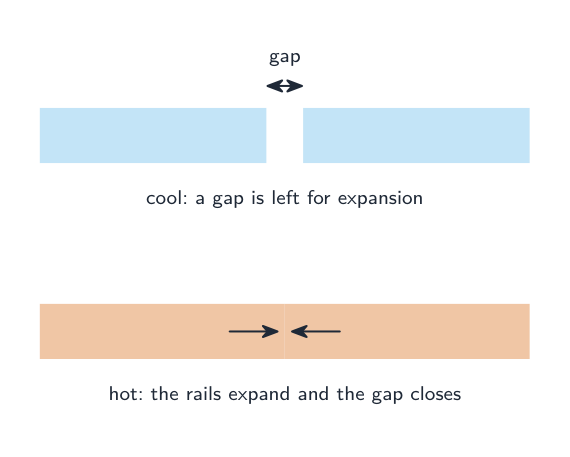
Everyday examples: gaps are left between railway lines; bridges sit on rollers; a tight metal lid loosens when heated.

ไทย

เมื่อสสารได้รับความร้อน อนุภาคของมันจะเคลื่อนที่มากขึ้นและกินพื้นที่มากขึ้น ทำให้วัสดุขยายตัว ก๊าซขยายตัวมากที่สุด ตามด้วยของเหลว แล้วถึงของแข็ง ลำดับนี้เกิดจากแรงระหว่างอนุภาค: ในของแข็ง อนุภาคถูกยึดติดกันใน โครงผลึก (รูปแบบที่กำหนดไว้) ดังนั้นจึงสั่นได้เพียงเล็กน้อยเท่านั้น; ในของเหลวถูกยึดด้วยแรงน้อยกว่า; ในก๊าซแรงมีความอ่อนแอกว่ามาก ดังนั้นอนุภาคจึงกระจายออกได้มากกว่ามาก

ตัวอย่างในชีวิตประจำวัน: ทิ้งช่องว่างระหว่างรางรถไฟ; สะพานวางอยู่บนลูกกลิ้ง; ฝาโลหะที่แน่นจะคลายออกเมื่อได้รับความร้อน

รางรถไฟสองเส้นที่มีช่องว่างเล็กน้อยเมื่อเย็น แล้วขยายตัวและสัมผัสกันเมื่อร้อน
ทิ้งช่องว่างเล็กน้อยระหว่างรางเมื่อเย็น เพื่อให้เมื่อบิดตัวด้วยความร้อน ช่องว่างนี้จะปิดลงแทนที่จะทำให้ทาง railway บิดเบี้ยว
Explore · ⁨สำรวจ⁩

Heating and specific heat capacity · ⁨การให้ความร้อนและความจุความร้อนจำเพาะ⁩

Q = mcΔT

The heat energy needed is proportional to the temperature rise for a given mass of material. · ⁨พลังงานความร้อนที่ต้องการ แปรผันตรงกับ การเพิ่มขึ้นของอุณหภูมิ สำหรับมวลวัสดุที่กำหนด⁩

Vocabulary · ⁨คำศัพท์⁩ Train · ⁨ฝึกฝน⁩
English ไทย
thermal expansion/ˈθɜːml ekˈspænʃn/ การขยายตัวจากความร้อน
lattice/ˈlætɪs/ ผลึก (lattice)
Watch lesson · ⁨ดูบทเรียน⁩
2.2

Internal energy and specific heat capacity · ⁨พลังงานภายในและความจุความร้อนจำเพาะ⁩

English

The internal energy 内能 of an object is the total energy of all its particles. Heating an object raises its internal energy and usually its temperature.

The specific heat capacity 比热容 is the energy needed to raise the temperature of 1 kg of a material by 1 °C.

$$c = \frac{\Delta E}{m\,\Delta\theta}$$

A material with a high specific heat capacity (like water) needs a lot of energy to warm up and cools down slowly.

Worked example. How much energy is needed to heat $2.0\ \text{kg}$ of water from $20\,{}^{\circ}\text{C}$ to $70\,{}^{\circ}\text{C}$? The specific heat capacity of water is $4200\ \text{J/(kg}\,{}^{\circ}\text{C)}$.

Rearranging $c = \frac{\Delta E}{m\,\Delta\theta}$ gives $\Delta E = mc\,\Delta\theta$, with $\Delta\theta = 70 - 20 = 50\,{}^{\circ}\text{C}$:

$$\Delta E = 2.0 \times 4200 \times 50 = 420\,000\ \text{J} = 420\ \text{kJ}$$

Measuring specific heat capacity. For a solid, use a metal block with two holes: one for an electric heater 加热器 and one for a thermometer 温度计. Measure the mass $m$ of the block. Switch on the heater for a measured time $t$ and record the current $I$ and the voltage $V$, so the energy supplied is $E = IVt$ (or read the energy from a joulemeter). Record the temperature rise $\Delta\theta$. Then $c = \dfrac{E}{m\,\Delta\theta}$. For a liquid, heat a measured mass of the liquid in a container and stir it, so the temperature is the same all through. Wrap the block or the container in insulating material 隔热材料, so less energy escapes to the air.

ไทย

พลังงานภายใน ของวัตถุคือพลังงานรวมของอนุภาคทั้งหมด ให้ความร้อนกับวัตถุจะเพิ่มพลังงานภายในของมันและมักจะทำให้สูงขึ้นอุณหภูมิ它也

ความจุความร้อนจำเพาะ คือพลังงานที่ต้องการเพื่อ升高อุณหภูมิของวัสดุ 1 กิโลกรัม ขึ้น 1 °C

$$c = \frac{\Delta E}{m\,\Delta\theta}$$

วัสดุที่มีความจุความร้อนจำเพาะสูง (เช่น น้ำ) ต้องการพลังงานมากในการทำความร้อนและเย็นลงช้า

ตัวอย่างวิธีทำ. ต้องใช้พลังงานเท่าไหร่ในการทำความร้อน $2.0\ \text{kg}$ ของน้ำจาก $20\,{}^{\circ}\text{C}$ ไปยัง $70\,{}^{\circ}\text{C}$? ความจุความร้อนจำเพาะของน้ำคือ $4200\ \text{J/(kg}\,{}^{\circ}\text{C)}$

จัดรูป $c = \frac{\Delta E}{m\,\Delta\theta}$ ใหม่จะได้ $\Delta E = mc\,\Delta\theta$, โดยที่ $\Delta\theta = 70 - 20 = 50\,{}^{\circ}\text{C}$:

$$\Delta E = 2.0 \times 4200 \times 50 = 420\,000\ \text{J} = 420\ \text{kJ}$$

การวัดความจุความร้อนจำเพาะ. สำหรับของแข็ง ใช้บล็อกโลหะที่มีรูสองรู: รูหนึ่งสำหรับเครื่อง ให้ความร้อน ไฟฟ้า และอีก รูหนึ่งสำหรับ เทอร์โมมิเตอร์ วัดมวล $m$ ของบล็อก เปิดเครื่องให้ความร้อนเป็นเวลา $t$ ที่วัดได้ และบันทึกกระแสไฟ $I$ และแรงดันไฟฟ้า $V$, ดังนั้นพลังงานที่จ่ายเข้าไปคือ $E = IVt$ (หรืออ่านค่าพลังงานจากจูลมิเตอร์) บันทึกการ升高อุณหภูมิ $\Delta\theta$. จากนั้น $c = \dfrac{E}{m\,\Delta\theta}$. สำหรับของเหลว, ให้ความร้อนมวลของเหลวที่วัดได้ในภาชนะและคนให้混匀, เพื่อให้混匀อุณหภูมิเท่ากันทั่วทั้งภาชนะ ห่อブロックหรือภาชนะด้วย ฉนวน, เพื่อลดการรั่วไหลของพลังงานสู่บรรยากาศ

น้ำเดือด: พลังงานภายในเพิ่มขึ้นตามอุณหภูมิ; ความจุความร้อนจำเพาะคือพลังงานต่อ kg ต่อ °C
น้ำเดือด: พลังงานภายในเพิ่มขึ้นตามอุณหภูมิ; ความจุความร้อนจำเพาะคือพลังงานต่อกิโลกรัมต่อองศาเซลเซียส
Vocabulary · ⁨คำศัพท์⁩ Train · ⁨ฝึกฝน⁩
English ไทย
internal energy/ɪnˈtɜːnl ˈenədʒi/ พลังงานภายใน
specific heat capacity/spəˈsɪfɪk hiːt kəˈpæsɪti/ ความจุความร้อนจำเพาะ
heater/ˈhiːtə/ เครื่องทำความร้อน
2.2

Melting, boiling and evaporation · ⁨การหลอมเหลว การเดือด และการระเหย⁩

English

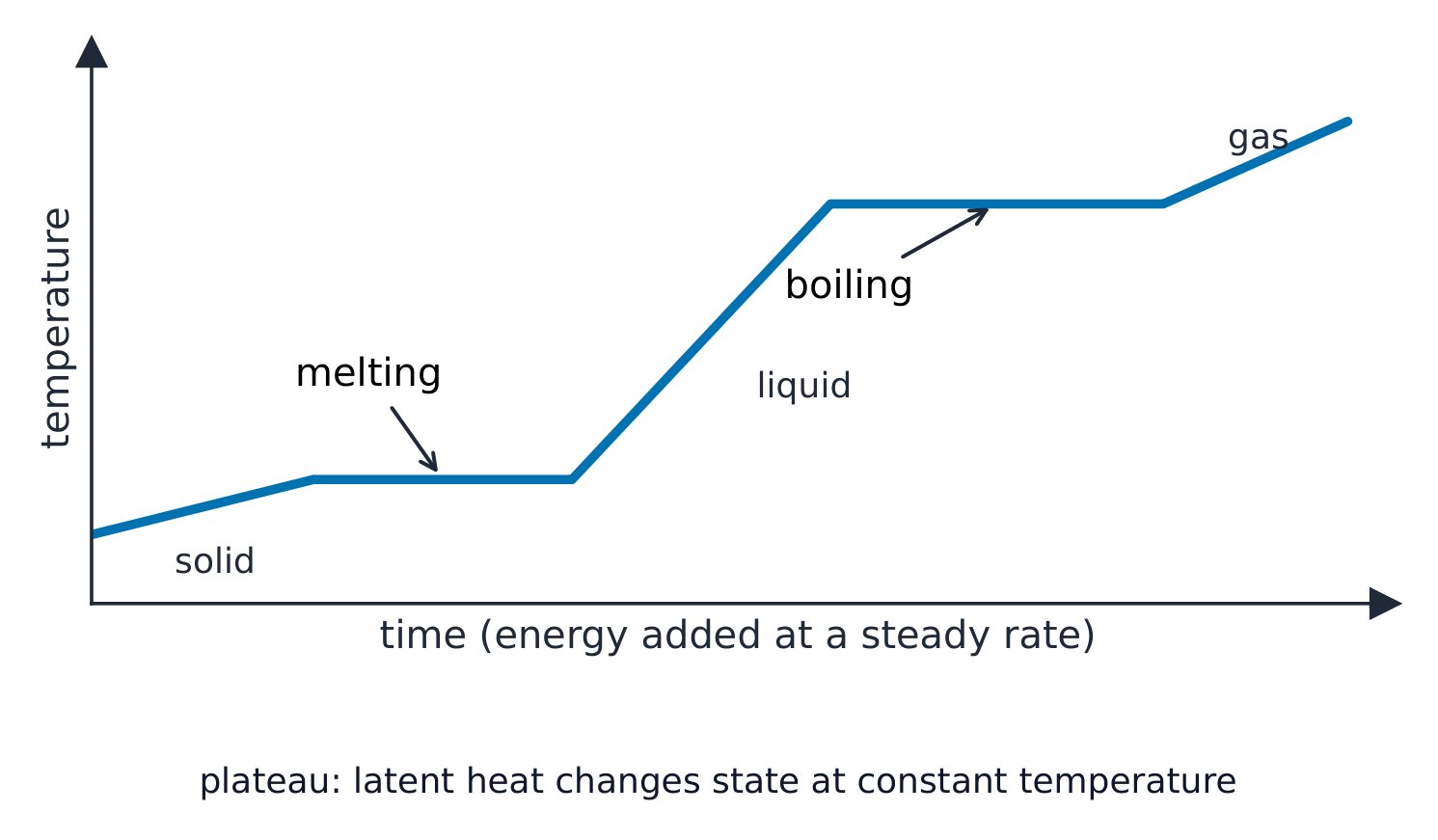
Melting 熔化 and boiling 沸腾 need energy, but the temperature stays the same while the state changes. This energy breaks the forces between particles. For water at normal air pressure, melting is at $0\,{}^{\circ}\text{C}$ and boiling at $100\,{}^{\circ}\text{C}$.

Evaporation 蒸发 is when a liquid changes to a gas at its surface, below the boiling point. The fastest particles escape from the surface. Because the fastest (most energetic) particles leave, the average energy of those left behind falls, so the liquid cools down 冷却. An object touching an evaporating liquid also cools, because the liquid takes energy from it: this is why sweat cools your skin.

Evaporation is faster when the temperature is higher, the surface area is larger, and there is more air movement over the surface.

ไทย

การหลอมเหลว และ การเดือด ต้องใช้พลังงาน แต่อุณหภูมิจะคงที่ขณะเปลี่ยนสถานะ พลังงานนี้ใช้เพื่อทำลายแรงระหว่างอนุภาค สำหรับน้ำที่ความดันบรรยากาศปกติ การหลอมเหลวเกิดขึ้นที่ $0\,{}^{\circ}\text{C}$ และการเดือดเกิดขึ้นที่ $100\,{}^{\circ}\text{C}$

กราฟแสดงอุณหภูมิเทียบกับเวลา มีช่วงราบเรียบระหว่างการหลอมเหลวและระหว่างการเดือด *ขณะที่สารละลายและ mientras它 boiling อุณหภูมิจะคงที่ แม้ว่าจะมีการเพิ่มพลังงานอย่างต่อเนื่องก็ตาม

การระเหย คือกระบวนการที่ของเหลวเปลี่ยนเป็นแก๊สที่ผิวหน้า โดยต่ำกว่าจุดเดือด อนุภาคที่มีความเร็วที่สุดจะหลุดออกจากผิวหน้า เมื่ออนุภาคที่มีพลังงานสูง (เร็วที่สุด) ออกไป พลังงานเฉลี่ยของอนุภาคที่เหลืออยู่จึงลดลง ทำให้ของเหลว เย็นลง วัตถุที่สัมผัสกับของเหลวที่กำลังระ,evaporate ก็เย็นลงเช่นกัน เนื่องจากของเหลวดูดความร้อนจากวัตถุนั้น นี่คือเหตุผลที่เหงื่อทำให้ผิวหนังเย็นลง

การระเหยเกิดขึ้นได้เร็วกว่าเมื่ออุณหภูมิสูงขึ้น พื้นที่ผิวกว้างขึ้น และมีกระแสอากาศไหลผ่านผิวหน้ามากขึ้น

Explore · ⁨สำรวจ⁩

The heating curve — watch the temperature pause · ⁨กราฟความร้อน — สังเกตว่าอุณหภูมิหยุดชะงัก⁩

While the substance is melting or boiling the temperature stays flat, even though heat is still going in — the energy breaks bonds instead of warming it. · ⁨ในขณะที่สารกำลังหลอมเหลวหรือเดือด อุณหภูมิจะคงที่ แม้ว่าจะมีความร้อนใส่เข้าไป continuously — พลังงานUsed to break bonds แทนที่จะทำให้ร้อนขึ้น⁩

Vocabulary · ⁨คำศัพท์⁩ Train · ⁨ฝึกฝน⁩
English ไทย
boiling/ˈbɔɪlɪŋ/ จุดเดือด
evaporation/ɪˌvæpəˈreɪʃn/ การระเหย
cools down/kuːlz daʊn/ เย็นลง
transfer of thermal energy/ˈtrænsfɜː ɒv ˈθɜːml ˈenədʒi/ การถ่ายโอนพลังงานความร้อน
2.3

Transfer of thermal energy 热能传递 · ⁨การถ่ายโอนพลังงานความร้อน⁩

Syllabus · ⁨หลักสูตร⁩
English

2.3.1 Conduction

Core Supplement
1 Describe experiments to demonstrate the properties of good thermal conductors and bad thermal conductors (thermal insulators) 2 Describe thermal conduction in all solids in terms of atomic or molecular lattice vibrations and also in terms of the movement of free (delocalised) electrons in metallic conductors
3 Describe, in terms of particles, why thermal conduction is bad in gases and most liquids
4 Know that there are many solids that conduct thermal energy better than thermal insulators but do so less well than good thermal conductors

2.3.2 Convection

Core Supplement
1 Know that convection is an important method of thermal energy transfer in liquids and gases
2 Explain convection in liquids and gases in terms of density changes and describe experiments to illustrate convection

2.3.3 Radiation

Core Supplement
1 Know that thermal radiation is infrared radiation and that all objects emit this radiation
2 Know that thermal energy transfer by thermal radiation does not require a medium 4 Know that for an object to be at a constant temperature it needs to transfer energy away from the object at the same rate that it receives energy
3 Describe the effect of surface colour (black or white) and texture (dull or shiny) on the emission, absorption and reflection of infrared radiation 5 Know what happens to an object if the rate at which it receives energy is less or more than the rate at which it transfers energy away from the object
6 Know how the temperature of the Earth is affected by factors controlling the balance between incoming radiation and radiation emitted from the Earth’s surface
7 Describe experiments to distinguish between good and bad emitters of infrared radiation
8 Describe experiments to distinguish between good and bad absorbers of infrared radiation
9 Describe how the rate of emission of radiation depends on the surface temperature and surface area of an object

2.3.4 Consequences of thermal energy transfer

Core Supplement
1 Explain some of the basic everyday applications and consequences of conduction, convection and radiation, including: (a) heating objects such as kitchen pans (b) heating a room by convection 2 Explain some of the complex applications and consequences of conduction, convection and radiation where more than one type of thermal energy transfer is significant, including: (a) a fire burning wood or coal (b) a radiator in a car
ไทย

2.3.1 การนำความร้อน

แก่น เพิ่มเติม
1 อธิบายการทดลองเพื่อแสดงคุณสมบัติของ ตัวนำความร้อนที่ดี และ ฉนวนความร้อน (ตัวนำความร้อนที่ไม่ดี) 2 อธิบายการนำความร้อนในของแข็งทุกชนิดในเชิงการสั่นสะเทือนของโครงตาข่ายอะตอมหรือโมเลกุล รวมถึงในเชิงการเคลื่อนที่ของอิเล็กตรอนอิสระ (delocalised electrons) ในตัวนำโลหะ
3 อธิบายในเชิงอนุภาค ว่าทำไมการนำความร้อนจึงไม่ดีในแก๊สและของเหลวส่วนใหญ่
4 รู้ว่ามีของแข็งจำนวนมากที่นำพลังงานความร้อนได้ดีกว่าฉนวนความร้อน แต่ไม่ดีเท่าตัวนำความร้อนที่ดี

2.3.2 การพาความร้อน

แก่น เพิ่มเติม
1 รู้ว่า การพาความร้อน เป็นวิธีการสำคัญในการถ่ายโอนพลังงานความร้อนในของเหลวและแก๊ส
2 อธิบายการพาความร้อนในของเหลวและแก๊สในเชิงการเปลี่ยนแปลงความหนาแน่น และอธิบายการทดลองเพื่อแสดงการพาความร้อน

2.3.3รังสี

แก่น เพิ่มเติม
1 รู้ว่า รังสีความร้อน คือ รังสีอินฟราเรด และวัตถุทุกชนิดจะปล่อยรังสีนี้
2 รู้ว่าการถ่ายโอนพลังงานความร้อน bằngรังสีความร้อน ไม่จำเป็นต้องอาศัยตัวกลาง 4 รู้ว่าสำหรับวัตถุที่จะมีอุณหภูมิคงที่ วัตถุต้องถ่ายโอนพลังงานออกไปจากตัวมันเองในอัตราเท่ากับที่มันได้รับพลังงาน
3 อธิบายผลกระทบของสีพื้นผิว (ดำหรือขาว) และลักษณะพื้นผิว (ด้านหรือเงา) ต่อการปล่อย การดูดซับ และการสะท้อนรังสีอินฟราเรด 5 รู้ว่า会发生อะไรกับวัตถุหากอัตราการได้รับพลังงานน้อยกว่าหรือมากกว่าอัตราการถ่ายโอนพลังงานออกจากวัตถุ
6 รู้ว่าอุณหภูมิของโลกได้รับผลกระทบจากปัจจัยควบคุมสมดุลระหว่างรังสีที่เข้ามาและรังสีที่ปล่อยออกจากพื้นผิวโลกอย่างไร
7 อธิบายการทดลองเพื่อแยกแยะระหว่างตัวปล่อยรังสีอินฟราเรดที่ดีและไม่ดี
8 อธิบายการทดลองเพื่อแยกแยะระหว่างตัวดูดรังสีอินฟราเรดที่ดีและไม่ดี
9 อธิบายว่าอัตราการปล่อยรังสีขึ้นอยู่กับอุณหภูมิพื้นผิวและพื้นที่ผิวของวัตถุอย่างไร

2.3.4 ผลกระทบของการถ่ายโอนพลังงานความร้อน

แก่น เพิ่มเติม
1 อธิบายการใช้งานและผลกระทบพื้นฐานในชีวิตประจำวันบางอย่างของการนำความร้อน การพาความร้อน และรังสี ได้แก่: (ก) การทำให้อุปกรณ์เช่นหม้อครัวร้อน (ข) การทำความร้อนห้องด้วยการพาความร้อน 2 อธิบายการใช้งานและผลกระทบที่ซับซ้อนบางอย่างของการนำความร้อน การพาความร้อน และรังสี ซึ่งมีการถ่ายโอนพลังงานความร้อนหลายประเภทที่สำคัญร่วมด้วย ได้แก่: (ก) ไฟไหม้ไม้หรือถ่าน (ข) รังไฮเดออร์ในรถยนต์

Source: Cambridge International syllabus · ⁨แหล่งที่มา: หลักสูตร Cambridge International⁩

English

Thermal energy moves from hotter places to colder places in three ways.

Conduction

Conduction 热传导 is the transfer of thermal energy through a material without the material moving. The particles in a solid sit in a lattice. Heated particles vibrate more and pass the energy to their neighbours. In metals, free electrons (delocalised electrons 自由电子) carry energy quickly, so metals are good thermal conductors 热导体.

Materials that conduct badly (like air, wood and plastic) are thermal insulators 热绝缘体.

Testing conductors. Fix a drawing pin with a little wax to one end of rods of copper, iron, glass and wood, and heat the other ends equally. The pin drops first from the copper rod, then from the iron rod, and last (or never) from the glass and the wood: metals are the best conductors. A metal rod held in a flame soon feels hot; a wooden rod does not.

Gases and most liquids are bad conductors because their particles are far apart and only pass on energy when they happen to collide. There is no lattice and there are no free electrons.

Convection

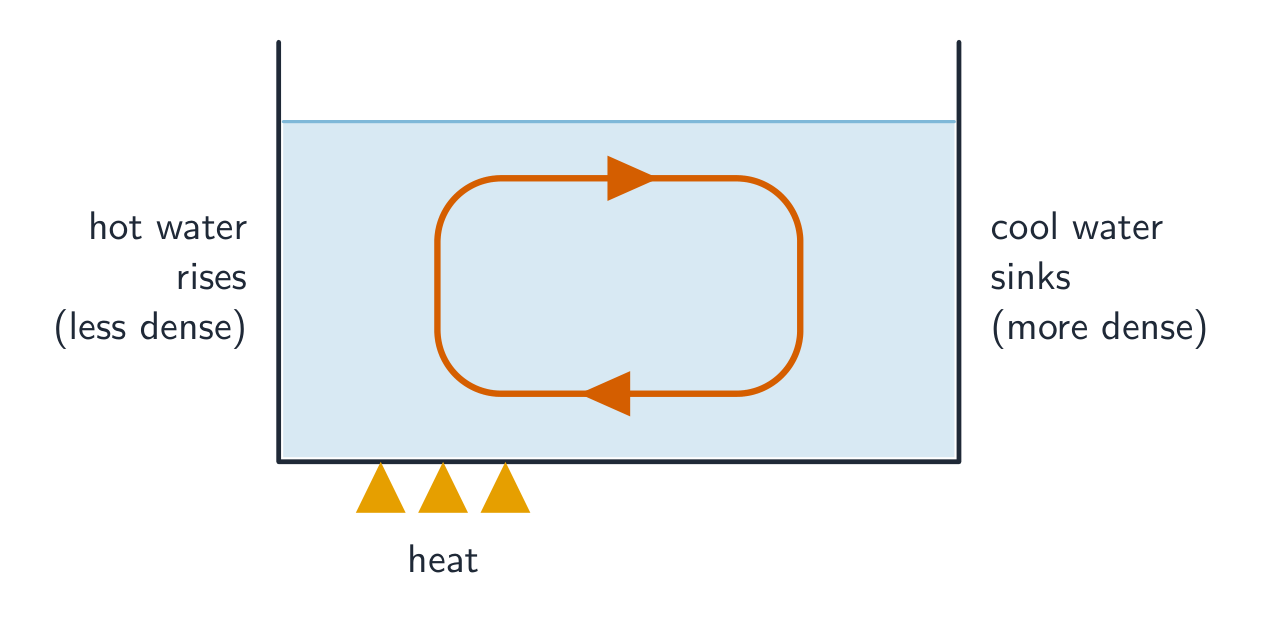
Convection 对流 happens in liquids and gases. When a fluid is heated it expands, becomes less dense, and rises. Cooler, denser fluid sinks to take its place. This circle of moving fluid is a convection current.

Showing convection. Drop a crystal of purple potassium permanganate 高锰酸钾 into a beaker of water and heat the beaker gently under the crystal. A coloured stream rises above the heat, spreads across the top and sinks at the sides. In air, a lit candle under one chimney of a smoke box pulls smoke down the other chimney and up above the flame.

Convection cannot happen in a solid because the particles cannot move from place to place.

Radiation

Thermal radiation 热辐射 is energy carried by infrared 红外线 waves. All objects emit it, and it needs no material to travel through — it can cross empty space (this is how energy reaches us from the Sun).

A surface that is dull 暗淡 and black is a good emitter 发射体 and a good absorber 吸收体 of infrared. A surface that is shiny and white is a poor emitter and a good reflector 反射体.

Comparing surfaces. Fill two cans, one dull black and one shiny silver, with hot water at the same temperature, and put a thermometer in each. The black can cools faster, so it is the better emitter. Then put the same two cans, full of cold water, at equal distances from a heater. The black can warms faster, so it is the better absorber. A Leslie cube 莱斯利立方体 (a metal box with one side of each finish) shows the same thing.

An object stays at a constant temperature when it emits energy at the same rate as it absorbs energy. The rate of emission is greater when the surface is hotter and larger. If an object absorbs energy faster than it emits it, its temperature rises; if it emits faster than it absorbs, its temperature falls.

The Earth's temperature. The Earth absorbs radiation from the Sun and emits infrared radiation back into space. Its average temperature stays constant only when the two rates are equal. Anything that changes this balance changes the temperature. Gases in the atmosphere 大气 such as carbon dioxide absorb some of the emitted infrared and send part of it back down, so more of these gases warms the Earth. Clouds and ice reflect incoming sunlight, so less ice means more energy is absorbed, and the Earth warms further.

Everyday examples

  • A kitchen pan has a metal base that conducts energy quickly to the food, and a plastic or wooden handle that is an insulator, so you can hold it.
  • A radiator 散热器 heats a room by convection: the air next to it warms, rises, and cooler air flows in to take its place, so the whole room warms.
  • Sitting near a fire you feel its radiation on your face at once; the air between you and the fire is a poor conductor.
  • A vacuum flask 保温瓶 keeps a drink hot by stopping all three transfers: the vacuum between its double walls stops conduction and convection, and its shiny silver surfaces stop radiation.
ไทย

พลังงานความร้อนเคลื่อนที่จากแหล่งที่มีอุณหภูมิสูงกว่าไปยังแหล่งที่มีอุณหภูมิต่ำกว่า ในสามรูปแบบ

การนำความร้อน

การนำความร้อน คือการถ่ายโอนพลังงานความร้อนผ่านวัสดุโดยไม่มีการเคลื่อนที่ของตัววัสดุนั้นเอง อนุภาคในของแข็งจัดเรียงอยู่ในโครงผลึก อนุภาคที่ถูกทำความร้อนจะสั่นสะเทือนมากขึ้นและส่งต่อพลังงานให้เพื่อนบ้าน ในโลหะ อิเล็กตรอนอิสระ (electrons ที่ไม่ติดกับอะตอม) จะพาพลังงานไปอย่างรวดเร็ว ดังนั้นโลหะจึงเป็น ตัวนำความร้อนที่ดี

วัสดุที่นำความร้อนไม่ดี (เช่น อากาศ ไม้ และพลาสติก)被称为 ฉนวนกันความร้อน

การทดสอบตัวนำความร้อน ยึดหมุดกระดาษด้วยขี้ผึ้งเล็กน้อยไว้ที่ปลายหนึ่งของแท่งทองแดง เหล็ก แก้ว และไม้ แล้วให้ความร้อนที่ปลายอีกด้านเท่าๆ กัน หมุดจะหลุดจากแท่งทองแดงก่อน ตามด้วยแท่งเหล็ก และสุดท้าย (หรืออาจไม่หลุดเลย) จากแก้วและไม้: โลหะคือตัวนำที่ดีที่สุด แท่งโลหะที่จับไว้ในเปลวไฟจะร้อนทันที ส่วนแท่งไม้จะไม่ร้อน

แก๊สและของเหลวส่วนใหญ่เป็นตัวนำความร้อนไม่ดี เพราะอนุภาคอยู่ห่างกันมากและส่งต่อพลังงานกันได้ก็ต่อเมื่อเกิดการชนกันโดยบังเอิญ ไม่มีโครงผลึกและไม่อิเล็กตรอนอิสระ

แท่งโลหะถูกทำความร้อนที่ปลายหนึ่ง อนุภาคสั่นสะเทือนและส่งต่อพลังงานไปยังปลายที่เย็น
ในการนำความร้อน อนุภาคที่สั่นสะเทือนส่งต่อพลังงานให้เพื่อนบ้าน ทำให้พลังงานไหลจากปลายร้อนไปยังปลายเย็น

การพาความร้อน

การพาความร้อน เกิดขึ้นในของเหลวและแก๊ส เมื่อของไหลได้รับความร้อนจะขยายตัว ความหนาแน่นลดลง และลอยตัวขึ้น ของไหลที่เย็นกว่าและมีความหนาแน่นมากกว่าจะจมลงไปแทนที่ ลูปของการเคลื่อนที่ของของไหลนี้เรียกว่า กระแสการพาความร้อน

ถ้วยวัดปริมาณน้ำถูกทำความร้อนจากด้านล่าง มีลูกศรวงกลมแสดงน้ำร้อนลอยขึ้นและน้ำเย็นจมลง
ของไหลที่ถูกทำความร้อนลอยขึ้นและของไหลที่เย็นกว่าจมลง ก่อให้เกิดกระแสการพาความร้อน

การสาธิตการพาความร้อน หยดผลึกสีม่วงของ โพแทสเซียมเพอร์แมงกาเนต ลงในถ้วยวัดปริมาณน้ำแล้วให้ความร้อนถ้วยเบาๆ ใต้ผลึก จะเห็นสายสีลอยขึ้นเหนือแหล่งความร้อน แพร่กระจายไปทั่วด้านบน และจมลงตามขอบด้านข้าง ในอากาศ เทียนที่จุดอยู่ใต้ปล่องควันด้านหนึ่งของกล่อง烟雾箱 ดึงควันลงปล่องควันอีกด้านและลอยขึ้นเหนือเปลวไฟ

การพาความร้อนไม่สามารถเกิดขึ้นในของแข็งได้เพราะอนุภาคไม่สามารถเคลื่อนที่จากที่หนึ่งไปยังอีกที่หนึ่งได้

การแผ่รังสี

รังสีความร้อน คือพลังงานที่พาไปด้วยคลื่น อินฟราเรด วัตถุทุกชนิดปล่อยรังสีนี้ออกมา และไม่จำเป็นต้องมีสื่อกลางในการเดินทาง สามารถทะลุผ่านอวกาศว่างเปล่าได้ (นี่คือวิธีที่พลังงานจากดวงอาทิตย์มาถึงเรา)

พื้นผิวที่เป็น ด้าน และสีดำ เป็น ผู้ปล่อย และ ผู้ดูดซับ อินฟราเรดได้ดี พื้นผิวที่เป็นมันเงาและสีขาว เป็นผู้ปล่อยที่ไม่ดีและเป็น ตัวสะท้อน ที่ดี

พื้นผิวด้านสีดำกำลังปล่อยคลื่นอินฟราเรดจำนวนมาก อยู่ข้างเคียงกับพื้นผิวมันเงาที่กำลังปล่อยน้อย
พื้นผิวด้านสีดำปล่อย (และดูดซับ) อินฟราเรดได้ดีกว่าพื้นผิวมันเงาและสีขาวมาก

เปรียบเทียบพื้นผิว เติมกระป๋องสองใบ一个ด้านเป็นสีดำด้าน อีกด้านเป็นสีเงินมันเงา ด้วยน้ำร้อนที่มีอุณหภูมิเท่ากัน แล้วใส่เทอร์โมมิเตอร์ในทั้งสองใบ กระป๋องสีดำจะเย็นลงเร็วกว่า แสดงว่าเป็นผู้ปล่อยที่ดีกว่า จากนั้นนำกระป๋องทั้งสองใบที่เต็มไปด้วยน้ำเย็นวาง距热源เท่ากัน กระป๋องสีดำจะอุ่นขึ้นเร็วกว่า แสดงว่าเป็นผู้ดูดซับที่ดีกว่า ลูกบาศก์เลสลี (กล่องโลหะที่มีแต่ละด้านเป็นพื้นผิวที่แตกต่างกัน) แสดงผลลัพธ์เดียวกัน

ภาพสามภาพของมือเดียวกัน: ในแสงธรรมดา warmth and glowing yellow in a thermal camera, then cooler and darker
กล้องความร้อน (อินฟราเรด) แปลงรังสีอินฟราเรดที่ปล่อยออกมาจากมืออุ่นให้เป็นภาพ; brightness means hotter

วัตถุจะคงอุณหภูมิไว้ได้เมื่อปล่อยพลังงานในอัตราเท่ากับที่ดูดซับพลังงาน อัตราการปล่อยจะเพิ่มขึ้นเมื่อพื้นผิวยิ่งร้อนและยิ่งใหญ่ หากวัตถุดูดซับพลังงานได้เร็วกว่าที่ปล่อย出来 อุณหภูมิจะเพิ่มขึ้น; ถ้าปล่อยออกได้เร็วกว่าที่ดูดซับ出来 อุณหภูมิจะลดลง

อุณหภูมิของโลก โลกดูดกลืนรังสีจากดวงอาทิตย์และปล่อยรังสีอินฟราเรดกลับสู่อวกาศ อุณหภูมิเฉลี่ยของโลกจะคงที่ก็ต่อเมื่ออัตราการดูดกลืนและการปล่อยรังสีเท่ากัน สิ่งใดเปลี่ยนแปลงสมดุลนี้จะทำให้เปลี่ยนอุณหภูมิ ก๊าซใน บรรยากาศ เช่น คาร์บอนไดออกไซด์ดูดกลืนรังสีอินฟราเรดส่วนหนึ่งและส่งกลับมาบางส่วน ทำให้ก๊าซเหล่านี้มากขึ้นทำให้โลกอุ่นขึ้น เมฆและน้ำแข็งสะท้อนแสงอาทิตย์ที่เข้ามา ดังนั้นน้ำแข็งน้อยลงหมายถึงการดูดกลืนพลังงานมากขึ้น และโลกจะอุ่นขึ้นอีก

ตัวอย่างในชีวิตประจำวัน

  • กระทะทำครัวมีฐานโลหะที่นำความร้อนไปยังอาหารได้อย่างรวดเร็ว และมีด้ามจับพลาสติกหรือไม้ซึ่งเป็นฉนวนกันความร้อน ทำให้คุณถือได้ปลอดภัย
  • เครื่องทำความร้อน อุ่นห้องด้วยการพาความร้อน: อากาศข้างๆ它อุ่นขึ้น ลอยขึ้น และอากาศเย็นไหลเข้ามาแทนที่ ทำให้ทั้งห้องอุ่นขึ้น
  • การนั่งใกล้กองไฟ คุณจะรู้สึกถึงความร้อนแบบรังสีบนใบหน้าทันที; อากาศระหว่างคุณกับกองไฟเป็นตัวนำความร้อนที่ไม่ดี
  • ขวดสุญญากาศ ช่วยรักษาอุณหภูมิของเครื่องดื่มให้ร้อนโดยขัดขวางการถ่ายโอนความร้อนทั้งสามแบบ: สุญญากาศระหว่างผนังสองชั้นช่วยหยุดการนำและความร้อนด้วยการพา และพื้นผิวสีเงินมันเงาช่วยหยุดการแผ่รังสี
Explore · ⁨สำรวจ⁩

Heat transfer lab · ⁨ห้องปฏิบัติการการถ่ายเทความร้อน⁩

Compare the routes by which thermal energy moves. · ⁨เปรียบเทียบเส้นทางที่พลังงานความร้อนเคลื่อนที่⁩

Vocabulary · ⁨คำศัพท์⁩ Train · ⁨ฝึกฝน⁩
English ไทย
conduction/kənˈdʌkʃn/ การนำความร้อน
delocalised electrons/dɪˈlɒkəlaɪzd ɪˈlektrɒnz/ อิเล็กตรอนที่กระจายตัว
thermal conductor/ˈθɜːml kənˈdʌktə/ ตัวนำความร้อน
thermal insulator/ˈθɜːml ˈɪnsjuːleɪtə/ ฉนวนความร้อน
convection/kənˈvekʃn/ การพาความร้อน
potassium permanganate/pəˈtæsɪəm pəˈmæŋɡəneɪt/ โพแทสเซียมเพอร์แมงกาเนต
thermal radiation/ˈθɜːml ˌreɪdɪˈeɪʃn/ รังสีความร้อน
infrared/ˌɪnfrəˈred/ อินฟราเรด
dull/dʌl/ ทึบแสง
emitter/ɪˈmɪtə/ ตัวปล่อยรังสี
absorber/əbˈsɔːbə/ ตัวดูดกลืน
reflector/rɪˈflektə/ ตัวสะท้อน
Leslie cube/ˈlesli kjuːb/ ลูกบาศก์เลสลี่
atmosphere/ˈætməsfɪə/ ชั้นบรรยากาศ
radiator/ˈreɪdɪeɪtə/ เครื่องทำความร้อน
vacuum flask/ˈvækjuːm flæsk/ กระบอกสุญญากาศ
Watch lesson · ⁨ดูบทเรียน⁩
2.3

Exam tips · ⁨ข้อแนะนำสำหรับการสอบ⁩

English
  • In the kinetic particle model, heating a gas makes its particles move faster and hit the walls harder and more often, so the pressure rises. The particles themselves do not get bigger.
  • Evaporation happens only at the surface and at any temperature; boiling happens throughout the liquid at one fixed temperature. Evaporation cools the liquid left behind, because the fastest particles escape.
  • During melting and boiling the temperature stays constant even though energy is still being supplied — that energy breaks the forces between particles.
  • For specific heat capacity use $\Delta E = mc\,\Delta\theta$, where $\Delta\theta$ is the change in temperature, not the final temperature.
  • Dull black surfaces are the best emitters and absorbers of infrared; shiny, light surfaces are the best reflectors. Convection needs a fluid to flow, so it cannot happen in a solid.
ไทย
  • ใน แบบจำลองอนุภาคจลน์ การให้ความร้อนแก๊สทำให้อนุภาคเคลื่อนที่เร็วขึ้นชนผนังแรงและบ่อยขึ้น ส่งผลให้ความดันเพิ่มขึ้น ส่วนตัวอนุภาคเองไม่ได้มีขนาดใหญ่ขึ้น
  • การระเหย เกิดขึ้นเฉพาะที่ผิวด้านบนและสามารถเกิดขึ้นได้ทุกอุณหภูมิ ในขณะที่ การเดือด เกิดขึ้นทั่วทั้งของเหลวที่อุณหภูมิคงที่หนึ่งเดียว การระเหยทำให้ของเหลวที่เหลืออยู่เย็นลง เนื่องจากอนุภาคที่มีพลังงานสูงที่สุดจะหลุดออกนอกของเหลว
  • ระหว่าง การหลอมละลาย และ การเดือด อุณหภูมิจะคงที่แม้ว่าจะมีการจ่ายพลังงานเข้ามาอย่างต่อเนื่อง — พลังงานนี้จะใช้เพื่อทำลายแรงยึดเหนี่ยวระหว่างอนุภาค
  • สำหรับ ความจุความร้อนจำเพาะ ให้ใช้ $\Delta E = mc\,\Delta\theta$ โดยที่ $\Delta\theta$ คือ การเปลี่ยนแปลง ของอุณหภูมิ ไม่ใช่ค่าอุณหภูมิสุดท้าย
  • พื้นสีดำด้านเป็น ตัวแผ่รังสีและตัวดูดกลืนรังสีอินฟราเรด ที่ดีที่สุด ส่วนพื้นผิวมันแสงสว่างจะเป็นตัวสะท้อนที่ดีที่สุด การพาความร้อน ต้องอาศัยของไหลในการไหลเวียน จึงไม่สามารถเกิดขึ้นในของแข็งได้

Interactive lessons on this topic · ⁨บทเรียนเชิงโต้ตอบสำหรับหัวข้อนี้⁩

Work through it step by step, with instant-check exercises. · ⁨ทำทีละขั้นตอน พร้อมแบบฝึกหัดตรวจสอบผลทันที⁩

Past Papers · ⁨ข้อสอบย้อนหลัง⁩

More topics in IGCSE Physics · ⁨Physics IGCSE⁩ · ⁨หัวข้อเพิ่มเติมใน IGCSE Physics · ⁨Physics IGCSE⁩⁩

Log in or create account · ⁨เข้าสู่ระบบหรือสร้างบัญชี⁩

IGCSE, A-Level & AP