Melting, boiling and evaporation
Introduced| English | Meaning |
|---|---|
| melting/ˈmeltɪŋ/ | The change of a substance from solid to liquid. |
| boiling/ˈbɔɪlɪŋ/ | Vaporisation throughout a liquid when its vapour pressure matches the surrounding pressure. |
| evaporation/ɪˌvæpəˈreɪʃn/ | The escape of particles from the surface of a liquid into its vapour without the whole liquid boiling. |
| boiling point/ˈbɔɪlɪŋ pɔɪnt/ | The temperature at which a liquid's vapour pressure equals the surrounding pressure. |
Why sweating cools you
- When sweat dries off your skin, you feel cooler.
- A changing state — liquid turning to gas — is carrying energy away.
- Let's see how melting 熔化, boiling 沸腾 and evaporation 蒸发 work.
Melting and boiling
- Melting (solid → liquid) and boiling (liquid → gas) both need energy.
- But while the state is changing, the temperature stays the same — the energy goes into breaking the forces between particles, not into speeding them up.
- For water at normal air pressure: melting at $0\ {}^{\circ}\text{C}$, boiling at $100\ {}^{\circ}\text{C}$.
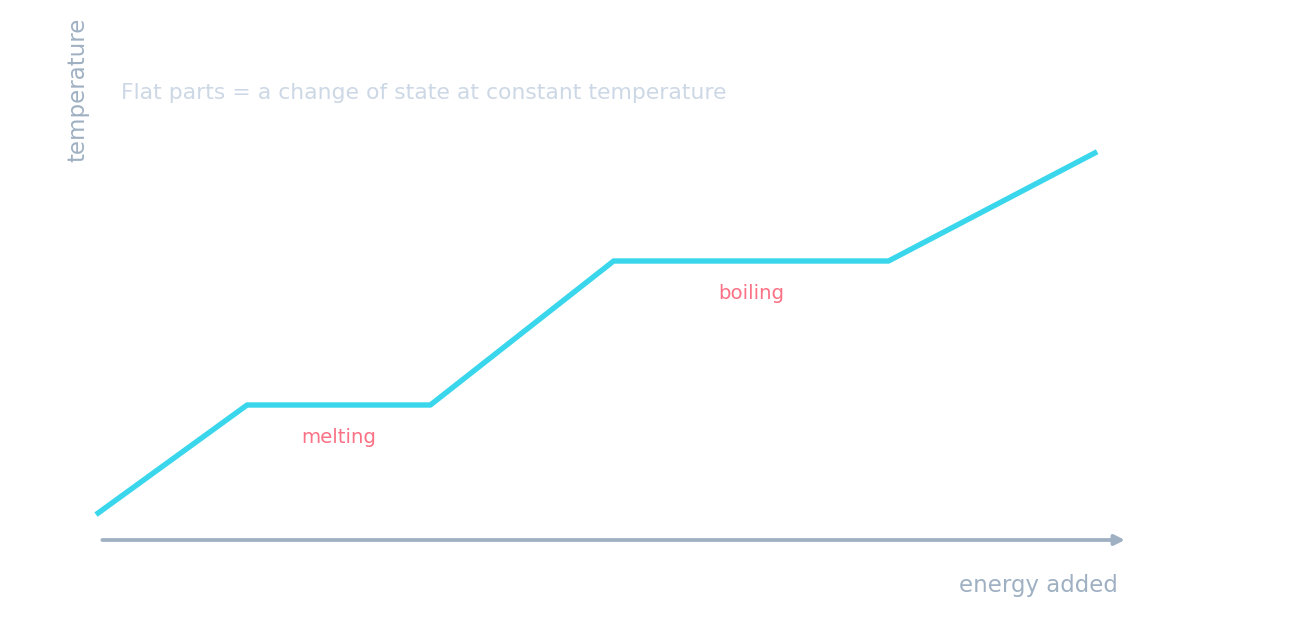
The heating curve — watch the temperature pause
While the substance is melting or boiling the temperature stays flat, even though heat is still going in — the energy breaks bonds instead of warming it.
While ice is melting into water, what happens to the temperature?
Difficulty 1/5 · 100 coins + a small bonus on first completion today
During a change of state the energy goes into breaking the forces between particles, so the temperature stays constant until the change is complete.
On a heating curve, a flat (horizontal) section means:
Difficulty 1/5 · 100 coins + a small bonus on first completion today
Energy is still being added, but it is used to change the state, so the temperature does not rise — the curve is flat.
Evaporation
- Evaporation is a liquid turning to gas at its surface, and it happens below the boiling point 沸点.
- The fastest particles escape from the surface.
- That leaves slower particles behind, so the average energy drops — the liquid cools down.
- This is exactly why evaporating sweat cools your skin.
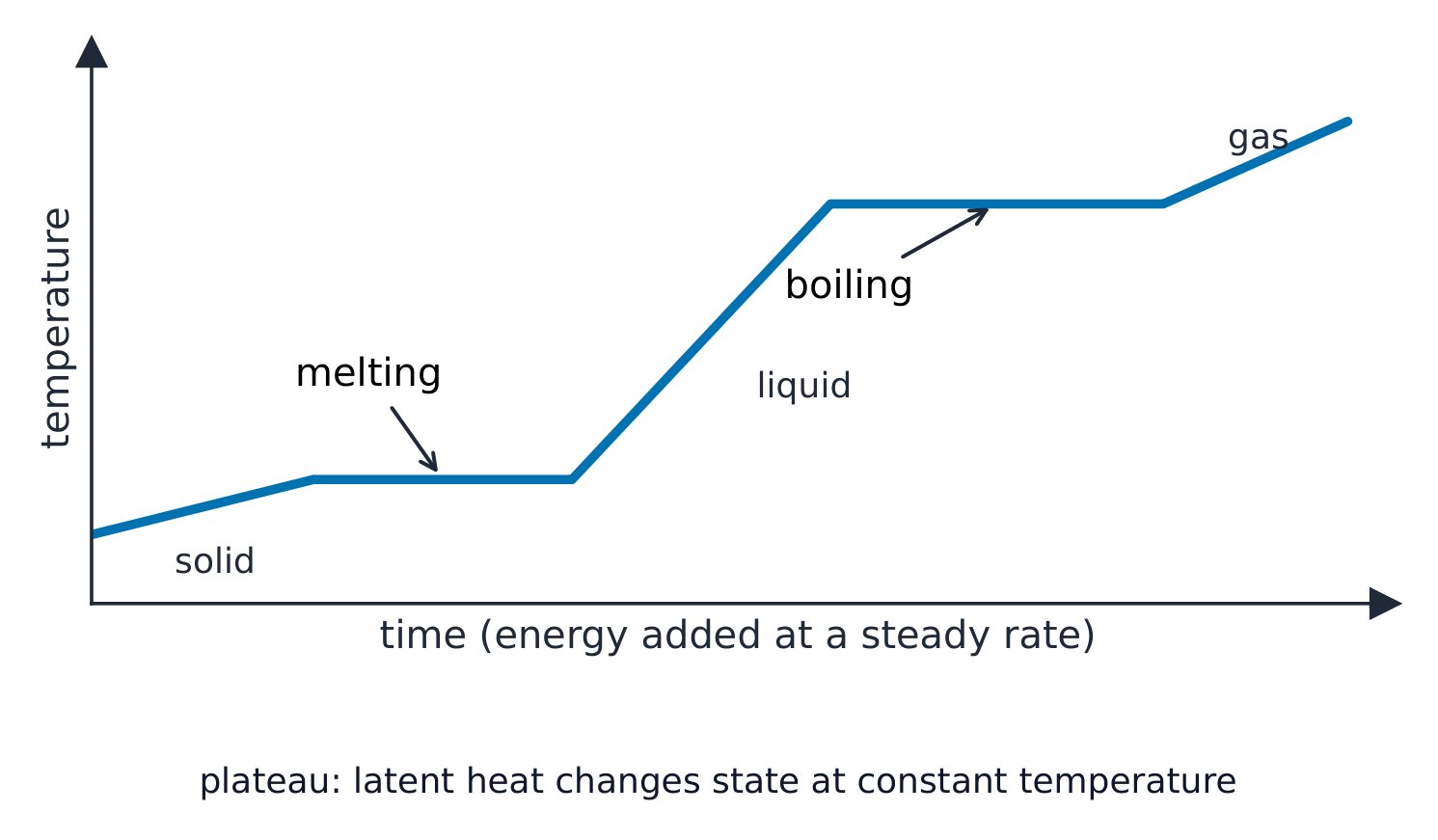
Temperature stays flat while the substance melts and while it boils
Evaporation can happen below the boiling point.
Difficulty 1/5 · 100 coins + a small bonus on first completion today
Evaporation happens at the surface at any temperature — the fastest surface particles escape. Boiling happens throughout the liquid at the boiling point.
Why does an evaporating liquid cool down?
Difficulty 1/5 · 100 coins + a small bonus on first completion today
The most energetic particles leave the surface, so the particles left behind have a lower average energy — a lower temperature.
What speeds up evaporation
- Higher temperature — more particles are moving fast enough to escape.
- Larger surface area — more particles are at the surface.
- More air movement (wind) — escaped particles are carried away, so fewer return.
- That's why washing dries fastest on a warm, breezy day.
Select all the things that make a puddle evaporate faster.
Difficulty 2/5 · 140 coins + a small bonus on first completion today
Higher temperature, larger surface area, and more airflow all speed up evaporation. A lower temperature slows it down.
You've got it
- melting and boiling need energy, but the temperature stays constant during the change
- a flat part on a heating curve = a change of state
- evaporation happens at the surface, below boiling; the fastest particles leave, so the liquid cools
- faster evaporation: higher temperature, bigger surface area, more airflow
Write from a melting temperature that stays at 60 degrees
- A substance melts at 60 degrees Celsius. Energy is still being supplied.
- State the temperature change during melting. Evaporation at 25 degrees can still cool the liquid.
A substance melts at 60 degrees Celsius while energy is supplied. What happens to its temperature during melting, and can evaporation at 25 degrees Celsius cool the liquid?
A flat part of the heating curve is a change of state. The fastest particles leave during evaporation.
What happens to the temperature while this substance melts?
Difficulty 1/5 · 100 coins + a small bonus on first completion today
The energy goes into breaking forces between particles, so the thermometer stays at 60 degrees Celsius. Other options — It rises steadily (because energy is being supplied); It falls to 0 degrees Celsius (the melting point of water).