Transfer of thermal energy
Introduced| English | Meaning |
|---|---|
| conduction/kənˈdʌkʃn/ | Through a material, particle to particle. |
| convection/kənˈvekʃn/ | Heat transfer through the bulk movement of a fluid. |
| radiation/ˌreɪdɪˈeɪʃn/ | The emission or transmission of energy through electromagnetic waves or particles. |
| insulators/ˈɪnsjuːleɪtəz/ | A material in which electric charge does not move readily under ordinary conditions. |
| infrared/ˌɪnfrəˈred/ | Electromagnetic radiation with wavelengths longer than visible red light and shorter than microwaves. |
| emitter/ɪˈmɪtə/ | A surface or object that gives out thermal radiation; dark matt surfaces are the best emitters. |
Three ways heat travels
- A metal spoon left in hot soup soon burns your hand.
- Yet the Sun warms you across millions of kilometres of empty space.
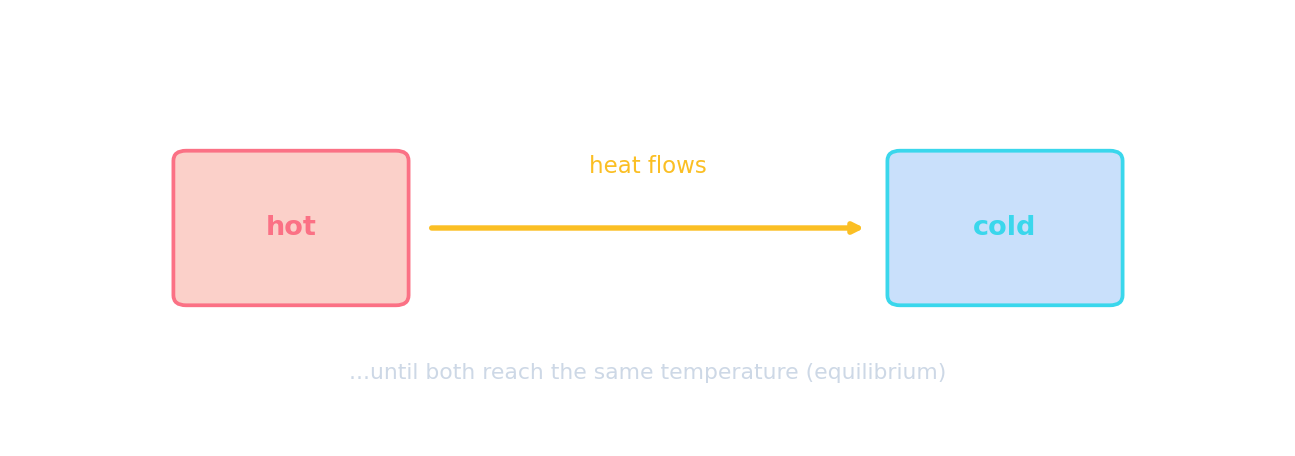
- Thermal energy always flows from hot to cold — by three routes: conduction 热传导, convection 对流 and radiation 辐射.
Heat transfer lab
Compare the routes by which thermal energy moves.
Conduction
- Conduction carries energy through a material without the material moving.
- Heated particles vibrate more and pass the energy to their neighbours.
- Metals are the best conductors: their free (delocalised) electrons carry energy quickly.
- Insulators 绝缘体 (air, wood, plastic) conduct badly — which is why we use them to keep things warm.

Conduction: vibrating particles pass energy along a metal bar
Why are metals such good conductors of thermal energy?
Difficulty 1/5 · 100 coins + a small bonus on first completion today
Metals have free (delocalised) electrons that move through the metal and carry energy rapidly from the hot end to the cold end.
Convection
- Convection happens in liquids and gases.
- Heated fluid expands, becomes less dense, and rises; cooler, denser fluid sinks to take its place.
- This circulation is a convection current — it carries energy around the fluid.
- It cannot happen in a solid, because the particles cannot move from place to place.
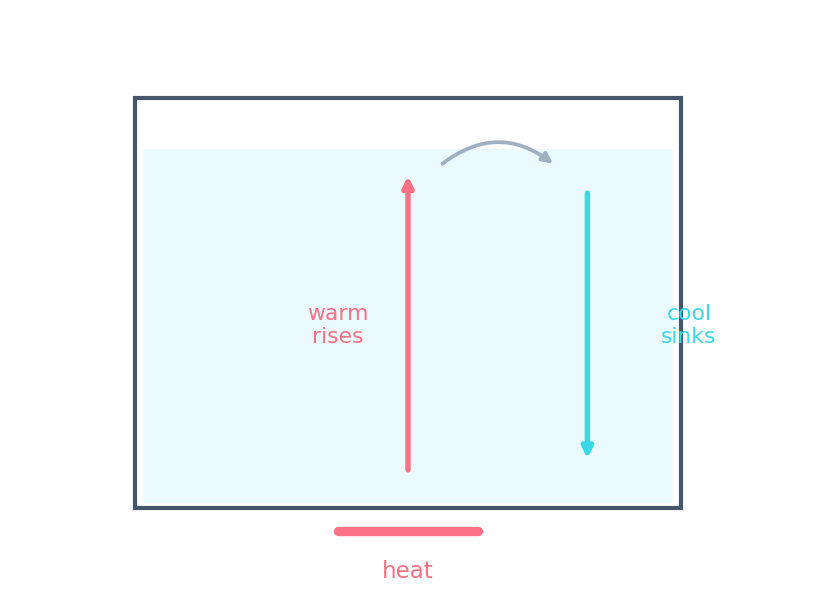
In convection, heated fluid rises because it has become:
Difficulty 1/5 · 100 coins + a small bonus on first completion today
Heating makes the fluid expand, so it is less dense and floats upward; cooler, denser fluid sinks to replace it.
Convection can happen in a solid.
Difficulty 1/5 · 100 coins + a small bonus on first completion today
Convection needs particles to move from place to place, so it only happens in liquids and gases — not solids.
Radiation
- Thermal radiation is energy carried by infrared 红外线 waves.
- All objects emit it, and it needs no material — it can cross empty space (this is how the Sun's energy reaches us).
- A dull, black surface is a good emitter 发射体 and absorber of infrared.
- A shiny, white surface is a poor emitter and a good reflector — which is why hot-water tanks and spacecraft are often shiny.

A dull, black surface emits (and absorbs) infrared much better than a shiny, white one
Which method of heat transfer can travel through empty space (a vacuum)?
Difficulty 1/5 · 100 coins + a small bonus on first completion today
Radiation is carried by infrared waves, which need no material — so the Sun's energy reaches us across empty space.
Match each method of heat transfer to how it works.
Difficulty 2/5 · 140 coins + a small bonus on first completion today
Conduction works through a material; convection moves the fluid itself in a current; radiation is infrared waves that need no material.
Which surface is the best emitter of thermal radiation?
Difficulty 1/5 · 100 coins + a small bonus on first completion today
Dull black surfaces are the best emitters (and absorbers) of infrared; shiny, light surfaces are poor emitters and good reflectors.
You've got it
- thermal energy always flows from hot to cold
- conduction: through a material, particle to particle; metals best (free electrons)
- convection: warm fluid rises, cool sinks — a current; never in solids
- radiation: infrared, needs no material; dull black = best emitter/absorber