ข้ามไปยังเนื้อหา
รายวิชา

GRE · GRE Subject Test · GRE Mathematics

  • 1

    C.1 · คำนวณเชิงตัวแปรเดียวและการประยุกต์ใช้

    1

    Scope and prerequisites

    English

    Undergraduate GRE preparation. Local objectives within the reviewed ETS scope; this is original teaching, not an official test or score predictor.

    Prerequisites: Exact algebra, trigonometry in radians, functions and inequalities.

    • Use limits, continuity and differentiability
    • Apply derivatives, integrals and the fundamental theorem
    • Recognise Riemann sums and distinguish them from infinite series

    continuity 连续性: Agreement of a function value with its limit.

    convergence 收敛: Approach to a finite limiting value.

    คำศัพท์ ฝึกฝน
    English ไทย
    continuity/kɒntɪˈnjuːɪti/ ความต่อเนื่อง
    convergence/kənˈvɜːdʒəns/ การลู่เข้า
    1

    Choose and justify a method

    English

    A limit describes values near a point, without requiring the function to be defined there. Continuity adds the requirement that the function value exists and agrees with the limit. Algebraic cancellation is valid only away from the cancelled zero, but can reveal a removable limit. One-sided limits must agree for a two-sided limit. For quotient limits, check the denominator and hypotheses before applying a rule; 0/0 is an indeterminate form, not an answer.

    A derivative is a limit of difference quotients and implies continuity; the converse fails, as |x| at zero shows. Product, quotient and chain rules describe different structures: the derivative of f(g(x)) is f′(g(x))g′(x), not a product of unrelated values. Differentiating a composition a second time generally produces two terms. Check domains, nonzero denominators and differentiability assumptions before using a symbolic expression as a derivative.

    The fundamental theorem says that the derivative of ∫ from a to x of a continuous integrand f(t) is f(x). With a variable upper bound h(x), multiply by h′(x); with two variable bounds, subtract the corresponding lower-bound contribution. A definite integral also arises as a limit of Riemann sums. Rewrite the sum as (1/n)Σf(k/n) before identifying the integral on [0,1], rather than treating n-dependent terms as constants.

    For example Σ from k=1 to n of n/(n²+k²) equals (1/n)Σ1/(1+(k/n)²), tending to ∫₀¹1/(1+t²)dt=π/4. This limit uses continuity and the partition width 1/n. A series over an unbounded number of terms is a different limit: terms tending to zero do not alone guarantee convergence. For Σ1/k the partial sums diverge; compare, estimate or apply a valid series test instead of using the necessary term condition as sufficient.

    1

    Worked reasoning

    English

    For F(x)=integral from 0 to x² of e^t dt, the fundamental theorem and chain rule give F′(x)=e^(x²)·2x. At x=1, F′(1)=2e. The upper limit is x², so omitting 2x misses its rate of change.

    Single-variable calculus and applications: course example
    Original course illustration; its values belong to the worked example, not the later practice.
    1

    Conditions and counterexamples

    English

    A-level calculus is useful prerequisite material but does not cover the undergraduate analysis and applications tested here.

    1

    Guided application

    English

    Let $F(x)=\int_x^{x^2}(1+t^2)\,dt$. Find $F'(x)$ and $F'(2)$. State why the theorem applies.

    Worked solution

    The integrand is continuous on the real line. The fundamental theorem and chain rule apply at both bounds:

    $$F'(x)=(1+x^4)2x-(1+x^2).$$
    $$F'(2)=(1+2^4)\,2\cdot2-(1+2^2)=63.$$
    Independently, an antiderivative is $t+t^3/3$. Thus $F=x^2+x^6/3-x-x^3/3$, with the same derivative.

    1

    Independent transfer

    English

    Find $\lim_{n\to\infty}\sum_{k=1}^n k/(n^2+k^2)$. Explain why this is a Riemann-sum limit. Then decide whether $\sum_{k=1}^{\infty}1/k$ converges.

    Check after attempting

    Rewrite each term as $\frac1n\frac{k/n}{1+(k/n)^2}$. The continuous function $f(t)=t/(1+t^2)$ on $[0,1]$ and mesh $1/n$ give

    $$L=\int_0^1\frac{t}{1+t^2}\,dt=\frac12\ln2.$$
    The harmonic series diverges: the block from $2^{j-1}+1$ through $2^j$ contains $2^{j-1}$ terms at least $1/2^j$, so each block adds at least $1/2$. Terms tending to zero is necessary but insufficient. The finite-sum integrand here depends on the scaled index; it is not the harmonic series.

  • 2

    C.2 · คำนวณหลายตัวแปรและการวิเคราะห์เวกเตอร์

    2

    Scope and prerequisites

    English

    Undergraduate GRE preparation. Local objectives within the reviewed ETS scope; this is original teaching, not an official test or score predictor.

    Prerequisites: Single-variable derivatives, dot products and iterated integration.

    • Compute partial derivatives, gradients and directional derivatives
    • Use multiple integrals and coordinate changes
    • Use derivative conditions to distinguish planes from curved surfaces

    gradient 梯度: Vector of partial derivatives.

    Jacobian 雅可比行列式: The local area or volume scaling in a coordinate change.

    คำศัพท์ ฝึกฝน
    English ไทย
    gradient/ˈɡreɪdɪənt/ เกรเดียนต์
    Jacobian/dʒæˈkəʊbɪən/ ดีเทอร์มิแนนต์ของจาโคเบียน
    2

    Choose and justify a method

    English

    A partial derivative changes one coordinate while fixing the others. For f=x²+3xy, f_x=2x+3y and f_y=3x. The gradient collects these derivatives; if f is differentiable, the directional derivative along a unit vector v is grad f·v. Normalise the direction before taking this dot product. A direction vector of length two would double the answer if used without normalisation.

    Differentiability means a valid linear approximation, not merely the existence of some partial derivatives at one point. Continuous first partials in a neighbourhood are a sufficient condition. For a composition f(x(t),y(t)), the chain rule gives f_x x′+f_y y′. Second derivatives can introduce both direct and mixed terms; a zero mixed partial alone places no restriction on the pure second partials.

    A multiple integral sums contributions over a specified region. Describe the region before choosing iterated limits; nonrectangular bounds may change when the order changes. In polar coordinates area is r dr dtheta, not just dr dtheta. A general coordinate change uses the absolute Jacobian determinant. Sign belongs to oriented vector quantities, while area and volume scaling use a nonnegative factor.

    If both first partials of a globally defined function on R² are constant, f_x=a and f_y=b, integrating successively gives f=ax+by+c, a plane. This cannot be inferred from parallel straight level sets alone: e^x has vertical parallel level lines but a curved graph. Nor do f_xy=f_yx=0 force a plane: x²+y² is a counterexample. Distinguish first-derivative constancy from absent mixed dependence and from the shape of selected level sets.

    2

    Worked reasoning

    English

    For f(x,y)=x²+3y², gradient f=(2x,6y). At (1,1) this is (2,6). In direction (3,4), the unit vector is (3/5,4/5), giving directional derivative 2·3/5+6·4/5=6.

    Multivariable calculus and vector analysis: course example
    Original course illustration; its values belong to the worked example, not the later practice.
    2

    Conditions and counterexamples

    English

    A non-unit direction vector gives a scaled directional rate, not the derivative per unit distance.

    2

    Guided application

    English

    For $f(x,y)=x^2+xy+2y^2$, find the directional derivative at $(1,-1)$ towards $(3,4)$. Evaluate $\iint_D(x^2+y^2)\,dA$ for the unit disk $D$.

    Worked solution

    The polynomial is differentiable. Normalise the direction: $u=(3/5,4/5)$. The gradient is $(2x+y,x+4y)$, hence $(1,-3)$ at the point.

    $$D_uf(1,-1)=\nabla f(1,-1)\cdot u=1\cdot3/5-3\cdot4/5=-9/5.$$
    Polar coordinates give $x^2+y^2=r^2$ and $dA=r\,dr\,d\theta$:
    $$I=\int_0^{2\pi}\int_0^1r^3\,dr\,d\theta=\pi/2.$$

    2

    Independent transfer

    English

    Define $g(x,y)=xy/\sqrt{x^2+y^2}$ away from the origin and $g(0,0)=0$. Both partial derivatives at the origin are zero. Is $g$ differentiable there? Is it continuous?

    Check after attempting

    Along each axis $g=0$, so both partials are zero. Continuity follows from $|xy|\le(x^2+y^2)/2$, which gives $|g(x,y)|\le\sqrt{x^2+y^2}/2\to0$. If differentiable, its linear derivative would be zero. Along $x=y=t\ne0$,

    $$\frac{|g(t,t)|}{\sqrt{t^2+t^2}}=\frac12.$$
    The required remainder ratio does not tend to zero. Thus continuity and existing partial derivatives do not establish differentiability.

  • 3

    A.1 · พีชคณิตเชิงเส้น

    3

    Scope and prerequisites

    English

    Undergraduate GRE preparation. Local objectives within the reviewed ETS scope; this is original teaching, not an official test or score predictor.

    Prerequisites: Linear equations, matrix multiplication, polynomials and complex roots.

    • Relate rank, nullity and solutions of linear systems
    • Analyse vector spaces and linear transformations
    • Compute eigenvalues, determinants and diagonalisation conditions

    rank 秩: Dimension of the image of a linear map.

    eigenvalue 特征值: A scalar satisfying Av=λv for a nonzero v.

    คำศัพท์ ฝึกฝน
    English ไทย
    rank/ræŋk/ อันดับ
    eigenvalue/ˈaɪdʒənvæljuː/ ค่าเฉพาะ
    3

    Choose and justify a method

    English

    A real vector space is closed under its specified addition and scalar multiplication and satisfies the vector-space axioms. A basis is an independent spanning list: every vector has a unique coordinate representation in that list. To test independence of matrix columns, solve the homogeneous system Ac=0; only the zero coefficient vector means independence. A spanning set can contain redundant vectors, so spanning alone does not make a basis.

    Row reduction exposes pivots and free variables without changing the solution set of a linear system. Rank is the dimension of the column image, equivalently the number of pivots. Nullity is the kernel dimension: for a map from an n-dimensional domain, rank+nullity=n. In a nonhomogeneous system, a zero coefficient row with nonzero right side means inconsistency; free variables give infinitely many solutions only after consistency has been established. The codomain dimension need not equal rank.

    A square matrix is invertible exactly when its determinant is nonzero, its kernel is zero and its rank equals its size. These statements do not require each entry to be nonzero. Triangular determinants are products of diagonal entries, so a matrix depending on a complex variable can be singular at complex roots absent from a real-only calculation. Row swaps reverse determinant sign; adding a multiple of one row to another leaves it unchanged. Check singularity before applying an inverse formula.

    An eigenvector is nonzero and satisfies Av=λv, so eigenvalues are roots of det(A−λI). Diagonalisation requires a full independent eigenvector basis over the chosen field. Distinct eigenvalues give independent eigenvectors, while repeated eigenvalues may have too small an eigenspace. A real symmetric matrix has a real orthonormal eigenbasis. A real odd-dimensional matrix has at least one real eigenvalue because its real characteristic polynomial has odd degree; that alone does not imply diagonalisation or all eigenvalues real.

    3

    Worked reasoning

    English

    A=[[1,1],[0,1]] has characteristic polynomial (1−λ)². Eigenvectors satisfy y=0, so its eigenspace has dimension one. Two independent eigenvectors are needed to diagonalise a 2×2 matrix; A is not diagonalizable.

    Linear algebra: course example
    Original course illustration; its values belong to the worked example, not the later practice.
    3

    Conditions and counterexamples

    English

    The algebraic multiplicity of an eigenvalue is not automatically the dimension of its eigenspace.

    3

    Guided application

    English

    For $T:\mathbb R^3\to\mathbb R^2$ with $T(x,y,z)=(x+2y+z,2x+4y+2z)$, find bases of the kernel and image. Solve $T(v)=(3,6)$ and $T(v)=(3,7)$.

    Worked solution

    The second row is twice the first, so rank is one. The homogeneous equation gives $x=-2y-z$.

    $$\ker T=\operatorname{span}\{(-2,1,0),(-1,0,1)\}.$$
    The two displayed vectors are independent. Every output is $(s,2s)$, and $(1,2)$ occurs; this is an image basis. Rank plus nullity is $1+2=3$, the domain dimension. For $(3,6)$, all solutions are $(3-2a-b,a,b)$, with $a,b\in\mathbb R$. For $(3,7)$ there is no solution, since $7\ne2\cdot3$.

    3

    Independent transfer

    English

    Let $A=\begin{pmatrix}2&1\\0&2\end{pmatrix}$. Determine its eigenvalues, determinant and diagonalisation over $\mathbb R$ and $\mathbb C$. Find $A^n$ for integers $n\ge1$ without repeated multiplication.

    Check after attempting

    The characteristic polynomial is $(2-\lambda)^2$ and $\det A=4$. Solving $(A-2I)v=0$ gives $v_2=0$, so the eigenspace has dimension one over either field. Two independent eigenvectors are required; the matrix is invertible but not diagonalizable over either field. Write $A=2I+N$ where $N^2=0$. The commuting binomial expansion leaves only two terms:

    $$A^n=2^nI+n2^{n-1}N=\begin{pmatrix}2^n&n2^{n-1}\\0&2^n\end{pmatrix}.$$
    Multiplying this expression by $A$ gives the formula at $n+1$, independently checking the coefficient.

  • 4

    A.2 · พีชคณิตนามธรรมและทฤษฎีจำนวน

    4

    ขอบเขตและเงื่อนไขก่อนเข้าเรียน

    เตรียมสอบ GRE ระดับปริญญาตรี วัตถุประสงค์ภายในขอบเขต ETS ที่ทบทวนนี้คือการสอนต้นฉบับ ไม่ใช่การทดสอบหรือตัวทำนายคะแนนอย่างเป็นทางการ

    ความรู้พื้นฐาน: การคำนวณจำนวนเต็ม เซต ฟังก์ชัน และการพิสูจน์โดยตัวอย่าง反驳

    • ใช้กลุ่ม กลุ่มย่อย โฮโมมอร์ฟิซึม และโครงสร้างควอโอเทนต์
    • แยกแยะวง, วงอินทิกรัล และฟิลด์
    • ประยุกต์การใช้การหาร habis, ความเท่ากันทางเศษส่วน และทฤษฎีจำนวนเบื้องต้น

    โฮโมมอร์ฟิซึม: ฟังก์ชันที่รักษาโครงสร้างการดำเนินการที่เกี่ยวข้อง

    ฟิลด์: แหวนคอมมิูเททีฟที่มีอินเวอร์สสำหรับทุกสมาชิกที่ไม่เป็นศูนย์

    4

    เลือกใช้วิธีและให้เหตุผลประกอบ

    กลุ่มต้องมีคุณสมบัติปิด การประกอบกัน Identity และอินเวอร์ส ส่วนความคอมมิউแททีฟเป็นเงื่อนไขเพิ่มเติม

    โฮโมมอร์ฟิซึมรักษาการดำเนินการ คีเนล (kernel) เป็นNORMAL SUBGROUP และใช้ระบุสมาชิกที่映射ไปยัง Identity

    ฟิลด์อนุญาตให้หารด้วยสมาชิกที่ไม่เป็นศูนย์ทุกตัว จำนวนเต็มเป็น Ring แต่ไม่ใช่ Field

    ทำงานกับความสมมูลแบบ mod n Residue a มี INVERSE แบบคูณก็ต่อเมื่อ gcd(a,n)=1เท่านั้น

    คำศัพท์ ฝึกฝน
    English ไทย
    homomorphism/ˈhɒməmɔːfɪzəm/ โฮโมมอร์ฟิซึม
    field/fiːld/ ฟิลด์
    4

    ตัวอย่างเหตุผลประกอบ

    modulo 8, 3 มี inverse คือ 3 เพราะ 3·3=9≡1 แต่ 2 ไม่มี inverse เพราะ gcd(2,8)=2 modulo จำนวน prime, ทุก residual ที่ไม่เป็นศูนย์จะมี inverse; สิ่งนี้ให้ finite field

    พีชคณิตนามธรรมและทฤษฎีจำนวน: ตัวอย่างหลักสูตร
    ภาพประกอบจากรายวิชาเดิม; ค่าต่างๆ เป็นของตัวอย่างที่หาคำตอบแล้ว ไม่ใช่แบบฝึกหัดในภายหลัง
    4

    เงื่อนไขและตัวอย่าง反驳

    ห้าม cancel factor ในสมการ modular โดยไม่ตรวจสอบว่ามันมี inverse หรือไม่

    4

    การประยุกต์ใช้แบบมีคำแนะนำ

    เปรียบเทียบกลุ่มการบวกและโครงสร้างการคูณของ $\mathbb Z/5\mathbb Z$ และ $\mathbb Z/6\mathbb Z$ ระบุหน่วยการคูณทั้งหมดในแต่ละกรณี อธิบายว่าทำไมการลบศูนย์ออกจึงไม่ทำให้เหลือกลุ่มการคูณเสมอไป

    วิธีทำตัวอย่าง

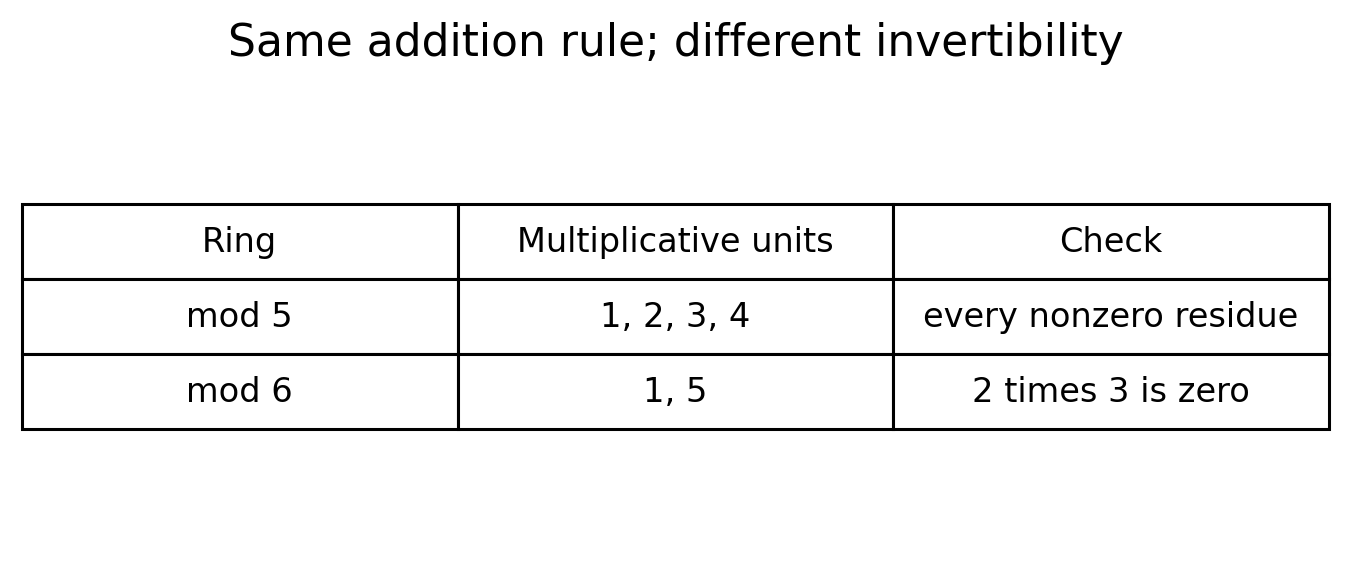
    ทั้งสองชุดเศษส่วนเป็นกลุ่มการบวก: คุณสมบัติปิด การประกอบ และ Identity มาจากการบวกจำนวนเต็ม และ $-a$ เป็นอินเวอร์สการบวก Residue ที่มีการคูณคือ UNIT ก็ต่อเมื่อ GCD กับโมดูลัสเท่ากับหนึ่ง หน่วย modulo ห้าคือ $1,2,3,4$; modulo หกคือ $1,5$ Modulo หก, $2\cdot3=0$ แม้ทั้งสองตัวประกอบจะไม่เป็นศูนย์ เซตที่ไม่ใช่ศูนย์ยังไม่ปิดภายใต้การคูณ Modulo ห้า ทุกเศษส่วนที่ไม่ใช่ศูนย์มีอินเวอร์ซ ดังนั้น Ring นี้ถึงจะเป็นฟิลด์ Ring กลุ่มการบวกและกลุ่มหน่วยเป็นโครงสร้างที่แตกต่างกัน

    4

    การถ่ายโอนแบบอิสระ

    ฟังก์ชันลดรูป $\phi:\mathbb Z\to\mathbb Z/6\mathbb Z$ กำหนดโดย $\phi(n)=[n]$ หา Keinel, Image และ Quotient แก้ $2x\equiv2\pmod6$ อย่างสมบูรณ์ และอธิบายว่าทำไมการตัด 2 mod 6 จึงล้มเหลว

    ตรวจสอบหลังทำแบบฝึกหัดแล้ว

    ฟังก์ชันนี้รักษาการบวกและการคูณ Keinel ของมันคือ $6\mathbb Z$ และ Image คือเศษทั้งหก ตัว Quotient ใช้ระบุจำนวนเต็มที่มีเศษเท่ากัน ดังนั้น $\mathbb Z/\ker\phi\cong\mathbb Z/6\mathbb Z$ ความสมมูลหมายถึง $6\mid2(x-1)$ หรือเทียบเท่ากับ $3\mid x-1$ ดังนั้น $x\equiv1\pmod3$ ให้เศษ $1$ และ $4$ mod หก แทนค่าได้ถูกต้องทั้งคู่ การตัด 2 โดยยังคงโมดูลัสหกจะทำให้สูญเสีย 4; 2 ไม่มีอินเวอร์สการคูณที่นั่น

  • 5

    T.1 · การวิเคราะห์จริงและโทโพโลยี

    5

    Scope and prerequisites

    English

    Undergraduate GRE preparation. Local objectives within the reviewed ETS scope; this is original teaching, not an official test or score predictor.

    Prerequisites: Quantified statements, inequalities, sequences and continuous functions.

    • Apply sequence and function limit definitions
    • Distinguish compactness, connectedness and completeness
    • Use metric-space and elementary topological reasoning

    compact 紧致的: Every open cover has a finite subcover.

    supremum 上确界: The least upper bound of a set.

    คำศัพท์ ฝึกฝน
    English ไทย
    compact/kəmˈpækt/ คอมแพ็กต์
    supremum/suːˈpreməm/ supremum
    5

    Choose and justify a method

    English

    An epsilon–delta statement controls all sufficiently close inputs. The quantifier order matters.

    In real Euclidean space, closed and bounded sets are compact. Do not apply this equivalence to every metric space.

    Continuous images of compact sets are compact, so a real continuous function on a compact domain attains extrema.

    Connectedness rules out a separation into disjoint nonempty open parts. Continuity preserves connectedness; completeness is a separate property.

    5

    Worked reasoning

    English

    f(x)=x on (0,1) is continuous and bounded but never equals its supremum 1. On [0,1], the same function attains its maximum at 1. The missing endpoint explains why the compact-domain theorem does not apply to the first case.

    Real analysis and topology: course example
    Original course illustration; its values belong to the worked example, not the later practice.
    5

    Conditions and counterexamples

    English

    A theorem’s conclusion cannot be used before its hypotheses have been checked.

    5

    Guided application

    English

    Prove continuity of $f(x)=x^2$ at 2 using an explicit epsilon–delta choice. Explain separately why it attains a minimum on $[1,3]$.

    Worked solution

    Given $\epsilon>0$, choose $\delta=\min(1,\epsilon/5)$. If $|x-2|<\delta$, then $1<x<3$, so $|x+2|<5$.

    $$|x^2-4|=|x-2||x+2|<5\delta\le\epsilon.$$
    The choice depends on epsilon, not on the later input x. The interval $[1,3]$ is nonempty and compact in the ordinary real metric. Continuity gives attained extrema. Here $x^2\ge1$, with equality at 1, so the minimum is 1.

    5

    Independent transfer

    English

    In the metric space $X=(0,1)$ with ordinary distance, is X bounded? Is it closed in itself? Is it compact or complete? Explain why “closed and bounded implies compact” cannot be used here.

    Check after attempting

    X is bounded and closed relative to itself, since its complement in X is empty. The Cauchy sequence $1/(n+2)$ has no limit in X, so X is not complete and therefore not compact as a metric space. Directly, the relative open cover $\{(1/n,1):n\ge2\}$ covers X but has no finite subcover. Heine–Borel requires closed and bounded as a subset of Euclidean space, not merely closed in an arbitrary chosen space. X is not closed in $\mathbb R$. No theorem hypothesis may change its ambient space halfway through the argument.

  • 6

    T.2 · คณิตศาสตร์เชิง rời, ความน่าจะเป็น และวิธีการเชิงตัวเลข

    6

    ขอบเขตและเงื่อนไขก่อนเข้าเรียน

    เตรียมสอบ GRE ระดับปริญญาตรี วัตถุประสงค์ภายในขอบเขต ETS ที่ทบทวนนี้คือการสอนต้นฉบับ ไม่ใช่การทดสอบหรือตัวทำนายคะแนนอย่างเป็นทางการ

    ความรู้พื้นฐาน: การนับจำนวนเบื้องต้น, ความน่าจะเป็น, สมการผลรวมซ้ำ และการหาอนุพันธ์

    • ใช้การนับจำนวน, สมการผลรวมซ้ำ, การคิดเกี่ยวกับกราฟ และตรรกะ
    • คำนวณความน่าจะเป็นและคุณสมบัติของการแจกแจง
    • ใช้การประมาณค่าเชิงตัวเลขและประเมินความผิดพลาด

    สมการผลรวมซ้ำ (recurrence): กฎที่เชื่อมพจน์ของลำดับเข้ากับพจน์ก่อนหน้า

    เหตุการณ์ที่ไม่สามารถเกิดขึ้นร่วมกันได้ (mutually exclusive): เหตุการณ์ที่ไม่สามารถเกิดขึ้นพร้อมกันได้

    คำศัพท์ ฝึกฝน
    English ไทย
    recurrence/rɪˈkʌrəns/ recurrences
    mutually exclusive/ˈmjuːtʃuːəli eksˈkluːsɪv/ mutually exclusive
    6

    เลือกใช้วิธีและให้เหตุผลประกอบ

    เลือกโมเดลการนับก่อน: การเลือก r วัตถุที่แตกต่างกันแบบเรียงลำดับใช้ n(n−1)⋯(n−r+1), ส่วนเซตย่อยที่ไม่เรียงลำดับใช้ C(n,r) กราฟง่ายเต็มรูปแบบที่มี n จุดยอดมีหนึ่งเส้นเชื่อมสำหรับคู่จุดยอดที่ไม่เรียงลำดับแต่ละคู่ ซึ่งให้ n(n−1)/2 เส้น;若有 loops หรือ multiple edges จะเปลี่ยนโมเดล สำหรับ n เส้นในตำแหน่งทั่วไปบนระนาบ เส้นที่ k ตัดเส้นก่อนหน้า k−1 เส้นที่จุดที่แตกต่างกันและเพิ่มพื้นที่ใหม่ k พื้นที่ รวมทั้งหมดคือ 1+n(n+1)/2; เส้นขนานหรือสามเส้นตัดกันที่จุดเดียวกันจะทำให้การนับนี้ไม่ถูกต้อง

    ใช้ส่วนเสริมในการนับอย่างน้อยหนึ่งครั้ง และกำหนดเงื่อนไขต่อประชากรที่เหลือจริงหลังจากการสุ่มโดยไม่แทนที่ สำหรับ r ผลลัพธ์ iid ที่เลือกจาก n ค่าที่มีความน่าจะเป็นเท่ากัน ความน่าจะเป็นที่ทั้งหมดจะแตกต่างกันคือ n(n−1)⋯(n−r+1)/n^r เมื่อ r≤n ส่วนเสริมของมันนับผลลัพธ์ที่ซ้ำกัน สำหรับการนับแบบ binomial ที่มี N การทดลองที่เป็นอิสระและโอกาสสำเร็จคงที่ p ค่าเฉลี่ยคือ Np และความแปรปรวนคือ Np(1−p) ความน่าจะเป็นที่เท่ากันเพียงอย่างเดียวไม่足以确立ความเป็นอิสระ

    สมการผลรวมซ้ำอธิบายค่าที่ตามมาจากค่าก่อนหน้าและต้องการข้อมูลเริ่มต้นเพียงพอที่จะกำหนดลำดับ แยกตัวชี้ออกจากค่า: a_n=2a_(n−1) พร้อม a_0=3 ให้ a_n=3·2^n การคิดเกี่ยวกับกราฟและอัลกอริทึมมักใช้เพื่อบ่งชี้ว่าจุดยอดหรือขั้นตอนใหม่เพิ่มอะไรเข้าไป สูตรปิดควรสอดคล้องทั้งกับสมการผลรวมซ้ำและเงื่อนไขเริ่มต้น การจับคู่พจน์ที่สังเกตได้น้อยๆ ไม่ได้พิสูจน์它为ทุกตัวชี้

    การประมาณค่าเชิงตัวเลขต้องใช้ข้อโต้แย้งเรื่องความผิดพลาด Bisection รักษาช่วงที่มีสัญญาณเปลี่ยนสำหรับฟังก์ชันต่อเนื่องและลดครึ่งความกว้างของแต่ละขั้นตอน; อาจไม่มีศูนย์ถ้าความล้มเหลวของความต่อเนื่อง การอัปเดต Newton คือ x_new=x−f(x)/f′(x) ซึ่งต้องการอนุพันธ์ที่ไม่เป็นศูนย์ที่จุดปัจจุบัน; การลู่เข้าไม่เกิดอัตโนมัติจากทุกค่าเริ่มต้น ค่า residual ของการประมาณและความผิดพลาดใน x นั้นต่างกัน ควรระบุสมมติฐานของวิธีการและเกณฑ์หยุดทำงาน แทนที่จะ treating extra displayed decimals ว่าเป็นความแม่นยำ

    6

    ตัวอย่างเหตุผลประกอบ

    สำหรับ f(x)=x²−2 และ x₀=1, ขั้นตอนของนิวตันให้ 1−(1−2)/2=1.5. ค่าถัดไปคือ 1.5−0.25/3=1.4167. ค่าเหล่านี้ประมาณ sqrt(2), แต่ f′(0)=0 ทำให้จุดเริ่มต้นเป็นศูนย์ไม่ถูกต้อง

    คณิตศาสตร์เชิง rời, ความน่าจะเป็น และวิธีการคำนวณเชิงตัวเลข: ตัวอย่างหลักสูตร
    ภาพประกอบจากรายวิชาเดิม; ค่าต่างๆ เป็นของตัวอย่างที่หาคำตอบแล้ว ไม่ใช่แบบฝึกหัดในภายหลัง
    6

    เงื่อนไขและตัวอย่าง反驳

    เหตุการณ์ที่มีความน่าจะเป็นบวกไม่สามารถเป็นอิสระต่อกันและเป็นเหตุขัดแย้งกันได้พร้อมกัน

    6

    การประยุกต์ใช้แบบมีคำแนะนำ

    การสุ่ม 4 ครั้งที่มีฉลากเป็นอิสระต่อกันและมีความน่าจะเป็นเท่ากันจากสัญลักษณ์ 5 ตัว โดยมีการนำกลับมาใช้ใหม่ จงหาความน่าจะเป็นที่จะมีอย่างน้อยสองครั้งที่ได้ค่าเหมือนกัน เปรียบเทียบจำนวนการจัดลำดับและการเลือกแบบไม่เรียงลำดับของสัญลักษณ์ที่แตกต่าง 4 ตัว

    วิธีทำตัวอย่าง

    มี $5^4$ สายการสุ่มที่เป็นไปได้เท่าๆ กัน สายที่ไม่ซ้ำกันมี $5\cdot4\cdot3\cdot2=120$ สาย

    $$P(\text{repeat})=1-\frac{5\cdot4\cdot3\cdot2}{5^4}=\frac{101}{125}.$$
    การเลือกแบบเรียงลำดับที่แตกต่างกันมี 120 แบบ; เซตย่อยแบบไม่เรียงลำดับมี $\binom54=5$ แบบ แต่ละเซตย่อยปรากฏใน $4!=24$ รูปแบบการจัดลำดับ การหารด้วย $4!$ เหมาะสมสำหรับการนับแบบไม่เรียงลำดับเท่านั้น ไม่ใช่ส่วนแบ่งของความน่าจะเป็นจากการสุ่ม

    6

    การถ่ายโอนแบบอิสระ

    ใช้วิธีทอนช่วงเพื่อหาค่า $f(x)=x^3-2$ บน $[1,2]$ ให้ช่วงที่คงไว้สองแรกแรกและขอบเขตของความคลาดเคลื่อนของจุดกึ่งกลางหลังจากทอนช่วงสิบครั้ง ควรใช้วิธีการทอนช่วงสำหรับ $1/x$ บน $[-1,1]$ เพียงแค่จากการเปลี่ยนเครื่องหมายเพียงอย่างเดียวหรือไม่?

    ตรวจสอบหลังทำแบบฝึกหัดแล้ว

    พหุนามนี้เป็นฟังก์ชันต่อเนื่อง; $f(1)<0<f(2)$ จุดกึ่งกลางแรกคือ $1.5$ ซึ่งมีค่าบวก จึงเก็บช่วง $[1,1.5]$ ไว้ จุดถัดไปคือ $1.25$ ซึ่งมีค่าลบ เก็บช่วง $[1.25,1.5]$ ไว้ หลังจากการแบ่งครึ่งสิบครั้ง ความกว้างจะเท่ากับ $2^{-10}$ และจุดกึ่งกลางของช่วงที่คงไว้นั้นจะต่างจากรากในช่วงนั้นไม่เกิน $2^{-11}=1/2048$ ขอบเขตความคลาดเคลื่อนใช้ช่วงนี้ ไม่ใช่ค่าคงค้างเล็กน้อยเพียงอย่างเดียว สำหรับ $1/x$ ค่าศูนย์เป็นจุดเอกฐานและไม่รากใด มีฟังก์ชันต่อเนื่องบนช่วงไม่ได้ เครื่องหมายตรงปลายคู่ขัดแย้งกันไม่อาจใช้วิธีการนี้ได้

  • 7

    T.3 · การวิเคราะห์เชิงซ้อนและเศษส่วน

    7

    Scope and prerequisites

    English

    Undergraduate GRE preparation. Local objectives within the reviewed ETS scope; this is original teaching, not an official test or score predictor.

    Prerequisites: Complex arithmetic, partial derivatives, series and oriented contours.

    • Test complex differentiability
    • Use contour integrals and residues
    • Evaluate contour integrals with simple and higher-order pole residues

    analytic 解析的: Complex differentiable throughout a neighbourhood.

    residue 留数: Coefficient of (z−a)^−1 in a Laurent series.

    คำศัพท์ ฝึกฝน
    English ไทย
    analytic/ˌænəˈlɪtɪk/ analytic
    residue/ˈresɪdjuː/ residue
    7

    Choose and justify a method

    English

    Write f(z)=u(x,y)+iv(x,y). Complex differentiability imposes u_x=v_y and u_y=−v_x; with continuous first partials locally, the Cauchy–Riemann equations establish analyticity there. They differ from real differentiability of a two-coordinate map. The conjugate function x−iy fails these equations on every open neighbourhood, although real partial derivatives exist. State the region being checked, not only a convenient point.

    An analytic function is complex differentiable throughout a neighbourhood and has a local convergent power series. A removable singularity can be filled analytically when the function is bounded near the missing point. A pole has a finite principal part in its Laurent series; an essential singularity has infinitely many negative-power terms. The residue is the coefficient of (z−a)⁻¹, not necessarily the leading or largest negative-power term.

    For an isolated pole of order m, write f(z)=g(z)/(z−a)^m with g analytic at a. The residue is g^(m−1)(a)/(m−1)!. A simple pole uses g(a); a double pole uses g′(a). This follows by expanding g into its Taylor series. Thus e^z/(z−a)² has residue e^a, while a constant numerator over a pure double pole has zero residue. The pole order alone does not determine the contour integral.

    For a positively oriented contour enclosing isolated singularities, the residue theorem gives ∮f(z)dz=2πi times the sum of enclosed residues, provided the function is analytic on the contour and elsewhere in the required interior. Reversing orientation changes the sign. Cauchy’s derivative formula is ∮g(z)/(z−a)^(m+1)dz=2πi g^(m)(a)/m! under its analytic-domain hypotheses. A singularity on the contour prevents direct application; a singularity outside contributes nothing to this contour.

    7

    Worked reasoning

    English

    For f(z)=conjugate(z), u=x and v=−y. Then u_x=1 but v_y=−1, so f is not complex differentiable. For 1/(z−2), a positively oriented circle |z−2|=1 encloses a simple pole of residue 1, hence the integral is 2πi.

    Complex analysis and residues: course example
    Original course illustration; its values belong to the worked example, not the later practice.
    7

    Conditions and counterexamples

    English

    Continuity or real differentiability alone does not imply complex analyticity.

    7

    Guided application

    English

    Use the Cauchy–Riemann equations to compare $z^2$ and $\overline z$. Find the residue of $e^z/z^2$ at zero and its integral around the counterclockwise unit circle.

    Worked solution

    For $z^2$, $u=x^2-y^2$ and $v=2xy$: $u_x=2x=v_y$ and $u_y=-2y=-v_x$. The partials are continuous everywhere, so the function is analytic everywhere. For $\overline z$, $u=x,v=-y$ and $u_x=1\ne-1=v_y$; it is nowhere complex differentiable. Since $e^z=1+z+z^2/2+\cdots$, the coefficient of $z^{-1}$ in $e^z/z^2$ is 1. Therefore the residue is 1 and the integral is $2\pi i$. The double pole does not force a zero residue.

    7

    Independent transfer

    English

    Integrate $1/[z(z-2)]$ around $|z|=1$, first counterclockwise and then clockwise. Can the same residue-theorem argument be used on $|z|=2$?

    Check after attempting

    Only zero is inside the unit circle. Its residue is $\lim_{z\to0}1/(z-2)=-1/2$. Thus the counterclockwise integral is $-\pi i$ and the clockwise integral is $\pi i$. The pole at 2 is outside and contributes nothing. The circle $|z|=2$ passes through a pole. The ordinary contour integral is not defined by this formula; the theorem requires analyticity on the contour. An indentation or principal-value prescription would be a different, explicitly specified problem.

  • 8

    C.3 · สมการเชิงอนุพันธ์และเงื่อนไขเริ่มต้น

    8

    ขอบเขตและเงื่อนไขก่อนเข้าเรียน

    เตรียมสอบ GRE ระดับปริญญาตรี วัตถุประสงค์ภายในขอบเขต ETS ที่ทบทวนนี้คือการสอนต้นฉบับ ไม่ใช่การทดสอบหรือตัวทำนายคะแนนอย่างเป็นทางการ

    ความรู้ก่อนหน้า: การหาอนุพันธ์, การอินทิเกรต, ฟังก์ชันเอ็กซ์โพเนนเชียล และสมการกำลังสอง

    • แก้สมการอันดับหนึ่งแบบแยกตัวแปรได้
    • แก้สมการอันดับสองสัมประสิทธิ์คงที่
    • ใช้เงื่อนไขเริ่มต้นและเงื่อนไขความไม่ซ้ำกัน

    เงื่อนไขเริ่มต้น: ค่าของคำตอบหรืออนุพันธ์ที่กำหนดไว้ที่จุดเริ่มต้น

    รากเฉพาะ: รากของพหุนามที่กำหนดรูปแบบคำตอบเอ็กซ์โพเนนเชียล

    คำศัพท์ ฝึกฝน
    English ไทย
    initial condition/ɪˈnɪʃl kənˈdɪʃn/ initial condition
    characteristic root/ˌkærɪktəˈrɪstɪk ruːt/ characteristic root
    8

    เลือกใช้วิธีและให้เหตุผลประกอบ

    สำหรับ y′=ky การแยกตัวแปรและการอินทิเกรตจะได้ y=Ce^(kt); ฟื้นฟูคำตอบศูนย์หากมีการหารด้วย y ค่าเริ่มต้นจะกำหนด C

    สมการอันดับสองเชิงเส้นสัมประสิทธิ์คงที่ใช้พหุนามเฉพาะ รากที่แตกต่างกันให้ผลลัพธ์เป็นเอ็กซ์โพเนนเชียล; รากซ้ำต้องใช้ (C1+C2t)e^(rt)

    รากเชิงซ้อน α±iβ ให้ e^(αt)(C1 cos βt+C2 sin βt). การเคลื่อนที่จริงประกอบด้วยข้อมูลทั้งแอมพลิจูดและเฟส

    การมีอยู่และความไม่ซ้ำกันขึ้นอยู่กับสมมติฐานใกล้จุดเริ่มต้น สัมประสิทธิ์เอกฐานหรือความล้มเหลวของพฤติกรรม Lipschitz局部สามารถทำให้ข้อสรุปความไม่ซ้ำกันที่เป็นที่รู้จักล้มเหลวได้

    8

    ตัวอย่างเหตุผลประกอบ

    แก้ y″+4y=0 โดยมี y(0)=3 และ y′(0)=4 รากของพหุนามลักษณะเฉพาะคือ ±2i ดังนั้น y=A cos2t+B sin2t เงื่อนไขแรกให้ A=3; การหาอนุพันธ์จะได้ y′(0)=2B=4 ดังนั้น B=2

    สมการต่างและเงื่อนไขเริ่มต้น: ตัวอย่างหลักสูตร
    ภาพประกอบจากรายวิชาเดิม; ค่าต่างๆ เป็นของตัวอย่างที่หาคำตอบแล้ว ไม่ใช่แบบฝึกหัดในภายหลัง
    8

    เงื่อนไขและตัวอย่าง反驳

    รากลักษณะซ้ำต้องการตัวประกอบ t; รากเลขยกกำลังเดียวกันสองตัวไม่ใช่คำตอบที่เป็นอิสระ.

    8

    การประยุกต์ใช้แบบมีคำแนะนำ

    แก้ $y''-4y'+4y=0$ ด้วย $y(0)=1$, $y'(0)=0$. ตรวจสอบทั้งสองเงื่อนไขเริ่มต้นและสมการ

    วิธีทำตัวอย่าง

    พหุนามเฉพาะคือ $(r-2)^2$. คำตอบอิสระคือ $e^{2t}$ และ $te^{2t}$, ดังนั้น $y=(C_1+C_2t)e^{2t}$. ค่าเริ่มต้นให้ $C_1=1$; อนุพันธ์ที่ศูนย์ให้ $2C_1+C_2=0$, ดังนั้น $C_2=-2$

    $$y(t)=(1-2t)e^{2t},\quad y'(t)=-4te^{2t},\quad y''(t)=(-4-8t)e^{2t}.$$
    การแทนค่าจะได้ $y''-4y'+4y=0$, และค่าเริ่มต้นทั้งสองเป็นจริง. สองสำเนาของ $e^{2t}$ จะไม่ครอบคลุมพื้นที่คำตอบ

    8

    การถ่ายโอนแบบอิสระ

    แสดงว่าปัญหาค่าเริ่มต้น $y'=2\sqrt{|y|}$, $y(0)=0$ มีคำตอบมากกว่าหนึ่งสำหรับ $t\ge0$. ระบุสมมติฐานความไม่ซ้ำกันมาตรฐานที่หายไป

    ตรวจสอบหลังทำแบบฝึกหัดแล้ว

    คำตอบหนึ่งคือศูนย์โดยนัย สำหรับ $a\ge0$ ใด ๆ ตั้งค่า $y_a(t)=0$ สำหรับ $0\le t\le a$ และ $y_a(t)=(t-a)^2$ สำหรับ $t>a$. ลาดับของฟังก์ชันเป็นศูนย์บนช่วงแรกและ $2(t-a)$ บนช่วงที่สอง; ทั้งสองฝั่งมีลาดับเป็นศูนย์ที่ a ดังนั้น $y_a$ จึงสามารถหาอนุพันธ์ได้ และเป็นไปตามสมการและเงื่อนไขเริ่มต้น ฝั่งขวาต่อเนื่องแต่ไม่เป็น Lipschitz ท้องถิ่นใน y ที่จุดศูนย์: $|2\sqrt h-0|/|h|=2/\sqrt h$ มีค่าไม่จำกัดจำนวน การมีอยู่ไม่บ่งบอกถึงความเดียว และหารด้วย $\sqrt y$ จะทำให้สูญเสียคำตอบที่เกี่ยวข้องกับเวลา

  • 9

    A.3 · กลุ่ม เซตผลคูณและฟังก์ชันผลquotient

    9

    Scope and prerequisites

    English

    Undergraduate GRE preparation. Local objectives within the reviewed ETS scope; this is original teaching, not an official test or score predictor.

    Prerequisites: Group axioms, functions, integer divisibility and permutations.

    • Verify group structure and compute element orders and subgroup indices
    • Use kernels and images to identify quotient groups
    • Distinguish normal subgroups from arbitrary subgroups
    • Classify permutation conjugacy by cycle type

    coset 陪集: A translate of a subgroup that forms one part of the coset partition.

    normal subgroup 正规子群: A subgroup invariant under conjugation by every group element.

    คำศัพท์ ฝึกฝน
    English ไทย
    coset/ˈkɒset/ coset
    normal subgroup/ˈnɔːml ˈsʌbɡruːp/ normal subgroup
    9

    Choose and justify a method

    English

    Before computing an order, check closure, associativity, an identity and an inverse for every element under the stated operation. A subset can inherit associativity yet fail closure or omit the identity. In a finite group, the order of an element is the least positive power giving the identity. In the additive group Z/nZ, it is the least positive multiple giving zero; the order of residue a is n/gcd(a,n). Lagrange's theorem says subgroup orders divide the group order. The converse is not a general existence theorem, and the order of a group is not the order of each element.

    A left coset gH is a translate of a subgroup H. Cosets have equal size and partition the group, so the index is |G|/|H| in a finite group. In an additive group write g+H. Membership in the same coset means the difference lies in H. A coset usually is not itself a subgroup because it may omit the identity.

    A homomorphism preserves the operation. Its kernel consists of elements sent to the identity, and its image consists of values actually reached. Every kernel is normal. The first isomorphism theorem identifies G/ker(phi) with im(phi); do not replace the image with the whole codomain unless the map is onto.

    Quotient multiplication is well defined only when H is normal. All subgroups of an abelian group are normal. In a nonabelian group test gHg^−1=H; a subgroup of index two is normal. For permutations compose in the stated convention, here rightmost first. Disjoint cycle lengths give the permutation order by their least common multiple. Conjugation hσh⁻¹ relabels the elements in σ’s cycles, so it preserves cycle lengths; conversely permutations with the same cycle lengths can be related by a relabelling. Thus conjugacy classes in S_n correspond to partitions of n, including fixed-point cycles. In S4 the types are 1+1+1+1, 2+1+1, 2+2, 3+1 and 4: five classes, not one class for each possible element order. The types 2+1+1 and 2+2 both have order two but are not conjugate.

    9

    Worked reasoning

    English

    Define phi from Z/12Z to Z/3Z by reducing residues modulo 3. It is onto and preserves addition. Its kernel H is {0,3,6,9}, so |H|=4 and the index is 12/4=3. The other cosets are {1,4,7,10} and {2,5,8,11}. Thus (Z/12Z)/H is isomorphic to Z/3Z. The element 3 in the original group has order 12/gcd(3,12)=4, not 3.

    Groups, cosets and quotient maps: course example
    Original course illustration; its values belong to the worked example, not the later practice.
    9

    Conditions and counterexamples

    English

    A quotient has one element per coset, not one per element of its kernel. A homomorphism need not be onto its stated codomain.

    9

    Guided application

    English

    In the additive group $\mathbb Z/18\mathbb Z$, let $H=\langle6\rangle$. List H and its cosets. Determine the order of 6 and identify the quotient.

    Worked solution

    $H=\{0,6,12\}$ has size three. The six cosets are $r+H=\{r,r+6,r+12\}$ for $r=0,1,2,3,4,5$. They partition all 18 residues. The element 6 has order three, while the quotient has order six. Reduction modulo six is onto with kernel H, so $(\mathbb Z/18\mathbb Z)/H\cong\mathbb Z/6\mathbb Z$. Normality holds because the original group is abelian.

    9

    Independent transfer

    English

    In $S_3$, let $H=\{e,(12)\}$. Check whether $H$ is normal, and decide whether coset multiplication defines a quotient group. Separately find the order of $(123)(45)$ in $S_5$.

    Check after attempting

    Conjugation by $(123)$ sends $(12)$ to $(23)$, which is outside H. Thus H is not normal. Left cosets still partition $S_3$, but multiplication of those cosets is not well defined independently of representatives. The disjoint cycles in $(123)(45)$ have lengths three and two, so its order is $\operatorname{lcm}(3,2)=6$. Element order and subgroup index are different quantities.

  • 10

    A.4 · วงแหวน อุดมการณ์ และโมดูล

    10

    Scope and prerequisites

    English

    Undergraduate GRE preparation. Local objectives within the reviewed ETS scope; this is original teaching, not an official test or score predictor.

    Prerequisites: Rings, fields, additive subgroups and homomorphisms.

    • Distinguish units, zero divisors and integral domains
    • Identify ideals and interpret quotient rings
    • Compare modules over rings with vector spaces over fields
    • Derive Boolean-ring properties without assuming commutativity

    ideal 理想: An additive subgroup of a ring absorbing multiplication by all ring elements.

    torsion 挠性: An element is annihilated by a nonzero scalar in the stated module.

    คำศัพท์ ฝึกฝน
    English ไทย
    ideal/aɪˈdɪəl/ ideal
    torsion/ˈtɔːʃn/ torsion
    10

    Choose and justify a method

    English

    For the domain, ideal and quotient examples below, use a commutative ring with identity 1 distinct from 0. A source problem may specify a general ring instead; do not assume its multiplication commutes unless stated or proved. A unit has a multiplicative inverse. A nonzero zero divisor multiplies some nonzero element to zero. An integral domain has no such zero divisors; cancellation of a nonzero factor then works. A field is a domain in which every nonzero element is a unit. Z is a domain but not a field; Z/6Z is neither.

    An ideal I is an additive subgroup that absorbs multiplication by every ring element. This is stronger than being a subring. In Z, nZ is an ideal; quotient elements are integer residue classes modulo n. In a commutative ring, R/I is a field exactly when I is maximal, and it is a domain exactly when I is prime. The ideal must be proper in both statements.

    A module allows scalars from a ring instead of requiring a field. Every abelian group is a Z-module by repeated addition, but it need not have a vector-space basis. In Z/6Z as a Z-module, 6 times the nonzero residue 1 is zero; this is torsion. For a vector space over a field, a nonzero scalar is invertible and cannot annihilate a nonzero vector.

    A submodule is closed under addition and all permitted scalar actions. A linear map of modules preserves both. The kernel and image are submodules, and the quotient by the kernel is isomorphic to the image. Do not apply finite-dimensional rank-nullity to an arbitrary module without establishing an appropriate free-module setting; integer row operations and field row operations permit different divisions. In a general Boolean ring, every a satisfies a²=a. Do not assume commutativity to prove it: idempotence of a+a gives 4a=2a, hence 2a=0. Expanding (a+b)²=a+b gives ab+ba=0, and characteristic two makes −ba=ba; therefore ab=ba. Idempotence does not imply nilpotence: in F2, the nonzero element 1 satisfies 1^n=1 for every positive n.

    10

    Worked reasoning

    English

    In Z/6Z, 2·3=0, so 2 and 3 are zero divisors. The units are 1 and 5 because their gcd with 6 is 1. In Z, the ideal 5Z gives the field Z/5Z, while 6Z gives a quotient with zero divisors. As Z-modules, the map from Z to Z/6Z has kernel 6Z; the quotient identifies integers differing by a multiple of 6, rather than producing a real vector space.

    Rings, ideals and modules: course example
    Original course illustration; its values belong to the worked example, not the later practice.
    10

    Conditions and counterexamples

    English

    A set can be a submodule without being a vector space over the rationals. Scalar division is valid only when the scalar inverse belongs to the structure.

    10

    Guided application

    English

    In $\mathbb Z/12\mathbb Z$, list the units and nonzero zero divisors. Is the ideal $(4)$ prime or maximal?

    Worked solution

    Units are the residues coprime to 12: $1,5,7,11$. The remaining nonzero residues $2,3,4,6,8,9,10$ are zero divisors. For each such a, $a\cdot(12/\gcd(a,12))=0$ modulo 12, with the second factor nonzero. The ideal $(4)=\{0,4,8\}$ gives quotient isomorphic to $\mathbb Z/4\mathbb Z$. This is not a domain, since $2\cdot2=0$, and is not a field. Hence the ideal is neither prime nor maximal.

    10

    Independent transfer

    English

    As a $\mathbb Z$-module, can $\mathbb Z/6\mathbb Z$ be free? Compare the ideals $(2)$ and $(x)$ in $\mathbb Z$ and $\mathbb Q[x]$, respectively, using their quotients.

    Check after attempting

    A nonzero free $\mathbb Z$-module has no nonzero vector annihilated by a nonzero integer: examine each integer coordinate. But $6[1]=0$ in $\mathbb Z/6\mathbb Z$. It is not free; a field-style basis argument is invalid. $\mathbb Z/(2)\cong\mathbb F_2$ is a field, so $(2)$ is maximal and prime. Evaluation at zero maps $\mathbb Q[x]$ onto $\mathbb Q$ with kernel $(x)$; its quotient is a field too. Both arguments use proper ideals in commutative rings with identity.

  • 11

    A.5 · พหุนาม และการขยายของสนาม

    11

    Scope and prerequisites

    English

    Undergraduate GRE preparation. Local objectives within the reviewed ETS scope; this is original teaching, not an official test or score predictor.

    Prerequisites: Polynomial division, fields and vector-space dimension.

    • Test polynomial irreducibility over the specified field
    • Construct small finite fields from irreducible polynomials
    • Use extension degrees and the tower law
    • Use cyclotomic roots and coefficient relations to compute sums and products

    irreducible polynomial 不可约多项式: A positive-degree polynomial with no factorisation into smaller positive degrees over the stated field.

    extension degree 扩张次数: The dimension of an extension field as a vector space over its base field.

    คำศัพท์ ฝึกฝน
    English ไทย
    irreducible polynomial/ɪrɪˈdjuːsɪbl ˌpɒlɪˈnəʊmɪəl/ irreducible polynomial
    extension degree/ekˈstenʃn dɪˈɡriː/ extension degree
    11

    Choose and justify a method

    English

    A polynomial is irreducible over a field if it has positive degree and no factorisation into polynomials of smaller positive degrees there. A quadratic or cubic is irreducible exactly when it has no root in that field. This root test alone fails for degree four or higher; for instance (x²+1)(x²+2) has no real root but is reducible over R. Always name the base field.

    The quotient F[x]/(p) is a field when p is irreducible. Reduce powers using p(alpha)=0, where alpha is the residue class of x. If F has q elements and p has degree d, the quotient has q^d elements represented by polynomials of degree below d. Z/4Z has four elements but has zero divisors, so it is not the field with four elements.

    Over F2, p(x)=x²+x+1 has values 1 at both 0 and 1 and is irreducible. In its quotient alpha²=alpha+1 because subtraction equals addition in characteristic two. The four elements are 0,1,alpha,alpha+1. All three nonzero elements must be units; compute their products rather than treating alpha as an ordinary real number.

    For nested finite-degree fields K inside L inside M, the tower law gives [M:K]=[M:L][L:K]. The degree of an algebraic element is the degree of its minimal polynomial. A finite extension of degree two does not contain an element of degree three over the base field. Over Q, sqrt(2) has degree two; adjoining sqrt(3) as well produces a degree-four extension, since sqrt(3) is not in Q(sqrt(2)). Over C, primitive nth roots of unity have exact order n and are the roots of the cyclotomic polynomial Φ_n. For n=10, divide x⁵+1 by x+1 to exclude the order-two root −1: Φ_10=x⁴−x³+x²−x+1. Vieta’s formulas give sum 1 and product 1 of its four primitive roots. Do not sum all tenth roots, or assume every nontrivial tenth root is primitive; a root’s order must be checked. For a monic degree d polynomial, product of its roots is (−1)^d times the constant coefficient.

    11

    Worked reasoning

    English

    In F2[alpha] with alpha²+alpha+1=0, multiply alpha(alpha+1) = alpha² + alpha = (alpha+1) + alpha = 1. Thus alpha^−1=alpha+1. Also alpha³=1 and alpha is not 1, so its multiplicative order is 3. This produces a field of four elements. By contrast 2·2=0 in Z/4Z, proving that quotient is not a field.

    Polynomials and field extensions: course example
    Original course illustration; its values belong to the worked example, not the later practice.
    11

    Conditions and counterexamples

    English

    Polynomial reducibility changes with the coefficient field. The polynomial x²−2 is irreducible over Q but splits over R.

    11

    Guided application

    English

    Construct $\mathbb F_2[x]/(x^2+x+1)$. List its elements and find the inverse of the residue $\alpha=[x]$.

    Worked solution

    The quadratic takes value one at both elements of $\mathbb F_2$, so it has no root and is irreducible. Its quotient is a field. Division leaves a representative of degree below two: $0,1,\alpha,1+\alpha$. The relation is $\alpha^2=\alpha+1$ in characteristic two. Consequently $\alpha(\alpha+1)=\alpha^2+\alpha=1$, so $\alpha^{-1}=\alpha+1$. This is not $\mathbb Z/4\mathbb Z$, which has a nonzero zero divisor.

    11

    Independent transfer

    English

    Is $x^4+4$ irreducible over $\mathbb Q$? Does the absence of rational roots answer that question? Can a degree-two extension of $\mathbb Q$ contain a root of an irreducible cubic over $\mathbb Q$?

    Check after attempting

    Direct multiplication gives $x^4+4=(x^2-2x+2)(x^2+2x+2)$, so it is reducible over $\mathbb Q$ despite having no real, hence no rational, roots. The no-root test characterises irreducibility only for degree two or three over a field. If an irreducible cubic root $\beta$ belonged to a degree-two extension L, then $\mathbb Q\subset\mathbb Q(\beta)\subset L$ and the tower law would make 3 divide 2. This is impossible. The conclusion uses irreducibility, not merely a cubic equation.

  • 12

    A.6 · ความเทียบเท่า Modular การหารเหลือ และฟังก์ชันทางเลขคณิต

    12

    Scope and prerequisites

    English

    Undergraduate GRE preparation. Local objectives within the reviewed ETS scope; this is original teaching, not an official test or score predictor.

    Prerequisites: Euclidean algorithm, prime factors and modular arithmetic.

    • Solve linear congruences using gcd conditions
    • Combine coprime congruences with the Chinese remainder theorem
    • Apply Euler's theorem only to invertible residues
    • Use prime-exponent divisibility to find least admissible integers

    congruence 同余: Equality of residues because the modulus divides their difference.

    totient 欧拉函数: The count of residues coprime to the positive integer modulus.

    คำศัพท์ ฝึกฝน
    English ไทย
    congruence/ˈkɒŋɡruːəns/ congruence
    totient/ˈtəʊʃənt/ totient
    12

    Choose and justify a method

    English

    The equation ax≡b modulo n has a solution exactly when d=gcd(a,n) divides b. If it does, divide a,b,n by d to obtain an equation with an invertible coefficient. It has one residue solution modulo n/d and d distinct solutions modulo n. Dividing the coefficient but leaving the original modulus generally loses solutions. Prime factorisation gives another divisibility tool: if n^k must be divisible by a product of prime powers p^a, each prime exponent in n must be at least ceil(a/k). These minimum exponents independently produce the least positive admissible n. For n⁴ divisible by 2⁷·3⁵, n must contain 2² and 3², so the least value is 36. This is a prime-exponent condition, not a congruence solved by modular division.

    The extended Euclidean algorithm expresses gcd(a,n) as ua+vn. When the gcd is 1, u is an inverse of a modulo n. Choose a representative in the required range after reduction. For 7 and 26, 1=15·7−4·26, so 15 is the inverse of 7 modulo 26; verify the product to catch a sign error.

    For coprime positive moduli m,n, the Chinese remainder theorem gives exactly one solution modulo mn for each pair of residue conditions. Substitute x=r+mk into the second congruence and solve for k. If the moduli are not coprime, their residue values must agree modulo gcd(m,n); when consistent, uniqueness is modulo the least common multiple, not the product.

    Euler's totient phi(n) counts residues coprime to n. For distinct prime divisors p, phi(n)=n times the product of (1−1/p). Euler's theorem gives a^phi(n)≡1 only when gcd(a,n)=1. The prime case is Fermat's little theorem. Reduce exponents only after checking this condition; a nonunit can become zero under repeated powers instead.

    12

    Worked reasoning

    English

    Solve 6x≡9 modulo 15. The gcd is 3 and divides 9. Divide all three quantities to get 2x≡3 modulo 5; the inverse of 2 is 3, so x≡9≡4 modulo 5. The original solutions modulo 15 are 4,9,14. For x≡2 modulo 4 and x≡3 modulo 7, write x=2+4k; then 4k≡1 modulo 7, giving k≡2. Hence x≡10 modulo 28.

    Congruences, divisibility and arithmetic functions: course example
    Original course illustration; its values belong to the worked example, not the later practice.
    12

    Conditions and counterexamples

    English

    The expression a^phi(n)≡1 is false for arbitrary a. For example 2 is not invertible modulo 8 and 2^4 is zero modulo 8.

    12

    Guided application

    English

    Solve $8x\equiv12\pmod{20}$ completely. Find an inverse of 7 modulo 20. Explain why Euler's theorem cannot be used to replace $2^8$ by 1 modulo 20.

    Worked solution

    The gcd is four and divides 12. Dividing all three numbers gives $2x\equiv3\pmod5$, so $x\equiv4\pmod5$. Modulo 20 the four answers are $4,9,14,19$; substitution gives remainder 12 each time. Since $7\cdot3=21$, the inverse of 7 is 3. Although $\phi(20)=8$, Euler's theorem requires a unit. The gcd of 2 and 20 is two, and $2^8=256\equiv16$, not 1.

    12

    Independent transfer

    English

    Solve $x\equiv2\pmod6$, $x\equiv5\pmod9$, or prove inconsistency. State the modulus for uniqueness. Find the least positive n such that $2^5\cdot3^7$ divides $n^3$.

    Check after attempting

    The residues agree modulo the gcd three. Put $x=2+6k$: then $6k\equiv3\pmod9$, hence $2k\equiv1\pmod3$ and $k\equiv2\pmod3$. Thus $x\equiv14\pmod{18}$. The modulus is the lcm, not 54. For the divisibility problem, write prime exponents in n. They must satisfy $3a\ge5$, $3b\ge7$, so $a\ge2$, $b\ge3$. The least n is $2^2\cdot3^3=108$; other prime factors can only increase it.

  • 13

    T.4 · ลำดับอนุกรม และการลู่เข้าแบบสม่ำเสมอ

    13

    ขอบเขตและเงื่อนไขก่อนเข้าเรียน

    เตรียมสอบ GRE ระดับปริญญาตรี วัตถุประสงค์ภายในขอบเขต ETS ที่ทบทวนนี้คือการสอนต้นฉบับ ไม่ใช่การทดสอบหรือตัวทำนายคะแนนอย่างเป็นทางการ

    ความรู้ก่อนหน้า: ขอบเขตของลำดับ, supremum, ความต่อเนื่อง และอนุกรมจำนวนจริง

    • ใช้เกณฑ์ของ Cauchy, การลู่เข้าแบบ monotonous และ subsequence
    • แยกแยะการลู่เข้าแบบ pointwise จาก uniform convergence ของฟังก์ชัน
    • ตรวจสอบสมมติฐานก่อนสลับลำดับ limit และการอินทิเกรต

    Cauchy sequence: ลำดับwhose พจน์ในภายหลังมากพอจะใกล้กันได้อย่างอิสระตามต้องการ

    uniform convergence: การลู่เข้าที่มีเกณฑ์ความคลาดเคลื่อน N เดียวที่ใช้งานได้ทุกจุดของโดเมน

    คำศัพท์ ฝึกฝน
    English ไทย
    Cauchy sequence/ˈkɔːtʃi ˈsiːkwəns/ Cauchy sequence
    uniform convergence/ˈjuːnɪfɔːm kənˈvɜːdʒəns/ uniform convergence
    13

    เลือกใช้วิธีและให้เหตุผลประกอบ

    ลำดับจำนวนจริงที่ลู่เข้าจะเป็น Cauchy และทุก Cauchy sequence ของจำนวนจริงจะลู่เข้าเนื่องจาก R เป็น complete ใน Q Cauchy sequence สามารถเข้าใกล้จำนวน irrational และล้มเหลวที่จะลู่เข้าภายใน Q ลำดับ monotonous ที่มีขอบเขตของจำนวนจริงจะลู่เข้า ลำดับที่มีขอบเขตอาจไม่ลู่เข้า แต่ Bolzano–Weierstrass รับรองว่ามี subsequence ที่ลู่เข้า; (-1)^n มี subsequential limits ที่แตกต่างกันสองค่า

    สำหรับอนุกรมจำนวนจริง绝对 convergence ชี้ให้เห็นถึง convergence; conditional convergence ไม่อนุญาตให้จัดเรียงใหม่อย่างอิสระโดยไม่ส่งผลต่อผลรวม อนุกรม Harmonic สลับสัญญาณลู่เข้าแต่ series ค่าสัมบูรณ์ของมันลู่เข้าไม่ได้นี้ ใน ratio test, limit ต่ำกว่า 1 ยืนยัน absolute convergence และสูงกว่า 1 ยืนยันการลู่เข้า; limit เท่ากับ 1 ไม่สามารถตัดสินได้正如 sum 1/n และ sum 1/n² แสดงให้เห็น

    การลู่เข้าแบบ pointwise เลือกดัชนี N แยกต่างหากสำหรับแต่ละ x และความคลาดเคลื่อน การลู่เข้าแบบ uniform เลือก N เดียวที่ใช้ได้สำหรับทุก x ในโดเมน สำหรับฟังก์ชันที่มีค่าเป็นจำนวนจริง ตรวจสอบ supremum ของ |f_n−f| ทั้งโดเมน Limit แบบ pointwise ที่ต่อเนื่องไม่ได้ยืนยัน uniform convergence โดยตัวเอง จุดปลายโดเมนและยอดแหลมที่หดตัวมักแยกแยะแนวคิดทั้งสอง

    Limit แบบ uniform ของฟังก์ชันต่อเนื่องจะเป็นต่อเนื่อง บนช่วงปิดจำกัด uniform convergence ของ Riemann-integrable functions อนุญาตให้สลับ limit และการอินทิเกรต การสับ derivative ต้องการสมมติฐานเพิ่มเติม; uniform convergence ของฟังก์ชันเพียงอย่างเดียวไม่เพียงพอ Weierstrass M-test สร้าง uniform absolute convergence ของอนุกรมฟังก์ชันหากแต่ละพจน์ถูกจำกัดโดย M_n ทั้งโดเมนและ sum M_n ลู่เข้า

    13

    ตัวอย่างเหตุผลประกอบ

    บน [0,1], f_n(x)=x^n ลิมิตไป 0 สำหรับ x<1 และไป 1 ที่ x=1. ลิมิตไม่ต่อเนื่อง, ดังนั้นการลิมิตจึงไม่สามารถเป็น uniform; โดยตรง, supremum error คือ 1, เข้าใกล้จากด้านล่าง 1. บน [0,a] với 0≤a<1, ลิมิตเป็นศูนย์และ supremum คือ a^n, ซึ่งลิมิตไปเป็นศูนย์, ดังนั้นการลิมิตจึงเป็น uniform. เปลี่ยนโดเมนเปลี่ยนข้อสรุป

    Sequences, series and uniform convergence: ตัวอย่างรายวิชา
    ภาพประกอบจากรายวิชาเดิม; ค่าต่างๆ เป็นของตัวอย่างที่หาคำตอบแล้ว ไม่ใช่แบบฝึกหัดในภายหลัง
    13

    เงื่อนไขและตัวอย่าง反驳

    การตรวจสอบหลายค่า x ที่คงที่พิสูจน์ไม่ได้ supremum bound หรือ uniform convergence. จุดที่สร้าง error มากที่สุดอาจเคลื่อนที่ตาม n

    13

    การประยุกต์ใช้แบบมีคำแนะนำ

    กำหนดการลู่เข้าแบบ pointwise และ uniform ของ $f_n(x)=x^n$ บน $[0,1]$ และบน $[0,a]$ สำหรับ $0<a<1$ ที่คงที่ เปรียบเทียบ $\sum1/n^2$ กับอนุกรม Harmonic สลับสัญญาณสำหรับการ absolute convergence

    วิธีทำตัวอย่าง

    ที่ $[0,1]$ ลิมิตมีค่าเป็นศูนย์สำหรับ $x<1$ และมีค่าหนึ่งเมื่อ 1 ลิมิตนี้ไม่ต่อเนื่อง ดังนั้น $f_n$ ที่ต่อเนื่องจึงไม่สามารถลู่เข้าแบบสม่ำเสมอได้ โดยตรงกว่านั้น ค่าความผิดพลาดสูงสุดบน $[0,1)$ คือหนึ่ง ที่ $[0,a]$ ค่าสูงสุดคือ $a^n\to0$ ดังนั้นการลู่เข้าจึงเป็นแบบสม่ำเสมอสู่ศูนย์อนุกรม p ที่มี p=2 ลู่เข้าอย่างสัมบูรณ์อนุกรมฮาร์โมนิกสลับสัญญาณลู่เข้าตามเงื่อนไขพจน์ที่ลดลงซึ่งมีลิมิตเป็นศูนย์ แต่อนุกรมสัมบูรณ์ลู่เข้าไม่อยู่ การลู่เข้าของอนุกรมนี้จึงเป็นการลู่เข้าแบบ有条件

    13

    การถ่ายโอนแบบอิสระ

    ให้ $g_n(x)=\sin(nx)/n$ บน $\mathbb R$ การลู่เข้านี้เป็นแบบสม่ำเสมอหรือไม่? อนุพันธ์ของมันอาจลู่เข้าสู่อนุพันธ์ของลิมิตได้หรือไม่ ใช้จุดเฉพาะเพื่อตัดสินใจ

    ตรวจสอบหลังทำแบบฝึกหัดแล้ว

    $\sup_{x\in\mathbb R}|g_n(x)|=1/n\to0$ ดังนั้นฟังก์ชันเหล่านี้ลู่เข้าแบบสม่ำเสมอสู่ศูนย์ แต่ $g_n'(x)=\cos(nx)$ และที่ $x=0$ อนุพันธ์เหล่านี้มีค่าทั้งหมดเป็น 1 อนุพันธ์ของลิมิตศูนย์คือ 0 ดังนั้นการลู่เข้าแบบสม่ำเสมอของฟังก์ชันเพียงอย่างเดียวจึงไม่เพียงพอต่อการหาอนุพันธ์ของลิมิต ต้องมีสมมติฐานเพิ่มเติมเกี่ยวกับการลู่เข้าของอนุพันธ์

  • 14

    T.5 · เซตเปิด ความหนาแน่น และการเชื่อมโยง

    14

    ขอบเขตและเงื่อนไขก่อนเข้าเรียน

    เตรียมสอบ GRE ระดับปริญญาตรี วัตถุประสงค์ภายในขอบเขต ETS ที่ทบทวนนี้คือการสอนต้นฉบับ ไม่ใช่การทดสอบหรือตัวทำนายคะแนนอย่างเป็นทางการ

    ความรู้พื้นฐาน: เซต, เซตเปิดสัมพัทธ์, ฟังก์ชันต่อเนื่องและลำดับ

    • คำนวณปิด, ภายในและขอบเขตในสเปซที่กำหนดให้
    • ใช้ความหนาแน่นและการเชื่อมโยงกับภาพต่อเนื่อง
    • แยกแยะโทโพโลยีสัมพัทธ์จากโทโพโลยียูคลิด.metrics

    โทโพโลยีสัมพัทธ์: เซตเปิดที่ยึดติดมาจากการตัดกันระหว่างสเปสย่อยกับเซตเปิดในสเปซแม่

    การเชื่อมโยง: ความไม่มีส่วนแยกออกเป็นเซตเปิดสัมพัทธ์ที่ไม่ว่างและไม่ซ้อนทับกัน

    14

    เลือกใช้วิธีและให้เหตุผลประกอบ

    ในสเปซเมตริก เซตเปิดจะcontainsทรงกลมขนาดเล็กรอบจุดแต่ละจุดภายในประกอบด้วยจุดดังกล่าว; การปิดรวมจุดลิมิตทั้งหมด; ขอบเขตคือการปิดลบด้วยภายใน เปิดและปิดไม่ใช่คำที่ขัดแย้งกัน; เซตว่างและสเปซทั้งหมดถือเป็นทั้งสองอย่าง ใน R เซต [0,1) มีภายใน (0,1), การปิด [0,1] และขอบเขต {0,1}

    ในสเปสย่อย X เซตเปิดจะมีรูปทรง X ตัดกับเซตเปิดในสเปซแม่ ดังนั้น [0,1) จึงเปิดสัมพัทธ์กับ [0,2] โดยใช้การตัดกับ (-1,1) แม้ว่าจะไม่ได้เปิดใน R เซตหนึ่งอาจปิดสัมพัทธ์โดยไม่ปิดในสเปซแม่เสมอ ควรระบุสเปซใดกำหนดเพื่อนบ้านและเมตริกใดถูกใช้

    ความหนาแน่นหมายความว่าทุกชุดเปิดครอบคลุมจะมีชุดย่อยจำกัด ใน Euclidean R^n Heine–Borel ทำให้สิ่ง这等价กับการปิดและมีขอบเขต ในสเปซเมตริก ความหนาแน่นเทียบเท่ากับความหนาแน่นเชิงลำดับ; ความสมบูรณ์และขอบเขตเพียงอย่างเดียวไม่เพียงพอในสเปซเมตริกทั่วไป ภาพต่อเนื่องของเซตหนาแน่นจะเป็นหนาแน่น ซึ่งให้ค่าสูงสุดและต่ำสุดที่บรรลุได้สำหรับฟังก์ชันต่อเนื่องจริงบนโดเมนหนาแน่นที่ไม่ว่าง

    เซตเชื่อมโยงไม่สามารถแยกออกเป็นสองส่วนเปิดสัมพัทธ์ที่ไม่ว่างและไม่ซ้อนทับกันได้ เซตย่อยเชื่อมโยงของ R คือช่วงพอดี ภาพต่อเนื่องของเซตเชื่อมโยงจะเป็นเชื่อมโยง ซึ่งให้ทฤษฎีบทค่ากลาง การเชื่อมโยงแบบเส้นทางบ่งบอกถึงการเชื่อมโยง แต่ไม่กลับกันในทุกสเปซ เซตหนาแน่นไม่จำเป็นต้องเชื่อมโยง และเซตเชื่อมโยงไม่จำเป็นต้องหนาแน่น; เซตสองจุดที่มีจำนวนจำกัดและช่วงเปิดเป็นตัวอย่างที่ขัดแย้งกัน

    14

    ตัวอย่างเหตุผลประกอบ

    ให้ X=[0,1] พร้อม relative topology ปกติ. เซต U=[0,0.5) เท่ากับ X intersected with (-1,0.5), ดังนั้น U จึงเป็น open ใน X. Its closure ใน X คือ [0,0.5], และ its boundary ใน X คือ {0.5}; ศูนย์เป็น interior point relative to X. สำหรับ f ต่อเนื่องบน X ที่มี f(0)<0<f(1), connectedness รับประกันการมีศูนย์, ในขณะที่ compactness แยกต่างหากรับประกัน extrema ที่ถูก attain

    เซตเปิด, ความหนาแน่น และการเชื่อมโยง: ตัวอย่างรายวิชา
    ภาพประกอบจากรายวิชาเดิม; ค่าต่างๆ เป็นของตัวอย่างที่หาคำตอบแล้ว ไม่ใช่แบบฝึกหัดในภายหลัง
    คำศัพท์ ฝึกฝน
    English ไทย
    relative topology/ˈrelətɪv təˈpɒlədʒi/ relative topology
    connectedness/kəˈnektɪdnəs/ connectedness
    14

    เงื่อนไขและตัวอย่าง反驳

    Heine–Borel's closed-and-bounded test เป็นทฤษฎีบทของ Euclidean space. Connectedness และ compactness ตอบคำถามที่แตกต่างกัน

    14

    การประยุกต์ใช้แบบมีคำแนะนำ

    ใน $X=[0,2]$ พร้อมโทโพโลยีสัมพัทธ์ หาภายใน, การปิดและขอบเขตของ $A=[0,1)$ A เป็นเซตเปิดหรือปิดใน X?

    วิธีทำตัวอย่าง

    $A=X\cap(-1,1)$ เปิดใน X ดังนั้นภายในสัมพัทธ์ของมันคือ A การปิดของมันคือ $[0,1]$ และขอบเขตคือ $\{1\}$ ศูนย์เป็นภายในสัมพัทธ์กับ X เพราะทรงกลมขนาดเล็กพอใน X ไม่มีส่วนลบ A ไม่ปิดใน X: ลำดับ $1-1/n$ สำหรับ $n\ge2$ ลู่เข้าสู่จุดที่ขาดหายไป 1 ในเส้นจริงแม่, ภายในและขอบเขตจะเป็น $(0,1)$ และ $\{0,1\}$ แทน

    14

    การถ่ายโอนแบบอิสระ

    ให้เซตจริงที่หนาแน่นและไม่เชื่อมโยงและเซตจริงที่เชื่อมโยงแต่ไม่หนาแน่น ฟังก์ชันจริงต่อเนื่องบนเซตหลังต้องบรรลุค่าสุดขั้วหรือไม่ อธิบายว่าสมบัติใดให้ทฤษฎีบทค่ากลาง

    ตรวจสอบหลังทำแบบฝึกหัดแล้ว

    เซตจำกัด $\{0,2\}$ หนาแน่นแต่ไม่เชื่อมโยง ช่วง $(0,1)$ เชื่อมโยงแต่ไม่หนาแน่น ฟังก์ชันเอกลักษณ์ต่อเนื่องบน $(0,1)$ ไม่บรรลุทั้งค่าสูงสุดและค่าต่ำสุด การเชื่อมโยงทำให้ภาพต่อเนื่องจริงเป็นช่วงและดังนั้นจึงให้ค่ากลาง ความหนาแน่นทำให้ภาพต่อเนื่องจริงที่ไม่ว่างบรรลุค่าสุดขั้ว สมบัติทั้งสองไม่สามารถแทนที่กันได้

  • 15

    C.4 · การขยายเทย์เลอร์และจุดปลายของอนุกรมกำลัง

    15

    ขอบเขตและเงื่อนไขก่อนเข้าเรียน

    เตรียมสอบ GRE ระดับปริญญาตรี วัตถุประสงค์ภายในขอบเขต ETS ที่ทบทวนนี้คือการสอนต้นฉบับ ไม่ใช่การทดสอบหรือตัวทำนายคะแนนอย่างเป็นทางการ

    ความรู้พื้นฐาน: อนุพันธ์, อนุกรมเรขาคณิตและทดสอบการลู่เข้า

    • สร้างพหุนามเทย์เลอร์และควบคุมข้อผิดพลาดในการประมาณ
    • หารัศมีของลู่เข้าและทดสอบจุดปลายแยกต่างหาก
    • แยกอนุพันธ์และอินทิเกรตอนุกรมกำลังภายในช่วงลู่เข้า

    รัศมีของลู่เข้า: ระยะห่างจากศูนย์กลางของอนุกรมภายในซึ่งอนุกรมกำลังลู่เข้าอย่างสัมบูรณ์

    ค่าคงเหลือ: ความแตกต่างระหว่างฟังก์ชันกับค่าประมาณเชิงจำกัด

    คำศัพท์ ฝึกฝน
    English ไทย
    radius of convergence/ˈreɪdɪəs ɒv kənˈvɜːdʒəns/ รัศมีของการลู่เข้า
    remainder/rɪˈmeɪndə/ remainder
    15

    เลือกใช้วิธีและให้เหตุผลประกอบ

    พหุนามเทย์เลอร์ระดับ m ที่ a คือผลบวก f^(k)(a)(x−a)^k/k! สำหรับ k ตั้งแต่ศูนย์ถึง m ตัวคูณ factorial มีอยู่ในแต่ละสัมประสิทธิ์ หากอนุพันธ์ถัดไปมีขนาดไม่เกิน M ระหว่าง a และ x ค่าคงเหลือของลากรองจ์จะมีขนาดไม่เกิน M|x−a|^(m+1)/(m+1)! ความเรียบเพียงอย่างเดียวไม่รับประกันว่าอนุกรมเทย์เลอร์อนันต์จะเท่ากับฟังก์ชันทุกที่

    อนุกรมกำลัง sum c_n(x−a)^n ลู่เข้าอย่างสัมบูรณ์ภายในรัศมี R และลู่เข้าไม่ลู่เข้าภายนอกรัศมีนั้น การทดสอบอัตราส่วนหรือรากมักใช้หา R โดยมีค่าที่เป็นไปได้คือศูนย์และอนันต์ ที่ x=a−R และ x=a+R การทดสอบอาจให้ผลไม่ชัดเจน ให้แทนค่าขอบเขตทั้งสองลงในอนุกรมเดิม พฤติกรรมที่จุดปลายทั้งสองอาจแตกต่างกัน

    ภายในช่วงเปิดของลู่เข้า การแยกอนุพันธ์และการอินทิเกรตตามพจน์รักษารัศมีไว้ แต่อาจเปลี่ยนแปลงการรวมหรือไม่รวมจุดปลาย เริ่มจากอนุกรมเรขาคณิต 1/(1−x)=sum x^n สำหรับ |x|<1 แล้วอินทิเกรตตั้งแต่ศูนย์ถึง x จะได้ −ln(1−x)=sum x^n/n สำหรับ n≥1 ตรวจสอบค่าคงเหลือของการอินทิเกรตและโดเมนของลอการิทึมจริง

    อนุกรมยังช่วยแก้รูปแบบลิมิตที่ยกเลิกกันได้ เพื่อหาค่า (e^x−1−x)/x² ใกล้ศูนย์ ให้保留พจน์แรกที่มีอยู่จริง x²/2 แทนการใช้ e^x≈1+x เท่านั้น การตัดทอนแบบอสมการ establishes ลิมิต ส่วนอสมการในช่วงจำกัดต้องการข้อโต้แย้งเกี่ยวกับเครื่องหมายหรือขนาดของค่าคงเหลือเพิ่มเติม อย่าแทนค่าในอนุกรมนอกช่วงลู่เข้า

    15

    ตัวอย่างเหตุผลประกอบ

    สำหรับ sum x^n/n กับ n≥1, การทดสอบอัตราส่วนให้รัศมี 1. ที่ x=1 มันคืออนุกรมฮาร์โมนิกที่ลู่ไม่เข้า; ที่ x=−1 มันคืออนุกรมสลับสัญญาณที่ลู่เข้า ดังนั้นช่วงลู่เข้าของมันคือ [−1,1). การแยกอนุพันธ์ด้านในจะได้ sum x^(n−1)=1/(1−x), ซึ่งลู่เข้าไม่ได้ที่ปลายช่วงใดเลย รัศมียังคง 1 แต่การ Functor ปลายช่วงเปลี่ยนไป

     expansions เทย์เลอร์และจุดปลายของอนุกรมกำลัง: ตัวอย่างรายวิชา
    ภาพประกอบจากรายวิชาเดิม; ค่าต่างๆ เป็นของตัวอย่างที่หาคำตอบแล้ว ไม่ใช่แบบฝึกหัดในภายหลัง
    15

    เงื่อนไขและตัวอย่าง反驳

    รัศมีไม่ใช่ช่วงลู่เข้าที่สมบูรณ์ ต้องทดสอบปลายช่วงและสัมประสิทธิ์แฟกทอเรียลอย่างชัดเจน

    15

    การประยุกต์ใช้แบบมีคำแนะนำ

    หาช่วงลู่เข้าของ $\sum_{n=1}^{\infty}x^n/n$ และอนุพันธ์ตามพจน์ของมัน ประมาณค่า $e^{0.1}$ ด้วยพหุนามเทย์เลอร์กำลังสอง พร้อมขอบเขตความผิดพลาดที่ยืนยันได้

    วิธีทำตัวอย่าง

    การทดสอบอัตราส่วนให้รัศมีเป็นหนึ่ง ที่ 1 อนุกรมฮาร์โมนิกดั้งเดิมลู่เข้าไม่ลู่เข้า; ที่ -1 อนุกรมสลับลู่เข้า ดังนั้นช่วงลู่เข้าดั้งเดิมคือ $[-1,1)$ อนุพันธ์คือ $\sum_{n=1}^{\infty}x^{n-1}=1/(1-x)$ เฉพาะสำหรับ $|x|<1$; พจน์ของมันไม่ลู่เข้าสู่ศูนย์ที่จุดปลายทั้งสอง $P_2(0.1)=1+0.1+0.1^2/2=1.105$. บน $[0,0.1]$, อนุพันธ์อันดับสามคือ $e^x<2$ ขอบเขตลากรองจ์ให้ค่า $|R_2|\le2(0.1)^3/6=1/3000$ ขอบเขตนี้ถูกกำหนดให้เผื่อไว้ ไม่ใช่การอ้างถึงความผิดพลาดที่แท้จริง

    15

    การถ่ายโอนแบบอิสระ

    หาค่า $\lim_{x\to0}(\cos x-1+x^2/2)/x^4$ อธิบายทำไมการแทน cosine ด้วยเพียง $1-x^2/2$ จึงไม่สามารถหาลิมิตนี้ได้

    ตรวจสอบหลังทำแบบฝึกหัดแล้ว

    ทฤษฎีบทเทย์เลอร์ใกล้ศูนย์ให้ $\cos x=1-x^2/2+x^4/24+O(x^6)$ การลบหักล้างพจน์คงที่และพจน์กำลังสอง ทำให้เหลือ $x^4/24+O(x^6)$ หลังหารแล้วลิมิตคือ $1/24$ การตัดทอนด้วยค่าคงเหลือเพียง $o(x^2)$ จะไม่ให้การควบคุมหลังหารด้วย $x^4$; ต้อง保留และ-bound ลำดับแรกที่มีอยู่จริง

  • 16

    C.5 · อินทิกรัลไม่ Proper และการประยุกต์ใช้ทางเรขาคณิต

    16

    Scope and prerequisites

    English

    Undergraduate GRE preparation. Local objectives within the reviewed ETS scope; this is original teaching, not an official test or score predictor.

    Prerequisites: Antiderivatives, limits, comparison and geometric integration.

    • Define improper integrals by limits at each singular boundary
    • Select area, volume and arc-length formulas from the geometry
    • Separate convergence of integrals from signed cancellation

    improper integral 反常积分: An integral defined by limits at infinite or singular boundaries.

    principal value 主值: A limit using prescribed symmetric cancellation that may exist when an ordinary improper integral diverges.

    คำศัพท์ ฝึกฝน
    English ไทย
    improper integral/ɪmˈprɒpə ˈɪntɪɡrəl/ อินทิกรัลแบบไม่ปกติ
    principal value/ˈprɪnsɪpl ˈvæljuː/ ค่าหลัก
    16

    Choose and justify a method

    English

    An infinite integration endpoint is replaced by a finite bound and a limit. At a singular point inside the interval, split the integral and require both one-sided integrals to converge separately. Symmetric cancellation can define a Cauchy principal value but does not prove convergence of the ordinary improper integral. For 1/x across zero, the two sides diverge even though symmetric cutoffs cancel.

    The integral of x^(−p) from 1 to infinity converges exactly when p>1. From zero to 1 it converges exactly when p<1. The same exponent behaves differently at the two boundaries. For positive integrands, comparison transfers convergence from a larger integrable function or divergence from a smaller nonintegrable one; keep the inequality direction correct. For an integral of a maximum or minimum, solve branch crossings and check which expression dominates each interval. For max(√(1−x²),x+1) on [−1,1], the interior crossing is zero; use the semicircle on [−1,0] and the line on [0,1]. The area is π/4+3/2, not the integral of either branch over the entire interval.

    For rotation around the x-axis, disks or washers integrate π(R²−r²) dx. Cylindrical shells use 2π times radius times height and integrate in the matching variable. Select the method by the geometry and verify nonnegative radii. Area between curves integrates upper minus lower, splitting where their order changes. A signed integral is not automatically geometric area.

    For a differentiable plane curve y=f(x), arc length is the integral of sqrt(1+(f′(x))²) dx. A surface formed by rotating a nonnegative f around the x-axis has area integral 2πf sqrt(1+(f′)²) dx. These are different quantities from volume. If an interval is unbounded, the geometric formula still needs a convergence test.

    16

    Worked reasoning

    English

    Rotate y=1/x for x≥1 around the x-axis. The disk volume is π times the integral of 1/x², so V=π. The lateral surface integrand is 2π(1/x)sqrt(1+1/x⁴), at least 2π/x; its improper integral diverges. Finite volume therefore does not imply finite surface area. This comparison avoids trying to find an unnecessary antiderivative.

    Improper integrals and geometric applications: course example
    Original course illustration; its values belong to the worked example, not the later practice.
    16

    Conditions and counterexamples

    English

    Never count a principal value as a convergent improper integral, or infer one geometric quantity's finiteness from another.

    16

    Guided application

    English

    For which real p does $\int_0^\infty x^{-p}\,dx$ converge? Compare the ordinary improper integral of $1/x$ on $[-1,1]$ with its symmetric principal value.

    Worked solution

    Split at 1. Near zero, convergence requires $p<1$; near infinity, it requires $p>1$. No real p meets both, and p=1 diverges logarithmically at both ends. Both one-sided parts must converge independently. For $1/x$ across zero, the negative and positive parts diverge separately, so the ordinary improper integral diverges. Symmetric cutoffs cancel to zero, yielding a principal value only. The zero is not the value of the ordinary integral.

    16

    Independent transfer

    English

    Rotate the region under $y=1/x$, $x\ge1$, around the x-axis. Prove its volume is finite and its lateral surface area is infinite.

    Check after attempting

    Disks give $V=\pi\lim_{b\to\infty}\int_1^b x^{-2}\,dx=\pi\lim(1-1/b)=\pi$. For surface area, $y'=-1/x^2$ and

    $$S=2\pi\int_1^\infty x^{-1}\sqrt{1+x^{-4}}\,dx.$$
    Its nonnegative integrand is at least $2\pi/x$, whose integral diverges. Comparison proves infinite lateral area. This includes neither an end cap nor a claim that finite volume implies finite area.

  • 17

    C.6 · ค่าสุดขีดหลายตัวแปรและการหาจุดสูงสุด/ต่ำสุดภายใต้ข้อจำกัด

    17

    Scope and prerequisites

    English

    Undergraduate GRE preparation. Local objectives within the reviewed ETS scope; this is original teaching, not an official test or score predictor.

    Prerequisites: Partial derivatives, quadratic forms, compactness and constraints.

    • Classify two-variable critical points with the Hessian
    • Use Lagrange multipliers with a regular constraint
    • Compare extrema and attainable values under regular constraints

    Hessian 海森矩阵: The matrix of second partial derivatives used to study local curvature.

    Lagrange multiplier 拉格朗日乘子: A scalar relating objective and regular constraint gradients at a constrained extremum.

    คำศัพท์ ฝึกฝน
    English ไทย
    Hessian/ˈheʃn/ เมทริกซ์เฮสเซียน
    Lagrange multiplier/ˈlæɡreɪndʒ ˌmʌltɪˈplaɪə/ ตัวคูณของลากรังจ์
    17

    Choose and justify a method

    English

    For a differentiable function on an open domain, an interior local extremum has zero gradient. This condition is necessary, not sufficient. For two variables at a critical point, let D=f_xx f_yy−(f_xy)². If D>0, f_xx>0 gives a strict local minimum and f_xx<0 gives a strict local maximum; D<0 gives a saddle. These tests require suitable second-derivative regularity near the point.

    When D=0 the second-derivative test is inconclusive, not evidence of a saddle. The functions x⁴+y⁴ and x⁴−y⁴ have the same zero Hessian at the origin, but one has a strict minimum and the other changes sign. Evaluate along contrasting directions or use a direct inequality. For a quadratic form, positive definiteness gives a more general Hessian interpretation.

    On a smooth equality constraint g(x,y)=c with nonzero gradient g, solve gradient f=lambda gradient g together with g=c. These equations generate candidates; they do not classify or guarantee a global extremum. If the constraint gradient vanishes, the regularity condition fails and the multiplier equations can miss a constrained extremum. Treat such points separately. For x²+y²=a and xy=b>0, (x−y)²=a−2b shows necessity a≥2b. It is also sufficient: take s=√(a+2b), d=√(a−2b), x=(s+d)/2 and y=(s−d)/2. These real values have xy=b and x²+y²=a. A minimum condition alone needs this attainment check to establish solvability.

    A continuous function on a compact feasible set attains global extrema. To find them, compare all interior candidates and all boundary pieces, including corners and endpoints. For a rectangle, optimise the restrictions on each edge. For a disk, the circular boundary may use a parameter or multiplier. Solving only the unconstrained gradient ignores possible boundary winners.

    17

    Worked reasoning

    English

    Minimise x²+y² subject to x+y=6. The constraint gradient is (1,1), so 2x=lambda and 2y=lambda. Thus x=y and the constraint gives x=y=3, with value 18. Completing the square on the line gives x²+(6−x)²=2(x−3)²+18, proving a global minimum. There is no maximum on this unbounded line, despite the existence of a multiplier candidate.

    Multivariable extrema and constrained optimisation: course example
    Original course illustration; its values belong to the worked example, not the later practice.
    17

    Conditions and counterexamples

    English

    A Lagrange multiplier solution is a candidate, not automatically a maximum or minimum. Check regularity and the complete feasible set.

    17

    Guided application

    English

    Classify the origin for $f(x,y)=x^2-y^2$ and for $g(x,y)=x^4+y^4$. State what a zero Hessian determinant permits you to conclude.

    Worked solution

    For f the Hessian is $\operatorname{diag}(2,-2)$ with determinant -4; the origin is a saddle. Along the axes the values have opposite signs. For g the Hessian at zero is zero, so the second-derivative test is inconclusive. Nevertheless $x^4+y^4\ge0$, with equality only at the origin; it is a strict global minimum. An inconclusive test is not a classification of the point.

    17

    Independent transfer

    English

    Find all extrema of $f(x,y)=xy$ subject to $x^2+y^2=2$. Compare with minimising $x^2+y^2$ on the line $x+y=4$, including whether maxima exist.

    Check after attempting

    The circle is compact and its constraint gradient $(2x,2y)$ never vanishes there. Multipliers give $y=2\lambda x$, $x=2\lambda y$. Neither coordinate can be zero at a stationary point; hence $y=\pm x$. The four candidates $(1,1),(-1,-1),(1,-1),(-1,1)$ give global maximum 1 and minimum -1. The bound $2|xy|\le x^2+y^2=2$ checks completeness. On the line, $x^2+(4-x)^2=2(x-2)^2+8$, so the minimum is 8 at $(2,2)$. There is no maximum because the expression is unbounded. Multiplier candidates alone do not establish compactness.

  • 18

    C.7 · การเปลี่ยนพิกัดและทฤษฎีบทอินทิกรัลของเวกเตอร์

    18

    ขอบเขตและเงื่อนไขก่อนเข้าเรียน

    เตรียมสอบ GRE ระดับปริญญาตรี วัตถุประสงค์ภายในขอบเขต ETS ที่ทบทวนนี้คือการสอนต้นฉบับ ไม่ใช่การทดสอบหรือตัวทำนายคะแนนอย่างเป็นทางการ

    ความรู้พื้นฐาน: อินทิกรัลหลายชั้น อนุพันธ์ย่อย และขอบที่มีทิศทาง

    • แปลงอินทิกรัลคู่และอินทิกรัลสามชั้นพร้อมจาคอบียน
    • ใช้ทฤษฎีบท格林 สโตกส์ และดิเวอร์เจนซ์พร้อมทิศทางที่ถูกต้อง
    • ตรวจสอบความผิดปกติของโดเมนก่อนระบุว่าเส้นทางไม่ขึ้นอยู่กับเส้นทาง

    ดิเวอร์เจนซ์: ผลรวมของอนุพันธ์ย่อยตามพิกัดของสนามเวกเตอร์ที่วัดการไหลออกในท้องถิ่น

    สนามคอนเซอร์เวทีฟ: สนามเวกเตอร์ที่เท่ากับเกรเดียนต์ของศักย์สเกลาร์ซึ่งอินทิกรัลเส้นไม่ขึ้นอยู่กับเส้นทาง

    18

    เลือกใช้วิธีและให้เหตุผลประกอบ

    การเปลี่ยนตัวแปรขยายพื้นที่หรือปริมาตรด้วยขนาดสัมบูรณ์ของดีเทอร์มิแนนต์จาคอบيان พิกัดขั้วใช้ r dr dtheta; พิกัดทรงกระบอกใช้ r dr dtheta dz; พิกัดทรงลูกบอลที่ใช้ phi วัดจากแกน z บวกใช้ rho² sin(phi) dρ dphi dtheta ระบุกฎเกณฑ์ของมุมและแปลงทั้งตัวถูกอินทิกรัลและบริเวณ หากขาดจาคอบียน จะเปลี่ยนอินทิกรัลความหนาแน่นสม่ำเสมอให้เป็นปริมาณทางฟิสิกส์ที่ผิดไป

    ทฤษฎีบท格林เทียบเท่าอินทิกรัลรอบขอบระนาบที่มีทิศทางบวก P dx+Q dy กับอินทิกรัลคู่ของ Q_x−P_y ในบริเวณ ทฤษฎีบทนี้ต้องการสมมติฐานปกติคืออนุพันธ์อันดับหนึ่งต่อเนื่องบนเซตเปิดที่ครอบคลุมบริเวณ รูพรุนต้องมีขอบด้านในที่มีทิศทางลบของตนเอง หรือวิธีการจัดการอื่นที่เหมาะสมสำหรับโดเมนที่หายไป ทฤษฎีบทไม่สามารถอินทิกรัลผ่านความผิดปกติของสนามได้

    ทฤษฎีบทสโตกส์เทียบเท่ารอบขอบพื้นผิวกับอินทิกรัลพื้นผิวของ curl F คูณกับเวกเตอร์หน่วยที่มีทิศทาง ทิศทางมือขวาเชื่อมโยงทิศทางขอบกับเวกเตอร์หน่วย ทฤษฎีบทดิเวอร์เจนซ์เทียบเท่าการไหลผ่านออกตามพื้นผิวปิดกับอินทิกรัลปริมาตรของ div F รอบขอบ การไหลผ่าน การหมุน และดิเวอร์เจนซ์ต่างกัน พื้นผิวปิดจำเป็นสำหรับทฤษฎีบทดิเวอร์เจนซ์แบบปกติ

    สนามเกรเดียนต์มีอินทิกรัลเส้นไม่ขึ้นอยู่กับเส้นทาง ซึ่งกำหนดโดยผลต่างศักย์ที่จุดเริ่มต้นและสิ้นสุด สนามที่ไม่มี curl และมีความต่อเนื่องของอนุพันธ์บนโดเมนเปิดแบบSimply connected เป็นคอนเซอร์เวทีฟ การไม่มีcurlเพียงอย่างเดียวในโดเมนที่มีรูพรุนไม่เพียงพอ สำหรับ F=(−y/(x²+y²),x/(x²+y²)), จุดกำเนิดถูกตัดออก; รอบวงหน่วยมีค่า 2π แม้ว่าจะไม่มีcurlที่สนามนิยามไว้ก็ตาม

    18

    ตัวอย่างเหตุผลประกอบ

    สำหรับ F=(x,y,z) divergence คือ 3 ดังนั้นฟลักซ์ออกผ่านทรงกลมรัศมี 2 จึงเป็น 3 เท่าของปริมาตร หรือ 3·(4π·2³/3)=32π สิ่งนี้หลีกเลี่ยงการใช้พารามิเตอร์ของพื้นผิว สำหรับสนามระนาบ (−y,x) ทฤษฎีบทของกรีนให้ circulation ของวงกลมหน่วยทวนเข็มนาฬิกาเป็นอินทิกรัลของ 1−(−1)=2 บนดิสก์ ดังนั้นจึงได้ 2π การกลับทิศทางจะเปลี่ยนเครื่องหมายของ circulation

    การเปลี่ยนพิกัดและทฤษฎีบทอินทิกรัลเวกเตอร์: ตัวอย่างรายวิชา
    ภาพประกอบจากรายวิชาเดิม; ค่าต่างๆ เป็นของตัวอย่างที่หาคำตอบแล้ว ไม่ใช่แบบฝึกหัดในภายหลัง
    คำศัพท์ ฝึกฝน
    English ไทย
    divergence/daɪˈvɜːdʒəns/ ดิเวอร์เจนซ์
    conservative field/kənˈsɜːvətɪv fiːld/ สนามคงที่
    18

    เงื่อนไขและตัวอย่าง反驳

    ไม่มี curl เป็นศูนย์ไม่เพียงพอเมื่อโดเมนมีรู การไหลออกและการหมุนทวนเข็มนาฬิกาใช้ทฤษฎีบทและกฎทิศทางที่แตกต่างกัน

    18

    การประยุกต์ใช้แบบมีคำแนะนำ

    คำนวณ $\iint_D(x^2+y^2)\,dA$ บน $1\le x^2+y^2\le4$ หาการไหลผ่านออกของ $F=(x,y,z)$ ผ่านทรงกลมหน่วย

    วิธีทำตัวอย่าง

    วงแหวนมีขอบเขตพิกัดขั้ว $1\le r\le2$, $0\le\theta\le2\pi$ รวมจาคอบیان,

    $$I=\int_0^{2\pi}\int_1^2r^3\,dr\,d\theta=15\pi/2.$$
    F ลาก différentiability ต่อเนื่องทั้งทรงกลมและมี div เป็นสาม Theorem div ให้ outward flux $3(4\pi/3)=4\pi$. การกำหนด inward orientation จะกลับเครื่องหมาย

    18

    การถ่ายโอนแบบอิสระ

    ให้ $G=(-y/(x^2+y^2),x/(x^2+y^2))$ บนระนาบที่มีจุดตัด出其 Its scalar curl เป็นศูนย์ที่นั่น ประเมิน circulation ของมันบนวงกลมหน่วยทวนเข็มนาฬิกา อธิบายว่าทำไม Green's theorem จึงไม่ให้ผลลัพธ์เป็นศูนย์

    ตรวจสอบหลังทำแบบฝึกหัดแล้ว

    Parameterize $r(t)=(\cos t,\sin t)$ สำหรับ $0\le t\le2\pi$. จากนั้น $G(r(t))=(-\sin t,\cos t)=r'(t)$, ดังนั้น $G\cdot r'=1$ และ integral คือ $2\pi$. Field นี้ไม่ถูกนิยามที่จุดกำเนิดภายในดิสก์ Green's theorem ต้องการความเรียบลื่นที่ต้องการใน neighborhood ของพื้นที่ ไม่ใช่แค่บนขอบเขตเท่านั้น Curl เป็นศูนย์บน domain ที่มีจุดตัดออกไม่ได้สร้าง global potential; field ที่ปิดและไม่ exact สามารถมี circulation รอบรูพรุนได้

  • 19

    T.6 · ฟังก์ชัน branch 역 และการประกอบฟังก์ชัน

    19

    ขอบเขตและเงื่อนไขก่อนเข้าเรียน

    เตรียมสอบ GRE ระดับปริญญาตรี วัตถุประสงค์ภายในขอบเขต ETS ที่ทบทวนนี้คือการสอนต้นฉบับ ไม่ใช่การทดสอบหรือตัวทำนายคะแนนอย่างเป็นทางการ

    ความรู้ก่อนหน้า: Domain ของฟังก์ชัน สมการกำลังสอง และการประกอบ

    • แยกแยะ injectivity และ surjectivity โดยใช้ stated domain และ codomain ที่กำหนด
    • เลือกและตรวจสอบ inverse branch โดย composition ในทั้งสองทิศทาง
    • ติดตามการประกอบฟังก์ชันซ้ำๆ พร้อมรักษา domain ไว้

    bijection: ฟังก์ชันที่เป็นทั้ง injective และ surjective ระหว่างเซตที่กำหนด

    involution: ฟังก์ชันที่ composition กับตัวเองเป็น identity บน domain ของมัน

    คำศัพท์ ฝึกฝน
    English ไทย
    bijection/baɪˈdʒekʃn/ ฟังก์ชันหนึ่งต่อหนึ่งและครบถ้วน
    involution/ɪnvəˈluːʃn/ การเปลี่ยนสภาพตัวเอง
    19

    เลือกใช้วิธีและให้เหตุผลประกอบ

    ฟังก์ชันกำหนด output ที่ถูกต้องหนึ่งค่าต่อ input ที่อนุญาต Injective หมายความว่า output เท่ากันบังคับให้ input เท่ากัน; surjective หมายความว่าทุกองค์ประกอบของ stated codomain ถูกเข้าถึง映射 x↦x² จาก R ไปยัง [0,∞) เป็น surjective แต่ไม่ใช่ injective จาก [0,∞) ไปยัง [0,∞) เป็นทั้งสองอย่าง ดังนั้นจึงเป็น bijective จาก [0,∞) ไปยัง R ยังคงเป็น injective แต่ล้มเหลวใน surjectivity แยก domain, image และ codomain ออกเมื่อทดสอบแต่ละข้ออ้าง

    Inverse function กลับ bijection แก้ y=f(x) เพื่อหา x แล้วใช้ original domain เพื่อเลือก branch สำหรับ f(x)=(x−2)²−5 สำหรับ x≥2, inverse คือ 2+√(y+5) สำหรับ y≥−5 Branch บวกจะคืนค่า inputs นอก域ที่เลือก ตรวจสอบ f⁻¹(f(x))=x สำหรับ allowed x และ f(f⁻¹(y))=y สำหรับ allowed y; composition ที่ไม่ตรวจสอบหนึ่งครั้งอาจซ่อน domain error ได้

    กราฟ inverse สะท้อนกราฟต้นแบบตามเส้น y=x; มันไม่เอา reciprocal ของ output values ฟังก์ชัน self-inverse หรือ involution สัมผัส f(f(x))=x ทุกครั้งที่ composition ถูกนิยาม ทั้ง −x บน R และ 1/x บน R ขาดจุดศูนย์เป็น involutions Involution ที่เพิ่มขึ้นอย่างเข้มงวดบนช่วงต้องเป็น identity: ถ้า f(x)>x, increasingness ให้ f(f(x))>f(x)>x, และข้อโต้แย้งที่คล้ายกันหักล้าง f(x)<x

    Iteration fⁿ หมายความว่า composition ซ้ำ ไม่ใช่กำลัง (f(x))ⁿ คำนวณ compositions แรกๆ และตรวจสอบ domains ของมันก่อนมองหา period สำหรับ f(x)=1/(1−x) บน R ขาด 0 และ 1, f²(x)=(x−1)/x และ f³(x)=x Image อยู่ within same allowed domain ดังนั้นลด iteration count modulo สาม สูตรที่แสดงเท่ากับ x หลัง cancel ไม่คืนค่าที่ห้ามใช้

    19

    ตัวอย่างเหตุผลประกอบ

    สำหรับ f(x)=(x−2)²−5 กับ x≥2, f(5)=4 และ f⁻¹(4)=2+√9=5. พาราโบลาที่ไม่จำกัดจะมีความเข้าสองค่า −1 และ 5 ให้ผลลัพธ์ 4. สำหรับ g(x)=1/(1−x), orbit 3→−1/2→2/3→3 มีรอบสาม ดังนั้น g⁸(3)=2/3; จำนวนนับเกี่ยวข้องกับการประกอบ ไม่ใช่เลขชี้กำลังแปด

    Functions, inverse branches and composition: course example
    ภาพประกอบจากรายวิชาเดิม; ค่าต่างๆ เป็นของตัวอย่างที่หาคำตอบแล้ว ไม่ใช่แบบฝึกหัดในภายหลัง
    19

    เงื่อนไขและตัวอย่าง反驳

    การเปลี่ยน codomain เปลี่ยนคุณสมบัติ surjectivity การสะท้อนข้าม y=x คือกราฟของฟังก์ชันผกผัน; การกลับค่า reciprocating ของ y เป็นกระบวนการที่แตกต่างกัน อย่าตัดค่าที่ไม่อนุญาตออก

    19

    การประยุกต์ใช้แบบมีคำแนะนำ

    Restrict $f(x)=(x-1)^2+2$ ไปยัง $x\ge1$. ระบุ image และ inverse ของมัน รวมถึง domains ตรวจสอบ inverse compositions ทั้งสอง

    วิธีทำตัวอย่าง

    Image คือ $[2,\infty)$. การแก้ $y=(x-1)^2+2$ ด้วย $x\ge1$ เลือก $x=1+\sqrt{y-2}$. ดังนั้น $f^{-1}:[2,\infty)\to[1,\infty)$ มีสูตรนั้น สำหรับ allowed x, $1+\sqrt{(x-1)^2}=x$ เพราะ $x-1\ge0$. สำหรับ allowed y, $(\sqrt{y-2})^2+2=y$. Branch รากลบเป็นของ restriction อื่น ไม่ใช่ inverse thứ hai บน域นี้

    19

    การถ่ายโอนแบบอิสระ

    ให้ $h(x)=1/(1-x)$. หา domain ของ $h\circ h\circ h$ และสูตรของมัน สามารถขยาย simplified expression ไปยัง excluded points โดยไม่เปลี่ยน original composite?

    ตรวจสอบหลังทำแบบฝึกหัดแล้ว

    ขั้นตอนแรกต้องการ $x\ne1$. ขั้นที่สองต้องการ $h(x)\ne1$, ซึ่งExclude x=0. สำหรับ $x\ne0,1$, $h^2(x)=(x-1)/x$. สิ่งนี้ไม่เคยเท่ากับหนึ่ง ดังนั้นขั้นตอนที่สามเพิ่ม exclusion ไม่มี.Then $h^3(x)=x$ on $\mathbb R\setminus\{0,1\}$. สูตร identity ถูกนิยามกว้างกว่า แต่การเพิ่ม 0 หรือ 1 นิยามการขยาย ไม่ใช่ original composite. แต่ละ intermediate input ต้องได้รับอนุญาตก่อน cancel

  • 20

    T.7 · ภาพเซต ความสัมพันธ์สมมูล และการปฏิเสธเชิงตรรกะ

    20

    Scope and prerequisites

    English

    Undergraduate GRE preparation. Local objectives within the reviewed ETS scope; this is original teaching, not an official test or score predictor.

    Prerequisites: Set operations, quantifiers, functions and elementary proof.

    • Prove image identities and distinguish inclusion from equality
    • Check reflexivity, symmetry and transitivity with explicit cases
    • Negate implications and quantified statements without changing their scope

    preimage 原像: The set of inputs whose outputs lie in a specified target set.

    equivalence relation 等价关系: A relation that is reflexive, symmetric and transitive.

    คำศัพท์ ฝึกฝน
    English ไทย
    preimage/ˌpriːˈɪmɪdʒ/ ภาพย้อนกลับ
    equivalence relation/ɪˈkwɪvələns rɪˈleɪʃn/ ความสัมพันธ์สมมูล
    20

    Choose and justify a method

    English

    For f:X→Y and A⊆X, the image f(A) consists of all outputs f(a) with a in A. A point is in f(A∪B) exactly when it comes from A or B, so f(A∪B)=f(A)∪f(B). If A⊆B, then f(A)⊆f(B). For an intersection only f(A∩B)⊆f(A)∩f(B) is automatic: the same output may come from different inputs. Use f(x)=x², A={−1}, B={1}; the left image is empty while the right intersection is {1}.

    Preimages behave differently. For C⊆Y, f⁻¹(C) here denotes the set of all inputs sent into C, even if f has no inverse function. Membership in two preimages means the very same input maps into both target sets. Consequently preimages preserve unions, intersections and complements relative to the stated domain/codomain. Do not transfer a theorem about preimages to images. If f is injective, image intersections do become equal, because equal outputs then force a shared input.

    A relation R on X is reflexive when xRx for every x, symmetric when xRy implies yRx, and transitive when xRy and yRz imply xRz. All three make an equivalence relation; its classes partition X. On integers, xRy when x and y have the same remainder modulo four gives four classes. The relation |x−y|≤1 is reflexive and symmetric but not transitive: 0R1 and 1R2 while 0 is not related to 2. Checking only a diagram or two properties is insufficient.

    An implication P⇒Q is false exactly when P is true and Q false. Thus the negation of P⇒(Q∧R) is P∧(¬Q∨¬R), not ¬P⇒(¬Q∧¬R). Negating “every x has property A” gives “there exists x without A”; negating “there exists x” gives “every x does not”. A counterexample can disprove a universal claim, while examples cannot prove it. The quantifiers retain their order when individually negated: ¬(∀x∃y S(x,y)) is ∃x∀y ¬S(x,y).

    20

    Worked reasoning

    English

    Let f map both a and b to label L. With A={a}, B={b}, f(A∩B)=∅ but f(A)∩f(B)={L}. For xRy defined by x=y or x=−y on R, reflexivity and symmetry follow directly, and two sign changes still give z=±x, proving transitivity. The classes are {x,−x}, with {0} a singleton. A false statement “every stored file has a hash” means at least one stored file has no hash; it does not mean all files lack hashes.

    Set images, equivalence relations and logical negation: course example
    Original course illustration; its values belong to the worked example, not the later practice.
    20

    Conditions and counterexamples

    English

    f⁻¹(C) can mean a preimage set without an inverse function. A reflexive, symmetric relation may still fail transitivity. Negate the whole statement before simplifying its parts.

    20

    Guided application

    English

    Prove $f(A\cap B)\subseteq f(A)\cap f(B)$. Give a strict-inclusion example. Under what additional assumption on f does equality follow for all A and B?

    Worked solution

    If $y=f(x)$ for $x\in A\cap B$, then x belongs to each set, so y belongs to each image. For strictness, map distinct a,b to the same c and take $A=\{a\}$, $B=\{b\}$. The left image is empty and the right intersection is $\{c\}$. If f is injective and $y=f(a)=f(b)$ with $a\in A,b\in B$, injectivity gives a=b in the intersection, proving reverse inclusion. Conversely the singleton example shows that equality for all pairs forces injectivity.

    20

    Independent transfer

    English

    On the integers define $aRb$ when $a-b$ is divisible by 4. Prove it is an equivalence relation and describe every class. Negate: “For every integer n there exists an integer m greater than n with property P.”

    Check after attempting

    Reflexivity uses $a-a=0$; symmetry uses the negative of a multiple of four; transitivity uses the sum of two such multiples. Classes are the four residues modulo four; the class of a is $a+4\mathbb Z$. The negation is: there exists an integer n such that every integer m greater than n fails P. Equivalently $\exists n\,\forall m\,(m>n\Rightarrow\neg P(m))$. It does not assert that P fails for every integer, nor that m is at most n for every m.

  • 21

    T.8 · การกำหนดเงื่อนไข การอนุมานแบบเบย์ และความคลาดเคลื่อนจากการสุ่มตัวอย่าง

    21

    Scope and prerequisites

    English

    Undergraduate GRE preparation. Local objectives within the reviewed ETS scope; this is original teaching, not an official test or score predictor.

    Prerequisites: Probability tables, expectation, variance and independent sampling.

    • Separate conditional, joint and independent-event probabilities
    • Calculate posterior probabilities with a complete base-rate table
    • Use variance and sample size to determine a sample mean standard error

    posterior probability 后验概率: A probability conditional on the observed evidence after accounting for prior proportions.

    standard error 标准误: The standard deviation of a statistic across repeated samples.

    คำศัพท์ ฝึกฝน
    English ไทย
    posterior probability/pɒˈstɪərɪə ˌprɒbəˈbɪlɪti/ ความน่าจะเป็นหลัง
    standard error/ˈstændəd ˈerə/ ความคลาดเคลื่อนมาตรฐาน
    21

    Choose and justify a method

    English

    For P(B)>0, P(A|B)=P(A∩B)/P(B): restrict the population to B before computing the fraction in A. Independence means P(A∩B)=P(A)P(B), equivalently P(A|B)=P(A) when the denominator is nonzero. Mutually exclusive events with positive probabilities cannot be independent, because their joint probability is zero. Sampling without replacement usually changes later probabilities; a fixed denominator for successive draws would describe a different experiment.

    Build joint probabilities by multiplying a prior category proportion by the relevant conditional probability. If D is the condition and + a positive result, P(D∩+)=P(D)P(+|D). The total positive probability is P(D)P(+|D)+P(not D)P(+|not D), because these are disjoint and cover every positive result. Bayes divides the first joint probability by this total. Sensitivity is P(+|D), while specificity is P(−|not D); the false-positive rate is one minus specificity.

    For a hypothetical test with prevalence 2%, sensitivity 90% and specificity 95%, use a population of 10,000 for clarity. Of 200 people with the condition, 180 test positive. Of 9,800 without it, 490 test positive. Therefore 180 of 670 positive results have the condition: posterior 18/67, about 26.9%. Reversing the conditional would give 90%, answering a different question. This is a mathematical model, not a recommendation about clinical decisions.

    For independent identically distributed observations with finite variance σ², the sample mean has expectation μ and variance σ²/n; its standard error is σ/√n. This is spread of repeated sample means, not the spread of individual observations. Quadrupling n halves the standard error, rather than quartering it. Normal population data give an exactly normal mean; otherwise a central-limit approximation needs adequate conditions and sample size. Correlation invalidates the simple independent variance calculation.

    21

    Worked reasoning

    English

    Let P(A)=0.4, P(B)=0.5 and P(A∩B)=0.3. Then P(A|B)=0.6, so A and B are not independent, since 0.3≠0.4·0.5. If a variable has standard deviation 12, an independent sample of size 36 has mean standard error 2. Increasing the sample size to 144 gives 1; the individual-observation standard deviation stays 12.

    Conditioning, Bayesian inference and sampling error: course example
    Original course illustration; its values belong to the worked example, not the later practice.
    21

    Conditions and counterexamples

    English

    Do not reverse P(+|D) into P(D|+). Include false positives in the posterior denominator. Standard deviation of individual observations and standard error of their mean have different sample-size behaviour.

    21

    Guided application

    English

    In a stated model, 10% of devices have a defect. A test is positive for 80% of defective and 5% of nondefective devices. Find the probability of a defect given a positive result using 1000 expected devices.

    Worked solution

    Expected counts are 100 defective and 900 nondefective. Positive counts are $100(0.8)=80$ and $900(0.05)=45$, respectively. The conditioned group contains 125 positives, hence

    $$P(D\mid+)={80\over80+45}={16\over25}=0.64.$$
    Negative counts 20 and 855 check both row totals. The sensitivity 0.8 is $P(+\mid D)$, not the requested reversed condition. These are illustrative model rates, not measured performance claims.

    21

    Independent transfer

    English

    Independent observations have variance 25. Find the standard error of their mean for n=100. If instead every distinct pair has covariance 1, find the mean's variance. Does quadrupling n necessarily halve the standard error in that second model?

    Check after attempting

    Independence gives $\operatorname{Var}(\overline X)=25/n$ and at 100 standard error $5/10=0.5$. With covariance one,

    $$\operatorname{Var}(\overline X)=\frac{25n+n(n-1)}{n^2}=1+\frac{24}{n}.$$
    At 100 it is 1.24. The standard error tends to one as n grows, rather than to zero; quadrupling n need not halve it. Covariance terms may be dropped only under justified uncorrelatedness, with independence a sufficient condition.

  • 22

    T.9 · ความคล้ายกัน การสเกล และตำแหน่งระยะทางวงกลม

    22

    ขอบเขตและเงื่อนไขก่อนเข้าเรียน

    เตรียมสอบ GRE ระดับปริญญาตรี วัตถุประสงค์ภายในขอบเขต ETS ที่ทบทวนนี้คือการสอนต้นฉบับ ไม่ใช่การทดสอบหรือตัวทำนายคะแนนอย่างเป็นทางการ

    ความรู้พื้นฐาน: สามเหลี่ยมคล้าย, สูตรระยะทาง และสมการกำลังสอง

    • จับคู่จุดยอดสามเหลี่ยมโดยดูมุมที่เท่ากันก่อนจะสร้างอัตราส่วนของด้าน
    • ใช้ปัจจัยมาตราส่วนของความยาว พื้นที่ และปริมาตรต่อการเปลี่ยนแปลงทางเรขาคณิต
    • ระบุเงื่อนไขระยะทางของวงกรอน และรักษาแขนของไฮเปอร์โบลาที่มีเครื่องหมาย

    ความคล้าย: ความเท่ากันของมุมที่สอดคล้องกันและอัตราส่วนของความยาวที่สอดคล้องกันเป็นค่าเดียวกัน

    โฟกัส: จุดคงที่ใช้ในการนิยามระยะทางของวงกรอน

    คำศัพท์ ฝึกฝน
    English ไทย
    similarity/ˌsɪmɪˈlærɪti/ ความคล้ายกัน
    focus/ˈfəʊkəs/ จุดโฟกัส
    22

    เลือกใช้วิธีและให้เหตุผลประกอบ

    สามเหลี่ยมจะคล้ายกันเมื่อมุมที่สอดคล้องกันเท่ากัน; อัตราส่วนของด้านที่สอดคล้องกันก็จะเท่ากัน เขียนการจับคู่จุดยอดให้ชัดเจน ถ้าสามเหลี่ยม APQ มีมุม A เท่ากับมุม A ของ ABC และมุม P เท่ากับมุม C การจับคู่ที่เป็นลำดับคือ A↔A, P↔C, Q↔B ดังนั้น AP/AC=AQ/AB=PQ/CB ด้าน AP อยู่บน AB แต่สอดคล้องกับ AC; การจับคู่โดยตำแหน่งของด้านหรือโดยตัวอักษร P อาจให้อัตราส่วนที่ผิด

    ด้วยค่าสเกลมาตรฐาน k>0 ความยาวจะคูณด้วย k พื้นที่จะคูณด้วย k² และปริมาตรจะคูณด้วย k³ การเพิ่มขึ้นของความยาว 30% หมายถึง k=1.30 ดังนั้นการเพิ่มขึ้นของพื้นที่คือ 1.30²−1=0.69 หรือ 69%; ไม่ใช่ 60% สำหรับรูปทรงคล้ายกันที่มีอัตราส่วนปริมาตรเป็น 27 อัตราส่วนความยาวจะเป็น 3 และอัตราส่วนพื้นที่ผิวจะเป็น 9. การเปลี่ยนแปลงเปอร์เซ็นต์และผลต่างสัมบูรณ์เป็นปริมาณที่ต่างกัน; ให้เขียนอัตราส่วนใหม่ต่อเก่าก่อนแปลงเป็นเปอร์เซ็นต์

    วงกลมกำหนดระยะทางจากจุดหนึ่งให้คงที่ วงรีกำหนดผลรวมระยะทางจากจุดโฟกัสสองจุดให้คงที่ ไฮเพอร์โบลากำหนดผลต่างสัมบูรณ์ของระยะทางเหล่านี้; พาราโบลากำหนดความเท่ากันของระยะทางจากโฟกัสไปยังเส้น directrice. นี่คือนิยามของเซตจุด ไม่ใช่ภาพร่างที่ต้องจดจำ สำหรับจุดโฟกัส (−c,0) และ (c,0), วงรีใช้ผลรวม 2a โดย a>c ไฮเพอร์โบลาที่ไม่เสื่อมสภาพใช้ผลต่างสัมบูรณ์ 2a โดย 0<a<c; ผลต่างที่มีเครื่องหมายจะแยกแยะกิ่งทั้งสองได้

    สำหรับไฮเพอร์โบลาที่มีแกนหลักแนวนอน, c²=a²+b² และสมการคือ x²/a²−y²/b²=1. ให้ r_A เป็นระยะทางไปยัง (−c,0) และ r_B เป็นระยะทางไปยัง (c,0). เงื่อนไข r_A−r_B=2a>0 เลือกกิ่งขวา x≥a; เงื่อนไขลบเลือกกิ่งซ้าย การยกกำลังสองอาจทำให้เสียสัญญาณนี้ ดังนั้นต้องตรวจสอบเงื่อนไขระยะทางเดิมหลังจากได้สมการแล้ว ผลต่างเป็นศูนย์จะได้เส้นตั้งฉากแบ่งครึ่งแทนไฮเพอร์โบลา; ผลต่างที่มากกว่าระยะห่างระหว่างโฟกัสเป็นไปไม่ได้ตามอสมการสามเหลี่ยม

    22

    ตัวอย่างเหตุผลประกอบ

    ให้ AB=10, AC=15 และ BC=20 จุด P บน AB มี AP=6 และ Q บน AC ทำให้มุม APQ เท่ากับมุม ACB ดังนั้น AP/AC=6/15=2/5 ซึ่ง PQ=8 และ AQ=4 แยกต่างหาก โฟกัสอยู่ที่ (−5,0),(5,0) และระยะทางไปจุดซ้ายลบด้วยระยะทางไปจุดขวาเท่ากับ 6 จะได้ a=3, b²=25−9=16: x²/9−y²/16=1 โดยที่ x≥3. จุด (−3,0) สอดคล้องกับสมการกำลังสองแต่ไม่สอดคล้องกับเงื่อนไขมีเครื่องหมาย

    ความคล้ายคลึง การขยายขนาด และลocus ระยะทางของกรวยตัดฉากรูป: ตัวอย่างในหลักสูตร
    ภาพประกอบจากรายวิชาเดิม; ค่าต่างๆ เป็นของตัวอย่างที่หาคำตอบแล้ว ไม่ใช่แบบฝึกหัดในภายหลัง
    22

    เงื่อนไขและตัวอย่าง反驳

    จับคู่มุมก่อนด้าน ร้อยละพื้นที่ใช้กำลังสองของตัวคูณความยาว สมการระยะทางยกกำลังสองอาจอธิบายทั้งสองสาขาแม้ว่าโจทย์เดิมจะขอเพียงสาขาเดียวก็ตาม

    22

    การประยุกต์ใช้แบบมีคำแนะนำ

    รูปทรงคล้ายกันมีอัตราส่วนพื้นที่ผิว 9:25. หาอัตราส่วนความยาวและปริมาตรที่สอดคล้องกัน อธิบายว่าทำไมการจับคู่จุดยอดจึงสำคัญก่อนสร้างอัตราส่วนสามเหลี่ยม

    วิธีทำตัวอย่าง

    การรากที่สองเชิงบวกจะได้อัตราส่วนความยาว 3:5. การยกกำลังสามจะได้อัตราส่วนปริมาตร 27:125. อัตราส่วนพื้นที่ไม่ใช่ค่าสเกลความยาวเอง จุดยอดที่สอดคล้องกันต้องจับคู่กับมุมที่เท่ากัน; มิฉะนั้นอัตราส่วนอาจเปรียบเทียบด้านที่ไม่เกี่ยวข้องกัน ความคล้ายคลึงเป็นการสมมติในที่นี้; อัตราส่วนพื้นที่เพียงอย่างเดียวไม่พิสูจน์ว่ารูปทรงทั่วไปมีความคล้ายคลึงกัน

    22

    การถ่ายโอนแบบอิสระ

    สำหรับจุดโฟกัส $A=(-5,0)$ และ $B=(5,0)$, หา locus $|PA|-|PB|=6$. สกัดสมการมาตรฐาน, เลือกกิ่งของมัน และตรวจสอบจุดยอดในความสัมพันธ์ที่ยังไม่ถูกยกกำลังสอง จะเกิดอะไรขึ้นหากผลต่างที่ต้องการเป็น 12?

    ตรวจสอบหลังทำแบบฝึกหัดแล้ว

    เขียน $r_A=\sqrt{(x+5)^2+y^2}$ และ $r_B=\sqrt{(x-5)^2+y^2}$. เงื่อนไขเดิมคือ $r_A-r_B=6$. เนื่องจาก $r_A^2-r_B^2=20x$, การคูณผลต่างระยะทางด้วยผลรวมจะได้ $r_A+r_B=10x/3$. ดังนั้น $r_B=5x/3-3$, ซึ่งต้องไม่เป็นลบ การยกกำลังสองสมการนี้จะได้ $(x-5)^2+y^2=(5x/3-3)^2$. ขยายและจัดกลุ่มจะได้ $16x^2/9-y^2=16$. ดังนั้นครึ่งหนึ่งของระยะโฟกัสคือ c=5, ครึ่งหนึ่งของผลต่างคือ a=3, และไฮเพอร์โบลาคือ $x^2/9-y^2/16=1$, โดยใช้ $b^2=c^2-a^2=16$. ผลต่างบวกเดิมเลือกกิ่งขวา $x\ge3$. ที่ $(3,0)$ ระยะทางคือ 8 และ 2, ผลต่างหก; ที่ $(-3,0)$ ผลต่างเป็นลบหก. การยกกำลังสองเพียงอย่างเดียวรักษากิ่งที่ไม่ถูกต้องนี้ไว้ ผลต่าง 12 มากกว่า $|AB|=10$ และเป็นไปไม่ได้ตามอสมการสามเหลี่ยมกลับด้าน

  • 23

    C.8 · เฟสของฟังก์ชันตรีโกณมิติและเส้นโค้งแบบพารามิเตอร์

    23

    Scope and prerequisites

    English

    Undergraduate GRE preparation. Local objectives within the reviewed ETS scope; this is original teaching, not an official test or score predictor.

    Prerequisites: Radian trigonometry, derivatives and curve parametrisation.

    • Distinguish amplitude, angular frequency, phase angle and horizontal shift
    • Eliminate a parameter while retaining its domain and tracing direction
    • Use parametric derivatives without assuming a vertical tangent is stationary

    phase angle 相位角: The angle offset inside a periodic function argument, defined modulo a full period.

    parametric curve 参数曲线: A curve whose coordinates are specified as functions of a shared parameter.

    คำศัพท์ ฝึกฝน
    English ไทย
    phase angle/feɪz ˈæŋɡl/ มุมเฟส
    parametric curve/ˌpærəˈmetrɪk kɜːv/ เส้นโค้งพารามิเตอร์
    23

    Choose and justify a method

    English

    For y=A cos(ωx−φ) with A>0 and ω>0, amplitude is A, period is 2π/ω, and horizontal shift is φ/ω. The phase angle φ is measured inside the cosine argument; it is not itself the horizontal shift unless ω=1. Start with peak-to-peak spacing for the period and midline-to-peak distance for amplitude. To find phase, substitute a known point and check the direction of motion there. Equivalent phases differ by 2π.

    For y=−2 cos(3x), rewrite the model with positive amplitude as 2 cos(3x−π). Its amplitude is 2, period 2π/3, and phase π; the equivalent right shift is π/3. Peaks occur where 3x−π is a multiple of 2π. A graph point at x=0 and y=0 alone cannot determine phase uniquely: slopes or another point distinguish the possible angles. Units and angle conventions matter; ordinary calculus trigonometric derivatives use radians.

    A parametric curve specifies x=x(t), y=y(t). Eliminating t describes a point set but can lose restrictions and direction. For x=cos³t, y=sin³t, real cube roots give |x|^(2/3)+|y|^(2/3)=1, an astroid with cusps on the axes. As t runs from 0 to 2π it starts at (1,0), passes (0,1) at π/2 and travels counterclockwise. Restricting t to [0,π/2] gives only the first-quadrant arc, not the entire implicit locus.

    When dx/dt≠0, dy/dx=(dy/dt)/(dx/dt). A horizontal tangent generally requires dy/dt=0 and dx/dt≠0; a vertical tangent generally reverses those conditions. If both vanish, inspect a limit or the local expansion rather than taking 0/0 as a slope. For x=t²,y=t³ at t=0, the quotient for t≠0 is 3t/2 and tends to zero: the cusp has a horizontal tangent. A zero parameter velocity is not by itself a local maximum or minimum of y as a function of x.

    23

    Worked reasoning

    English

    For y=−2 cos(3x), minima include x=0 and maxima include x=π/3. The phase representation 2 cos(3x−π) gives the same values. For x=2 cos t,y=sin t, elimination gives x²/4+y²=1; at t=π/4, dx/dt=−√2 and dy/dt=√2/2, hence slope −1/2. The full parameter interval [0,2π] traces the ellipse once counterclockwise.

    Trigonometric phase and parametric curves: course example
    Original course illustration; its values belong to the worked example, not the later practice.
    23

    Conditions and counterexamples

    English

    Phase angle and horizontal shift differ by the frequency factor. An implicit equation can add untraced parts of a curve. If both parameter derivatives vanish, use local reasoning instead of labelling every such point an extremum.

    23

    Guided application

    English

    For $y=-3\cos(2x)$, state amplitude, period, a positive-amplitude phase representation and the corresponding horizontal shift. Parameterise the ellipse $x^2/9+y^2/4=1$ counterclockwise.

    Worked solution

    Amplitude is three and period $2\pi/2=\pi$. Write $y=3\cos(2x-\pi)$, with phase $\pi$ and rightward shift $\pi/2$. Phase and shift are not the same. One parametrisation is $x=3\cos t,y=2\sin t$, $0\le t\le2\pi$, which begins at $(3,0)$ and initially moves upward. Eliminating t checks the ellipse equation.

    23

    Independent transfer

    English

    For $x=t^2,y=t^3$ on $-1\le t\le1$, determine the traced locus and tangent at t=0. Does vanishing parameter velocity prove there is no tangent? Does the implicit equation alone retain the whole parameter restriction?

    Check after attempting

    Elimination gives $y^2=x^3$, with $0\le x\le1$ and both signs of y. For t nonzero, $dy/dx=3t/2\to0$. The secant slope from the origin is $y/x=t\to0$ too, so the cusp has horizontal tangent. Both parameter derivatives vanish at zero, making the raw quotient $0/0$ inconclusive, not proving absence of a tangent. The unrestricted implicit equation also has points with x>1; the interval restriction must be carried separately.

  • 24

    T.10 · เรขาคณิตของเวกเตอร์ การฉายภาพ และพื้นที่ที่มีทิศทาง

    24

    ขอบเขตและเงื่อนไขก่อนเข้าเรียน

    เตรียมสอบ GRE ระดับปริญญาตรี วัตถุประสงค์ภายในขอบเขต ETS ที่ทบทวนนี้คือการสอนต้นฉบับ ไม่ใช่การทดสอบหรือตัวทำนายคะแนนอย่างเป็นทางการ

    ความรู้พื้นฐาน: เวกเตอร์พิกัด, ผลคูณจุด/ผลคูณไขว้ และ.norms

    • ใช้ผลคูณจุดเพื่อจำแนงมุมและคำนวณการฉายภาพ
    • คำนวณพื้นที่สามเหลี่ยมและทิศทางโดยใช้ผลคูณไขว้
    • สร้างหรือปฏิเสธการกำหนดค่าเครื่องหมายผลคูณจุดแบบระนาบ

    orthogonal: มีผลคูณจุดเป็นศูนย์ในปริภูมิผลคูณภายในจริง

    cross product: เวกเตอร์ตั้งฉากที่มีทิศทางในสามมิติ whose magnitude ถูกสร้างด้วยพื้นที่สี่เหลี่ยมขนาน

    คำศัพท์ ฝึกฝน
    English ไทย
    orthogonal/ɔːˈθɒɡənl/ ตั้งฉากกัน
    cross product/krɒs ˈprɒdʌkt/ ผลคูณไขว้
    24

    เลือกใช้วิธีและให้เหตุผลประกอบ

    สำหรับเวกเตอร์จริง u,v ที่ไม่เท่ากับศูนย์, u·v=|u||v| cos θ. ผลคูณจุดที่เป็นบวก เป็นศูนย์ หรือลบ สอดคล้องกับมุมเล็กที่เป็นมุมแหลม มุมฉาก หรือมุมทื่อ ตามลำดับ การฉายภาพสเกลาร์ของ v ตาม u คือ (v·u)/|u|; การฉายภาพเวกเตอร์คือ ((v·u)/(u·u))u. ส่วนต่างจากการฉายภาพนี้ตั้งฉากกับ u. อย่าสับสนระหว่างเวกเตอร์ที่ฉายภาพกับองค์ประกอบสเกลาร์ที่มีเครื่องหมายของมัน เวกเตอร์ศูนย์ตั้งฉากกับทุกเวกเตอร์แต่ไม่มีทิศทางมุมที่กำหนด

    สำหรับเวกเตอร์สามมิติ, u×v ตั้งฉากกับทั้งสองและมีขนาด |u||v| sin θ. การคำนวณพิกัดใช้ (u₂v₃−u₃v₂, u₃v₁−u₁v₃, u₁v₂−u₂v₁). ขนาดนี้คือพื้นที่สี่เหลี่ยมขนาน ดังนั้นสามเหลี่ยมที่เกิดจากเวกเตอร์ขอบสองตัวจะมีพื้นที่ครึ่งหนึ่งของค่านี้ การกลับลำดับ将它们จะเปลี่ยนเครื่องหมายผลคูณไขว้แต่รักษาพื้นที่ไว้ สร้างเวกเตอร์ขอบทั้งสองจากจุดยอดเดียวกัน; การไขว้เวกเตอร์ตำแหน่งที่ไม่เกี่ยวข้องกันทั่วไปจะวัดพื้นที่สามเหลี่ยมผิด

    ระนาบผ่านจุด p ที่มี normal n ไม่เป็นศูนย์ มีสมการ n·(x−p)=0. ระยะห่างจาก q ไปยังระนาบคือ |n·(q−p)|/|n|; ตัวส่วนทำให้สเกลของสมการเป็นมาตรฐาน ผลคูณสามสเกลาร์ u·(v×w) ให้ปริมาตรสี่เหลี่ยมหน้าจั่วที่มีเครื่องหมาย; ค่าสัมบูรณ์คือปริมาตรเรขาคณิต ผลคูณสามเป็นศูนย์หมายถึงความสัมพันธ์เชิงเส้นของเวกเตอร์ขอบทั้งสาม ไม่ใช่จำเป็นต้องว่าแต่ละคู่ตั้งฉากหรือขนานกัน

    สำหรับเวกเตอร์สี่ตัวบนระนาบ, มีผลคูณจุดแบบไม่มีลำดับหกชนิด การกำหนดค่า e₁,−e₁,e₂,−e₂ มีผลคูณลบสองชนิดและศูนย์สี่ชนิด; e₁,e₁,e₂,e₂ มีผลคูณบวกสองชนิดและศูนย์สี่ชนิด. สี่เวกเตอร์ที่ไม่เป็นศูนย์ไม่สามารถมีผลคูณคู่ทั้งหมดเป็นลบได้ เรียงทิศทางของพวกมันรอบวงกลม: ช่องว่างมุมติดต่อกันแต่ละช่องจะต้องมากกว่า 90°, ทำให้ผลรวมของช่องว่างสี่ช่องเกิน 360°. เวกเตอร์ศูนย์ไม่สามารถช่วยRequirement แบบลบเข้มได้ เพราะผลคูณจุดของมันหายไป

    24

    ตัวอย่างเหตุผลประกอบ

    ด้วย p=(0,0,0), q=(2,0,0), r=(0,3,0), ขอบคือ u=(2,0,0), v=(0,3,0). ผลคูณเวกเตอร์ของพวกเขาคือ (0,0,6), ซึ่งให้พื้นที่สามเหลี่ยม 3. สำหรับ w=(3,4) และ u=(1,0), การฉายภาพเวกเตอร์คือ (3,0) และส่วนที่เหลือที่ตั้งฉากคือ (0,4). ระนาบ 2x−y+2z=6 มีความยาวของเวกเตอร์ปกติ 3, ดังนั้นระยะห่างจากจุดกำเนิดคือ 6/3=2.

    Vector geometry, projections and oriented area: course example
    ภาพประกอบจากรายวิชาเดิม; ค่าต่างๆ เป็นของตัวอย่างที่หาคำตอบแล้ว ไม่ใช่แบบฝึกหัดในภายหลัง
    24

    เงื่อนไขและตัวอย่าง反驳

    ขนาดของผลคูณเวกเตอร์คือพื้นที่รูปสี่เหลี่ยมขนาน ดังนั้นหารสองเพื่อหาพื้นที่สามเหลี่ยม. ผลคูณสเกลาร์เป็นศูนย์เป็นการบอกความเป็น orthogonal แบบพีชคณิต แม้สำหรับเวกเตอร์ศูนย์ก็ตาม. ระยะห่างจากระนาบต้องหารด้วยความยาวของเวกเตอร์ปกติ

    24

    การประยุกต์ใช้แบบมีคำแนะนำ

    ฉาย $v=(2,3,6)$ ลงบน $u=(1,0,2)$. หาพื้นที่สามเหลี่ยมที่มีจุดยอด O, u และ v. ตรวจสอบว่า residual ของการฉายภาพตั้งฉากกับ u

    วิธีทำตัวอย่าง

    $v\cdot u=14$ และ $u\cdot u=5$, ดังนั้นการฉายภาพเวกเตอร์คือ $(14/5)u=(14/5,0,28/5)$.残余คือ $(-4/5,3,2/5)$, ซึ่งมีผลคูณจุดกับ u เป็นศูนย์. ผลคูณไขว้คือ $u\times v=(-6,-2,3)$ dengan norm เจ็ด. พื้นที่สามเหลี่ยมคือครึ่งหนึ่งของพื้นที่สี่เหลี่ยมขนาน, หรือ $7/2$. เวกเตอร์ขอบทั้งสองเริ่มที่ O; การไขว้เวกเตอร์ตำแหน่งที่ไม่เกี่ยวข้องกันจะไม่คำนวณสามเหลี่ยมที่ต้องการโดยทั่วไป

    24

    การถ่ายโอนแบบอิสระ

    สามารถมีเวกเตอร์สี่ตัวที่ไม่เป็นศูนย์ใน $\mathbb R^2$ ที่มีผลคูณคู่ทั้งหมดเป็นลบเข้มได้หรือไม่? ให้การพิสูจน์. การอนุญาตให้มีผลคูณศูนย์เปลี่ยนแปลงความเป็นไปได้อย่างไร?

    ตรวจสอบหลังทำแบบฝึกหัดแล้ว

    เรียงทิศทางของพวกมันรอบวงกลม. ทุกช่องว่างติดต่อกันต้องมากกว่า $\pi/2$: หากช่องว่างมีค่าไม่เกิน $\pi/2$, คู่นี้จะมีการผลคูณไม่เป็นลบ. สี่ช่องว่างเช่นนี้จะรวมกันได้มากกว่า $2\pi$, เป็นไปไม่ได้. ดังนั้นผลคูณทั้งหกจึงไม่สามารถเป็นลบเข้มได้. ด้วยผลคูณที่ไม่เป็นบวก, $e_1,e_2,-e_1,-e_2$ ทำงาน: คู่ติดต่อกันตั้งฉากและคู่ตรงข้ามมีผลคูณลบ. เวกเตอร์ศูนย์ไม่สามารถ satisfying strict negativity ได้

  • 25

    C.9 · ปัจจัยอินทิเกรตและสมการดิฟเฟอเรนเชียลไม่ Homogeneous

    25

    ขอบเขตและเงื่อนไขก่อนเข้าเรียน

    เตรียมสอบ GRE ระดับปริญญาตรี วัตถุประสงค์ภายในขอบเขต ETS ที่ทบทวนนี้คือการสอนต้นฉบับ ไม่ใช่การทดสอบหรือตัวทำนายคะแนนอย่างเป็นทางการ

    ความรู้พื้นฐาน: กฎผลคูณอันดับหนึ่ง,函数เลขชี้กำลัง และสมการลักษณะเฉพาะ

    • แก้สมการเชิงเส้นอันดับหนึ่งโดยใช้ตัวคูณบูรณาการ
    • สร้างส่วนเอกพันธุ์และส่วนเฉพาะของคำตอบสัมประสิทธิ์คงที่
    • จัดการกับปรากฏการณ์เรโซแนนซ์และตรวจสอบผลลัพธ์ในสมการเดิม

    ตัวประกอบอินทิเกรต (Integrating factor): ตัวคูณที่แปลงสมการเชิงเส้นอันดับหนึ่งให้อยู่ในรูปอนุพันธ์ของผลคูณ

    คำตอบเฉพาะ (Particular solution): คำตอบหนึ่งซึ่ง satisfying การบังคับแบบไม่เอกพันธุ์ที่กำหนดให้

    คำศัพท์ ฝึกฝน
    English ไทย
    integrating factor/ˈɪntɪɡreɪtɪŋ ˈfæktə/ ตัวประกอบอินทิเกรต
    particular solution/pəˈtɪkjʊlə səˈluːʃn/ คำตอบเฉพาะ
    25

    เลือกใช้วิธีและให้เหตุผลประกอบ

    สมการเชิงเส้นอันดับหนึ่งมีรูปแบบ y′+p(x)y=q(x) บนช่วงที่สัมประสิทธิ์เป็นฟังก์ชันต่อเนื่อง อาจไม่ใช่สมการแยกตัวแปรได้ ตั้งค่า μ(x)=exp(∫p(x)dx) เนื่องจาก μ′=pμ เมื่อคูณด้วย μ จะได้ (μy)′=μq ดังนั้น y=μ⁻¹(∫μq dx+C) เลือกพหุนามกลับหลังที่สะดวกสำหรับ p; ค่าคงที่ของการอินทิเกรตจะเพียงสเกล μ และตัดกันออกไปจากคำตอบ ใช้อารมณ์เริ่มต้นหลังจากอินทิเกรต และเว้นจุดสัมประสิทธิ์ที่มีปัญหาไว้ภายนอกช่วงที่เลือก

    สำหรับ y′+2xy=x กับ y(0)=1, μ=e^(x²) จากนั้น (e^(x²)y)′=x e^(x²) ซึ่งอินทิกรัลได้เป็น e^(x²)/2+C ดังนั้น y=1/2+C e^(−x²) และเงื่อนไขเริ่มต้นทำให้ C=1/2 การแทนค่าโดยตรงตรวจสอบได้ว่า y′+2xy=x ตัวประกอบอินทิเกรตทำให้ด้านซ้ายมือเป็นอนุพันธ์ของผลคูณ ไม่ใช่ตัวคูณเพิ่มที่คงเหลือคูณกับด้านขวามือเดิมในคำตอบสุดท้าย

    สำหรับ ay″+by′+cy=r(x) โดย a ไม่เป็นศูนย์ แก้สมการลักษณะเฉพาะ aλ²+bλ+c=0 เพื่อหาส่วนเอกพันธุ์ รากจริงที่แตกต่างกันให้เอ็กซ์โพเนนเชียลสองตัว; รากซ้ำ λ ให้ (C₁+C₂x)e^(λx); ราก α±iβ ให้ e^(αx)(C₁ cos βx+C₂ sin βx) คำตอบสมบูรณ์คือ y_h+y_p การบังคับแบบพหุนามบ่งชี้ให้ลองคำตอบเฉพาะแบบพหุนาม; การบังคับแบบเอ็กซ์โพเนนเชียลหรือไซน์/คอสائنบ่งชี้ให้ใช้ครอบครัวที่สอดคล้องกัน โดยมีสัมประสิทธิ์เพียงพอเพื่อรองรับการหาอนุพันธ์

    หากคำตอบเฉพาะที่ลองซ้ำกับคำตอบเอกพันธุ์ จะไม่สามารถสร้างการบังคับได้: คูณด้วย x หนึ่งครั้งสำหรับรากเดียว, สองครั้งสำหรับรากซ้ำ สำหรับ y″−3y′+2y=e^x, Ke^x แบบธรรมดาจะถูกทำให้เป็นศูนย์ ลอง Kxe^x จะได้ −Ke^x ดังนั้น y_p=−xe^x เงื่อนไขเริ่มต้นกำหนดค่าคงที่เอกพันธุ์ได้ก็ต่อเมื่อบวก y_p แล้ว แทนฟังก์ชันสุดท้ายลงในสมการเดิมเพื่อตรวจสอบเครื่องหมายและการบังคับ; การตรวจสอบด้วยค่าเริ่มต้นเพียงอย่างเดียวไม่สามารถยืนยันสมการต่าง ๆ ได้

    25

    ตัวอย่างเหตุผลประกอบ

    สำหรับ y″−3y′+2y=4, รากของสมการลักษณะเฉพาะคือ 1 และ 2 การแก้ particular แบบคงที่ y_p=2 ทำให้ 2y_p=4, ดังนั้น y=C₁e^x+C₂e^(2x)+2 สำหรับ y′+2xy=x และ y(0)=1, การแก้สมการอันดับหนึ่งแยกตัวแปรได้คือ y=(1+e^(−x²))/2 สิ่งเหล่านี้แสดงวิธีการที่ต่างกัน; ไม่มีสมการใดกลายเป็น homogeneous เพียงเพราะด้านซ้ายของสมการเป็นเชิงเส้น

    ตัวประกอบอินทิเกรตและสมการต่าง ๆ ที่ไม่เอกพันธุ์: ตัวอย่างรายวิชา
    ภาพประกอบจากรายวิชาเดิม; ค่าต่างๆ เป็นของตัวอย่างที่หาคำตอบแล้ว ไม่ใช่แบบฝึกหัดในภายหลัง
    25

    เงื่อนไขและตัวอย่าง反驳

    เก็บการแก้ particular ไว้ การลองแก้ที่สั่นพ้องจำเป็นต้องมีปัจจัย x การพิสูจน์ด้วยตัวประกอบอินทิเกรตใช้ได้ในช่วงสัมประสิทธิ์ที่มีค่าถูกต้องและไม่ควรหารด้วย y หรือละเลยคำตอบที่เป็นศูนย์อย่างเงียบๆ

    25

    การประยุกต์ใช้แบบมีคำแนะนำ

    แก้ $y'+2y=e^x$, $y(0)=1$ โดยใช้ตัวประกอบอินทิเกรต ตรวจสอบคำตอบโดยตรง

    วิธีทำตัวอย่าง

    สัมประสิทธิ์เป็นฟังก์ชันต่อเนื่องทุกที่ ตัวประกอบอินทิเกรตคือ $\mu=e^{2x}$ การคูณจะได้ $(e^{2x}y)'=e^{3x}$ การอินทิเกรตจะได้ $y=e^x/3+Ce^{-2x}$ เงื่อนไขเริ่มต้นทำให้ C=2/3, ดังนั้น $y=e^x/3+2e^{-2x}/3$ การหาอนุพันธ์จะได้ $y'=e^x/3-4e^{-2x}/3$; บวก 2y จะได้ $e^x$, และ y(0)=1

    25

    การถ่ายโอนแบบอิสระ

    แก้ $y''-2y'+y=e^x$ พร้อม $y(0)=0,y'(0)=0$ อธิบายว่าทำไมทั้ง $Ke^x$ และ $Kxe^x$ จึงไม่ใช่คำตอบเฉพาะที่เพียงพอ

    ตรวจสอบหลังทำแบบฝึกหัดแล้ว

    รากเอกพันธุ์คือ 1 ด้วย multiplicity สอง, ดังนั้น $y_h=(C_1+C_2x)e^x$ คำลองทั้งสองถูกเสนอมาอยู่แล้วว่าอยู่ในพื้นที่เอกพันธุ์นี้และถูกทำให้เป็นศูนย์ วาง $y=e^xv$; แล้ว $y''-2y'+y=e^xv''$ ดังนั้น $v''=1$ และ $v=x^2/2+C_2x+C_1$ เงื่อนไขเริ่มต้นสองข้อทำให้ $C_1=C_2=0$, ดังนั้น $y=x^2e^x/2$ การแทนค่านี้ยังตรวจสอบการบังคับโดยไม่พึ่งพาแค่ค่าเริ่มต้น

  • 26

    T.11 · ส่วนประกอบที่อ่อน Invariant ของลูป และการติดตามแผนภูมิกระแส

    26

    Scope and prerequisites

    English

    Undergraduate GRE preparation. Local objectives within the reviewed ETS scope; this is original teaching, not an official test or score predictor.

    Prerequisites: Binomial coefficients, complements and assignment tracing.

    • Count indistinguishable allocations with nonnegative or positive constraints
    • Trace a flowchart in statement order with correct reset behaviour
    • Use a loop invariant and a progress measure to justify an algorithm

    weak composition 弱组合分拆: An ordered allocation of a total into nonnegative integer parts.

    loop invariant 循环不变量: A property preserved before and after each iteration of a loop.

    คำศัพท์ ฝึกฝน
    English ไทย
    weak composition/wiːk ˌkɒmpəˈzɪʃn/ การแยกส่วนแบบอ่อน
    loop invariant/luːp ɪnˈveərɪənt/ ตัวแปรคงที่ของวงวน
    26

    Choose and justify a method

    English

    The number of nonnegative integer solutions of x₁+⋯+x_k=n is C(n+k−1,k−1), for n≥0 and k≥1. Represent n identical stars separated into k named boxes by k−1 bars; adjacent bars and end bars allow zero entries. Boxes are distinguishable, objects are not. Counting distinct tokens would instead assign each token independently, giving k^n before other constraints. Decide the model from what the objects and recipients represent, not from a familiar-looking binomial coefficient.

    For positive allocations x_i≥1, put z_i=x_i−1; the remaining total is n−k, giving C(n−1,k−1) when n≥k. More general lower bounds x_i≥a_i are handled by subtracting each a_i. At least one zero is the complement of every entry positive: subtract C(n−1,k−1) from the nonnegative total. Overlapping cases such as exactly two empty boxes need a different count; subtracting each empty-box case independently double-counts their intersections.

    Trace a flowchart one executed statement at a time, recording variables in a table. Distinguish assignment from a mathematical equality test; the right side of an assignment uses the old value before replacement. Record which branch executes next and which variables reset. A new outer-loop candidate may reset an inner sum without resetting the candidate itself. For a process that adds 1,3,5,… to S from zero, after m additions S=m² and the next addend is 2m+1.

    A loop invariant is true before and after each iteration. The square-sum invariant holds initially at m=0 and is preserved because m²+(2m+1)=(m+1)². An invariant alone does not prove termination. To test whether an integer N≥0 is square by adding odd numbers until S≥N, S grows without bound; equivalently m increases and must reach a bound such as N. At exit, equality means square and overshoot means nonsquare. A printed value must be reached on an actual execution path; a plausible numerical pattern alone is not a trace.

    26

    Worked reasoning

    English

    Distribute 11 identical tokens among 4 named boxes. Nonnegative allocations number C(14,3)=364; all-positive allocations number C(10,3)=120. Therefore 244 allocations have at least one empty box. For the odd-sum test with N=10, S progresses 0,1,4,9,16; it overshoots and rejects 10. For N=9 it exits at S=9 after three additions. The next addends are 1,3,5,7,9; sum and next-addend columns must not be confused.

    Weak compositions, loop invariants and flowchart tracing: course example
    Original course illustration; its values belong to the worked example, not the later practice.
    26

    Conditions and counterexamples

    English

    Identical objects and distinct objects use different models. At least one empty box is not the same as exactly one. In a flowchart, preserve update order and reset only variables that the executed path actually resets.

    26

    Guided application

    English

    Count nonnegative solutions of $a+b+c=8$ with $a\ge2$. How many also have $b,c\ge1$? How many of the first set have at least one of b,c equal to zero?

    Worked solution

    Put $u=a-2$. Then $u+b+c=6$ has $\binom82=28$ nonnegative solutions. Requiring b,c positive and subtracting one from each gives total four in three nonnegative variables, counted by $\binom62=15$. The complement count is $28-15=13$. Directly b=0 gives seven, c=0 gives seven, and both zero is counted twice, giving $7+7-1=13$.

    26

    Independent transfer

    English

    Trace this algorithm for N=15 and N=16: initialise S=0, k=1; while S<N, execute S=S+k, then k=k+2; report whether S=N. State an invariant, and justify termination for integer $N\ge0$.

    Check after attempting

    After m iterations, $S=m^2$ and $k=2m+1$. The trace pairs (S,k) are $(0,1),(1,3),(4,5),(9,7),(16,9)$. Thus 15 is rejected by overshoot and 16 accepted. The invariant holds initially and is preserved since $m^2+(2m+1)=(m+1)^2$. The sum grows without bound, so it eventually reaches or exceeds N; for example m=N suffices when N is positive. For N=0 the loop is skipped and equality holds. An invariant alone would not establish termination.

  • 27

    C.10 · การหาอนุพันธ์แบบImplicitและJacobian 역

    27

    Scope and prerequisites

    English

    Undergraduate GRE preparation. Local objectives within the reviewed ETS scope; this is original teaching, not an official test or score predictor.

    Prerequisites: Chain rule, matrix inversion and local inverse hypotheses.

    • Differentiate a coupled implicit system as a linear system
    • Use a nonzero Jacobian determinant to justify a local inverse
    • Distinguish inverse partial derivatives from scalar reciprocal rules

    Jacobian matrix 雅可比矩阵: The matrix of first partial derivatives of a vector-valued map.

    local inverse 局部逆映射: An inverse defined on neighbourhoods of a particular input and output point.

    คำศัพท์ ฝึกฝน
    English ไทย
    Jacobian matrix/dʒæˈkəʊbɪən ˈmeɪtrɪks/ เมทริกซ์จาโคเบียน
    local inverse/ˈləʊkl ɪnˈvɜːs/ ฟังก์ชันผกผันท้องถิ่น
    27

    Choose and justify a method

    English

    For a differentiable map F(u,v)=(x,y)=(f(u,v),g(u,v)), its Jacobian is J=[[f_u,f_v],[g_u,g_v]]. Small changes satisfy [dx,dy] (transpose)=J[du,dv] (transpose) to first order. To find u_x while holding y fixed, differentiate both defining equations with respect to x: f_u u_x+f_v v_x=1 and g_u u_x+g_v v_x=0. These are a coupled linear system, not two independent scalar inverse rules.

    If f and g are continuously differentiable near the point and det J=f_u g_v−f_v g_u is nonzero there, the inverse-function theorem supplies a differentiable local inverse. Its derivative is J⁻¹=(1/det J)[[g_v,−f_v],[−g_u,f_u]]. Thus u_x=g_v/det J, u_y=−f_v/det J, v_x=−g_u/det J and v_y=f_u/det J. Evaluate every derivative at the corresponding point. A local inverse need not extend to a global one.

    For implicit equations H(u,v,x,y)=0 and K(u,v,x,y)=0, differentiate while fixing the requested independent coordinate. Solve [[H_u,H_v],[K_u,K_v]][u_x,v_x] (transpose)=−[H_x,K_x] (transpose). The determinant in the unknown variables u,v must be nonzero to use the usual implicit-function theorem. Signs on the right come from moving known derivatives to the other side. If the determinant vanishes, this theorem is inconclusive; it does not by itself prove no inverse or no implicit solution exists.

    The scalar shortcut du/dx=1/(dx/du) holds for a one-variable inverse with nonzero derivative, but usually fails for a coupled system because v changes to keep y fixed. For x=u+v,y=u+2v, J=[[1,1],[1,2]] has determinant 1 and inverse [[2,−1],[−1,1]]. Therefore u_x=2 while 1/f_u=1. An inverse Jacobian transforms differential sensitivities; a change-of-variables integral instead uses the absolute determinant for area or volume scaling, not a selected inverse entry.

    27

    Worked reasoning

    English

    Take x=u²+v and y=u−v. At (u,v)=(1,0), the output is (1,1), and J=[[2,1],[1,−1]] has determinant −3. The inverse is [[1/3,1/3],[1/3,−2/3]], so u_x=1/3 and v_y=−2/3 there. Multiplying J by this inverse gives the identity. The reciprocal 1/f_u=1/2 is not u_x because changing u also requires changing v to keep y fixed.

    Implicit differentiation and the inverse Jacobian: course example
    Original course illustration; its values belong to the worked example, not the later practice.
    27

    Conditions and counterexamples

    English

    Differentiate both equations and state which output is held fixed. Nonzero determinant guarantees a local inverse under the regularity hypotheses; zero determinant is not a proof of impossibility. Use an inverse entry for sensitivities and an absolute determinant for integration.

    27

    Guided application

    English

    Let $x=u^2+v,y=u-v$. At $(u,v)=(1,0)$, find the inverse Jacobian and the four inverse partial derivatives. Check by multiplication.

    Worked solution

    The corresponding output is $(1,1)$. The Jacobian is $J=\begin{pmatrix}2&1\\1&-1\end{pmatrix}$ with determinant -3, nonzero. Continuous partials give a differentiable local inverse. Thus

    $$J^{-1}=\begin{pmatrix}1/3&1/3\\1/3&-2/3\end{pmatrix}.$$
    Read rows as (u_x,u_y) and (v_x,v_y), all at output (1,1). Multiplication gives the identity. In particular $u_x=1/3$, not $1/x_u=1/2$: v changes to keep y fixed.

    27

    Independent transfer

    English

    For $F(u,v)=(u^2-v^2,2uv)$, decide whether its derivative is invertible away from the origin and whether F is globally injective on the punctured plane. What does a zero determinant at the origin establish by itself?

    Check after attempting

    $\det DF=4(u^2+v^2)>0$ away from zero, so the inverse-function theorem supplies a local inverse at each such point. But $F(u,v)=F(-u,-v)$, so it is not globally injective on the punctured plane. A vanishing determinant at zero means this theorem cannot guarantee a differentiable local inverse there. It is not, by itself, a general proof that no local set-theoretic inverse can exist for any map; for example the scalar cube map is bijective despite derivative zero at zero.

  • 28

    A.7 · การแยก LU และ Nullity ของฟังก์ชันประกอบ

    28

    Scope and prerequisites

    English

    Undergraduate GRE preparation. Local objectives within the reviewed ETS scope; this is original teaching, not an official test or score predictor.

    Prerequisites: Row operations, triangular systems and rank-nullity.

    • Solve a factored linear system by forward and backward substitution
    • Apply row permutations consistently when pivoting is required
    • Bound the kernel dimension of a composition using image-kernel intersections

    forward substitution 前代: Solving a lower triangular system from its first equation downward.

    nullity 零度: The dimension of the kernel of a linear map.

    คำศัพท์ ฝึกฝน
    English ไทย
    forward substitution/ˈfɔːwəd ˌsʌbstɪˈtjuːʃn/ การแทนค่าด้านหน้า
    nullity/ˈnʌlɪti/ ความว่างเปล่า (nullity)
    28

    Choose and justify a method

    English

    A factorisation A=LU expresses a square matrix as lower triangular L and upper triangular U. With unit diagonal L, forward substitution is especially simple. An invertible matrix need not admit this form without row exchanges: a zero leading pivot can require a permutation. For PA=LU, solve Ly=Pb, then Ux=y. The permutation acts on the right side as well as the coefficient matrix. Nonzero leading principal pivots justify the usual no-exchange elimination, not invertibility alone.

    In Ly=b, compute y from top to bottom, subtracting terms already known; divide by the current diagonal unless it is one. In Ux=y, compute x from bottom to top. For each equation substitute back into the original row as a check. Reusing LU for many right sides avoids repeating the elimination: dense factorisation takes cubic-order work in dimension, while each triangular solve takes quadratic-order work. Exact arithmetic can check small examples; numerical pivoting reduces some roundoff problems but cannot remove inherent ill-conditioning.

    For B:V→W and A:W→Z, ker B is contained in ker(A∘B), but the latter can be larger. Extra vectors are those mapped by B into ker A. Restrict B to ker(A∘B): its image is im B∩ker A and its kernel is ker B. Rank-nullity on this restricted map gives dim ker(A∘B)=dim ker B+dim(im B∩ker A). The intersection, not the whole kernel of A, determines the extra nullity.

    For endomorphisms of R⁶ with nullity A=2 and nullity B=3, rank B=3 and the intersection dimension can range from 0 to 2. Thus nullity of A∘B ranges from 3 to 5. Bounds depend on the common intermediate space: for subspaces of dimensions r and s in an m-dimensional space, their intersection has dimension between max(0,r+s−m) and min(r,s). Reversing the composition can change its nullity, even though AB and BA are both defined. Choose compatible spaces before applying these formulas.

    28

    Worked reasoning

    English

    Let L=[[1,0,0],[2,1,0],[−1,3,1]], U=[[2,1,−1],[0,3,2],[0,0,4]], and b=(−1,−1,12). Forward substitution gives y=(−1,1,8). Back substitution gives x₃=2, x₂=(1−4)/3=−1, and x₁=(−1−(−1)+2)/2=1. Therefore x=(1,−1,2). Multiplying Ux gives y and multiplying Ly gives b, independently checking the factor order.

    LU factorisation and nullity of composed maps: course example
    Original course illustration; its values belong to the worked example, not the later practice.
    28

    Conditions and counterexamples

    English

    Solve with L first and U second, and permute b if PA=LU. A composition’s nullity is not automatically the sum of the two nullities; only the image-kernel intersection adds to nullity B.

    28

    Guided application

    English

    Let $L=\begin{pmatrix}1&0\\2&1\end{pmatrix}$, $U=\begin{pmatrix}3&1\\0&2\end{pmatrix}$ and $b=(5,12)^T$. Solve LUx=b and verify in the multiplied matrix. For PA=LU, where does P act when solving Ax=b?

    Worked solution

    First solve Ly=b: $y_1=5$, $2y_1+y_2=12$, so $y_2=2$. Then Ux=y gives $x_2=1$ and $3x_1+1=5$, hence $x_1=4/3$. The product matrix is $A=\begin{pmatrix}3&1\\6&4\end{pmatrix}$; applying it to $(4/3,1)^T$ gives $(5,12)^T$. If PA=LU, multiply the original equation by P and solve Ly=Pb, followed by Ux=y. Omitting P on b solves a different system.

    28

    Independent transfer

    English

    Let A and B be endomorphisms of $\mathbb R^5$ with nullities two and three, respectively. Find all possible nullities of AB, and justify both the bound and attainability.

    Check after attempting

    Rank B is two. Restrict B to $\ker(AB)$ to get

    $$\dim\ker(AB)=\dim\ker B+\dim(\operatorname{im}B\cap\ker A).$$
    The two subspaces in the intersection both have dimension two in five dimensions, so intersection dimension may be zero, one or two. Thus nullity is 3, 4 or 5. To realise each, take $\ker A=\operatorname{span}(e_1,e_2)$ and image B respectively $\operatorname{span}(e_3,e_4)$, $\operatorname{span}(e_1,e_3)$ or $\operatorname{span}(e_1,e_2)$. Choose any rank-two B onto that image. These constructions prove attainability rather than only a loose interval bound.

  • 29

    C.11 · การอินทิเกรตด้วยการส่วนประกอบ, การกลับลำดับ และสมมาตร

    29

    Scope and prerequisites

    English

    Undergraduate GRE preparation. Local objectives within the reviewed ETS scope; this is original teaching, not an official test or score predictor.

    Prerequisites: Product rule, improper limits and planar integration regions.

    • Derive integration-by-parts reductions with valid endpoint limits
    • Reverse a double integral by reconstructing its region
    • Use reflection symmetry while checking removable endpoint behaviour

    integration by parts 分部积分: An integration identity derived from the product rule with a boundary term.

    reflection symmetry 反射对称: A relation between integrand values at points mirrored across an interval midpoint.

    คำศัพท์ ฝึกฝน
    English ไทย
    integration by parts/ˌɪntɪˈɡreɪʃn baɪ pɑːts/ การอินทิเกรตด้วยส่วนประกอบ
    reflection symmetry/rɪˈflekʃn ˈsɪmətri/ สมมาตรสะท้อน
    29

    Choose and justify a method

    English

    Integration by parts comes from the product rule: ∫u dv=uv−∫v du. For definite integrals include the boundary term at both ends. With I_n(x)=∫₁ˣ(ln t)^n dt, choose u=(ln t)^n and dv=dt. For n≥1 the lower boundary vanishes, giving I_n=x(ln x)^n−n I_(n−1). A plus sign would violate the differentiated identity. Keep the same lower limit in a recurrence; changing it changes the constants.

    For improper integrals first apply the identity on finite endpoints, then justify the limiting boundary and remaining integral. If ∫₋∞^∞e^(−x²)dx=√π, set u=x and dv=x e^(−x²)dx for ∫x²e^(−x²)dx. Since v=−e^(−x²)/2 and x e^(−x²)→0 at both infinities, the full second moment is √π/2. Evenness gives the positive-half-line moment √π/4. The vanished boundary is part of the argument, not an automatic property of every improper integral.

    To reverse ∫₀¹∫ₓ¹F(x,y)dy dx, describe the triangle 0≤x≤y≤1, then rewrite it as ∫₀¹integral from 0 to yF(x,y)dx dy. Both the outer interval and inner bounds change; swapping symbols alone changes the region. For F=e^(y²), integrating over x first gives ∫₀¹y e^(y²)dy=(e−1)/2. Continuity on this compact triangle makes order reversal valid; singular or conditionally convergent cases require stronger care.

    If an integrable function on [a,b] satisfies f(a+b−x)=−f(x), reflection makes its integral equal to its negative, hence zero. For sin(2mx)/sin x on [0,π] with positive integer m, reflection x↦π−x changes the numerator sign and preserves the denominator. The apparent endpoint singularities are removable: limits are 2m at zero and −2m at π. Check these limits before invoking symmetry; cancellation is not a substitute for integrability.

    29

    Worked reasoning

    English

    For I₂(x)=∫₁ˣ(ln t)²dt, the recurrence gives x(ln x)²−2I₁(x), with I₁(x)=x ln x−x+1. Therefore I₂=x[(ln x)²−2ln x+2]−2. The constant −2 ensures I₂(1)=0. Separately, reversing the triangular e^(y²) integral produces a factor y from the inner x-length; dropping that factor would restore the original difficulty and change the value.

    Integration by parts, order reversal and symmetry: course example
    Original course illustration; its values belong to the worked example, not the later practice.
    29

    Conditions and counterexamples

    English

    Improper integration by parts needs endpoint limits. Reconstruct the region before reversing order. An odd-looking reflected integrand must be integrable, including any removable endpoints.

    29

    Guided application

    English

    Evaluate $\int_0^1\int_x^1 e^{y^2}\,dy\,dx$ by reversing order. Describe the region before and after reversal. Derive a formula for $I_2(x)=\int_1^x(\ln t)^2\,dt$, $x>0$.

    Worked solution

    The region is $0\le x\le y\le1$. In the reversed order, y ranges from zero to one and x from zero to y. Continuity on the compact triangle permits order reversal, giving $\int_0^1 ye^{y^2}\,dy=(e-1)/2$. Integration by parts with $u=(\ln t)^2$, $dv=dt$ gives $I_2=x(\ln x)^2-2I_1$. Since $I_1=x\ln x-x+1$,

    $$I_2=x[(\ln x)^2-2\ln x+2]-2.$$
    Differentiation checks the integrand; substituting x=1 checks the constant.

    29

    Independent transfer

    English

    For positive integer m, evaluate $\int_0^{\pi}\sin(2mx)/\sin x\,dx$. Justify endpoint integrability before invoking symmetry.

    Check after attempting

    The endpoint limits are 2m at zero and -2m at pi, by the first-order sine limit. Both singularities are removable, so the continuously extended integrand is integrable. Reflection $x\mapsto\pi-x$ preserves the denominator and reverses the numerator. The integral equals its negative and therefore is zero. Symmetric cancellation would not establish convergence for a genuinely divergent endpoint; the removable limits are essential.

  • 30

    C.12 · อัตราที่เกี่ยวข้องและลิมิตของเศษส่วนที่ขจัดได้

    30

    Scope and prerequisites

    English

    Undergraduate GRE preparation. Local objectives within the reviewed ETS scope; this is original teaching, not an official test or score predictor.

    Prerequisites: Chain rule, circular cross-sections and limits.

    • Translate a geometric rate into a derivative of the relevant quantity
    • Derive and differentiate a spherical-cap volume formula
    • Separate continuous quotient extension from differentiable extension

    related rate 相关变化率: A rate obtained by differentiating the relationship between changing quantities.

    removable limit 可去极限: A finite nearby limit used to fill in a missing function value continuously.

    คำศัพท์ ฝึกฝน
    English ไทย
    related rate/rɪˈleɪtɪd reɪt/ อัตราเปลี่ยนแปลงที่เกี่ยวข้อง
    removable limit/rɪˈmuːvəbl ˈlɪmɪt/ ลิมิตที่กำจัดได้
    30

    Choose and justify a method

    English

    For a quantity V depending on a changing depth h(t), the chain rule gives dV/dt=V′(h) dh/dt. A draining tank has dh/dt<0, so signed dV/dt is negative; an outflow magnitude is its negative. Draw the geometry and name the instantaneous depth before substituting numbers. Do not treat the rate as a static volume divided by elapsed time unless the situation actually specifies a constant average rate.

    A spherical tank of radius R has cross-section radius squared R²−(R−h)²=2Rh−h² at depth h from the bottom. Integrating these circular areas gives the cap volume V(h)=π(Rh²−h³/3), for 0≤h≤2R. Its derivative π(2Rh−h²) is the current cross-sectional area. At R=3,h=1,dh/dt=−1/4, signed volume rate is −5π/4 and outflow magnitude 5π/4. The formula works for both shallow and deep caps within the stated range.

    If f and g are continuously differentiable near zero, f(0)=g(0)=0 and g′(0)≠0, then f(x)/g(x) tends to f′(0)/g′(0). This follows from f(x)=f′(0)x+o(x) and g(x)=g′(0)x+o(x); continuity of g′ keeps the quotient defined nearby except at zero. Filling in this limit gives a continuous extension. The argument does not require f′(0) nonzero, and it does not prove the extended quotient differentiable.

    For f(x)=x|x| and g(x)=x, both are continuously differentiable, f(0)=g(0)=0 and g′(0)=1. Their quotient for x≠0 is |x|, which extends continuously at zero but has unequal one-sided derivatives there. For (f²−f)/(2g−g³), factor to (f/g)(f−1)/(2−g²); its removable limit is −f′(0)/(2g′(0)). Additional factors approach −1 and 2. Distinguish the limit of the quotient from the derivative of its extension.

    30

    Worked reasoning

    English

    For a sphere with R=3 and depth h=1, cross-sectional area is π(6−1)=5π. A depth decrease of 1/4 per time unit therefore removes volume at magnitude 5π/4 per time unit. For f(x)=sin(2x),g(x)=3x, the quotient extends at zero with value 2/3. This limit says nothing about the size of a tank and should not be substituted as a derivative rate without identifying the dependent quantities.

    Related rates and removable quotient limits: course example
    Original course illustration; its values belong to the worked example, not the later practice.
    30

    Conditions and counterexamples

    English

    Use instantaneous cross-section area, not total tank surface area. Report a signed volume change or a positive outflow as requested. A finite removable quotient limit establishes continuity, not differentiability of the filled-in quotient.

    30

    Guided application

    English

    A spherical tank has radius 2 m and water depth h measured from its bottom. Derive V(h). At h=1 m and $dh/dt=-0.1\ \mathrm{m/min}$, find signed volume change and outflow magnitude.

    Worked solution

    At depth s, the cross-sectional radius obeys $r(s)^2=2Rs-s^2$. Integrating disks gives $V(h)=\pi(Rh^2-h^3/3)$ for $0\le h\le2R$.

    $$\frac{dV}{dt}=\pi(2Rh-h^2)\frac{dh}{dt}.$$
    $$\frac{dV}{dt}=\pi[2(2\ \mathrm m)(1\ \mathrm m)-(1\ \mathrm m)^2](-0.1\ \mathrm{m/min})=-0.3\pi\ \mathrm{m^3/min}.$$
    The outflow magnitude is $0.3\pi\ \mathrm{m^3/min}$. The sign describes loss of stored water, not negative physical outflow.

    30

    Independent transfer

    English

    Suppose f,g are continuously differentiable near zero, $f(0)=g(0)=0$, $f'(0)=4$, $g'(0)=2$. Find the removable limit of $(f^2-f)/(2g-g^3)$. Do these assumptions imply differentiability of the extended quotient? Give a counterexample to that general implication.

    Check after attempting

    Since g'(0) is nonzero, the denominator is nonzero near zero except at zero. Factor the expression as $(f/g)(f-1)/(2-g^2)$. Its limit is $(4/2)(-1)/2=-1$. First-order differentiability gives $f/g\to f'(0)/g'(0)$; it does not give second-order control. For a counterexample preserving these derivatives, take $f(x)=4x+x|x|$ and $g(x)=2x$. They are continuously differentiable. For nonzero x the quotient becomes $(2+|x|/2)(-1+4x+x|x|)/(2-4x^2)$. Its expansion is $-1+4x-|x|/4+O(x^2)$, giving different one-sided derivatives. Thus the extension is continuous but not differentiable.

  • 31

    T.12 · ความสมบูรณ์ของเมตริกและการปิดจากฐาน

    31

    Scope and prerequisites

    English

    Undergraduate GRE preparation. Local objectives within the reviewed ETS scope; this is original teaching, not an official test or score predictor.

    Prerequisites: Metric axioms, Cauchy sequences and topology from a basis.

    • Check a pullback metric using the properties of its defining map
    • Decide completeness through the image of an isometry
    • Determine closure using every basic neighbourhood instead of Euclidean intuition

    complete metric space 完备度量空间: A metric space in which every Cauchy sequence converges to a point of that space.

    neighbourhood basis 邻域基: Basic neighbourhoods sufficient to test local topological properties.

    คำศัพท์ ฝึกฝน
    English ไทย
    complete metric space/kəmˈpliːt ˈmetrɪk speɪs/ สเปซเมตริกที่สมบูรณ์
    neighbourhood basis/ˈneɪbəhʊd ˈbeɪsɪs/ ฐานของเพื่อนบ้าน
    31

    Choose and justify a method

    English

    For an injective map h:X→R, d(x,y)=|h(x)−h(y)| is a metric: symmetry and the triangle inequality come from R, and injectivity ensures d(x,y)=0 only when x=y. The map h is an isometry onto its image h(X). If h is not injective, this construction may be only a pseudometric. Bounded distances do not prove a space complete, and a familiar set of points can have very different Cauchy behaviour under different metrics.

    The pullback metric is complete exactly when the image h(X) is complete in the ordinary real distance. A closed subset of R is complete. For h(x)=arctan x on R, the image is (−π/2,π/2), which omits its endpoints. The sequence n is Cauchy in the pullback metric because arctan n→π/2, but no real x has arctan x=π/2, so the metric is incomplete. For h(x)=x³, the image is all R and the pullback metric is complete. Topological equivalence alone does not preserve completeness.

    In a topology with a basis, x lies in the closure of A when every basic open neighbourhood of x meets A. This is a membership test, not automatically a Euclidean endpoint operation. The basis must cover the space, and for a point in two basis sets there must be a smaller basis set containing it within their intersection. A point can lie in the closure of a singleton even when it is not the singleton’s own point; that possibility depends on the topology.

    On X={2,3,4,…}, take basic sets U_k={n in X: n divides k}, for k≥2. They cover X since x∈U_x; intersections are U_gcd(k,l) when the gcd is at least 2, or empty. A point x lies in closure of {n} exactly when every k divisible by x is also divisible by n: equivalently n divides x. More directly, the smallest basic neighbourhood U_x contains n precisely when n divides x, and every other neighbourhood containing x includes these divisors. Thus closure of {8} consists of positive multiples of 8, not the divisors of 8.

    31

    Worked reasoning

    English

    Under d(x,y)=|arctan x−arctan y|, the integer sequence goes toward a missing image endpoint rather than a point of R, so it is Cauchy without convergence in that space. In the divisor basis, 16 lies in closure of {8}, since any basic set containing 16 also contains 8. But 4 does not: U_4={2,4} is a neighbourhood of 4 missing 8. This explicitly separates multiples from divisors.

    Metric completeness and closure from a basis: course example
    Original course illustration; its values belong to the worked example, not the later practice.
    31

    Conditions and counterexamples

    English

    A Cauchy limit must belong to the same space. Completeness is a metric property, not just a topological one. For closure, test every neighbourhood of the candidate point, rather than every neighbourhood of the singleton value.

    31

    Guided application

    English

    On $\mathbb R$ compare $d_1(x,y)=|x^3-y^3|$ and $d_2(x,y)=|\arctan x-\arctan y|$. Prove they are metrics and decide completeness.

    Worked solution

    Both defining maps are injective, giving positive separation; absolute distance gives symmetry and the triangle inequality. Each map is an isometry onto its real image. The cube map has image all of $\mathbb R$, a complete space, so d1 is complete. The arctangent image is the open interval $(-\pi/2,\pi/2)$, which is incomplete. The sequence n is d2-Cauchy because arctan n tends to pi/2, but no real point has that image, so it has no d2-limit. Bounded metric values do not imply completeness.

    31

    Independent transfer

    English

    On $X=\{2,3,4,\ldots\}$ use the divisor basis $U_k=\{n\in X:n\mid k\}$. Find the closure of $\{6\}$ and the interior of $\{6\}$. Verify the basis conditions, including empty intersections.

    Check after attempting

    Every x belongs to Ux. An intersection is $U_{\gcd(k,l)}$ if the gcd is at least two, and is empty for gcd one. Thus a point in an intersection has a basic neighbourhood within it. The smallest basic neighbourhood of x is Ux, contained in every Uk that contains x. It meets {6} exactly when $6\mid x$. Therefore the closure is $\{6,12,18,\ldots\}$, the multiples of six. The point six is not interior to its singleton because U6 also contains two and three. No other point is in that singleton, so its interior is empty. This closure calculation uses all basic neighbourhoods, not Euclidean intuition.

เข้าสู่ระบบหรือสร้างบัญชี

IGCSE, A-Level & AP