Skip to content · ⁨ข้ามไปยังเนื้อหา⁩

Thermochemistry · ⁨เทอร์โมเคมี⁩

AP Chemistry · Topic 6 · ⁨หัวข้อ 6⁩

Video lesson for this topic · ⁨บทเรียนวิดีโอสำหรับหัวข้อนี้⁩ Open the video page · ⁨เปิดหน้าวิดีโอ⁩
8:53

เทอร์โมเคมี

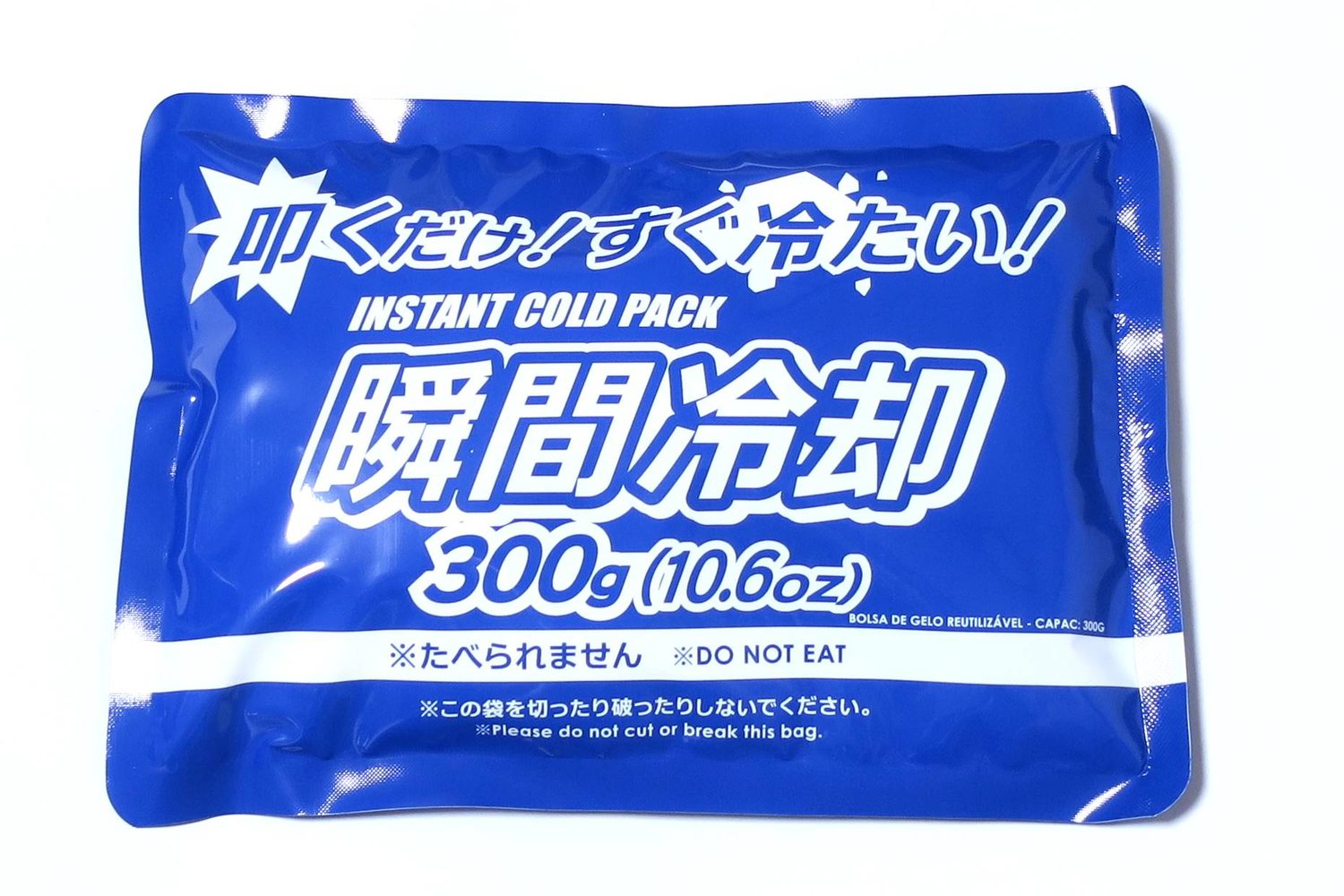
บีบแพ็กนี้แล้วในไม่กี่วินาทีมันจะเย็นจัดเหมือนน้ำแข็ง. ไม่มีอะไรกำลังเผาไหม้; ไม่มีอะไรกำลังทำให้เย็นลงจากภายนอก. ของแข็งเพียงอย่างเดียวกำลังละลายในน้ำภายใน…

English narration · English + 中文 subtitles burned in · ⁨การบรรยายภาษาอังกฤษ · คำบรรยายภาษาอังกฤษ + 中文 ลอยตัวบนภาพ⁩

6.1

Endothermic and Exothermic Processes · ⁨กระบวนการดูดความร้อนและคายความร้อน⁩

Syllabus · ⁨หลักสูตร⁩
English

Learning Objective 6.1.A: Explain the relationship between experimental observations and energy changes associated with a chemical or physical transformation.

  • 6.1.A.1 Temperature changes in a system indicate energy changes.
  • 6.1.A.2 Energy changes in a system can be described as endothermic and exothermic processes such as the heating or cooling of a substance, phase changes, or chemical transformations.
  • 6.1.A.3 When a chemical reaction occurs, the energy of the system either decreases (exothermic reaction), increases (endothermic reaction), or remains the same. For exothermic reactions, the energy lost by the reacting species (system) is gained by the surroundings, as heat transfer from or work done by the system. Likewise, for endothermic reactions, the system gains energy from the surroundings by heat transfer to or work done on the system.
  • 6.1.A.4 The formation of a solution may be an exothermic or endothermic process, depending on the relative strengths of intermolecular/interparticle interactions before and after the dissolution process.
ไทย

จุดประสงค์การเรียนรู้ 6.1.A: อธิบายความสัมพันธ์ระหว่างผลการทดลองกับการเปลี่ยนแปลงพลังงานที่เกี่ยวข้องกับการเปลี่ยนแปลงทางเคมีหรือฟิสิกส์

  • 6.1.A.1 การเปลี่ยนแปลงอุณหภูมิในระบบบ่งบอกถึงการเปลี่ยนแปลงพลังงาน
  • 6.1.A.2 การเปลี่ยนแปลงพลังงานในระบบสามารถอธิบายได้ด้วยกระบวนการดูดความร้อนและคายความร้อน เช่น การให้ความร้อนหรือความเย็นแก่สาร การเปลี่ยนสถานะ หรือการเปลี่ยนแปลงทางเคมี
  • 6.1.A.3 เมื่อเกิดปฏิกิริยาเคมี พลังงานของระบบอาจลดลง (ปฏิกิริยาคายความร้อน), เพิ่มขึ้น (ปฏิกิริยาดูดความร้อน) หรือคงที่ สำหรับปฏิกิริยาคายความร้อน พลังงานที่สูญเสียโดยสปีชีส์ทำปฏิกิริยา (ระบบ) จะถูก-absorbed-โดยสิ่งแวดล้อม ผ่านการถ่ายเทความร้อนหรือการทำงานที่ทำโดยระบบ ในทำนองเดียวกัน สำหรับปฏิกิริยาดูดความร้อน ระบบจะรับพลังงานจากสิ่งแวดล้อมผ่านการถ่ายเทความร้อนเข้าหรือการทำงานที่ทำต่อระบบ
  • 6.1.A.4 การเกิดสารละลายอาจเป็นกระบวนการคายความร้อนหรือดูดความร้อน ขึ้นอยู่กับความแรงสัมพัทธ์ของแรงระหว่างโมเลกุล/ระหว่างอนุภาค ก่อนและหลังกระบวนการละลาย
Source: College Board AP Course and Exam Description · ⁨แหล่งที่มา: คำอธิบายหลักสูตรและข้อสอบ College Board AP⁩

English

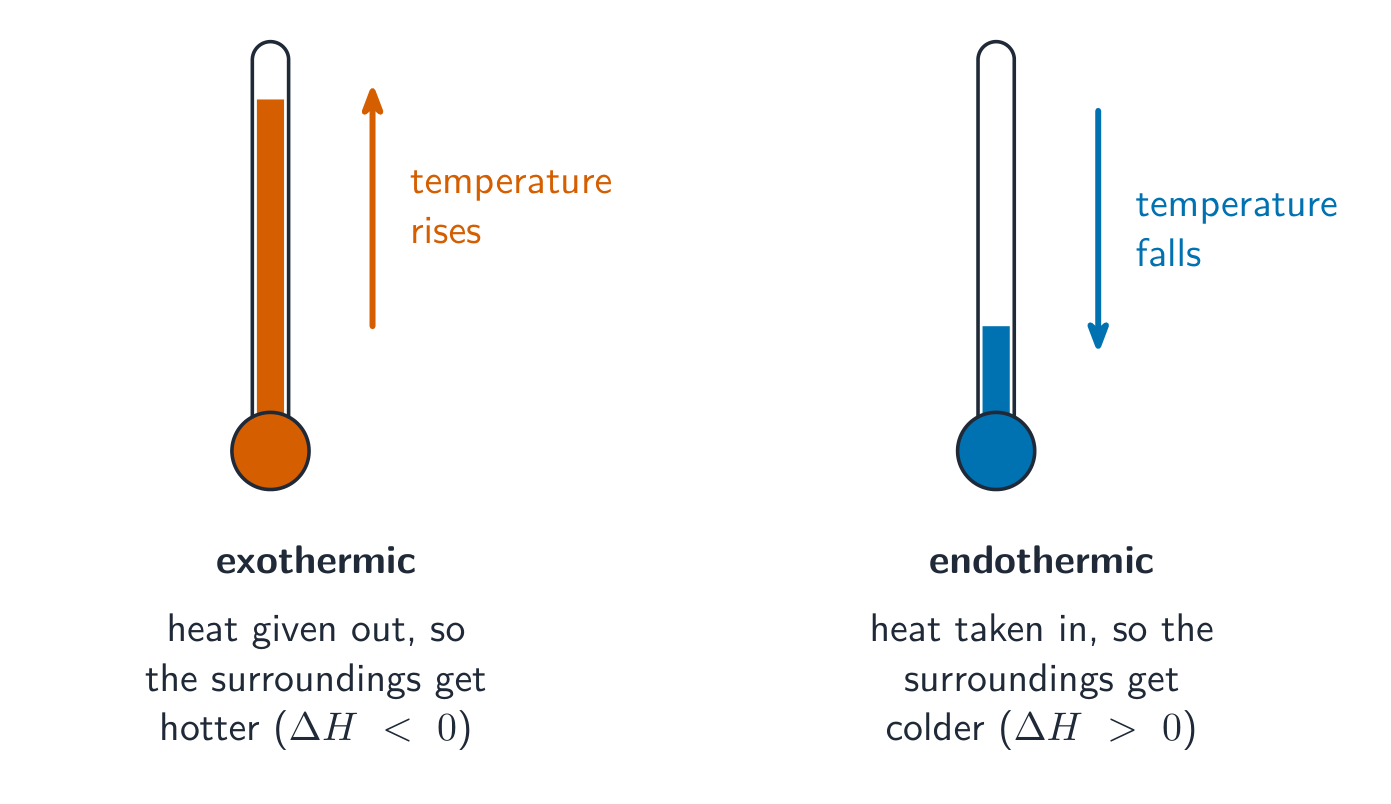
Thermochemistry 热化学 tracks energy in reactions. A process is exothermic 放热 if it releases energy to the surroundings (feels hot, $\Delta H<0$) and endothermic 吸热 if it absorbs energy (feels cold, $\Delta H>0$). Breaking bonds costs energy; forming bonds releases it – the net decides the sign.

ไทย
ถุงเย็นทันที: กระบวนการดูดความร้อนดูดความร้อนจากสิ่งแวดล้อม

เทอร์โมเคมี ติดตามพลังงานในปฏิกิริยา กระบวนการเป็น คายความร้อน หากปล่อยพลังงานสู่สิ่งแวดล้อม (รู้สึกร้อน, $\Delta H<0$) และเป็น ดูดความร้อน หากดูดพลังงาน (รู้สึกเย็น, $\Delta H>0$) การแตกพันธะต้องใช้พลังงาน การสร้างพันธะจะปล่อยพลังงาน – ผลต่างสุทธิจะเป็นตัวกำหนดเครื่องหมาย

ปฏิกิริยาคายความร้อนทำให้สิ่งแวดล้อมอุ่นขึ้น; กระบวนการดูดความร้อนทำให้สิ่งแวดล้อมเย็นลง
Explore · ⁨สำรวจ⁩

Compare endothermic and exothermic profiles · ⁨เปรียบเทียบกราฟเอนโดเทอร์มิกและเอ็กซ์โซเทอร์มิก⁩

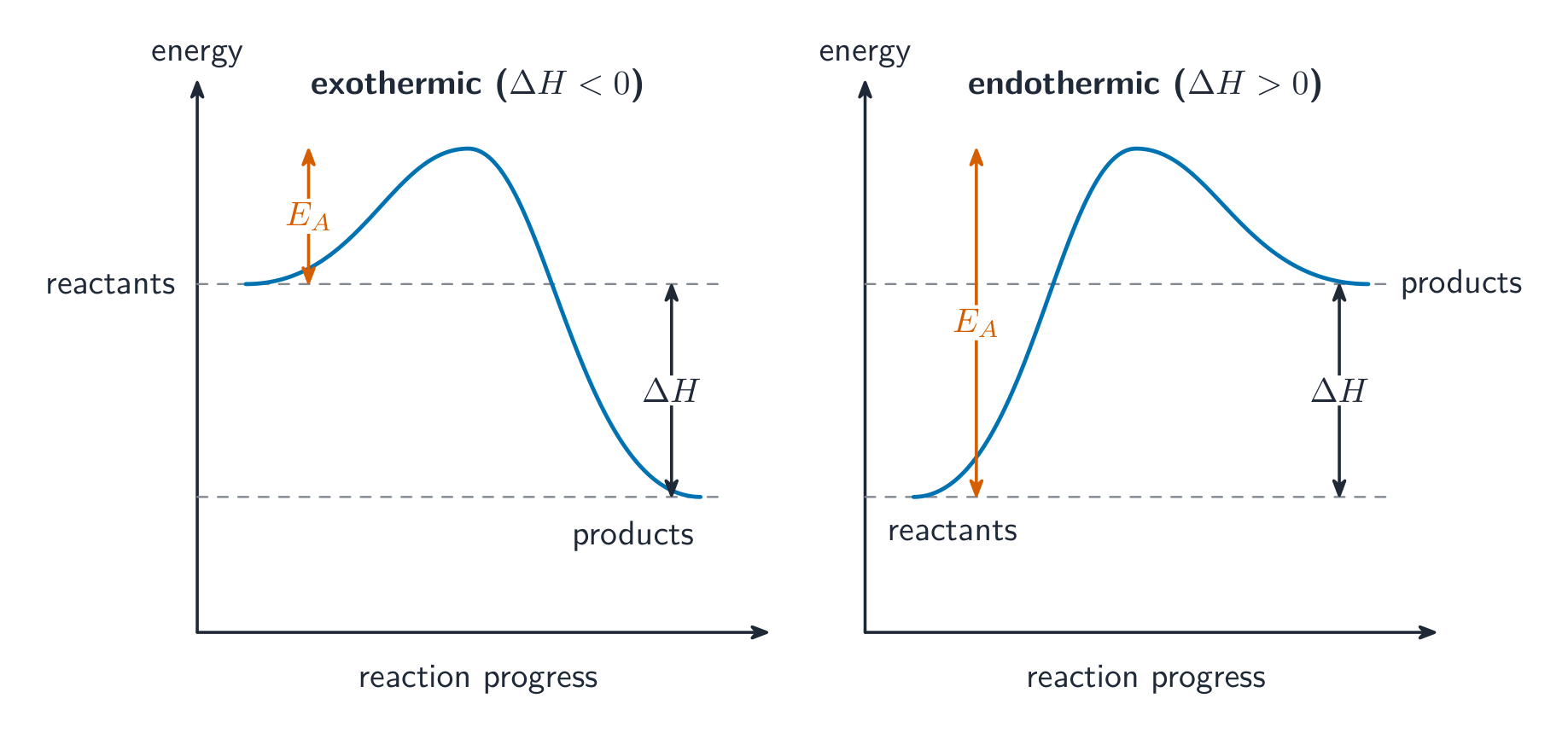
An exothermic reaction releases energy (products lower than reactants, $\Delta H<0$); an endothermic one absorbs it. The hump is the activation energy. · ⁨ปฏิกิริยาเอ็กซ์โซเทอร์มิก ปล่อยพลังงาน (ผลิตภัณฑ์ต่ำกว่าสารตั้งต้น, $\Delta H<0$); ปฏิกิริยาเอนโดเทอร์มิก ดูดซับพลังงาน ยอดเขาคือพลังงานกระตุ้น⁩

6.2

Energy Diagrams · ⁨แผนภูมิพลังงาน⁩

Syllabus · ⁨หลักสูตร⁩
English

Learning Objective 6.2.A: Represent a chemical or physical transformation with an energy diagram.

  • 6.2.A.1 A physical or chemical process can be described with an energy diagram that shows the endothermic or exothermic nature of that process.
ไทย

จุดประสงค์การเรียนรู้ 6.2.A: แสดงการเปลี่ยนแปลงทางเคมีหรือฟิสิกส์ด้วยแผนภูมิพลังงาน

  • 6.2.A.1 กระบวนการทางฟิสิกส์หรือเคมีสามารถอธิบายได้ด้วยแผนภูมิพลังงานที่แสดงลักษณะการดูดหรือคายความร้อนของกระบวนการนั้น

Source: College Board AP Course and Exam Description · ⁨แหล่งที่มา: คำอธิบายหลักสูตรและข้อสอบ College Board AP⁩

English

An energy diagram plots energy from reactants to products. Reactants above products means exothermic; below means endothermic. The vertical gap between them is the enthalpy change $\Delta H$.

ไทย

แผนภูมิพลังงานพล็อตพลังงานจากสารตั้งต้นไปยังผลิตภัณฑ์ สารตั้งต้นอยู่เหนือผลิตภัณฑ์หมายถึงการคายความร้อน; อยู่ใต้หมายถึงการดูดความร้อน ช่องว่างแนวตั้งระหว่างสองสิ่งนี้คือการเปลี่ยนแปลงเอนทาลปี $\Delta H$

แผนภูมิพลังงาน: ผลิตภัณฑ์การคายความร้อนอยู่ที่ใต้สารตั้งต้น, การดูดความร้อนอยู่เหนือ
6.3

Heat Transfer and Thermal Equilibrium · ⁨การถ่ายเทความร้อนและสมดุลทางความร้อน⁩

Syllabus · ⁨หลักสูตร⁩
English

Learning Objective 6.3.A: Explain the relationship between the transfer of thermal energy and molecular collisions.

  • 6.3.A.1 The particles in a warmer body have a greater average kinetic energy than those in a cooler body.
  • 6.3.A.2 Collisions between particles in thermal contact can result in the transfer of energy. This process is called "heat transfer," "heat exchange," or "transfer of energy as heat."
  • 6.3.A.3 Eventually, thermal equilibrium is reached as the particles continue to collide. At thermal equilibrium, the average kinetic energy of both bodies is the same, and hence, their temperatures are the same.
ไทย

จุดประสงค์การเรียนรู้ 6.3.A: อธิบายความสัมพันธ์ระหว่างการถ่ายเทพลังงานความร้อนกับการชนกันของโมเลกุล

  • 6.3.A.1 อนุภาคในวัตถุที่มีอุณหภูมิสูงกว่ามีพลังงานจลน์เฉลี่ยมากกว่าอนุภาคในวัตถุที่มีอุณหภูมิต่ำกว่า
  • 6.3.A.2 การชนกันระหว่างอนุภาคที่สัมผัสกันทางความร้อนสามารถนำไปสู่การถ่ายเทพลังงาน กระบวนการนี้เรียกว่า "การถ่ายเทความร้อน" "การแลกเปลี่ยนความร้อน" หรือ "การถ่ายโอนพลังงานด้วยความร้อน"
  • 6.3.A.3 ในที่สุดก็จะถึงความสมดุลทางความร้อนเมื่ออนุภาคยังคงชนกัน ที่ความสมดุลทางความร้อน พลังงานจลน์เฉลี่ยของทั้งสองวัตถุจะเท่ากัน และดังนั้น อุณหภูมิของทั้งสองก็เท่ากัน

Source: College Board AP Course and Exam Description · ⁨แหล่งที่มา: คำอธิบายหลักสูตรและข้อสอบ College Board AP⁩

English

Heat 热量 flows from hot to cold until objects reach thermal equilibrium 热平衡 (equal temperature). Energy is conserved: the heat lost by the hot object equals the heat gained by the cold one.

ไทย

ความร้อน ไหลจากวัตถุร้อนไปยังวัตถุเย็นจนวัตถุทั้งสองถึง สมดุลทางความร้อน (อุณหภูมิเท่ากัน) พลังงานถูกอนุรักษ์: ความร้อนที่วัตถุร้อนสูญเสียเท่ากับความร้อนที่วัตถุเย็นได้รับ

6.4

Heat Capacity and Calorimetry · ⁨ความจุความร้อนและการวัดค่าความร้อน⁩

Syllabus · ⁨หลักสูตร⁩
English

Learning Objective 6.4.A: Calculate the heat $q$ absorbed or released by a system undergoing heating/cooling based on the amount of the substance, the heat capacity, and the change in temperature.

  • 6.4.A.1 The heating of a cool body by a warmer body is an important form of energy transfer between two systems. The amount of heat transferred between two bodies may be quantified by the heat transfer equation:

    • Equation: $q = mc\Delta T$.

    Calorimetry experiments are used to measure the transfer of heat.

  • 6.4.A.2 The first law of thermodynamics states that energy is conserved in chemical and physical processes.

  • 6.4.A.3 The transfer of a given amount of thermal energy will not produce the same temperature change in equal masses of matter with differing specific heat capacities.

  • 6.4.A.4 Heating a system increases the energy of the system, while cooling a system decreases the energy of the system.

  • 6.4.A.5 The specific heat capacity of a substance and the molar heat capacity are both used in energy calculations.

  • 6.4.A.6 Chemical systems change their energy through three main processes: heating/cooling, phase transitions, and chemical reactions.

  • 6.4.A.7 In calorimetry experiments involving dissolution, temperature changes of the mixture within the calorimeter can be used to determine the direction of energy flow. If the temperature of the mixture increases, thermal energy is released by the dissolution process (exothermic). If the temperature of the mixture decreases, thermal energy is absorbed by the dissolution process (endothermic).

ไทย

จุดประสงค์การเรียนรู้ 6.4.A: คำนวณความร้อน $q$ ที่ระบบดูดหรือคายขณะ undergoing การให้ความร้อน/ความเย็น โดยพิจารณาจากปริมาณสาร ความจุความร้อน และการเปลี่ยนแปลงอุณหภูมิ

  • 6.4.A.1 การให้ความร้อนวัตถุที่เย็นด้วยวัตถุที่ร้อน merupakanรูปแบบสำคัญของการถ่ายโอนพลังงานระหว่างสองระบบ ปริมาณความร้อนที่ถ่ายโอนระหว่างสองวัตถุสามารถคำนวณได้จากสมการการถ่ายเทความร้อน:

    • สมการ: $q = mc\Delta T$.

    การทดลองวัดความร้อนใช้เพื่อวัดการถ่ายเทความร้อน

  • 6.4.A.2 กฎข้อที่หนึ่งแห่งเทอร์โมไดนามิกส์ระบุว่าพลังงานถูกอนุรักษ์ในกระบวนการทางเคมีและฟิสิกส์

  • 6.4.A.3 การถ่ายโอนพลังงานความร้อนในปริมาณที่กำหนดจะไม่ทำให้เกิดการเปลี่ยนแปลงอุณหภูมิเท่ากันในมวลสารที่มีขนาดเท่ากันแต่มีความจุความร้อนจำเพาะต่างกัน

  • 6.4.A.4 การให้ความร้อนระบบ会增加พลังงานของระบบ ในขณะที่การทำให้เย็นระบบ会降低พลังงานของระบบ

  • 6.4.A.5 ความจุความร้อนจำเพาะของสารและความจุความร้อนโมลาร์ใช้ทั้งคู่ในการคำนวณพลังงาน

  • 6.4.A.6 ระบบทางเคมีเปลี่ยนพลังงานผ่านสามกระบวนการหลัก: การให้ความร้อน/ความเย็น การเปลี่ยนสถานะ และปฏิกิริยาเคมี

  • 6.4.A.7 ในการทดลองวัดความร้อนที่เกี่ยวข้องกับการละลาย การเปลี่ยนแปลงอุณหภูมิของส่วนผสมภายในเครื่องวัดความร้อนสามารถใช้เพื่อกำหนดทิศทางของการไหลของพลังงาน หากอุณหภูมิของส่วนผสมเพิ่มขึ้น พลังงานความร้อนถูกปล่อยออกมาจากกระบวนการละลาย (คายความร้อน) หากอุณหภูมิของส่วนผสมลดลง พลังงานความร้อนถูกดูดซับโดยกระบวนการละลาย (ดูดความร้อน)

Source: College Board AP Course and Exam Description · ⁨แหล่งที่มา: คำอธิบายหลักสูตรและข้อสอบ College Board AP⁩

English

The heat to change a substance's temperature is

$$q=mc\,\Delta T,$$
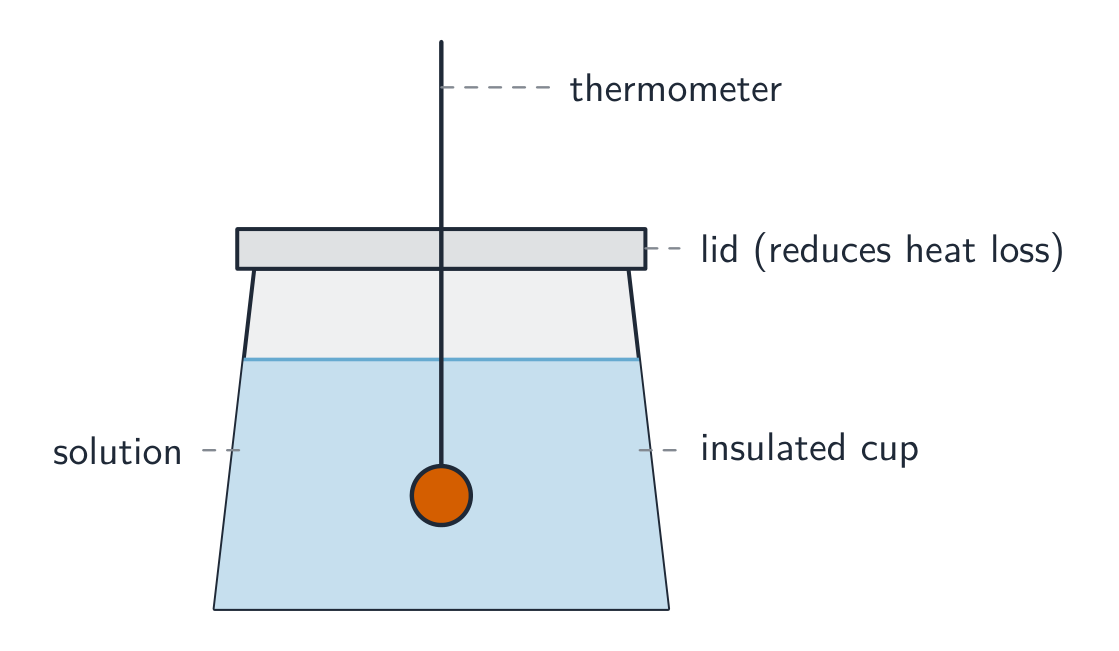
where $c$ is the specific heat 比热容 (energy per gram per degree). Calorimetry 量热法 measures a reaction's heat by tracking the temperature change of surrounding water: the heat the water gains equals the heat the reaction releases.

Worked example. A reaction in a coffee-cup calorimeter warms $100\ \text{g}$ of water by $8.0\,{}^{\circ}\text{C}$ ($c=4.18\ \text{J/(g}\,{}^{\circ}\text{C)}$). The heat absorbed by the water is

$$q=mc\,\Delta T=100\times4.18\times8.0=3.3\times10^{3}\ \text{J}.$$
By energy conservation the reaction released this $3.3\ \text{kJ}$, so it is exothermic ($q_{\text{rxn}}=-3.3\ \text{kJ}$).

ไทย

ความร้อนที่ต้องการเพื่อเปลี่ยนอุณหภูมิของสารคือ

$$q=mc\,\Delta T,$$
โดยที่ $c$ คือ ความจุความร้อนจำเพาะ (พลังงานต่อกรัมต่อองศา) การวัดค่าความร้อน วัดความร้อนของปฏิกิริยาโดยการติดตามการเปลี่ยนแปลงอุณหภูมิของน้ำรอบข้าง: ความร้อนที่น้ำได้รับเท่ากับความร้อนที่ปฏิกิริยาปล่อยออกมา

การวัดค่าความร้อน: วัดการเปลี่ยนแปลงอุณหภูมิของสารละลายที่มีมวลทราบล่วงหน้า

ตัวอย่างวิธีทำ. ปฏิกิริยาในเครื่องวัดค่าความร้อนแบบถ้วยกาแฟทำให้ $100\ \text{g}$ ของน้ำอุ่นขึ้น $8.0\,{}^{\circ}\text{C}$ ($c=4.18\ \text{J/(g}\,{}^{\circ}\text{C)}$) ความร้อนที่น้ำดูดรับคือ

$$q=mc\,\Delta T=100\times4.18\times8.0=3.3\times10^{3}\ \text{J}.$$
ด้วยการอนุรักษ์พลังงาน ปฏิกิริยานี้จึง ปล่อย $3.3\ \text{kJ}$ ออกมา ดังนั้นจึงเป็นการคายความร้อน ($q_{\text{rxn}}=-3.3\ \text{kJ}$)

Explore · ⁨สำรวจ⁩

Heat different materials · ⁨ความร้อนแยกวัสดุต่างกัน⁩

$Q=mc\Delta T$: a high specific heat (like water's) means a lot of energy for a small temperature rise. Compare materials for the same heat input. · ⁨$Q=mc\Delta T$: ค่า ความร้อนจำเพาะ สูง (เช่น ของน้ำ) หมายความว่าต้องใช้พลังงานมากเพื่อให้อุณหภูมิเพิ่มขึ้นเล็กน้อย เปรียบเทียบวัสดุภายใต้การใส่ความร้อนเท่ากัน⁩

Vocabulary · ⁨คำศัพท์⁩ Train · ⁨ฝึกฝน⁩
English ไทย
Thermochemistry/ˈθɜːməkemɪstri/ เทอร์โมเคมี
exothermic/eɡzəˈðɜːmɪk/ คายความร้อน
endothermic/ˌendəʊˈθɜːmɪk/ ดูดความร้อน
Heat/hiːt/ ความร้อน
thermal equilibrium/ˈθɜːml ˌiːkwɪˈlɪbrɪəm/ สมดุลความร้อน
specific heat/spəˈsɪfɪk hiːt/ ความร้อนจำเพาะ
Calorimetry/ˌkælɔːˈrɪmətri/ การวัดความร้อน
phase change/feɪz tʃeɪndʒ/ การเปลี่ยนแปลงสถานะ
enthalpy of reaction/enˈθælpi ɒv rɪˈækʃn/ เอนثالปีของปฏิกิริยา
state function/steɪt ˈfʌŋkʃn/ ฟังก์ชันสถานะ
standard enthalpy of formation/ˈstændəd enˈθælpi ɒv fɔːˈmeɪʃn/ เอนثالปีมาตรฐานของการเกิดสารประกอบ
Hess's law/ˈhesɪz lɔː/ กฎของเฮส (Hess's law)
6.5

Energy of Phase Changes · ⁨พลังงานของการเปลี่ยนสถานะ⁩

Syllabus · ⁨หลักสูตร⁩
English

Learning Objective 6.5.A: Explain changes in the heat $q$ absorbed or released by a system undergoing a phase transition based on the amount of the substance in moles and the molar enthalpy of the phase transition.

  • 6.5.A.1 Energy must be transferred to a system to cause a substance to melt (or boil). The energy of the system therefore increases as the system undergoes a solid-to-liquid (or liquid-to-gas) phase transition. Likewise, a system releases energy when it freezes (or condenses). The energy of the system decreases as the system undergoes a liquid-to-solid (or gas-to-liquid) phase transition. The temperature of a pure substance remains constant during a phase change.
  • 6.5.A.2 The energy absorbed during a phase change is equal to the energy released during a complementary phase change in the opposite direction. For example, the molar enthalpy of condensation of a substance is equal to the negative of its molar enthalpy of vaporization. Similarly, the molar enthalpy of fusion can be used to calculate the energy absorbed when melting a substance and the energy released when freezing a substance.
ไทย

จุดประสงค์การเรียนรู้ 6.5.A: อธิบายการเปลี่ยนแปลงความร้อน $q$ ที่ระบบดูดหรือคายขณะ undergo การเปลี่ยนสถานะ โดยพิจารณาจากปริมาณสารเป็นโมลและเอนทาลปีโมลาร์ของการเปลี่ยนสถานะ

  • 6.5.A.1 ต้องมีการถ่ายโอนพลังงานเข้าสู่ระบบเพื่อให้สารหลอมเหลว (หรือระเหย) ดังนั้นพลังงานของระบบจึงเพิ่มขึ้นเมื่อระบบ undergo การเปลี่ยนสถานะจากของแข็งเป็นของเหลว (หรือของเหลวเป็นแก๊ส) ในทำนองเดียวกัน ระบบจะปล่อยพลังงานเมื่อแข็งตัว (หรือควบแน่น) พลังงานของระบบจะลดลงเมื่อระบบ undergo การเปลี่ยนสถานะจากของเหลวเป็นของแข็ง (หรือแก๊สเป็นของเหลว) อุณหภูมิของสารบริสุทธิ์จะคงที่ระหว่างการเปลี่ยนสถานะ
  • 6.5.A.2 พลังงานที่ดูดซับระหว่างการเปลี่ยนสถานะจะมีค่าเท่ากับพลังงานที่ปล่อยออกduring การเปลี่ยนสถานะที่สมบูรณ์ในทิศทางตรงข้าม ตัวอย่างเช่น เอนทาลปีโมลาร์ของการควบแน่นของสารจะมีค่าเท่ากับลบของเอนทาลปีโมลาร์ของการระเหย同样地,เอนทาลปีโมลาร์ของการหลอมเหลวสามารถใช้คำนวณพลังงานที่ดูดซับขณะหลอมเหลวสารและพลังงานที่ปล่อยออกขณะแข็งตัวสาร

Source: College Board AP Course and Exam Description · ⁨แหล่งที่มา: คำอธิบายหลักสูตรและข้อสอบ College Board AP⁩

English

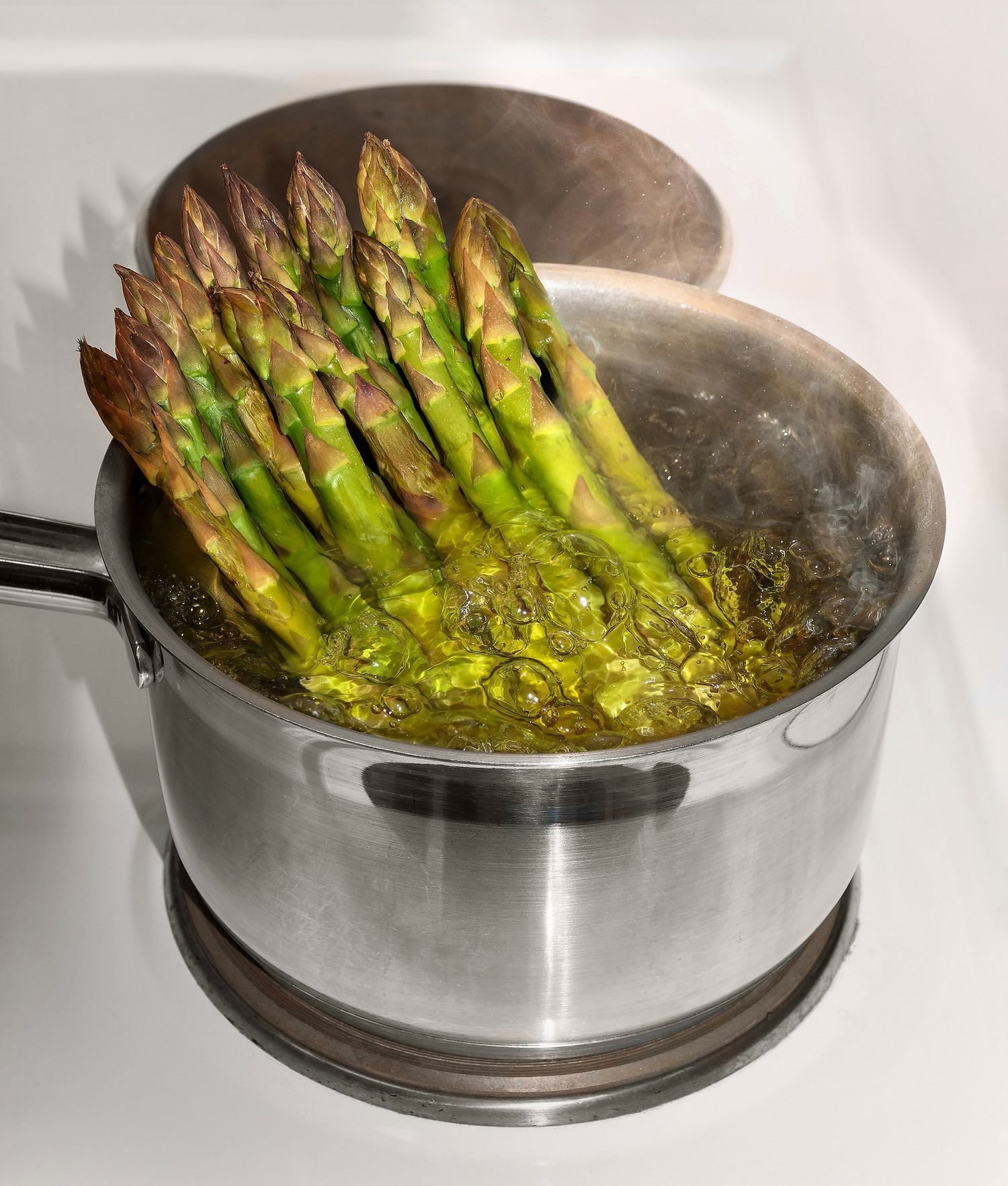
During a phase change 相变 (melting, boiling) the temperature stays constant while heat goes into breaking intermolecular forces, not raising kinetic energy. The energy needed is $q=n\,\Delta H_{\text{fus}}$ (melting) or $q=n\,\Delta H_{\text{vap}}$ (boiling) – the flat steps on a heating curve.

ไทย

ระหว่างการ เปลี่ยนสถานะ (การหลอมเหลว, การเดือด) อุณหภูมิจะ คงที่ ในขณะที่ความร้อนถูกนำไปใช้เพื่อBREAKแรงระหว่างโมเลกุล ไม่ใช่เพิ่มพลังงานจลน์ พลังงานที่ต้องใช้คือ $q=n\,\Delta H_{\text{fus}}$ (การหลอมเหลว) หรือ $q=n\,\Delta H_{\text{vap}}$ (การเดือด) – ซึ่งเป็นขั้นราบบนกราฟความร้อน

ไอน้ำจากการต้มน้ำ: การเปลี่ยนสถานะดูดหรือปล่อยพลังงานที่อุณหภูมิคงที่
Explore · ⁨สำรวจ⁩

Heat through a phase change · ⁨ให้ความร้อนผ่านการเปลี่ยนสถานะ⁩

During a phase change the temperature holds flat while energy breaks bonds — the latent heat. Watch the plateaus at melting and boiling. · ⁨ระหว่างการ เปลี่ยนสถานะ อุณหภูมิจะคงที่ขณะที่พลังงานทำลายพันธะ —即潜热. ดูระดับราบที่จุดหลอมเหลวและจุดเดือด⁩

6.6

Introduction to Enthalpy of Reaction · ⁨บทนำเรื่องเอนทาลปีของปฏิกิริยา⁩

Syllabus · ⁨หลักสูตร⁩
English

Learning Objective 6.6.A: Calculate the heat $q$ absorbed or released by a system undergoing a chemical reaction in relationship to the amount of the reacting substance in moles and the molar enthalpy of reaction.

  • 6.6.A.1 The enthalpy change of a reaction gives the amount of heat energy released (for negative values) or absorbed (for positive values) by a chemical reaction at constant pressure.
  • 6.6.A.2 When the products of a reaction are at a different temperature than their surroundings, they exchange energy with the surroundings to reach thermal equilibrium. Thermal energy is transferred to the surroundings as the reactants convert to products in an exothermic reaction. Thermal energy is transferred from the surroundings as the reactants convert to products in an endothermic reaction.
  • 6.6.A.3 The chemical potential energy of the products of a reaction is different from that of the reactants because of the breaking and forming of bonds. The energy difference results in a change in the kinetic energy of the particles, which manifests as a temperature change.
    • Exclusion Statement: The technical distinctions between enthalpy and internal energy will not be assessed on the AP Exam. Most reactions studied at the AP level are carried out at constant pressure, where the enthalpy change of the process is equal to the heat (and by extension, the energy) of reaction.
ไทย

จุดประสงค์การเรียนรู้ 6.6.A: คำนวณความร้อน $q$ ที่ถูกดูดกลืนหรือปล่อยออกมาโดยระบบที่กำลังเกิดปฏิกิริยาเคมี โดยสัมพันธ์กับปริมาณของสารที่เข้าทำปฏิกิริยาในหน่วยโมลและเอนทาลปีของปฏิกิริยาต่อหนึ่งโมล

  • 6.6.A.1 การเปลี่ยนแปลงเอนทาลปีของปฏิกิริยาแสดงถึงปริมาณพลังงานความร้อนที่ถูกปล่อยออก (สำหรับค่าลบ) หรือถูกดูดกลืน (สำหรับค่าบวก) โดยปฏิกิริยาเคมีที่ความดันคงที่
  • 6.6.A.2 เมื่อผลิตภัณฑ์ของปฏิกิริยามีอุณหภูมิแตกต่างจากสิ่งแวดล้อม ониจะแลกเปลี่ยนพลังงานกับสิ่งแวดล้อมเพื่อให้ถึงสภาวะสมดุลทางความร้อน พลังงานความร้อนจะถูกถ่ายโอนไปยังสิ่งแวดล้อมเมื่อสารตั้งต้นเปลี่ยนเป็นผลิตภัณฑ์ในปฏิกิริยาแบบคายความร้อน พลังงานความร้อนจะถูกถ่ายโอนจากสิ่งแวดล้อมเมื่อสารตั้งต้นเปลี่ยนเป็นผลิตภัณฑ์ในปฏิกิริยาแบบดูดความร้อน
  • 6.6.A.3 พลังงานศักย์ทางเคมีของผลิตภัณฑ์ต่างจากสารตั้งต้นเนื่องจากมีการแตกและการสร้างพันธะ ความแตกต่างของพลังงานนี้ส่งผลให้เกิดการเปลี่ยนแปลงพลังงานจลน์ของอนุภาค ซึ่งปรากฏเป็นการเปลี่ยนแปลงอุณหภูมิ
    • ข้อสังเกต: ความแตกต่างเชิงเทคนิคระหว่างเอนทาลปีและพลังงานภายในจะไม่ถูกทดสอบในการสอบ AP ส่วนใหญ่ปฏิกิริยาที่ศึกษาในระดับ AP จะดำเนินการที่ความดันคงที่ ซึ่งการเปลี่ยนแปลงเอนทาลปีของกระบวนการมีค่าเท่ากับความร้อน (และโดยนัยคือพลังงาน) ของปฏิกิริยา

Source: College Board AP Course and Exam Description · ⁨แหล่งที่มา: คำอธิบายหลักสูตรและข้อสอบ College Board AP⁩

English

The enthalpy of reaction 反应焓 $\Delta H_{\text{rxn}}$ is the heat released or absorbed at constant pressure. Because enthalpy is a state function 状态函数, $\Delta H$ depends only on the initial and final states, not the path taken – the key that makes the next three methods work.

ไทย

เอนทาลปีของปฏิกิริยา $\Delta H_{\text{rxn}}$ คือความร้อนที่ถูกปล่อยหรือดูดที่ความดันคงที่ เนื่องจากเอนทาลปีเป็น ฟังก์ชันสถานะ $\Delta H$ จึงขึ้นอยู่กับเฉพาะสถานะเริ่มต้นและสุดท้ายเท่านั้น ไม่ขึ้นกับเส้นทางที่ใช้ – ซึ่งเป็นกุญแจสำคัญที่ทำให้สามวิธีการถัดไปใช้งานได้

6.7

Bond Enthalpies · ⁨พลังงานพันธะ⁩

Syllabus · ⁨หลักสูตร⁩
English

Learning Objective 6.7.A: Calculate the enthalpy change of a reaction based on the average bond energies of bonds broken and formed in the reaction.

  • 6.7.A.1 During a chemical reaction, bonds are broken and/or formed, and these events change the potential energy of the system.
  • 6.7.A.2 The average energy required to break all of the bonds in the reactant molecules can be estimated by adding up the average bond energies of all the bonds in the reactant molecules. Likewise, the average energy released in forming the bonds in the product molecules can be estimated. If the energy released is greater than the energy required, the reaction is exothermic. If the energy required is greater than the energy released, the reaction is endothermic.
ไทย

จุดประสงค์การเรียนรู้ 6.7.A: คำนวณการเปลี่ยนแปลงเอนทาลปีของปฏิกิริยาตามพลังงานพันธะเฉลี่ยของพันธะที่ถูกแตกและสร้างขึ้นในปฏิกิริยา

  • 6.7.A.1 ระหว่างปฏิกิริยาเคมี พันธะจะถูกแตกและ/หรือสร้างขึ้น และเหตุการณ์เหล่านี้จะเปลี่ยนพลังงานศักย์ของระบบ
  • 6.7.A.2 พลังงานเฉลี่ยที่ต้องการในการแตกพันธะทั้งหมดในโมเลกุลของสารตั้งต้นสามารถประมาณได้โดยการรวมพลังงานพันธะเฉลี่ยของพันธะทั้งหมดในโมเลกุลของสารตั้งต้น ในทำนองเดียวกัน พลังงานเฉลี่ยที่ถูกปล่อยออกมาในการสร้างพันธะในโมเลกุลของผลิตภัณฑ์ก็สามารถประมาณได้ หากพลังงานที่ถูกปล่อยออกมากกว่าพลังงานที่ต้องการ ปฏิกิริยานั้นจะเป็นปฏิกิริยาแบบคายความร้อน หากพลังงานที่ต้องการมากกว่าพลังงานที่ถูกปล่อยออก ปฏิกิริยานั้นจะเป็นปฏิกิริยาแบบดูดความร้อน

Source: College Board AP Course and Exam Description · ⁨แหล่งที่มา: คำอธิบายหลักสูตรและข้อสอบ College Board AP⁩

English

One way to estimate $\Delta H$: sum the energy to break all reactant bonds, then subtract the energy released forming product bonds:

$$\Delta H \approx \sum (\text{bonds broken}) - \sum (\text{bonds formed}).$$
This is an approximation, since bond enthalpies are averages.

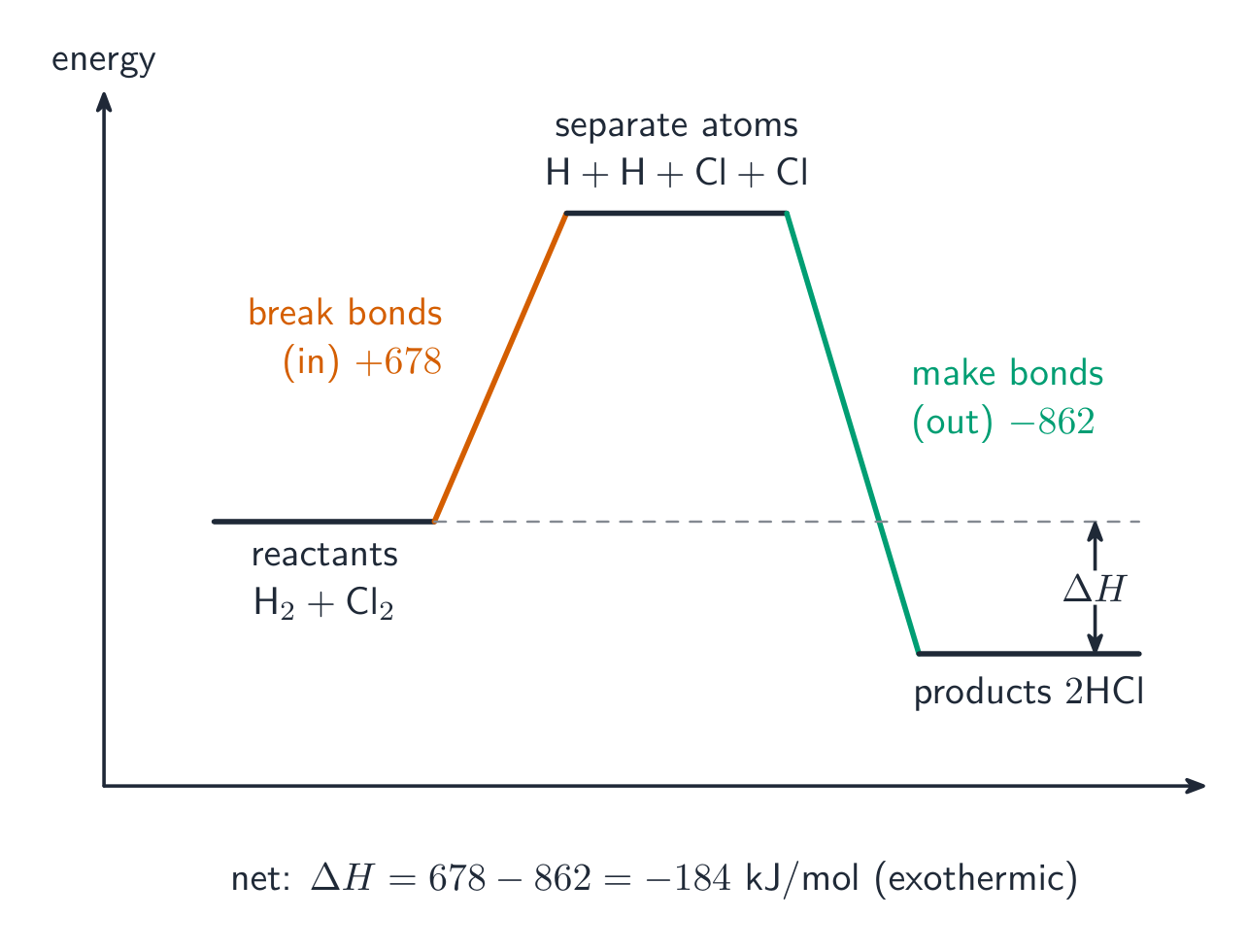
Worked example. Estimate $\Delta H$ for $\text{H}_2+\text{Cl}_2\rightarrow2\text{HCl}$ using bond enthalpies H–H $=436$, Cl–Cl $=242$, H–Cl $=431\ \text{kJ/mol}$. Break both reactant bonds ($436+242=678$) and form two H–Cl bonds ($2\times431=862$):

$$\Delta H\approx 678-862=-184\ \text{kJ},$$
exothermic, because the strong H–Cl bonds formed release more than the reactant bonds cost.

ไทย

อีกวิธีหนึ่งในการประมาณค่า $\Delta H$: รวมพลังงาน用於 BREAK พันธะของสารตั้งต้นทั้งหมด แล้วลบด้วยพลังงาน ** Released** ในการสร้างพันธะของผลิตภัณฑ์:

$$\Delta H \approx \sum (\text{bonds broken}) - \sum (\text{bonds formed}).$$
นี่เป็นการประมาณค่า เนื่องจากพลังงานพันธะเป็นค่าเฉลี่ย

การแตกพันธะต้องดูดพลังงาน; การสร้างพันธะจะปล่อยพลังงาน

ตัวอย่างวิธีทำ. ประมาณค่า $\Delta H$ สำหรับ $\text{H}_2+\text{Cl}_2\rightarrow2\text{HCl}$ โดยใช้พลังงานพันธะ H–H $=436$, Cl–Cl $=242$, H–Cl $=431\ \text{kJ/mol}$. แตกพันธะของสารตั้งต้นทั้งสอง ($436+242=678$) และสร้างพันธะ H–Cl สองอัน ($2\times431=862$):

$$\Delta H\approx 678-862=-184\ \text{kJ},$$
เป็นการคายความร้อน เพราะพันธะ H–Cl ที่แข็งแรงซึ่งเกิดขึ้นใหม่ ปล่อยพลังงานมากกว่าต้นทุนของพันธะสารตั้งต้น

6.8

Enthalpy of Formation · ⁨เอนทาลปีของการเกิด⁩

Syllabus · ⁨หลักสูตร⁩
English

Learning Objective 6.8.A: Calculate the enthalpy change for a chemical or physical process based on the standard enthalpies of formation.

  • 6.8.A.1 Tables of standard enthalpies of formation can be used to calculate the standard enthalpies of reactions.
    • Equation: $\Delta H^{\circ}_{reaction} = \Sigma \Delta H^{\circ}_{f\ products} - \Sigma \Delta H^{\circ}_{f\ reactants}$
ไทย

จุดประสงค์การเรียนรู้ 6.8.A: คำนวณการเปลี่ยนแปลงเอนทาลปีสำหรับกระบวนการทางเคมีหรือฟิสิกส์ตามเอนทาลปีการเกิดมาตรฐาน

  • 6.8.A.1 ตารางเอนทาลปีการเกิดมาตรฐานสามารถใช้คำนวณเอนทาลปีของปฏิกิริยามาตรฐานได้
    • สมการ: $\Delta H^{\circ}_{reaction} = \Sigma \Delta H^{\circ}_{f\ products} - \Sigma \Delta H^{\circ}_{f\ reactants}$

Source: College Board AP Course and Exam Description · ⁨แหล่งที่มา: คำอธิบายหลักสูตรและข้อสอบ College Board AP⁩

English

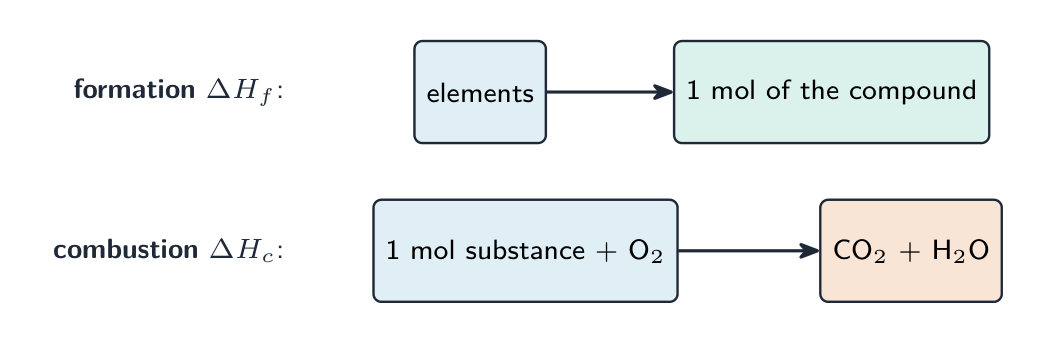
The standard enthalpy of formation 生成焓 $\Delta H_f^\circ$ is the enthalpy to make one mole of a compound from its elements (zero for an element in its standard state). Then

$$\Delta H_{\text{rxn}}^\circ = \sum \Delta H_f^\circ(\text{products}) - \sum \Delta H_f^\circ(\text{reactants}).$$

Worked example. Find $\Delta H_{\text{rxn}}^\circ$ for burning methane, $\text{CH}_4+2\text{O}_2\rightarrow\text{CO}_2+2\text{H}_2\text{O}$, given $\Delta H_f^\circ$: CH$_4=-75$, CO$_2=-394$, H$_2$O$=-286\ \text{kJ/mol}$ (O$_2=0$). Products minus reactants:

$$\Delta H_{\text{rxn}}^\circ=[-394+2(-286)]-[-75+0]=-966+75=-891\ \text{kJ},$$
a large release, as expected for a combustion.

ไทย

เอนทาลปีมาตรฐานของการเกิด $\Delta H_f^\circ$ คือเอนทาลปี用于สร้างสารประกอบหนึ่งโมลจากธาตุองค์ประกอบ (เป็นศูนย์สำหรับธาตุในสถานะมาตรฐาน) จากนั้น

$$\Delta H_{\text{rxn}}^\circ = \sum \Delta H_f^\circ(\text{products}) - \sum \Delta H_f^\circ(\text{reactants}).$$

การเกิดสร้างสารประกอบจากธาตุองค์ประกอบ; การเผาไหม้เผาผลาญในออกซิเจน

ตัวอย่างวิธีทำ. หา $\Delta H_{\text{rxn}}^\circ$ สำหรับการเผาไหม้เมทาน, $\text{CH}_4+2\text{O}_2\rightarrow\text{CO}_2+2\text{H}_2\text{O}$, กำหนดให้ $\Delta H_f^\circ$: CH$_4=-75$, CO$_2=-394$, H$_2$O$=-286\ \text{kJ/mol}$ (O$_2=0$). ผลิตภัณฑ์ลบด้วยสารตั้งต้น:

$$\Delta H_{\text{rxn}}^\circ=[-394+2(-286)]-[-75+0]=-966+75=-891\ \text{kJ},$$
เป็นการปล่อยความร้อนมาก ตามที่คาดหวังสำหรับการเผาไหม้

6.9

Hess's Law · ⁨กฎเฮสส์⁩

Syllabus · ⁨หลักสูตร⁩
English

Learning Objective 6.9.A: Represent a chemical or physical process as a sequence of steps.

  • 6.9.A.1 Many processes can be broken down into a series of steps. Each step in the series has its own energy change.

Learning Objective 6.9.B: Explain the relationship between the enthalpy of a chemical or physical process and the sum of the enthalpies of the individual steps.

  • 6.9.B.1 Because total energy is conserved (first law of thermodynamics), and each individual reaction in a sequence transfers thermal energy to or from the surroundings, the net thermal energy transferred in the sequence will be equal to the sum of the thermal energy transfers in each of the steps. These thermal energy transfers are the result of potential energy changes among the species in the reaction sequence; thus, at constant pressure, the enthalpy change of the overall process is equal to the sum of the enthalpy changes of the individual steps.
  • 6.9.B.2 The following are essential principles of Hess's law:
    • i. When a reaction is reversed, the enthalpy change stays constant in magnitude but becomes reversed in mathematical sign.
    • ii. When a reaction is multiplied by a factor $c$, the enthalpy change is multiplied by the same factor $c$.
    • iii. When two (or more) reactions are added to obtain an overall reaction, the individual enthalpy changes of each reaction are added to obtain the net enthalpy change of the overall reaction.
    • Exclusion Statement: The concept of state functions will not be assessed on the AP Exam.
ไทย

จุดประสงค์การเรียนรู้ 6.9.A: แสดงกระบวนการทางเคมีหรือฟิสิกส์เป็นลำดับขั้นตอน

  • 6.9.A.1 หลายกระบวนการสามารถแยกออกเป็นชุดของขั้นตอนได้ แต่ละขั้นตอนในชุดจะมีค่าการเปลี่ยนแปลงพลังงานของตัวเอง

จุดประสงค์การเรียนรู้ 6.9.B: อธิบายความสัมพันธ์ระหว่างเอนทาลปีของกระบวนการทางเคมีหรือฟิสิกส์กับผลรวมของเอนทาลปีของขั้นตอนย่อยต่างๆ

  • 6.9.B.1 เนื่องจากพลังงานรวมถูกอนุรักษ์ (กฎข้อที่หนึ่งของอุณหพลศาสตร์) และแต่ละปฏิกิริยาย่อยในลำดับจะถ่ายโอนพลังงานความร้อนเข้าหรือออกจากสิ่งแวดล้อม พลังงานความร้อนสุทธิที่ถ่ายโอนในลำดับนี้จะเท่ากับผลรวมของการถ่ายโอนพลังงานความร้อนในแต่ละขั้นตอน การถ่ายโอนพลังงานความร้อนเหล่านี้เป็นผลมาจากการเปลี่ยนแปลงพลังงานศักย์ระหว่างสปีชีส์ในลำดับปฏิกิริยา ดังนั้นที่ความดันคงที่ การเปลี่ยนแปลงเอนทาลปีของกระบวนการโดยรวมจะมีค่าเท่ากับผลรวมของการเปลี่ยนแปลงเอนทาลปีของแต่ละขั้นตอนย่อย
  • 6.9.B.2 หลักการสำคัญของกฎของเฮสมีดังนี้:
    • i. เมื่อปฏิกิริยาย้อนกลับ การเปลี่ยนแปลงเอนทาลปีจะมีขนาดเท่าเดิมแต่เครื่องหมายทางคณิตศาสตร์จะกลับด้าน
    • ii. เมื่อปฏิกิริยากำคูณด้วยตัวคูณ $c$ การเปลี่ยนแปลงเอนทาลปีจะถูกคูณด้วยตัวคูณนั้นเอง $c$
    • iii. เมื่อปฏิกิริยาสอง (หรือมากกว่า) ปฏิกิริยาถูกนำมารวมกันเพื่อได้รับปฏิกิริยารวมกัน การเปลี่ยนแปลงเอนทาลปีของแต่ละปฏิกิริยาจะถูกนำมารวมกันเพื่อรับค่าการเปลี่ยนแปลงเอนทาลปีสุทธิของปฏิกิริยารวม
    • ข้อสังเกต: แนวคิดเกี่ยวกับฟังก์ชันสถานะจะไม่ถูกทดสอบในการสอบ AP

Source: College Board AP Course and Exam Description · ⁨แหล่งที่มา: คำอธิบายหลักสูตรและข้อสอบ College Board AP⁩

English
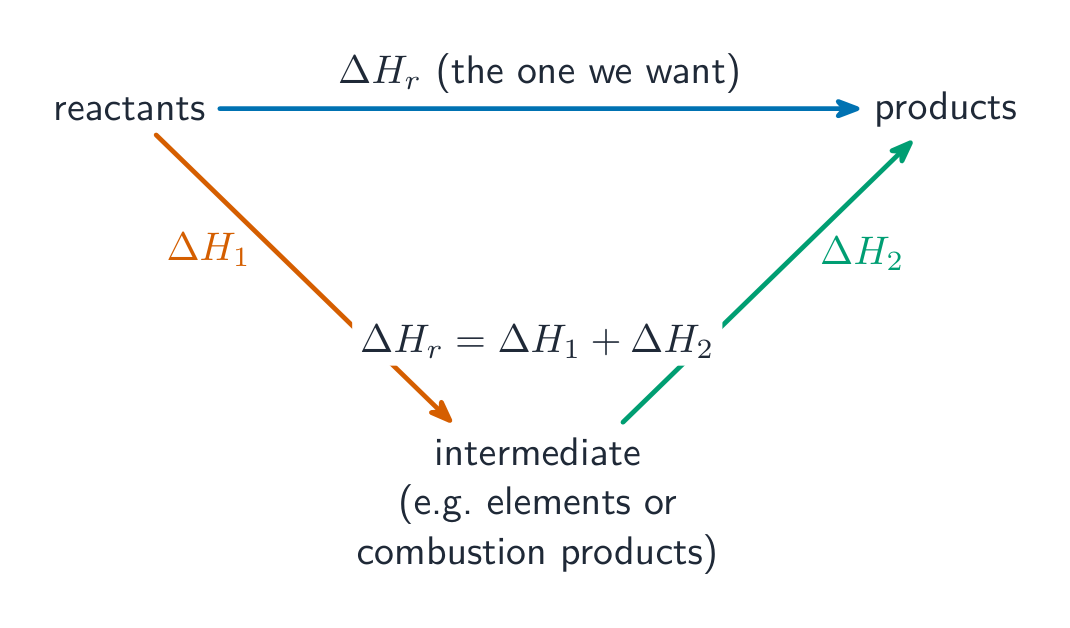
Hess's law: the route does not matter

Hess's law 盖斯定律: if a reaction is the sum of several steps, its $\Delta H$ is the sum of the steps' $\Delta H$ values. Reverse a step and flip the sign; scale a step and scale its $\Delta H$. This lets you find a hard-to-measure $\Delta H$ by combining known reactions – a frequent exam calculation.

ไทย
กฎเฮสส์: เส้นทางไม่สำคัญ

กฎของเฮส: หากปฏิกิริยาเป็นผลรวมของหลายขั้นตอน ค่า $\Delta H$ ของปฏิกิริยานั้นจะเป็นผลรวมของค่า $\Delta H$ ของแต่ละขั้นตอน กลับขั้นตอนหนึ่งให้เปลี่ยนเครื่องหมาย; ขยายขนาดขั้นตอนใดให้ขยาย $\Delta H$ ของขั้นตอนนั้นด้วย วิธีนี้ช่วยให้หา $\Delta H$ ที่วัดได้ยากโดยการรวมปฏิกิริยาที่ทราบค่าไว้ – ซึ่งเป็นโจทย์คำนวณที่พบบ่อยในการสอบ

กฎของเฮส: เส้นทางโดยตรงและทางอ้อมให้ค่าการเปลี่ยนแปลงเอนทาลปีรวมเท่ากัน
6.9

Exam tips · ⁨ข้อแนะนำสำหรับการสอบ⁩

English
  • An exothermic reaction has $\Delta H<0$ (feels hot); endothermic has $\Delta H>0$ — always give $\Delta H$ a sign and units.
  • In calorimetry use $q=mc\,\Delta T$ with the mass of the water/solution; the reaction releases what the water gains.
  • Bond enthalpies: $\Delta H\approx\sum(\text{bonds broken})-\sum(\text{bonds made})$ — breaking is endothermic, making is exothermic (the classic sign trap).
  • Hess's law: the total $\Delta H$ is the sum of the steps' — reverse a step and flip the sign, scale a step and scale $\Delta H$.
  • During a phase change the temperature stays constant while energy goes into the forces between particles.
ไทย
  • ปฏิกิริยาคายความร้อน มี $\Delta H<0$ (รู้สึกร้อน); ปฏิกิริยาดูดความร้อน มี $\Delta H>0$ — ให้ $\Delta H$ เป็นเครื่องหมายและหน่วยเสมอ
  • ในการวัดความร้อนใช้ $q=mc\,\Delta T$ กับมวลของ น้ำ/สารละลาย; ปฏิกิริยาปล่อยพลังงานเท่าที่น้ำได้รับ
  • พลังงานพันธะ: $\Delta H\approx\sum(\text{bonds broken})-\sum(\text{bonds made})$ — การแตกตัวเป็นดูดความร้อน การสร้างเป็นคายความร้อน (กับดักเครื่องหมายคลาสสิก)
  • กฎของเฮส: ค่า $\Delta H$ รวมคือผลรวมของขั้นตอน — กลับด้านขั้นตอนหนึ่งและเปลี่ยนเครื่องหมาย, ขยายขนาดขั้นตอนหนึ่งและขยาย $\Delta H$ ตามสัดส่วน
  • ระหว่าง การเปลี่ยนสถานะ อุณหภูมิคงที่ในขณะที่พลังงานถูกนำไปใช้กับแรงระหว่างอนุภาค

Interactive lessons on this topic · ⁨บทเรียนเชิงโต้ตอบสำหรับหัวข้อนี้⁩

Work through it step by step, with instant-check exercises. · ⁨ทำทีละขั้นตอน พร้อมแบบฝึกหัดตรวจสอบผลทันที⁩

Past Papers · ⁨ข้อสอบย้อนหลัง⁩

More topics in AP Chemistry · ⁨หัวข้อเพิ่มเติมใน AP Chemistry⁩

Log in or create account · ⁨เข้าสู่ระบบหรือสร้างบัญชี⁩

IGCSE, A-Level & AP