The clever move is not to plug in zero (undefined), but to watch what the average rate approaches as the interval gets smaller and smaller. That approaching value is a limit. So calculus lets us describe change at an instant – as a limit of average rates over ever-shorter intervals. This one idea powers the derivative (Unit 2) and, run in reverse, the integral (Unit 6). Everything else in this unit defines limits carefully and computes them reliably.
ข้อความยกเว้น: คำนิยาม epsilon-delta ของลิมิตไม่ได้ถูกทดสอบในการสอบ AP Calculus AB หรือ BC อย่างไรก็ตาม ครูอาจรวมหัวข้อนี้ไว้ในหลักสูตรหากมีเวลาเพียงพอ
This topic is intended to focus on the skill of selecting an appropriate procedure for determining limits. Students should be given opportunities to practice when and how to apply all learning objectives relating to determining limits.
แหล่งที่มา: คำอธิบายหลักสูตรและข้อสอบ College Board AP
This topic is intended to focus on connecting representations. Students should be given opportunities to practice when and how to apply all learning objectives relating to limits and translating mathematical information from a single representation or across multiple representations.
แหล่งที่มา: คำอธิบายหลักสูตรและข้อสอบ College Board AP
แหล่งที่มา: คำอธิบายหลักสูตรและข้อสอบ College Board AP
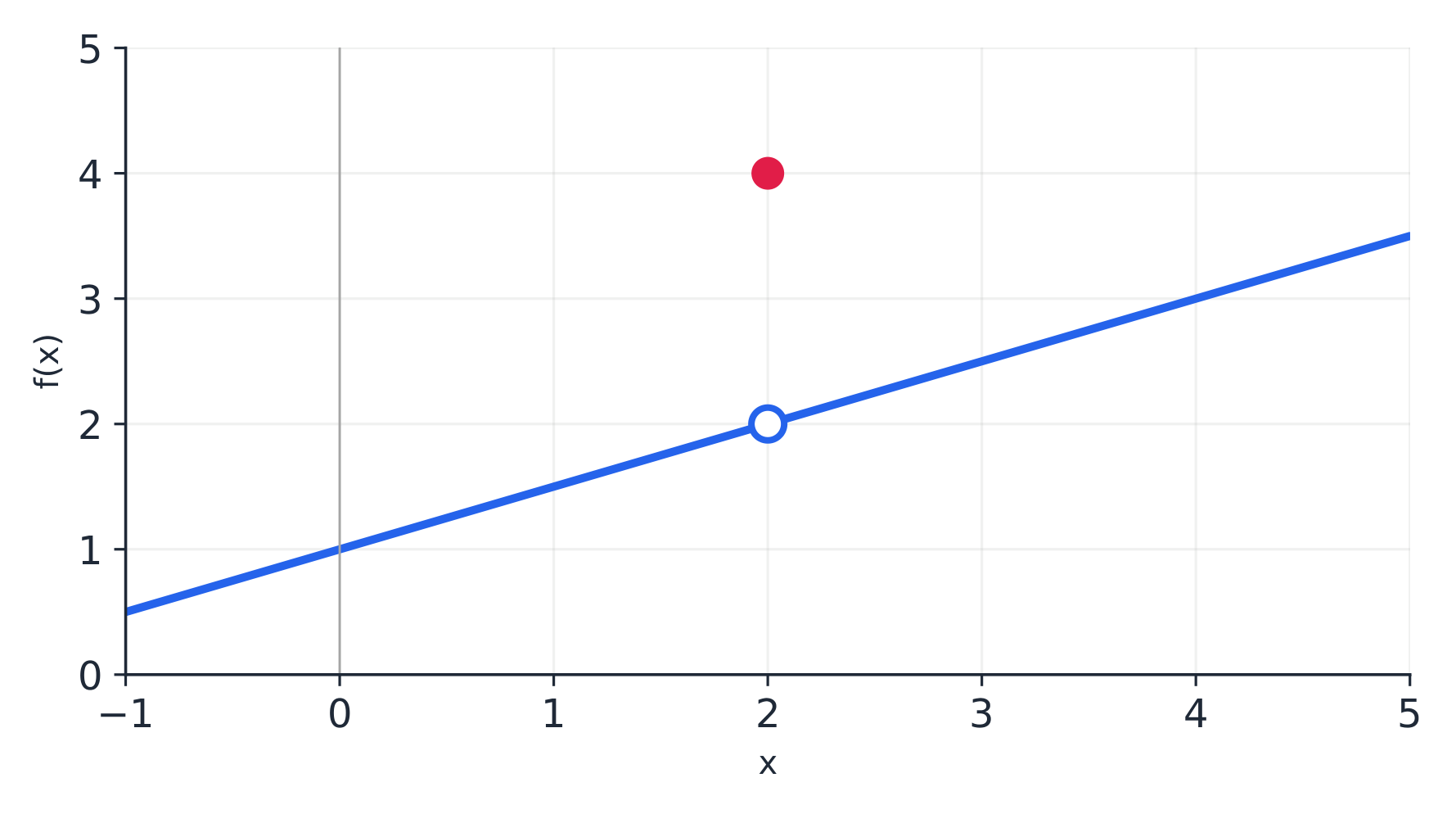
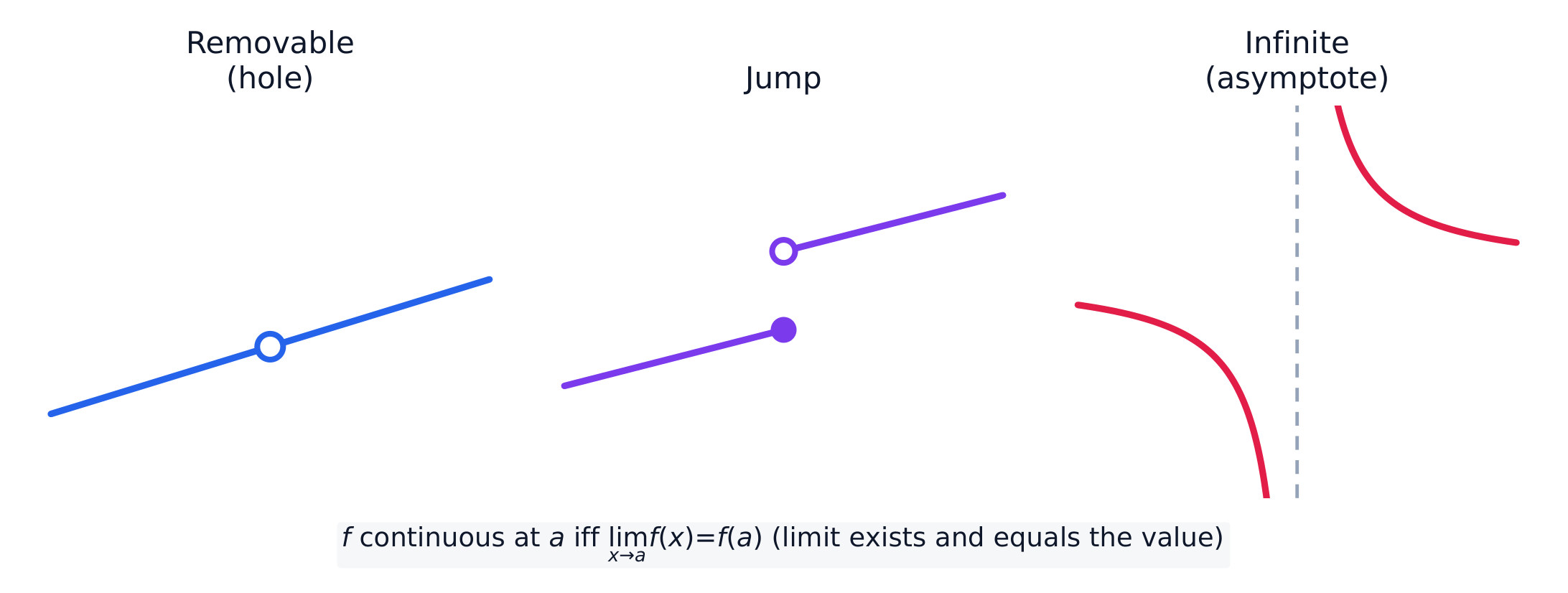
ถ้า ลิมิตมีอยู่ ที่รูพรุน ความไม่ต่อเนื่องนั้น กำจัดได้: กำหนดนิยามฟังก์ชันใหม่ที่จุดนั้นเพียงจุดเดียวให้มีค่าเท่ากับลิมิต และกราฟจะถูกซ่อมแซม secara_formally, set the missing value to $\displaystyle \lim_{x\to c} f(x)$.
แหล่งที่มา: คำอธิบายหลักสูตรและข้อสอบ College Board AP
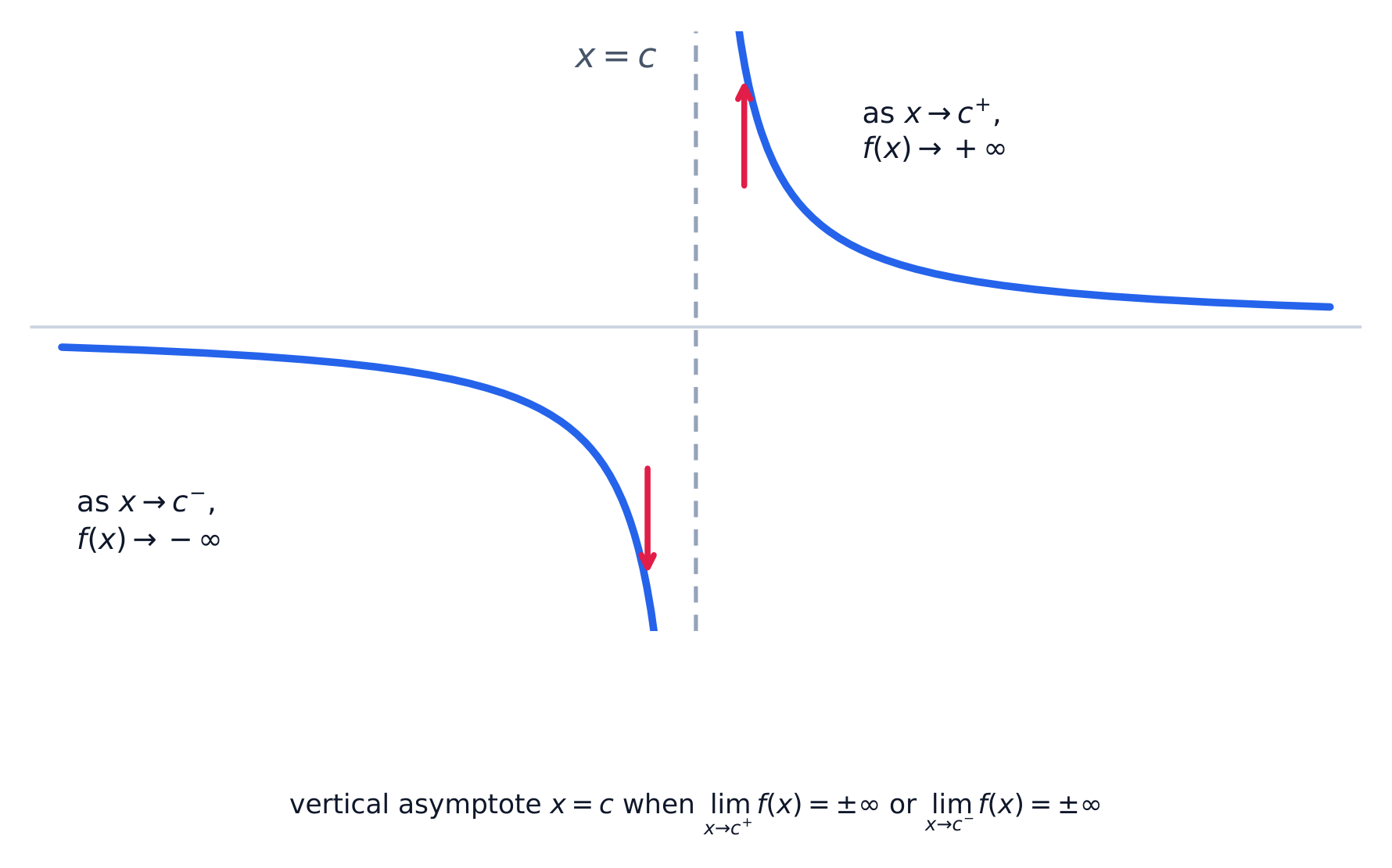
แนวคิดลิมิตขยายไปยัง ลิมิตอนันต์ เมื่อฟังก์ชันมีค่าเพิ่มขึ้นโดยไม่จำกัดnear $x=c$, we write $\lim_{x\to c} f(x) = \pm\infty$. This describes a vertical asymptote at $x=c$: the graph hugs the vertical line $x=c$ and shoots off toward $\pm\infty$.
near a vertical asymptote the graph hugs the line $x=c$. Here the left side falls to $-\infty$ and the right side climbs to $+\infty$, so the two-sided limit does not exist.
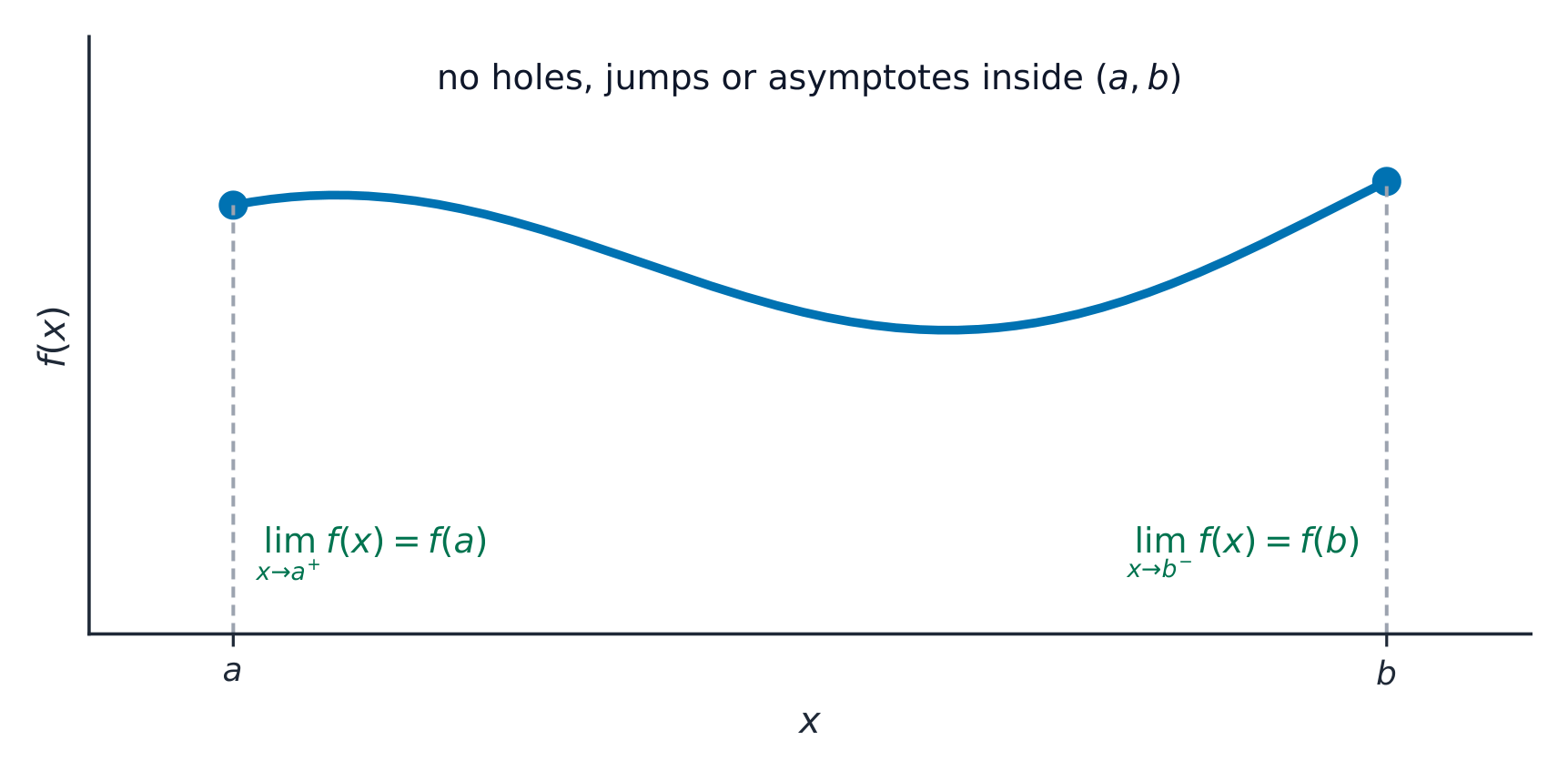
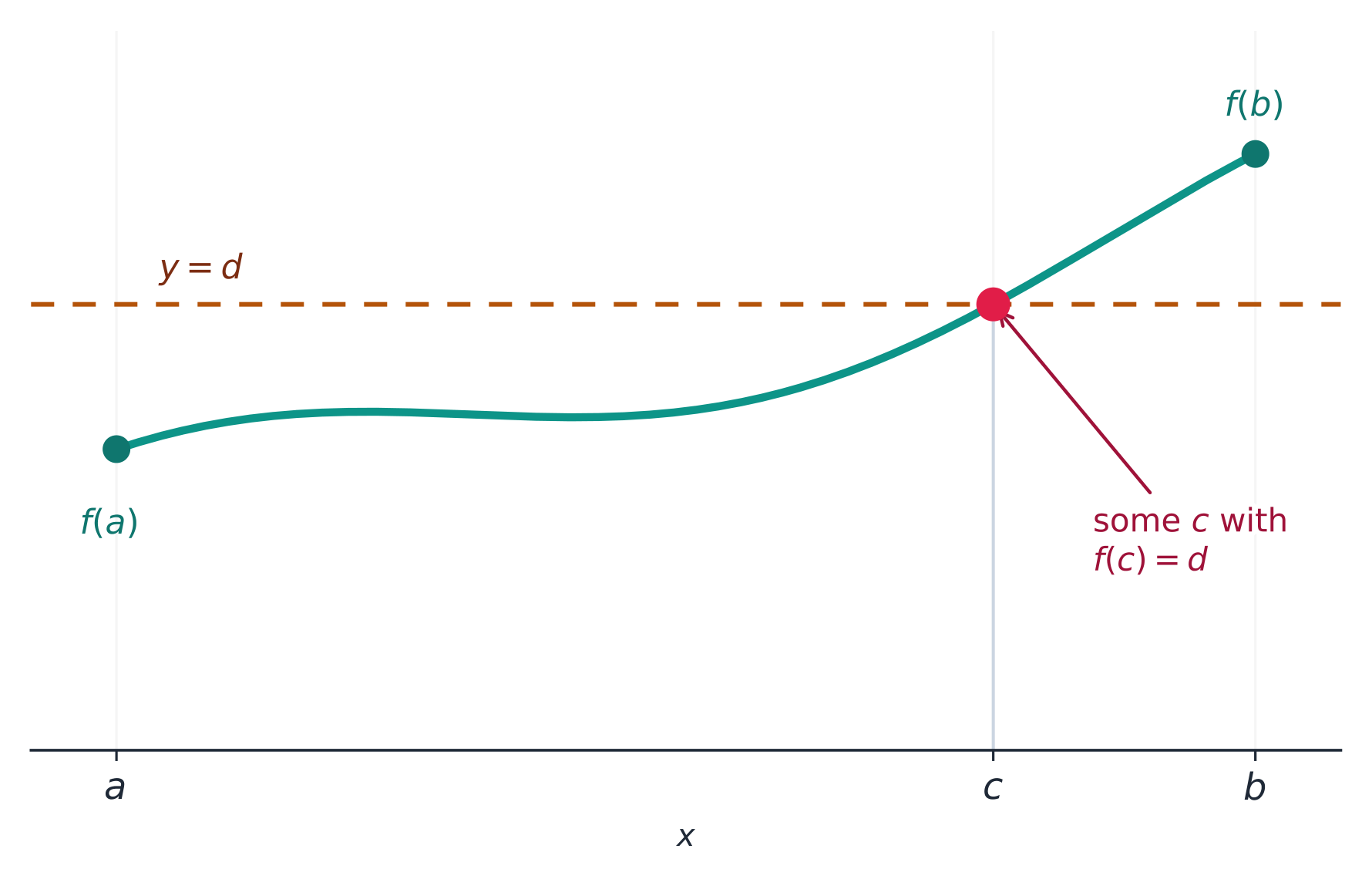
If $f$ is continuous on the closed interval $[a,b]$, and $d$ is any number between$f(a)$ and $f(b)$, then there is at least one number $c$ in $(a,b)$ with $f(c)=d$.
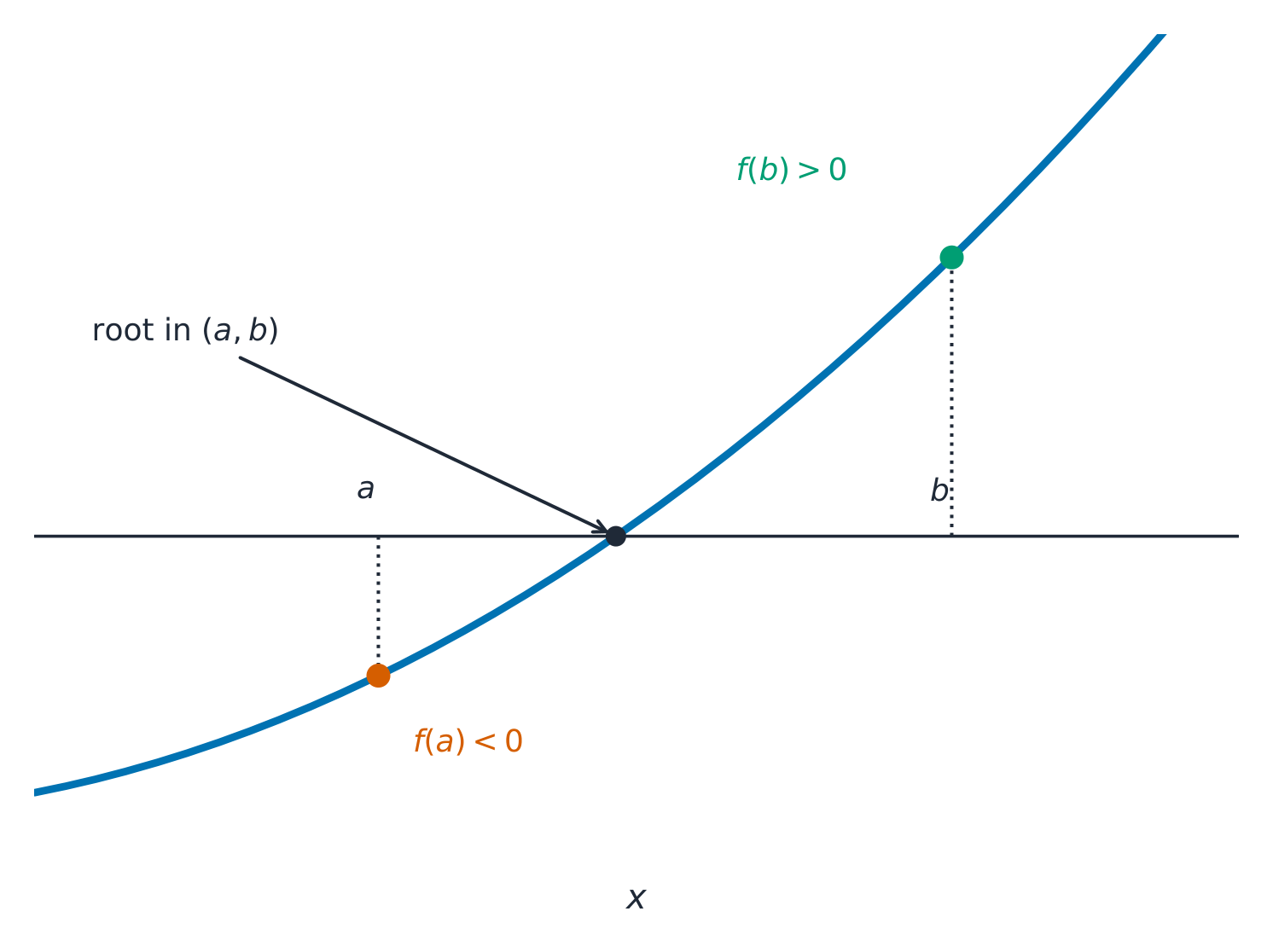
สัญญาณตรงข้ามของ f(a) และ f(b) บ่งชี้ว่ามีรากอยู่ระหว่าง a และ b