Defining Limits and Using Limit Notation
Introduced| English |
|---|
| limit/ˈlɪmɪt/ |
| approaches/əˈprəʊtʃɪz/ |
| one-sided limit/wʌn ˈsaɪdɪd ˈlɪmɪt/ |
| left-hand/left hænd/ |
| right-hand/raɪt hænd/ |
| two-sided limit/tuː ˈsaɪdɪd ˈlɪmɪt/ |
Where is the graph heading?
- Forget the single point for a moment — ask where the curve is heading as you slide $x$ toward a value.
- Follow $f(x)=\dfrac{x^2-1}{x-1}$ as $x$ gets close to $1$. Plug in $x=1$ and you get $\tfrac{0}{0}$ — undefined.
- Yet the outputs march steadily toward $2$: $f(0.9)=1.9$, $f(0.99)=1.99$, $f(1.01)=2.01$.
- The function has a hole at $x=1$, but it is clearly aiming at $2$. That target value is the limit 极限.
Watch where the curve heads
y = ax² + bx + c
Drag the coefficients and pick an input $c$ in your mind — the limit is the height the curve approaches near $c$, not the point itself.
Writing it down: limit notation
- We write $\displaystyle\lim_{x \to c} f(x) = L$ and read it "the limit of $f$ of $x$, as $x$ approaches 趋近 $c$, equals $L$."
- $c$ is the input we creep toward; $L$ is the output the function heads for.
- Crucially, $x \to c$ means "gets close to $c$" — never "equals $c$." We stay off the point itself.
- For our example: $\displaystyle\lim_{x \to 1}\dfrac{x^2-1}{x-1} = 2$, even though $f(1)$ does not exist.
The notation $\lim_{x \to c} f(x) = L$ means that as $x$...
$x \to c$ means $x$ approaches $c$ without touching it, and $f(x)$ heads toward $L$.
Evaluate $\displaystyle\lim_{x \to 3}\dfrac{x^2-9}{x-3}$.
Factor: $\frac{(x-3)(x+3)}{x-3}=x+3$ for $x\neq3$, which heads to $3+3=6$.
Coming from the left and the right
- You can approach $c$ from two directions, and each has its own one-sided limit 单侧极限.
- From below ($x$ slightly less than $c$): the left-hand 左侧 limit, $\displaystyle\lim_{x \to c^-} f(x)$.
- From above ($x$ slightly more than $c$): the right-hand 右侧 limit, $\displaystyle\lim_{x \to c^+} f(x)$.
- The small $-$ and $+$ signs sit up high on $c$ to show the direction of travel.
Which expression is the right-hand limit of $f$ at $c$?
The $+$ superscript on $c$ means $x$ approaches from above — the right-hand side.
The two sides must agree
- The ordinary two-sided limit 双侧极限 $\displaystyle\lim_{x \to c} f(x)$ exists only when both one-sided limits exist and are equal.
-
$$\lim_{x \to c^-} f(x) = \lim_{x \to c^+} f(x) = L \iff \lim_{x \to c} f(x) = L$$
- If the left side heads for one value and the right side for another, the two-sided limit does not exist (DNE).
A two-sided limit at $c$ exists only when the left-hand and right-hand limits are both present and ____.
The two one-sided limits must agree on a single value $L$.
Select all situations in which $\lim_{x\to c} f(x)$ does not exist.
A limit fails when the sides disagree, the value is unbounded, or it oscillates. A mismatch with $f(c)$ alone does not kill the limit — it only breaks continuity.
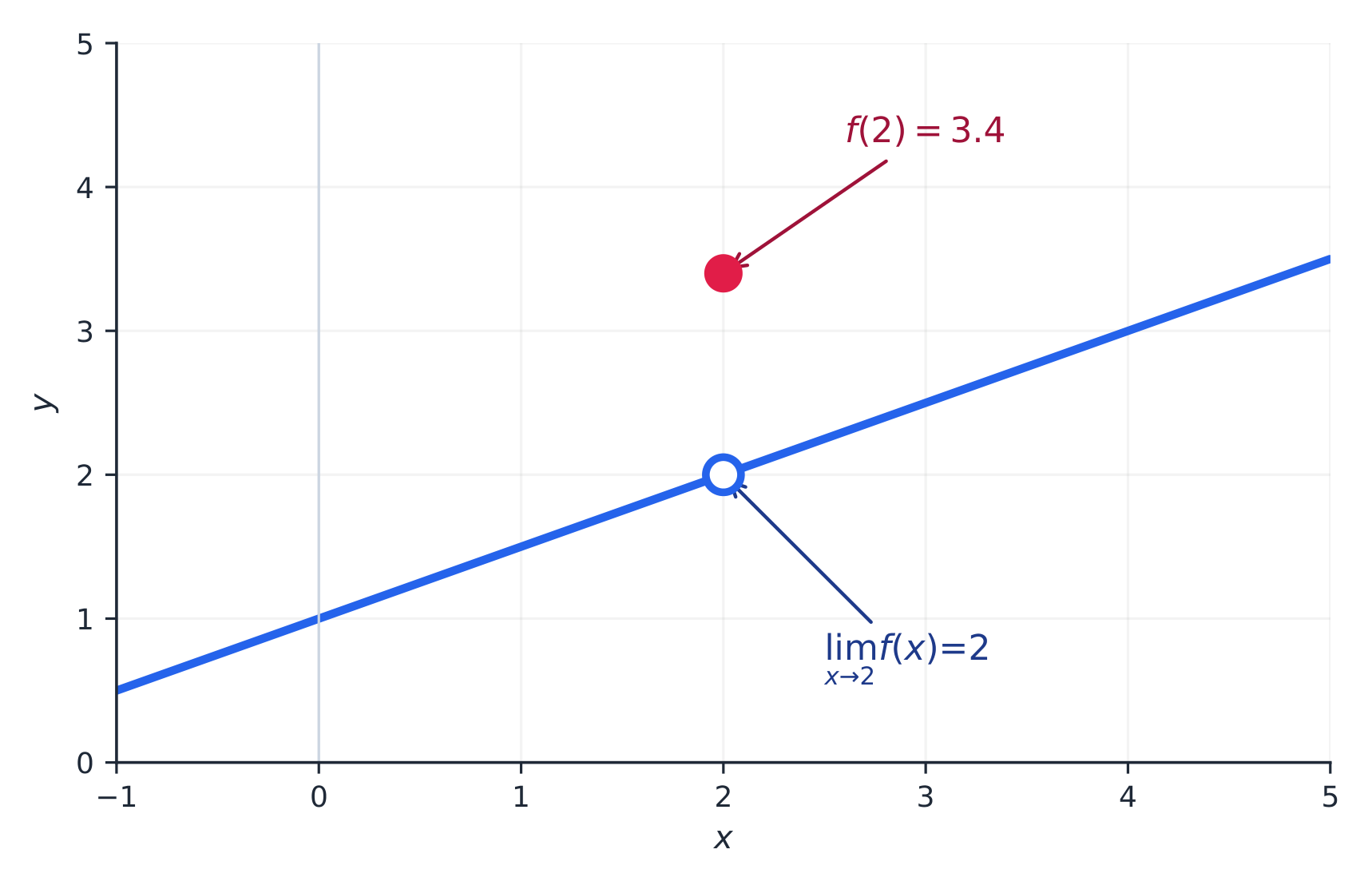
The limit is about the journey, not the destination point. $\lim_{x \to c} f(x)$ can exist even when $f(c)$ is undefined, and it can differ from $f(c)$ when the point is plotted somewhere off the curve. Never assume $\lim_{x\to c} f(x)=f(c)$ — that is a special case (continuity), not a rule.
If $f(c)$ is undefined, then $\lim_{x \to c} f(x)$ cannot exist.
The limit is about the approach, not the point. $\lim_{x\to 1}\frac{x^2-1}{x-1}=2$ even though $f(1)$ is undefined.
For a piecewise function, $\displaystyle\lim_{x\to 2^-} f(x) = 3$ and $\displaystyle\lim_{x\to 2^+} f(x) = 5$.
- The left side heads for $3$; the right side heads for $5$.
- They disagree, so $\displaystyle\lim_{x \to 2} f(x)$ does not exist — the graph jumps at $x=2$.
- This is true no matter what value (if any) is plotted at $x=2$.
$\displaystyle\lim_{x\to c} f(x)=L$ says $f(x)$ heads toward $L$ as $x$ nears $c$ from both sides — without ever touching $c$. The two-sided limit exists iff the left-hand and right-hand limits both exist and are equal. The limit describes where the function is going, which need not equal $f(c)$.