Connecting Infinite Limits and Vertical Asymptotes
Introduced 15:10
Limits & Continuity
Here is a puzzle. A car's speedometer reads sixty kilometres per hour. But what does speed mean at a single instant? Speed is distance divided by time. Yet at…
English narration · English and 中文 subtitles you can switch
In this lesson
| English | Meaning |
|---|---|
| infinite limit/ˈɪnfɪnət ˈlɪmɪt/ | Limit behaviour in which a function grows without bound in the positive or negative direction as its input approaches a specified value. |
| vertical asymptote/ˈvɜːtɪkl ˈæsɪmptəʊt/ | A vertical line approached by a curve as its output grows without bound near a particular input. |
When the output runs away to infinity
- Sometimes as $x\to c$ the function grows without bound. We write $\displaystyle\lim_{x\to c}f(x)=\infty$ (or $-\infty$): an infinite limit 无穷极限.
- "$=\infty$" describes how the limit fails. It is not a number, and the limit does not exist as a finite value.
Writing $\lim_{x\to c}f(x)=\infty$ means the limit exists as a finite number.
Difficulty 1/5 · 100 coins + a small bonus on first completion today
It is shorthand for unbounded growth; as a finite number the limit does not exist.
Read each side with a sign check
- Substitution gives nonzero over 0. Find the sign of the numerator and of the tiny denominator on each side; the signs decide $+\infty$ or $-\infty$.
- $\dfrac1{x-2}$: for $x\to2^-$ the bottom is a tiny negative, so $\to-\infty$; for $x\to2^+$ it is a tiny positive, so $\to+\infty$.
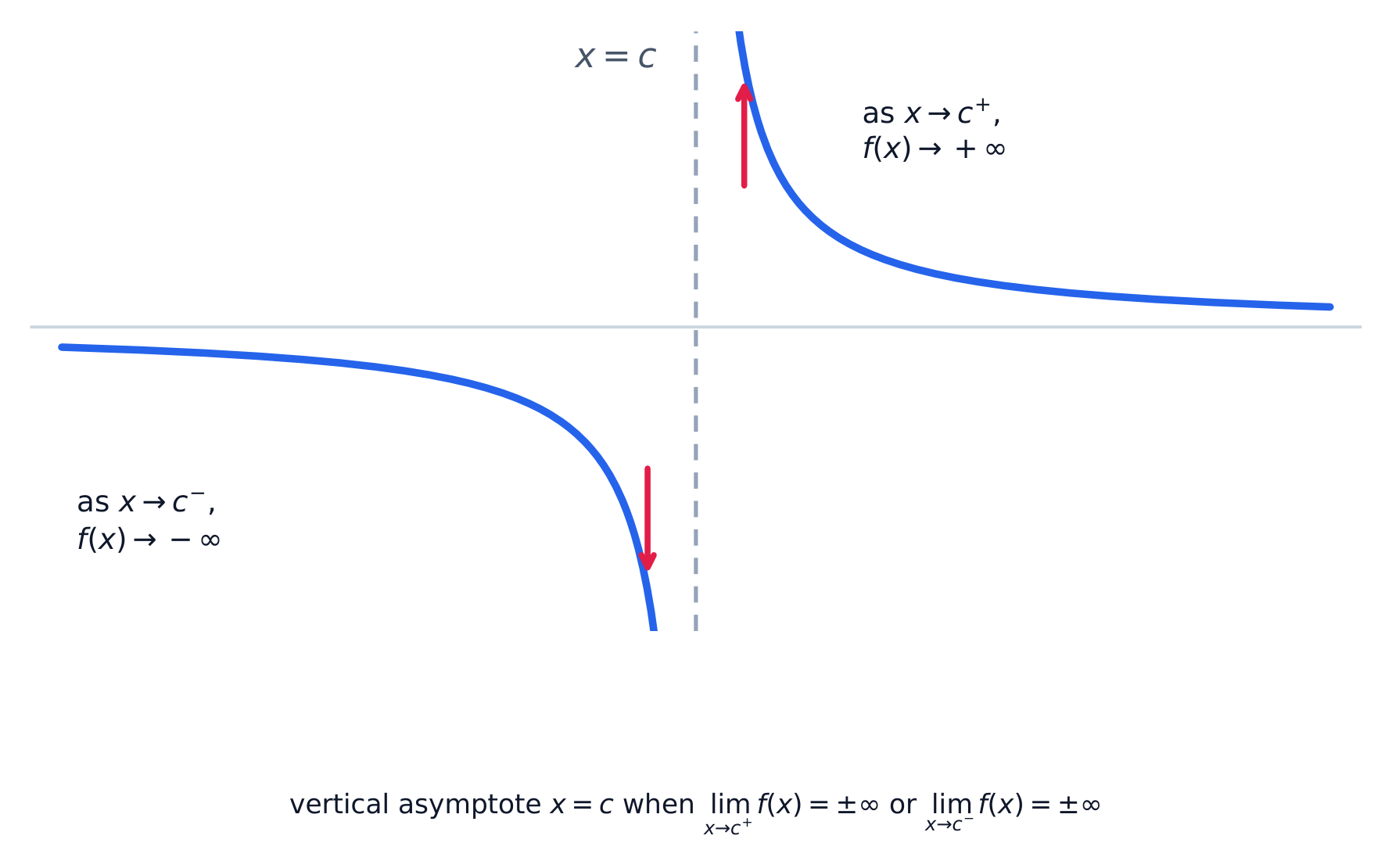
A vertical asymptote 竖直渐近线 x = c: f grows without bound as x approaches c
Watch it climb the asymptote
y = a / (x − b)
As $x$ nears $b$, the reciprocal shoots to $+\infty$ from one side and $-\infty$ from the other — the line $x=b$ is a vertical asymptote.
For $f(x)=\dfrac1{x-2}$, what is $\displaystyle\lim_{x\to2^-}f(x)$?
Difficulty 1/5 · 100 coins + a small bonus on first completion today
Just left of $2$, $x-2$ is a tiny negative, so $\frac{1}{\text{tiny}^-}\to-\infty$.
Spotting the vertical asymptote
- A vertical asymptote 竖直渐近线 $x=c$ is where the graph shoots to $\pm\infty$. For a rational function: the denominator is 0 at $c$ and the numerator is not (after cancelling).
- If both are 0, factor first: it may be a removable hole instead.
At what $x$-value does $f(x)=\dfrac{x+1}{x-4}$ have a vertical asymptote?
Difficulty 2/5 · 140 coins + a small bonus on first completion today
Denominator zero at $x=4$, numerator $=5\neq0$ → asymptote $x=4$.
The line $x=c$ that a graph hugs as it shoots to $\pm\infty$ is a vertical ____.
Difficulty 1/5 · 100 coins + a small bonus on first completion today
It marks an infinite discontinuity.
A negative numerator. Find $\displaystyle\lim_{x\to3^+}\dfrac{x-5}{x-3}$ and $\displaystyle\lim_{x\to3^-}\dfrac{x-5}{x-3}$.
- Near 3 the top is about $-2$ (negative). From the right the bottom is a tiny positive: negative ÷ positive → $-\infty$.
- From the left the bottom is a tiny negative: negative ÷ negative → $+\infty$.
What is $\displaystyle\lim_{x\to4^-}\dfrac{x+3}{x-4}$?
Difficulty 1/5 · 100 coins + a small bonus on first completion today
The top is about 7 (positive). For $x$ just below 4, $x-4$ is a tiny negative. Positive ÷ tiny negative → $-\infty$.
A squared denominator. Find $\displaystyle\lim_{x\to1}\dfrac{x-5}{(x-1)^2}$.
- $(x-1)^2$ is a tiny positive on both sides; the top is about $-4$.
- Both sides go to $-\infty$, so we may write $\displaystyle\lim_{x\to1}\dfrac{x-5}{(x-1)^2}=-\infty$.
What is $\displaystyle\lim_{x\to-2}\dfrac{x+1}{(x+2)^2}$?
Difficulty 1/5 · 100 coins + a small bonus on first completion today
Near $-2$ the top is about $-1$; $(x+2)^2$ is a tiny positive on both sides. Negative ÷ tiny positive → $-\infty$ from both sides.
Hole or asymptote? Find the vertical asymptotes of $\dfrac{x^2-4}{x^2-x-2}$.
- $\dfrac{(x-2)(x+2)}{(x-2)(x+1)}=\dfrac{x+2}{x+1}$ for $x\neq2$.
- $x=2$ cancels: a hole. $x=-1$ stays (top $=1$): the only vertical asymptote is $x=-1$.
For $\dfrac{x^2-9}{x-3}$ at $x=3$, both top and bottom are zero. This is...
Difficulty 1/5 · 100 coins + a small bonus on first completion today
Both zero means cancel: $x+3\to6$. It is a removable hole, not an asymptote.
A rational function has a vertical asymptote at $x=c$ when which hold?
Difficulty 2/5 · 140 coins + a small bonus on first completion today
Denominator zero, numerator nonzero → blow-up. If the numerator is also zero, it may be a removable hole.
For $f(x)=\dfrac{x+1}{x-2}$, the denominator is 0 at $x=2$ but the numerator is not. What does the graph do at $x=2$?
A non-zero over zero blows up.
At $x=c$ the denominator is 0 and the numerator is not (after cancelling). That means...
Difficulty 1/5 · 100 coins + a small bonus on first completion today
The function is unbounded there.
- A zero denominator is not automatically an asymptote. Cancel first.
- Don't stop at "$\infty$": check the sign on each side. Opposite signs mean the two-sided limit does not exist, not even as $\pm\infty$.
- An even power like $(x-1)^2$ keeps the same sign on both sides.
An infinite limit $\lim_{x\to c}f(x)=\pm\infty$ means unbounded growth. It is a description, not a value. Use the signs of the top and the tiny bottom on each side. After cancelling, a zero denominator with a nonzero numerator gives a vertical asymptote.
What went wrong? Only the site team sees this.