| Enduring Understanding | Learning Objective | Essential Knowledge |
|---|---|---|
CHA-4 | CHA-4.A |
|
Integration and Accumulation of Change
AP Calculus AB · Topic 6
 10:18
10:18
Accumulation & Integration
Differentiation found rates of change. Integration runs it in reverse: given a rate, it finds the total accumulated change. Here is the key picture. Water…
English narration · English + 中文 subtitles burned in
6.1
Exploring Accumulations of Change
Syllabus
Source: College Board AP Course and Exam Description
Differentiation found rates. Integration runs the idea in reverse: given a rate of change, it finds the accumulated change 累积变化. The key picture: the area between the graph of a rate function and the $x$-axis gives the total accumulation.
- If the rate is positive over an interval, the accumulated change is positive; if negative, negative. Area below the axis counts as negative.
- Simple regions (triangles, rectangles) can be found with geometry 几何.
- Units: the area's unit is the rate's unit times the input's unit. A rate in vehicles-per-hour times hours gives vehicles.
Vocabulary
Train
| English |
|---|
| accumulated change/əˈkjuːmjʊleɪtɪd tʃeɪndʒ/ |
| geometry/dʒiˈɒmətri/ |
6.2
Approximating Areas with Riemann Sums

Syllabus
| Enduring Understanding | Learning Objective | Essential Knowledge |
|---|---|---|
LIM-5 | LIM-5.A |
|
Source: College Board AP Course and Exam Description
When exact area is hard, approximate it with a Riemann sum 黎曼和 – split the interval into subintervals and add up rectangle (or trapezoid) areas. The four standard estimates:
- Left Riemann sum – rectangle height from the left endpoint of each subinterval.
- Right Riemann sum – height from the right endpoint.
- Midpoint Riemann sum – height from the midpoint 中点.
- Trapezoidal sum 梯形法 – average the two endpoint heights (a trapezoid).
Subintervals may be uniform (equal width) or nonuniform – read widths from the table.
Over- or underestimate? Judge from the behavior of the function: for an increasing function, a left sum underestimates and a right sum overestimates; a trapezoidal sum overestimates when the function is concave up and underestimates when concave down. Exam parts ask you to state which and why.
Worked example. A table gives $f(0)=3$, $f(2)=5$, $f(4)=8$, $f(6)=9$. Estimate $\int_0^6 f(x)\,dx$ with a right Riemann sum of three equal subintervals ($\Delta x=2$). Use the right endpoint of each strip:
$$2\big(f(2)+f(4)+f(6)\big)=2(5+8+9)=44.$$
Since $f$ is increasing, this right sum is an overestimate; the left sum $2(3+5+8)=32$ would be an underestimate.
Explore
Approximate area with rectangles
y = ax³ + bx² + cx + d
A Riemann sum approximates the area under a curve with rectangles. Add more, thinner rectangles and the estimate converges to the exact definite integral.
Vocabulary
Train
| English |
|---|
| Riemann sum/ˈriːmən sʌm/ |
| midpoint/ˈmɪdpɔɪnt/ |
| Trapezoidal sum/ˈtræpɪzɔɪdl sʌm/ |
6.3
Riemann Sums and Integral Notation
Syllabus
| Enduring Understanding | Learning Objective | Essential Knowledge |
|---|---|---|
LIM-5 | LIM-5.B |
|
LIM-5.C |
|
Source: College Board AP Course and Exam Description
As the subinterval widths shrink to zero, the Riemann sum approaches an exact value – the definite integral 定积分:
$$\int_a^b f(x)\,dx = \lim_{\max \Delta x_i \to 0}\sum_{i=1}^{n} f(x_i^{*})\,\Delta x_i.$$
Here $\Delta x_i$ is the width of the $i$th subinterval and $x_i^{*}$ a point inside it. So a definite integral is the limit of a Riemann sum, and you should be able to translate each into the other.
Vocabulary
Train
| English |
|---|
| definite integral/ˈdefɪnət ˈɪntɪɡrəl/ |
6.4
The Fundamental Theorem of Calculus and Accumulation Functions
Syllabus
| Enduring Understanding | Learning Objective | Essential Knowledge |
|---|---|---|
FUN-5 | FUN-5.A |
|
Source: College Board AP Course and Exam Description
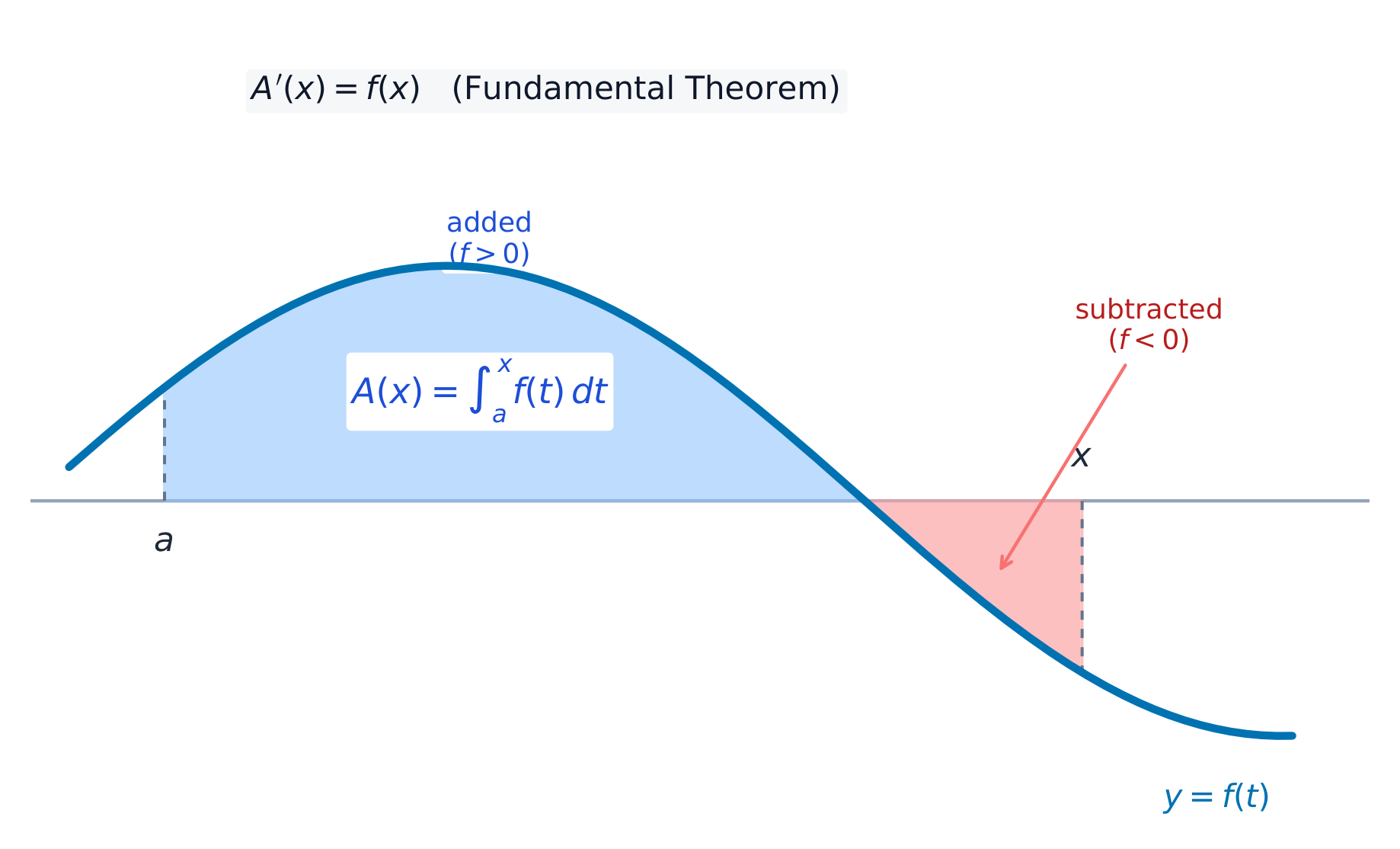
A definite integral with a variable upper limit defines a new accumulation function 累积函数. The Fundamental Theorem of Calculus 微积分基本定理 (first part) says differentiation undoes this accumulation: if $f$ is continuous, then
$$\frac{d}{dx}\int_a^x f(t)\,dt = f(x).$$
So if $g(x)=\int_a^x f(t)\,dt$, then $g'(x)=f(x)$ and $g''(x)=f'(x)$. This is the engine behind the very common "let $g(x)=\int_a^x f(t)\,dt$" questions.
Explore
Accumulate area as an integral
y = ax³ + bx² + cx + d
An accumulation function $\int_a^x f(t)\,dt$ builds up signed area as $x$ moves. The Fundamental Theorem says its derivative is just $f(x)$.
Vocabulary
Train
| English |
|---|
| accumulation function/əˌkjuːmjʊˈleɪʃn ˈfʌŋkʃn/ |
| Fundamental Theorem of Calculus/ˌfʌndəˈmentl ˈθɪərəm ɒv ˈkælkjʊləs/ |
6.5
Behavior of Accumulation Functions
Syllabus
| Enduring Understanding | Learning Objective | Essential Knowledge |
|---|---|---|
FUN-5 | FUN-5.A |
|
Source: College Board AP Course and Exam Description
Because $g'(x)=f(x)$, everything from Unit 5 applies to an accumulation function using the graph of $f$:
- $g$ is increasing where $f>0$ and decreasing where $f<0$;
- $g$ has a local extremum where $f$ crosses zero (with a sign change);
- $g$ is concave up where $f$ is increasing; inflection points of $g$ occur where $f$ has a local extremum.
To get a value of $g$, compute the signed area: $g(x)=\int_a^x f(t)\,dt$, adding areas above the axis and subtracting areas below.
6.6
Properties of Definite Integrals
Syllabus
| Enduring Understanding | Learning Objective | Essential Knowledge |
|---|---|---|
FUN-6 | FUN-6.A |
|
Source: College Board AP Course and Exam Description
These properties simplify computation and appear constantly:
$$\int_a^a f = 0,\qquad \int_b^a f = -\int_a^b f,\qquad \int_a^b \big(f\pm g\big) = \int_a^b f \pm \int_a^b g,$$
$$\int_a^b k\,f = k\int_a^b f,\qquad \int_a^c f + \int_c^b f = \int_a^b f.$$
The last (splitting at an interior point $c$) lets you build a total integral from pieces read off a graph.
6.7
The Fundamental Theorem and Evaluating Integrals
Syllabus
| Enduring Understanding | Learning Objective | Essential Knowledge |
|---|---|---|
FUN-6 | FUN-6.B |
|
Source: College Board AP Course and Exam Description
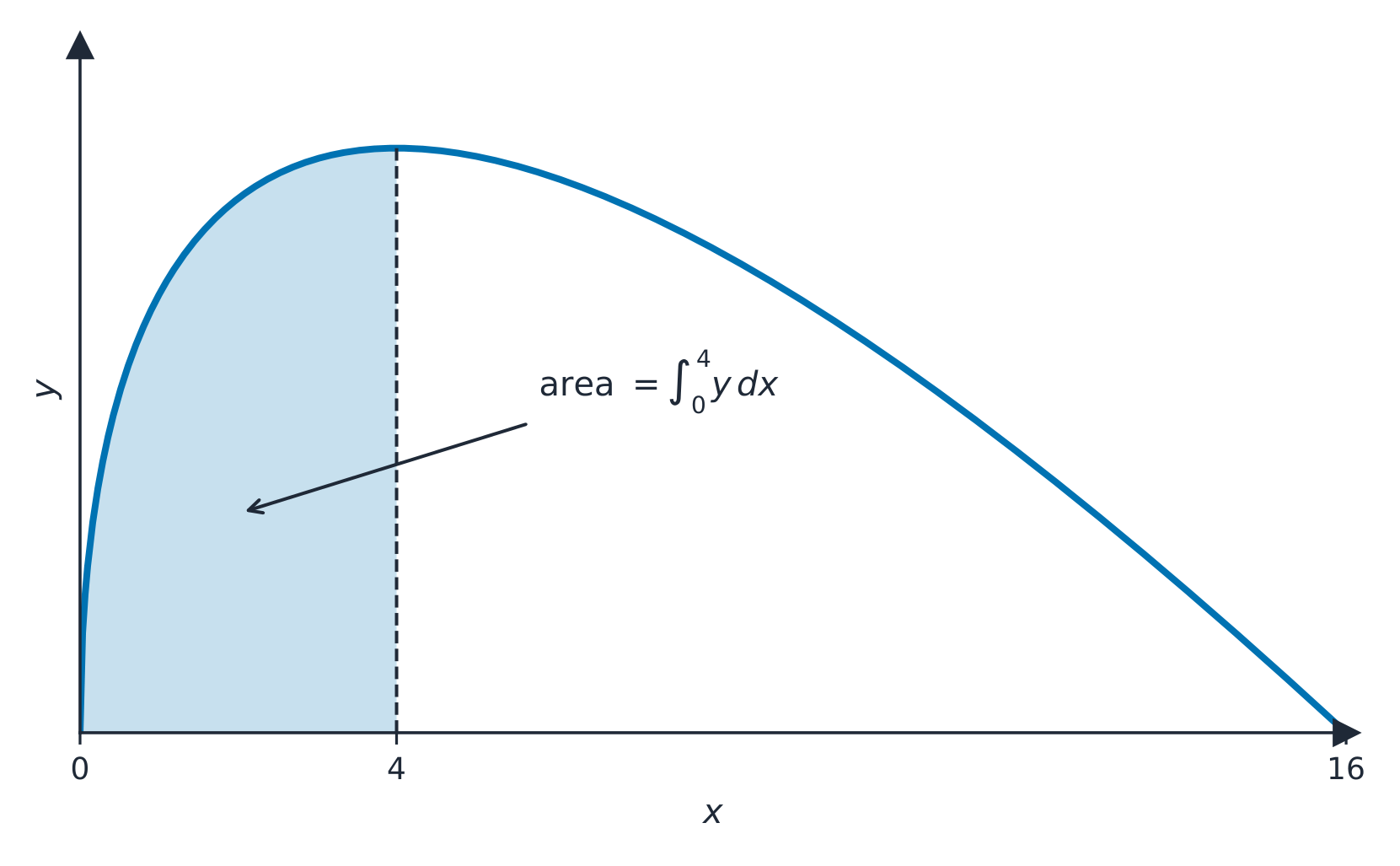
The second part of the Fundamental Theorem evaluates a definite integral using an antiderivative 原函数. If $F'=f$, then
$$\int_a^b f(x)\,dx = F(b)-F(a).$$
So: find any antiderivative $F$, then subtract its values at the two limits. This is how most exact integrals are computed. It also gives the net change view: $\int_a^b g'(t)\,dt = g(b)-g(a)$, so a starting value plus accumulated change gives a later value, e.g. $g(5)=g(0)+\int_0^5 g'(t)\,dt$.
Worked example. Evaluate $\int_1^3 (2x+1)\,dx$. An antiderivative is $F(x)=x^2+x$, so
$$\int_1^3(2x+1)\,dx=F(3)-F(1)=(9+3)-(1+1)=12-2=10.$$
Vocabulary
Train
| English |
|---|
| antiderivative/ˌæntɪdɪˈrɪvətɪv/ |
6.8
Antiderivatives and Indefinite Integrals
Syllabus
| Enduring Understanding | Learning Objective | Essential Knowledge |
|---|---|---|
FUN-6 | FUN-6.C |
|
Source: College Board AP Course and Exam Description
An indefinite integral 不定积分 is the family of all antiderivatives, written with a constant of integration 积分常数:
$$\int f(x)\,dx = F(x)+C.$$
Reverse each derivative rule to build the basic antiderivatives:
$$\int x^n\,dx = \frac{x^{n+1}}{n+1}+C\ (n\neq -1),\quad \int \frac{1}{x}\,dx = \ln|x|+C,\quad \int e^x\,dx = e^x+C,$$
$$\int \cos x\,dx = \sin x + C,\quad \int \sin x\,dx = -\cos x + C.$$
Vocabulary
Train
| English |
|---|
| indefinite integral/ɪnˈdefɪnət ˈɪntɪɡrəl/ |
| constant of integration/ˈkɒnstənt ɒv ˌɪntɪˈɡreɪʃn/ |
6.9
Integrating Using Substitution
Syllabus
| Enduring Understanding | Learning Objective | Essential Knowledge |
|---|---|---|
FUN-6 | FUN-6.D |
|
Source: College Board AP Course and Exam Description
$u$-substitution 换元积分法 reverses the chain rule. Choose an inside function $u=g(x)$, so $du=g'(x)\,dx$, and rewrite the integral entirely in $u$:
$$\int f\big(g(x)\big)g'(x)\,dx = \int f(u)\,du.$$
Look for a function and its derivative both present. For a definite integral, either change the limits to $u$-values or convert back to $x$ before substituting the original limits.
Worked example. Evaluate $\int 2x\cos(x^2)\,dx$. The inside function is $u=x^2$, whose derivative $2x\,dx=du$ is present, so
$$\int 2x\cos(x^2)\,dx=\int \cos u\,du=\sin u + C=\sin(x^2)+C.$$
Spotting that $2x$ is exactly $\dfrac{du}{dx}$ is the whole trick.
6.10
Long Division and Completing the Square
Syllabus
| Enduring Understanding | Learning Objective | Essential Knowledge |
|---|---|---|
FUN-6 | FUN-6.D |
|
Source: College Board AP Course and Exam Description
Two algebraic set-up moves let more integrals fit the basic forms: polynomial long division 多项式长除法 when the top degree is $\ge$ the bottom degree of a rational function, and completing the square 配方法 to turn a quadratic denominator into a form that integrates to an arctangent or logarithm.
Vocabulary
Train
| English |
|---|
| polynomial long division/ˌpɒlɪˈnəʊmɪəl lɒŋ dɪˈvɪʒn/ |
| completing the square/kəmˈpliːtɪŋ ðə skweə/ |
6.14
Selecting Techniques for Antidifferentiation
Syllabus
This topic is intended to focus on the skill of selecting an appropriate procedure for antidifferentiation. Students should be given opportunities to practice when and how to apply all learning objectives relating to antidifferentiation.
Source: College Board AP Course and Exam Description
A skill topic: match the integral to a method. Try a basic antiderivative first; look for a $u$-substitution (an inside function whose derivative is also present); use algebra (division, completing the square, splitting a fraction) to reshape the integrand into a standard form. Naming the structure first prevents wasted effort.
6.14
Exam tips
- Integration is antidifferentiation; use the power rule $\int x^n\,dx=\tfrac{x^{n+1}}{n+1}+C$ and don't forget the $+C$.
- The Fundamental Theorem links the two: $\int_a^b f'(x)\,dx=f(b)-f(a)$, and $\tfrac{d}{dx}\int_a^x f(t)\,dt=f(x)$.
- Approximate a definite integral with Riemann sums or the trapezoidal rule from a table of values.
- A definite integral is a signed area (below the axis counts negative); split at sign changes for total area.
- Use u-substitution and remember to change the limits (or back-substitute) accordingly.
Vocabulary
Train
| English |
|---|
| u-substitution/juː ˌsʌbstɪˈtjuːʃn/ |
Interactive lessons on this topic
Work through it step by step, with instant-check exercises.
- Exploring Accumulations of Change
- Approximating Areas with Riemann Sums
- Riemann Sums, Summation Notation, and Definite Integral Notation
- The Fundamental Theorem of Calculus and Accumulation Functions
- Interpreting the Behavior of Accumulation Functions Involving Area
- Applying Properties of Definite Integrals
- The Fundamental Theorem of Calculus and Definite Integrals
- Finding Antiderivatives and Indefinite Integrals: Basic Rules and Notation
- Integrating Using Substitution
- Integrating Functions Using Long Division and Completing the Square
- Selecting Techniques for Antidifferentiation