| Enduring Understanding | Learning Objective | Essential Knowledge |
|---|---|---|
FUN-7 | FUN-7.A |
|
Differential Equations
AP Calculus AB · Topic 7
 5:24
5:24
Differential Equations
Many real situations are described not by a formula, but by a rate. A population grows faster when it is larger. A hot drink cools faster when it is hotter. An…
English narration · English + 中文 subtitles burned in
7.1
Modeling Situations with Differential Equations
Syllabus
Source: College Board AP Course and Exam Description
A differential equation 微分方程 is an equation that relates a function to its own derivatives. It describes a situation by its rate of change. For example, "the rate of change of a quantity is proportional to its size" becomes
$$\frac{dy}{dt} = ky.$$
Learning to translate a sentence about a rate into a differential equation is the first skill of this unit.
Vocabulary
Train
| English |
|---|
| differential equation/ˌdɪfəˈrenʃl ɪˈkweɪʒn/ |
7.2
Verifying Solutions for Differential Equations
Syllabus
| Enduring Understanding | Learning Objective | Essential Knowledge |
|---|---|---|
FUN-7 | FUN-7.B |
|
Source: College Board AP Course and Exam Description
A solution 解 of a differential equation is a function that makes it true. You can verify a proposed solution by differentiating it and substituting into the equation: if both sides match, it is a solution. Note a differential equation usually has infinitely many solutions – a whole family – differing by a constant.
Vocabulary
Train
| English |
|---|
| solution/səˈluːʃn/ |
7.3
Sketching Slope Fields

Syllabus
| Enduring Understanding | Learning Objective | Essential Knowledge |
|---|---|---|
FUN-7 | FUN-7.C |
|
Source: College Board AP Course and Exam Description
A slope field 斜率场 draws the differential equation as a grid of short segments: at each point $(x,y)$ the segment has slope $\dfrac{dy}{dx}$ evaluated there. To sketch one, plug several points into the right-hand side and draw a small segment with that slope at each. The picture shows the shape of the solution curves without solving.
Exam skill. A common part gives a portion of a slope field and asks you to sketch the particular solution through a given point – start at the point and follow the segments, staying tangent to them.
Explore
Read a differential equation as a slope field
A slope field draws the slope $dy/dx$ at each point. A solution curve threads through, always tangent to the little segments — you can sketch it by following the flow.
Vocabulary
Train
| English |
|---|
| slope field/sləʊp fiːld/ |
7.4
Reasoning Using Slope Fields
Syllabus
| Enduring Understanding | Learning Objective | Essential Knowledge |
|---|---|---|
FUN-7 | FUN-7.C |
|
Source: College Board AP Course and Exam Description
Solutions to a differential equation are functions or families of functions. Read a slope field to reason about behavior: where the segments are flat ($\tfrac{dy}{dx}=0$) the solution is momentarily level; where they steepen the solution rises or falls faster; horizontal rows of equal slope suggest the rate depends only on $y$ (or only on $x$).
7.6
Finding General Solutions Using Separation of Variables
Syllabus
| Enduring Understanding | Learning Objective | Essential Knowledge |
|---|---|---|
FUN-7 | FUN-7.D |
|
Source: College Board AP Course and Exam Description
Many exam differential equations are solved by separation of variables 分离变量法. If $\dfrac{dy}{dx}$ factors into a function of $x$ times a function of $y$, move all $y$'s to one side and all $x$'s to the other, then integrate both sides:
$$\frac{dy}{dx}=g(x)h(y)\;\Longrightarrow\;\int \frac{dy}{h(y)} = \int g(x)\,dx.$$
Add the constant of integration once (on the $x$-side). This gives the general solution 通解.
Worked example. Solve $\dfrac{dy}{dx}=xy$ with the initial condition $y(0)=2$. Separate and integrate:
$$\int\frac{dy}{y}=\int x\,dx\;\Rightarrow\;\ln|y|=\frac{x^2}{2}+C\;\Rightarrow\;y=Ae^{x^2/2}.$$
Applying $y(0)=2$ gives $A=2$, so the particular solution is $y=2e^{x^2/2}$.
Vocabulary
Train
| English |
|---|
| separation of variables/ˌsepəˈreɪʃn ɒv ˈveərɪəblz/ |
| general solution/ˈdʒenərəl səˈluːʃn/ |
7.7
Finding Particular Solutions Using Initial Conditions and Separation of Variables
Syllabus
| Enduring Understanding | Learning Objective | Essential Knowledge |
|---|---|---|
FUN-7 | FUN-7.E |
|
Source: College Board AP Course and Exam Description
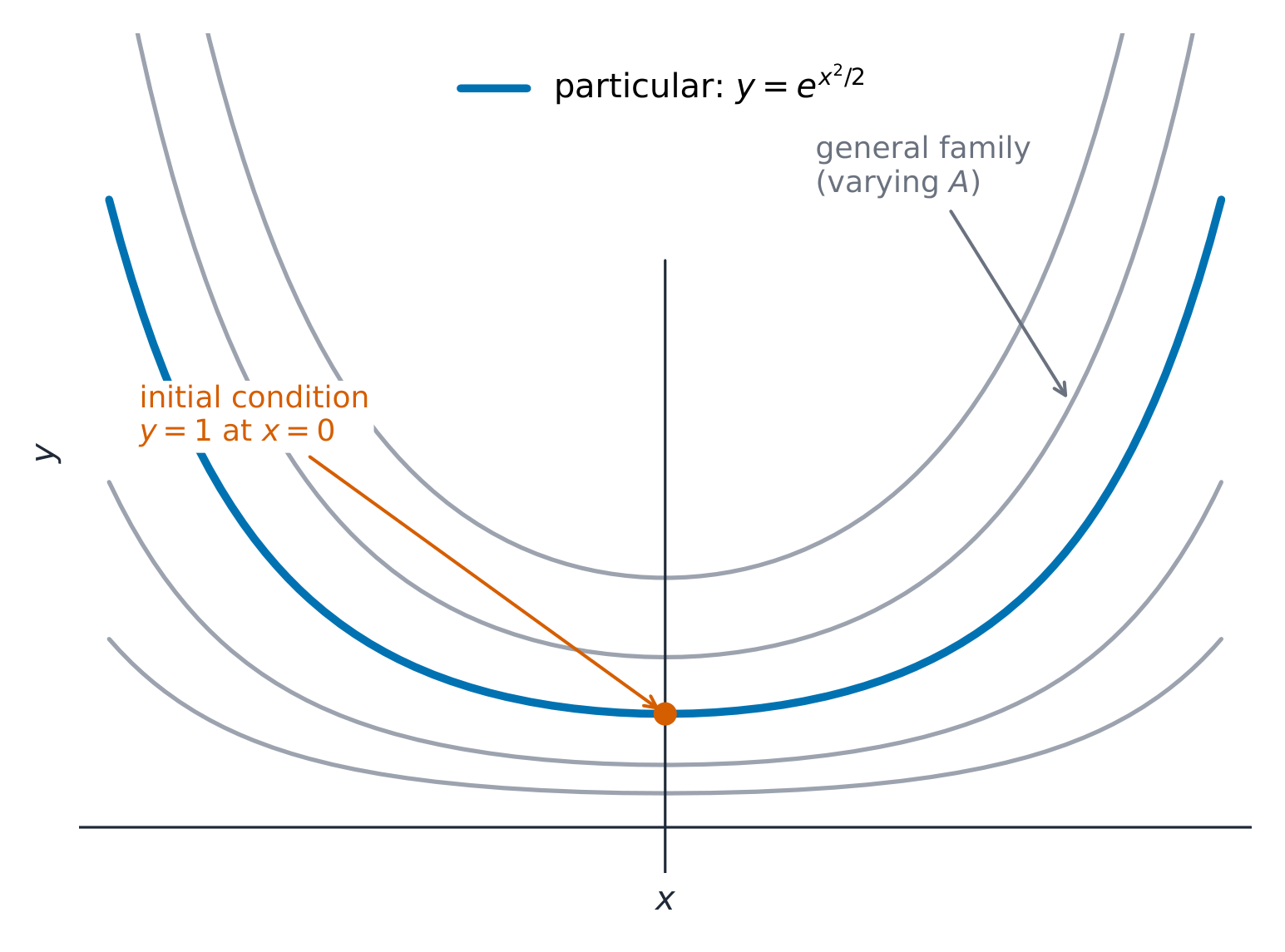
An initial condition 初始条件 – a known point $(x_0,y_0)$ – pins down one curve from the family. Substitute it to solve for the constant $C$; the result is the particular solution 特解. There is exactly one solution through a given point. Watch for domain restrictions 定义域限制: keep the branch that contains the initial point (for example, the correct sign of a square root).
Vocabulary
Train
| English |
|---|
| initial condition/ɪˈnɪʃl kənˈdɪʃn/ |
| particular solution/pəˈtɪkjʊlə səˈluːʃn/ |
| domain restrictions/dəˈmeɪn rɪˈstrɪkʃnz/ |
7.8
Exponential Models with Differential Equations
Syllabus
| Enduring Understanding | Learning Objective | Essential Knowledge |
|---|---|---|
FUN-7 | FUN-7.F |
|
FUN-7.G |
|
Source: College Board AP Course and Exam Description
The most important model is exponential growth and decay 指数增长与衰减. The equation $\dfrac{dy}{dt}=ky$ (rate proportional to size) has the solution:
$$y = y_0\,e^{kt},$$
where $y_0$ is the value at $t=0$. Here $k>0$ gives growth and $k<0$ gives decay. You can derive this by separation of variables ($\int \tfrac{dy}{y} = \int k\,dt$), and it models processes like population growth, radioactive decay, and Newton's law of cooling. A follow-up part may ask for $\dfrac{d^2y}{dt^2}$: differentiate $\dfrac{dy}{dt}=ky$ again (using $\dfrac{dy}{dt}=ky$) to express it in terms of $y$.
Worked example. A sample decays by $\dfrac{dy}{dt}=-0.10\,y$ (in years) from $y_0=50\ \text{g}$. The solution is $y=50e^{-0.10t}$, so after $10$ years $y=50e^{-1}=18.4\ \text{g}$. Its half-life solves $25=50e^{-0.10t}$, i.e. $e^{-0.10t}=\tfrac12$, giving $t=\dfrac{\ln 2}{0.10}=6.9\ \text{years}$ – independent of the starting amount.

Explore
An exponential growth/decay model
y = a·e^(bx) + c
The equation $dy/dt=ky$ has exponential solutions: quantity changes at a rate proportional to itself, giving unbounded growth ($k>0$) or decay to zero ($k<0$).
Vocabulary
Train
| English |
|---|
| exponential growth and decay/ˌekspəˈnenʃl ɡrəʊθ ænd dɪˈkeɪ/ |
7.8
Exam tips
- Solve a separable equation by getting all $y$ on one side and all $x$ on the other, then integrating both sides (add $+C$ once).
- Use the initial condition to find $C$ (a particular solution).
- Sketch or read a slope field: the little segments show $\tfrac{dy}{dx}$ at each point, and a solution curve follows them.
- Recognise exponential models $\tfrac{dy}{dt}=ky\Rightarrow y=Ce^{kt}$ (growth/decay).
- A differential equation gives the slope — you must integrate to recover the function.
Interactive lessons on this topic
Work through it step by step, with instant-check exercises.
- Modeling Situations with Differential Equations
- Verifying Solutions for Differential Equations
- Sketching Slope Fields
- Reasoning Using Slope Fields
- Finding General Solutions Using Separation of Variables
- Finding Particular Solutions Using Initial Conditions and Separation of Variables
- Exponential Models with Differential Equations