| Enduring Understanding | Learning Objective | Essential Knowledge |
|---|---|---|
CHA-4 | CHA-4.B |
|
Applications of Integration
AP Calculus AB · Topic 8
 6:04
6:04
Applications of Integration
What is the average value of a function? Not the average of a few points — the average across a whole interval. Picture the area under the curve. Now flatten…
English narration · English + 中文 subtitles burned in
8.1
Average Value of a Function
Syllabus
Source: College Board AP Course and Exam Description
The average value 平均值 of a continuous function $f$ over $[a,b]$ is the integral divided by the interval length:
$$f_{\text{avg}} = \frac{1}{b-a}\int_a^b f(x)\,dx.$$
It is the constant height of a rectangle on $[a,b]$ with the same area as under $f$. Do not confuse it with the average rate of change (which divides change in $f$ by the interval), or with a Riemann-sum average of a few values – the exam distinguishes these carefully. Report units in context (e.g. the average rate "in vehicles per hour").
Worked example. The average value of $f(x)=x^2$ on $[0,3]$ is
$$f_{\text{avg}}=\frac{1}{3-0}\int_0^3 x^2\,dx=\frac{1}{3}\left[\frac{x^3}{3}\right]_0^3=\frac{1}{3}(9)=3.$$
Explore
The average value of a function
y = ax³ + bx² + cx + d
The average value of $f$ on $[a,b]$ is its integral divided by the width — the constant height whose rectangle has the same area as under the curve.
Vocabulary
Train
| English |
|---|
| average value/ˈævrɪdʒ ˈvæljuː/ |
8.2
Position, Velocity, and Acceleration Using Integrals
Syllabus
| Enduring Understanding | Learning Objective | Essential Knowledge |
|---|---|---|
CHA-4 | CHA-4.C |
|
Source: College Board AP Course and Exam Description
Integration reverses the motion links of Unit 4. For a particle in straight-line motion over $[t_1,t_2]$:
- Displacement 位移 (net change in position) $= \displaystyle\int_{t_1}^{t_2} v(t)\,dt$.
- Total distance travelled 总路程 $= \displaystyle\int_{t_1}^{t_2} |v(t)|\,dt$ – integrate speed, so direction changes add up instead of cancelling.
- Position at a later time $= x(t_1) + \displaystyle\int_{t_1}^{t} v(s)\,ds$; velocity from acceleration $v(t)=v(t_1)+\int_{t_1}^t a(u)\,du$.
The displacement-versus-distance distinction (with the absolute value) is a classic graded point.
Read the sign before adding motion
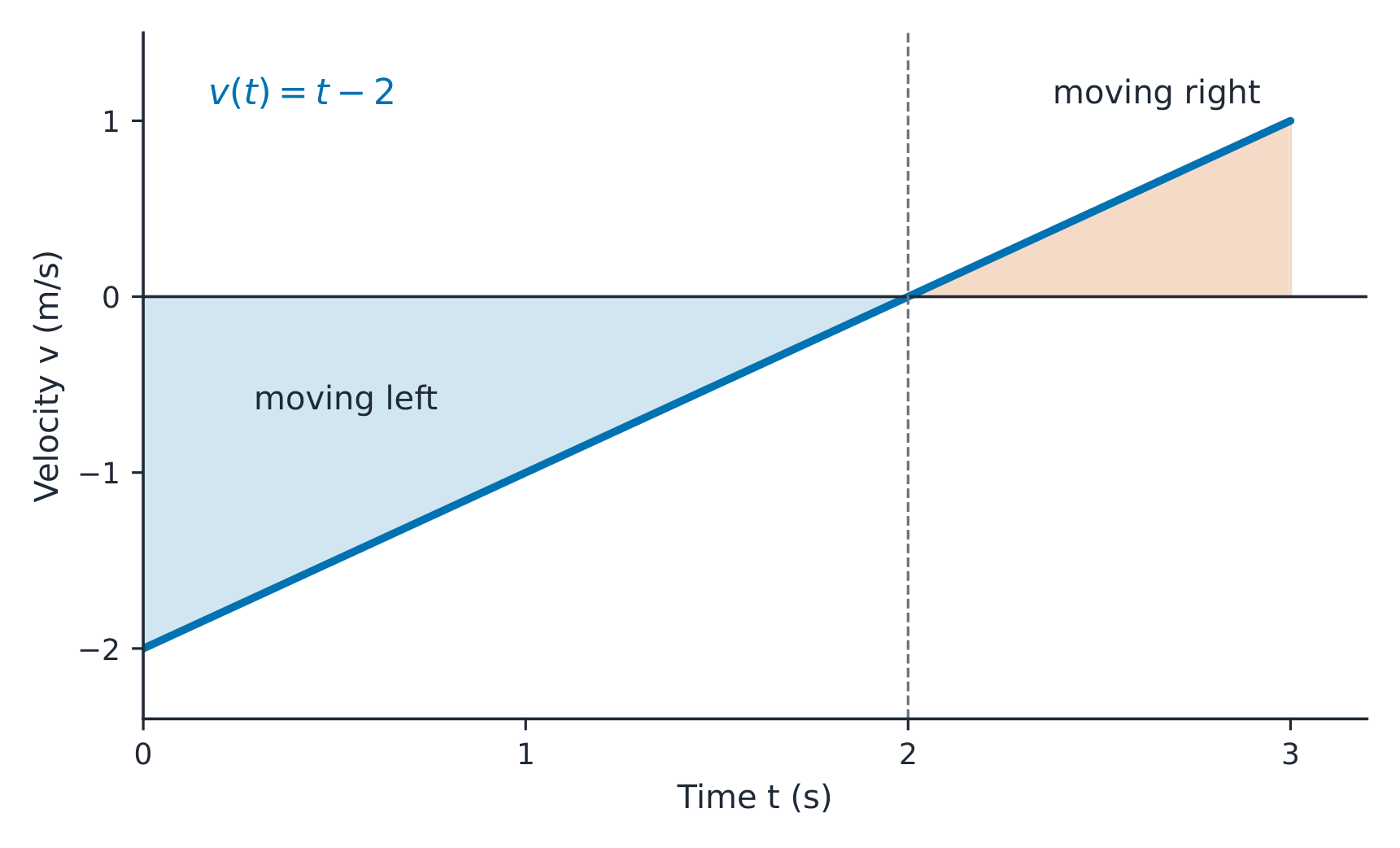
For $v(t)=t-2$ m/s on $[0,3]$, solve $v(t)=0$ and test either side. The particle moves left on $[0,2)$ and right on $(2,3]$.
Displacement is signed:
$$\Delta x=\int_0^3 v(t)\,dt=\left[\frac{t^2}{2}-2t\right]_0^3=-1.5\ \text{m}.$$
Total distance counts both journeys positively. Split at the sign change:
$$D=\int_0^3|v(t)|\,dt=-\int_0^2(t-2)\,dt+\int_2^3(t-2)\,dt.$$
$$D=|-2|+\frac12=2.5\ \text{m}.$$
The particle travels two metres left and half a metre right. Taking only $|\int_0^3v(t)\,dt|=1.5$ m loses the return journey.
Position needs a starting position. If $x(0)=5$ m, then
$$x(3)=x(0)+\int_0^3v(t)\,dt=5-1.5=3.5\ \text{m}.$$
The final position is right of the origin, even though displacement is negative.
A zero of velocity is a candidate for a turn. Check signs: $v(t)=(t-1)^2$ is positive on both sides of $t=1$, so the particle stops momentarily without changing direction.
Recover velocity with an initial condition
For $a(t)=4$ m/s$^2$ and $v(0)=1$ m/s:
$$v(t)=v(0)+\int_0^t a(u)\,du=1+\int_0^t4\,du=1+4t.$$
Here $t$ is in seconds and $v(t)$ is in metres per second. Equivalently, integrate to $4t+C$ and use $v(0)=1$ to find $C=1$. Each integration needs its own initial condition.
Original exam applications
2025 AB Q5D (calculator not allowed). The original gives $v_J(t)=2t(t^2-1)^3$ and $x_J(0)=7$, without physical units. Recover position, using $u=t^2-1$ and $du=2t\,dt$:
$$x_J(2)=x_J(0)+\int_0^2 v_J(t)\,dt=7+\int_{-1}^{3}u^3\,du.$$
$$x_J(2)=7+\left[\frac{u^4}{4}\right]_{-1}^{3}=7+\frac{81-1}{4}=27.$$
The change in position is $20$, while final position is $27$. Keep the initial position outside the integral.
2014 AB Q4(c). At times $2,5,8,12$ min, train velocities are $100,40,-120,-150$ m/min. Starting position is $s_A(2)=300$ m east of the origin. Write the exact position expression, then estimate the signed change by the three specified trapezoids:
$$s_A(12)=s_A(2)+\int_2^{12}v_A(t)\,dt=300+\int_2^{12}v_A(t)\,dt.$$
$$\Delta s\approx3\frac{100+40}{2}+3\frac{40-120}{2}+4\frac{-120-150}{2}=-450\ \text{m}.$$
$$s_A(12)\approx300-450=-150\ \text{m}.$$
This means about $150$ m west of the origin. Preserve the unequal interval widths and signs. Sampled velocities do not locate every zero, so absolute trapezoids do not give exact total distance.
Vocabulary
Train
| English |
|---|
| Displacement/dɪˈspleɪsmənt/ |
| Total distance travelled/ˈtəʊtl ˈdɪstəns ˈtrævld/ |
8.3
Accumulation Functions and Definite Integrals in Applied Contexts
Syllabus
| Enduring Understanding | Learning Objective | Essential Knowledge |
|---|---|---|
CHA-4 | CHA-4.D |
|
CHA-4.E |
|
Source: College Board AP Course and Exam Description
A function defined as an integral accumulates a rate of change. The net change 净变化 theorem is the everyday tool: the definite integral of a rate over an interval gives the net change of the quantity:
$$\text{(final)} = \text{(initial)} + \int_a^b (\text{rate})\,dt.$$
So "how much water is in the tank at $t=5$" = starting amount + $\int_0^5(\text{inflow}-\text{outflow})\,dt$. Watch signs (in minus out) and units. Many multi-part FRQs are built entirely on this idea – often paired with "write, but do not evaluate, an integral expression that gives the total...".
Vocabulary
Train
| English |
|---|
| net change/net tʃeɪndʒ/ |
8.4
Finding the Area Between Curves (Functions of x)
Syllabus
| Enduring Understanding | Learning Objective | Essential Knowledge |
|---|---|---|
CHA-5 | CHA-5.A |
|
Source: College Board AP Course and Exam Description
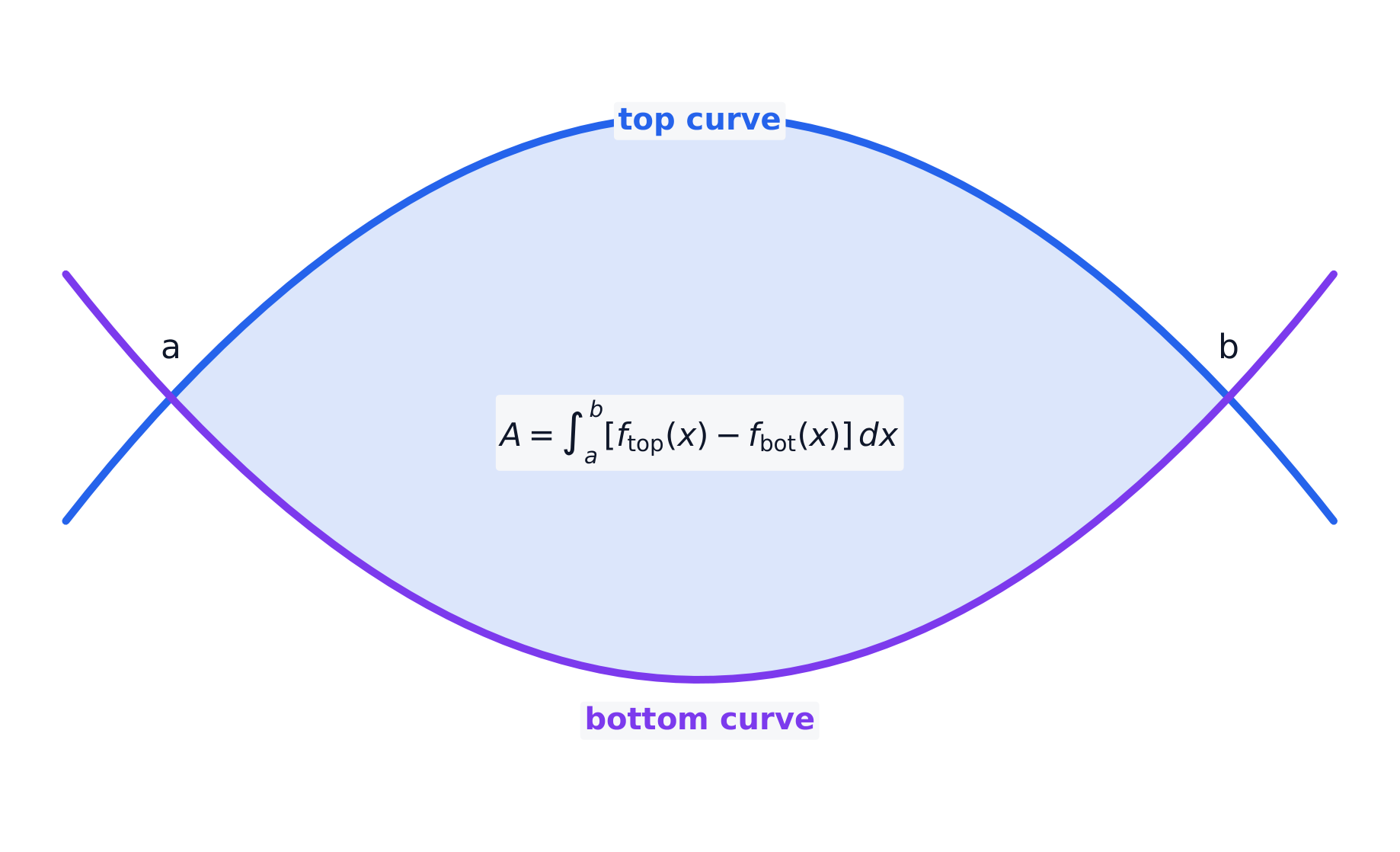
The area between two curves $y=f(x)$ (top) and $y=g(x)$ (bottom) on $[a,b]$ is:
$$A = \int_a^b \big[f(x)-g(x)\big]\,dx = \int_a^b (\text{top} - \text{bottom})\,dx.$$
Find the intersection points first to set the limits, and always subtract bottom from top.
Worked example. Find the area between $y=x$ and $y=x^2$. They cross at $x=0$ and $x=1$, and on $(0,1)$ the line $y=x$ is on top, so
$$A=\int_0^1 (x-x^2)\,dx=\left[\frac{x^2}{2}-\frac{x^3}{3}\right]_0^1=\frac12-\frac13=\frac16.$$
8.5
Finding the Area Between Curves (Functions of y)
Syllabus
| Enduring Understanding | Learning Objective | Essential Knowledge |
|---|---|---|
CHA-5 | CHA-5.A |
|
Source: College Board AP Course and Exam Description
Some regions are easier described with horizontal slices – integrate with respect to $y$:
$$A = \int_c^d \big[x_{\text{right}}(y) - x_{\text{left}}(y)\big]\,dy = \int_c^d (\text{right}-\text{left})\,dy.$$
Choose $x$- or $y$-slices to keep a single top/bottom (or right/left) pair over the whole region.
8.6
Area Between Curves With More Than Two Intersections
Syllabus
| Enduring Understanding | Learning Objective | Essential Knowledge |
|---|---|---|
CHA-5 | CHA-5.A |
|
Source: College Board AP Course and Exam Description
If the curves cross more than twice, one function is on top for part of the region and the other on top elsewhere. Split into a sum of integrals at each crossing, or integrate the absolute value of the difference:
$$A = \int_a^b \big|f(x)-g(x)\big|\,dx.$$
Determine which curve is higher on each subinterval before writing the integrals.
8.7
Volumes with Cross Sections: Squares and Rectangles
Syllabus
| Enduring Understanding | Learning Objective | Essential Knowledge |
|---|---|---|
CHA-5 | CHA-5.B |
|
Source: College Board AP Course and Exam Description
If a solid has a known cross section 横截面 perpendicular to an axis, its volume is the integral of the cross-sectional area:
$$V = \int_a^b A(x)\,dx.$$
For square cross sections with side equal to the region's height $s(x)=f(x)-g(x)$, use $A(x)=[s(x)]^2$; for a rectangle of height $k\cdot s(x)$, use $A(x)=k\,[s(x)]^2$. The exam phrase "the base of a solid... cross sections are squares/rectangles" signals exactly this.
Vocabulary
Train
| English |
|---|
| cross section/krɒs ˈsekʃn/ |
8.8
Volumes with Cross Sections: Triangles and Semicircles
Syllabus
| Enduring Understanding | Learning Objective | Essential Knowledge |
|---|---|---|
CHA-5 | CHA-5.B |
|
Source: College Board AP Course and Exam Description
Same method, different area formula: for an equilateral triangle 三角形 of side $s$, $A=\tfrac{\sqrt{3}}{4}s^2$; for a semicircle 半圆 of diameter $s$, $A=\tfrac{\pi}{8}s^2$. Set the shape's key length equal to the region's slice length $s(x)$, then integrate $A(x)$.
Vocabulary
Train
| English |
|---|
| triangle/ˈtraɪæŋɡl/ |
| semicircle/ˈsemɪsɜːkl/ |
8.9
Volume with the Disc Method (About the x- or y-Axis)
Syllabus
| Enduring Understanding | Learning Objective | Essential Knowledge |
|---|---|---|
CHA-5 | CHA-5.C |
|
Source: College Board AP Course and Exam Description
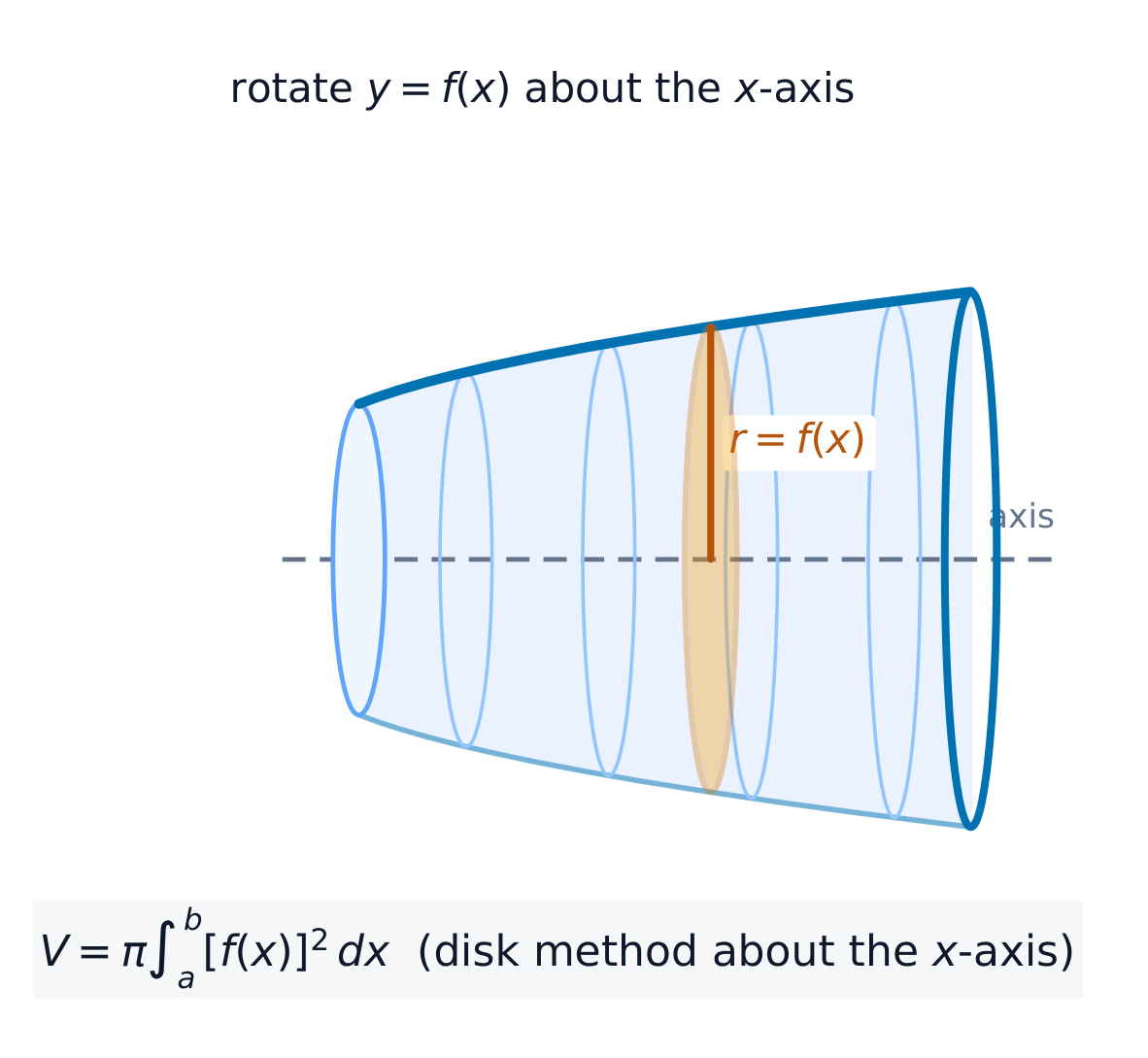
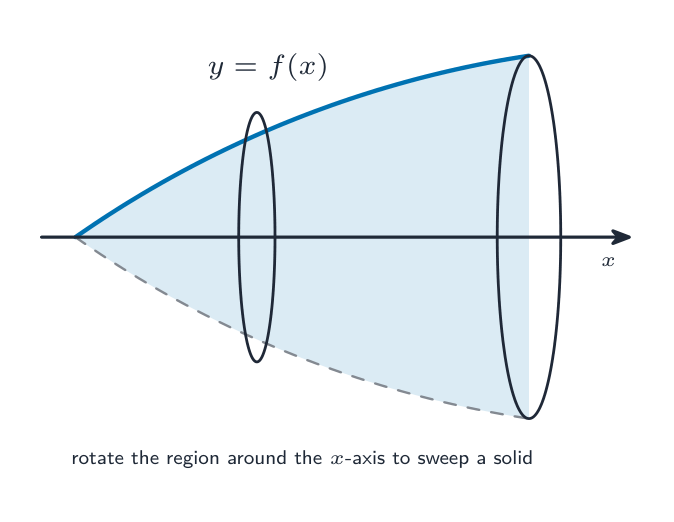
Revolving a region around an axis makes a solid of revolution 旋转体. If the region touches the axis, each slice is a disc 圆盘 of radius $r$ = the function value:
$$V = \pi\int_a^b [r(x)]^2\,dx.$$
Around the $x$-axis, $r=f(x)$ and integrate in $x$; around the $y$-axis, express $x$ as a function of $y$ and integrate in $y$.
Worked example. Revolve the region under $y=\sqrt{x}$ from $x=0$ to $x=4$ about the $x$-axis. Each disc has radius $r=\sqrt{x}$, so
$$V=\pi\int_0^4 (\sqrt{x})^2\,dx=\pi\int_0^4 x\,dx=\pi\left[\frac{x^2}{2}\right]_0^4=8\pi.$$
Vocabulary
Train
| English |
|---|
| solid of revolution/ˈsɒlɪd ɒv ˌrevəˈluːʃn/ |
| disc/dɪsk/ |
8.10
Volume with the Disc Method (About Other Axes)
Syllabus
| Enduring Understanding | Learning Objective | Essential Knowledge |
|---|---|---|
CHA-5 | CHA-5.C |
|
Source: College Board AP Course and Exam Description
Around any horizontal or vertical line $y=k$ or $x=k$, the radius is the distance from the curve to that line, e.g. $r(x)=|f(x)-k|$. Set up the radius carefully, then use $V=\pi\int r^2$.
8.11 8.12
Volume with the Washer Method
Syllabus
| Enduring Understanding | Learning Objective | Essential Knowledge |
|---|---|---|
CHA-5 | CHA-5.C |
|
| Enduring Understanding | Learning Objective | Essential Knowledge |
|---|---|---|
CHA-5 | CHA-5.C |
|
Source: College Board AP Course and Exam Description
When the region does not touch the axis, each slice is a washer 垫圈 (a ring) with an outer radius $R$ and inner radius $r$:
$$V = \pi\int_a^b \Big([R]^2 - [r]^2\Big)\,dx.$$
$R$ is the distance from the axis to the farther boundary and $r$ to the nearer one. Around a line other than an axis, both radii are measured as distances to that line – a very common exam variation (e.g. revolving about $y=-2$).
Vocabulary
Train
| English |
|---|
| washer/ˈwɒʃə/ |
8.11 8.12
Exam tips
- Area between curves is $\int(\text{top}-\text{bottom})\,dx$ — find the intersection points for the limits and keep top minus bottom.
- For a volume of revolution, add up disc/washer cross-sections of area $\pi r^2$ (or $\pi(R^2-r^2)$).
- The average value of $f$ on $[a,b]$ is $\tfrac{1}{b-a}\int_a^b f\,dx$.
- Accumulated change is $\int$ of a rate: total = initial value $+\int_a^b(\text{rate})\,dt$.
- Integration means "adding up infinitely many tiny pieces" — set up the integrand as one thin slice.
Interactive lessons on this topic
Work through it step by step, with instant-check exercises.
- Finding the Average Value of a Function on an Interval
- Connecting Position, Velocity, and Acceleration of Functions Using Integrals
- Using Accumulation Functions and Definite Integrals in Applied Contexts
- Finding the Area Between Curves Expressed as Functions of x
- Finding the Area Between Curves Expressed as Functions of y
- Finding the Area Between Curves That Intersect at More Than Two Points
- Volumes with Cross Sections: Squares and Rectangles
- Volumes with Cross Sections: Triangles and Semicircles
- Volume with Disc Method: Revolving Around the x- or y-Axis
- Volume with Disc Method: Revolving Around Other Axes
- Volume with Washer Method: Revolving Around the x- or y-Axis
- Volume with Washer Method: Revolving Around Other Axes