| Enduring Understanding | Learning Objective | Essential Knowledge |
|---|---|---|
FUN-1 | FUN-1.B |
|
Analytical Applications of Differentiation
AP Calculus AB · Topic 5
 10:27
10:27
Analysing Functions: The Mean Value Theorem
Imagine a road trip. Over two hours, you cover one hundred and twenty kilometres — an average speed of sixty. Here is a surprising promise: at some instant…
English narration · English + 中文 subtitles burned in
5.1
The Mean Value Theorem
Syllabus
Source: College Board AP Course and Exam Description
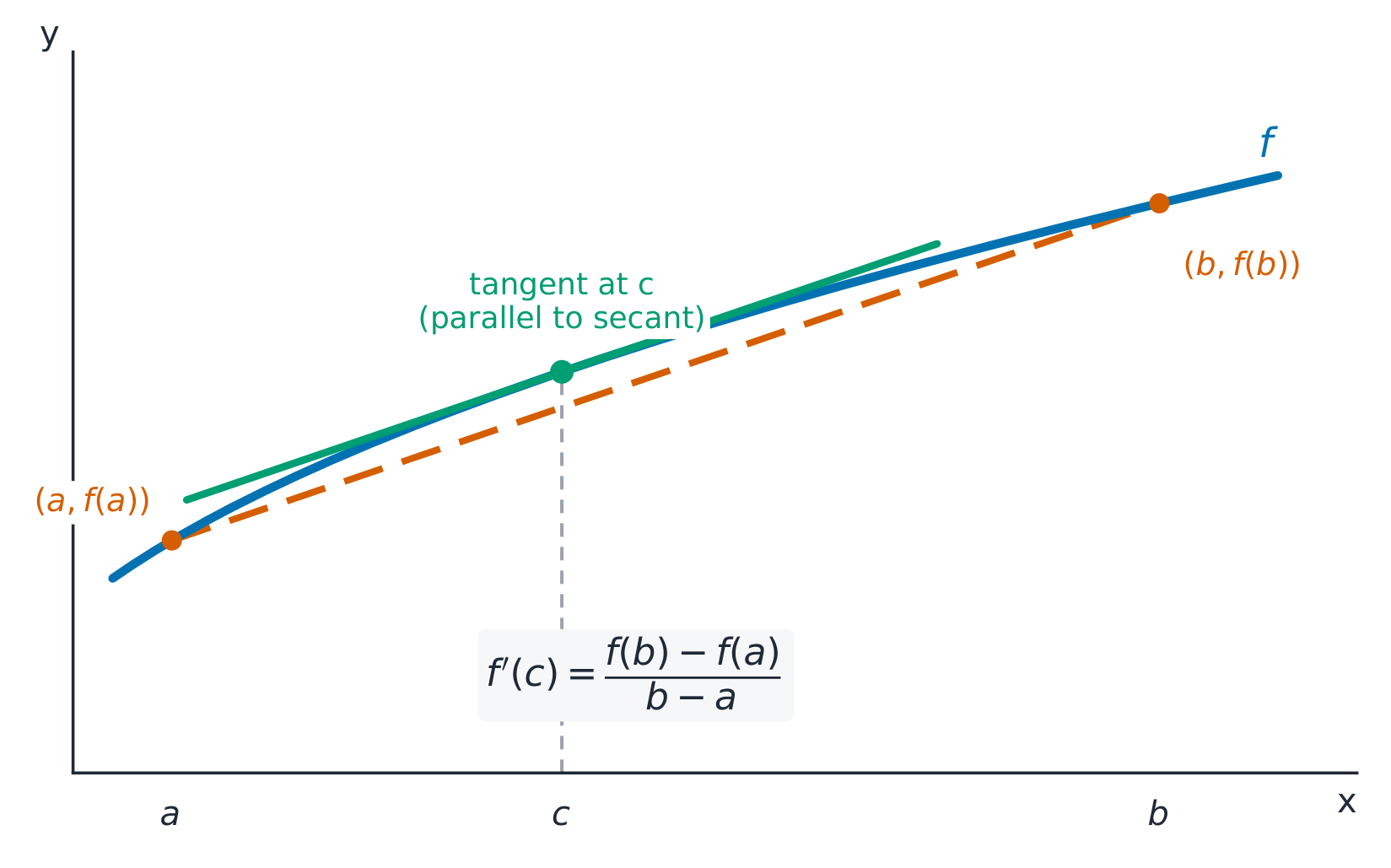
The Mean Value Theorem 中值定理 (MVT) links the average rate of change to an instantaneous one:
If $f$ is continuous on $[a,b]$ and differentiable on $(a,b)$, then there is at least one point $c$ in $(a,b)$ where
$$f'(c) = \frac{f(b)-f(a)}{b-a}.$$
In words: somewhere inside the interval, the instantaneous rate equals the average rate. Geometrically, some tangent line is parallel to the line joining the endpoints.
Exam skill. Like the IVT, the MVT is an existence theorem, and questions ask you to justify. Full credit needs: (1) state $f$ is continuous on $[a,b]$ and differentiable on $(a,b)$; (2) compute the average rate $\frac{f(b)-f(a)}{b-a}$; (3) conclude "by the MVT there is a $c$ in $(a,b)$ with $f'(c)$ equal to that value." Both hypotheses must be named.
Worked example. Verify the MVT for $f(x)=x^2$ on $[1,3]$. It is a polynomial, so continuous and differentiable everywhere. The average rate is $\dfrac{f(3)-f(1)}{3-1}=\dfrac{9-1}{2}=4$. Setting $f'(c)=2c=4$ gives $c=2$, which does lie in $(1,3)$ – the guaranteed point.
Explore
The Mean Value Theorem
y = ax³ + bx² + cx + d
The MVT guarantees a point where the tangent is parallel to the secant — the instantaneous rate equals the average rate somewhere inside the interval.
Vocabulary
Train
| English |
|---|
| Mean Value Theorem/miːn ˈvæljuː ˈθɪərəm/ |
5.2
Extreme Values and Critical Points
Syllabus
| Enduring Understanding | Learning Objective | Essential Knowledge |
|---|---|---|
FUN-1 | FUN-1.C |
|
Source: College Board AP Course and Exam Description
The Extreme Value Theorem 极值定理 (EVT) guarantees extremes exist: a function continuous on a closed interval $[a,b]$ attains both an absolute maximum and an absolute minimum on it.
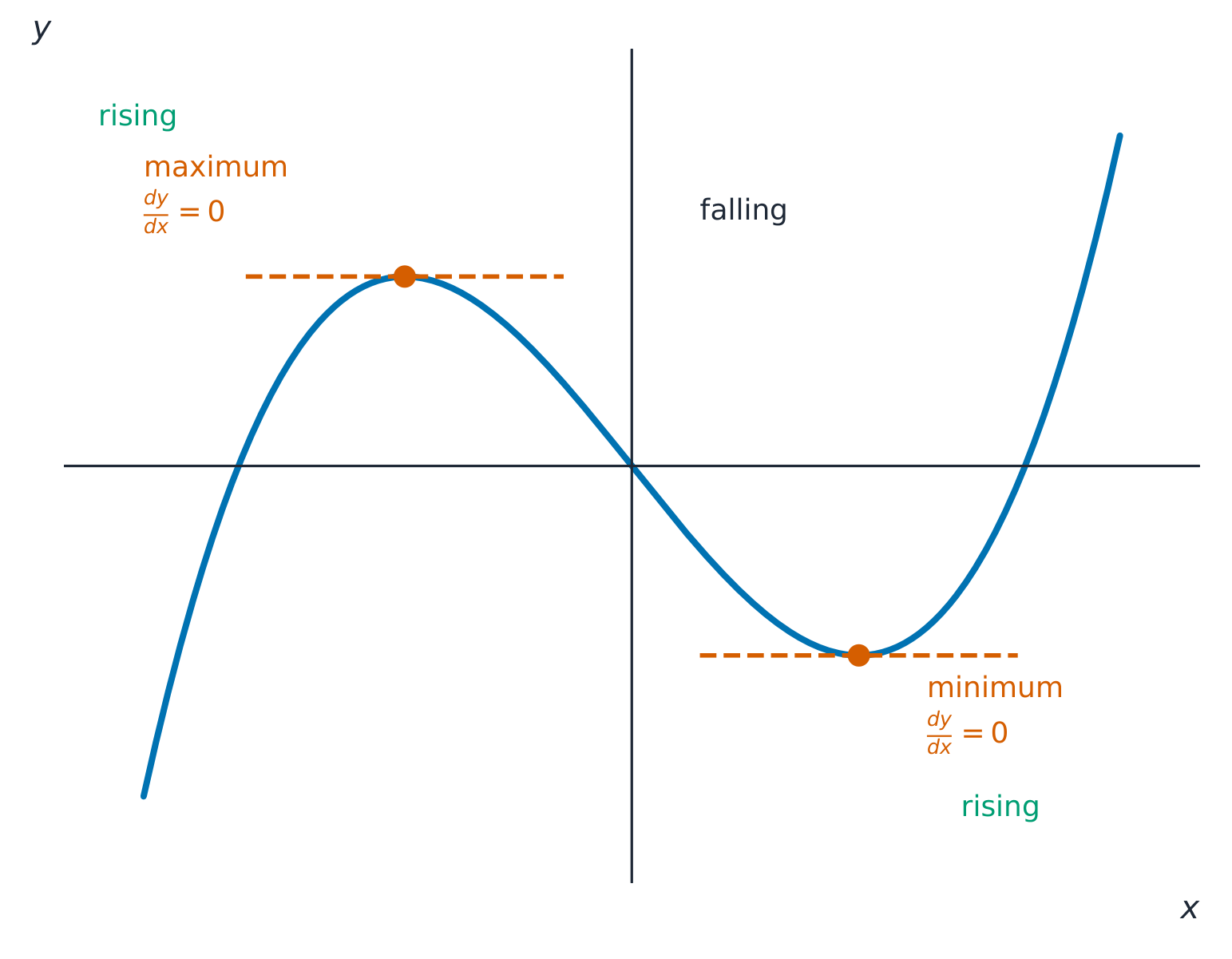
A critical point 临界点 is an interior point where $f'(x)=0$ or $f'(x)$ does not exist. All local (relative) extrema 局部极值 occur at critical points – but not every critical point is an extremum. So critical points are the candidates; you must test each.
Vocabulary
Train
| English |
|---|
| Extreme Value Theorem/ekˈstriːm ˈvæljuː ˈθɪərəm/ |
| critical point/ˈkrɪtɪkl pɔɪnt/ |
| local (relative) extrema/ˈləʊkl ekˈstremə/ |
5.3
Increasing and Decreasing Intervals
Syllabus
| Enduring Understanding | Learning Objective | Essential Knowledge |
|---|---|---|
FUN-4 | FUN-4.A |
|
Source: College Board AP Course and Exam Description
The first derivative tells you where $f$ rises or falls:
- $f'(x) > 0$ on an interval $\Rightarrow$ $f$ is increasing 递增 there;
- $f'(x) < 0$ $\Rightarrow$ $f$ is decreasing 递减.
On the exam, "find the intervals where $f$ is increasing" means: find the critical points, then test the sign of $f'$ between them, and justify with the sign of $f'$ (a stated reason, not just an interval).
Vocabulary
Train
| English |
|---|
| increasing/ɪnˈkriːsɪŋ/ |
| decreasing/ˈdiːkriːsɪŋ/ |
5.4
The First Derivative Test
Syllabus
| Enduring Understanding | Learning Objective | Essential Knowledge |
|---|---|---|
FUN-4 | FUN-4.A |
|
Source: College Board AP Course and Exam Description
To classify a critical point $x=c$ as a local max, local min, or neither, check how $f'$ changes sign there:
- $f'$ changes $+$ to $-$ at $c$ $\Rightarrow$ local maximum 极大值;
- $f'$ changes $-$ to $+$ at $c$ $\Rightarrow$ local minimum 极小值;
- $f'$ does not change sign $\Rightarrow$ neither.
Always state the sign change as your justification.
Worked example. Classify the critical points of $f(x)=x^3-3x^2$. Here $f'(x)=3x^2-6x=3x(x-2)$, zero at $x=0$ and $x=2$. Testing signs: $f'>0$ for $x<0$, $f'<0$ on $(0,2)$, and $f'>0$ for $x>2$. So $f'$ turns $+\to-$ at $x=0$ (a local maximum, $f(0)=0$) and $-\to+$ at $x=2$ (a local minimum, $f(2)=-4$).
Vocabulary
Train
| English |
|---|
| local maximum/ˈləʊkl ˈmæksɪməm/ |
| local minimum/ˈləʊkl ˈmɪnɪməm/ |
5.5
The Candidates Test for Absolute Extrema
Syllabus
| Enduring Understanding | Learning Objective | Essential Knowledge |
|---|---|---|
FUN-4 | FUN-4.A |
|
Source: College Board AP Course and Exam Description
On a closed interval, absolute (global) extrema occur only at critical points or endpoints. The candidates test:
- List all critical points in $[a,b]$ and the two endpoints.
- Evaluate $f$ at each candidate.
- The largest output is the absolute maximum; the smallest is the absolute minimum.
Show the table of values – the comparison is the argument.
5.6
Concavity and Points of Inflection
Syllabus
| Enduring Understanding | Learning Objective | Essential Knowledge |
|---|---|---|
FUN-4 | FUN-4.A |
|
Source: College Board AP Course and Exam Description
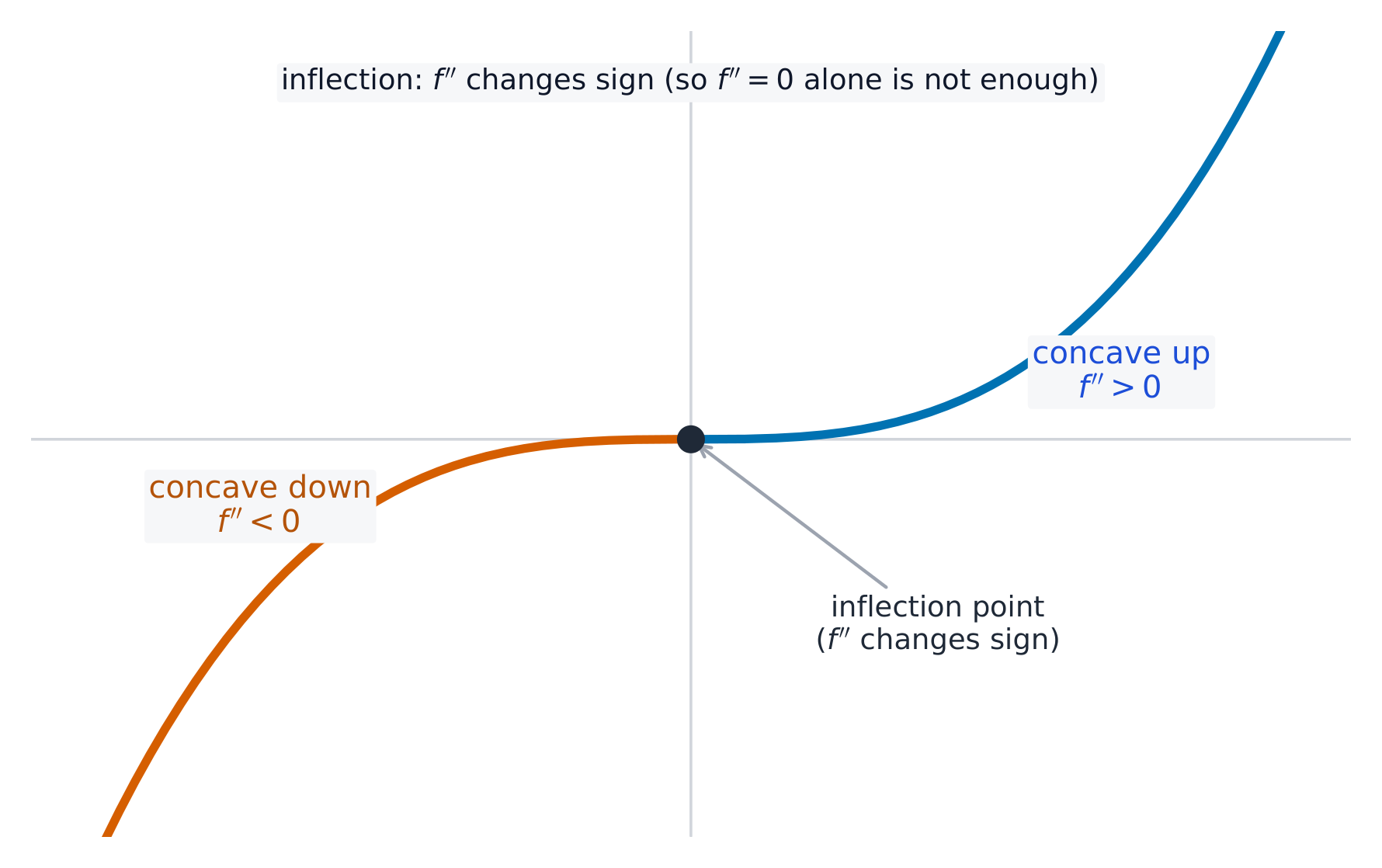
The second derivative describes bending:
- $f'' > 0$ $\Rightarrow$ $f$ is concave up 上凹 (curving like a cup; $f'$ is increasing);
- $f'' < 0$ $\Rightarrow$ $f$ is concave down 下凹 ($f'$ is decreasing).
A point of inflection 拐点 is a continuous point where concavity changes. Where the second derivative exists on neighbouring intervals, use its sign change; a zero alone is insufficient. Report its $x$-coordinate and justify with the sign change of $f''$.
Worked counterexample: a zero is only a candidate
For $h(x)=x^4$, $h''(x)=12x^2$ is positive on both sides of 0, so there is no inflection. Yet $h(x)\ge h(0)=0$, so 0 is a minimum even though $h''(0)=0$. For $k(x)=x^3$, $k''(x)=6x$ changes from negative to positive, giving an inflection at 0. Check neighbouring concavity; the second derivative need not exist at the point itself. The function must be continuous at an inflection point.
Explore
Where concavity flips
y = ax³ + bx² + cx + d
Concavity is the sign of $f''$: concave up holds water, concave down spills it. A point of inflection is where it switches.
Vocabulary
Train
| English |
|---|
| concave up/kɒnˈkeɪv ʌp/ |
| concave down/kɒnˈkeɪv daʊn/ |
| point of inflection/pɔɪnt ɒv ɪnˈflekʃn/ |
5.7
The Second Derivative Test
Syllabus
| Enduring Understanding | Learning Objective | Essential Knowledge |
|---|---|---|
FUN-4 | FUN-4.A |
|
Source: College Board AP Course and Exam Description
An alternative way to classify a critical point $c$ where $f'(c)=0$:
- $f''(c) > 0$ $\Rightarrow$ concave up $\Rightarrow$ local minimum;
- $f''(c) < 0$ $\Rightarrow$ concave down $\Rightarrow$ local maximum;
- $f''(c) = 0$ $\Rightarrow$ the test is inconclusive – fall back on the first derivative test.
Special case: if a continuous function has only one critical point on an interval and it is a local extremum, that point is also the absolute extremum there.
5.8
Sketching a Function and Its Derivatives
Syllabus
| Enduring Understanding | Learning Objective | Essential Knowledge |
|---|---|---|
FUN-4 | FUN-4.A |
|
Source: College Board AP Course and Exam Description
Worked example: connect the same three graphs
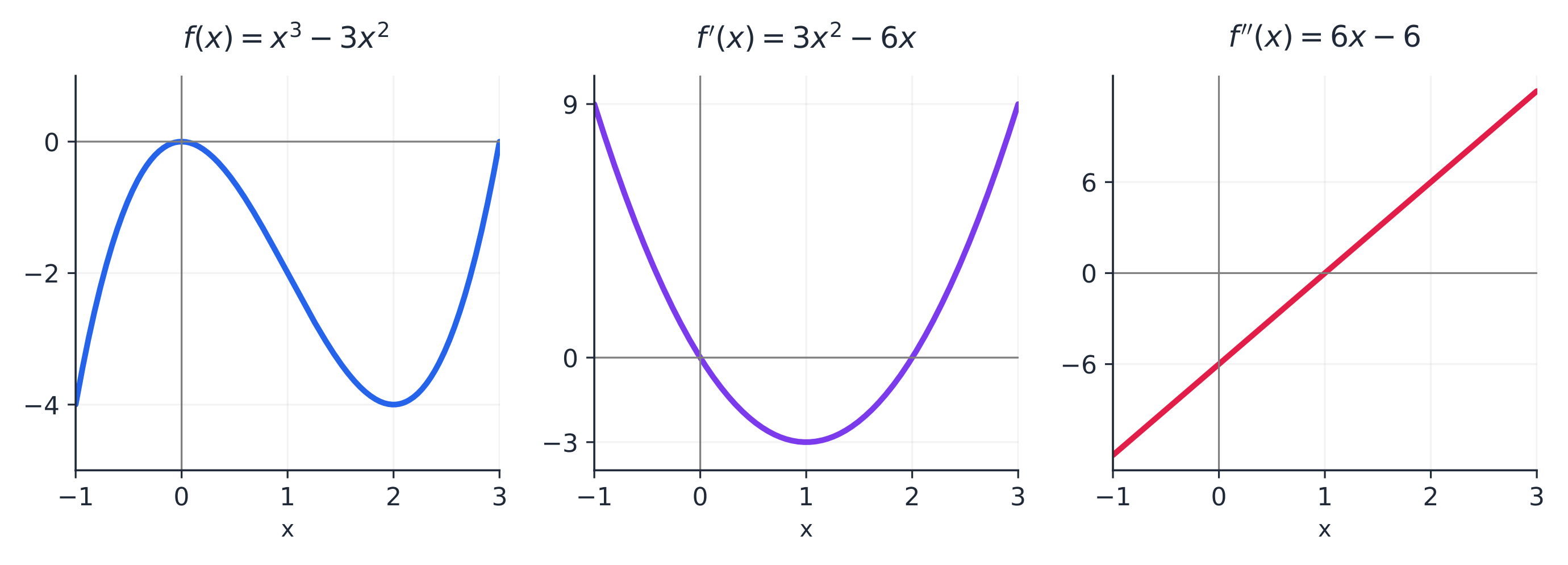
For $f(x)=x^3-3x^2$, the derivative is $f'(x)=3x(x-2)$ and the second derivative is $f''(x)=6x-6$.
On $(-1,0)$, $(0,2)$ and $(2,3)$, the signs of $f'$ are positive, negative and positive. Hence $f$ increases, decreases and increases. The sign changes give a local maximum at $(0,0)$ and minimum at $(2,-4)$. On $(-1,0)$ the function is increasing but concave down: $f'>0$ while $f'$ decreases. Concavity changes at 1 because $f''$ changes from negative to positive; the inflection is $(1,-2)$, where $f'(1)=-3$.
Adding 5 to $f$ leaves both derivatives unchanged. The shape and turning-point x coordinates stay the same; the vertical position needs a given function value.
5.9
Connecting f, f-prime, and f-double-prime
Syllabus
| Enduring Understanding | Learning Objective | Essential Knowledge |
|---|---|---|
FUN-4 | FUN-4.A |
|
Source: College Board AP Course and Exam Description
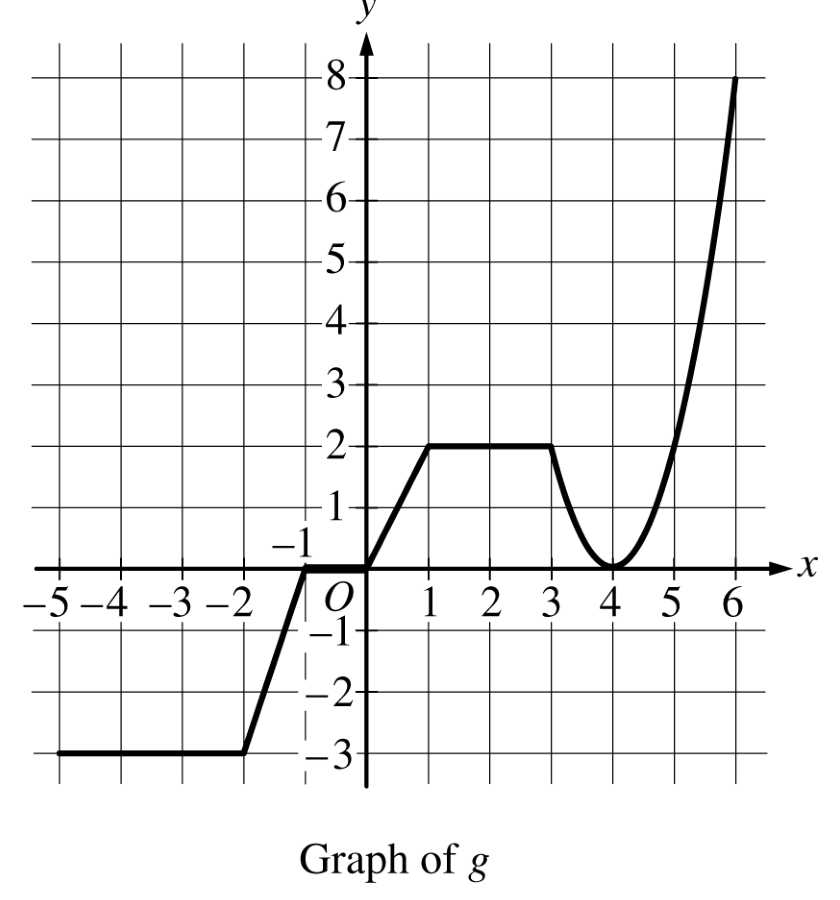
Original 2018 AB Q 3(c–d): read the displayed derivative
The given $g$ is $f'$. For $f$ to be increasing and concave up, $g$ must be positive and increasing: $(0,1)$ and $(4,6)$. At 4, $g$ changes from decreasing to increasing, so $f$ has an inflection. Since $g$ is positive on both sides of 4, $f$ has no extremum there. The official scheme awards both the interval answer and its reason.
Original 2025 AB Q 4B: the notation changes
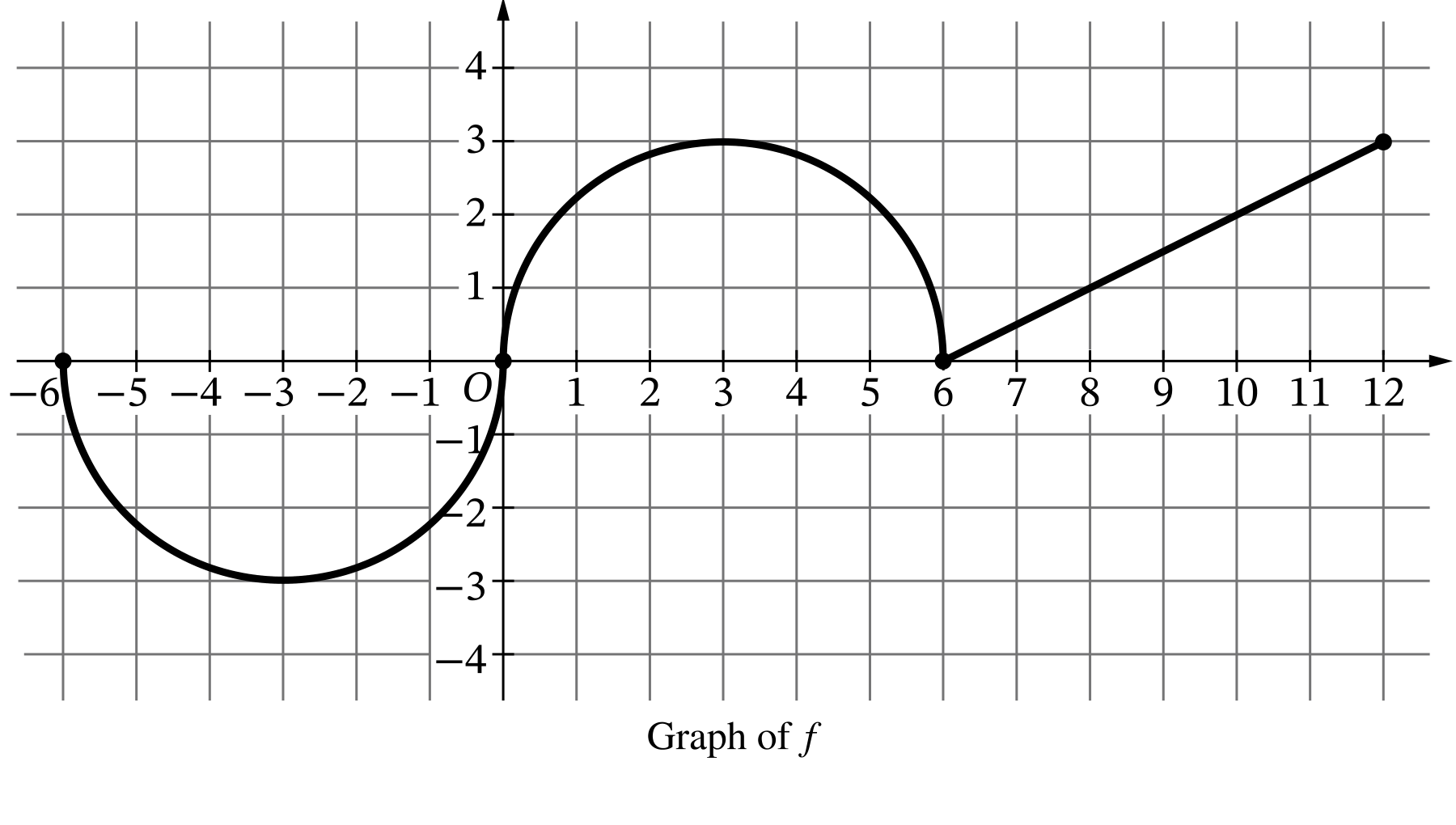
Here $g(x)=\int_6^x f(t)\,dt$, so $g'=f$. The inflections of $g$ occur at $x=-3,3,6$: the displayed $f$ changes decreasing/increasing behaviour there. At 0, $f$ increases on both sides, so $g$ remains concave up. At 6 the change of concavity is valid even though $f'$ is undefined at its corner. The official scheme requires evidence tied to the given graph, not simply naming a change in concavity.
Explore
Slope and bend from the graph
y = ax³ + bx² + cx + d
Where $f'>0$ the function rises; where $f''>0$ it bends up. Slide the tangent to link the shape of $f$ to the signs of its derivatives.
5.10
Introduction to Optimization

Syllabus
| Enduring Understanding | Learning Objective | Essential Knowledge |
|---|---|---|
FUN-4 | FUN-4.B |
|
Source: College Board AP Course and Exam Description
Optimization 最优化 uses the derivative to find the largest or smallest value of a quantity on an interval. It is the candidates/derivative-test machinery applied to a real goal.
Vocabulary
Train
| English |
|---|
| Optimization/ˌɒptɪmaɪˈzeɪʃn/ |
5.11
Solving Optimization Problems
Syllabus
| Enduring Understanding | Learning Objective | Essential Knowledge |
|---|---|---|
FUN-4 | FUN-4.C |
|
Source: College Board AP Course and Exam Description
A dependable procedure:
- Write the quantity to optimize as a function of one variable (use a constraint equation to eliminate extras).
- State the interval of allowed inputs.
- Find critical points ($f'=0$ or undefined) and test them (first- or second-derivative test, or candidates test if the interval is closed).
- Answer the question asked, with units and interpretation in context – the maximum area, the minimum cost, etc.
Worked example. A farmer has $100\ \text{m}$ of fence for a rectangular pen against a wall, so only three sides need fencing. Maximize the area. Let the two ends be $x$ and the side parallel to the wall be $y$; the constraint is $2x+y=100$, so $y=100-2x$. The area is
$$A(x)=x(100-2x)=100x-2x^2,\qquad A'(x)=100-4x=0\;\Rightarrow\;x=25.$$
Since $A''=-4<0$ this is a maximum, giving $y=50$ and $A=25\times50=1250\ \text{m}^2$.
5.12
Behaviors of Implicit Relations
Syllabus
| Enduring Understanding | Learning Objective | Essential Knowledge |
|---|---|---|
FUN-4 | FUN-4.D |
|
FUN-4.E |
|
Source: College Board AP Course and Exam Description
All of this extends to implicitly defined relations. A critical point of an implicit relation is where $\dfrac{dy}{dx}=0$ (horizontal tangent) or is undefined (vertical tangent). Because $\dfrac{dy}{dx}$ is usually a relation in $x$ and $y$, and the second derivative involves $x$, $y$, and $\dfrac{dy}{dx}$, substitute your first-derivative expression back in when finding $\dfrac{d^2y}{dx^2}$, then reason about concavity from its sign.
5.12
Exam tips
- $f'>0$ means increasing, $f'<0$ decreasing; candidates for extrema are where $f'=0$ or is undefined.
- Classify a critical point with the first-derivative sign change or the second-derivative test ($f''>0$ minimum, $f''<0$ maximum).
- $f''>0$ is concave up, $f''<0$ concave down; a point of inflection is where concavity changes ($f''$ changes sign).
- For an absolute extremum on a closed interval, also check the endpoints.
- Justify every conclusion by citing the sign of $f'$ or $f''$ — the exam demands the reasoning, not just the answer.
Interactive lessons on this topic
Work through it step by step, with instant-check exercises.
- Using the Mean Value Theorem
- Extreme Value Theorem, Global Versus Local Extrema, and Critical Points
- Determining Intervals on Which a Function Is Increasing or Decreasing
- Using the First Derivative Test to Determine Relative (Local) Extrema
- Using the Candidates Test to Determine Absolute (Global) Extrema
- Determining Concavity of Functions over Their Domains
- Using the Second Derivative Test to Determine Extrema
- Sketching Graphs of Functions and Their Derivatives
- Connecting a Function, Its First Derivative, and Its Second Derivative
- Introduction to Optimization Problems
- Solving Optimization Problems
- Exploring Behaviors of Implicit Relations