| Enduring Understanding | Learning Objective | Essential Knowledge |
|---|---|---|
CHA-3 | CHA-3.A |
|
Contextual Applications of Differentiation
AP Calculus AB · Topic 4
 6:54
6:54
Interpreting the Derivative in Context
Now that we can compute derivatives, we use them to describe the real world. A derivative is a rate of change. How fast is a population growing? How fast is a…
English narration · English + 中文 subtitles burned in
4.1
Interpreting the Derivative in Context
Syllabus
Source: College Board AP Course and Exam Description
Once you can compute derivatives, you use them to describe the real world. The derivative $f'(x)$ is the instantaneous rate of change of $f$ with respect to its input. Reading and reporting this rate correctly is a graded skill.
Units matter. The unit of $f'(x)$ is the unit of $f$ divided by the unit of $x$. If $C(t)$ is a number of acres and $t$ is in weeks, then $C'(t)$ is in acres per week. On the exam, "Using correct units, interpret the meaning of $g'(140)$" wants a full sentence: the value, the quantity, the rate word "per", and the moment. For example: "$g'(140)=2.3$ means that at $x=140$, the quantity is increasing at about $2.3$ units per unit of $x$."
4.2
Straight-Line Motion: Position, Velocity, and Acceleration
Syllabus
| Enduring Understanding | Learning Objective | Essential Knowledge |
|---|---|---|
CHA-3 | CHA-3.B |
|
Source: College Board AP Course and Exam Description
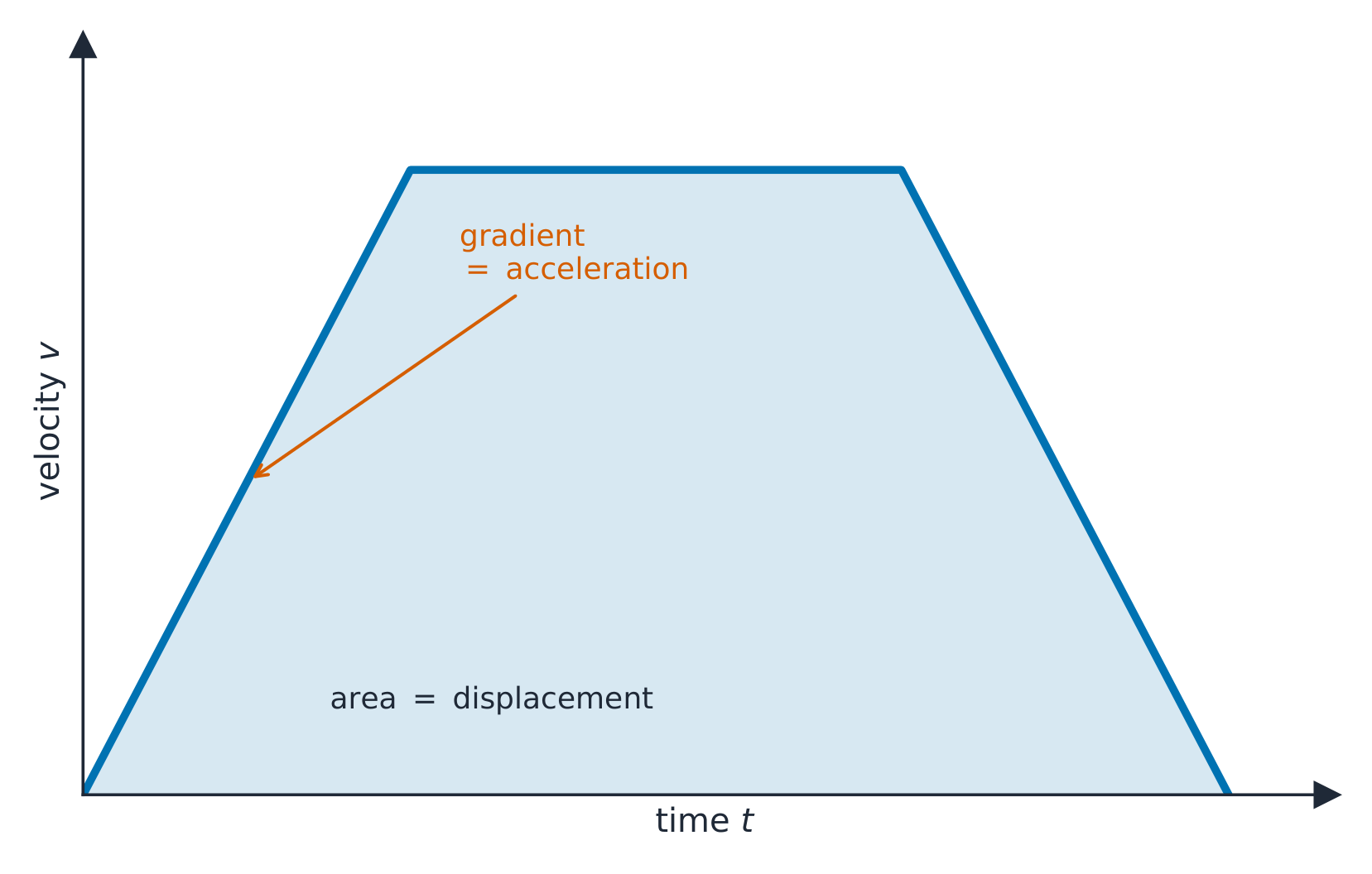
For a particle moving on a line, three functions of time are linked by differentiation:
- position 位置 $s(t)$;
- velocity 速度 $v(t)=s'(t)$ – signed; its sign gives direction;
- acceleration 加速度 $a(t)=v'(t)=s''(t)$.
Key readings (frequent exam parts):
- The particle is at rest 静止 when $v(t)=0$.
- It moves right/up when $v(t)>0$ and left/down when $v(t)<0$; it changes direction where $v$ changes sign.
- Speed 速率 is $|v(t)|$. Speed is increasing when $v$ and $a$ have the same sign (the particle is speeding up), and decreasing when they have opposite signs.
Worked example. A particle moves with $s(t)=t^3-6t^2+9t$. Then $v(t)=3t^2-12t+9=3(t-1)(t-3)$, so it is at rest at $t=1$ and $t=3$, and changes direction at each. At $t=2$, $v(2)=3(1)(-1)=-3<0$ (moving left) and $a(2)=6(2)-12=0$; just after, $a>0$ while $v<0$, so it is slowing down there. Distinguish carefully between velocity (has direction) and speed (does not) – the exam tests this exact difference.

Explore
Velocity is the slope of position
y = ax³ + bx² + cx + d
For straight-line motion, velocity is the derivative (slope) of position and acceleration the derivative of velocity. Slide the point to read the instantaneous velocity.
Vocabulary
Train
| English |
|---|
| position/pəˈzɪʃn/ |
| velocity/vəˈlɒsɪti/ |
| acceleration/əkˌseləˈreɪʃn/ |
| at rest/æt rest/ |
| Speed/spiːd/ |
4.3
Rates of Change Beyond Motion
Syllabus
| Enduring Understanding | Learning Objective | Essential Knowledge |
|---|---|---|
CHA-3 | CHA-3.C |
|
Source: College Board AP Course and Exam Description
The same derivative idea models any changing quantity: a draining tank, a spreading population, a cooling cup. Whenever a problem says "the rate at which...", it is describing a derivative. Read the units to know which quantity's rate you have, then interpret in context.
4.4
Introduction to Related Rates

Syllabus
| Enduring Understanding | Learning Objective | Essential Knowledge |
|---|---|---|
CHA-3 | CHA-3.D |
|
Source: College Board AP Course and Exam Description
In a related rates 相关变化率 problem, several quantities change together over time, and you know some rates but want another. The engine is the chain rule: differentiate a relationship with respect to time $t$. Every variable becomes a function of $t$, so each derivative picks up a "$\,/\,dt$" factor. Product and quotient rules may also be needed.
Vocabulary
Train
| English |
|---|
| related rates/rɪˈleɪtɪd reɪts/ |
4.5
Solving Related Rates Problems
Syllabus
| Enduring Understanding | Learning Objective | Essential Knowledge |
|---|---|---|
CHA-3 | CHA-3.E |
|
Source: College Board AP Course and Exam Description
A reliable procedure – and a full-credit template on the exam:
- Name the variables and write down the given rates and the unknown rate (e.g. "$\dfrac{dh}{dt}=-2$ cm/day, find $\dfrac{dV}{dt}$").
- Write an equation relating the quantities (often a geometric or volume formula).
- Differentiate both sides with respect to $t$ (chain rule) – before substituting numbers.
- Substitute the known values at the instant of interest, and solve for the unknown rate.
- State the answer with units and the correct sign (a decreasing quantity has a negative rate).
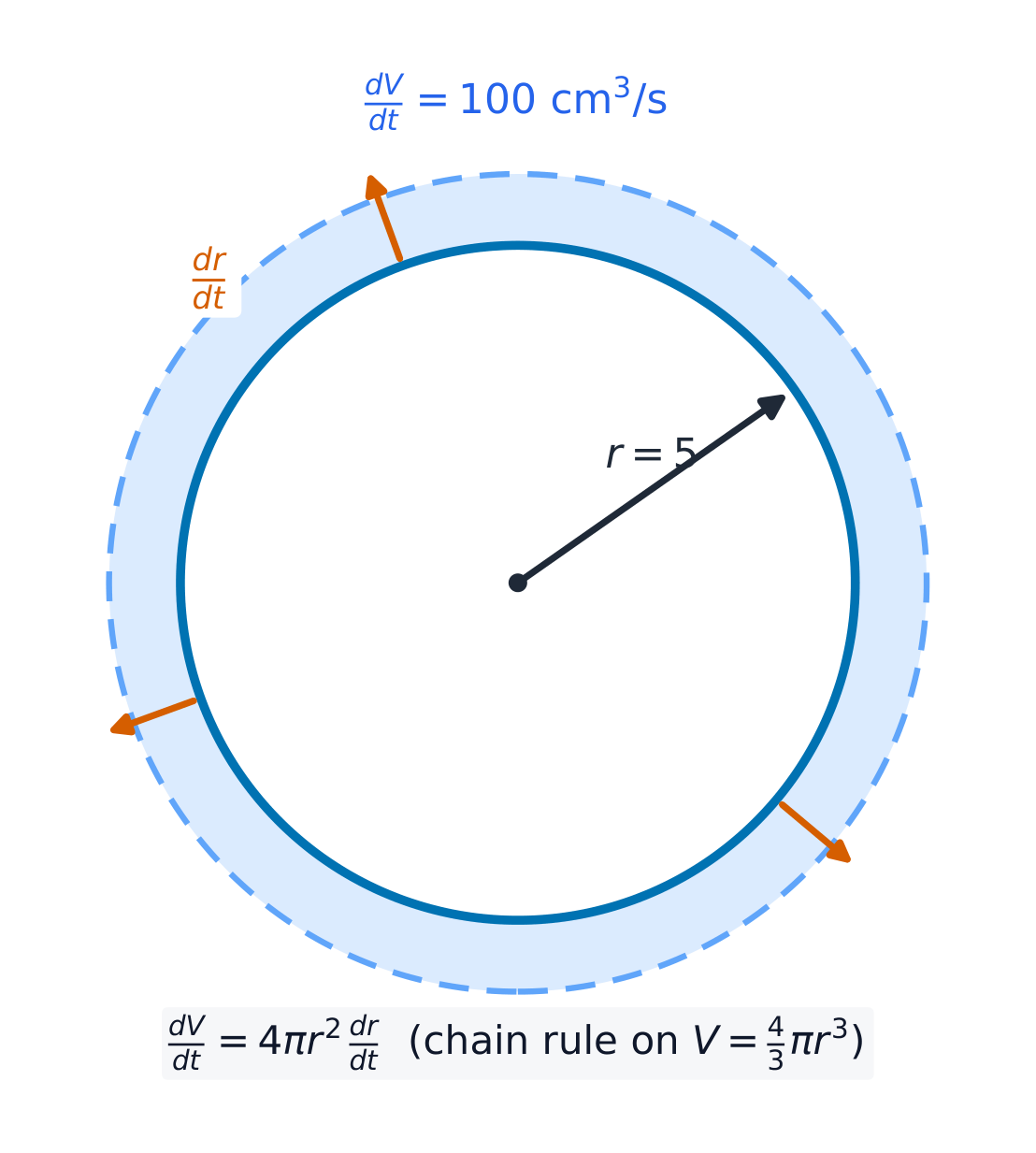
Worked example. Air is pumped into a spherical balloon so its volume grows at $\dfrac{dV}{dt}=100\ \text{cm}^3/\text{s}$. How fast is the radius growing when $r=5\ \text{cm}$? Start from $V=\tfrac43\pi r^3$ and differentiate with respect to $t$ first:
$$\frac{dV}{dt}=4\pi r^2\frac{dr}{dt}\;\Rightarrow\;100=4\pi(5)^2\frac{dr}{dt}\;\Rightarrow\;\frac{dr}{dt}=\frac{100}{100\pi}=\frac{1}{\pi}\approx 0.32\ \text{cm/s}.$$
Substituting $r=5$ too early is the classic error – differentiate the general relationship, then plug in.
4.6
Local Linearity and Linearization
Syllabus
| Enduring Understanding | Learning Objective | Essential Knowledge |
|---|---|---|
CHA-3 | CHA-3.F |
|
Source: College Board AP Course and Exam Description
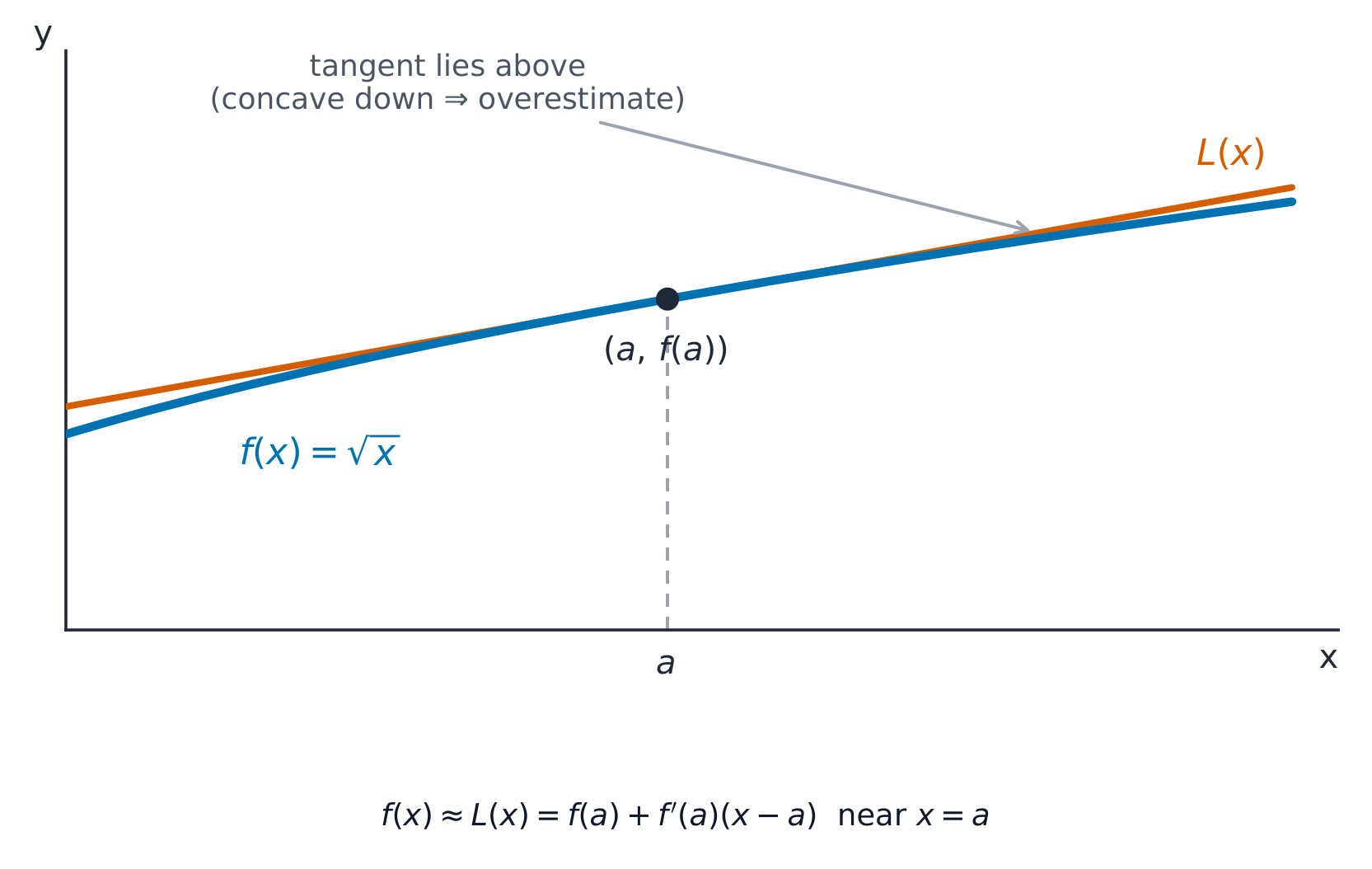
Near a point of tangency, a smooth curve looks like its tangent line – this is local linearity 局部线性. So the tangent line gives a linear approximation 线性近似 (linearization) of the function near that point:
$$f(x) \approx L(x) = f(a) + f'(a)(x-a).$$
Use it to estimate $f$ at an $x$ close to $a$.
Worked example. Estimate $\sqrt{4.1}$. Take $f(x)=\sqrt{x}$ and $a=4$: $f(4)=2$ and $f'(x)=\dfrac{1}{2\sqrt{x}}$ so $f'(4)=\dfrac14$. Then $L(4.1)=2+\tfrac14(4.1-4)=2.025$ (the true value is $2.0248\ldots$). Because $\sqrt{x}$ is concave down, the tangent lies above the curve, so this is a slight overestimate 高估 – justify over/under with the sign of $f''$.
Explore
Approximate a curve with its tangent line
y = ax³ + bx² + cx + d
Local linearity: near a point a smooth curve looks like its tangent line, so the tangent gives a good linear approximation of nearby values.
Vocabulary
Train
| English |
|---|
| local linearity/ˈləʊkl lɪˈnɪərɪti/ |
| linear approximation/ˈlɪnɪə əˌprɒksɪˈmeɪʃn/ |
| overestimate/ˌəʊvəˈrestɪmət/ |
4.7
L'Hospital's Rule for Indeterminate Forms
Syllabus
| Enduring Understanding | Learning Objective | Essential Knowledge |
|---|---|---|
LIM-4 | LIM-4.A |
|
Source: College Board AP Course and Exam Description
When direct substitution in a quotient of limits gives the indeterminate form 未定式 $\dfrac{0}{0}$ or $\dfrac{\infty}{\infty}$, you may use L'Hospital's Rule 洛必达法则:
$$\lim_{x\to c}\frac{f(x)}{g(x)} = \lim_{x\to c}\frac{f'(x)}{g'(x)},$$
provided the right-hand limit exists. Differentiate the top and bottom separately (this is not the quotient rule), then try the limit again. First confirm the form really is $\tfrac{0}{0}$ or $\tfrac{\infty}{\infty}$ – applying the rule to any other form is a mistake.
Worked example. Evaluate $\displaystyle\lim_{x\to 0}\frac{\sin x}{x}$. Substituting gives $\tfrac00$, so differentiate top and bottom: $\displaystyle\lim_{x\to 0}\frac{\cos x}{1}=\cos 0=1$ – confirming the famous limit from Unit 1.
Vocabulary
Train
| English |
|---|
| indeterminate form/ˌɪndɪˈtɜːmɪnət fɔːm/ |
| L'Hospital's Rule/ˈelhɒspɪtlz ruːl/ |
4.7
Exam tips
- In motion problems: velocity is the derivative of position, acceleration the derivative of velocity; speed increases when velocity and acceleration share a sign.
- For related rates, differentiate the relating equation with respect to time, then substitute the given values last.
- Use the tangent line for a linear approximation near a known point; it is accurate only close by.
- Read the sign of a rate: positive means the quantities move together, negative means opposite.
- Always state units and interpret the answer in context.
Interactive lessons on this topic
Work through it step by step, with instant-check exercises.
- Interpreting the Meaning of the Derivative in Context
- Straight-Line Motion: Connecting Position, Velocity, and Acceleration
- Rates of Change in Applied Contexts Other Than Motion
- Introduction to Related Rates
- Solving Related Rates Problems
- Approximating Values Using Local Linearity and Linearization
- Using L'Hospital's Rule for Determining Limits of Indeterminate Forms