| Enduring Understanding | Learning Objective | Essential Knowledge |
|---|---|---|
FUN-3 | FUN-3.C |
|
Differentiation: Composite, Implicit, and Inverse Functions
AP Calculus AB · Topic 3
 6:49
6:49
The Chain Rule
Look closely at this function: the sine of x squared. It is really two functions, one inside the other. First, square the input. Then take the sine of the…
English narration · English + 中文 subtitles burned in
3.1
The Chain Rule
Syllabus
Source: College Board AP Course and Exam Description
Unit 2 differentiated single functions. Unit 3 differentiates functions built inside other functions. The chain rule 链式法则 differentiates a composite function 复合函数 $f\big(g(x)\big)$:
$$\frac{d}{dx}\,f\big(g(x)\big) = f'\big(g(x)\big)\cdot g'(x).$$
"Derivative of the outer function (leaving the inside alone), times the derivative of the inside." The inner derivative $g'(x)$ is the piece students forget, so always ask "what is the inside, and what is its derivative?" Example:
$$\frac{d}{dx}\sin(x^2) = \cos(x^2)\cdot 2x.$$
In Leibniz notation, with $y=f(u)$ and $u=g(x)$, the rule reads $\dfrac{dy}{dx}=\dfrac{dy}{du}\cdot\dfrac{du}{dx}$ – the intermediate $du$ appears to "cancel." Exam questions often give a table for $f$, $g$, $f'$, $g'$ and ask for $h'(a)$ where $h(x)=f\big(g(x)\big)$; evaluate $f'\big(g(a)\big)\cdot g'(a)$ by reading values.
Worked example. Differentiate $h(x)=(2x^2+1)^5$. The outer function is "(something)$^5$", the inner is $2x^2+1$:
$$h'(x)=5(2x^2+1)^4\cdot\frac{d}{dx}(2x^2+1)=5(2x^2+1)^4\cdot 4x=20x(2x^2+1)^4.$$
Vocabulary
Train
| English |
|---|
| chain rule/tʃeɪn ruːl/ |
| composite function/ˈkɒmpəzɪt ˈfʌŋkʃn/ |
3.2
Implicit Differentiation

Syllabus
| Enduring Understanding | Learning Objective | Essential Knowledge |
|---|---|---|
FUN-3 | FUN-3.D |
|
Source: College Board AP Course and Exam Description
Some curves are defined implicitly – by an equation in $x$ and $y$ that is not solved for $y$, such as $x^2+y^2=25$. Implicit differentiation 隐函数求导 finds $\dfrac{dy}{dx}$ without solving for $y$ first. It is just the chain rule, treating $y$ as a function of $x$.
The method: differentiate both sides with respect to $x$; every time you differentiate a $y$-term, multiply by $\dfrac{dy}{dx}$ (the chain rule); then solve algebraically for $\dfrac{dy}{dx}$. For $x^2+y^2=25$:
$$2x + 2y\frac{dy}{dx}=0 \;\Longrightarrow\; \frac{dy}{dx} = -\frac{x}{y}.$$
Worked example. Find the tangent line to the circle $x^2+y^2=25$ at the point $(3,4)$. From above $\dfrac{dy}{dx}=-\dfrac{x}{y}=-\dfrac{3}{4}$ there, so the tangent is
$$y-4=-\tfrac{3}{4}(x-3).$$
Notice the tangent is perpendicular to the radius, as geometry promises – a good sanity check.
Exam skill – "Show that $\dfrac{dy}{dx}=\ldots$". This exact prompt appears most years (e.g. "Show that $\dfrac{dy}{dx}=\dfrac{2y}{y^2-2x}$"). Because the target is given, you must show every algebra step cleanly: differentiate both sides, use the product/chain rules on mixed $xy$ terms, collect all $\dfrac{dy}{dx}$ terms on one side, factor, and divide. A correct final line that skips the algebra earns little. Follow-up parts then ask for a tangent line, or where the tangent is horizontal ($\tfrac{dy}{dx}=0$, so the numerator is $0$) or vertical (the denominator is $0$).
Vocabulary
Train
| English |
|---|
| Implicit differentiation/ɪmˈplɪsɪt ˌdɪfəˌrenʃɪˈeɪʃn/ |
3.3
Differentiating Inverse Functions
Syllabus
| Enduring Understanding | Learning Objective | Essential Knowledge |
|---|---|---|
FUN-3 | FUN-3.E |
|
Source: College Board AP Course and Exam Description
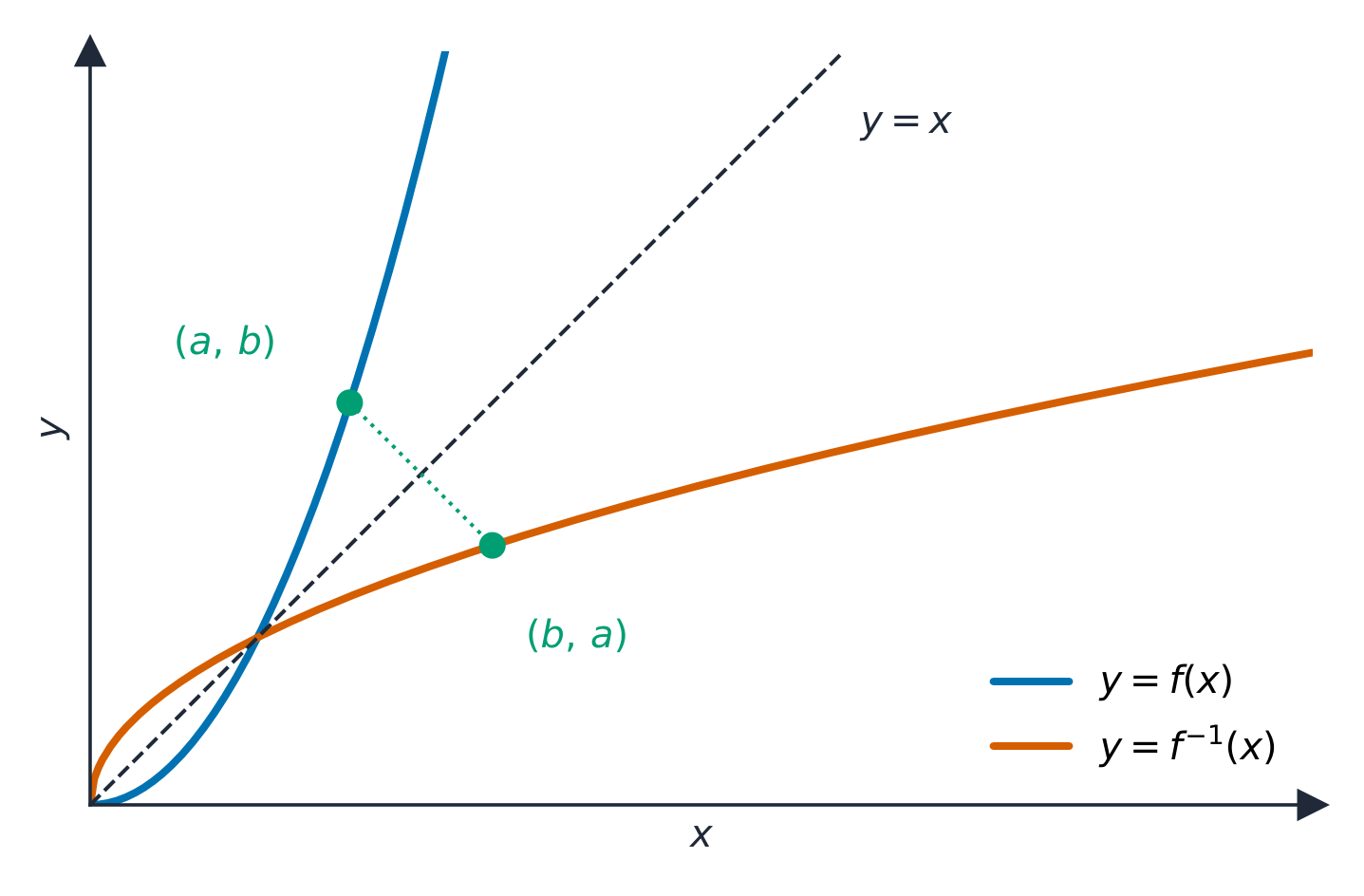
If $g$ is the inverse function 反函数 of $f$ (so $f(g(x))=x$), the chain rule links their derivatives:
$$g'(x) = \frac{1}{f'\big(g(x)\big)},\qquad\text{provided } f'\big(g(x)\big)\neq 0.$$
In words: the derivative of the inverse at a point is the reciprocal 倒数 of the derivative of the original function at the matching point. A common exam setup gives a table and a point $(a,b)$ on $f$ (so $(b,a)$ is on $g$), then asks for $g'(b)=\dfrac{1}{f'(a)}$.
Worked example. Suppose $f(2)=5$ and $f'(2)=3$, and $g$ is the inverse of $f$. Because $(2,5)$ lies on $f$, the point $(5,2)$ lies on $g$, and
$$g'(5)=\frac{1}{f'(2)}=\frac{1}{3}.$$
The graphs of $f$ and $g$ are mirror images across $y=x$, so their slopes at matching points are reciprocals.
Explore
An exponential and its inverse the logarithm
y = a·e^(bx) + c
Inverse functions are mirror images across $y=x$, and their slopes are reciprocals: $\frac{d}{dx}[f^{-1}(x)] = \dfrac{1}{f'(f^{-1}(x))}$. Where one is steep, its inverse is shallow.
Vocabulary
Train
| English |
|---|
| inverse function/ɪnˈvɜːs ˈfʌŋkʃn/ |
| reciprocal/rɪˈsɪprəkl/ |
3.4
Differentiating Inverse Trigonometric Functions
Syllabus
| Enduring Understanding | Learning Objective | Essential Knowledge |
|---|---|---|
FUN-3 | FUN-3.E |
|
Source: College Board AP Course and Exam Description
The same idea gives the derivatives of the inverse trigonometric functions 反三角函数. The three you should know:
$$\frac{d}{dx}\arcsin x = \frac{1}{\sqrt{1-x^2}}, \quad \frac{d}{dx}\arctan x = \frac{1}{1+x^2}, \quad \frac{d}{dx}\text{arcsec}\,x = \frac{1}{|x|\sqrt{x^2-1}}.$$
Combine these with the chain rule when the input is itself a function, e.g. $\dfrac{d}{dx}\arctan(3x)=\dfrac{3}{1+9x^2}$.
Vocabulary
Train
| English |
|---|
| inverse trigonometric functions/ɪnˈvɜːs ˌtrɪɡənəʊˈmetrɪk ˈfʌŋkʃnz/ |
3.5
Selecting Procedures for Calculating Derivatives
Syllabus
This topic is intended to focus on the skill of selecting an appropriate procedure for calculating derivatives. Students should be given opportunities to practice when and how to apply all learning objectives relating to calculating derivatives.
Source: College Board AP Course and Exam Description
A skill topic: real derivatives mix several rules, so read the structure of the expression first, from the outside in.
- Is it a sum? Differentiate term by term.
- A product or quotient? Apply that rule, and expect to use the chain rule inside.
- A composite (something inside something)? Chain rule.
- Given implicitly? Implicit differentiation.
Name the outermost operation, apply its rule, and recurse inward. Neatness prevents the sign and bookkeeping errors that cost marks.
3.6
Calculating Higher-Order Derivatives
Syllabus
| Enduring Understanding | Learning Objective | Essential Knowledge |
|---|---|---|
FUN-3 | FUN-3.F |
|
Source: College Board AP Course and Exam Description
Differentiating $f'$ produces the second derivative 二阶导数 $f''$; repeating gives higher-order derivatives. The notations:
$$f''(x)=\frac{d^2y}{dx^2}=y'', \qquad\text{and in general}\qquad f^{(n)}(x)=\frac{d^n y}{dx^n}.$$
The second derivative measures how the slope is changing; it drives concavity 凹凸性 and acceleration in later units. To find $f''$ implicitly, differentiate the expression for $\dfrac{dy}{dx}$ again (with the quotient and chain rules), then substitute $\dfrac{dy}{dx}$ back in.
Explore
Slope of the slope: the second derivative
y = ax³ + bx² + cx + d
Differentiating again gives the second derivative — the rate at which the slope changes. Where the tangent's slope is itself increasing, the curve bends upward (concave up).
Vocabulary
Train
| English |
|---|
| second derivative/ˈsekənd dɪˈrɪvətɪv/ |
| concavity/kənˈkævɪti/ |
3.6
Exam tips
- Use the chain rule for composite functions — differentiate the outside, then multiply by the derivative of the inside (the most-forgotten factor).
- For implicit differentiation, differentiate both sides with respect to $x$ and attach $\tfrac{dy}{dx}$ each time $y$ is differentiated, then solve.
- Get the second derivative by differentiating twice (velocity → acceleration).
- Combine rules carefully in layered expressions (chain inside product, etc.).
- The inverse function's graph is the reflection in $y=x$; its slope is the reciprocal of the original's at the matching point.
Interactive lessons on this topic
Work through it step by step, with instant-check exercises.