Working with the Intermediate Value Theorem (IVT)
Introduced| English |
|---|
| Intermediate Value Theorem/ˌɪntəˈmiːdɪət ˈvæljuː ˈθɪərəm/ |
| solution/səˈluːʃn/ |
| zero/ˈzɪərəʊ/ |
If you climbed from 1 m to 3 m, you passed 2 m
- Walk continuously from a height of $1$ m to $3$ m. At some instant you were at exactly $2$ m — you couldn't skip it.
- That obvious-sounding fact is the Intermediate Value Theorem 介值定理 (IVT).
- It guarantees a function hits every height between its endpoint values.
- The one catch: the path must be continuous — no teleporting, no jumps.
A continuous climb crosses every level
y = ax³ + bx + c
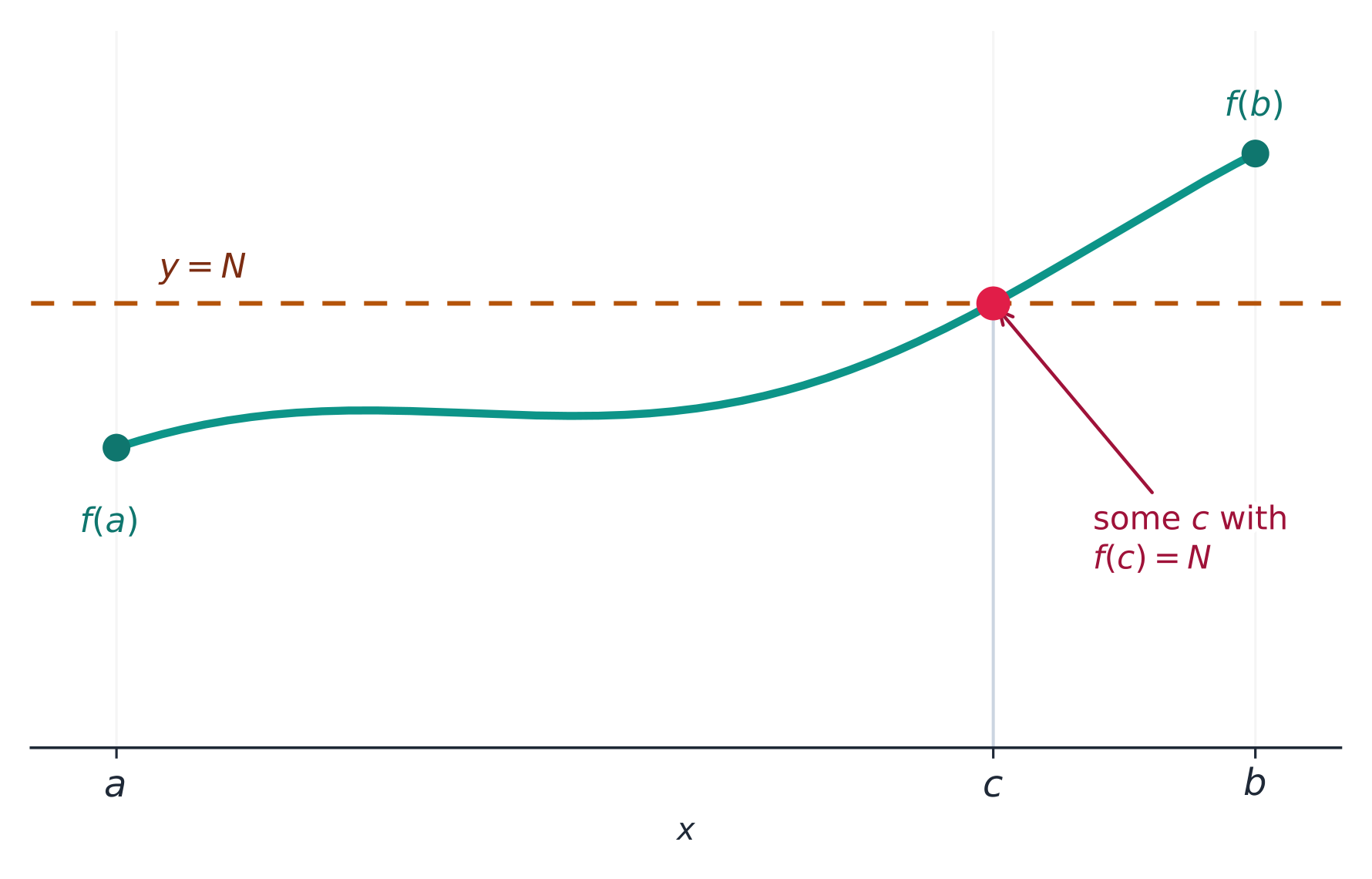
This continuous curve passes through every height between its ends — pick a target $N$ in range and it is hit somewhere.
What the theorem promises
- If $f$ is continuous on the closed interval $[a,b]$, and $N$ is any value between $f(a)$ and $f(b)$,
- then there exists at least one $c$ in $(a,b)$ with $f(c)=N$.
- In words: a continuous function takes every intermediate output somewhere in between.
- It is an existence theorem — it promises a $c$ exists, but does not tell you its value.
The IVT tells you the exact value of $c$ where $f(c)=N$.
It is an existence theorem — it guarantees a $c$ exists but does not locate it.
Check the hypotheses first
- Before you use the IVT, confirm the two requirements out loud:
- (1) $f$ is continuous on $[a,b]$ (a polynomial, or otherwise verified — see 1.12).
- (2) the target $N$ lies strictly between $f(a)$ and $f(b)$.
- Skip either check and the conclusion is not guaranteed — for a function with a jump, IVT says nothing.
To apply the IVT on $[a,b]$ with target $N$, you need all of...
IVT needs continuity and a target in range. Differentiability is not required.
The IVT requires the function to be ____ on the closed interval.
Without continuity a jump can skip the target value.
A continuous $f$ has $f(2)=5$ and $f(6)=9$. For which target $N$ does the IVT guarantee a solution $f(c)=N$?
$N$ must lie between $5$ and $9$; only $7$ qualifies.
The classic use: guaranteeing a root
- To show an equation has a solution 解 in $[a,b]$, rewrite it as $g(x)=0$ and target $N=0$.
- If $g$ is continuous and $g(a)$ and $g(b)$ have opposite signs, then $0$ is between them.
- IVT then guarantees a zero 零点 $c$ where $g(c)=0$ — the equation has a root in $(a,b)$.
- This "sign change ⇒ a root" argument is the theorem's most common exam appearance.
A continuous $g$ has $g(1)=-2$ and $g(3)=4$. The IVT guarantees...
Opposite signs bracket $0$; IVT guarantees existence of a root, not its count or location.
For $g(x)=x^2-2$ on $[1,2]$, compute $g(1)$ to check for a sign change with $g(2)=2$.
$g(1)=1-2=-1<0$ and $g(2)=2>0$: a sign change, so $\sqrt2$ is a root in $(1,2)$.
The IVT needs continuity on the whole closed interval and a target strictly between the endpoint values. Without continuity it fails: a function that jumps from $1$ to $3$ never equals $2$. And the IVT only guarantees existence — it does not locate $c$ or say how many such $c$ there are.
Show $x^3 + x - 1 = 0$ has a solution in $[0,1]$.
- Let $g(x)=x^3+x-1$; it is a polynomial, so continuous on $[0,1]$. ✓
- $g(0)=-1$ (negative) and $g(1)=1$ (positive) — opposite signs, so $N=0$ is between them.
- By the IVT, there is a $c\in(0,1)$ with $g(c)=0$. The equation has a root in $(0,1)$.
The Intermediate Value Theorem: if $f$ is continuous on $[a,b]$ and $N$ lies between $f(a)$ and $f(b)$, then $f(c)=N$ for some $c$ in $(a,b)$. Always verify continuity and that $N$ is in range first. Its headline use: a sign change of a continuous function guarantees a root in the interval — an existence result, not a value.