Connecting Multiple Representations of Limits
Introduced 15:10
Limits & Continuity
Here is a puzzle. A car's speedometer reads sixty kilometres per hour. But what does speed mean at a single instant? Speed is distance divided by time. Yet at…
English narration · English and 中文 subtitles you can switch
In this lesson
| English | Meaning |
|---|---|
| graph/ɡræf/ | A visual representation showing a relationship between quantities, often using points or curves on coordinate axes. |
| table/ˈteɪbl/ | Information arranged in rows and columns. |
| formula/ˈfɔːmjʊlə/ | A symbolic rule or equation expressing a relationship between quantities. |
| representations/ˌreprɪˈzenteɪʃnz/ | Different ways of describing the same mathematical object or relationship, such as equations, tables, graphs or words. |
One limit, four disguises
- A limit can appear as a graph 图像, a table 表格, a formula 公式 or a sentence in words. $\displaystyle\lim_{x\to2}f(x)=3$ is the same fact in all four representations 表示.
- AP questions mix them on purpose, so practise translating in both directions.
Graph, table, formula, and words are four ____ of the same limit.
Difficulty 1/5 · 100 coins + a small bonus on first completion today
They must all tell a consistent story.
Graph ⇄ words
- From a graph, trace both sides toward $c$ and read the shared height. In words: "the left and right limits are both 3, so the limit is 3", even if the dot sits elsewhere.
- A jump becomes "the one-sided limits differ, so the limit does not exist".
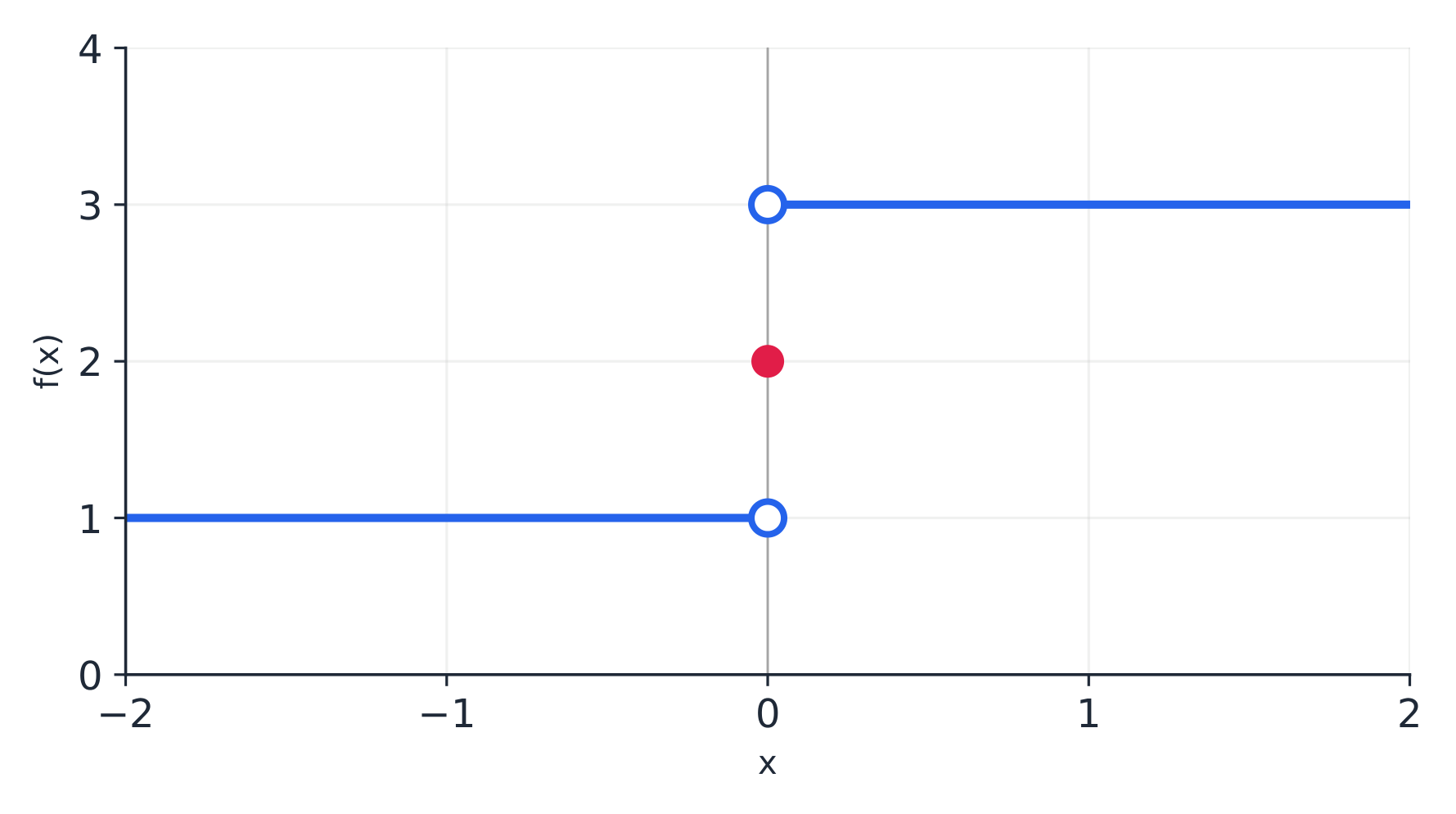
One-sided limits disagree: from the left f approaches 1 and from the right 3 so the limit at 0 does not exist
A graph shows the curve heading to height $3$ from both sides of $x=2$, with a filled dot at $(2,7)$. Which statement matches?
Difficulty 1/5 · 100 coins + a small bonus on first completion today
The curve's approach gives the limit $3$; the filled dot gives the separate value $f(2)=7$.
"As $x$ approaches 1 from the right, $f(x)$ approaches 2; from the left, $f(x)$ approaches 2; and $f(1)=5$." Which graph matches?
Difficulty 1/5 · 100 coins + a small bonus on first completion today
Both sides head to 2, so the curve has a hole at height 2. The value $f(1)=5$ is a separate filled dot.
Table ⇄ formula
- A table gives an estimate. Algebra on the formula (factor, substitute) turns it into an exact value.
- If the table and the algebra disagree, recheck both: a table can be fooled, and algebra can contain a sign slip.
A table gives $f(1.99)=4.98$, $f(2.01)=5.02$. Report the numerical estimate of $\lim_{x\to2}f(x)$.
Difficulty 2/5 · 140 coins + a small bonus on first completion today
Both sides close in on $5$.
Which representation gives an exact limit value (not just an estimate)?
Difficulty 1/5 · 100 coins + a small bonus on first completion today
Algebra gives certainty; tables and graphs only estimate or illustrate.
Confirm $\displaystyle\lim_{x\to1}\dfrac{x^2+4x-5}{x-1}$ in two representations.
- Formula: $\dfrac{(x-1)(x+5)}{x-1}=x+5$ for $x\ne1$, so the limit is 6.
- Table: $f(0.99)=5.99$, $f(1.01)=6.01$. Both sides close in on 6: the two agree.
Watch it climb the asymptote
y = a / (x − b)
As $x$ nears $b$, the reciprocal shoots to $+\infty$ from one side and $-\infty$ from the other — the line $x=b$ is a vertical asymptote.
A good habit is to confirm an algebraic limit with a quick table or graph.
Difficulty 1/5 · 100 coins + a small bonus on first completion today
Cross-checking across representations catches errors.
Mixed AP item. $g$ is shown by a graph with $\displaystyle\lim_{x\to2}g(x)=4$, and $h(x)=x^2-1$. Find $\displaystyle\lim_{x\to2}\big(3g(x)-h(x)\big)$.
- From the graph: $\lim g=4$. From the formula: $h$ is a polynomial, so $\lim h=h(2)=3$.
- Limit laws: $3(4)-3=9$. One answer from two representations.
A graph shows $\displaystyle\lim_{x\to3}g(x)=-1$, and $h(x)=x^2+2x$. Find $\displaystyle\lim_{x\to3}g(x)\,h(x)$.
Difficulty 2/5 · 140 coins + a small bonus on first completion today
$h$ is a polynomial, so $\lim_{x\to3}h(x)=9+6=15$. Product law: $(-1)(15)=-15$.
Your algebra gives $\displaystyle\lim_{x\to c}f(x)=4$, but you read the graph as heading to 5. What should you do with the disagreement?
A mismatch means a mistake, not a new limit.
Algebra gives a limit of 4, and a sketch was read as 5. What is the right next step?
Difficulty 1/5 · 100 coins + a small bonus on first completion today
The representations have to match.
- The representations must tell a consistent story. If algebra says 4 but the graph clearly heads to 2, one of them is wrong. Find the error.
- When reading a graph, the limit comes from the curve, not from a filled dot.
If algebra says the limit is $4$ but a graph clearly heads to $2$, what should you do?
Difficulty 2/5 · 140 coins + a small bonus on first completion today
A clash means an error — find it. Averaging or picking the easy one is never valid.
Graph, table, formula and words are four views of one limit. Translate between them, use algebra for exact values, and use a graph or table as a quick check. A disagreement means an error to hunt down.
What went wrong? Only the site team sees this.