Skip to content · ⁨ข้ามไปยังเนื้อหา⁩

Forces, density and pressure · ⁨แรง ความหนาแน่น และความดัน⁩

A-Level Physics · ⁨Physics A-Level⁩ · Topic 4 · ⁨หัวข้อ 4⁩

Video lesson for this topic · ⁨บทเรียนวิดีโอสำหรับหัวข้อนี้⁩ Open the video page · ⁨เปิดหน้าวิดีโอ⁩
17:06

โมเมนต์และความดัน

หอคอยเอนาเรจในอิตาลีเอียงมานานกว่าแปดร้อยปี — แต่ยังไม่ล้มลง ทำไม? น้ำหนักทั้งหมดของหอคอยกระทำที่จุดเดียว: จุดศูนย์กลาง… ของมัน

English narration · English + 中文 subtitles burned in · ⁨การบรรยายภาษาอังกฤษ · คำบรรยายภาษาอังกฤษ + 中文 ลอยตัวบนภาพ⁩

4.1

Turning effects of forces · ⁨ผลกระทบจากการหมุนของแรง⁩

Syllabus · ⁨หลักสูตร⁩
English
  1. understand that the weight of an object may be taken as acting at a single point known as its centre of gravity
  2. define and apply the moment of a force
  3. understand that a couple is a pair of forces that acts to produce rotation only
  4. define and apply the torque of a couple
ไทย
  1. เข้าใจว่า น้ำหนัก ของวัตถุสามารถพิจารณาว่ากระทำที่จุดเดียวซึ่งเรียกว่า ศูนย์มวล
  2. นิยามและใช้ โมเมนต์ของแรง
  3. เข้าใจว่า คู่แรง คือคู่ของแรงที่ทำหน้าที่เพื่อให้เกิดการหมุนเท่านั้น
  4. นิยามและใช้ โมเมนต์ของคู่แรง

Source: Cambridge International syllabus · ⁨แหล่งที่มา: หลักสูตร Cambridge International⁩

English
The principle of moments

Centre of gravity

The weight 重力 of a large object can be treated as acting at one single point, called the centre of gravity 重心 (the same as the centre of mass 质心 in a uniform gravitational field). For a uniform, regular shape — a rectangle, a sphere, a uniform rod — the centre of gravity is at the middle.

When you draw a free-body diagram 受力图, always put the weight arrow at the centre of gravity.

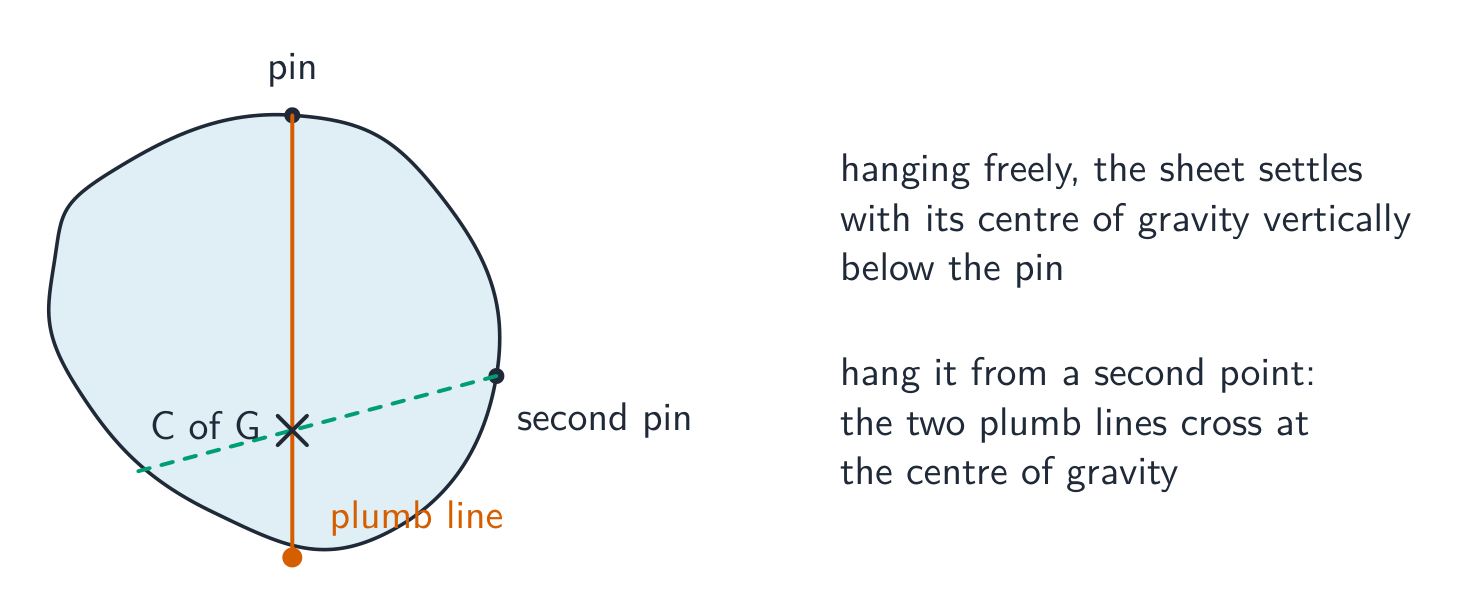
For an irregular shape, find the centre of gravity by experiment. Hang the object freely from a pin: in equilibrium it settles with its centre of gravity vertically below the pin, because only then does the weight have no moment about the pin. A plumb line 铅垂线 hung from the same pin marks that vertical. Hang the object from a second point and draw the second line; the centre of gravity is where the two lines cross. The same fact answers the exam's "explain why the sheet hangs like this": its centre of gravity is directly below the support, so the weight's line of action passes through the pivot and there is no resultant torque.

For a non-uniform 非均匀 bar, the centre of gravity is not at the middle. Find it by balancing the bar on a pivot, or by taking moments: if the bar's weight $W$ balances a known weight, the distance of its centre of gravity from the pivot is the one moment that makes the two sides equal.

Moment of a force

The moment 力矩 of a force about a point is

$$M = F \cdot d,$$

where $F$ is the size of the force 力 and $d$ is the perpendicular distance 垂直距离 from the point to the line of action 作用线 of the force. Unit: $\text{N m}$.

If the force acts at angle $\theta$ to a lever arm 力臂 of length $r$ from the pivot 支点, then $d = r\sin\theta$, so $M = F r\sin\theta$. Only the part of the force perpendicular 垂直 to the lever arm makes it turn.

Worked example. A force of $50\ \text{N}$ is applied to the end of a spanner $0.40\ \text{m}$ long, at $30°$ to the spanner. Find the moment of the force about the nut.

$$M = F r\sin\theta = 50 \times 0.40 \times \sin 30° = 50 \times 0.40 \times 0.50 = 10\ \text{N m}.$$

A moment is either clockwise 顺时针 or anticlockwise 逆时针 about the chosen point.

Couple and torque

A couple 力偶 is a pair of forces that are:

  • equal in size,
  • opposite in direction,
  • with their lines of action a perpendicular distance apart.

A couple makes the body turn only — its resultant force is zero, so it gives no straight-line acceleration.

The torque 力偶矩 of a couple is the turning effect it makes:

$$\tau = F \cdot d,$$

where $F$ is the size of one force and $d$ is the perpendicular distance between the two lines of action. Unit: $\text{N m}$. The torque is the same about any point — a special property of couples.

A common multiple-choice trap: two equal forces in the same direction are not a couple (they have a resultant force and cause translation 平动). A couple needs equal size and opposite direction.

Watch the distance in the formula. For a couple of two forces $F$ each acting a distance $d$ from a central pivot, on opposite sides, the perpendicular distance between the two lines of action is $2d$, so the torque is $F \times 2d = 2Fd$. Taking moments about the pivot gives the same answer, $Fd + Fd$. The two-mark definition wants both parts: the product of one of the forces and the perpendicular distance between the lines of action of the forces.

ไทย
หลักการโมเมนต์

จุดศูนย์กลางแรงโน้มถ่วง

น้ำหนักของวัตถุขนาดใหญ่สามารถพิจารณาว่ากระทำที่จุดเดียวที่เรียกว่า จุดศูนย์กลางแรงโน้มถ่วง (ซึ่งเหมือนกับ จุดศูนย์กลางมวล ในสนามโน้มถ่วงสม่ำเสมอ) สำหรับรูปร่างสม่ำเสมอและสมมาตร เช่นสี่เหลี่ยมจัตุรัสทรงกลมแท่งสม่ำเสมอ จุดศูนย์กลางแรงโน้มถ่วงจะอยู่ที่กึ่งกลาง

เมื่อคุณวาด แผนภาพร่างกายอิสระ ต้องวางลูกศรน้ำหนักที่จุดศูนย์กลางแรงโน้มถ่วงเสมอ

สำหรับรูปร่างที่ไม่สม่ำเสมอ ให้หาจุดศูนย์กลางแรงโน้มถ่วงโดยการทดลอง แขวนวัตถุอย่างอิสระจากหมุด: ในสภาวะสมดุลมันจะนิ่งลงโดยมีจุดศูนย์กลางแรงโน้มถ่วงอยู่ ใต้หมุดในแนวตั้ง เพราะเพียงเท่านั้นน้ำหนักจึงไม่มีโมเมนต์รอบหมุด สายน้ำหนัก ที่แขวนจากหมุดเดียวกันจะบอกลายเส้นแนวดิ่งนี้ แขวนวัตถุจากจุดที่สองแล้ววาดเส้นที่สอง؛ จุดศูนย์กลางแรงโน้มถ่วงคือจุดที่เส้นทั้งสองตัดกัน ข้อเท็จจริงเดียวกันนี้ตอบคำถามสอบ "อธิบายว่าทำไมแผ่นกระดาษถึงแขวนแบบนี้": จุดศูนย์กลางแรงโน้มถ่วงอยู่ใต้จุดรองรับโดยตรง ดังนั้นเส้นกระทำของน้ำหนักผ่านจุดหมุนและไม่เกิดโมเมนต์สุทธิ

แผ่นกระดาษไม่สมมาตรแขวนจากหมุด พร้อมสายน้ำหนักจากหมุดวาด横跨上去; หมุดที่สองและเส้นประตัดกับเส้นแรกที่จุดศูนย์กลางแรงโน้มถ่วง ซึ่งทำเครื่องหมายด้วยเครื่องหมาย X
การหาจุดศูนย์กลางแรงโน้มถ่วง: แขวนอย่างอิสระ วัตถุจะนิ่งลงโดยมีจุดศูนย์กลางแรงโน้มถ่วงอยู่ใต้หมุดในแนวตั้ง ดังนั้นสายน้ำหนักสองเส้นจากหมุดสองจุดจะตัดกันที่จุดนั้น

สำหรับแท่ง ไม่สม่ำเสมอ จุดศูนย์กลางแรงโน้มถ่วงจะไม่อยู่ที่กึ่งกลาง หาได้โดยการوازنแท่งบนจุดหมุน หรือโดยการtaking moments: ถ้า น้ำหนัก ของแท่ง $W$ BALANCES น้ำหนักที่กำหนดให้ ระยะทางจากจุดศูนย์กลางแรงโน้มถ่วงไปยังจุดหมุนคือโมเมนต์ที่ทำให้สองด้านเท่ากัน

โมเมนต์ของแรง

โมเมนต์ ของแรงรอบจุดหนึ่งคือ

$$M = F \cdot d,$$

โดยที่ $F$ คือขนาดของ แรง และ $d$ คือ ระยะตั้งฉาก จากจุดนั้นไปยัง เส้นกระทำ ของแรง หน่วยวัด: $\text{N m}$

ถ้าแรงกระทำที่มุม $\theta$ กับ คันโยก ยาว $r$ จาก จุดหมุน แล้ว $d = r\sin\theta$, ดังนั้น $M = F r\sin\theta$. เพียงส่วนประกอบของแรงที่ ตั้งฉาก กับคันโยกเท่านั้นที่ทำให้มันหมุน

ตัวอย่างคำนวณ. แรงแบบ $50\ \text{N}$ ถูกกระทำที่ปลายประแจยาว $0.40\ \text{m}$, ที่มุม $30°$ ต่อประแจ. หาค่าโมเมนต์ของแรงรอบน็อต

$$M = F r\sin\theta = 50 \times 0.40 \times \sin 30° = 50 \times 0.40 \times 0.50 = 10\ \text{N m}.$$
จุดหมุนพร้อมแรง F กระทำที่ปลายคันโยกยาว r ที่มุม theta; ระยะตั้งฉาก d จากจุดหมุนไปยังเส้นกระทำของแรงแสดงด้วยเส้นประแนวนอน
โมเมนต์ขึ้นอยู่กับระยะตั้งฉาก $d$ จากจุดหมุนไปยังแนวกระทำของแรง

โมเมนต์จะเป็นeither ตามเข็มนาฬิกา หรือ ทวนเข็มนาฬิกา รอบจุดที่เลือก

คู่แรงและโมเมนต์บิด

คู่แรง คือคู่ของแรงที่เป็น:

  • มีขนาดเท่ากัน,
  • มีทิศทางตรงกันข้าม,
  • และมีเส้นกระทำห่างกันเป็นระยะตั้งฉาก

คู่แรงทำให้วัตถุ หมุนเท่านั้น — แรงลัพธ์ของมันเป็นศูนย์ ดังนั้นจึงไม่ให้ความเร่งเชิงเส้น

โมเมนต์บิด ของคู่แรงคือผลกระทบต่อการหมุนที่มันสร้าง:

$$\tau = F \cdot d,$$

โดยที่ $F$ คือขนาดของแรงหนึ่งตัวและ $d$ คือระยะตั้งฉากระหว่างเส้นกระทำทั้งสอง หน่วยวัด: $\text{N m}$. โมเมนต์บิดจะมีค่าเท่ากันรอบจุดใดๆ — ซึ่งเป็นคุณสมบัติพิเศษของคู่แรง

ดิสก์ที่มีแรง F สองแรงขนาดเท่ากันและทิศทางตรงข้ามกันกระทำที่ปลายทั้งสองซึ่งห่างกันด้วยเส้นผ่านศูนย์กลาง 2r พร้อมลูกศรโค้งแสดงโมเมนต์ที่ทำให้ดิสก์หมุน
คู่แรง: แรงสองตัวเท่ากันและตรงข้ามกัน มีระยะห่างกัน เกิดโมเมนต์

กับดักข้อสอบแบบเลือกตอบที่พบบ่อย: แรงสองแรงที่มีขนาดเท่ากันแต่อยู่ใน ทิศทางเดียวกัน จะไม่จัดเป็นคู่แรง (因为它们会产生แรงลัพธ์และทำให้เกิดการ เคลื่อนที่เชิงเส้น) คู่แรงจำเป็นต้องมีขนาดเท่ากัน และ ทิศทางตรงข้าม

ระวังระยะในสูตร สำหรับคู่แรงของแรง $F$ แต่ละตัวกระทำที่ระยะ $d$ จากจุดหมุนกลาง ซึ่งอยู่คนละด้าน ระยะตั้งฉากระหว่างแนวการกระทำของแรงทั้งสองคือ $2d$ ดังนั้นโมเมนต์จึงเท่ากับ $F \times 2d = 2Fd$ การคำนวณโมเมนต์รอบจุดหมุนจะได้คำตอบเดียวกันคือ $Fd + Fd$ นิยามสำหรับคะแนน 2 ข้อ ต้องระบุทั้งสองส่วน: ผลคูณของแรงหนึ่งใดกับระยะตั้งฉากระหว่างแนวการกระทำของแรงทั้งสอง

Explore · ⁨สำรวจ⁩

Balance the see-saw · ⁨ปรับสมดุลกระดาก⁩

Put a weight on each side and slide it in or out. A small weight far from the pivot can balance a big weight close in — the beam is level when force × distance matches on both sides. · ⁨วางน้ำหนักลงบนแต่ละด้านและเลื่อนเข้าหรือออก. น้ำหนักเล็กน้อยที่อยู่ไกลจากจุดหมุนสามารถดุลกับน้ำหนักมากที่อยู่ใกล้ได้ — คานจะราบเรียบเมื่อแรง × ระยะ ทางทั้งสองฝั่งเท่ากัน⁩

Vocabulary · ⁨คำศัพท์⁩ Train · ⁨ฝึกฝน⁩
English ไทย
force/fɔːs/ แรง
moment/ˈməʊmənt/ ปัจจุบัน
centre of gravity/ˈsentə ɒv ˈɡrævɪti/ ศูนย์ถ่วง
weight/weɪt/ น้ำหนัก
centre of mass/ˈsentə ɒv mæs/ ศูนย์กลางมวล
free-body diagram/friː ˈbɒdi ˈdaɪəɡræm/ แผนภาพวัตถุอิสระ
torque/tɔːk/ แรงบิด
non-uniform/nɒn ˈjuːnɪfɔːm/ ไม่สม่ำเสมอ
perpendicular distance/ˌpɜːpənˈdɪkjʊlə ˈdɪstəns/ ระยะตั้งฉาก
perpendicular/ˌpɜːpənˈdɪkjʊlə/ ตั้งฉาก
lever arm/ˈliːvə ɑːm/ แขนงก้าน
horizontal/ˌhɒrɪˈzɒntl/ เป็นแนวนอน
couple/ˈkʌpl/ คู่มุม
resultant force/rɪˈzʌltənt fɔːs/ แรงลัพธ์
translation/trænˈsleɪʃn/ การแปลรหัส
angular acceleration/ˈæŋɡjʊlə əkˌseləˈreɪʃn/ ความเร่งมุม
tension/ˈtenʃn/ แรงตึง
component/kəmˈpəʊnənt/ องค์ประกอบ
4.2

Equilibrium of forces · ⁨ความสมดุลของแรง⁩

Syllabus · ⁨หลักสูตร⁩
English
  1. state and apply the principle of moments
  2. understand that, when there is no resultant force and no resultant torque, a system is in equilibrium
  3. use a vector triangle to represent coplanar forces in equilibrium
ไทย
  1. บอกและใช้ หลักการของโมเมนต์
  2. เข้าใจว่า เมื่อไม่มี แรงลัพธ์ และไม่มี โมเมนต์ลัพธ์ ระบบจะอยู่ในสภาวะ สมดุล
  3. ใช้ สามเหลี่ยมเวกเตอร์ เพื่อแทน แรงในระนาบเดียวกัน ที่อยู่ในสภาวะสมดุล

Source: Cambridge International syllabus · ⁨แหล่งที่มา: หลักสูตร Cambridge International⁩

English

Conditions for equilibrium

A body is in equilibrium 平衡 when:

  1. the resultant force 合力 is zero (no straight-line acceleration), AND
  2. the resultant moment about any point is zero (no angular acceleration 角加速度).

Both must hold. A body with no resultant force can still be turning; a body with no resultant moment can still be moving in a straight line.

The classic multiple-choice case: four forces, two equal pairs pointing in opposite directions but not along the same lines. The resultant force is zero, so the centre of mass does not accelerate, but the pairs form couples with a resultant torque, so the object spins faster and faster while its centre of mass moves at constant velocity. Only when both conditions hold is the body in equilibrium.

Principle of moments

For a body that is not turning, the total clockwise moment about any point equals the total anticlockwise moment about the same point. This is the principle of moments 力矩原理.

To solve a balance problem:

  1. Choose a pivot — usually where an unknown force acts, so that force drops out (its distance is zero).
  2. List every force and its perpendicular distance from the pivot.
  3. Set $\sum M_{\text{clockwise}} = \sum M_{\text{anticlockwise}}$.
  4. Use $\sum F = 0$ if you need a second equation.

A ruler balanced on a pivot with masses on each side is solved this way. For a heavy uniform rod, remember to include its weight acting at its centre of gravity. Stated for the marks: for a body in equilibrium, the sum of the clockwise moments about any point equals the sum of the anticlockwise moments about that same point.

Worked example. A uniform beam of length $4.0\ \text{m}$ is pivoted at its centre. A $40\ \text{N}$ weight hangs $1.5\ \text{m}$ from the pivot on one side. How far from the pivot, on the other side, must a $30\ \text{N}$ weight hang to balance the beam?

The beam's own weight acts at the centre (the pivot), so it has no moment. Setting clockwise $=$ anticlockwise moments:

$$40 \times 1.5 = 30 \times d \quad\Rightarrow\quad d = \frac{60}{30} = 2.0\ \text{m}.$$

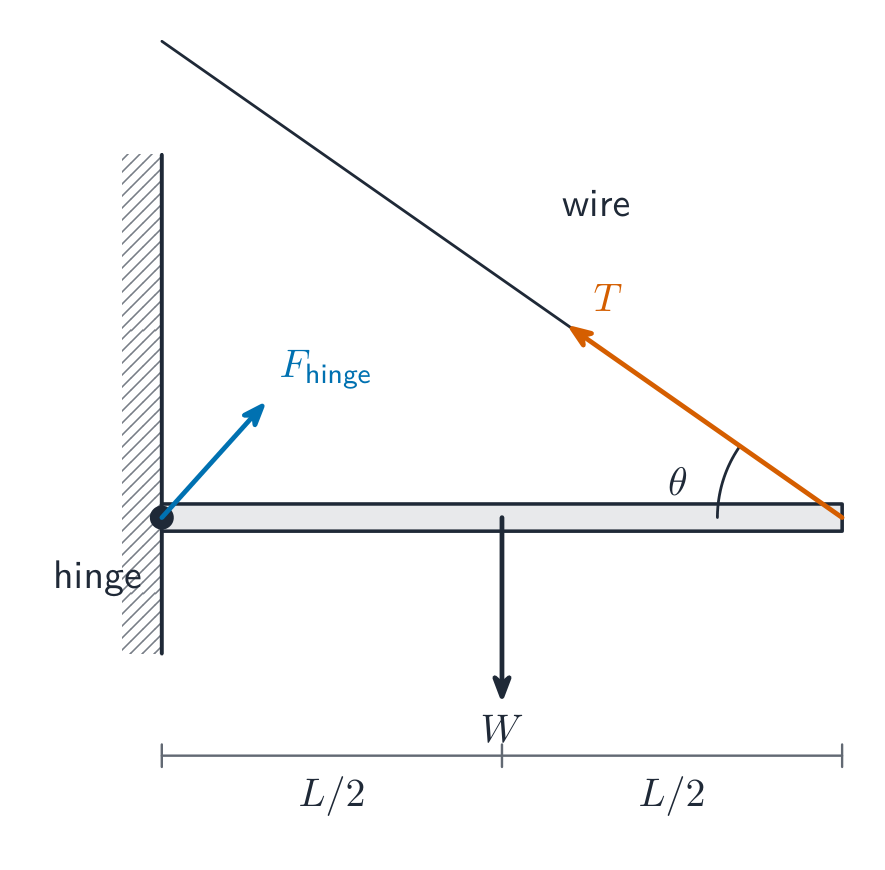
Worked example. A uniform rod of length $L$ and weight $W = 28\ \text{N}$ is hinged to a wall at one end and held horizontal by a wire from its other end. The wire makes $40°$ with the rod. Find the tension $T$ in the wire.

Take moments about the hinge, so the unknown hinge force drops out. The weight acts at the centre, a distance $L/2$ from the hinge: its moment is $W \times L/2$, clockwise. The tension acts at the end, but not at right angles to the rod, so its moment is $T\sin 40° \times L$, anticlockwise (only the component of $T$ perpendicular to the rod turns it). Equate them:

$$T \sin 40° \times L = W \times \frac{L}{2} \quad\Rightarrow\quad T = \frac{28}{2 \sin 40°} = 22\ \text{N}.$$

The length $L$ cancels, which is why the question need not give it. If a load hangs from the rod as well, add its moment on the clockwise side. This is the shape of almost every moments question: choose the pivot where the unknown force acts, use the perpendicular component of any angled force, and let unknown lengths cancel.

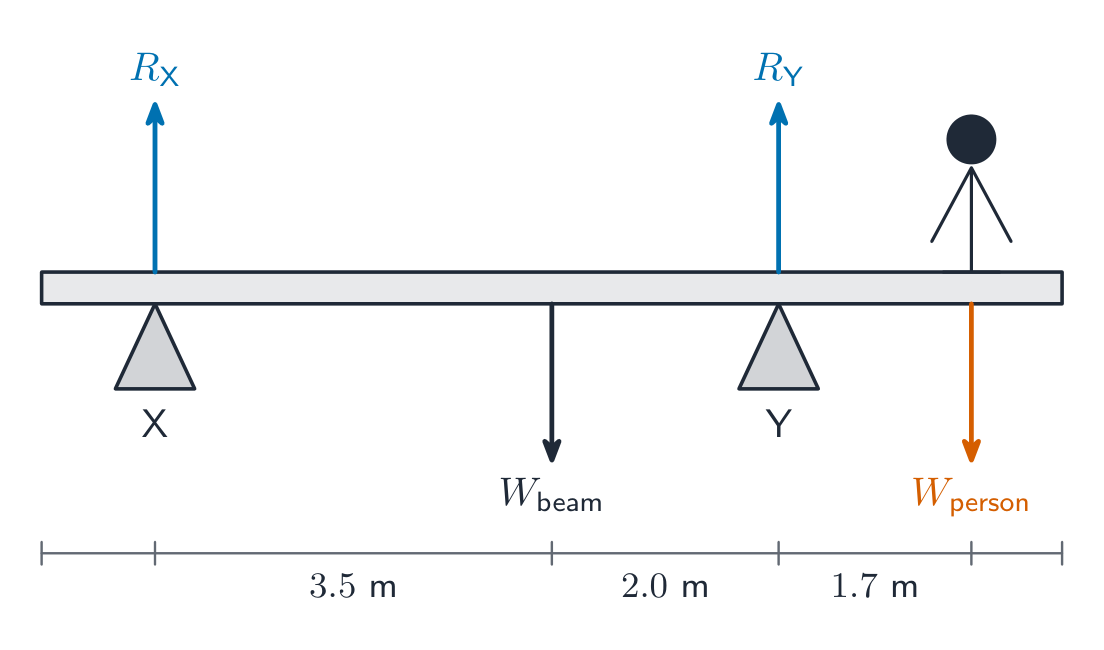
Worked example. A uniform beam of weight $200\ \text{N}$ and length $9.0\ \text{m}$ rests on two supports, X at $1.0\ \text{m}$ from the left end and Y at $6.5\ \text{m}$. A person of weight $700\ \text{N}$ stands $1.7\ \text{m}$ from Y, beyond it. Find the force from each support.

Two unknown forces, $R_{\text{X}}$ and $R_{\text{Y}}$, so take moments about X to remove $R_{\text{X}}$. The beam's weight acts at its centre, $3.5\ \text{m}$ from X; Y is $5.5\ \text{m}$ from X; the person is $7.2\ \text{m}$ from X:

$$R_{\text{Y}} \times 5.5 = 200 \times 3.5 + 700 \times 7.2 \quad\Rightarrow\quad R_{\text{Y}} = \frac{700 + 5040}{5.5} = 1040\ \text{N}.$$

Then the resultant force is zero: $R_{\text{X}} + R_{\text{Y}} = 200 + 700$, so $R_{\text{X}} = 900 - 1040 = -140\ \text{N}$. A negative answer means the beam would lift off X: with the person that far past Y, X must hold the beam down, not up. Questions often ask where a person can stand before the beam tips; that is the position at which $R_{\text{X}}$ becomes zero.

Vector triangle

Three forces in the same plane that are in equilibrium can be drawn as a closed vector triangle 矢量三角形 — drawn tip-to-tail, the three arrows come back to the start. This is a drawing method instead of splitting into components 分量.

Use the sine rule 正弦定理 or the cosine rule 余弦定理 on the triangle to find unknown sizes or directions, or draw the triangle to scale on graph paper.

You can also split each force into horizontal 水平 and vertical 竖直 components and set $\sum F_{x} = 0$ and $\sum F_{y} = 0$.

To draw the triangle for the marks: draw the weight first (vertical, to scale), then add the other two forces tip to tail in their real directions, so the third arrow closes the triangle; label every side with its force and mark the angles. For a block resting on a slope the three forces are the weight (vertical), the normal contact force (perpendicular to the slope) and friction (along the slope), so the triangle is right-angled with the weight as the hypotenuse. For a picture hanging from a string over a pin, the two equal tensions make an isosceles triangle with the weight. The test of any answer is that the triangle closes; if it does not, the object is not in equilibrium.

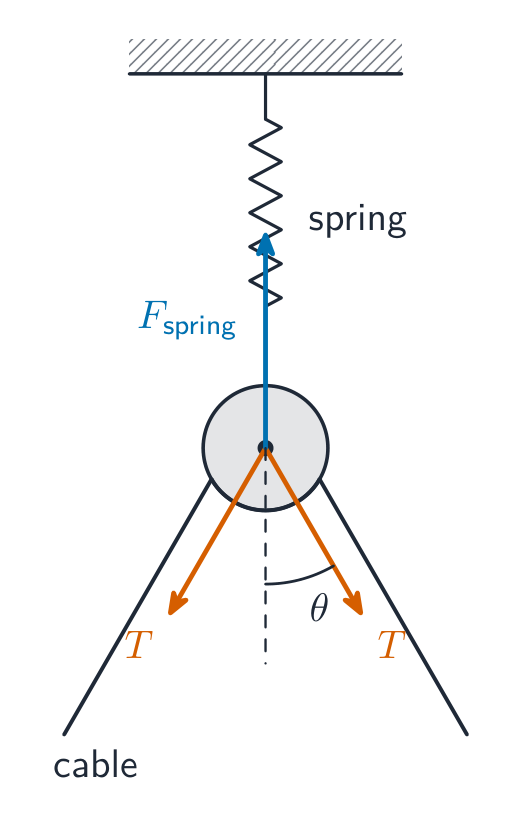
Worked example. A pulley of negligible weight is held by a spring. A single cable passes under the pulley, and each side of the cable makes $30°$ with the vertical. The tension in the cable is $T = 60\ \text{N}$. Find the force from the spring and the extension of the spring, given its spring constant is $2000\ \text{N m}^{-1}$.

Because it is one continuous cable, the tension is the same on both sides. The two tensions pull down and outwards; their horizontal components cancel and their vertical components add, so the spring must pull up with $F = 2T\cos 30° = 2 \times 60 \times 0.866 = 104\ \text{N}$. From Hooke's law (topic 6), $x = F / k = 104 / 2000 = 0.052\ \text{m}$. If the angle to the vertical grows, $\cos\theta$ falls, so the spring force and extension fall: the cable is pulling more sideways and less upwards.

ไทย

เงื่อนไขความสมดุล

วัตถุจะอยู่ในสภาวะ สมดุล เมื่อ:

  1. แรงลัพธ์ เป็นศูนย์ (ไม่มีการเร่งความเร็วเชิงเส้น), และ
  2. โมเมนต์ลัพธ์รอบจุดใดๆ เป็นศูนย์ (ไม่มีความเร่งเชิงมุม).

ทั้งสองเงื่อนไขต้องเกิดขึ้นพร้อมกัน วัตถุที่ไม่มีแรงลัพธ์อาจยังหมุนได้ วัตถุที่ไม่มีโมเมนต์ลัพธ์อาจยังเคลื่อนที่ตามเส้นตรงได้

กรณีข้อสอบแบบเลือกตอบคลาสสิก: แรงสี่แรง มีสองคู่ที่มีขนาดเท่ากันและทิศทางตรงข้ามกันแต่ไม่อยู่บนแนวเดียวกัน แรงลัพธ์เป็นศูนย์ ดังนั้นศูนย์กลางมวลไม่เร่ง แต่คู่แรงเหล่านี้สร้างคู่แรงที่มีโมเมนต์ลัพธ์ ทำให้วัตถุหมุนเร็วขึ้นเรื่อยๆ ในขณะที่ศูนย์กลางมวลเคลื่อนที่ด้วยความเร็วคงที่ วัตถุจะอยู่ในสภาวะสมดุลก็ต่อเมื่อทั้งสองเงื่อนไขเป็นจริงเท่านั้น

หลักการโมเมนต์

สำหรับวัตถุที่ไม่หมุน ผลรวมของโมเมนต์ทวนเข็มนาฬิการอบจุดใดๆ เท่ากับผลรวมของโมเมนต์ตามเข็มนาฬิการอบจุดเดียวกัน นี่คือ หลักการโมเมนต์

ในการแก้โจทย์สมดุล:

  1. เลือกจุดหมุน — มักเป็นตำแหน่งที่แรงที่ไม่ทราบค่ากระทำ เพื่อให้แรงนั้นหายไป (เพราะระยะเป็นศูนย์).
  2. จดforce ทุกตัวและระยะตั้งฉากจากจุดหมุน.
  3. ตั้งสมการ $\sum M_{\text{clockwise}} = \sum M_{\text{anticlockwise}}$.
  4. ใช้ $\sum F = 0$ หากต้องการสมการเพิ่มเติม.

ไม้บรรทัดที่วางสมดุลบนจุดหมุนโดยมีมวลทั้งสองข้างแก้ได้แบบนี้ สำหรับแท่งสม่ำเสมอหนัก ให้จำไว้ว่าต้องรวมน้ำหนักที่กระทำที่ศูนย์กลางมวล之它 stating for the marks: สำหรับวัตถุในสภาวะสมดุล ผลรวมของโมเมนต์ตามเข็มนาฬิการอบจุดใดๆ เท่ากับผลรวมของโมเมนต์ทวนเข็มนาฬิการอบจุดเดียวกัน

ตัวอย่างวิธีทำ. แท่งสม่ำเสมอยาว $4.0\ \text{m}$ วางบนจุดหมุนที่กึ่งกลาง มีน้ำหนัก $40\ \text{N}$ แขวนอยู่ที่ระยะ $1.5\ \text{m}$ จากจุดหมุนด้านหนึ่ง ต้องวางน้ำหนัก $30\ \text{N}$ ที่ระยะเท่าไรจากจุดหมุนอีกด้านหนึ่งเพื่อทำให้แท่งสมดุล?

น้ำหนักของแท่งเองกระทำที่กึ่งกลาง (จุดหมุน) จึงไม่มีโมเมนต์ ตั้งให้โมเมนต์ตามเข็มนาฬิกา $=$ โมเมนต์ทวนเข็มนาฬิกา:

$$40 \times 1.5 = 30 \times d \quad\Rightarrow\quad d = \frac{60}{30} = 2.0\ \text{m}.$$
ไม้บรรทัดแนวนอนที่วางสมดุลบนจุดหมุนกลาง โดยมีน้ำหนักแขวนอยู่ที่ระยะต่างกัน; น้ำหนักทางซ้ายให้โมเมนต์ทวนเข็มนาฬิกา และน้ำหนักทางขวาให้โมเมนต์ตามเข็มนาฬิกา
น้ำหนักบนไม้บรรทัดที่สมดุลบนจุดหมุน — ใช้ทดสอบหลักการของโมเมนต์
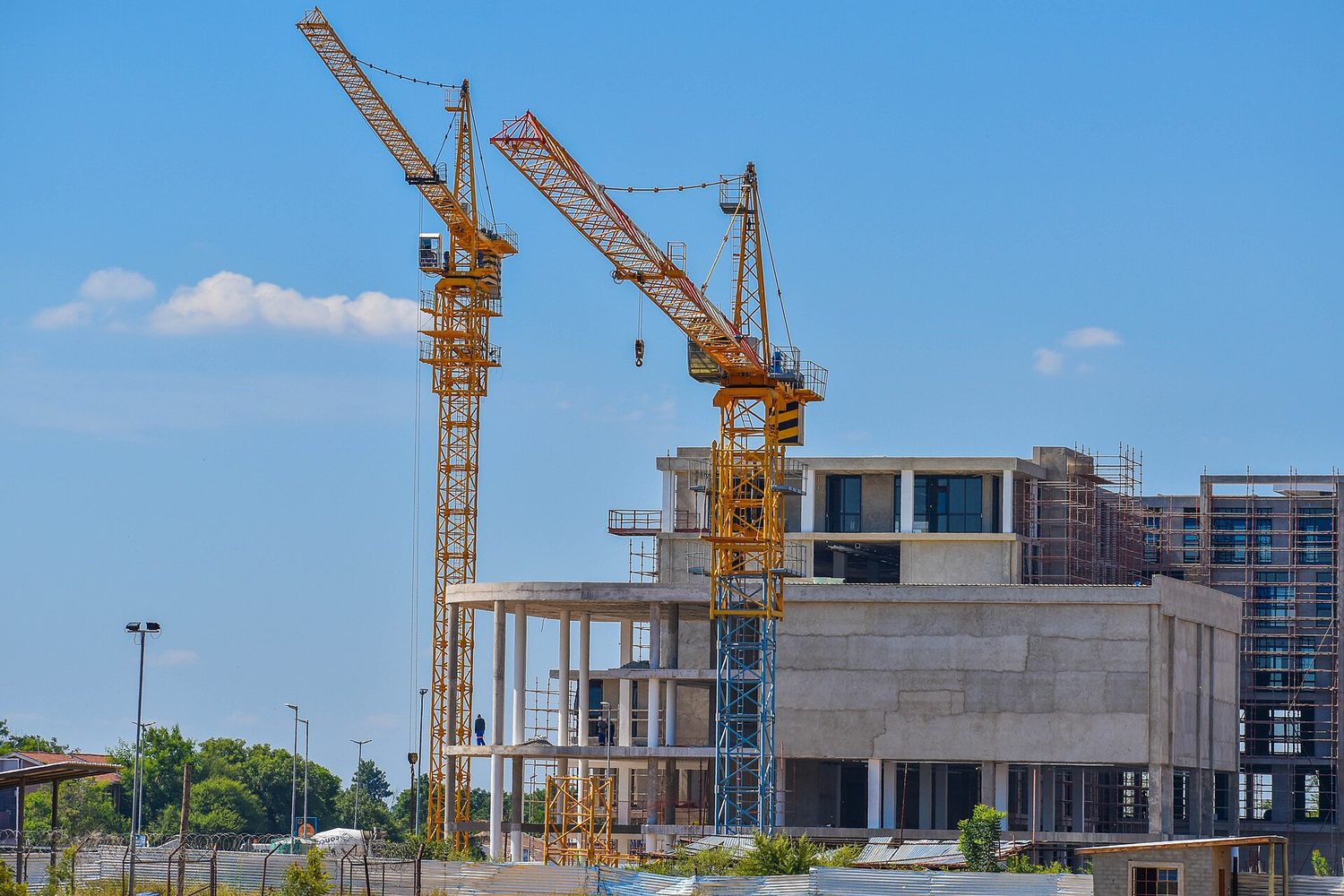
เครนหอคอย ณ พื้นที่ก่อสร้างในเมือง แต่ละตัวมีแขนยาวและน้ำหนักถ่วง平衡ที่แขนสั้นด้านหลังเสา
เครนหอคอยคือโจทย์เรื่องโมเมนต์: โมเมนต์ของน้ำหนักถ่วง平衡รอบเสาจะสมดุลกับโมเมนต์ของโหลด

ตัวอย่างวิธีทำ. แท่งสม่ำเสมอยาว $L$ และมีน้ำหนัก $W = 28\ \text{N}$ ยึดติดกับผนังที่ปลายด้านหนึ่ง และยึดให้ตั้งนอนด้วยสายจากปลายอีกด้าน สายทำมุม $40°$ กับแท่ง หาแรงตึง $T$ ในสาย

แท่งสม่ำเสมอที่ยึดติดกับผนังที่ปลายซ้าย ถูกยึดให้ตั้งนอนด้วยสายจากปลายขวาขึ้นไปหาผนังที่มุม theta เทียบกับแท่ง น้ำหนัก W กระทำที่กึ่งกลางของแท่ง แรงตึง T กระทำตามสาย และมีแรงที่ไม่ทราบค่ากระทำที่จุดยึด; ทำเครื่องหมายระยะ L/2 และ L/2 *แท่งที่ยึดติดกับผนังด้วยสาย: การคำนวณโมเมนต์รอบจุดยึดจะทำให้แรงที่ไม่ทราบค่าที่จุดยึดหายไป
คำนวณโมเมนต์รอบจุดยึด sehingga แรงที่ไม่ทราบค่าที่จุดยึดหายไป น้ำหนักกระทำที่กึ่งกลาง ซึ่งเป็นระยะ $L/2$ จากจุดยึด: โมเมนต์ของมันคือ $W \times L/2$, ตามเข็มนาฬิกา แรงตึงกระทำที่ปลายแต่ไม่ตั้งฉากกับแท่ง ดังนั้นโมเมนต์ของมันคือ $T\sin 40° \times L$, ทวนเข็มนาฬิกา (เฉพาะองค์ประกอบของ $T$ ที่ตั้งฉากกับแท่งเท่านั้นที่ทำให้มันหมุน) เทบเท่ากัน:

$$T \sin 40° \times L = W \times \frac{L}{2} \quad\Rightarrow\quad T = \frac{28}{2 \sin 40°} = 22\ \text{N}.$$

ความยาว $L$ หักล้างกัน ซึ่งเป็นเหตุผลที่โจทย์ไม่จำเป็นต้องระบุ หากมีโหลดแขวนบนแท่งด้วย ให้เพิ่มโมเมนต์นั้นเข้าฝั่งตามเข็มนาฬิกา นี่คือรูปแบบเกือบทุกโจทย์โมเมนต์: เลือกจุดหมุนที่แรงที่ไม่ทราบค่ากระทำ ใช้องค์ประกอบตั้งฉากของแรงที่เอียง และปล่อยให้ความยาวที่ไม่ทราบค่าหักล้างกัน

ตัวอย่างวิธีทำ. แท่งสม่ำเสมอที่มีน้ำหนัก $200\ \text{N}$ และความยาว $9.0\ \text{m}$ วางอยู่บนฐานรองรับสองจุด X ที่ระยะ $1.0\ \text{m}$ จากปลายซ้าย และ Y ที่ระยะ $6.5\ \text{m}$ คนที่มีน้ำหนัก $700\ \text{N}$ ยืนอยู่ที่ระยะ $1.7\ \text{m}$ จาก Y ผ่านไป beyond it หาแรงจากฐานรองรับแต่ละจุด

แท่งแนวนอนวางอยู่บนฐานรองรับสามเหลี่ยม X และ Y โดยมีแรงสนับสนุน R_X และ R_Y ชี้ขึ้นที่จุดเหล่านั้น น้ำหนักของแท่งกระทำลงที่กึ่งกลาง และน้ำหนักคนกระทำลงใกล้ปลายขวา; แถบแสดงระยะด้านล่างระบุว่า 3.5 เมตรจาก X ถึงกึ่งกลาง, 2.0 เมตรจากกึ่งกลางถึง Y และ 1.7 เมตรจาก Y ถึงคน *แท่งบนฐานรองรับสองจุด: การคำนวณโมเมนต์รอบฐานรองรับจุดหนึ่งจะให้แรงของฐานรองรับอีกจุดหนึ่ง; ผลรวมของแรงจะหาแรงจุดแรกได้
แรงที่ไม่ทราบค่าสองตัว คือ $R_{\text{X}}$ และ $R_{\text{Y}}$, ดังนั้นคำนวณโมเมนต์รอบ X เพื่อลบ $R_{\text{X}}$ ออก น้ำหนักของแท่งกระทำที่กึ่งกลาง ซึ่งเป็นระยะ $3.5\ \text{m}$ จาก X; Y อยู่ห่างจาก X $5.5\ \text{m}$; คนอยู่ห่างจาก X $7.2\ \text{m}$:

$$R_{\text{Y}} \times 5.5 = 200 \times 3.5 + 700 \times 7.2 \quad\Rightarrow\quad R_{\text{Y}} = \frac{700 + 5040}{5.5} = 1040\ \text{N}.$$

จากนั้นแรงลัพธ์เป็นศูนย์: $R_{\text{X}} + R_{\text{Y}} = 200 + 700$, ดังนั้น $R_{\text{X}} = 900 - 1040 = -140\ \text{N}$. คำตอบที่เป็นลบหมายความว่าแท่งจะยกออกจาก X: เมื่อคนยืนไกลเกิน Y那么 X ต้องกดแท่งไว้ ไม่สามารถดันขึ้นได้ โจทย์มักถามว่าคนสามารถยืนได้ที่ใดก่อนที่แท่งจะคว่ำ: นั่นคือตำแหน่งที่ $R_{\text{X}}$ จะกลายเป็นศูนย์.

สามเหลี่ยมเวกเตอร์

แรงสามแรงในระนาบเดียวกันซึ่งอยู่ในสภาวะสมดุล สามารถวาดเป็น สามเหลี่ยมเวกเตอร์ปิด — เมื่อวาดปลายลูกศรติดกับปลายลูกศรอีกตัว ลูกศรทั้งสามจะวนกลับไปยังจุดเริ่มต้น นี่คือวิธีการวาดแทนการแยกเป็น องค์ประกอบ

แรงสามแรงในสภาวะสมดุล (น้ำหนัก W และความตึงสองแรง) วาดปลายติดปลายเป็นสามเหลี่ยมปิดที่วนกลับไปยังจุดเริ่มต้น
แรงสามแรงในสภาวะสมดุลจะสร้างสามเหลี่ยมเวกเตอร์ปิด

ใช้ กฎของไซน์ หรือ กฎของโคไซน์ กับสามเหลี่ยมเพื่อหาค่าหรือทิศทางที่ไม่ทราบค่า หรือวาดสามเหลี่ยมตามสเกลบนกระดาษกราฟ

คุณสามารถแยกแรงแต่ละตัวออกเป็น องค์ประกอบแนวนอน และ องค์ประกอบแนวตั้ง แล้วกำหนด $\sum F_{x} = 0$ และ $\sum F_{y} = 0$.

ในการวาดสามเหลี่ยมสำหรับโจทย์: วาดน้ำหนักก่อน (แนวตั้ง ตามสเกล) จากนั้นเพิ่มแรงอีกสองแรงโดยต่อปลายลูกศรไปในทิศทางจริง เพื่อให้ลูกศรสุดท้ายปิดรูปสามเหลี่ยม; ทำป้ายชื่อทุกด้านด้วยชื่อแรงและทำเครื่องหมายมุม สำหรับวัตถุวางนิ่งบนทางลาด แรงสามแรงคือ น้ำหนัก (แนวตั้ง), แรงสัมผัสปกติ (ตั้งฉากกับทางลาด) และแรงเสียดทาน (ตามทางลาด) ดังนั้นสามเหลี่ยมจะเป็นสามเหลี่ยมมุมฉากโดยมีน้ำหนักเป็นด้านตรงข้ามมุมฉาก สำหรับภาพที่แขวนด้วยเชือกผ่านหมุด ความตึงเท่ากันสองแรงจะทำให้เกิดสามเหลี่ยมหน้าจั่วร่วมกับน้ำหนัก การทดสอบคำตอบใด ๆ คือให้สามเหลี่ยมปิดได้; หากไม่ปิด หมายความว่าวัตถุนั้นไม่อยู่ในสภาวะสมดุล

ตัวอย่างวิธีทำ. รอกที่มีน้ำหนักน้อยมากถูกยึดด้วยสปริง เชือกเส้นเดียวพาดผ่านใต้รอก และแต่ละด้านของเชือกทำมุม $30°$ กับแนวตั้ง ความตึงในเชือกคือ $T = 60\ \text{N}$ จงหาแรงจากสปริงและการยืดตัวของสปริง โดยกำหนดค่าคงที่สปริงคือ $2000\ \text{N m}^{-1}$

รอกที่แขวนอยู่กับสปริงที่ยึดเพดานไว้ เชือกพาดผ่านใต้รอกและยกขึ้นทำมุม theta กับแนวตั้ง มีลูกศรแรงสามตัวกระทำที่รอก: ความตึง T สองแรงตาม方向和และแรงสปริงชี้ขึ้น
รอกที่ถูกยึดด้วยสปริง: ความตึงสองแรงในเชือกเส้นเดียวกันมีค่าเท่ากัน และแรงสปริงจะต้านองค์ประกอบแนวตั้งของความตึงทั้งสอง

เนื่องจากเป็นเชือกเส้นต่อเนื่อง ความตึงจึงเท่ากันทั้งสองด้าน ความตึงทั้งสองดึงลงและออกด้านข้าง; องค์ประกอบแนวนอนหักล้างกันและองค์ประกอบแนวตั้งบวกกัน ดังนั้นสปริงต้องดึงขึ้นด้วย $F = 2T\cos 30° = 2 \times 60 \times 0.866 = 104\ \text{N}$ จากกฎของฮุค (หัวข้อ 6), $x = F / k = 104 / 2000 = 0.052\ \text{m}$. หากมุมเทียบกับแนวตั้งเพิ่มขึ้น, $\cos\theta$ จะลดลง ทำให้แรงสปริงและการยืดตัวลดลง: เชือกดึงด้านข้างมากขึ้นและดึงขึ้นน้อยลง

Explore · ⁨สำรวจ⁩

Forces in equilibrium · ⁨แรงในสภาวะสมดุล⁩

When forces are balanced the resultant is zero — the vectors form a closed loop. Drag the arrows to keep them cancelling. · ⁨เมื่อแรงสมดุล แรงลัพธ์จะเป็นศูนย์ — เวกเตอร์สร้างเป็นวงปิด ลากลูกศรเพื่อรักษาการหักล้างกัน⁩

Vocabulary · ⁨คำศัพท์⁩ Train · ⁨ฝึกฝน⁩
English ไทย
principle of moments/ˈprɪnsɪpl ɒv ˈməʊmənts/ หลักการโมเมนต์
equilibrium/ˌiːkwɪˈlɪbrɪəm/ จุดดุลยภาพ
plumb line/plʌm laɪn/ เส้นตั้งฉาก
vertical/ˈvɜːtɪkl/ แนวตั้ง
line of action/laɪn ɒv ˈækʃn/ เส้นของการกระทำ
pivot/ˈpɪvət/ จุดหมุน
clockwise/ˈklɒkwaɪz/ ตามเข็มนาฬิกา
anticlockwise/ˌæntɪˈklɒkwaɪz/ ทวนเข็มนาฬิกา
vector triangle/ˈvektə ˈtraɪæŋɡl/ สามเหลี่ยมเวกเตอร์
closed vector triangle/kləʊzd ˈvektə ˈtraɪæŋɡl/ สามเหลี่ยมเวกเตอร์ปิด
sine rule/saɪn ruːl/ กฎ سین
cosine rule/ˈkəʊsaɪn ruːl/ กฎโคไซน์
Watch lesson · ⁨ดูบทเรียน⁩
4.3

Density · ⁨ความหนาแน่น⁩

Syllabus · ⁨หลักสูตร⁩
English
  1. define and use density
  2. define and use pressure
  3. derive, from the definitions of pressure and density, the equation for hydrostatic pressure $\Delta p = \rho g \Delta h$
  4. use the equation $\Delta p = \rho g \Delta h$
  5. understand that the upthrust acting on an object in a fluid is due to a difference in hydrostatic pressure
  6. calculate the upthrust acting on an object in a fluid using the equation $F = \rho g V$ (Archimedes' principle)
ไทย
  1. นิยามและใช้ ความหนาแน่น
  2. นิยามและใช้ ความดัน
  3. สกัดสูตรสำหรับ ความดันไฮโดรสแตติก $\Delta p = \rho g \Delta h$ จากนิยามของความดันและความหนาแน่น
  4. ใช้สมการ $\Delta p = \rho g \Delta h$
  5. เข้าใจว่า แรงลอยตัว ที่กระทำต่อวัตถุในของไหลเกิดจากความแตกต่างของความดันไฮโดรสแตติก
  6. คำนวณแรงลอยตัวที่กระทำต่อวัตถุในของไหลโดยใช้สมการ $F = \rho g V$ (หลักการของอาร์คิมิดีส)

Source: Cambridge International syllabus · ⁨แหล่งที่มา: หลักสูตร Cambridge International⁩

English

Density 密度 is the mass per unit volume:

$$\rho = \frac{m}{V}.$$

Unit: $\text{kg m}^{-3}$ (or $\text{g cm}^{-3}$; $1\ \text{g cm}^{-3} = 1000\ \text{kg m}^{-3}$). Density is a scalar 标量.

Some useful densities to know:

  • water: $1000\ \text{kg m}^{-3}$
  • air at room conditions: $\sim 1.2\ \text{kg m}^{-3}$
  • iron / steel: $\sim 7800\ \text{kg m}^{-3}$

Measuring density is a practical question in disguise. For a cuboid, measure the mass on a balance and the three side lengths with a rule or calipers, then $\rho = m / (xyz)$. Because density is a product and quotient, the percentage uncertainty in $\rho$ is the sum of the percentage uncertainties in $m$, $x$, $y$ and $z$ (topic 1). A zero error on the balance, or a rule whose end is worn, is a systematic error; repeating the readings does not remove it, but subtracting the zero reading does.

Worked example. A block has mass $(120 \pm 1)\ \text{g}$ and sides $(4.0 \pm 0.1)\ \text{cm}$, $(3.0 \pm 0.1)\ \text{cm}$ and $(2.0 \pm 0.1)\ \text{cm}$. Find its density and the percentage uncertainty.

$\rho = 120 / (4.0 \times 3.0 \times 2.0) = 5.0\ \text{g cm}^{-3} = 5000\ \text{kg m}^{-3}$. The percentage uncertainties are $0.8\%$, $2.5\%$, $3.3\%$ and $5.0\%$, so the density is uncertain by $12\%$, about $\pm 600\ \text{kg m}^{-3}$. The shortest side contributes most, which is why a question asks which measurement to improve first.

ไทย
ภูเขาน้ำแข็งขนาดใหญ่ลอยอยู่ในทะเล
ภูเขาน้ำแข็งลอยโดยมีปริมาตรส่วนใหญ่ซ่อนอยู่: น้ำแข็งมีความหนาแน่นน้อยกว่าน้ำเล็กน้อย

ความหนาแน่น คือมวลต่อหน่วยปริมาตร:

$$\rho = \frac{m}{V}.$$

หน่วย: $\text{kg m}^{-3}$ (หรือ $\text{g cm}^{-3}$; $1\ \text{g cm}^{-3} = 1000\ \text{kg m}^{-3}$). ความหนาแน่นเป็น สเกลาร์

ค่าความหนาแน่นที่สำคัญควรจดจำ:

  • น้ำ: $1000\ \text{kg m}^{-3}$
  • อากาศที่อุณหภูมิห้อง: $\sim 1.2\ \text{kg m}^{-3}$
  • เหล็ก / เหล็กกล้า: $\sim 7800\ \text{kg m}^{-3}$

การวัดความหนาแน่นเป็นคำถามปฏิบัติที่ซ่อนอยู่ สำหรับทรงสี่เหลี่ยมผืนผ้า ให้ชั่งมวลด้วยตาชั่งและวัดความยาวสามด้านด้วยไม้บรรทัดหรือคาลิเปอร์ แล้ว $\rho = m / (xyz)$. เนื่องจากความหนาแน่นเป็นผลคูณและผลหาร ค่าความคลาดเคลื่อนเปอร์เซ็นต์ใน $\rho$ คือ ผลรวม ของค่าความคลาดเคลื่อนเปอร์เซ็นต์ใน $m$, $x$, $y$ และ $z$ (หัวข้อ 1) ความคลาดเคลื่อนศูนย์ของตาชั่ง หรือไม้บรรทัดwhose ปลายสึกหรอ เป็นความคลาดเคลื่อนแบบระบบ; การอ่านซ้ำไม่ได้ขจัดมันออกไป แต่สามารถลบค่าศูนย์ออกได้

ตัวอย่างวิธีทำ. บล็อกมีมวล $(120 \pm 1)\ \text{g}$ และด้านยาว $(4.0 \pm 0.1)\ \text{cm}$, $(3.0 \pm 0.1)\ \text{cm}$ และ $(2.0 \pm 0.1)\ \text{cm}$. จงหาความหนาแน่นและความคลาดเคลื่อนเปอร์เซ็นต์

$\rho = 120 / (4.0 \times 3.0 \times 2.0) = 5.0\ \text{g cm}^{-3} = 5000\ \text{kg m}^{-3}$. ค่าความคลาดเคลื่อนเปอร์เซ็นต์คือ $0.8\%$, $2.5\%$, $3.3\%$ และ $5.0\%$, ดังนั้นความหนาแน่นจึงคลาดเคลื่อนไป $12\%$, ประมาณ $\pm 600\ \text{kg m}^{-3}$. ด้านสั้นที่สุดมีส่วนร่วมมากที่สุด นี่คือเหตุผลที่คำถามถามว่าควรปรับปรุงการวัดอย่างไหนก่อน

Vocabulary · ⁨คำศัพท์⁩ Train · ⁨ฝึกฝน⁩
English ไทย
density/ˈdensɪti/ ความหนาแน่น
Watch lesson · ⁨ดูบทเรียน⁩
4.3

Pressure · ⁨ความดัน⁩

English

Pressure 压强 is the force per unit area, where the force acts at right angles to the surface:

$$p = \frac{F}{A}.$$

Unit: $\text{Pa} = \text{N m}^{-2}$. Pressure is a scalar.

The force is the one pressing at right angles to the surface, and the area is the area of contact. A tree trunk of weight $9.0\ \text{kN}$ standing on a post of diameter $0.28\ \text{m}$ presses with $p = F / A = 9000 / (\pi \times 0.14^{2}) = 1.5 \times 10^{5}\ \text{Pa}$; the same weight on a wider post gives a smaller pressure. Convert diameters to radii, and centimetres to metres, before squaring.

Hydrostatic pressure

Take a column of fluid 流体 with density $\rho$, cross-sectional area 横截面积 $A$ and height $\Delta h$. Its weight is

$$W = m g = (\rho \cdot A \cdot \Delta h) \cdot g.$$

This weight presses down on the area $A$ at the bottom, so the extra pressure at the bottom compared with the top is

$$\Delta p = \frac{W}{A} = \rho g \Delta h.$$

This is the hydrostatic pressure 流体静压强 equation. It depends only on the density of the fluid and the depth 深度 — the shape of the container does not matter.

Worked example. Find the extra pressure due to the water at the bottom of a swimming pool $2.5\ \text{m}$ deep. (Water density $1000\ \text{kg m}^{-3}$, $g = 9.81\ \text{m s}^{-2}$.)

$$\Delta p = \rho g \Delta h = 1000 \times 9.81 \times 2.5 \approx 2.5 \times 10^{4}\ \text{Pa}.$$

For a submarine at depth $h$ below the surface, the pressure from the water is $\rho_{\text{seawater}}\, g\, h$. For the total pressure, add the atmospheric pressure 大气压强 at the surface (about $1.0 \times 10^{5}\ \text{Pa}$).

Upthrust and Archimedes' principle

When an object is submerged 浸没 in a fluid, the pressure at the bottom of the object is greater than the pressure at the top (by $\rho g \Delta h$, where $\Delta h$ is the object's height). This difference gives a net upward force called the upthrust 浮力.

For an object of volume $V$ (the volume of fluid displaced 排开), the upthrust is

$$F_{\text{upthrust}} = \rho_{\text{fluid}}\, g\, V.$$

This is Archimedes' principle 阿基米德原理: the upthrust on a body in a fluid equals the weight of the fluid it pushes aside.

Worked example. A metal block of volume $2.0 \times 10^{-3}\ \text{m}^{3}$ is fully submerged in water. Find the upthrust on it. (Water density $1000\ \text{kg m}^{-3}$, $g = 9.81\ \text{m s}^{-2}$.)

$$F_{\text{upthrust}} = \rho_{\text{fluid}}\, g\, V = 1000 \times 9.81 \times 2.0 \times 10^{-3} \approx 20\ \text{N}.$$

For a fully submerged object, $V$ is its full volume. For a floating 漂浮 object, $V$ is only the volume below the surface — the object floats when the upthrust on the part below the surface equals its weight.

Whether an object floats at all depends on densities: for a fully submerged object the ratio of upthrust to weight is $\rho_{\text{fluid}} V g / \rho_{\text{object}} V g = \rho_{\text{fluid}} / \rho_{\text{object}}$, so it floats if it is less dense than the fluid and sinks if it is denser. Halving the object's density doubles that ratio; changing its volume or the depth changes nothing.

Worked example. A cylinder of mass $11\ \text{kg}$ and diameter $0.78\ \text{m}$ floats upright in water of density $990\ \text{kg m}^{-3}$. Find the depth $y$ of its base below the surface.

Floating means upthrust $=$ weight. The submerged volume is the base area times the depth, $A y$, with $A = \pi \times 0.39^{2} = 0.478\ \text{m}^{2}$:

$$\rho g A y = m g \quad\Rightarrow\quad y = \frac{m}{\rho A} = \frac{11}{990 \times 0.478} = 0.023\ \text{m}.$$

Each extra newton of load on the cylinder needs an extra $1 / (\rho g A)$ of depth, so the depth rises in a straight line with the added weight, wherever on the cylinder it is placed.

Force balance with upthrust

A block held under water by a string tied to the bottom of the container is in equilibrium under three vertical forces: weight (down), tension 张力 (down), upthrust (up). Set $F_{\text{upthrust}} = W + T$ to find the tension.

A submerged block hanging from a newton meter 弹簧测力计 reads less than its weight in air, because of the upthrust: reading $= W - F_{\text{upthrust}}$.

Worked example. A cylinder of weight $25.0\ \text{N}$ hangs from a newton meter fully submerged in water, and the meter reads $10.0\ \text{N}$. Find the volume of the cylinder.

The upthrust is the missing $15.0\ \text{N}$, and upthrust $= \rho g V$, so $V = 15.0 / (1000 \times 9.81) = 1.53 \times 10^{-3}\ \text{m}^{3}$. The same method finds the density of the cylinder: $25.0 / (9.81 \times 1.53 \times 10^{-3}) = 1670\ \text{kg m}^{-3}$.

The upthrust depends on the fluid density and the displaced volume, not on the object's material or depth (for an incompressible 不可压缩 fluid). On a planet with smaller $g$, the upthrust is smaller in the same ratio as the weight, so a floating object still floats with the same fraction below the surface.

ไทย

ความดัน คือแรงต่อหน่วยพื้นที่ ซึ่งแรงนั้นกระทำตั้งฉากกับพื้นผิว:

$$p = \frac{F}{A}.$$

หน่วย: $\text{Pa} = \text{N m}^{-2}$. ความดันเป็นสเกลาร์

แรงคือแรงที่กดตั้งฉากกับพื้นผิว และพื้นที่คือพื้นที่สัมผัส ต้นไม้ที่มีน้ำหนัก $9.0\ \text{kN}$ ตั้งอยู่บนเสาที่มีเส้นผ่านศูนย์กลาง $0.28\ \text{m}$ กดด้วยความดัน $p = F / A = 9000 / (\pi \times 0.14^{2}) = 1.5 \times 10^{5}\ \text{Pa}$; น้ำหนักเท่ากันแต่วางบนเสาที่มีเส้นผ่านศูนย์กลางกว้างกว่าจะได้ความดันน้อยกว่า แปลงเส้นผ่านศูนย์กลางเป็นรัศมี และเซนติเมตรเป็นเมตร ก่อนทำการยกกำลังสอง

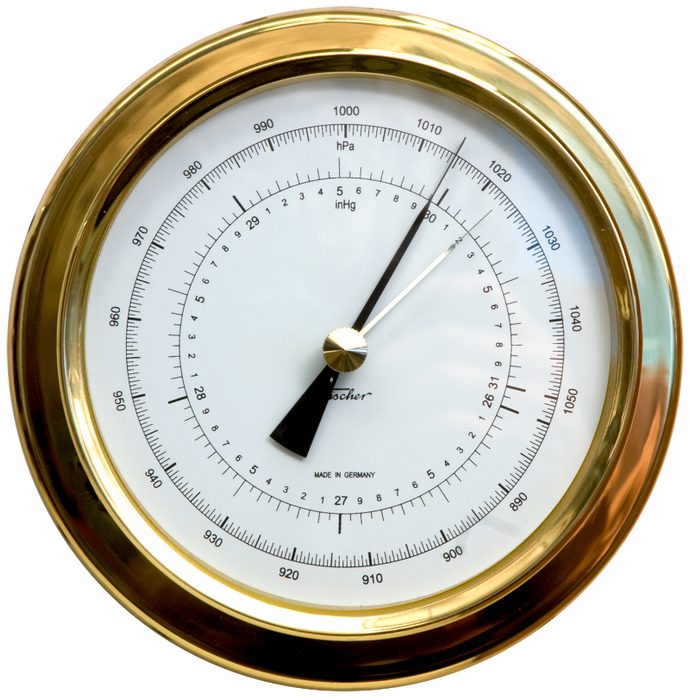
เครื่องวัดความดันอากาศ aneroid แบบแม่นยำที่มีกรอบทองเหลืองและหน้าปัดสีขาว เข็มชี้ไปที่สเกลที่ระบุเป็นเฮกโตปาสคาล (hPa) และนิ้วปรอท (inHg)
เครื่องวัดความดันบรรยากาศแบบ aneroid ที่มีความแม่นยำสูงวัดความดันบรรยากาศ

ความดันไฮโดรสแตติก

พิจารณาแท่ง ของเหลว ที่มีความหนาแน่น $\rho$, พื้นที่หน้าตัด $A$ และความสูง $\Delta h$. น้ำหนักของมันคือ

$$W = m g = (\rho \cdot A \cdot \Delta h) \cdot g.$$

น้ำหนักนี้กดลงบนพื้นที่ $A$ ที่ด้านล่าง ดังนั้นความดันเพิ่มเติมที่ด้านล่างเมื่อเทียบกับด้านบนคือ

$$\Delta p = \frac{W}{A} = \rho g \Delta h.$$

นี่คือสมการ ความดันไฮโดรสแตติก. มันขึ้นอยู่กับความหนาแน่นของของเหลวและ ความลึก เท่านั้น – รูปร่างของภาชนะไม่สำคัญ

ตัวอย่างวิธีทำ. จงหาความดันเพิ่มเติมจากน้ำที่ก้นสระน้ำลึก $2.5\ \text{m}$. (ความหนาแน่นน้ำ $1000\ \text{kg m}^{-3}$, $g = 9.81\ \text{m s}^{-2}$.)

$$\Delta p = \rho g \Delta h = 1000 \times 9.81 \times 2.5 \approx 2.5 \times 10^{4}\ \text{Pa}.$$
แท่งของเหลวทรงสี่เหลี่ยมผืนผ้าที่มีพื้นที่หน้าตัด A ภายในภาชนะ โดยมีระดับความลึก h1 ที่ด้านบนและ h2 ที่ด้านล่างทำเครื่องหมายไว้; น้ำหนัก W ของแท่งกระทำลงและสร้างความดันเพิ่มเติมที่ฐาน
เสาของเหลวที่มีพื้นที่ $A$: น้ำหนักของมันกำหนดค่าความดันเพิ่มที่ความลึกด้านล่าง

สำหรับเรือดำน้ำที่ความลึก $h$ ใต้ผิวน้ำ ความดันจากน้ำคือ $\rho_{\text{seawater}}\, g\, h$. สำหรับความดันรวม ให้บวกกับ ความดันบรรยากาศ ที่ผิวน้ำ (ประมาณ $1.0 \times 10^{5}\ \text{Pa}$)

แรงพยวและหลักการของอาร์คิมิดีส

เมื่อวัตถุถูก จุ่ม ลงในของเหลว ความดันที่ด้านล่างของวัตถุนั้นมากกว่าความดันที่ด้านบน (โดย $\rho g \Delta h$, โดยที่ $\Delta h$ คือความสูงของวัตถุ) ความแตกต่างนี้ทำให้เกิดแรงสุทธิในทิศทางขึ้นซึ่งเรียกว่า แรงลอยตัว

บล็อกจุ่มอยู่ในของเหลวแสดงแรงกดลง F_down ที่较小บนหน้าด้านบนและแรงยก F_up ที่ใหญ่กว่าบนหน้าด้านล่าง ทำให้เกิดแรงลอยตัวสุทธิ
แรงลอยตัวเกิดขึ้นเนื่องจากความดันที่ด้านล่างของวัตถุมากกว่าที่ด้านบน

สำหรับวัตถุที่มีปริมาตร $V$ (ปริมาตรของของเหลวที่ถูก แทนที่), แรงลอยตัวคือ

$$F_{\text{upthrust}} = \rho_{\text{fluid}}\, g\, V.$$

นี่คือ กฎของอาร์คิมิดีส: แรงลอยตัวต่อร่างกายในของเหลวเท่ากับน้ำหนักของของเหลวที่ร่างกายนั้นผลักออก

ตัวอย่างวิธีทำ บล็อกโลหะที่มีปริมาตร $2.0 \times 10^{-3}\ \text{m}^{3}$ จุ่มลงในน้ำอย่างสมบูรณ์ จงหาแรงลอยตัว对它。(ความหนาแน่นของน้ำ $1000\ \text{kg m}^{-3}$, $g = 9.81\ \text{m s}^{-2}$.)

$$F_{\text{upthrust}} = \rho_{\text{fluid}}\, g\, V = 1000 \times 9.81 \times 2.0 \times 10^{-3} \approx 20\ \text{N}.$$

สำหรับวัตถุที่จุ่มลงอย่างสมบูรณ์, $V$ คือปริมาตรทั้งหมดของมัน สำหรับวัตถุที่ ลอย, $V$ เป็นเพียงปริมาตรที่อยู่ใต้ผิวน้ำ — วัตถุลอยเมื่อแรงลอยตัวต่อส่วนที่อยู่ใต้ผิวน้ำเท่ากับน้ำหนักของมัน

ว่าวัตถุจะลอยได้หรือไม่ขึ้นอยู่กับความหนาแน่น: สำหรับวัตถุที่จุ่มลงอย่างสมบูรณ์ อัตราส่วนระหว่างแรงลอยตัวต่อน้ำหนักคือ $\rho_{\text{fluid}} V g / \rho_{\text{object}} V g = \rho_{\text{fluid}} / \rho_{\text{object}}$, ดังนั้นมันจึงลอยหากมีความหนาแน่นน้อยกว่าของเหลว และจมหากมีความหนาแน่นมากกว่า การลดความหนาแน่นของวัตถุลงครึ่งหนึ่งจะทำให้ค่าอัตราส่วนนี้เพิ่มขึ้นเป็นสองเท่า; การเปลี่ยนปริมาตรหรือความลึกจะไม่เปลี่ยนแปลงอะไรเลย

ตัวอย่างวิธีทำ กระบอกทรงกลมที่มีมวล $11\ \text{kg}$ และมีเส้นผ่านศูนย์กลาง $0.78\ \text{m}$ ลอยตั้งตรงในน้ำที่มีความหนาแน่น $990\ \text{kg m}^{-3}$ จงหาความลึก $y$ ของฐานอยู่ใต้ผิวน้ำ

การลอยหมายความว่าแรงลอยตัว $=$ น้ำหนัก ปริมาตรที่จุ่มอยู่คือพื้นที่ฐานคูณด้วยความลึก, $A y$, โดยที่ $A = \pi \times 0.39^{2} = 0.478\ \text{m}^{2}$:

$$\rho g A y = m g \quad\Rightarrow\quad y = \frac{m}{\rho A} = \frac{11}{990 \times 0.478} = 0.023\ \text{m}.$$

ทุกนิวตันของน้ำหนักเพิ่มที่ใส่ลงบนกระบอกต้องการความลึกเพิ่มอีก $1 / (\rho g A)$, ดังนั้นความลึกจึงเพิ่มขึ้นเป็นเส้นตรงตามน้ำหนักที่เพิ่มเข้าไป ไม่ว่าจะถูกวางไว้ที่ไหนบนกระบอกก็ตาม

บล็อกลอยอยู่บางส่วนใต้เส้นผิวน้ำ; น้ำหนักของมันกระทำลงและแรงลอยตัวต่อส่วนที่จุ่มอยู่กระทำขึ้น, และมันลอยเมื่อแรงลอยตัวเท่ากับน้ำหนัก
วัตถุที่ลอยจะจมลงจนกว่าแรงลอยตัวต่อส่วนที่จุ่มอยู่จะเท่ากับน้ำหนักของมัน

สมดุลของแรงกับแรงลอยตัว

บล็อกที่ถูกยึดไว้ใต้ผิวน้ำด้วยเชือกผูกกับก้นภาชนะอยู่ในสภาวะสมดุลภายใต้แรงแนวตั้งสามแรง: น้ำหนัก (ลง), แรงตึง (ลง), แรงลอยตัว (ขึ้น) ตั้ง $F_{\text{upthrust}} = W + T$ เพื่อหาค่าแรงตึง

บล็อกที่จุ่มอยู่แขวนจาก เครื่องวัดนิวตัน แสดงค่าน้อยกว่าน้ำหนัก它在อากาศ, เนื่องจากแรงลอยตัว: ค่าที่อ่านได้ $= W - F_{\text{upthrust}}$

ตัวอย่างวิธีทำ กระบอกทรงกลมที่มีน้ำหนัก $25.0\ \text{N}$ แขวนจากเครื่องวัดนิวตันจุ่มลงในน้ำอย่างสมบูรณ์, และเครื่องวัดแสดงค่า $10.0\ \text{N}$ จงหาปริมาตรของกระบอกทรงกลม

แรงลอยตัวคือ $15.0\ \text{N}$ ที่หายไป, และแรงลอยตัว $= \rho g V$, ดังนั้น $V = 15.0 / (1000 \times 9.81) = 1.53 \times 10^{-3}\ \text{m}^{3}$. วิธีเดียวกันนี้สามารถหาความหนาแน่นของกระบอกทรงกลมได้: $25.0 / (9.81 \times 1.53 \times 10^{-3}) = 1670\ \text{kg m}^{-3}$

แรงลอยตัวขึ้นอยู่กับความหนาแน่นของของเหลวและปริมาตรที่ถูกแทนที่, ไม่ใช่วัสดุของวัตถุหรือความลึก (สำหรับของเหลวที่ บีบอัดไม่ได้) บนดาวเคราะห์ที่มี $g$ น้อยกว่า, แรงลอยตัวจะน้อยลงในอัตราส่วนเดียวกับน้ำหนัก, ดังนั้นวัตถุที่ลอยจะยังคงลอยอยู่ในสัดส่วนใต้ผิวน้ำเท่าเดิม

Explore · ⁨สำรวจ⁩

Pressure with depth · ⁨ความดันกับความลึก⁩

p = ρg·h

Pressure is proportional to depth — the gradient is ρg. · ⁨ความดัน แปรผันตรงกับ ความลึก — ความชันคือ ρg⁩

Vocabulary · ⁨คำศัพท์⁩ Train · ⁨ฝึกฝน⁩
English ไทย
floating/ˈfləʊtɪŋ/ ลอยตัว
scalar/ˈskeɪlə/ สเกลาร์
pressure/ˈpreʃə/ ความดัน
atmospheric pressure/ˌætməsˈferɪk ˈpreʃə/ ความดันบรรยากาศ
hydrostatic pressure/ˌhaɪdrəˈstætɪk ˈpreʃə/ hydrostatic pressure
fluid/ˈfluːɪd/ ของไหล
cross-sectional area/krɒs ˈsekʃənl ˈeərɪə/ พื้นที่หน้าตัด
depth/depθ/ มิติลึก
upthrust/ˈʌpθrʌst/ แรงลอยตัว
Archimedes' principle/ˌɑːkɪˈmiːdiːz ˈprɪnsɪpl/ หลักของอาร์คิมิดีส
submerged/səbˈmɜːdʒd/ จมอยู่ใต้น้ำ
displaced/dɪˈspleɪst/ ถูกแทนที่
newton meter/ˈnjuːtn ˈmiːtə/ นิวตันเมตร
incompressible/ˌɪnkəmˈpresəbl/ อัดตัวไม่ได้
4.3

Definitions the examiner accepts · ⁨คำนิยามที่ผู้สอบยอมรับ⁩

English

A definition question is marked against fixed wording. Learn these exactly, and give one answer only.

Term Definition
centre of gravity the point at which the whole weight of an object may be considered to act
moment of a force the product of the force and the perpendicular distance from the point to the line of action of the force
couple a pair of equal and opposite forces whose lines of action do not coincide, which produces rotation only
torque of a couple the product of one of the forces and the perpendicular distance between the lines of action of the forces
principle of moments for a body in equilibrium, the sum of the clockwise moments about any point equals the sum of the anticlockwise moments about that point
equilibrium the state of a body on which the resultant force and the resultant torque are both zero
density mass per unit volume
pressure force per unit area, where the force acts at right angles to the surface
upthrust the upward force on a body in a fluid caused by the pressure being greater on its lower surface than on its upper surface
Archimedes' principle the upthrust on a body in a fluid is equal to the weight of the fluid displaced by the body
ไทย

คำถามคำนิยามจะให้คะแนนตามข้อความที่กำหนดไว้你必须 exact. เรียนรู้ให้ถูกต้องและตอบเพียงคำตอบเดียวเท่านั้น

พจน์ นิยาม
จุดศูนย์ถ่วง จุดที่น้ำหนักทั้งหมดของวัตถุสามารถพิจารณาได้ว่ากระทำลง
โมเมนต์ของแรง ผลคูณของแรงกับระยะทางตั้งฉากจากจุดถึงแนวกระทำของแรง
คู่แรง คู่แรงที่มีขนาดเท่ากันและทิศทางตรงกันข้ามwhose lines of action ไม่ซ้อนทับกัน, ซึ่งสร้างการหมุนเท่านั้น
โมเมนต์คู่แรง ผลคูณของแรงหนึ่งและระยะทางตั้งฉากระหว่างแนวกระทำของแรงทั้งสอง
หลักการโมเมนต์ สำหรับร่างกายที่อยู่ในสภาวะสมดุล, ผลรวมของโมเมนต์ตามเข็มนาฬิการอบจุดใด ๆ เท่ากับผลรวมของโมเมนต์ทวนเข็มนาฬิการอบจุดนั้น
สภาวะสมดุล สถานะของร่างกายที่แรงลัพธ์และโมเมนต์ลัพธ์เป็นศูนย์ทั้งสองอย่าง
ความหนาแน่น มวลต่อหน่วยปริมาตร
ความดัน แรงต่อหน่วยพื้นที่, โดยที่แรงกระทำตั้งฉากกับพื้นผิว
แรงลอยตัว แรงที่กระทำขึ้นต่อร่างกายในของเหลวที่เกิดจากความดันที่พื้นผิวด้านล่างมากกว่าพื้นผิวด้านบน
กฎของอาร์คิมิดีส แรงลอยตัวต่อร่างกายในของเหลวเท่ากับน้ำหนักของของเหลวที่ถูกแทนที่โดยร่างกายนั้น
4.3

Exam tips · ⁨ข้อแนะนำสำหรับการสอบ⁩

English
  • Take moments about a chosen pivot; for equilibrium, total clockwise $=$ total anticlockwise moments and the resultant force is zero.
  • A body in equilibrium under three forces gives a closed triangle of forces.
  • Fluid pressure $= \rho g h$; upthrust $=$ weight of fluid displaced (Archimedes).
  • Distinguish mass, weight and density, and give the base unit each time.

Common mistakes

  • Resolving with $\cos\theta$ where the geometry needs $\sin\theta$. Draw the triangle and check which side the angle is next to before choosing.
  • Substituting the weight of the object where the question is about the upthrust on it. Upthrust is the weight of the fluid displaced, $\rho_{\text{fluid}} V g$.
  • Leaving out the weight of a uniform beam. It acts at the centre, and it has a moment about any pivot that is not at the centre.
  • Using the distance along the rod for an angled force. The moment needs the perpendicular distance, or the perpendicular component of the force.
  • Taking the torque of a couple as $Fd$ with $d$ measured from the pivot. The distance is between the two lines of action, so a symmetric couple gives $2Fd$.
ไทย
  • พิจารณา โมเมนต์ รอบจุดหมุนที่เลือก; เพื่อความสมดุล, ผลรวมโมเมนต์ตามเข็มนาฬิกา $=$ ผลรวมโมเมนต์ทวนเข็มนาฬิกา และ แรงลัพธ์เป็นศูนย์
  • ร่างกายที่อยู่ในสภาวะสมดุลภายใต้แรงสามแรงจะให้ สามเหลี่ยมปิด ของแรง
  • ความดันของของเหลว $= \rho g h$; แรงลอยตัว $=$ น้ำหนักของของเหลวที่ถูกแทนที่ (อาร์คิมิดีส)
  • แยกแยะมวล, น้ำหนัก และความหนาแน่น, และให้หน่วยพื้นฐานของแต่ละครั้ง

ข้อผิดพลาดที่พบบ่อย

  • การแยกองค์ประกอบด้วย $\cos\theta$ เมื่อรูปทรง هندาจำเป็นต้องใช้ $\sin\theta$ วาดสามเหลี่ยมและตรวจสอบว่ามุมอยู่ติดกับด้านไหนก่อนเลือก
  • แทนที่น้ำหนักของวัตถุเมื่อโจทย์ถามเกี่ยวกับแรงลอยตัว对它 แรงลอยตัวคือน้ำหนักของของเหลวที่ถูกแทนที่, $\rho_{\text{fluid}} V g$
  • การละเลยน้ำหนักของคานสม่ำเสมอ มันกระทำที่จุดกึ่งกลาง, และมีโมเมนต์รอบจุดหมุนใดๆที่ไม่ใช่จุดกึ่งกลาง
  • การใช้ระยะทางตามแกนคันโยกสำหรับแรงเอียง โมเมนต์ต้องใช้ระยะทางตั้งฉาก, หรือองค์ประกอบตั้งฉากของแรง
  • การคำนวณโมเมนต์คู่แรงว่าเป็น $Fd$ โดยที่ $d$ วัดจากจุดหมุน ระยะทางอยู่ระหว่างแนวกระทำทั้งสอง, ดังนั้นคู่แรงสมมาตรจะให้ $2Fd$

Interactive lessons on this topic · ⁨บทเรียนเชิงโต้ตอบสำหรับหัวข้อนี้⁩

Work through it step by step, with instant-check exercises. · ⁨ทำทีละขั้นตอน พร้อมแบบฝึกหัดตรวจสอบผลทันที⁩

Past Papers · ⁨ข้อสอบย้อนหลัง⁩

More topics in A-Level Physics · ⁨Physics A-Level⁩ · ⁨หัวข้อเพิ่มเติมใน A-Level Physics · ⁨Physics A-Level⁩⁩

Log in or create account · ⁨เข้าสู่ระบบหรือสร้างบัญชี⁩

IGCSE, A-Level & AP