Skip to content · ⁨ข้ามไปยังเนื้อหา⁩

Oscillations · ⁨การสั่นสะเทือน⁩

A-Level Physics · ⁨Physics A-Level⁩ · Topic 17 · ⁨หัวข้อ 17⁩

Video lesson for this topic · ⁨บทเรียนวิดีโอสำหรับหัวข้อนี้⁩ Open the video page · ⁨เปิดหน้าวิดีโอ⁩
15:13

การสั่นและการเคลื่อนที่แบบฮาร์มอนิกอย่างง่าย

ในปี ค.ศ. 1940 สะพานแห่งใหม่ได้เปิด横跨 across Tacoma Narrows — ยาว เรียบร้อย และเมื่อปรากฏว่าเป็นอันตราย ภายในไม่กี่เดือน ลมธรรมดาทำให้สะพานสั่นไหว…

English narration · English + 中文 subtitles burned in · ⁨การบรรยายภาษาอังกฤษ · คำบรรยายภาษาอังกฤษ + 中文 ลอยตัวบนภาพ⁩

17.1

Simple harmonic motion: definition · ⁨การเคลื่อนที่แบบฮาร์มอนิกเชิงเส้น: นิยาม⁩

Syllabus · ⁨หลักสูตร⁩
English
  1. understand and use the terms displacement, amplitude, period, frequency, angular frequency and phase difference in the context of oscillations, and express the period in terms of both frequency and angular frequency
  2. understand that simple harmonic motion occurs when acceleration is proportional to displacement from a fixed point and in the opposite direction
  3. use $a = -\omega^2 x$ and recall and use, as a solution to this equation, $x = x_0 \sin \omega t$
  4. use the equations $v = v_0 \cos \omega t$ and $v = \pm \omega \sqrt{x_0^2 - x^2}$
  5. analyse and interpret graphical representations of the variations of displacement, velocity and acceleration for simple harmonic motion
ไทย
  1. เข้าใจและใช้คำศัพท์ การกระจัด, แอมพลิจูด, คาบ, ความถี่, ความถี่เชิงมุม และ ผลต่างเฟส ในบริบทของการสั่นสะเทือน, และแสดงคาบใน terms of ทั้งความถี่และความถี่เชิงมุม
  2. เข้าใจว่า การเคลื่อนที่แบบฮาร์มอนิกอย่างง่าย เกิดขึ้นเมื่อ ความเร่ง สัดส่วนกับ การกระจัด จากจุดอ้างอิงตายตัวและอยู่ในทิศทางตรงกันข้าม
  3. ใช้ $a = -\omega^2 x$ และจำและใช้, ในฐานะคำตอบของสมการนี้, $x = x_0 \sin \omega t$
  4. ใช้สมการ $v = v_0 \cos \omega t$ และ $v = \pm \omega \sqrt{x_0^2 - x^2}$
  5. วิเคราะห์และตีความการแสดงกราฟของการเปลี่ยนแปลงของการกระจัด, ความเร็ว และความเร่งสำหรับการเคลื่อนที่แบบฮาร์มอนิกอย่างง่าย

Source: Cambridge International syllabus · ⁨แหล่งที่มา: หลักสูตร Cambridge International⁩

English
SHM: spring, circle and graph in phase

A particle moves with simple harmonic motion 简谐运动 (SHM) when its acceleration 加速度 is:

  • proportional to its displacement from a fixed equilibrium 平衡 point, and
  • directed back towards that point — opposite in sign to the displacement.

The defining equation is

$$a = -\omega^{2} x,$$

where $x$ is the displacement 位移 from equilibrium and $\omega$ is a positive constant, the angular frequency 角频率. The minus sign means "directed back towards equilibrium".

The two-mark definition. Simple harmonic motion is motion in which the acceleration is proportional to the displacement from a fixed point and is always directed towards that point (in the opposite direction to the displacement). Both halves are needed. "The significance of the minus sign": the acceleration is in the opposite direction to the displacement — always towards the equilibrium position. "State what is meant by the frequency of the oscillations": the number of complete oscillations per unit time.

Many systems do this near a stable equilibrium: a mass on a spring 弹簧, a pendulum 单摆 (small swing), a floating block pushed down, the charge on a capacitor 电容器 in an LC circuit, atoms in a solid.

Key terms

  • displacement $x$ — distance from equilibrium at a moment (a vector along the line of motion).
  • amplitude 振幅 $x_{0}$ — the largest displacement from equilibrium. Always positive.
  • period 周期 $T$ — the time for one full oscillation.
  • frequency 频率 $f$ — the number of oscillations per second; $f = 1/T$. Unit: Hz.
  • angular frequency $\omega$ — $\omega = 2\pi/T = 2\pi f$. Unit: $\text{rad s}^{-1}$.
  • phase difference 相位差 — the fraction of a cycle (in radians) by which one oscillation leads or lags another. A quarter-cycle apart is a phase difference of $\pi/2$.

So $T = 2\pi/\omega$ and $f = \omega/(2\pi)$ — given any one of $\omega$, $f$, $T$ you can find the others.

Worked example. A mass on a spring oscillates with SHM of amplitude $0.050\ \text{m}$ and frequency $2.5\ \text{Hz}$. Find its maximum acceleration.

The angular frequency is $\omega = 2\pi f = 2\pi \times 2.5 = 15.7\ \text{rad s}^{-1}$. The acceleration is largest at the extremes, where $|a| = \omega^{2}x_{0}$:

$$a_{\text{max}} = \omega^{2}x_{0} = 15.7^{2} \times 0.050 \approx 12\ \text{m s}^{-2}.$$

Showing that a motion is simple harmonic

The exam's favourite four-mark derivation, and the recipe is always the same: (1) displace the object by $x$ from equilibrium; (2) find the resultant restoring force, which comes out as $F = -(\text{constant}) \times x$; (3) apply Newton's second law, $a = F/m = -(\text{constant}/m)\,x$; (4) this has the form $a = -\omega^{2}x$, so the motion is simple harmonic with $\omega^{2} = \text{constant}/m$, and $T = 2\pi/\omega$. Say in words why the force points back towards equilibrium and why it is proportional to $x$ — those are the marks, not the algebra.

Worked example. A mass $m$ hangs from a spring of spring constant $k$. Show that, when displaced and released, it moves with simple harmonic motion, and find the period.

At equilibrium the spring tension balances the weight. Displace the mass a distance $x$ downwards: the tension increases by $kx$ (Hooke's law), so there is a resultant force $kx$ upwards, towards equilibrium. Newton's second law: $a = -\dfrac{k}{m}x$. This is $a = -\omega^{2}x$ with $\omega^{2} = k/m$, so the motion is simple harmonic and $T = 2\pi/\omega = 2\pi\sqrt{m/k}$. (A trolley held between two identical springs has both pulling it back, $F = -2kx$, so $\omega^{2} = 2k/m$.)

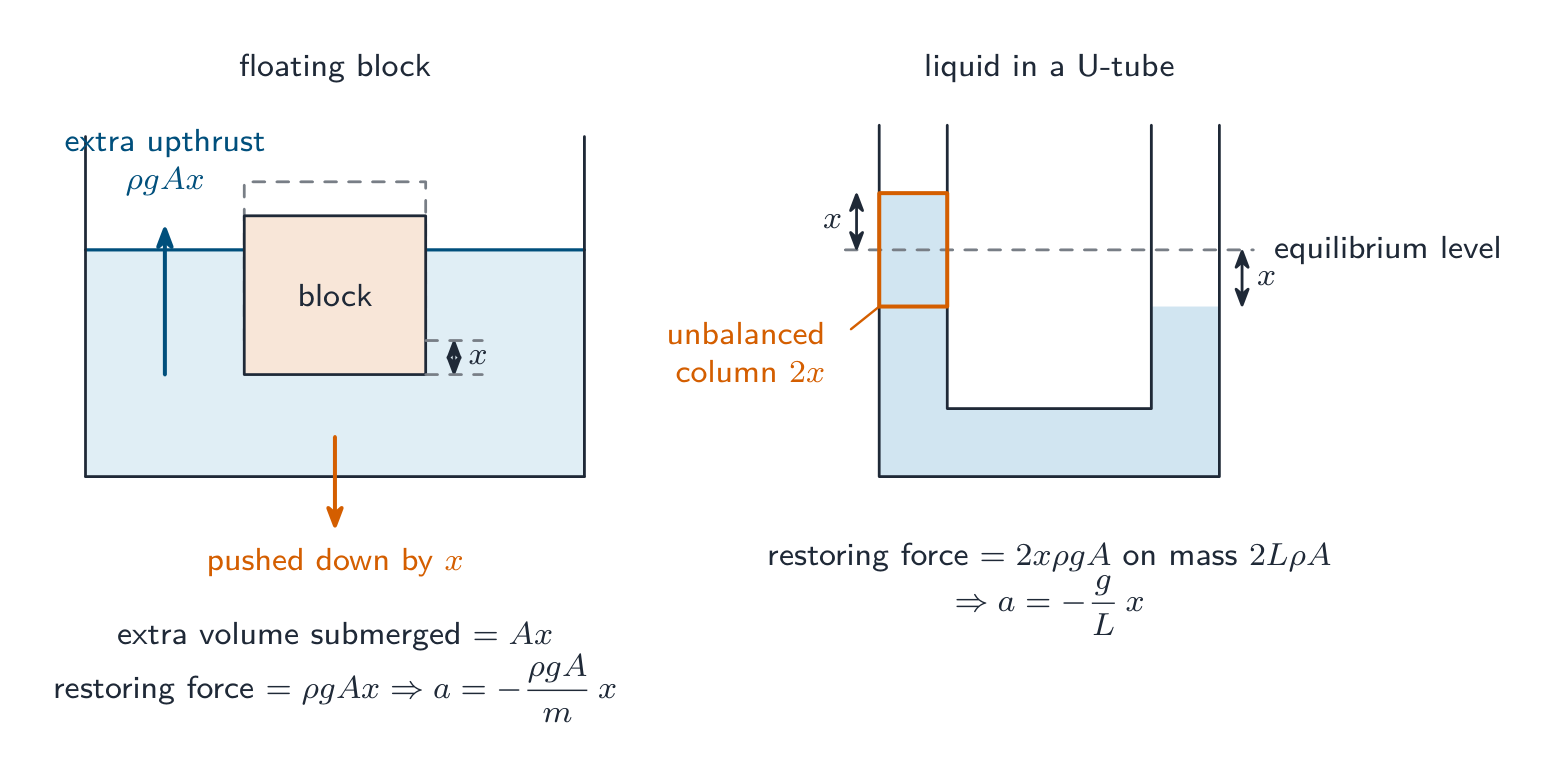
Worked example. A cuboidal block of cross-sectional area $A$ and mass $m$ floats in a liquid of density $\rho$ with its base a depth $h$ below the surface. It is pushed down a small distance $x$ and released. Show that it oscillates with simple harmonic motion and find the period in terms of $h$ and $g$.

When the block is pushed down by $x$ an extra volume $Ax$ is submerged, so the upthrust 浮力 increases by the weight of that extra liquid, $\rho g A x$; this extra force acts upwards, towards the equilibrium position. Hence $a = -\dfrac{\rho g A}{m}x$: proportional to $x$ and opposite in direction, so the motion is simple harmonic with $\omega^{2} = \rho g A/m$. At equilibrium the upthrust on the submerged volume $Ah$ equals the weight, $\rho g A h = mg$, so $m = \rho A h$ and $\omega^{2} = g/h$: $T = 2\pi\sqrt{h/g}$ — the same form as a pendulum of length $h$.

Worked example. A U-tube of cross-sectional area $A$ contains liquid of density $\rho$; the column in each arm has length $L$. The liquid is displaced so that one surface is $x$ above its equilibrium level and the other $x$ below. Show that the liquid oscillates with simple harmonic motion.

The two surfaces now differ in height by $2x$, so a column of liquid of height $2x$ is unbalanced: the restoring force on the liquid is the weight of that column, $2x\rho g A$, directed so as to level the surfaces. The mass being moved is the whole liquid, $2L\rho A$. So $a = -\dfrac{2x\rho g A}{2L\rho A} = -\dfrac{g}{L}x$: simple harmonic, with $\omega^{2} = g/L$ and $T = 2\pi\sqrt{L/g}$. Note that $\rho$ and $A$ cancel — the period depends on neither the liquid nor the tube.

ไทย
SHM: สปริง, วงกลม และกราฟอยู่ในเฟสเดียวกัน
นาฬิกาลูกตุ้ม
นาฬิกาลูกตุ้มรักษาเวลาโดยใช้การเคลื่อนที่แบบฮาร์มอนิกเชิงเส้น.

อนุภาคเคลื่อนที่ด้วย การเคลื่อนที่แบบฮาร์มอนิกเชิงเส้น (SHM) เมื่อ ความเร่ง ของมันคือ:

  • แปรผันตรงกับระยะกระจัด จากจุดสมดุลที่ตายตัว, และ
  • ชี้กลับเข้าสู่จุดนั้น — มีเครื่องหมายตรงข้ามกับระยะกระจัด.

สมการกำหนดคือ

$$a = -\omega^{2} x,$$

โดยที่ $x$ คือ ระยะกระจัด จากจุดสมดุล และ $\omega$ เป็นค่าคงที่บวก, ความถี่มุม. เครื่องหมายลบหมายถึง "ชี้กลับเข้าสู่จุดสมดุล".

นิยาม 2 คะแนน. การเคลื่อนที่แบบฮาร์มอนิกเชิงเส้นคือการเคลื่อนที่ที่ความเร่งแปรผันตรงกับระยะกระจัดจากจุดตายตัวและชี้เข้าสู่จุดนั้นเสมอ (ในทิศทางตรงข้ามกับระยะกระจัด). ทั้งสองส่วนจำเป็น. "ความสำคัญของเครื่องหมายลบ": ความเร่งอยู่ใน ทิศทางตรงข้าม กับระยะกระจัด — เสมอเข้าสู่ตำแหน่งสมดุล. "ระบุว่าความถี่ของการสั่นคืออะไร": จำนวนรอบการสั่นสมบูรณ์ต่อหน่วยเวลา.

หลายระบบดำเนินการแบบนี้ใกล้จุดสมดุลที่เสถียร: มวลบน สปริง, ลูกตุ้ม (การแกว่งเล็กน้อย), บล็อกลอยน้ำที่ถูกกดลง,ประจุบน ตัวเก็บประจุ ในวงจร LC, อะตอมในของแข็ง.

มวลติดบนสปริงแสดงด้านบนและด้านล่างของเส้นสมดุล; ในแต่ละกรณีลูกศรความเร่งชี้กลับเข้าสู่จุดสมดุล ข้ามกับลูกศรการกระจัด
ความเร่งชี้กลับเข้าสู่จุดเสมอ ข้ามกับการกระจัด

คำศัพท์สำคัญ

  • การกระจัด $x$ — ระยะห่างจากจุดสมดุล ณ เวลาหนึ่ง (เป็นเวกเตอร์ตามแนวการเคลื่อนที่).
  • แอมพลิจูด $x_{0}$ — การกระจัดสูงสุดจากจุดสมดุล เป็นค่าบวกเสมอ.
  • คาบ $T$ — เวลาที่ใช้สำหรับการสั่นหนึ่งรอบเต็ม.
  • ความถี่ $f$ — จำนวนรอบการสั่นต่อวินาที; $f = 1/T$. หน่วย: Hz.
  • ความถี่เชิงมุม $\omega$ — $\omega = 2\pi/T = 2\pi f$. หน่วย: $\text{rad s}^{-1}$.
  • ผลต่างเฟส — ส่วนหนึ่งของรอบ (ในหน่วยเรเดียน) ที่การสั่นหนึ่งรอบนำหน้าหรือล่าช้ากว่าอีกการสั่นหนึ่ง การแยกกันครึ่งรอบคือผลต่างเฟส $\pi/2$.

ดังนั้น $T = 2\pi/\omega$ และ $f = \omega/(2\pi)$ — เมื่อทราบค่าใดค่าหนึ่งระหว่าง $\omega$, $f$, $T$ คุณสามารถหาค่าที่เหลือได้.

ตัวอย่างวิธีทำ. มวลติดบนสปริงมีการสั่นแบบ SHM ด้วยแอมพลิจูด $0.050\ \text{m}$ และความถี่ $2.5\ \text{Hz}$. จงหาความเร่งสูงสุด.

ความถี่เชิงมุมคือ $\omega = 2\pi f = 2\pi \times 2.5 = 15.7\ \text{rad s}^{-1}$. ความเร่งมีค่ามากสุดที่ตำแหน่งสุดขั้ว ซึ่ง $|a| = \omega^{2}x_{0}$:

$$a_{\text{max}} = \omega^{2}x_{0} = 15.7^{2} \times 0.050 \approx 12\ \text{m s}^{-2}.$$

การพิสูจน์ว่าการเคลื่อนที่เป็นแบบฮาร์มอนิกง่าย

ข้อสอบชอบถามบทพิสูจน์ 4 คะแนนนี้ และสูตรคือเหมือนกันเสมอ: (1) เลื่อนวัตถุไป $x$ จากจุดสมดุล; (2) หา แรงคืนตัวรวม ซึ่งจะได้ค่าเป็น $F = -(\text{constant}) \times x$; (3) ใช้กฎข้อที่สองของนิวตัน, $a = F/m = -(\text{constant}/m)\,x$; (4) สมการนี้มีรูปแบบ $a = -\omega^{2}x$ ดังนั้นการเคลื่อนที่จึงเป็นแบบฮาร์มอนิกง่ายที่มี $\omega^{2} = \text{constant}/m$ และ $T = 2\pi/\omega$. อธิบายด้วยคำพูดว่า ทำไม แรงจึงชี้กลับเข้าสู่จุดสมดุลและ ทำไม จึงแปรผันตรงกับ $x$ — นี่คือสิ่งที่ examiner ให้คะแนน ไม่ใช่การคำนวณพีชคณิต.

แสดงระบบสองชนิดที่เบี่ยงเบนจากสมดุล: ท่อน้ำลอยน้ำที่ถูกกดลงระยะ x ทำให้มีปริมาตรเพิ่ม Ax จมน้ำและมีแรงลอยเพิ่ม ρgAx ขึ้นด้านบน; และท่อกันน้ำรูปตัวยูที่มีคอลัมน์ด้านซ้ายสูงจากจุดสมดุล x และคอลัมน์ด้านขวาลดจากจุดสมดุล x ทำให้เกิดคอลัมน์ของเหลวความสูง 2x ที่ไม่สมดุล
การจัดตั้ง "พิสูจน์ว่าเป็น SHM" สองแบบ: หาแรงเพิ่มเมื่อระบบถูกเลื่อนไป $x$ และพิสูจน์ว่ามันแปรผันตรงกับ $x$ และชี้กลับเข้าหา

ตัวอย่างวิธีทำ. มวล $m$ แขวนกับสปริงที่มีค่าคงที่สปริง $k$. พิสูจน์ว่าเมื่อเลื่อนแล้วปล่อย มันจะเคลื่อนที่แบบฮาร์มอนิกง่าย และหาคาบ.

ที่จุดสมดุล แรงตึงสปริงสมดุลกับน้ำหนัก เลื่อนมวลลง $x$: แรงตึงเพิ่มขึ้น $kx$ (กฎของฮุก) จึงมีแรงลัพธ์ $kx$ ชี้ขึ้น สู่จุดสมดุล กฎข้อที่สองของนิวตัน: $a = -\dfrac{k}{m}x$. นี่คือ $a = -\omega^{2}x$ ที่มี $\omega^{2} = k/m$ ดังนั้นการเคลื่อนที่จึงเป็นแบบฮาร์มอนิกง่ายและ $T = 2\pi/\omega = 2\pi\sqrt{m/k}$. (รถเข็นที่ยึดไว้ระหว่างสปริง identical สอง ตัว มีแรงดึงทั้งสองข้างกลับเข้าหา $F = -2kx$ ดังนั้น $\omega^{2} = 2k/m$.)

ตัวอย่างวิธีทำ. บล็อกสี่เหลี่ยมผืนผ้าที่มีพื้นที่หน้าตัด $A$ และมวล $m$ ลอยอยู่ในของเหลวที่มีความหนาแน่น $\rho$ โดยฐานอยู่ลึก $h$ ใต้ผิวน้ำ ถูกกดลงเล็กน้อย $x$ แล้วปล่อย พิสูจน์ว่ามันสั่นแบบฮาร์มอนิกง่าย และหาคาบในพจน์ของ $h$ และ $g$.

เมื่อบล็อกถูกกดลง $x$ ปริมาตรเพิ่ม $Ax$ จมอยู่ ดังนั้น แรงพยุง เพิ่มขึ้นเท่ากับน้ำหนักของของเหลวเพิ่มนั้น, $\rho g A x$; แรงเพิ่มนี้กระทำ ชี้ขึ้น สู่ตำแหน่งสมดุล ดังนั้น $a = -\dfrac{\rho g A}{m}x$: แปรผันตรงกับ $x$ และตรงข้ามทิศทาง ดังนั้นการเคลื่อนที่จึงเป็นแบบฮาร์มอนิกง่ายที่มี $\omega^{2} = \rho g A/m$. ที่จุดสมดุล แรงพยุงต่อปริมาตรจม $Ah$ เท่ากับน้ำหนัก, $\rho g A h = mg$ ดังนั้น $m = \rho A h$ และ $\omega^{2} = g/h$: $T = 2\pi\sqrt{h/g}$ — รูปแบบเดียวกับลูกตุ้มนาน $h$.

ตัวอย่างวิธีทำ. ท่อรูป U พื้นที่หน้าตัด $A$里面有ของเหลวความหนาแน่น $\rho$; คอลัมน์ในแต่ละแขนมีความยาว $L$. ของเหลวถูกเลื่อนให้พื้นผิวด้านหนึ่งสูงกว่าระดับสมดุล $x$ และอีกด้านหนึ่งต่ำกว่า $x$. พิสูจน์ว่าของเหลวสั่นแบบฮาร์มอนิกง่าย.

ตอนนี้พื้นผิวทั้งสองต่างกันสูง $2x$ ทำให้คอลัมน์ของเหลวสูง $2x$ ไม่สมดุล: แรงคืนตัวต่อของเหลวคือน้ำหนักของคอลัมน์นี้, $2x\rho g A$, ชี้เพื่อให้พื้นผิวเท่ากัน. มวลที่ถูกเคลื่อนย้ายคือของเหลวทั้งหมด, $2L\rho A$. ดังนั้น $a = -\dfrac{2x\rho g A}{2L\rho A} = -\dfrac{g}{L}x$: แบบฮาร์มอนิก, ที่มี $\omega^{2} = g/L$ และ $T = 2\pi\sqrt{L/g}$. หมายเหตุว่า $\rho$ และ $A$ ตัดกัน — คาบไม่ขึ้นอยู่กับของเหลวหรือท่อก็ตาม.

Explore · ⁨สำรวจ⁩

Swing a pendulum · ⁨แกว่งลูกตุ้มนาฬิกา⁩

Set it swinging, then change the start angle — the time for one swing stays the same (that is what makes it a good clock). Now make the string longer, or move to the Moon, and watch the period change. · ⁨ตั้งให้แกว่ง แล้วเปลี่ยนมุมเริ่มต้น — เวลาสำหรับการแกว่งครั้งเดียวจะคงที่ (นั่นคือเหตุผลที่ทำให้มันเป็นนาฬิกาที่ดี) ตอนนี้ทำให้สายยาวขึ้น หรือย้ายไปดวงจันทร์ และดูคาบเปลี่ยนไป⁩

Vocabulary · ⁨คำศัพท์⁩ Train · ⁨ฝึกฝน⁩
English ไทย
simple harmonic motion/ˈsɪmpl hɑːˈmɒnɪk ˈməʊʃn/ การเคลื่อนที่แบบฮาร์มอนิกอย่างง่าย
spring/sprɪŋ/ สปริง
pendulum/ˈpendjʊləm/ ลูกตุ้ม
17.1

Displacement, velocity, acceleration in SHM · ⁨การกระจัด, ความเร็ว, ความเร่ง ใน SHM⁩

English

If the particle starts at $x = 0$ moving in the positive direction at $t = 0$, then

$$x = x_{0} \sin (\omega t).$$

Differentiating once gives the velocity 速度:

$$v = x_{0} \omega \cos(\omega t) = v_{0} \cos(\omega t),$$

where $v_{0} = x_{0} \omega$ is the maximum speed (as the particle passes through equilibrium).

Differentiating again gives the acceleration:

$$a = -x_{0} \omega^{2} \sin(\omega t) = -\omega^{2} x,$$

which is the SHM defining equation again. (If the particle instead starts at the extreme position $x = x_{0}$ at $t = 0$, use $x = x_{0} \cos(\omega t)$. Choose the one that fits the start conditions.)

Velocity in terms of displacement

A useful relation that does not use time:

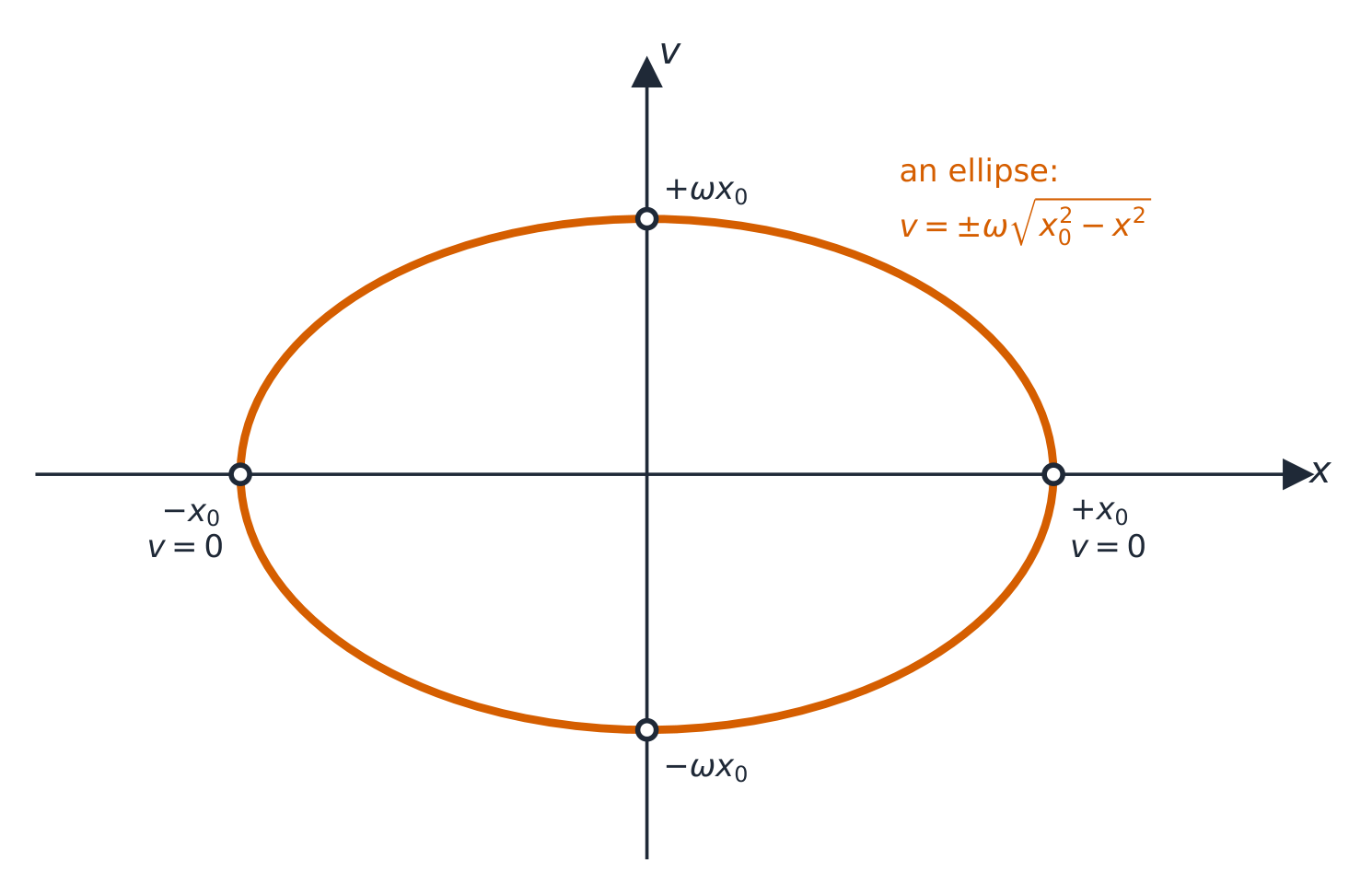
$$v = \pm \omega \sqrt{x_{0}^{2} - x^{2}}.$$
  • at equilibrium ($x = 0$): $v = \pm \omega x_{0}$ (maximum speed). Both signs, because the particle passes through equilibrium twice each cycle.
  • at the extremes ($x = \pm x_{0}$): $v = 0$ (at rest for an instant).

Worked example. The same oscillation has amplitude $x_{0} = 0.050\ \text{m}$ and angular frequency $\omega = 15.7\ \text{rad s}^{-1}$. Find the speed when the displacement is $x = 0.030\ \text{m}$.

$$v = \omega\sqrt{x_{0}^{2} - x^{2}} = 15.7\sqrt{0.050^{2} - 0.030^{2}} = 15.7 \times 0.040 \approx 0.63\ \text{m s}^{-1}.$$

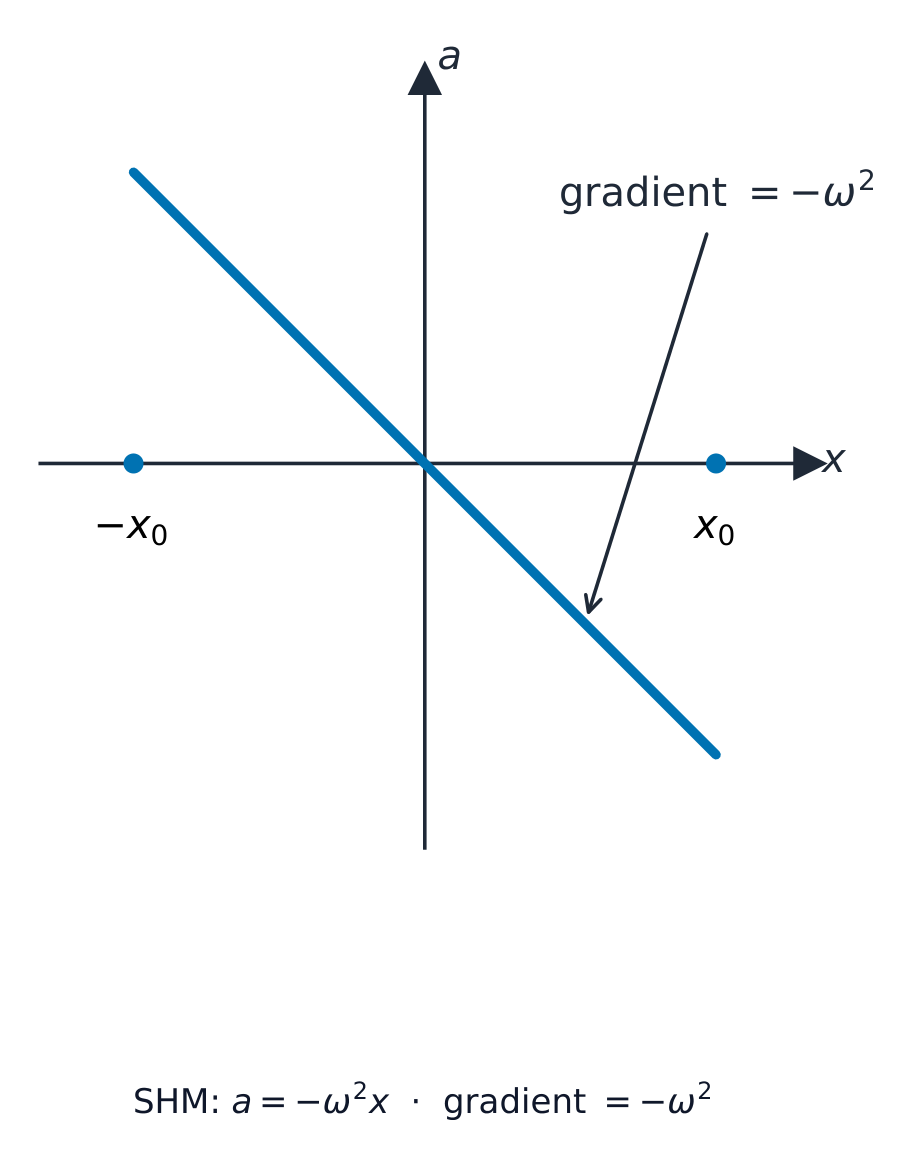
Reading the $v$–$x$ graph. Its width gives the amplitude ($x = \pm x_{0}$ where $v = 0$) and its height the maximum speed ($v = \pm\omega x_{0}$ at $x = 0$), so $\omega = v_{0}/x_{0}$ and the period follows. Asked to sketch $a$ against $x$ on the same axes, draw the straight line through the origin with negative gradient $-\omega^{2}$, reaching $\mp\omega^{2}x_{0}$ at $x = \pm x_{0}$.

Worked example. The velocity of an oscillating block varies with time as $v = 0.56\sin(5.1t)$, with $v$ in $\text{m s}^{-1}$ and $t$ in seconds. Find the amplitude, the period and the maximum acceleration.

Compare with $v = v_{0}\sin\omega t$: $v_{0} = 0.56\ \text{m s}^{-1}$ and $\omega = 5.1\ \text{rad s}^{-1}$. Since $v_{0} = \omega x_{0}$, the amplitude is $x_{0} = 0.56/5.1 = 0.11\ \text{m}$; $T = 2\pi/\omega = 1.2\ \text{s}$; $a_{\text{max}} = \omega^{2}x_{0} = \omega v_{0} = 5.1 \times 0.56 = 2.9\ \text{m s}^{-2}$. (Because this $v$ is a sine, the block was at an extreme at $t = 0$: its displacement is a cosine.)

SHM as the shadow of circular motion. A ball moving round a circle of radius $R$ at angular speed $\omega$, lit from the side, casts a shadow that moves back and forth with simple harmonic motion of amplitude $R$ and the same $\omega$: the shadow's displacement is $x = R\cos\omega t$ (if it starts at an extreme), its maximum speed is $R\omega$ and its maximum acceleration $R\omega^{2}$. For a circle of diameter $0.46\ \text{m}$ and $\omega = 1.9\ \text{rad s}^{-1}$ the shadow has amplitude $0.23\ \text{m}$, $v_{0} = 0.44\ \text{m s}^{-1}$ and $a_{\text{max}} = 0.83\ \text{m s}^{-2}$ — greatest in size at the two ends of its path and always directed back towards the centre.

Graphs against time

For $x = x_{0}\sin\omega t$:

  • $x$ vs $t$ — a sine curve, amplitude $x_{0}$, period $T = 2\pi/\omega$.
  • $v$ vs $t$ — a cosine curve, leading $x$ by $\pi/2$, amplitude $\omega x_{0}$.
  • $a$ vs $t$ — a negative sine curve, out of phase with $x$ by $\pi$ (180°), amplitude $\omega^{2} x_{0}$.

Graph of $a$ against $x$

A straight line through the origin with negative gradient $-\omega^{2}$. So you can read $\omega$ from the graph: gradient $= -\omega^{2}$, so $\omega = \sqrt{|\text{gradient}|}$, then $T = 2\pi / \omega$. This is a common exam pattern.

Worked example. A graph of the height $h$ of an object of mass $36\ \text{kg}$ undergoing vertical simple harmonic motion shows $h$ varying between $2\ \text{m}$ and $10\ \text{m}$, with one complete oscillation every $4.0\ \text{s}$. Find the amplitude, the angular frequency, the maximum speed, the maximum acceleration and the maximum kinetic energy.

Amplitude $x_{0} = (10 - 2)/2 = 4.0\ \text{m}$ (half the peak-to-peak range; the equilibrium height is $6\ \text{m}$). $\omega = 2\pi/T = 2\pi/4.0 = 1.57\ \text{rad s}^{-1}$. $v_{\text{max}} = \omega x_{0} = 6.3\ \text{m s}^{-1}$; $a_{\text{max}} = \omega^{2}x_{0} = 9.9\ \text{m s}^{-2}$; $E_{\text{K,max}} = \tfrac{1}{2}mv_{\text{max}}^{2} = \tfrac{1}{2} \times 36 \times 6.28^{2} = 7.1 \times 10^{2}\ \text{J}$. Reading the amplitude as the full height range instead of half of it is the commonest slip here.

Worked example. A small object rests on a horizontal platform that oscillates vertically with simple harmonic motion of amplitude $6.0\ \text{mm}$. Find the highest frequency at which the object stays in contact with the platform throughout, and state where in the motion contact is first lost.

The object leaves the platform when the platform's downward acceleration exceeds $g$ — at the top of the oscillation, where the acceleration is greatest and directed downwards: the platform then falls away faster than the object can. The limit is $\omega^{2}x_{0} = g$: $\omega = \sqrt{9.81/0.0060} = 40\ \text{rad s}^{-1}$, so $f = \omega/2\pi = 6.4\ \text{Hz}$. Below this the normal contact force at the top is small but positive; above it, zero.

ไทย

หากอนุภาคเริ่มที่ $x = 0$ เคลื่อนที่ไปในทิศทางบวกที่ $t = 0$, แล้ว

$$x = x_{0} \sin (\omega t).$$

ดิฟครั้งแรกจะได้ ความเร็ว:

$$v = x_{0} \omega \cos(\omega t) = v_{0} \cos(\omega t),$$

โดยที่ $v_{0} = x_{0} \omega$ คือ ความเร็วสูงสุด (เมื่ออนุภาคผ่านจุดสมดุล).

ดิฟอีกครั้งจะได้ความเร่ง:

$$a = -x_{0} \omega^{2} \sin(\omega t) = -\omega^{2} x,$$

ซึ่งคือสมการกำหนด SHM อีกครั้ง. (หากอนุภาคเริ่มต้นที่ตำแหน่งสุดขั้ว $x = x_{0}$ ที่ $t = 0$, ใช้ $x = x_{0} \cos(\omega t)$. เลือกแบบที่เหมาะกับเงื่อนไขเริ่มต้น.)

ความเร็วในพจน์ของการกระจัด

ความสัมพันธ์ที่มีประโยชน์ที่ไม่ต้องใช้เวลา:

$$v = \pm \omega \sqrt{x_{0}^{2} - x^{2}}.$$
  • ที่จุดสมดุล ($x = 0$): $v = \pm \omega x_{0}$ (ความเร็วสูงสุด). ทั้งเครื่องหมาย เพราะอนุภาคผ่านจุดสมดุลสองครั้งต่อรอบ.
  • ที่ตำแหน่งสุดขั้ว ($x = \pm x_{0}$): $v = 0$ (หยุดนิ่งชั่วขณะ).

ตัวอย่างวิธีทำ. การสั่นเดียวกันมีแอมพลิจูด $x_{0} = 0.050\ \text{m}$ และความถี่เชิงมุม $\omega = 15.7\ \text{rad s}^{-1}$. จงหาความเร็วเมื่อการกระจัดเป็น $x = 0.030\ \text{m}$.

$$v = \omega\sqrt{x_{0}^{2} - x^{2}} = 15.7\sqrt{0.050^{2} - 0.030^{2}} = 15.7 \times 0.040 \approx 0.63\ \text{m s}^{-1}.$$
กราฟของความเร็วเทียบกับระยะกระจัดสำหรับการเคลื่อนที่แบบฮาร์มอนิกเชิงเส้น: รูปวงรีที่มีจุดศูนย์กลางอยู่ที่จุดกำเนิด ตัดแกนระยะกระจัดที่บวกและลบของแอมพลิจูด ซึ่งความเร็วเป็นศูนย์ และตัดแกนความเร็วที่บวกและลบของความเร็วสูงสุด
กราฟความเร็วเทียบกับระยะกระจัดเป็นรูปวงรี: $v = 0$ ที่จุดสุดขั้วและ $v = \pm\omega x_{0}$ ผ่านจุดสมดุล — อ่านค่า $x_{0}$ และ $v_{0}$ จากจุดที่ตัดแกน แล้วคำนวณหา $\omega = v_{0}/x_{0}$

การอ่านกราฟ $v$–$x$. ความกว้างของกราฟแสดงถึงแอมพลิจูด ($x = \pm x_{0}$ เมื่อ $v = 0$) และความสูงแสดงความเร็วสูงสุด ($v = \pm\omega x_{0}$ ที่ $x = 0$) ดังนั้นจึงได้ $\omega = v_{0}/x_{0}$ และจากนั้นหาคาบตามไปด้วย หากโจทย์ให้วาดกราฟ $a$ เทียบกับ $x$ บนแกนเดียวกัน ให้วาดเส้นตรงผ่านจุดกำเนิดที่มีความชันติดลบเท่ากับ $-\omega^{2}$ โดยจะถึงค่า $\mp\omega^{2}x_{0}$ ที่ $x = \pm x_{0}$

ตัวอย่างวิธีทำ ความเร็วของบล็อกที่สั่นแปรผันตามเวลาตามสมการ $v = 0.56\sin(5.1t)$ โดยมี $v$ ในหน่วย $\text{m s}^{-1}$ และ $t$ ในหน่วยวินาที จงหาแอมพลิจูด คาบ และความเร่งสูงสุด

เปรียบเทียบกับ $v = v_{0}\sin\omega t$: $v_{0} = 0.56\ \text{m s}^{-1}$ และ $\omega = 5.1\ \text{rad s}^{-1}$. เนื่องจาก $v_{0} = \omega x_{0}$, แอมพลิจูดคือ $x_{0} = 0.56/5.1 = 0.11\ \text{m}$; $T = 2\pi/\omega = 1.2\ \text{s}$; $a_{\text{max}} = \omega^{2}x_{0} = \omega v_{0} = 5.1 \times 0.56 = 2.9\ \text{m s}^{-2}$. (เนื่องจาก $v$ นี้เป็น sine ท่อน้ำจึงอยู่ที่จุดสุดขั้วที่ $t = 0$: การกระจัดของมันคือ cosinus.)

การเคลื่อนที่แบบฮาร์มอนิก简单เป็นเงาของการเคลื่อนที่วงกลม ลูกบอลที่เคลื่อนที่รอบวงกลมรัศมี $R$ ด้วยความเร็วเชิงมุม $\omega$ เมื่อส่องแสงจากด้านข้างจะเกิดเงาที่เคลื่อนที่ไปมาด้วยการเคลื่อนที่แบบฮาร์มอนิก简单ที่มีแอมพลิจูด $R$ และมี $\omega$ เหมือนกัน: การกระจัดของเงาคือ $x = R\cos\omega t$ (หากเริ่มต้นที่จุดสุดขั้ว), ความเร็วสูงสุดคือ $R\omega$ และความเร่งสูงสุดคือ $R\omega^{2}$ สำหรับวงกลมที่มีเส้นผ่านศูนย์กลาง $0.46\ \text{m}$ และ $\omega = 1.9\ \text{rad s}^{-1}$ เงามีแอมพลิจูด $0.23\ \text{m}$, $v_{0} = 0.44\ \text{m s}^{-1}$ และ $a_{\text{max}} = 0.83\ \text{m s}^{-2}$ — มีขนาดใหญ่ที่สุดที่ปลายทั้งสองของเส้นทางและชี้กลับเข้าหาจุดกึ่งกลางเสมอ

กราฟเทียบกับเวลา

สำหรับ $x = x_{0}\sin\omega t$:

  • $x$ เทียบกับ $t$ — เป็นโค้งไซน์, แอมพลิจูด $x_{0}$, คาบ $T = 2\pi/\omega$.
  • $v$ เทียบกับ $t$ — เป็นโค้งโคไซน์, 超前 $x$ จำนวน $\pi/2$, แอมพลิจูด $\omega x_{0}$.
  • $a$ เทียบกับ $t$ — เป็นโค้งไซน์ติดลบ, ต่างเฟสกับ $x$ จำนวน $\pi$ (180°), แอมพลิจูด $\omega^{2} x_{0}$.
กราฟระยะกระจัดเทียบกับเวลาสำหรับการเคลื่อนที่แบบฮาร์มอนิกเชิงเส้น: โคว์ไซน์ที่มีแอมพลิจูด x0 เริ่มจากศูนย์
ระยะกระจัดแปรผันตามเวลาแบบไซน์ในกรณีการเคลื่อนที่แบบฮาร์มอนิกเชิงเส้น
กราฟระยะกระจัด ความเร็ว และความเร่งเทียบกับเวลา แสดงเป็นสามโค้งซ้อนกันในช่วงหนึ่งคาบ; ความเร็วเป็นโคไซน์ที่超前ระยะกระจัด四分之一รอบ และความเร่งเป็นลบไซน์ซึ่งต่างเฟสกับระยะกระจัดพอดี โดยมีเส้นประเชื่อมจุดที่สอดคล้องกัน
ความเร็ว超前ระยะกระจัด四分之一รอบ; ความเร่งต่างเฟสกับระยะกระจัดอย่างสมบูรณ์

กราฟ $a$ เทียบกับ $x$

เส้นตรงผ่านจุดกำเนิดที่มีความชันติดลบเท่ากับ $-\omega^{2}$. ดังนั้นคุณสามารถอ่านค่า $\omega$ จากกราฟได้: ความชัน $= -\omega^{2}$, ดังนั้น $\omega = \sqrt{|\text{gradient}|}$, จากนั้นหา $T = 2\pi / \omega$. นี่คือรูปแบบข้อสอบที่พบบ่อย

กราฟความเร่งเทียบกับระยะกระจัด: เส้นตรงผ่านจุดกำเนิดเอียงลงด้วยความชันลบ omega curry
กราฟความเร่ง–ระยะกระจัดเป็นเส้นตรงผ่านจุดกำเนิดที่มีความชัน $-\omega^{2}$

ตัวอย่างวิธีทำ กราฟความสูง $h$ ของวัตถุที่มีมวล $36\ \text{kg}$ ที่มีการเคลื่อนที่แบบฮาร์มอนิกเชิงเส้นแนวตั้ง แสดงให้เห็นว่า $h$ เปลี่ยนแปลงระหว่าง $2\ \text{m}$ และ $10\ \text{m}$, โดยมีการสั่นครบหนึ่งรอบทุก $4.0\ \text{s}$ จงหาแอมพลิจูด ความเร็วเชิงมุม ความเร็วสูงสุด ความเร่งสูงสุด และพลังงานจลน์สูงสุด

แอมพลิจูด $x_{0} = (10 - 2)/2 = 4.0\ \text{m}$ (ครึ่งหนึ่งของช่วงยอดต่อยอด; ความสูงสมดุลคือ $6\ \text{m}$). $\omega = 2\pi/T = 2\pi/4.0 = 1.57\ \text{rad s}^{-1}$. $v_{\text{max}} = \omega x_{0} = 6.3\ \text{m s}^{-1}$; $a_{\text{max}} = \omega^{2}x_{0} = 9.9\ \text{m s}^{-2}$; $E_{\text{K,max}} = \tfrac{1}{2}mv_{\text{max}}^{2} = \tfrac{1}{2} \times 36 \times 6.28^{2} = 7.1 \times 10^{2}\ \text{J}$. การอ่านค่าแอมพลิจูดเป็นความสูงทั้งหมดแทนที่จะเป็นครึ่งหนึ่งเป็นเรื่องผิดพลาดที่พบบ่อยที่สุดในข้อนี้

ตัวอย่างวิธีทำ วัตถุขนาดเล็กวางอยู่บนแท่นแนวนอนที่สั่นในแนวตั้งด้วยการเคลื่อนที่แบบฮาร์มอนิกเชิงเส้นที่มีแอมพลิจูด $6.0\ \text{mm}$ จงหาความถี่สูงสุดที่วัตถุยังคงสัมผัสกับแท่นตลอดการเคลื่อนที่ และระบุตำแหน่งในการเคลื่อนที่ที่แรงสัมผัสหายไปเป็นครั้งแรก

วัตถุหลุดออกจากแท่นเมื่อความเร่งลงของแท่นเกินกว่า $g$ — ที่ ด้านบน ของการสั่น ซึ่งมีความเร่งมากที่สุดและชี้ลง: แท่นจะตกลงมาเร็วกว่าที่วัตถุสามารถทำได้ ขอบเขตคือ $\omega^{2}x_{0} = g$: $\omega = \sqrt{9.81/0.0060} = 40\ \text{rad s}^{-1}$, ดังนั้น $f = \omega/2\pi = 6.4\ \text{Hz}$. ต่ำกว่านี้แรงปฏิกิริยาปกติที่ด้านบนจะมีค่าน้อยแต่เป็นบวก; สูงกว่านี้จะเป็นศูนย์

Vocabulary · ⁨คำศัพท์⁩ Train · ⁨ฝึกฝน⁩
English ไทย
acceleration/əkˌseləˈreɪʃn/ ความเร่ง
displacement/dɪˈspleɪsmənt/ การกระจัด
equilibrium/ˌiːkwɪˈlɪbrɪəm/ จุดดุลยภาพ
angular frequency/ˈæŋɡjʊlə ˈfriːkwənsi/ ความถี่เชิงมุม
velocity/vəˈlɒsɪti/ ความเร็ว
kinetic energy/kɪˈnetɪk ˈenədʒi/ พลังงานจลน์
17.2

Energy in simple harmonic motion · ⁨พลังงานในการเคลื่อนที่แบบฮาร์มอนิกเชิงเส้น⁩

Syllabus · ⁨หลักสูตร⁩
English
  1. describe the interchange between kinetic and potential energy during simple harmonic motion
  2. recall and use $E = \frac{1}{2}m\omega^2x_0^2$ for the total energy of a system undergoing simple harmonic motion
ไทย
  1. อธิบายการแลกเปลี่ยนระหว่าง พลังงานจลน์ และ พลังงานศักย์ระหว่างการเคลื่อนที่แบบฮาร์มอนิกอย่างง่าย
  2. จำและใช้ $E = \frac{1}{2}m\omega^2x_0^2$ สำหรับ พลังงานรวม ของระบบที่ดำเนินการสั่นสะเทือนแบบฮาร์มอนิกอย่างง่าย

Source: Cambridge International syllabus · ⁨แหล่งที่มา: หลักสูตร Cambridge International⁩

English

A simple harmonic oscillator keeps swapping energy between two forms:

  • kinetic energy 动能 $E_{\text{K}} = \tfrac{1}{2} m v^{2}$.
  • potential energy $E_{\text{P}}$ (elastic for a spring, gravitational for a pendulum).

With no damping 阻尼, the total energy is constant (this is conservation of energy 能量守恒).

Maximum and minimum

  • at equilibrium ($x = 0$): $v$ is largest, so $E_{\text{K}}$ is largest and $E_{\text{P}}$ is smallest (zero, by choice).
  • at the extremes ($x = \pm x_{0}$): $v = 0$, so $E_{\text{K}} = 0$ and $E_{\text{P}}$ is largest.

Total energy

Using $v_{\text{max}} = \omega x_{0}$:

$$E_{\text{total}} = \tfrac{1}{2} m v_{\text{max}}^{2} = \tfrac{1}{2} m \omega^{2} x_{0}^{2}.$$

Two key facts: the total energy is proportional to the square of the amplitude (doubling $x_{0}$ gives four times the energy), and to $\omega^{2}$.

Energy against displacement

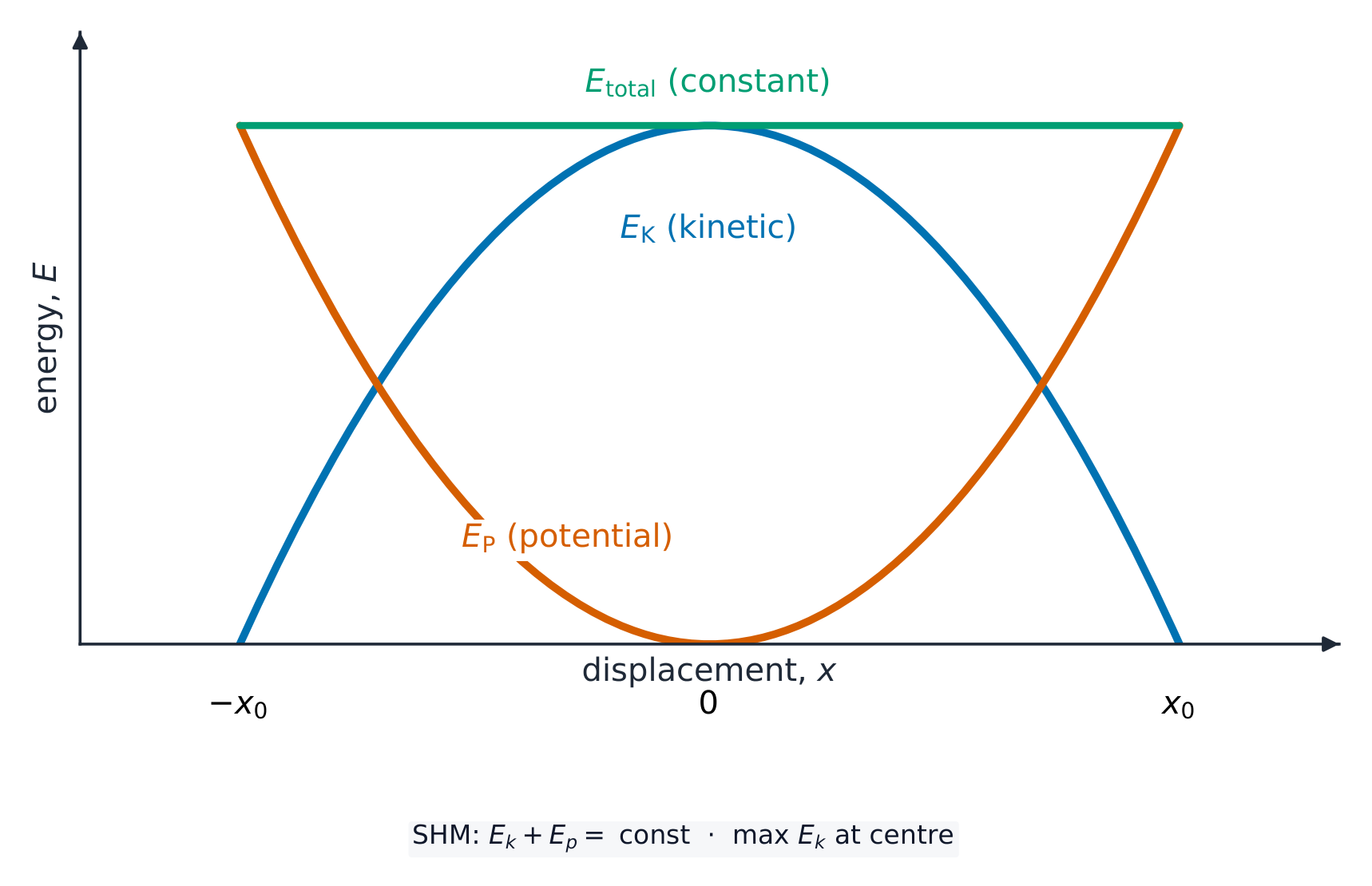
Using $v^{2} = \omega^{2}(x_{0}^{2} - x^{2})$:

$$E_{\text{K}} = \tfrac{1}{2} m \omega^{2} (x_{0}^{2} - x^{2}), \qquad E_{\text{P}} = \tfrac{1}{2} m \omega^{2} x^{2}.$$

So $E_{\text{K}}$ is a downward parabola (peak at $x = 0$, zero at $x = \pm x_{0}$) and $E_{\text{P}}$ is an upward parabola (zero at $x = 0$, largest at $x = \pm x_{0}$). Their sum is constant.

Worked example. A $0.20\ \text{kg}$ mass oscillates with amplitude $x_{0} = 0.050\ \text{m}$ and angular frequency $\omega = 15.7\ \text{rad s}^{-1}$. Find the total energy of the oscillation.

The total energy equals the maximum kinetic energy, as the mass passes through $x = 0$ at $v_{\text{max}} = \omega x_{0}$:

$$E = \tfrac{1}{2} m \omega^{2} x_{0}^{2} = \tfrac{1}{2}(0.20)(15.7)^{2}(0.050)^{2} \approx 0.062\ \text{J}.$$

This stays constant, swapping between kinetic and potential form twice each cycle.

Describing the interchange without calculation. At an extreme of the motion the oscillator is momentarily at rest: its kinetic energy is zero and its potential energy is a maximum. As it moves towards equilibrium the restoring force does work on it, so potential energy is converted to kinetic energy; at the equilibrium position the kinetic energy is a maximum and the potential energy a minimum. Beyond it the kinetic energy is converted back to potential energy until the other extreme. The total stays constant, and the exchange happens twice per oscillation, so the energy graphs against time have twice the frequency of the displacement graph.

Worked example. A pendulum bob of mass $0.81\ \text{kg}$ swings with small oscillations of amplitude $32\ \text{mm}$ and period $1.9\ \text{s}$. Find the total energy of the oscillation, and state what happens to it if the amplitude falls to $16\ \text{mm}$.

$\omega = 2\pi/1.9 = 3.31\ \text{rad s}^{-1}$; $E = \tfrac{1}{2}m\omega^{2}x_{0}^{2} = \tfrac{1}{2} \times 0.81 \times 3.31^{2} \times 0.032^{2} = 4.5 \times 10^{-3}\ \text{J}$. Halving the amplitude quarters the energy ($E \propto x_{0}^{2}$), to $1.1 \times 10^{-3}\ \text{J}$; the difference has been dissipated as thermal energy by air resistance.

ไทย

ตัวสั่นแบบฮาร์มอนิกเชิงเส้นจะแลกเปลี่ยนพลังงานระหว่างสองรูปแบบอย่างต่อเนื่อง:

  • พลังงานจลน์ $E_{\text{K}} = \tfrac{1}{2} m v^{2}$.
  • พลังงานศักย์ $E_{\text{P}}$ (เป็นพลังงานยืดหยุ่นสำหรับสปริง หรือพลังงานโน้มถ่วงสำหรับลูกตุ้ม).

โดยไม่มีการ ลดทอน, พลังงานรวม จะมีค่าคงที่ (นี่คือ กฎการอนุรักษ์พลังงาน).

ค่าสูงสุดและต่ำสุด

  • ที่ จุดสมดุล ($x = 0$): $v$ มีค่ามากที่สุด, ดังนั้น $E_{\text{K}}$ จึงมีค่ามากที่สุดและ $E_{\text{P}}$ มีค่าน้อยที่สุด (เป็นศูนย์ ตามการกำหนด).
  • ที่ จุดสุดขั้ว ($x = \pm x_{0}$): $v = 0$为零, ดังนั้น $E_{\text{K}} = 0$ และ $E_{\text{P}}$ จึงมีค่ามากที่สุด.

พลังงานรวม

โดยใช้ $v_{\text{max}} = \omega x_{0}$:

$$E_{\text{total}} = \tfrac{1}{2} m v_{\text{max}}^{2} = \tfrac{1}{2} m \omega^{2} x_{0}^{2}.$$

ข้อเท็จจริงสำคัญสองประการ: พลังงานรวมแปรผันตรงกับ กำลังสองของแอมพลิจูด (การคูณ $x_{0}$ ด้วยสอง เท่ากับเพิ่มพลังงานสี่เท่า), และแปรผันตรงกับ $\omega^{2}$.

พลังงานเทียบกับระยะกระจัด

โดยใช้ $v^{2} = \omega^{2}(x_{0}^{2} - x^{2})$:

$$E_{\text{K}} = \tfrac{1}{2} m \omega^{2} (x_{0}^{2} - x^{2}), \qquad E_{\text{P}} = \tfrac{1}{2} m \omega^{2} x^{2}.$$

ดังนั้น $E_{\text{K}}$ เป็นพาราโบลาหงาย (ยอดที่ $x = 0$, ศูนย์ที่ $x = \pm x_{0}$) และ $E_{\text{P}}$ เป็นพาราโบลาดิ่ง (ศูนย์ที่ $x = 0$, มากที่สุดที่ $x = \pm x_{0}$). ผลรวมของทั้งสองมีค่าคงที่

กราฟแสดงความสัมพันธ์กับการกระจัด แสดงพลังงานจลนในรูปพาราโบลาหงายลง พลังงานศักยในรูปพาราโบลาหงายขึ้น และผลรวมคงที่ในรูปเส้นแนวนอนสำหรับพลังงานรวม
พลังงานจลนและพลังงานศักย์สลับกันตลอดรอบ mientrasพลังงานรวมคงที่

ตัวอย่างวิธีทำ. มวล $0.20\ \text{kg}$ สั่นด้วยแอมพลิจูด $x_{0} = 0.050\ \text{m}$ และความถี่เชิงมุม $\omega = 15.7\ \text{rad s}^{-1}$. หาพลังงานรวมของการสั่น.

พลังงานรวมเท่ากับพลังงานจลนสูงสุด เมื่อมวลเคลื่อนที่ผ่าน $x = 0$ ที่ $v_{\text{max}} = \omega x_{0}$:

$$E = \tfrac{1}{2} m \omega^{2} x_{0}^{2} = \tfrac{1}{2}(0.20)(15.7)^{2}(0.050)^{2} \approx 0.062\ \text{J}.$$

ค่านี้คงที่ โดยสลับระหว่างรูปทรงของพลังงานจลน์และพลังงานศักย์สองครั้งในแต่ละรอบ

การอธิบายการแลกเปลี่ยนโดยไม่ใช้การคำนวณ ที่จุดสุดขั้วของการเคลื่อนที่ ตัวสั่นจะหยุดนิ่งชั่วคราว: พลังงานจลน์เป็นศูนย์ และพลังงานศักมีค่าสูงสุด เมื่อมันเคลื่อนที่เข้าหาตำแหน่งสมดุล แรงคืนตัวจะทำงานต่อมัน ดังนั้นพลังงานศักย์จึงถูกแปลงเป็นพลังงานจลน์; ที่ตำแหน่งสมดุล พลังงานจลน์จะมีค่าสูงสุดและพลังงานศักย์มีค่าต่ำสุด เมื่อผ่านตำแหน่งนั้นไป พลังงานจลน์จะถูกแปลงกลับเป็นพลังงานศักย์จนกว่าจะถึงจุดสุดขั้วอีกด้านหนึ่ง ค่ารวมจะคงที่ และการแลกเปลี่ยนนี้จะเกิดขึ้น สองครั้งต่อการสั่นหนึ่งรอบ ดังนั้นกราฟพลังงานเทียบกับเวลาจะมีความถี่เป็นสองเท่าของกราฟการกระจัด

ตัวอย่างวิธีทำ ลูกตุ้มน้ำหนัก $0.81\ \text{kg}$ สั่นด้วยการสั่นเล็ก ๆ ที่มีขนาด $32\ \text{mm}$ และมีคาบ $1.9\ \text{s}$. จงหาค่าพลังงานรวมของการสั่น และระบุว่าถ้าขนาดลดเหลือ $16\ \text{mm}$ จะเกิดอะไรขึ้น

$\omega = 2\pi/1.9 = 3.31\ \text{rad s}^{-1}$; $E = \tfrac{1}{2}m\omega^{2}x_{0}^{2} = \tfrac{1}{2} \times 0.81 \times 3.31^{2} \times 0.032^{2} = 4.5 \times 10^{-3}\ \text{J}$. การลดขนาดลงครึ่งหนึ่งจะทำให้พลังงานลดลงเป็น四分之一 ($E \propto x_{0}^{2}$), เหลือ $1.1 \times 10^{-3}\ \text{J}$; ส่วนต่างนี้ได้ถูกกระจายออกไปเป็นพลังงานความร้อนโดยแรงต้านอากาศ

Explore · ⁨สำรวจ⁩

Energy in SHM · ⁨พลังงานใน SHM⁩

Watch energy swap between kinetic and potential as the oscillator moves — fastest (max KE) at the centre, still (max PE) at the ends. · ⁨สังเกตการแลกเปลี่ยนระหว่าง พลังงานจลน์ และ พลังงานศักย์ ขณะตัวสั่นเคลื่อนที่ — เร็วสุด (KE สูงสุด) ที่กึ่งกลาง, หยุดนิ่ง (PE สูงสุด) ที่ขอบ⁩

Watch lesson · ⁨ดูบทเรียน⁩
17.3

Damped oscillations · ⁨การสั่นแบบมีการหน่วง⁩

Syllabus · ⁨หลักสูตร⁩
English
  1. understand that a resistive force acting on an oscillating system causes damping
  2. understand and use the terms light, critical and heavy damping and sketch displacement–time graphs illustrating these types of damping
  3. understand that resonance involves a maximum amplitude of oscillations and that this occurs when an oscillating system is forced to oscillate at its natural frequency
ไทย
  1. เข้าใจว่า แรงต้านทาน ที่กระทำต่อระบบสั่นสะเทือนทำให้เกิด การลดทอน
  2. เข้าใจและใช้คำศัพท์ การลดทอนเบา, การลดทอนระดับวิกฤต และ การลดทอนหนัก以及 sketch displacement–time graphs illustrating these types of damping
  3. เข้าใจว่า การสั่นพ้อง เกี่ยวข้องกับแอมพลิจูดสูงสุดของการสั่นสะเทือนและสิ่งนี้เกิดขึ้นเมื่อระบบสั่นสะเทือนถูกบังคับให้สั่นที่ ความถี่ธรรมชาติ ของมัน

Source: Cambridge International syllabus · ⁨แหล่งที่มา: หลักสูตร Cambridge International⁩

English

A resistive force (friction 摩擦力, drag 阻力, air resistance 空气阻力) causes damping — the amplitude shrinks over time as energy is lost as heat. Three named cases:

Light damping

The amplitude shrinks slowly over many cycles (a light damping 轻阻尼 case). The system still oscillates near its natural frequency, but each cycle is smaller than the last. A car's suspension is light-to-medium damped, so bumps die away but the ride stays smooth.

Critical damping

The least damping that brings the system back to equilibrium without overshooting and without oscillating — a critical damping 临界阻尼 case. It returns in the shortest time. A galvanometer 检流计 or analogue voltmeter 电压表 is critically damped so the needle settles quickly.

Heavy damping

So much resistance that the system returns slowly, with no oscillation, but more slowly than the critical case — a heavy damping 过阻尼 case. A door with a strong closer is heavily damped.

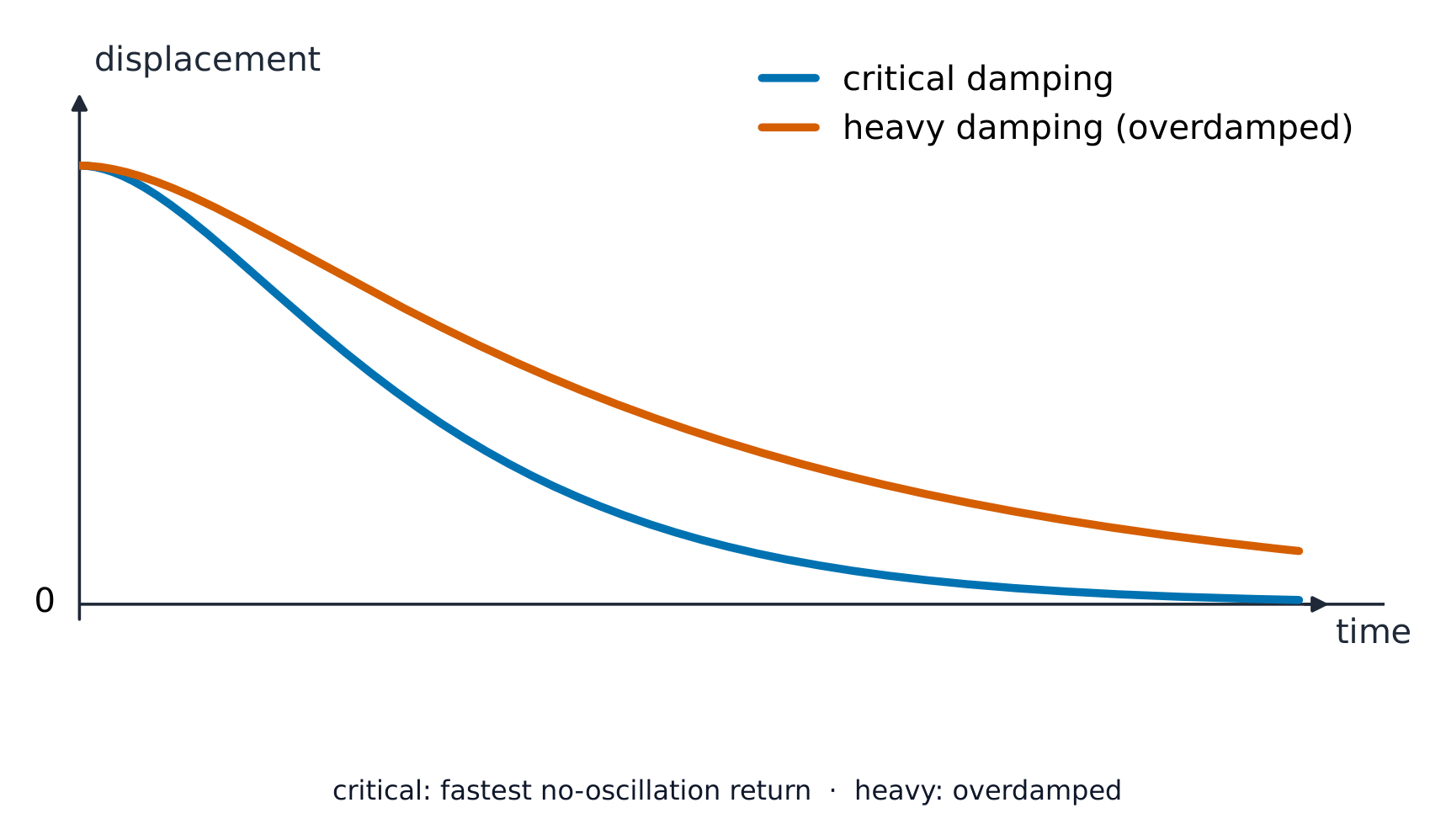
On a displacement–time graph: light damping is a wave whose size dies away smoothly; critical damping returns quickly with no overshoot; heavy damping returns slowly.

As the exam asks it. Damping is the decrease in the amplitude of an oscillation caused by a resistive force that dissipates the oscillator's energy. In light damping the system oscillates with an amplitude that decreases gradually (exponentially) with time; the period is almost unchanged. In critical damping the system returns to equilibrium in the shortest possible time without oscillating. In heavy damping it returns to equilibrium slowly, without oscillating. Sketching them: the light-damping curve is a sine wave inside a shrinking envelope; the critical and heavy curves both fall to zero without crossing the axis, the heavy one more slowly.

Worked example. A bar magnet hangs from a spring with one pole inside a coil that is connected through a switch to a resistor. The magnet is set oscillating. Explain why the oscillations die away more quickly when the switch is closed.

The moving magnet changes the magnetic flux linking the coil, so an e.m.f. is induced (Faraday's law); with the switch closed a current flows through the resistor and dissipates energy as heat. By Lenz's law the induced current opposes the motion of the magnet — an extra resistive force. That energy comes from the oscillation, so the amplitude decreases faster: the circuit adds damping. With the switch open there is an e.m.f. but no current, so no extra energy loss.

ไทย

แรงต้านทาน (แรงเสียดทาน, แรงต้าน, แรงต้านอากาศ) ทำให้เกิดการ หน่วง — ซึ่งขนาดจะเล็กลงเมื่อเวลาผ่านไปเนื่องจากพลังงานสูญเสียในรูปของความร้อน มีสามกรณีที่มีชื่อเรียก:

หน่วงเบา

ขนาด ลดลงช้าๆ ตลอดหลายรอบ (กรณี หน่วงเบา) ระบบยังสั่นอยู่ใกล้กับความถี่ธรรมชาติของมัน แต่แต่ละรอบจะเล็กกว่ารอบก่อนหน้า ระบบกันสะเทือนของรถยนต์มีการหน่วงระดับเบาถึงกลาง ดังนั้น bump จะหายไปแต่การขับขี่ยังคงเรียบเนียน

กราฟการกระจัดเทียบกับเวลาแสดงการสั่นwhose ขนาดลดลงอย่างช้าๆ ถูกจำกัดด้วย envelope การลดลงที่เรียบเนียน
ในการหน่วงเบา ขนาดจะค่อยๆ ลดหายไปตลอดหลายรอบ

หน่วงวิกฤต

การหน่วงน้อยที่สุดที่จะนำระบบกลับสู่ตำแหน่งสมดุล โดยไม่ข้ามเส้นและไม่มีการสั่น — กรณี หน่วงวิกฤต มันจะกลับมาในเวลาสั้นที่สุด กัลวานอมิเตอร์ หรือ โวลต์มิเตอร์ แบบอะนาล็อกมีการหน่วงวิกฤตเพื่อให้เข็มหยุดนิ่งได้เร็ว

หน่วงหนัก

มีความต้านทานมากจนระบบกลับมาช้า ไม่มีการสั่น แต่ช้ากว่ากรณีวิกฤต — กรณี หน่วงหนัก ประตูที่มีตัวปิดประตูที่แข็งแรงมีการหน่วงหนัก

บนกราฟการกระจัด–เวลา: หน่วงเบาคือคลื่น whose ขนาดลดหายไปอย่างเรียบ; หน่วงวิกฤตกลับมาเร็วโดยไม่ข้ามเส้น; หน่วงหนักกลับมาช้า

กราฟการกระจัดเทียบกับเวลาเปรียบเทียบโค้งหน่วงวิกฤตที่กลับสู่ตำแหน่งสมดุลอย่างรวดเร็วโดยไม่ข้ามเส้นและโค้งหน่วงเกิน (หน่วงหนัก) ที่กลับมาช้ากว่า
หน่วงวิกฤตกลับสู่ตำแหน่งสมดุลเร็วที่สุดโดยไม่ข้ามเส้น; หน่วงเกินกลับมาช้ากว่า

ตามรูปแบบที่ข้อสอบถาม การหน่วง คือการลดลงของขนาดของการสั่นซึ่งเกิดจากแรงต้านทานที่กระจายพลังงานของตัวสั่น ใน หน่วงเบา ระบบสั่นด้วยขนาดที่ลดลงอย่างต่อเนื่อง (แบบเอ็กซ์โพเนนเชียล) กับเวลา; คาบแทบไม่เปลี่ยนแปลง ใน หน่วงวิกฤต ระบบกลับสู่ตำแหน่งสมดุลในเวลาสั้นที่สุดโดยไม่สั่น ใน หน่วงหนัก มันกลับสู่ตำแหน่งสมดุลช้าโดยไม่สั่น การวาดภาพ: โครฟหน่วงเบาคือคลื่นไซน์ภายใน envelope ที่เล็กลง; โครฟวิกฤตและหน่วงหนักทั้งสองลดลงสู่ศูนย์โดยไม่ตัดแกน, ครอฟหน่วงหนักช้ากว่า

ตัวอย่างวิธีทำ แท่งแม่เหล็กแขวนอยู่กับสปริง โดยมีขั้วหนึ่งอยู่ภายในคอยล์ที่เชื่อมต่อกับสวิตช์ไปยังตัวต้านทาน ตั้งให้แม่เหล็กสั่น อธิบายว่าทำไมการสั่นจะหายเร็วขึ้นเมื่อสวิตช์เปิด

แม่เหล็กที่เคลื่อนที่เปลี่ยนการไหลของสนามแม่เหล็กที่貫穿 คอยล์ ดังนั้น e.m.f. จึงถูกเหนี่ยวนำ (กฎของฟาราเดย์); เมื่อสวิตช์เปิดกระแสไฟฟ้าจะไหลผ่านตัวต้านทานและกระจายพลังงานในรูปของความร้อน ตามกฎของเลนซ์ กระแสที่ถูกเหนี่ยวนำจะต้านทานการเคลื่อนที่ของแม่เหล็ก — ซึ่งเป็นแรงต้านทานเพิ่มเติม พลังงานนี้มาจาก การสั่น ดังนั้นขนาดจึงลดลงเร็วขึ้น: วงจรเพิ่มการหน่วง เมื่อสวิตช์ปิดจะมี e.m.f. แต่ไม่มีกระแส ดังนั้นจึงไม่มีการสูญเสียพลังงานเพิ่มเติม

Vocabulary · ⁨คำศัพท์⁩ Train · ⁨ฝึกฝน⁩
English ไทย
damping/ˈdæmpɪŋ/ การลดทอน
conservation of energy/ˌkɒnsəˈveɪʃn ɒv ˈenədʒi/ กฎการอนุรักษ์พลังงาน
air resistance/eə rɪˈzɪstəns/ แรงต้านอากาศ
friction/ˈfrɪkʃn/ แรงเสียดทาน
drag/dræɡ/ แรงต้านทานการเคลื่อนที่
light damping/laɪt ˈdæmpɪŋ/ หน่วงเบา (light damping)
heavy damping/ˈhevi ˈdæmpɪŋ/ หน่วงหนัก (heavy damping)
Watch lesson · ⁨ดูบทเรียน⁩
17.3

Forced oscillations and resonance · ⁨การสั่นแบบถูกบังคับและการสั่นพ้อง⁩

English

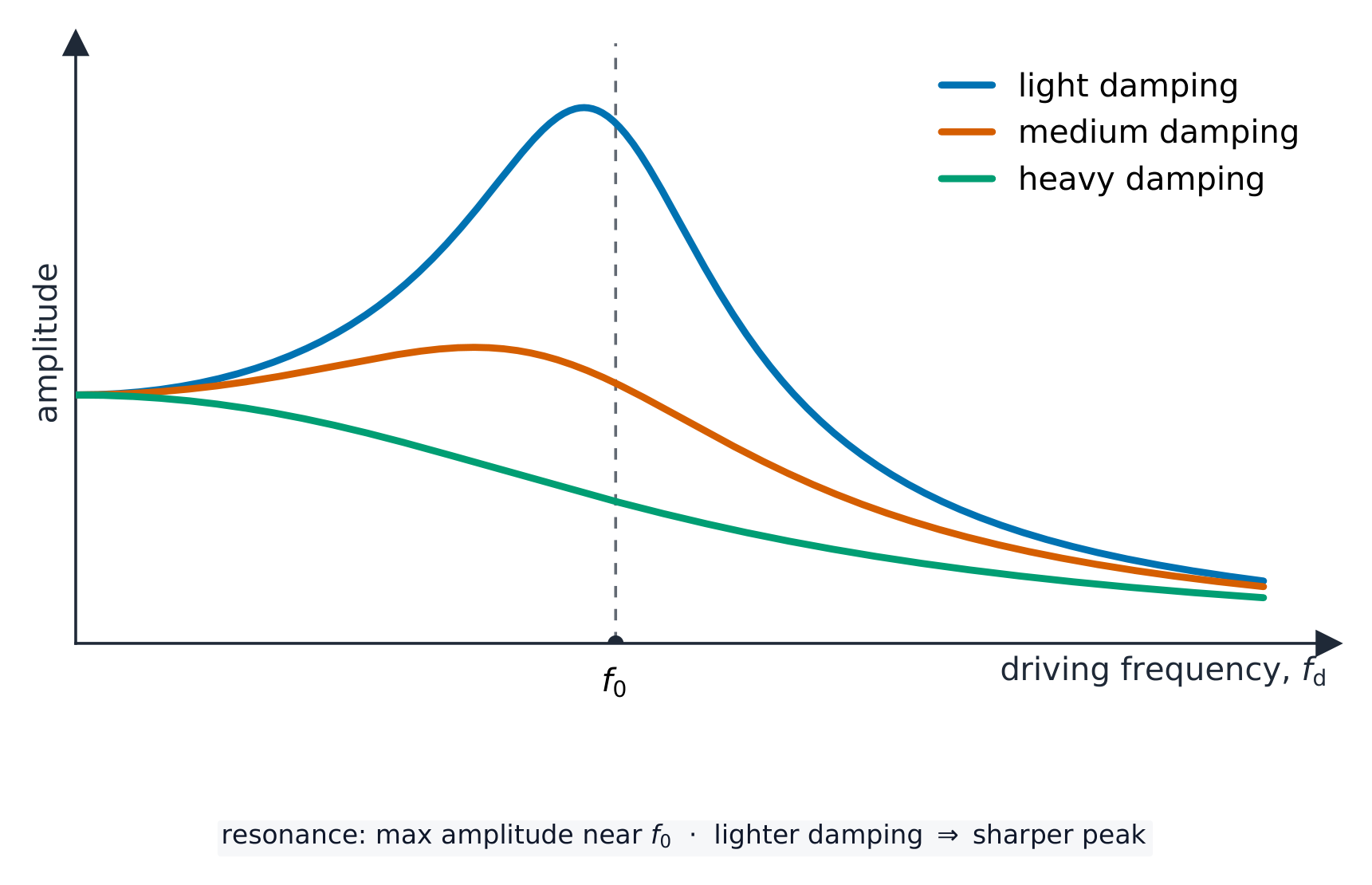
A forced oscillation 受迫振动 is driven by an outside periodic force at a frequency $f_{\text{d}}$ chosen by the experimenter. The system then oscillates at this driving frequency 驱动频率 $f_{\text{d}}$, not at its own natural frequency. A plot of amplitude against $f_{\text{d}}$ is a resonance curve 共振曲线 with a peak.

Resonance

Resonance 共振 happens when the driving frequency equals the system's natural frequency 固有频率 $f_{0}$. At resonance the amplitude is largest and the energy transfer from the driver is most efficient.

Examples:

  • a swing pushed at the right rate builds up a large amplitude.
  • a wine glass broken by a sound at its natural ringing frequency.
  • a building shaken by an earthquake whose frequency matches a natural frequency — engineers design buildings so their natural frequencies avoid the main earthquake range.

The peak's shape depends on damping: lighter damping → a sharper, higher peak; heavier damping → a broader, lower peak, shifted slightly to lower frequency.

The two-mark definition. Resonance is the condition in which a system is forced to oscillate at its natural frequency, and the amplitude of the oscillation is a maximum (the transfer of energy from the driver is greatest). Both parts — driving frequency equal to natural frequency, and maximum amplitude — are needed.

Worked example. A ball on a stretched string has a natural frequency of $4.0\ \text{Hz}$. The string is driven by a vibration generator whose frequency is increased slowly from $0$ to $10\ \text{Hz}$. Sketch the variation of the amplitude of the ball with the driving frequency, and state the effect of adding damping.

The curve starts at a small, non-zero amplitude at low frequency, rises to a sharp peak at $4.0\ \text{Hz}$, and falls away towards zero at high frequency; the peak is at the natural frequency, and only there is the amplitude a maximum. More damping makes the peak lower and broader and shifts it slightly to a lower frequency; the amplitude far from resonance hardly changes.

ไทย
ภาพระยะใกล้ของสายกีตาร์
สายกีตาร์ที่ถูกดึงจะสั่นที่ความถี่พ้องของตัวมันเอง

การสั่นแบบถูกบังคับ (forced oscillation) คือการสั่นที่ถูกขับเคลื่อนโดยแรงภายนอกที่เป็น周期性 (periodic force) ที่มีความถี่ $f_{\text{d}}$ ซึ่งผู้ทดลองเลือกไว้ ระบบจึงสั่นด้วยความถี่นี้ ความถี่ของตัวขับเคลื่อน (driving frequency) $f_{\text{d}}$ ไม่ใช่ความถี่ธรรมชาติของระบบ กราฟแสดงความกว้างต่อ $f_{\text{d}}$ เป็น กราฟการสั่นพ้อง (resonance curve) ซึ่งมีจุดสูงสุด

การสั่นพ้อง

การสั่นพ้อง (Resonance) เกิดขึ้นเมื่อความถี่ของตัวขับเคลื่อนเท่ากับ ความถี่ธรรมชาติ (natural frequency) $f_{0}$ ของระบบ เมื่อเกิดการสั่นพ้อง ความกว้างจะมีค่า มากที่สุด และการถ่ายโอนพลังงานจากตัวขับเคลื่อนมีประสิทธิภาพสูงสุด

กราฟการสั่นพ้อง: แสดงความกว้างเทียบกับความถี่ของตัวขับเคลื่อนสำหรับการหน่วงแสง กลาง และหนัก แต่ละเส้นมีจุดสูงสุดใกล้กับความถี่ธรรมชาติและลดลงทางทั้งสองด้าน; การหน่วงเบาทำให้จุดยอดแหลมและสูงกว่า
ความกว้างของการสั่นแบบถูกบังคับจะสูงสุดที่การสั่นพ้อง เมื่อความถี่ของตัวขับเคลื่อนเท่ากับความถี่ธรรมชาติ

ภาพถ่ายขาวดำของถนนสะพาน Tacoma Narrows ที่บิดเบี้ยวไปด้านหนึ่งอย่างมาก ในขณะที่ผู้ชายคนหนึ่งเกาะติดอยู่ *การสั่นพ้องสามารถทำลายได้ ในปี ค.ศ. 1940 ลมได้ผลักสะพาน Tacoma Narrows ให้เข้าใกล้ความถี่ธรรมชาติของมัน ด้วยระบบลดทอนที่น้อยมาก การบิดตัวจึงเพิ่มขึ้นเรื่อยๆ จนแผ่นทางเดินแตกสลาย วิศวกรจึงออกแบบสะพานและอาคารให้มีความถี่ธรรมชาติหลีกเลี่ยงแรงกระตุ้นเหล่านี้

ตัวอย่าง:

  • แกว่งที่ถูกเขย่าด้วยความเร็วที่เหมาะสมจะสร้างแอมพลิจูดขนาดใหญ่ขึ้น
  • แก้วไวน์แตกเนื่องจากเสียงที่มีความถี่เท่ากับความถี่การสั่นพ้องตามธรรมชาติของแก้ว
  • อาคารสั่นไหวจากแผ่นดินไหวที่มีความถี่ตรงกับความถี่ธรรมชาติ — วิศวกรออกแบบอาคารให้มีความถี่ธรรมชาติหลีกเลี่ยงช่วงความถี่หลักของแผ่นดินไหว

รูปร่างของยอดกราฟขึ้นอยู่กับระบบลดทอน: การลดทอนน้อย → ยอดกราฟแหลมและสูง; การลดทอนมาก → ยอดกราฟกว้างและต่ำ เลื่อนไปทางความถี่ต่ำกว่าเล็กน้อย

นิยามสำหรับ 2 คะแนน การสั่นพ้องคือสภาวะที่ระบบถูกบังคับให้สั่นที่ความถี่ธรรมชาติ และแอมพลิจูดของการสั่นมีค่าสูงสุด (การถ่ายโอนพลังงานจากตัวขับเคลื่อนมีมากที่สุด) ทั้งสองส่วน — ความถี่ขับเคลื่อนเท่ากับความถี่ธรรมชาติ และแอมพลิจูดสูงสุด — จำเป็นต้องมี

ตัวอย่างวิธีทำ ลูกบอลบนเชือกที่ตึงมีความถี่ธรรมชาติ $4.0\ \text{Hz}$ เชือกนั้นถูกขับเคลื่อนโดยเครื่องกำเนิดการสั่นwhose的频率 slowly from $0$ to $10\ \text{Hz}$. วาดกราฟแสดงการเปลี่ยนแปลงของแอมพลิจูดของลูกบอลเมื่อเทียบกับความถี่ขับเคลื่อน และอธิบายผลของการเพิ่มระบบลดทอน

กราฟเริ่มต้นที่แอมพลิจูดเล็กแต่ไม่ศูนย์ที่ความถี่ต่ำ แล้วพุ่งขึ้นสู่ยอดแหลมที่ $4.0\ \text{Hz}$ และลดลงเข้าใกล้ศูนย์ที่ความถี่สูง; ยอดกราฟอยู่ที่ความถี่ธรรมชาติ และเพียงเท่านั้นที่แอมพลิจูดจะมีค่าสูงสุด การเพิ่มการลดทอนจะทำให้ยอดกราฟ ต่ำลงและกว้างขึ้น serta เลื่อนไปทางความถี่ต่ำกว่าเล็กน้อย; แอมพลิจูดที่ห่างจากจุดสั่นพ้องแทบจะไม่เปลี่ยน

Explore · ⁨สำรวจ⁩

Resonance · ⁨เรโซแนนซ์⁩

Drive the swing at different frequencies. Far from its natural frequency it barely moves; tune them to match and the amplitude explodes — resonance, the same effect that can shake a bridge apart. · ⁨เขย่าชิงช้าด้วยความถี่ต่างๆ ห่างจากความถี่ธรรมชาติมันแทบไม่ขยับ เมื่อปรับให้ตรงกัน แอมพลิจูดจะพุ่งสูง — เรโซแนนซ์ ผลลัพธ์เดียวกันที่สามารถทำให้สะพานพังทลายได้⁩

Vocabulary · ⁨คำศัพท์⁩ Train · ⁨ฝึกฝน⁩
English ไทย
frequency/ˈfriːkwənsi/ ความถี่
capacitor/kəˈpæsɪtə/ ตัวเก็บประจุ
amplitude/ˈæmplɪtjuːd/ แอมพลิจูด
period/ˈpɪərɪəd/ รอบ
phase difference/feɪz ˈdɪfrəns/ ความต่างเฟส
upthrust/ˈʌpθrʌst/ แรงลอยตัว
natural frequency/ˈnætʃərəl ˈfriːkwənsi/ ความถี่ธรรมชาติ
critical damping/ˈkrɪtɪkl ˈdæmpɪŋ/ หน่วงวิกฤต (critical damping)
galvanometer/ˌɡælvəˈnɒmɪtə/ กาลวานอมิเตอร์
voltmeter/ˈvəʊltmiːtə/ โวลต์มิเตอร์
forced oscillation/fɔːst ˌɒsɪˈleɪʃn/ การสั่นforced
resonance/ˈrezənəns/ เรโซแนนซ์
driving frequency/ˈdraɪvɪŋ ˈfriːkwənsi/ ความถี่ขับ
resonance curve/ˈrezənəns kɜːv/ กราฟเรโซแนนซ์
17.3

Definitions the examiner accepts · ⁨คำนิยามที่ผู้สอบยอมรับ⁩

English

A definition question is marked against fixed wording. Learn these exactly, and give one answer only.

Term Definition
simple harmonic motion motion in which the acceleration is proportional to the displacement from a fixed point and is always directed towards that point
amplitude the maximum displacement from the equilibrium position
period the time for one complete oscillation
frequency the number of complete oscillations per unit time
angular frequency $\omega = 2\pi f = 2\pi/T$; the rate at which the phase of the oscillation changes
phase difference the fraction of a cycle, expressed as an angle, by which one oscillation leads or lags another
damping the reduction in amplitude of an oscillation caused by a resistive force that dissipates its energy
critical damping the damping that returns a displaced system to equilibrium in the shortest time without oscillation
natural frequency the frequency at which a system oscillates when displaced and left to oscillate freely
resonance the forced oscillation of a system at its natural frequency, at which the amplitude is a maximum
ไทย

คำถามคำนิยามจะให้คะแนนตามข้อความที่กำหนดไว้你必须 exact. เรียนรู้ให้ถูกต้องและตอบเพียงคำตอบเดียวเท่านั้น

พจน์ นิยาม
การเคลื่อนที่แบบฮาร์มอนิก การเคลื่อนที่ซึ่งความเร่งแปรผันตรงกับระยะกระจัดจากจุดคงที่และมีทิศทางเข้าสู่จุดนั้นเสมอ
แอมพลิจูด ระยะกระจัดสูงสุดจากตำแหน่งสมดุล
ระยะเวลา เวลาที่ใช้ในการสั่นครบหนึ่งรอบ
ความถี่ จำนวนรอบการสั่นสมบูรณ์ต่อหน่วยเวลา
ความถี่เชิงมุม $\omega = 2\pi f = 2\pi/T$; อัตราที่เฟสของการสั่นเปลี่ยนแปลง
ความต่างเฟส ส่วนหนึ่งของรอบการสั่น ซึ่งแสดงเป็นมุม โดยที่การสั่นหนึ่งนำหน้าหรือล่าช้ากว่าอีกการสั่นหนึ่ง
ระบบลดทอน การลดลงของแอมพลิจูดของการสั่นอันเกิดจากแรงต้านทานที่กระจายพลังงานออก
การลดทอนวิกฤต การลดทอนที่ทำให้ระบบที่กระจัดออกจากตำแหน่งสมดุลกลับสู่ตำแหน่งสมดุลในเวลาสั้นที่สุดโดยไม่มีการสั่น
ความถี่ธรรมชาติ ความถี่ที่ระบบสั่นเมื่อถูกกระจัดออกและปล่อยให้สั่นอย่างอิสระ
การสั่นพ้อง การสั่นforced ของระบบที่ความถี่ธรรมชาติ ซึ่งมีแอมพลิจูดสูงสุด
17.3

Exam tips · ⁨ข้อแนะนำสำหรับการสอบ⁩

English
  • The SHM condition is $a = -\omega^2 x$ (acceleration proportional to displacement, directed back to equilibrium); to show a motion is SHM, find the restoring force, show it is proportional to $x$ and directed back, and read off $\omega^{2}$.
  • Learn $x = x_0\sin\omega t$ (or cos), $v_{max} = \omega x_0$, $a_{max} = \omega^2 x_0$ and $v = \pm\omega\sqrt{x_0^2 - x^2}$; KE and PE interchange with the total energy constant, $E = \tfrac{1}{2}m\omega^{2}x_{0}^{2} \propto x_{0}^{2}$.
  • Velocity is zero at the extremes and maximum at the centre; acceleration is greatest at the extremes and zero at the centre.
  • The amplitude is half the peak-to-peak range of a displacement graph; $\omega$ comes from the period, or from the gradient of $a$–$x$, or from $v_{0}/x_{0}$.
  • Resonance occurs when the driving frequency equals the natural frequency; damping lowers and broadens the peak.

Common mistakes

  • Defining SHM as "oscillation about an equilibrium position". The mark scheme wants acceleration proportional to displacement and directed towards the fixed point.
  • Saying the minus sign means the acceleration is negative. It means the acceleration is opposite in direction to the displacement.
  • Sketching $v$ against $x$ as a straight line. It is an ellipse; $a$ against $x$ is the straight line.
  • Taking the amplitude as the whole range of the displacement. It is half the range.
  • Defining resonance as "a large amplitude". It is forced oscillation at the natural frequency, giving the maximum amplitude.
  • Calling critical damping "no damping", or heavy damping "the fastest return". Critical damping is the fastest return without oscillation; heavy damping is slower.
ไทย
  • เงื่อนไขการเคลื่อนที่แบบฮาร์มอนิกเชิง-simple (SHM condition is $a = -\omega^2 x$) (ความเร่งแปรผันตามการกระจัด และมีทิศทางกลับสู่ตำแหน่งสมดุล); เพื่อ พิสูจน์ ว่าการเคลื่อนที่นั้นเป็น SHM ให้หาแรงคืนตัว (restoring force) แสดงว่าแปรผันกับ $x$ และมีทิศทางกลับ และอ่านค่า $\omega^{2}$ ออกมา
  • เรียนรู้ $x = x_0\sin\omega t$ (หรือ cos), $v_{max} = \omega x_0$, $a_{max} = \omega^2 x_0$ และ $v = \pm\omega\sqrt{x_0^2 - x^2}$; พลังงานจลน์และพลังงานศักย์แลกเปลี่ยนกันโดยที่ พลังงานรวมคงที่, $E = \tfrac{1}{2}m\omega^{2}x_{0}^{2} \propto x_{0}^{2}$.
  • ความเร็วเป็น ศูนย์ที่จุดสุดขั้ว และสูงสุดที่จุดกึ่งกลาง; ความเร่งมีค่ามากสุดที่จุดสุดขั้วและเป็นศูนย์ที่จุดกึ่งกลาง
  • แอมพลิจูดเป็น ครึ่งหนึ่ง ของช่วงยอดถึงยอดของกราฟระยะกระจัด; $\omega$ หาได้จาก ระยะเวลา, หรือจากความชันของ $a$–$x$, หรือจาก $v_{0}/x_{0}$
  • การสั่นพ้อง เกิดขึ้นเมื่อความถี่ขับเคลื่อนเท่ากับความถี่ธรรมชาติ; การลดทอนทำให้ยอดกราฟต่ำลงและกว้างขึ้น

ข้อผิดพลาดที่พบบ่อย

  • นิยาม SHM ว่า "การสั่นรอบๆ ตำแหน่งสมดุล" คำตอบในข้อสอบต้องการความเร่งแปรผันตรงกับระยะกระจัด และ มีทิศทางเข้าสู่จุดคงที่
  • การบอกว่าเครื่องหมายลบหมายความว่าความเร่งเป็นลบ ความหมายที่แท้จริงคือความเร่งมีทิศทางตรงข้ามกับระยะกระจัด
  • การวาดกราฟ $v$ เทียบกับ $x$ เป็นเส้นตรง กราฟนี้เป็นวงรี; การวาด $a$ เทียบกับ $x$ จึงเป็นเส้นตรง
  • การรับว่าแอมพลิจูดคือช่วงเต็มของระยะกระจัด ที่จริงแล้วเป็นครึ่งหนึ่งของช่วง
  • นิยามการสั่นพ้องว่า "แอมพลิจูดขนาดใหญ่" ที่ถูกต้องคือการสั่นforced ที่ความถี่ธรรมชาติ ซึ่งให้ แอมพลิจูดสูงสุด
  • การเรียกการลดทอนวิกฤตว่า "ไม่มีระบบลดทอน" หรือการลดทอนหนักว่า "การกลับเร็วที่สุด" การลดทอนวิกฤตคือการกลับเร็วที่สุดโดยไม่มีการสั่น; การลดทอนหนักจะช้ากว่า

Interactive lessons on this topic · ⁨บทเรียนเชิงโต้ตอบสำหรับหัวข้อนี้⁩

Work through it step by step, with instant-check exercises. · ⁨ทำทีละขั้นตอน พร้อมแบบฝึกหัดตรวจสอบผลทันที⁩

Past Papers · ⁨ข้อสอบย้อนหลัง⁩

More topics in A-Level Physics · ⁨Physics A-Level⁩ · ⁨หัวข้อเพิ่มเติมใน A-Level Physics · ⁨Physics A-Level⁩⁩

Log in or create account · ⁨เข้าสู่ระบบหรือสร้างบัญชี⁩

IGCSE, A-Level & AP