Energy in simple harmonic motion
Introduced| English | Meaning |
|---|---|
| equilibrium/ˌiːkwɪˈlɪbrɪəm/ | A state with no resultant force or resultant moment. |
| damping/ˈdæmpɪŋ/ | The reduction of oscillation amplitude caused by energy transfer out of the oscillating system. |
Where the energy goes at the top of a swing
- At the highest point of a swing you are, for an instant, completely still. Your kinetic energy is exactly zero.
- A moment later you are moving faster than at any other point in the arc. Nothing pushed you; the energy was never gone.
- It was in the potential store, and it came straight back out. An oscillation is that exchange, repeated for as long as friction allows.
- This lesson is the energy of an oscillator: how it swaps, why the total is constant, and why the total depends on the square of the amplitude.
The swap
- At the equilibrium 平衡 position the speed is greatest, so the kinetic energy is maximum and the potential energy is at its minimum.
- At the extremes the oscillator is momentarily at rest, so the kinetic energy is zero and the potential energy is at its maximum.
- In between, the two trade continuously. The exchange happens twice per full oscillation, since the oscillator passes through the centre twice.
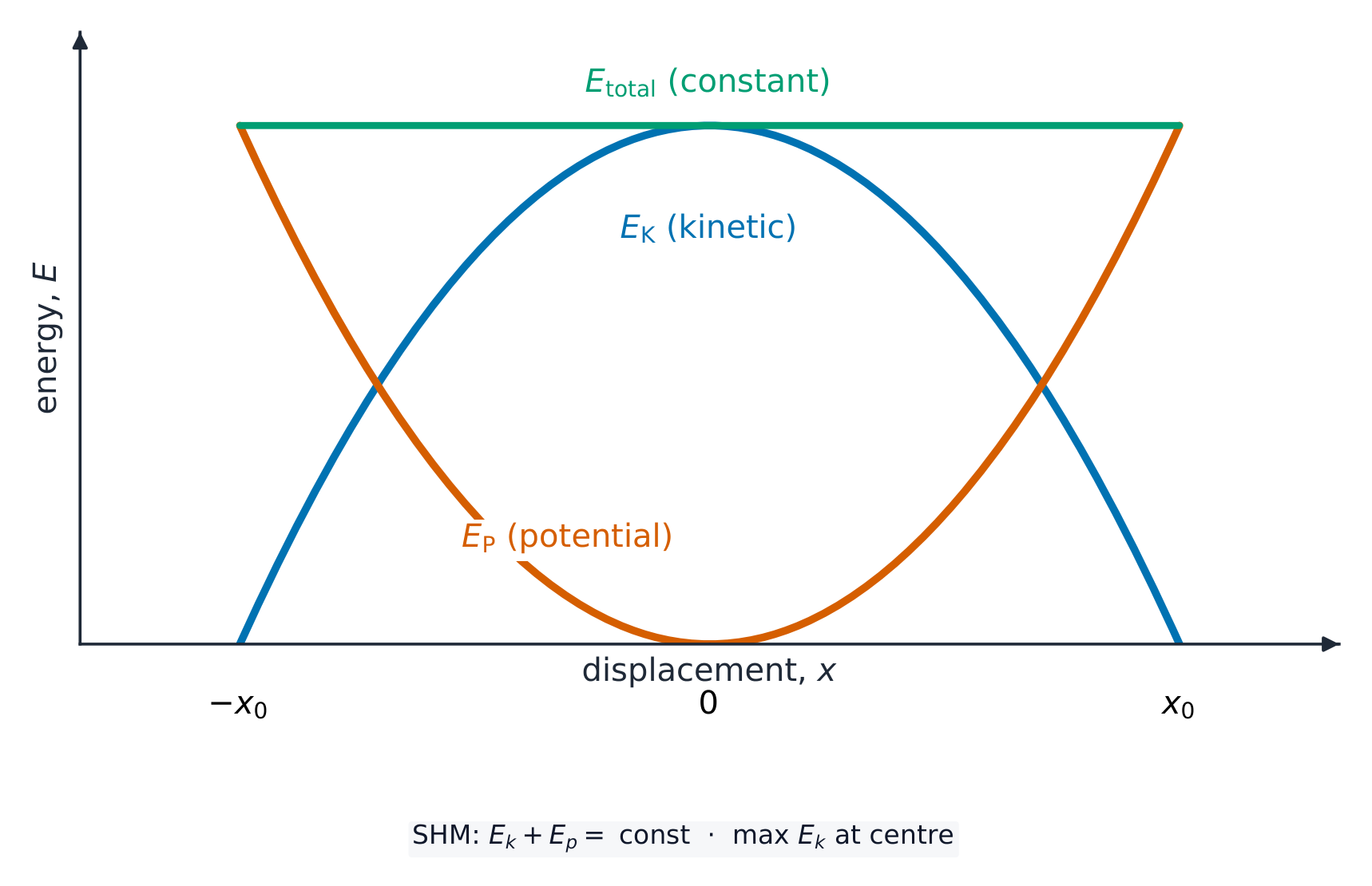
Two curves in opposite phase, and a flat line above them
The kinetic energy of an oscillator is greatest:
Difficulty 1/5 · 100 coins + a small bonus on first completion today
Speed is greatest at the middle, so KE peaks there while PE is at its lowest.
At the extreme positions of the motion, all the energy is potential.
Difficulty 1/5 · 100 coins + a small bonus on first completion today
The oscillator is momentarily at rest there, so KE = 0 and all the energy is potential.
The total is constant
- With no damping 阻尼, no resistive force removing energy, the total energy stays constant. This is conservation of energy applied to the oscillator.
- The easiest place to evaluate it is at the centre, where all of it is kinetic and the speed is $\omega x_0$:
- On a graph against displacement, the kinetic energy is a downward parabola, the potential energy an upward one, and their sum is a horizontal line.
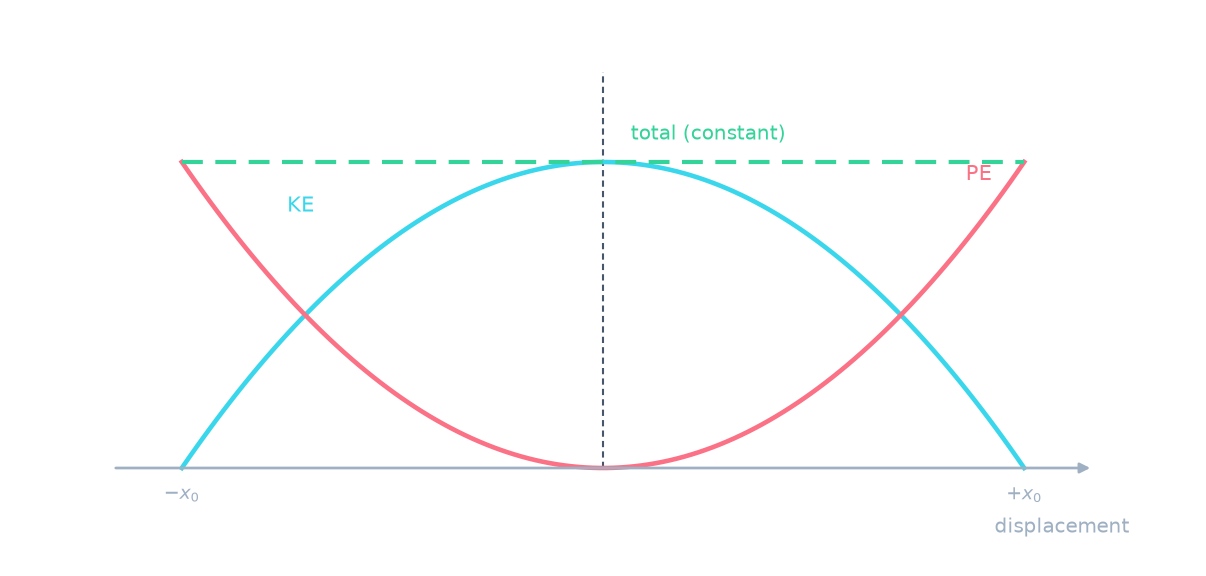
The two parabolas add to a constant at every displacement
Energy in SHM
KE + PE = constant
Energy trades between kinetic (fastest at the centre) and potential (max at the ends).
With no damping, the total energy of an oscillator stays constant.
Difficulty 1/5 · 100 coins + a small bonus on first completion today
Energy just swaps between KE and PE; their sum is conserved.
Energy and amplitude
- Because $E = \tfrac12 m\omega^2 x_0^2$, the total energy is proportional to the square of the amplitude.
- Double the amplitude and the energy is four times as large. Triple it and the energy is nine times.
- This is the relationship the exam tests most often, and answering "twice" for a doubled amplitude is the commonest error in the subtopic.
If the amplitude doubles, the total energy of an oscillator becomes:
Difficulty 1/5 · 100 coins + a small bonus on first completion today
$E \propto x_0^{2}$, so doubling $x_0$ gives $2^{2} = 4$ times the energy.
The amplitude of an undamped oscillator is doubled. What happens to its total energy?
Difficulty 1/5 · 100 coins + a small bonus on first completion today
E is proportional to the square of the amplitude, from E = m omega^2 x0^2 / 2. Answering "twice" is the commonest error in this subtopic.
Worked example: find the total energy
- An oscillator of mass $0.20\ \text{kg}$ has angular frequency $10\ \text{rad/s}$ and amplitude $0.050\ \text{m}$. Find its total energy and its kinetic energy at a displacement of $0.030\ \text{m}$.
- Total: $E = \tfrac12 m \omega^2 x_0^2 = \tfrac12 \times 0.20 \times 10^2 \times 0.050^2 = 0.025\ \text{J}$.
- At $x = 0.030\ \text{m}$: $v = \omega\sqrt{x_0^2 - x^2} = 10\sqrt{0.050^2 - 0.030^2} = 0.40\ \text{m/s}$, so $E_{\text{k}} = \tfrac12 \times 0.20 \times 0.40^2 = 0.016\ \text{J}$.
- The potential energy there is the difference, $0.025 - 0.016 = 0.009\ \text{J}$. Using the constant total to get the second energy is quicker and safer than a separate formula.
An oscillator has $m = 0.20\ \text{kg}$, $\omega = 10\ \dfrac{\text{rad}}{\text{s}}$ and amplitude $0.10\ \text{m}$. What is its total energy?
Difficulty 2/5 · 140 coins + a small bonus on first completion today
$E = \tfrac{1}{2}m\omega^{2}x_0^{2} = \tfrac{1}{2} \times 0.20 \times 10^{2} \times 0.10^{2} = 0.10\ \text{J}$.
An oscillator of mass 0.20 kg has omega = 10 rad/s and amplitude 0.050 m. What is its total energy, in joules?
Difficulty 2/5 · 140 coins + a small bonus on first completion today
E = m omega^2 x0^2 / 2 = 0.20 x 100 x 0.0025 / 2 = 0.025 J. Evaluating at the centre, where all the energy is kinetic, is the quickest route.
If the total energy is 0.025 J and the kinetic energy at some displacement is 0.016 J, the potential energy there is ____ J.
Difficulty 1/5 · 100 coins + a small bonus on first completion today
The total is constant, so the potential energy is simply the total minus the kinetic. That subtraction is quicker and safer than a separate formula.
Worked example: reading the energy graphs
- Sketch how the kinetic energy, the potential energy and the total energy of an undamped oscillator vary with displacement.
- Kinetic energy: maximum at $x = 0$, falling to zero at $x = \pm x_0$, a downward parabola.
- Potential energy: zero at $x = 0$, rising to the maximum at $x = \pm x_0$, an upward parabola, and the mirror image of the first.
- Total: a horizontal line at the value of either maximum, since the two curves always add to the same amount.
- Against time instead of displacement, both curves are still parabola-shaped in energy but now oscillate at twice the frequency of the displacement, because energy peaks twice per cycle.
Match each energy of an undamped oscillator to its graph against displacement.
Difficulty 2/5 · 140 coins + a small bonus on first completion today
The two parabolas are mirror images, so they add to the same value at every displacement. That flat line is conservation of energy drawn out.
Plotted against time, the kinetic energy of an oscillator repeats at twice the frequency of the displacement.
Difficulty 1/5 · 100 coins + a small bonus on first completion today
The oscillator passes through the centre twice per cycle, so kinetic energy peaks twice per cycle while displacement peaks once.
Energy against time runs at double the frequency
- Plot the displacement against time and you get one cycle per period. Plot the kinetic energy against time and you get two.
- The reason is the square. Kinetic energy depends on $v^2$, and $v$ passes through its maximum magnitude twice in every cycle, once going each way.
- So both energy curves complete two maxima per oscillation, and their frequency is double that of the displacement.
- The two curves are exact mirrors of each other about the half-total line, and their sum is a horizontal line at the total energy.
- A sketch question here is marked on three things: the doubled frequency, the two curves being out of step by half their period, and the flat total.
The kinetic energy of an oscillator varies at twice the frequency of its displacement.
Difficulty 1/5 · 100 coins + a small bonus on first completion today
KE depends on v squared, and the speed reaches its maximum twice per cycle, once in each direction. The potential energy does the same, and the two sum to a flat line.
Marks that slip away
- Energy is proportional to amplitude squared. Doubling the amplitude gives four times the energy, not twice.
- Kinetic energy is maximum at the centre, potential at the ends. Do not swap them.
- Against time, the energy curves repeat at twice the frequency of the displacement, because there are two energy peaks per oscillation.
- The total is constant only when there is no damping. Say so when the question mentions resistive forces.
You've got it
- kinetic energy is maximum at the centre and zero at the extremes; potential energy does the opposite, and they exchange twice per cycle
- with no damping the total is constant: $E = \tfrac12 m\omega^2 x_0^2$, most easily evaluated at the centre where all of it is kinetic
- against displacement the energies are two opposite parabolas whose sum is a horizontal line
- $E \propto x_0^2$: double the amplitude, four times the energy