Damped and forced oscillations
Introduced| English | Meaning |
|---|---|
| driving force/ˈdraɪvɪŋ fɔːs/ | An external force applied to make or maintain a system's motion or oscillation. |
| damping/ˈdæmpɪŋ/ | The reduction of oscillation amplitude caused by energy transfer out of the oscillating system. |
| forced oscillations/fɔːst ˌɒsɪˈleɪʃnz/ | forced oscillations |
| resonance/ˈrezənəns/ | A large oscillation response when a system is driven near one of its natural frequencies. |
| driving frequency/ˈdraɪvɪŋ ˈfriːkwənsi/ | The frequency of the external influence acting on an oscillating system. |
| natural frequency/ˈnætʃərəl ˈfriːkwənsi/ | A frequency at which a system oscillates freely after being disturbed. |
The bridge that had to be closed on its opening day
- London's Millennium Bridge opened in June 2000. Within hours it was swaying sideways so alarmingly that it was closed, and it stayed closed for nearly two years.
- Nobody had done anything wrong with the steel. The problem was that a small sideways sway made people adjust their step, that adjustment pushed the bridge at exactly the rhythm it liked, and the sway grew.
- A driving force at the right frequency, an oscillator with too little damping: those two ingredients build amplitude out of almost nothing.
- This lesson is damping 阻尼, forced oscillations 受迫振动, and resonance 共振.
Damping
- Damping is the removal of energy from an oscillator by a resistive force such as friction or air drag.
- The amplitude decreases with time, and the lost energy is transferred to thermal energy in the oscillator and its surroundings.
- The frequency is essentially unchanged for light damping, so the oscillation keeps its rhythm as it fades. That is a bell: same note, dying away.

The envelope shrinks; the spacing of the peaks does not
Damping of an oscillation is caused by:
Difficulty 1/5 · 100 coins + a small bonus on first completion today
Friction or drag carries energy away as heat, so each swing is smaller than the last.
Damping reduces the frequency of an oscillation rather than its amplitude.
Difficulty 1/5 · 100 coins + a small bonus on first completion today
The amplitude falls as energy becomes thermal. For light damping the frequency is essentially unchanged, which is why a bell keeps its note as it fades.
The three degrees of damping
- Light damping: the amplitude decreases slowly over many oscillations. The system still oscillates.
- Critical damping: the system returns to equilibrium in the shortest possible time without oscillating or overshooting. This is what a car suspension and an analogue meter needle are designed for.
- Heavy damping: the system returns to equilibrium slowly and without oscillating, taking longer than critical. A heavy door closer is the example.
- The exam distinction is between critical and heavy: both avoid oscillating, but only critical does it in the shortest time.
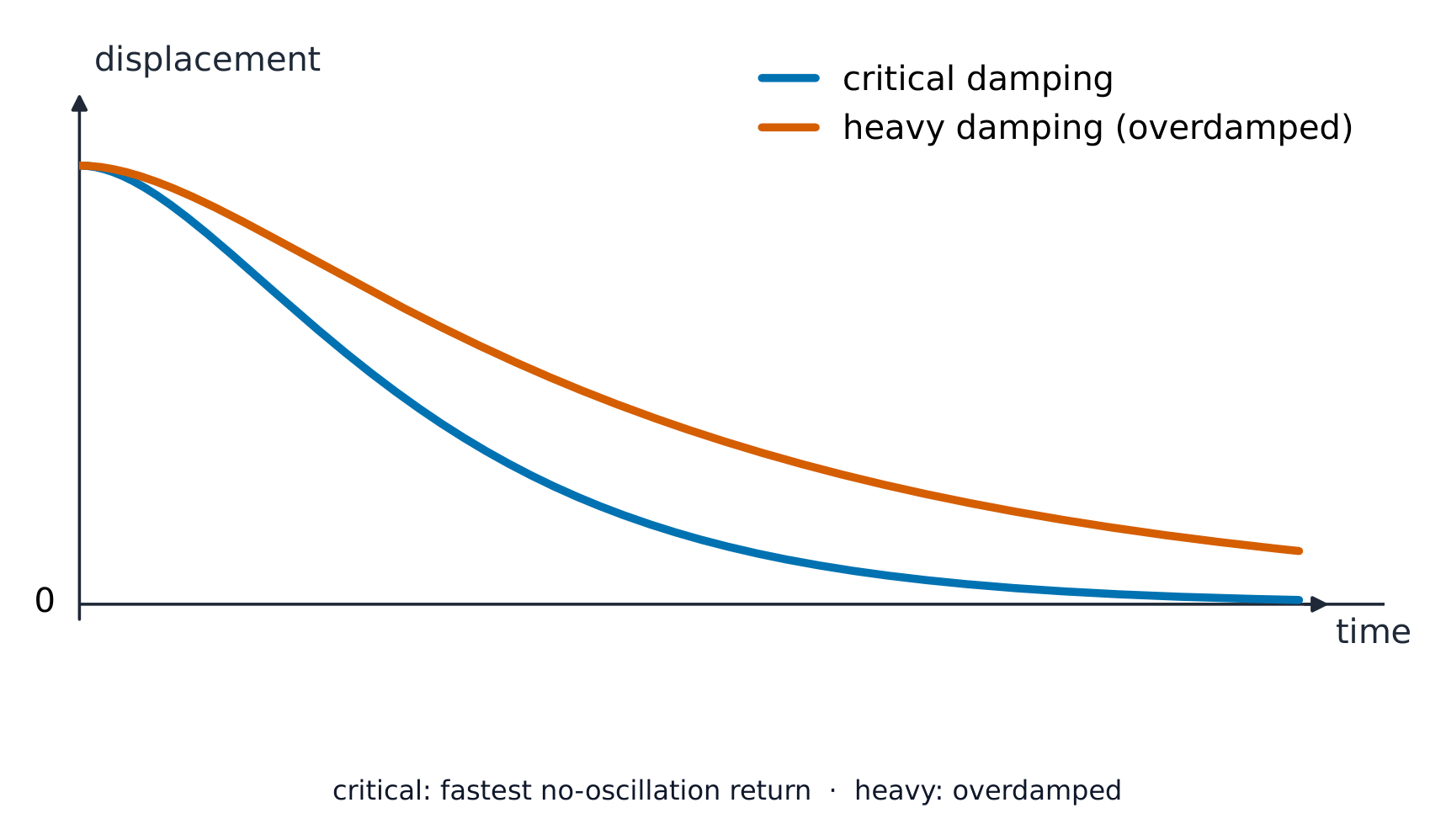
Two curves that both avoid overshooting, one much slower than the other
Match each type of damping to its behaviour.
Difficulty 2/5 · 140 coins + a small bonus on first completion today
Critical damping returns to equilibrium in the shortest time without overshooting; heavy damping is slower still.
Worked example: choose the damping
- A car's suspension is designed so that after hitting a bump the car returns to its normal height quickly and without bouncing. What damping is used, and why?
- Critical damping: it returns the system to equilibrium in the shortest time with no oscillation, so the car neither bounces (light damping) nor sags back slowly (heavy damping).
- An analogue ammeter needle must settle on a reading as quickly as possible. Critical damping again, and for the same reason: a needle that overshoots must be waited for, and one that is heavily damped is slow to read.
- Name the type, then give both properties: shortest time and no oscillation.
A car suspension returns the car to its normal height quickly without bouncing. Which damping is this, and why?
Difficulty 1/5 · 100 coins + a small bonus on first completion today
Heavy damping also avoids oscillating but takes longer, so the car would sag back slowly. Give both properties: shortest time and no oscillation.
Forced oscillations
- A forced oscillation happens when a driving force 驱动力 of frequency $f_{\text{d}}$ is applied to a system.
- After the start-up settles, the system oscillates at the driving frequency 驱动频率, not at its own natural frequency.
- Its natural frequency 固有频率 $f_0$ is the frequency at which it oscillates when displaced and left alone, with no driving force.
- Both facts matter and are often confused: the driving frequency sets how fast it oscillates, and the natural frequency decides how big the response is.
A forced oscillator vibrates at:
Difficulty 1/5 · 100 coins + a small bonus on first completion today
It follows the driver — it oscillates at the driving frequency $f_{\text{d}}$.
Once the start-up has settled, a forced oscillator vibrates at the ____ frequency.
Difficulty 1/5 · 100 coins + a small bonus on first completion today
The driving frequency sets how fast it oscillates; the natural frequency decides only how large the response is.
Resonance
- Resonance occurs when the driving frequency equals the natural frequency of the system. The amplitude is then a maximum, and there is maximum transfer of energy from the driver to the system.
- The lighter the damping, the higher and sharper the resonance peak, and the closer the peak sits to $f_0$. Heavier damping gives a lower, broader peak.
- Everyday resonance: pushing a swing in time with it, a wine glass shattered by a sung note, a radio tuned to a station, and the Millennium Bridge.

Same natural frequency, very different responses
Resonance happens when the driving frequency equals the ____ frequency.
Difficulty 1/5 · 100 coins + a small bonus on first completion today
At $f_{\text{d}} = f_0$ the driver feeds energy in most effectively and the amplitude peaks.
Lighter damping gives a sharper, higher resonance peak.
Difficulty 1/5 · 100 coins + a small bonus on first completion today
Less energy is lost each cycle, so the amplitude builds higher and the peak is narrower.
Worked example: describe a resonance curve
- Sketch and describe how the amplitude of a lightly damped driven oscillator varies with driving frequency. [3]
- The amplitude is small at low driving frequency, rises to a sharp maximum when the driving frequency equals the natural frequency, and falls again at higher frequencies.
- With greater damping the peak is lower and broader, and occurs at a slightly lower frequency.
- The mark most often lost is failing to say where the peak is: at the natural frequency, which is the whole definition of resonance.
Resonance
Drive the swing at different frequencies. Far from its natural frequency it barely moves; tune them to match and the amplitude explodes — resonance, the same effect that can shake a bridge apart.
Describing a resonance curve, which statements earn marks? Select all that apply.
Difficulty 2/5 · 140 coins + a small bonus on first completion today
Beyond the peak the amplitude falls again. Saying where the peak is, at the natural frequency, is the mark most often lost.
Wanted and unwanted
- Wanted: a radio or television tuned by matching a circuit's natural frequency to the broadcast; a microwave oven driving water molecules; magnetic resonance imaging; a musical instrument's air column or string.
- Unwanted: a bridge or building driven by wind, footsteps or an earthquake; a vibrating car panel at one particular engine speed.
- The engineering answer to unwanted resonance is to increase the damping, which lowers and broadens the peak, or to change the natural frequency so it no longer matches the driver.
Select all the examples of resonance.
Difficulty 2/5 · 140 coins + a small bonus on first completion today
Each of the first three matches a driving frequency to a natural frequency. A rolling ball is not a driven oscillation.
Marks that slip away
- A damped oscillator loses amplitude, not frequency. Say what decreases.
- Critical damping is the shortest time without oscillating; heavy damping also avoids oscillating but is slower. Give both properties.
- A forced oscillator vibrates at the driving frequency. Its natural frequency decides only how large the response is.
- Resonance is the driving frequency equal to the natural frequency, not merely close to it. Name where the peak is.
An engineer must stop a footbridge resonating with pedestrians' footsteps. Put a sensible approach in order.
Difficulty 3/5 · 200 coins + a small bonus on first completion today
The two engineering answers to unwanted resonance are more damping or a different natural frequency. Both were used on the Millennium Bridge.
You've got it
- damping is a resistive force removing energy, so the amplitude falls and the energy becomes thermal; the rhythm is essentially unchanged
- light damping decays slowly and still oscillates; critical returns to equilibrium in the shortest time without oscillating; heavy also does not oscillate but is slower
- a forced oscillator vibrates at the driving frequency, whatever its natural frequency
- resonance is driving frequency equal to natural frequency, giving maximum amplitude and maximum energy transfer; lighter damping gives a higher, sharper peak