Simple harmonic motion
Introduced| English | Meaning |
|---|---|
| simple harmonic motion/ˈsɪmpl hɑːˈmɒnɪk ˈməʊʃn/ | Oscillation in which acceleration is proportional to displacement from equilibrium and directed towards equilibrium. |
| displacement/dɪˈspleɪsmənt/ | The straight-line change in position, including direction. |
| equilibrium/ˌiːkwɪˈlɪbrɪəm/ | A state with no resultant force or resultant moment. |
| amplitude/ˈæmplɪtjuːd/ | The maximum displacement from an equilibrium position. |
| period/ˈpɪərɪəd/ | The time taken for one complete oscillation or cycle. |
| frequency/ˈfriːkwənsi/ | The number of complete cycles per unit time. |
| angular frequency/ˈæŋɡjʊlə ˈfriːkwənsi/ | The rate of change of phase in radians per second, equal to two pi times frequency. |
The lamp that taught the world to keep time
- In 1583 a student in Pisa cathedral, bored during a sermon, timed a swinging lamp against his own pulse. Whether the lamp swung wide or narrow, each swing took the same time.
- That is not obvious and it is not true of most motions. It is true whenever the restoring force grows in proportion to how far the thing has been displaced, and that one condition defines the whole topic.
- Galileo's observation became the pendulum clock, and every clock for the next 300 years.
- This lesson is simple harmonic motion 简谐运动: its defining equation, the words that describe it, and how to read $\omega$ off a graph.
The definition
- A body moves with simple harmonic motion when its acceleration is proportional to its displacement 位移 from a fixed point, and always directed towards that point.
- Both halves are needed for both marks. "Proportional to displacement" alone describes a force pushing it further away just as well.
- In symbols, with the minus sign carrying "towards the equilibrium position":

Displaced right, accelerating left; displaced left, accelerating right
In simple harmonic motion, the acceleration is:
Difficulty 1/5 · 100 coins + a small bonus on first completion today
That is exactly $a = -\omega^{2}x$ — bigger displacement, bigger pull back; always toward the middle.
A full definition of simple harmonic motion needs which statements? Select all that apply.
Difficulty 2/5 · 140 coins + a small bonus on first completion today
Those two statements are the definition and carry both marks. The constant period is a consequence of them, and the speed is certainly not constant.
The vocabulary
- Displacement $x$: distance from the equilibrium 平衡 position, with a direction. Amplitude 振幅 $x_0$: the maximum displacement.
- Period 周期 $T$: the time for one complete oscillation. Frequency 频率 $f = 1/T$: oscillations per second, in hertz.
- Angular frequency 角频率 $\omega$: connects the two, $\omega = \dfrac{2\pi}{T} = 2\pi f$. Given any one of $\omega$, $f$ and $T$ you can find the others, and most questions start by doing exactly that.
Swing a pendulum
Set it swinging, then change the start angle — the time for one swing stays the same (that is what makes it a good clock). Now make the string longer, or move to the Moon, and watch the period change.
An oscillation has a period of $2.0\ \text{s}$. What is its angular frequency $\omega$?
Difficulty 2/5 · 140 coins + a small bonus on first completion today
$\omega = \dfrac{2\pi}{T} = \dfrac{2\pi}{2.0} = \pi \approx 3.14\ \dfrac{\text{rad}}{\text{s}}$.
Displacement with time
- Starting from the equilibrium position at $t = 0$: $x = x_0 \sin(\omega t)$. Starting from an extreme: $x = x_0 \cos(\omega t)$.
- Which you use depends only on where the motion starts. Read the question's opening condition before choosing.
- The graph is a sine curve of amplitude $x_0$ and period $T$, and the motion repeats exactly.

One period, one full cycle, and then the same again
Speed anywhere in the motion
- The speed at displacement $x$, without needing the time:
- At the centre, $x = 0$, this gives the maximum speed $v_{\text{max}} = \omega x_0$. At the extremes, $x = \pm x_0$, it gives zero.
- That is the pattern to hold on to: fastest in the middle, momentarily at rest at each end, and the acceleration is the other way round, zero in the middle and greatest at the ends.
In SHM the speed is greatest at the ____ position.
Difficulty 1/5 · 100 coins + a small bonus on first completion today
At the middle all the energy is kinetic, so the speed is maximum ($v = \omega x_0$).
At the extremes of the motion ($x = \pm x_0$), the speed is zero.
Difficulty 1/5 · 100 coins + a small bonus on first completion today
The oscillator stops for an instant at each end before reversing — speed zero, acceleration maximum.
An oscillator has amplitude $0.10\ \text{m}$ and $\omega = 10\ \dfrac{\text{rad}}{\text{s}}$. What is its maximum speed?
Difficulty 2/5 · 140 coins + a small bonus on first completion today
Maximum speed $= \omega x_0 = 10 \times 0.10 = 1.0\ \dfrac{\text{m}}{\text{s}}$.
Match each quantity to where in the oscillation it is greatest.
Difficulty 2/5 · 140 coins + a small bonus on first completion today
Speed and acceleration peak at opposite places, and they are never both maximum at the same instant.
Worked example: from period to maximum speed
- A mass oscillates with a period of $2.0\ \text{s}$ and an amplitude of $0.10\ \text{m}$. Find its maximum speed and its maximum acceleration.
- First $\omega$: $\omega = \dfrac{2\pi}{T} = \dfrac{2\pi}{2.0} = 3.14\ \text{rad/s}$. Almost every SHM question begins here.
- Maximum speed, at the centre: $v_{\text{max}} = \omega x_0 = 3.14 \times 0.10 = 0.31\ \text{m/s}$.
- Maximum acceleration, at the extremes: $a_{\text{max}} = \omega^2 x_0 = 3.14^2 \times 0.10 = 0.99\ \text{m/s}^2$.
- Note where each maximum occurs. A question asking "at what displacement" wants the centre for speed and the extremes for acceleration.
An oscillation has period 2.0 s and amplitude 0.10 m. What is its maximum speed in m/s?
Difficulty 2/5 · 140 coins + a small bonus on first completion today
omega = 2 pi / T = 3.14 rad/s, and v_max = omega x0 = 0.31 m/s, which occurs at the centre. The maximum acceleration, at the ends, is omega squared times x0 = 0.99 m/s^2.
Reading the acceleration-displacement graph
- Because $a = -\omega^2 x$, a graph of acceleration against displacement is a straight line through the origin with a negative gradient.
- The gradient is $-\omega^2$, so $\omega = \sqrt{|\text{gradient}|}$ and then $T = 2\pi/\omega$.
- This is the standard way an exam gives you $\omega$ without stating it. A straight line through the origin with negative gradient is also the standard way of asking you to show that a motion is simple harmonic.
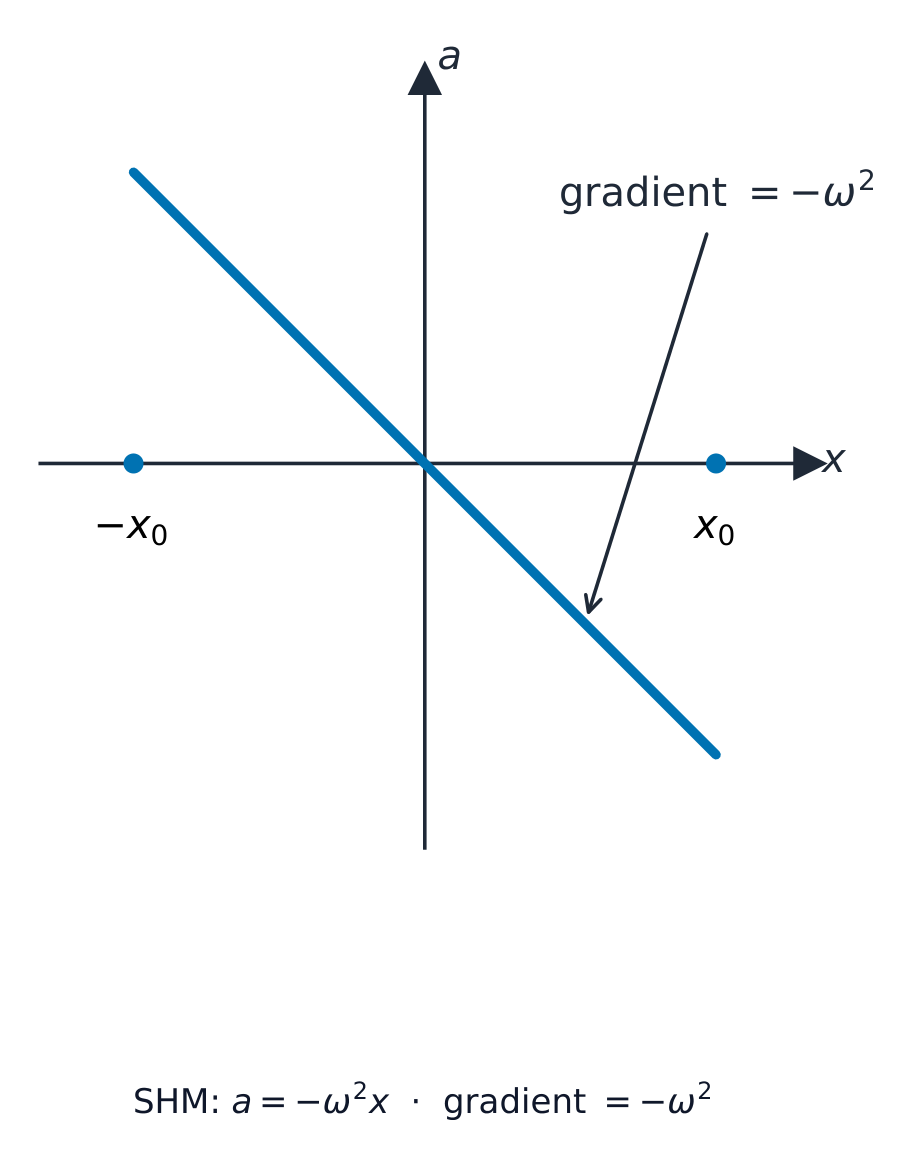
Straight, through the origin, negative: all three matter
On an acceleration-against-displacement graph for SHM, the gradient equals:
Difficulty 1/5 · 100 coins + a small bonus on first completion today
$a = -\omega^{2}x$ is a straight line of gradient $-\omega^{2}$, so $\omega = \sqrt{|\text{gradient}|}$.
Worked example: is it simple harmonic?
- Measurements of a trolley's acceleration at various displacements give a straight line through the origin with gradient $-25\ \text{/s}^2$. Show that the motion is simple harmonic and find the period.
- The graph is a straight line, so $a \propto x$; it passes through the origin, so there is no constant term; and its gradient is negative, so the acceleration is directed towards the equilibrium position. Those three facts are the definition, so the motion is simple harmonic.
- The gradient is $-\omega^2 = -25$, so $\omega = 5.0\ \text{rad/s}$ and $T = \dfrac{2\pi}{5.0} = 1.3\ \text{s}$.
An acceleration-displacement graph for an oscillator is a straight line through the origin of gradient -25 per second squared. What is the period, in seconds?
Difficulty 2/5 · 140 coins + a small bonus on first completion today
The gradient is minus omega squared, so omega = 5.0 rad/s and T = 2 pi / 5.0 = 1.3 s. Straight, through the origin and negative is also the proof that the motion is simple harmonic.
Marks that slip away
- The definition needs both halves: proportional to displacement and directed towards a fixed point. The minus sign is what carries the second.
- $\omega$ is in rad s$^{-1}$, not hertz. Convert with $\omega = 2\pi f$ before substituting.
- Speed is greatest at the centre; acceleration is greatest at the extremes. They are never both maximum at once.
- Choose sine or cosine from where the motion starts, not by habit.
You've got it
- SHM: acceleration proportional to displacement and directed towards a fixed point, so $a = -\omega^2 x$
- $\omega = \dfrac{2\pi}{T} = 2\pi f$, and almost every question starts by finding $\omega$
- $x = x_0\sin\omega t$ from the centre or $x_0\cos\omega t$ from an extreme; $v = \pm\omega\sqrt{x_0^2 - x^2}$, so $v_{\text{max}} = \omega x_0$ at the centre and $a_{\text{max}} = \omega^2 x_0$ at the ends
- an acceleration-displacement graph that is straight, through the origin and negative proves SHM, and its gradient is $-\omega^2$