Skip to content · ⁨ข้ามไปยังเนื้อหา⁩

Mechanics · ⁨กลศาสตร์⁩

A-Level Mathematics · ⁨Mathematics A-Level⁩ · Topic 4 · ⁨หัวข้อ 4⁩

Video lesson for this topic · ⁨บทเรียนวิดีโอสำหรับหัวข้อนี้⁩ Open the video page · ⁨เปิดหน้าวิดีโอ⁩
12:38

กลศาสตร์

ดันรถเข็น และมันจะเร่งความเร็ว ดันแรงขึ้น และมันจะเร่งเร็วขึ้น ดันรถเข็นที่หนักกว่าด้วยแรงเท่าเดิม และมันแทบจะไม่ขยับเลย กลศาสตร์ทั้งหมด…

English narration · English + 中文 subtitles burned in · ⁨การบรรยายภาษาอังกฤษ · คำบรรยายภาษาอังกฤษ + 中文 ลอยตัวบนภาพ⁩

English

This handout covers Topic 4: Mechanics 力学. It studies how forces make objects move. Throughout this topic, take the acceleration of free fall as $g = 10\ \text{m s}^{-2}$.

ไทย

เอกสารฉบับนี้ครอบคลุมหัวข้อที่ 4: กลศาสตร์ ศึกษาว่าแรงทำให้วัตถุเคลื่อนที่อย่างไร ตลอดหัวข้อนี้ ให้ใช้ความเร่งโน้มถ่วงอิสระเท่ากับ $g = 10\ \text{m s}^{-2}$

4.1

Forces and equilibrium · ⁨แรงและสมดุล⁩

Syllabus · ⁨หลักสูตร⁩
English
Candidates should be able to: Notes and examples
identify the forces acting in a given situation e.g. by drawing a force diagram.
understand the vector nature of force, and find and use components and resultants Calculations are always required, not approximate solutions by scale drawing.
use the principle that, when a particle is in equilibrium, the vector sum of the forces acting is zero, or equivalently, that the sum of the components in any direction is zero Solutions by resolving are usually expected, but equivalent methods (e.g. triangle of forces, Lami's Theorem, where suitable) are also acceptable; these other methods are not required knowledge, and will not be referred to in questions.
understand that a contact force between two surfaces can be represented by two components, the normal component and the frictional component
use the model of a 'smooth' contact, and understand the limitations of this model
understand the concepts of limiting friction and limiting equilibrium, recall the definition of coefficient of friction, and use the relationship $F = \mu R$ or $F \leqslant \mu R$, as appropriate Terminology such as 'about to slip' may be used to mean 'in limiting equilibrium' in questions.
use Newton's third law. e.g. the force exerted by a particle on the ground is equal and opposite to the force exerted by the ground on the particle.
ไทย
ผู้เข้าสอบควรสามารถ: หมายเหตุและตัวอย่าง
ระบุแรงที่กระทำในสถานการณ์ที่กำหนด เช่น โดยการวาดแผนภาพแรง
เข้าใจลักษณะของเวกเตอร์ของแรง และหาและใช้องค์ประกอบและผลรวมแรง ต้องทำการคำนวณเท่านั้น ไม่สามารถหาคำตอบโดยประมาณจากแผนภาพมาตราส่วนได้
ใช้หลักการที่ว่า เมื่ออนุภาคอยู่ในสภาวะสมดุล ผลรวมของเวกเตอร์ของแรงที่กระทำจะมีค่าเป็นศูนย์ หรือเทียบเท่ากันคือ ผลรวมขององค์ประกอบในทิศทางใดๆ จะมีค่าเป็นศูนย์ โดยปกติจะคาดหวังการแก้โจทย์ด้วยการแยกองค์ประกอบ แต่วิธีการอื่นที่สมมูลกัน (เช่นสามเหลี่ยมของแรง, กฎของลามี ในกรณีที่เหมาะสม) ก็ยอมรับได้; วิธีการเหล่านี้ไม่ใช่ความรู้ที่ต้องจำ และจะไม่ถูกกล่าวถึงในข้อสอบ
เข้าใจว่า แรงสัมผัสระหว่างพื้นผิวสองพื้นผิวสามารถแสดงด้วยองค์ประกอบสองอย่าง ได้แก่ องค์ประกอบตั้งฉากและองค์ประกอบแรงเสียดทาน
ใช้โมเดล 'พื้นผิวเรียบ' และเข้าใจข้อจำกัดของโมเดลนี้
เข้าใจแนวคิดของ แรงเสียดทานสูงสุด และ สภาวะสมดุลสูงสุด จำนิยามของ สัมประสิทธิ์แรงเสียดทาน และใช้ความสัมพันธ์ $F = \mu R$ หรือ $F \leqslant \mu R$ ตามความเหมาะสม คำศัพท์ เช่น 'กำลังจะลื่น' อาจถูกใช้แทนคำว่า 'อยู่ในสภาวะสมดุลสูงสุด' ในข้อสอบ
ใช้กฎข้อที่สามของนิวตัน เช่น แรงที่อนุภาคกระทำต่อพื้นดินมีขนาดเท่ากันและทิศตรงข้ามกับแรงที่พื้นดินกระทำต่ออนุภาค

Source: Cambridge International syllabus · ⁨แหล่งที่มา: หลักสูตร Cambridge International⁩

English

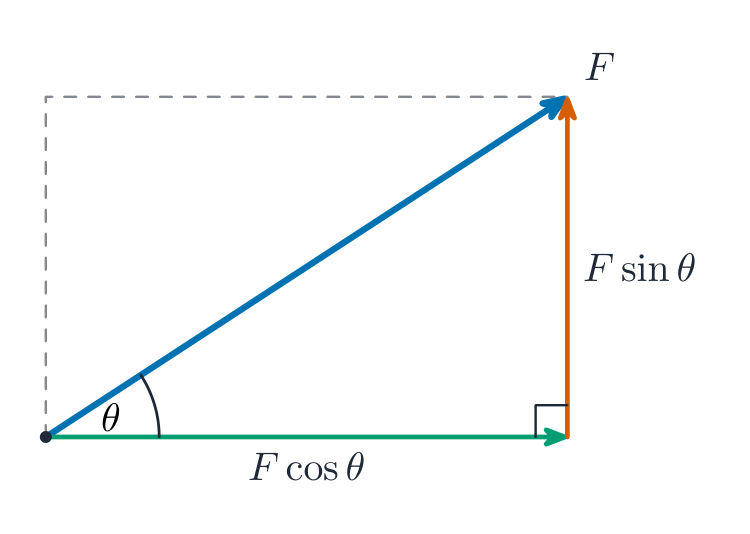
A force 力 is a push or a pull. It is a vector, so it has size and direction. Because it is a vector, you can split a force into components 分量 (usually horizontal and vertical), and you can add several forces into one resultant 合力.

A particle is in equilibrium 平衡 when the forces are balanced: the vector sum of the forces is zero. In practice this means the components in any direction add to zero.

Friction

When two surfaces touch, the contact force 接触力 between them has two parts: the normal reaction 法向反作用力 $R$, at right angles to the surface, and the friction 摩擦力 $F$, along the surface, which opposes sliding. A "smooth" surface is a model with no friction.

Friction can only grow up to a maximum. At that maximum the body is in limiting equilibrium 极限平衡, about to slip, and the friction is limiting friction 最大静摩擦力. The maximum is set by the coefficient of friction 摩擦系数 $\mu$:

$$F \leqslant \mu R, \qquad \text{with } F = \mu R \text{ at the point of slipping}.$$

By Newton's third law 牛顿第三定律, the two surfaces push on each other with equal and opposite forces.

Worked example. A block of weight $20\text{ N}$ rests on a rough horizontal table with coefficient of friction $\mu = 0.4$. Find the largest horizontal force that can be applied before the block slides.

The table's normal reaction balances the weight, so $R = 20\text{ N}$. The block is on the point of slipping when friction reaches its maximum $F = \mu R = 0.4 \times 20 = 8\text{ N}$. In equilibrium the applied force equals the friction, so the largest force it can resist is $8\text{ N}$.

ไทย

แรง คือการดันหรือดึง มันคือเวกเตอร์ ดังนั้นจึงมีขนาดและทิศทาง เนื่องจากเป็นเวกเตอร์ คุณสามารถแยกแรงออกเป็น องค์ประกอบ (มักจะเป็นแนวนอนและแนวตั้ง) และรวมหลายแรงเข้าด้วยกันเป็น แรงลัพธ์ เดียว

ลูกศรแรงที่แยกออกเป็นองค์ประกอบแนวนอนและแนวตั้งซึ่งสร้างเป็นสามเหลี่ยมมุมฉาก
แรงที่มุม $\theta$ มีส่วนประกอบแนวนอน $F\cos\theta$ และส่วนประกอบแนวตั้ง $F\sin\theta$

อนุภาคอยู่ใน สมดุล เมื่อแรงสมดุลกัน: ผลรวมเวกเตอร์ของแรงเป็นศูนย์ ในทางปฏิบัติหมายความว่าองค์ประกอบในทุกทิศทางรวมกันได้ศูนย์

นักปีนเขาที่แขวนอยู่บนเชือกหน้าผาทะเลอันชัน ถูกยึดให้อยู่ห่างจากผนังหิน
โจทย์กลศาสตร์ทุกข้อมีลักษณะคล้ายภาพนี้ แรงสามแรงกระทำต่อผู้ปีน — น้ำหนักชี้ตรงลง, แรงตึงตามเชือก, และแรงดันจากหิน — เนื่องจากแรงเหล่านี้สมดุล ผู้ปีนจึงลอยนิ่งอยู่ในสภาวะสมดุล การแยกแต่ละแรงออกเป็นส่วนแนวนอนและแนวตั้งจะแปลงภาพให้เป็นสมการ

แรงเสียดทาน

เมื่อพื้นผิวสองสัมผัสกัน แรงสัมผัส ระหว่าง他们有สองส่วน: ปฏิกิริยาปกติ $R$, ตั้งฉากกับพื้นผิว, และ แรงเสียดทาน $F$, ตามแนวพื้นผิว ซึ่งต้านการลื่นไถล พื้นผิว "เรียบ" เป็นแบบจำลองที่ไม่มีแรงเสียดทาน

แรงเสียดทานสามารถเพิ่มขึ้นได้สูงสุดถึงค่าหนึ่ง เมื่อถึงค่าสูงสุดนั้นวัตถุจะอยู่ใน สภาวะสมดุลจำกัด, ล้วนกำลังจะลื่นไถล และแรงเสียดทานนั้นเรียกว่า แรงเสียดทานจำกัด ค่าสูงสุดกำหนดโดย สัมประสิทธิ์แรงเสียดทาน $\mu$:

$$F \leqslant \mu R, \qquad \text{with } F = \mu R \text{ at the point of slipping}.$$

ลูกบาศก์บนพื้นผิวหยาบพร้อมปฏิกิริยาปกติชี้ขึ้น, น้ำหนักชี้ลง, แรงดึงที่กระทำ และแรงเสียดทาน
บนพื้นผิวหยาบ แรงสัมผัสแยกออกเป็นปฏิกิริยาปกติ $R$ และแรงเสียดทาน $F$ (สูงสุดเท่าใด $\mu R$).

ตาม กฎข้อที่สามของนิวตัน พื้นผิวทั้งสองผลักกันด้วยแรงที่มีขนาดเท่ากันแต่ทิศทางตรงกันข้าม

ตัวอย่างวิธีทำ. ลูกบาศก์น้ำหนัก $20\text{ N}$ วางอยู่บนโต๊ะราบหยาบที่มีสัมประสิทธิ์แรงเสียดทาน $\mu = 0.4$. หาแรงแนวนอนสูงสุดที่สามารถกระทำได้ก่อนที่ลูกบาศก์จะลื่นไถล

ปฏิกิริยาปกติของโต๊ะบาลานซ์กับน้ำหนัก ดังนั้น $R = 20\text{ N}$. ลูกบาศก์กำลังจะลื่นไถลเมื่อแรงเสียดทานถึงค่าสูงสุด $F = \mu R = 0.4 \times 20 = 8\text{ N}$. ในสภาวะสมดุล แรงที่กระทำเท่ากับแรงเสียดทาน ดังนั้นแรงสูงสุดที่它能抗衡的是 $8\text{ N}$.

Explore · ⁨สำรวจ⁩

Adding forces

resultant = a + b

Forces add tip-to-tail. They are in equilibrium when the resultant is zero. · ⁨แรงรวมกันแบบ ปลายติดปลาย แรงจะอยู่ในสภาวะ สมดุล เมื่อผลรวมเป็นศูนย์⁩

Vocabulary · ⁨คำศัพท์⁩ Train · ⁨ฝึกฝน⁩
English ไทย
Mechanics/mɪˈkænɪks/ กลศาสตร์
force/fɔːs/ แรง
components/kəmˈpəʊnənts/ components
resultant/rɪˈzʌltənt/ 合力
equilibrium/ˌiːkwɪˈlɪbrɪəm/ จุดดุลยภาพ
contact force/ˈkɒntækt fɔːs/ แรงสัมผัส
normal reaction/ˈnɔːml rɪˈækʃn/ แรงปฏิกิริยาปกติ
friction/ˈfrɪkʃn/ แรงเสียดทาน
limiting friction/ˈlɪmɪtɪŋ ˈfrɪkʃn/ แรงเสียดทานจำกัด
coefficient of friction/ˌkəʊɪˈfɪʃənt ɒv ˈfrɪkʃn/ สัมประสิทธิ์ความเสียดทาน
Newton's third law/ˈnjuːtnz θɜːd lɔː/ กฎข้อที่สามของนิวตัน
4.2

Kinematics of motion in a straight line · ⁨จลนวิทยาของการเคลื่อนที่ในเส้นตรง⁩

Syllabus · ⁨หลักสูตร⁩
English
Candidates should be able to: Notes and examples
understand the concepts of distance and speed as scalar quantities, and of displacement, velocity and acceleration as vector quantities Restricted to motion in one dimension only. The term 'deceleration' may sometimes be used in the context of decreasing speed.
sketch and interpret displacement–time graphs and velocity–time graphs, and in particular appreciate that – the area under a velocity–time graph represents displacement, – the gradient of a displacement–time graph represents velocity, – the gradient of a velocity–time graph represents acceleration
use differentiation and integration with respect to time to solve simple problems concerning displacement, velocity and acceleration Calculus required is restricted to techniques from the content for Paper 1: Pure Mathematics 1.
use appropriate formulae for motion with constant acceleration in a straight line. Questions may involve setting up more than one equation, using information about the motion of different particles.
ไทย
ผู้เข้าสอบควรสามารถ: หมายเหตุและตัวอย่าง
เข้าใจแนวคิดของ ระยะทาง และ อัตราเร็ว เป็น ปริมาณสเกลาร์ และของ การกระจัด, ความเร็ว และ ความเร่ง เป็น ปริมาณเวกเตอร์ จำกัดอยู่เพียงการเคลื่อนที่ในหนึ่งมิติเท่านั้น คำว่า 'ความชะลอตัว' อาจถูกใช้ในบริบทของการลดความเร็ว
วาดและตีความ กราฟการกระจัด–เวลา และ กราฟความเร็ว–เวลา โดยเฉพาะอย่างยิ่งต้องตระหนักว่า – พื้นที่ใต้กราฟความเร็ว–เวลา แทนการกระจัด, – ความชันของกราฟการกระจัด–เวลา แทนความเร็ว, – ความชันของกราฟความเร็ว–เวลา แทนความเร่ง
ใช้ ดิฟเฟอเรนเชียล และ อินทิเกรต เทียบกับเวลาเพื่อแก้โจทย์ง่าย ๆ เกี่ยวกับการกระจัด ความเร็ว และความเร่ง การคำนวณเชิงอนุพันธ์ที่ใช้จะจำกัดอยู่ที่เทคนิคจากเนื้อหาของ Paper 1: Pure Mathematics 1 เท่านั้น
ใช้สูตรที่เหมาะสมสำหรับการเคลื่อนที่ที่มี ความเร่งคงที่ ในแนวตรง ข้อสอบอาจต้องการให้ตั้งสมการมากกว่าหนึ่งสมการ โดยใช้ข้อมูลเกี่ยวกับการเคลื่อนที่ของอนุภาคต่าง ๆ

Source: Cambridge International syllabus · ⁨แหล่งที่มา: หลักสูตร Cambridge International⁩

English

Distance 距离 and speed 速率 are scalars (size only). Displacement 位移, velocity 速度 and acceleration 加速度 are vectors (size and direction).

On a velocity-time graph 速度时间图, the area under the graph is the displacement and the gradient is the acceleration (a negative acceleration is a deceleration 减速度). On a displacement-time graph, the gradient is the velocity. More generally, differentiate with respect to time to go from displacement to velocity to acceleration, and integrate to go back.

For motion with constant acceleration 匀加速, use these formulae (the "suvat" equations):

$$v = u + at, \qquad s = ut + \tfrac12 at^2, \qquad v^2 = u^2 + 2as, \qquad s = \tfrac12(u + v)t.$$

Worked example. A car starts from rest and accelerates at $2.5\ \text{m s}^{-2}$ for $4\ \text{s}$. Find its speed and the distance travelled.

$$v = 0 + 2.5\times 4 = 10\ \text{m s}^{-1}, \qquad s = 0 + \tfrac12(2.5)(4^2) = 20\ \text{m}.$$

ไทย

ระยะทาง และ อัตราเร็ว เป็นสเกลาร์ (มีเพียงขนาด) การกระจัด, ความเร็ว และ ความเร่ง เป็นเวกเตอร์ (มีทั้งขนาดและทิศทาง)

บน กราฟความเร็ว-เวลา พื้นที่ใต้กราฟคือการกระจัด และความชันคือความเร่ง (ความเร่งลบคือ ความชะลอตัว) บนกราฟการกระจัด-เวลา ความชันคือความเร็ว โดยทั่วไปmaxLengthกับเวลาเพื่อเปลี่ยนจากการกระจัดเป็นความเร็วเป็นความเร่ง, และอินทิเกรตเพื่อกลับไป

กราฟความเร็ว-เวลาที่เพิ่มขึ้น, คงที่, แล้วลดลง พร้อมพื้นที่ใต้กราฟถูกทึบสี
พื้นที่ทึบสีให้ระยะทางที่เดินทาง; ความชันของเส้นให้ความเร่ง

สำหรับการเคลื่อนที่ด้วยความเร่งคงที่ ใช้สูตรเหล่านี้ (สมการ "suvat"): *

$$v = u + at, \qquad s = ut + \tfrac12 at^2, \qquad v^2 = u^2 + 2as, \qquad s = \tfrac12(u + v)t.$$

ตัวอย่างวิธีทำ. รถคันหนึ่งเริ่มเคลื่อนที่จากจุดหยุดนิ่ง และมีความเร่ง $2.5\ \text{m s}^{-2}$ เป็นเวลา $4\ \text{s}$. หาความเร็วและระยะทางที่เดินทางได้

$$v = 0 + 2.5\times 4 = 10\ \text{m s}^{-1}, \qquad s = 0 + \tfrac12(2.5)(4^2) = 20\ \text{m}.$$

Explore · ⁨สำรวจ⁩

Velocity–time graph · ⁨กราฟความเร็ว-เวลา⁩

Change the start velocity and acceleration. The gradient is the acceleration; the area under the line is the displacement. · ⁨เปลี่ยนความเร็วเริ่มต้นและความเร่ง ความชัน คือความเร่ง; พื้นที่ใต้เส้นคือระยะกระจัด⁩

Vocabulary · ⁨คำศัพท์⁩ Train · ⁨ฝึกฝน⁩
English ไทย
velocity/vəˈlɒsɪti/ ความเร็ว
acceleration/əkˌseləˈreɪʃn/ ความเร่ง
velocity-time graph/vəˈlɒsɪti taɪm ɡræf/ กราฟความเร็ว-เวลา
constant acceleration/ˈkɒnstənt əkˌseləˈreɪʃn/ ความเร่งคงที่
4.3

Momentum · ⁨โมเมนตัม⁩

Syllabus · ⁨หลักสูตร⁩
English
Candidates should be able to: Notes and examples
use the definition of linear momentum and show understanding of its vector nature For motion in one dimension only.
use conservation of linear momentum to solve problems that may be modelled as the direct impact of two bodies. Including direct impact of two bodies where the bodies coalesce on impact. Knowledge of impulse and the coefficient of restitution is not required.
ไทย
ผู้เข้าสอบควรสามารถ: หมายเหตุและตัวอย่าง
ใช้นิยามของ โมเมนตัมเชิงเส้น และแสดงความเข้าใจในลักษณะของเวกเตอร์ของมัน สำหรับการเคลื่อนที่ในหนึ่งมิติเท่านั้น
ใช้ การอนุรักษ์โมเมนตัมเชิงเส้น เพื่อแก้โจทย์ที่อาจจำลองเป็นการชนกันโดยตรงของวัตถุสองชิ้น รวมถึงการชนกันโดยตรงของวัตถุสองชิ้นที่ติดกันหลังการชน ไม่จำเป็นต้องรู้เรื่องแรงกระแทกและสัมประสิทธิ์การคืนตัว

Source: Cambridge International syllabus · ⁨แหล่งที่มา: หลักสูตร Cambridge International⁩

English

The linear momentum 动量 of a body is $\text{mass} \times \text{velocity}$. It is a vector. In a direct collision of two bodies, the total momentum is unchanged. This is the conservation of linear momentum 动量守恒:

$$m_1 u_1 + m_2 u_2 = m_1 v_1 + m_2 v_2.$$

Worked example. A body of mass $2\ \text{kg}$ moving at $3\ \text{m s}^{-1}$ hits a stationary body of mass $1\ \text{kg}$, and they stick together. Find their common speed afterwards.

$$2(3) + 1(0) = (2 + 1)v \;\Rightarrow\; v = \frac{6}{3} = 2\ \text{m s}^{-1}.$$

ไทย
เครื่องเล่นนิวตันคราดัลล์ด้วยลูกเหล็ก
เครื่องแสดงการ conserveโมเมนตัมของนิวต้อนสาธิตหลักการ conserveโมเมนตัมในการชนกัน.

โมเมนตัมเชิงเส้น ของวัตถุคือ $\text{mass} \times \text{velocity}$. มันเป็นเวกเตอร์ ในการชนกันโดยตรงของวัตถุสอง物体,โมเมนตัมรวมไม่เปลี่ยนแปลง นี่คือ กฎการอนุรักษ์โมเมนตัมเชิงเส้น: *

$$m_1 u_1 + m_2 u_2 = m_1 v_1 + m_2 v_2.$$

วัตถุสอง物体ก่อนการชนและติดกันเคลื่อนที่หลังจากการชน
โมเมนตัมรวมมีค่าเท่ากันก่อนและหลังการชน

ตัวอย่างวิธีทำ. วัตถุมวล $2\ \text{kg}$ เคลื่อนที่ด้วยความเร็ว $3\ \text{m s}^{-1}$ ชนกับวัตถุอื่นที่หยุดนิ่งซึ่งมีมวล $1\ \text{kg}$ และทั้งสองติดกัน together. หาค่าความเร็วร่วมกันของทั้งสองหลังจากการชน

$$2(3) + 1(0) = (2 + 1)v \;\Rightarrow\; v = \frac{6}{3} = 2\ \text{m s}^{-1}.$$

Explore · ⁨สำรวจ⁩

A collision · ⁨การชน⁩

Set each mass and speed and collide them. Total momentum stays the same before and after. · ⁨ตั้งมวลและความเร็วของแต่ละวัตถุแล้วชนกัน โมเมนตัมรวมคงที่ ก่อนและหลังการชน⁩

Vocabulary · ⁨คำศัพท์⁩ Train · ⁨ฝึกฝน⁩
English ไทย
momentum/məʊˈmentəm/ โมเมนตัม
conservation of momentum/ˌkɒnsəˈveɪʃn ɒv məʊˈmentəm/ การอนุรักษ์โมเมนตัม
Newton's laws of motion/ˈnjuːtnz lɔːz ɒv ˈməʊʃn/ กฎการเคลื่อนที่ของนิวตัน
mass/mæs/ มวล
weight/weɪt/ น้ำหนัก
tension/ˈtenʃn/ แรงตึง
4.4

Newton's laws of motion · ⁨กฎการเคลื่อนที่ของนิวตัน⁩

Syllabus · ⁨หลักสูตร⁩
English
Candidates should be able to: Notes and examples
• apply Newton’s laws of motion to the linear motion of a particle of constant mass moving under the action of constant forces, which may include friction, tension in an inextensible string and thrust in a connecting rod If any other forces resisting motion are to be considered (e.g. air resistance) this will be indicated in the question.
• use the relationship between mass and weight $W = mg$. In this component, questions are mainly numerical, and use of the approximate numerical value $10\text{ (ms}^{-2}\text{)}$ for $g$ is expected.
• solve simple problems which may be modelled as the motion of a particle moving vertically or on an inclined plane with constant acceleration Including, for example, motion of a particle on a rough plane where the acceleration while moving up the plane is different from the acceleration while moving down the plane.
• solve simple problems which may be modelled as the motion of connected particles. e.g. particles connected by a light inextensible string passing over a smooth pulley, or a car towing a trailer by means of either a light rope or a light rigid tow-bar.
ไทย
ผู้เข้าสอบควรสามารถ: หมายเหตุและตัวอย่าง
• ใช้ กฎการเคลื่อนที่ของนิวตัน กับการเคลื่อนที่เชิงเส้นของอนุภาคที่มีมวลคงที่ ซึ่งถูกกระทำด้วยแรงคงที่ ซึ่งอาจรวมถึง แรงเสียดทาน, แรงตึง ในสายที่ไม่ยืดได้ และ แรงผลัก ในแกนเชื่อม หากมีแรงต้านทานการเคลื่อนที่อื่นใดที่ต้องการพิจารณา (เช่น แรงต้านอากาศ) จะระบุไว้ในข้อสอบ
• ใช้ความสัมพันธ์ระหว่าง มวล และ น้ำหนัก $W = mg$. ในส่วนนี้ ข้อสอบส่วนใหญ่จะเป็นตัวเลข และคาดว่าจะใช้ค่าประมาณ $10\text{ (ms}^{-2}\text{)}$ สำหรับ $g$
• แก้โจทย์ง่าย ๆ ที่อาจจำลองเป็นการเคลื่อนที่ของอนุภาคที่เคลื่อนที่ในแนวตั้งหรือบนระนาบเอียงด้วยความ เร่งคงที่ รวมถึงตัวอย่าง เช่น การเคลื่อนที่ของอนุภาคบนระนาบหยาบซึ่งความเร่งขณะเคลื่อนที่ขึ้นระนาบจะแตกต่างจากความเร่งขณะเคลื่อนที่ลงระนาบ
• แก้โจทย์ง่าย ๆ ที่อาจจำลองเป็นการเคลื่อนที่ของ อนุภาคที่เชื่อมโยงกัน เช่น อนุภาคที่เชื่อมต่อกันด้วยสายเบาที่ไม่ยืดได้ผ่านลูกกลิ้งเรียบ หรือรถลากเทรลเลอร์ด้วยเชือกเบาหรือคันลากแข็งเบา

Source: Cambridge International syllabus · ⁨แหล่งที่มา: หลักสูตร Cambridge International⁩

English

Newton's laws of motion 牛顿运动定律 connect force and acceleration. The key one is: resultant force $=$ mass 质量 $\times$ acceleration,

$$F = ma.$$
The weight 重力 of a body is the force of gravity on it: $W = mg$. Forces in a problem may include weight, friction, tension 张力 in a string, the thrust 推力 (push) in a rod, and air resistance 空气阻力.

For motion on an inclined plane 斜面, split each force into a part along the slope and a part at right angles to it, then apply $F = ma$ along the slope. For connected particles 连接质点 (joined by a string), apply $F = ma$ to each body, or to the whole system.

Worked example. A block of mass $12\ \text{kg}$ is pulled up a rough plane by a rope parallel to the slope. The plane is at $20^\circ$ to the horizontal, the coefficient of friction is $0.4$, and the acceleration is $2\ \text{m s}^{-2}$. Find the tension in the rope.

The normal reaction is $R = mg\cos 20^\circ = 120\cos 20^\circ = 112.8\ \text{N}$, so the friction is $F = \mu R = 0.4 \times 112.8 = 45.1\ \text{N}$. Along the slope, $T - mg\sin 20^\circ - F = ma$:

$$T = ma + mg\sin 20^\circ + F = 12(2) + 120\sin 20^\circ + 45.1 = 24 + 41.0 + 45.1 = 110\ \text{N (3 s.f.)}.$$

ไทย

กฎการเคลื่อนที่ของนิวตัน เชื่อมโยงแรงกับความเร่ง กฎที่สำคัญที่สุดคือ: แรงลัพธ์ $=$ มวล $\times$ ความเร่ง,

$$F = ma.$$
น้ำหนัก ของวัตถุคือแรงโน้มถ่วง作用于其上: $W = mg$. แรงในโจทย์อาจรวมถึงน้ำหนัก, แรงเสียดทาน, แรงตึง ในเชือก, แรงดัน (push) ในแกน, และ แรงต้านอากาศ

สำหรับการเคลื่อนที่บน ระนาบเอียง, แยกแต่ละแรงออกเป็นส่วนตามแนวลาดและส่วนตั้งฉากกับมัน, จากนั้นใช้ $F = ma$ ตามแนวลาด สำหรับ อนุภาคที่เชื่อมโยงกัน (ต่อกันด้วยเชือก), ใช้ $F = ma$ กับแต่ละวัตถุ, หรือกับระบบทั้งหมด

ลูกบาศก์บนระนาบเอียงพร้อมน้ำหนัก, ปฏิกิริยาปกติ, แรงตึงตามแนวลาด และแรงเสียดทานตามแนวลาด
บนระนาบเอียง, แยกแรงตามแนวลาดและตั้งฉากกับมัน

ตัวอย่างวิธีทำ. ลูกบาศก์มวล $12\ \text{kg}$ ถูกดึงขึ้นไปบนระนาบหยาบด้วยเชือกขนานกับแนวลาด ระนาบทำมุม $20^\circ$ กับแนวนอน, สัมประสิทธิ์แรงเสียดทานคือ $0.4$, และความเร่งคือ $2\ \text{m s}^{-2}$. หาแรงตึงในเชือก

ปฏิกิริยาปกติคือ $R = mg\cos 20^\circ = 120\cos 20^\circ = 112.8\ \text{N}$, ดังนั้นแรงเสียดทานคือ $F = \mu R = 0.4 \times 112.8 = 45.1\ \text{N}$. ตามแนวลาด, $T - mg\sin 20^\circ - F = ma$:

$$T = ma + mg\sin 20^\circ + F = 12(2) + 120\sin 20^\circ + 45.1 = 24 + 41.0 + 45.1 = 110\ \text{N (3 s.f.)}.$$

Explore · ⁨สำรวจ⁩

Resultant force · ⁨แรงลัพธ์⁩

F = ma

The resultant force sets the acceleration. Balanced forces ⇒ no acceleration. · ⁨แรงลัพธ์กำหนดความเร่ง. แรงสมดุล ⇒ ไม่มีความเร่ง⁩

Vocabulary · ⁨คำศัพท์⁩ Train · ⁨ฝึกฝน⁩
English ไทย
inclined plane/ɪnˈklaɪnd pleɪn/ ระนาบเอียง
connected particles/kəˈnektɪd ˈpɑːtɪklz/ อนุภาคเชื่อมต่อกัน
work done/wɜːk dʌn/ งานที่ทำ
kinetic energy/kɪˈnetɪk ˈenədʒi/ พลังงานจลน์
gravitational potential energy/ˌɡrævɪˈteɪʃənl pəˈtenʃl ˈenədʒi/ พลังงานศักย์โน้มถ่วง
4.5

Energy, work and power · ⁨พลังงาน, งาน และกำลัง⁩

Syllabus · ⁨หลักสูตร⁩
English
Candidates should be able to: Notes and examples
• understand the concept of the work done by a force, and calculate the work done by a constant force when its point of application undergoes a displacement not necessarily parallel to the force $W = Fd \cos \theta$; Use of the scalar product is not required.
• understand the concepts of gravitational potential energy and kinetic energy, and use appropriate formulae
• understand and use the relationship between the change in energy of a system and the work done by the external forces, and use in appropriate cases the principle of conservation of energy Including cases where the motion may not be linear (e.g. a child on a smooth curved ‘slide’), where only overall energy changes need to be considered.
• use the definition of power as the rate at which a force does work, and use the relationship between power, force and velocity for a force acting in the direction of motion Including calculation of (average) power as
$$\frac{\text{Work done}}{\text{Time taken}}$$
$P = Fv$.
• solve problems involving, for example, the instantaneous acceleration of a car moving on a hill against a resistance.
ไทย
ผู้เข้าสอบควรสามารถ: หมายเหตุและตัวอย่าง
• เข้าใจแนวคิดของ งานที่ทำ โดยแรง และคำนวณงานที่ทำโดยแรงคงที่เมื่อจุดที่แรงกระทำเกิดการกระจัดซึ่งไม่จำเป็นต้องขนานกับแรง $W = Fd \cos \theta$; ไม่จำเป็นต้องใช้ ผลคูณสเกลาร์
• เข้าใจแนวคิดของ พลังงานศักย์โน้มถ่วง และ พลังงานจลน์ และใช้สูตรที่เหมาะสม
• เข้าใจและใช้ความสัมพันธ์ระหว่างการเปลี่ยนแปลงพลังงานของระบบกับงานที่ทำโดยแรงภายนอก และใช้ หลักการอนุรักษ์พลังงาน ในกรณีที่เหมาะสม รวมถึงกรณีที่การเคลื่อนที่อาจไม่เป็นเชิงเส้น (เช่น เด็กบนสไลด์โค้งเรียบ) โดยพิจารณาเฉพาะการเปลี่ยนแปลงพลังงานโดยรวม
• ใช้นิยามของ กำลัง ในแง่ของอัตราการ就做งานของแรง และใช้ความสัมพันธ์ระหว่าง กำลัง แรง และ ความเร็ว สำหรับแรงที่กระทำในทิศทางของการเคลื่อนที่ รวมถึงการคำนวณ (เฉลี่ย) กำลังในรูป
$$\frac{\text{Work done}}{\text{Time taken}}$$
$P = Fv$
• แก้โจทย์ที่เกี่ยวข้องกับ เช่น ความเร่งทันที ของรถยนต์ที่วิ่งบนเขาและเผชิญกับแรงต้านทาน

Source: Cambridge International syllabus · ⁨แหล่งที่มา: หลักสูตร Cambridge International⁩

English

The work done 功 by a constant force is the scalar product of force and displacement — the force times the distance moved in the direction of the force: $W = Fd\cos\theta$, where $\theta$ is the angle between the force and the motion. Work is measured in joules (J).

Energy comes in forms you can calculate:

  • Kinetic energy 动能 (energy of movement): $\text{KE} = \tfrac12 mv^2$.
  • Gravitational potential energy 重力势能 (energy of height): $\text{PE} = mgh$.

The work done by the outside forces equals the change in the total energy. When no friction acts, the total energy stays the same — the conservation of energy 能量守恒.

Power 功率 is the rate of doing work. For a force pulling in the direction of motion, $P = Fv$ (power $=$ force $\times$ velocity). Power is measured in watts (W).

Worked example. A car engine works at $12\ \text{kW}$ while the car moves at $20\ \text{m s}^{-1}$ on a level road. Find the driving force.

$$P = Fv \;\Rightarrow\; F = \frac{P}{v} = \frac{12000}{20} = 600\ \text{N}.$$

ไทย
รถเหวี่ยงวนรอบวงในแนวตั้ง
รถเหวี่ยงแลกเปลี่ยนพลังงานศักย์เป็นพลังงานจลน์ขณะเคลื่อนที่ขึ้นและลง

งานที่ทำ oleh一个constant force คือ ผลคูณสเกลาร์ of force and displacement — the force times the distance moved in the direction of the force: $W = Fd\cos\theta$, where $\theta$ is the angle between the force and the motion. Work is measured in joules (J).

Energy comes in forms you can calculate:

  • พลังงานจลน์ (energy of movement): $\text{KE} = \tfrac12 mv^2$.
  • พลังงานศักย์โน้มถ่วง (energy of height): $\text{PE} = mgh$.

งานที่ทำโดยแรงภายนอกเท่ากับผลต่างของพลังงานทั้งหมด เมื่อไม่มีแรงเสียดทาน พลังงานทั้งหมดจะคงที่ — นี่คือ กฎการอนุรักษ์พลังงาน (conservation of energy).

กำลัง (Power) คืออัตราการทำงาน สำหรับแรงที่ดึงไปในทิศทางของการเคลื่อนที่ $P = Fv$ (กำลัง $=$ แรง $\times$ ความเร็ว). กำลังวัดเป็นหน่วยวัตต์ (W).

ตัวอย่างวิธีทำ. เครื่องยนต์รถยนต์ทำงานที่ $12\ \text{kW}$ ในขณะที่รถเคลื่อนที่ด้วยความเร็ว $20\ \text{m s}^{-1}$ บนถนนราบ. หาแรงขับเคลื่อน

$$P = Fv \;\Rightarrow\; F = \frac{P}{v} = \frac{12000}{20} = 600\ \text{N}.$$

Explore · ⁨สำรวจ⁩

Conservation of energy · ⁨การอนุรักษ์พลังงาน⁩

Drop the object and watch energy change form. With no friction, GPE + KE stays constant the whole way down. · ⁨ปล่อยวัตถุแล้วดูการเปลี่ยนแปลงพลังงาน เมื่อไม่มีแรงเสียดทาน GPE + KE คงที่ ตลอดการตก⁩

Vocabulary · ⁨คำศัพท์⁩ Train · ⁨ฝึกฝน⁩
English ไทย
distance/ˈdɪstəns/ ระยะทาง
speed/spiːd/ ความเร็ว
displacement/dɪˈspleɪsmənt/ การกระจัด
conservation of energy/ˌkɒnsəˈveɪʃn ɒv ˈenədʒi/ กฎการอนุรักษ์พลังงาน
power/ˈpaʊə/ กำลัง
limiting equilibrium/ˈlɪmɪtɪŋ ˌiːkwɪˈlɪbrɪəm/ สมดุลจำกัด
deceleration/dɪˌseləˈreɪʃn/ การลดความเร็ว
thrust/θrʌst/ แรงดัน
air resistance/eə rɪˈzɪstəns/ แรงต้านอากาศ
4.5

Exam tips · ⁨ข้อแนะนำสำหรับการสอบ⁩

English
  • Draw a clear force diagram and resolve into perpendicular components; for equilibrium, each direction sums to zero.
  • Use SUVAT only for constant acceleration and keep a consistent positive direction.
  • Apply $F = ma$ along the direction of motion, including friction ($F = \mu R$) on a rough surface.
  • State your assumptions (light inextensible string, smooth pulley, particle) — they are often worth a mark.
ไทย
  • วาด แผนภาพแรง ให้ชัดเจนและแยกเป็นองค์ประกอบที่ตั้งฉากกัน; สำหรับสภาวะสมดุล, ผลรวมของแต่ละทิศทางเป็นศูนย์
  • ใช้ SUVAT เฉพาะกรณีความเร่งคงที่และรักษาทิศทางบวกให้สอดคล้องกัน
  • ใช้ $F = ma$ ตามทิศทางการเคลื่อนที่, รวมถึงแรงเสียดทาน ($F = \mu R$) บนพื้นผิวหยาบ
  • ระบุ สมมติฐาน ของคุณ (เชือกเบาและไม่ยืด, รอกเรียบ, อนุภาค) — มักจะมีคะแนนให้

Interactive lessons on this topic · ⁨บทเรียนเชิงโต้ตอบสำหรับหัวข้อนี้⁩

Work through it step by step, with instant-check exercises. · ⁨ทำทีละขั้นตอน พร้อมแบบฝึกหัดตรวจสอบผลทันที⁩

Past Papers · ⁨ข้อสอบย้อนหลัง⁩

More topics in A-Level Mathematics · ⁨Mathematics A-Level⁩ · ⁨หัวข้อเพิ่มเติมใน A-Level Mathematics · ⁨Mathematics A-Level⁩⁩

Log in or create account · ⁨เข้าสู่ระบบหรือสร้างบัญชี⁩

IGCSE, A-Level & AP