Kinematics of motion in a straight line
Introduced| English | Meaning |
|---|---|
| acceleration/əkˌseləˈreɪʃn/ | The rate of change of velocity. |
| kinematics/ˌkɪnɪˈmætɪks/ | The description of motion using quantities such as position, velocity and acceleration without analysing its causes. |
| distance/ˈdɪstəns/ | The total length of a path travelled. |
| speed/spiːd/ | The distance travelled per unit time. |
| displacement/dɪˈspleɪsmənt/ | The straight-line change in position, including direction. |
| velocity/vəˈlɒsɪti/ | The rate of change of displacement. |
| velocity–time graph/vəˈlɒsɪti taɪm ɡræf/ | velocity–time graph |
| gradient/ˈɡreɪdɪənt/ | The change in the vertical coordinate divided by the change in the horizontal coordinate. |
| constant acceleration/ˈkɒnstənt əkˌseləˈreɪʃn/ | Motion in which velocity changes by equal amounts over equal time intervals. |
The language of motion
- How fast is a car going after 10 seconds of acceleration 加速度? How far has a ball fallen in 3 seconds?
- Kinematics 运动学 answers these questions with a small set of powerful equations — the suvat equations.
Scalars, vectors and graphs
- Distance 距离 and speed 速率 are scalars; displacement 位移, velocity 速度 and acceleration are vectors.
- On a velocity–time graph 速度-时间图: area = displacement, gradient 斜率 = acceleration.
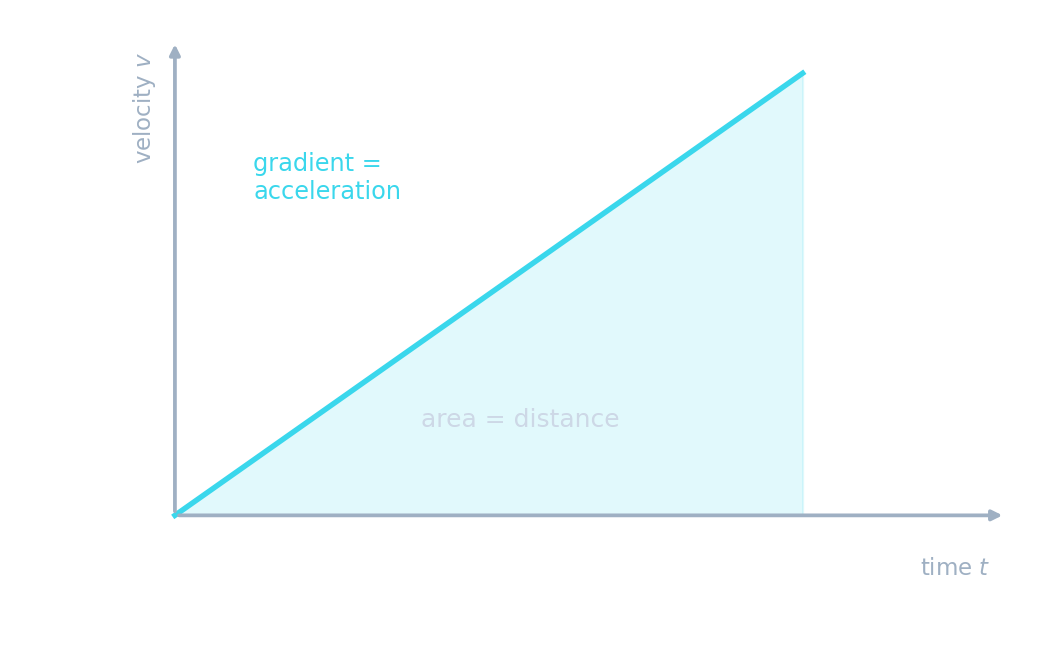
On a velocity–time graph, the gradient is the acceleration and the area underneath is the displacement.
- Differentiate to go displacement → velocity → acceleration; integrate to go back.
Reading a v–t graph. A straight line from $(0, 0)$ to $(4, 10)$: gradient $= \dfrac{10}{4} = 2.5\text{ m s}^{-2}$ (acceleration). Area $= \dfrac{1}{2} \times 4 \times 10 = 20\text{ m}$ (displacement).
Kinematics & the v–t graph
v = u + at
Constant acceleration: the gradient of the v–t line is a, and the area is the displacement.
On a velocity–time graph, the area under the line gives the:
Difficulty 1/5 · 100 coins + a small bonus on first completion today
Area = displacement; the gradient gives the acceleration.
The suvat equations
For constant acceleration 匀加速:
Constant acceleration only. The suvat equations assume acceleration doesn't change. If acceleration varies (e.g. air resistance), you need calculus instead.

On a velocity-time graph, area is displacement and gradient is acceleration
A car starts from rest and accelerates at 2.5 m/s² for 4 s. Using v = u + at, what is its speed (m/s)?
Difficulty 2/5 · 140 coins + a small bonus on first completion today
v = 0 + 2.5 × 4 = 10 m/s.
For the same car (u = 0, a = 2.5, t = 4), what distance does it travel? (s = ut + ½at²)
Difficulty 2/5 · 140 coins + a small bonus on first completion today
s = 0 + ½ × 2.5 × 4² = ½ × 2.5 × 16 = 20 m.
Using v² = u² + 2as with u = 0, a = 3, s = 24, find v.
Difficulty 2/5 · 140 coins + a small bonus on first completion today
v² = 0 + 2(3)(24) = 144, so v = 12 m/s.
The suvat equations apply when acceleration is changing.
Difficulty 1/5 · 100 coins + a small bonus on first completion today
The suvat equations assume constant acceleration. For variable acceleration, use calculus.
Worked example
- From rest ($u = 0$), $a = 2.5\text{ m s}^{-2}$, $t = 4\text{ s}$:
- $v = u + at = 0 + 2.5 \times 4 = 10\text{ m s}^{-1}$.
- $s = ut + \dfrac{1}{2}at^2 = 0 + \dfrac{1}{2}(2.5)(16) = 20\text{ m}$.
Variable acceleration
- When acceleration isn't constant, use calculus:
- $v = \dfrac{ds}{dt}$, $a = \dfrac{dv}{dt} = \dfrac{d^2s}{dt^2}$.
- Integrate to go the other way: $s = \int v\,dt$, $v = \int a\,dt$.
- On a velocity–time graph the area is displacement; on a displacement–time graph the gradient is velocity. Differentiation and integration move between them; a negative acceleration is deceleration.
To go from displacement to velocity, you:
Difficulty 1/5 · 100 coins + a small bonus on first completion today
Velocity is the derivative of displacement: v = ds/dt.
You've got it
- v–t graph: area = displacement, gradient = acceleration
- suvat (constant a): $v = u+at$, $s = ut + \tfrac12 at^2$, $v^2 = u^2 + 2as$
- differentiate s→v→a; integrate to reverse