Forces and equilibrium
Introduced| English | Meaning |
|---|---|
| force/fɔːs/ | An interaction that can change an object’s motion or shape. |
| equilibrium/ˌiːkwɪˈlɪbrɪəm/ | A state with no resultant force or resultant moment. |
| component/kəmˈpəʊnənt/ | The part of a vector acting in a specified direction. |
| friction/ˈfrɪkʃn/ | A force that opposes relative motion between contacting surfaces. |
| normal reaction/ˈnɔːml rɪˈækʃn/ | The contact force a surface exerts on an object perpendicular to the surface. |
| limiting friction/ˈlɪmɪtɪŋ ˈfrɪkʃn/ | The greatest static friction available just before slipping, equal to the coefficient of static friction times the normal force in the model. |
| coefficient of friction/ˌkəʊɪˈfɪʃənt ɒv ˈfrɪkʃn/ | The ratio of frictional force to normal contact force, at limiting friction for the static case. |
| pulley/ˈpʊli/ | A wheel over which a rope or belt runs, used to change the direction of a force or transmit motion. |
| acceleration/əkˌseləˈreɪʃn/ | The rate of change of velocity. |
| tension/ˈtenʃn/ | A pulling force transmitted through a stretched string, cable or similar object. |
Why bridges don't fall down
- Every bridge, every building, every shelf stays put because the forces 力 on it balance.
- Engineers call this equilibrium 平衡 — the vector sum of all forces is zero. Master this and you can analyse any static structure.
Adding forces
resultant = a + b
Forces add tip-to-tail. They are in equilibrium when the resultant is zero.
Forces and components 分量
- A force is a vector (size + direction). Split it into components: horizontal $F\cos\theta$, vertical $F\sin\theta$.
- A particle is in equilibrium when the forces balance — the vector sum is zero (components add to zero in every direction).
Worked example. A 10 N force acts at $30^{\circ}$ to the horizontal. Horizontal component $= 10\cos 30^{\circ} = 8.66$ N. Vertical component $= 10\sin 30^{\circ} = 5$ N.
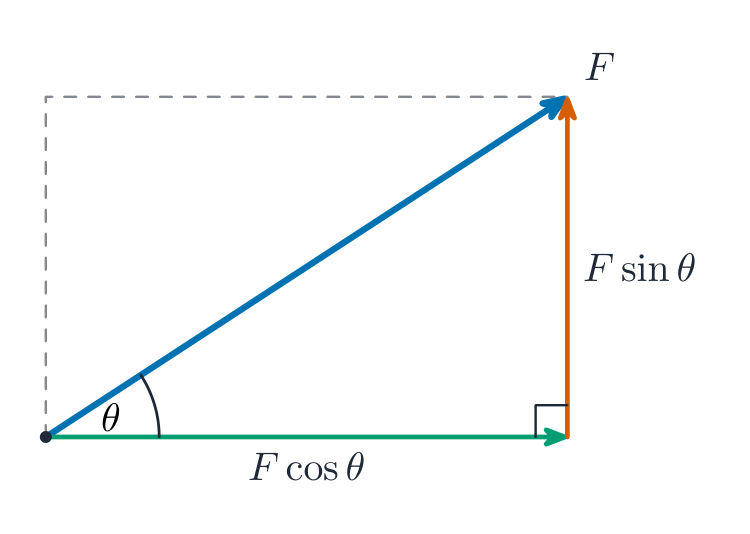
A force splits into F cos theta across and F sin theta up
A particle is in equilibrium when the forces on it:
Difficulty 1/5 · 100 coins + a small bonus on first completion today
Equilibrium means the forces balance — their vector sum is zero.
The horizontal component of a force F at angle θ to the horizontal is:
Difficulty 1/5 · 100 coins + a small bonus on first completion today
Horizontal component = F cos θ; vertical component = F sin θ.
Friction 摩擦力
- The contact force has the normal reaction 法向反作用力 $R$ (perpendicular) and friction $F$ (along the surface, opposing sliding).
- Friction grows only up to a maximum (limiting friction 最大静摩擦力):
- where $\mu$ is the coefficient of friction 摩擦系数.
Friction opposes motion (or tendency to move). If a block is about to slide down a slope, friction acts up the slope. The direction is always opposite to the (attempted) motion.

The contact force: normal reaction R up and friction F along the surface, with F at most mu R
The coefficient of friction is 0.4 and the normal reaction is 100 N. What is the maximum (limiting) friction force, in N?
Difficulty 2/5 · 140 coins + a small bonus on first completion today
Maximum friction = μR = 0.4 × 100 = 40 N.
Friction always acts in the direction of motion.
Difficulty 1/5 · 100 coins + a small bonus on first completion today
Friction opposes motion (or the tendency to move). It acts in the opposite direction to the (attempted) motion.
Worked example — equilibrium on a slope
- A 5 kg block rests on a rough slope at $20^{\circ}$ to the horizontal. Find the friction force.
- Resolve parallel to slope: $F = mg\sin 20^{\circ} = 5 \times 10 \times 0.342 = 17.1$ N.
- Resolve perpendicular: $R = mg\cos 20^{\circ} = 5 \times 10 \times 0.940 = 47.0$ N.
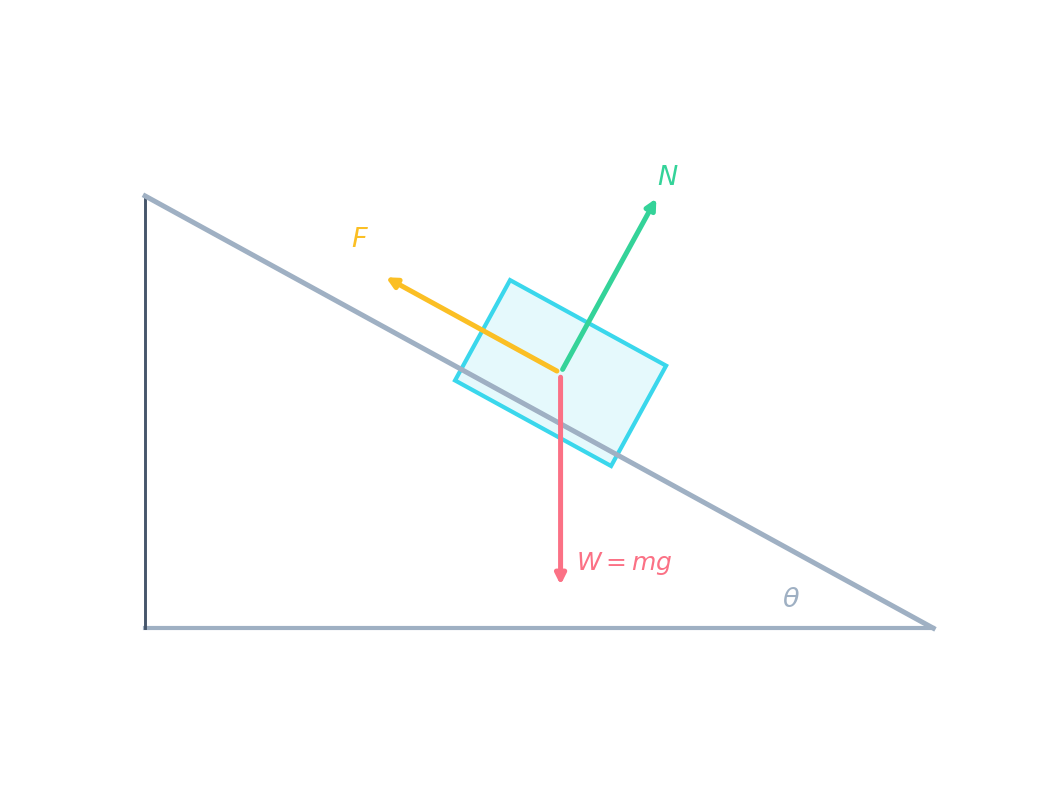
On a slope, resolve the weight into components parallel (mg sin θ) and perpendicular (mg cos θ) to the surface.
A 5 kg block on a 30° slope. The component of weight parallel to the slope is mg sin 30°. Find it (g = 10).
Difficulty 2/5 · 140 coins + a small bonus on first completion today
5 × 10 × sin 30° = 50 × 0.5 = 25 N.
A 5 kg block on a 30° slope. The normal reaction is mg cos 30°. Find it (g = 10, 1 dp).
Difficulty 2/5 · 140 coins + a small bonus on first completion today
5 × 10 × cos 30° = 50 × 0.866 = 43.3 N.
Connected particles
- When two particles are connected by a light string over a smooth pulley 滑轮, they have the same acceleration 加速度 and the same tension 张力.
- Write $F = ma$ for each particle, then solve the two equations simultaneously.

Forces on a block on a rough slope: weight, normal reaction, tension and friction
- Friction reaches its maximum in limiting equilibrium, when the body is about to slip.
You've got it
- a force splits into $F\cos\theta$ (horizontal) and $F\sin\theta$ (vertical)
- equilibrium = forces balance (vector sum zero)
- friction $F \leq \mu R$, reaching $\mu R$ when about to slip
Write from a resultant of 50 N
- A 40 N force and a 30 N force act at right angles.
- Find the resultant.
Forces of 40 N and 30 N act at right angles. What is the size of their resultant, and what resultant means equilibrium?
1600 plus 900 is 2500, which is 50 squared.
What is the resultant?
Difficulty 1/5 · 100 coins + a small bonus on first completion today
40 squared plus 30 squared is 50 squared.