This handout covers Topic 4: Mechanics 力学. It studies how forces make objects move. Throughout this topic, take the acceleration of free fall as $g = 10\ \text{m s}^{-2}$.
Mechanics
A-Level Mathematics · Topic 4
 12:38
12:38
Mechanics
Push a shopping trolley, and it speeds up. Push harder, and it speeds up faster. Push a heavier one with the same effort, and it barely moves. All of mechanics…
English narration · English + 中文 subtitles burned in
4.1
Forces and equilibrium
Syllabus
| Candidates should be able to: | Notes and examples |
|---|---|
| identify the forces acting in a given situation | e.g. by drawing a force diagram. |
| understand the vector nature of force, and find and use components and resultants | Calculations are always required, not approximate solutions by scale drawing. |
| use the principle that, when a particle is in equilibrium, the vector sum of the forces acting is zero, or equivalently, that the sum of the components in any direction is zero | Solutions by resolving are usually expected, but equivalent methods (e.g. triangle of forces, Lami's Theorem, where suitable) are also acceptable; these other methods are not required knowledge, and will not be referred to in questions. |
| understand that a contact force between two surfaces can be represented by two components, the normal component and the frictional component | |
| use the model of a 'smooth' contact, and understand the limitations of this model | |
| understand the concepts of limiting friction and limiting equilibrium, recall the definition of coefficient of friction, and use the relationship $F = \mu R$ or $F \leqslant \mu R$, as appropriate | Terminology such as 'about to slip' may be used to mean 'in limiting equilibrium' in questions. |
| use Newton's third law. | e.g. the force exerted by a particle on the ground is equal and opposite to the force exerted by the ground on the particle. |
Source: Cambridge International syllabus
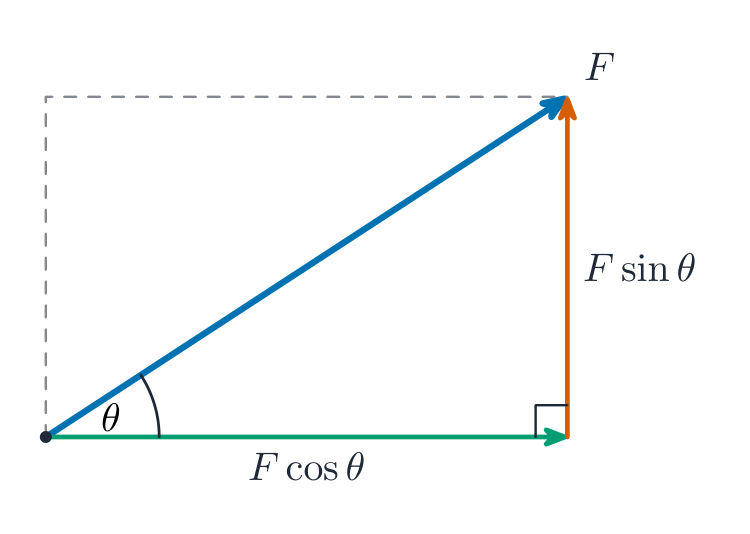
A force 力 is a push or a pull. It is a vector, so it has size and direction. Because it is a vector, you can split a force into components 分量 (usually horizontal and vertical), and you can add several forces into one resultant 合力.
A particle is in equilibrium 平衡 when the forces are balanced: the vector sum of the forces is zero. In practice this means the components in any direction add to zero.

Friction
When two surfaces touch, the contact force 接触力 between them has two parts: the normal reaction 法向反作用力 $R$, at right angles to the surface, and the friction 摩擦力 $F$, along the surface, which opposes sliding. A "smooth" surface is a model with no friction.
Friction can only grow up to a maximum. At that maximum the body is in limiting equilibrium 极限平衡, about to slip, and the friction is limiting friction 最大静摩擦力. The maximum is set by the coefficient of friction 摩擦系数 $\mu$:
$$F \leqslant \mu R, \qquad \text{with } F = \mu R \text{ at the point of slipping}.$$

By Newton's third law 牛顿第三定律, the two surfaces push on each other with equal and opposite forces.
Worked example. A block of weight $20\text{ N}$ rests on a rough horizontal table with coefficient of friction $\mu = 0.4$. Find the largest horizontal force that can be applied before the block slides.
The table's normal reaction balances the weight, so $R = 20\text{ N}$. The block is on the point of slipping when friction reaches its maximum $F = \mu R = 0.4 \times 20 = 8\text{ N}$. In equilibrium the applied force equals the friction, so the largest force it can resist is $8\text{ N}$.
Explore
Adding forces
resultant = a + b
Forces add tip-to-tail. They are in equilibrium when the resultant is zero.
Vocabulary
Train
| English |
|---|
| Mechanics/mɪˈkænɪks/ |
| force/fɔːs/ |
| components/kəmˈpəʊnənts/ |
| resultant/rɪˈzʌltənt/ |
| equilibrium/ˌiːkwɪˈlɪbrɪəm/ |
| contact force/ˈkɒntækt fɔːs/ |
| normal reaction/ˈnɔːml rɪˈækʃn/ |
| friction/ˈfrɪkʃn/ |
| limiting friction/ˈlɪmɪtɪŋ ˈfrɪkʃn/ |
| coefficient of friction/ˌkəʊɪˈfɪʃənt ɒv ˈfrɪkʃn/ |
| Newton's third law/ˈnjuːtnz θɜːd lɔː/ |
| limiting equilibrium/ˈlɪmɪtɪŋ ˌiːkwɪˈlɪbrɪəm/ |
4.2
Kinematics of motion in a straight line

Syllabus
| Candidates should be able to: | Notes and examples |
|---|---|
| understand the concepts of distance and speed as scalar quantities, and of displacement, velocity and acceleration as vector quantities | Restricted to motion in one dimension only. The term 'deceleration' may sometimes be used in the context of decreasing speed. |
| sketch and interpret displacement–time graphs and velocity–time graphs, and in particular appreciate that – the area under a velocity–time graph represents displacement, – the gradient of a displacement–time graph represents velocity, – the gradient of a velocity–time graph represents acceleration | |
| use differentiation and integration with respect to time to solve simple problems concerning displacement, velocity and acceleration | Calculus required is restricted to techniques from the content for Paper 1: Pure Mathematics 1. |
| use appropriate formulae for motion with constant acceleration in a straight line. | Questions may involve setting up more than one equation, using information about the motion of different particles. |
Source: Cambridge International syllabus
Distance 距离 and speed 速率 are scalars (size only). Displacement 位移, velocity 速度 and acceleration 加速度 are vectors (size and direction).
On a velocity-time graph 速度时间图, the area under the graph is the displacement and the gradient is the acceleration (a negative acceleration is a deceleration 减速度). On a displacement-time graph, the gradient is the velocity. More generally, differentiate with respect to time to go from displacement to velocity to acceleration, and integrate to go back.
For motion with constant acceleration 匀加速, use these formulae (the "suvat" equations):
$$v = u + at, \qquad s = ut + \tfrac12 at^2, \qquad v^2 = u^2 + 2as, \qquad s = \tfrac12(u + v)t.$$
Worked example. A car starts from rest and accelerates at $2.5\ \text{m s}^{-2}$ for $4\ \text{s}$. Find its speed and the distance travelled.
$$v = 0 + 2.5\times 4 = 10\ \text{m s}^{-1}, \qquad s = 0 + \tfrac12(2.5)(4^2) = 20\ \text{m}.$$
Explore
Velocity–time graph
Change the start velocity and acceleration. The gradient is the acceleration; the area under the line is the displacement.
Vocabulary
Train
| English |
|---|
| distance/ˈdɪstəns/ |
| speed/spiːd/ |
| displacement/dɪˈspleɪsmənt/ |
| velocity/vəˈlɒsɪti/ |
| acceleration/əkˌseləˈreɪʃn/ |
| velocity-time graph/vəˈlɒsɪti taɪm ɡræf/ |
| constant acceleration/ˈkɒnstənt əkˌseləˈreɪʃn/ |
| deceleration/dɪˌseləˈreɪʃn/ |
4.3
Momentum

Syllabus
| Candidates should be able to: | Notes and examples |
|---|---|
| use the definition of linear momentum and show understanding of its vector nature | For motion in one dimension only. |
| use conservation of linear momentum to solve problems that may be modelled as the direct impact of two bodies. | Including direct impact of two bodies where the bodies coalesce on impact. Knowledge of impulse and the coefficient of restitution is not required. |
Source: Cambridge International syllabus
The linear momentum 动量 of a body is $\text{mass} \times \text{velocity}$. It is a vector. In a direct collision of two bodies, the total momentum is unchanged. This is the conservation of linear momentum 动量守恒:
$$m_1 u_1 + m_2 u_2 = m_1 v_1 + m_2 v_2.$$

Worked example. A body of mass $2\ \text{kg}$ moving at $3\ \text{m s}^{-1}$ hits a stationary body of mass $1\ \text{kg}$, and they stick together. Find their common speed afterwards.
$$2(3) + 1(0) = (2 + 1)v \;\Rightarrow\; v = \frac{6}{3} = 2\ \text{m s}^{-1}.$$
Explore
A collision
Set each mass and speed and collide them. Total momentum stays the same before and after.
Vocabulary
Train
| English |
|---|
| momentum/məʊˈmentəm/ |
| conservation of momentum/ˌkɒnsəˈveɪʃn ɒv məʊˈmentəm/ |
4.4
Newton's laws of motion

Syllabus
| Candidates should be able to: | Notes and examples |
|---|---|
| • apply Newton’s laws of motion to the linear motion of a particle of constant mass moving under the action of constant forces, which may include friction, tension in an inextensible string and thrust in a connecting rod | If any other forces resisting motion are to be considered (e.g. air resistance) this will be indicated in the question. |
| • use the relationship between mass and weight | $W = mg$. In this component, questions are mainly numerical, and use of the approximate numerical value $10\text{ (ms}^{-2}\text{)}$ for $g$ is expected. |
| • solve simple problems which may be modelled as the motion of a particle moving vertically or on an inclined plane with constant acceleration | Including, for example, motion of a particle on a rough plane where the acceleration while moving up the plane is different from the acceleration while moving down the plane. |
| • solve simple problems which may be modelled as the motion of connected particles. | e.g. particles connected by a light inextensible string passing over a smooth pulley, or a car towing a trailer by means of either a light rope or a light rigid tow-bar. |
Source: Cambridge International syllabus
Newton's laws of motion 牛顿运动定律 connect force and acceleration. The key one is: resultant force $=$ mass 质量 $\times$ acceleration,
$$F = ma.$$
The weight 重力 of a body is the force of gravity on it: $W = mg$. Forces in a problem may include weight, friction, tension 张力 in a string, the thrust 推力 (push) in a rod, and air resistance 空气阻力.
For motion on an inclined plane 斜面, split each force into a part along the slope and a part at right angles to it, then apply $F = ma$ along the slope. For connected particles 连接质点 (joined by a string), apply $F = ma$ to each body, or to the whole system.
Worked example. A block of mass $12\ \text{kg}$ is pulled up a rough plane by a rope parallel to the slope. The plane is at $20^\circ$ to the horizontal, the coefficient of friction is $0.4$, and the acceleration is $2\ \text{m s}^{-2}$. Find the tension in the rope.
The normal reaction is $R = mg\cos 20^\circ = 120\cos 20^\circ = 112.8\ \text{N}$, so the friction is $F = \mu R = 0.4 \times 112.8 = 45.1\ \text{N}$. Along the slope, $T - mg\sin 20^\circ - F = ma$:
$$T = ma + mg\sin 20^\circ + F = 12(2) + 120\sin 20^\circ + 45.1 = 24 + 41.0 + 45.1 = 110\ \text{N (3 s.f.)}.$$
Explore
Resultant force
F = ma
The resultant force sets the acceleration. Balanced forces ⇒ no acceleration.
Vocabulary
Train
| English |
|---|
| Newton's laws of motion/ˈnjuːtnz lɔːz ɒv ˈməʊʃn/ |
| mass/mæs/ |
| weight/weɪt/ |
| tension/ˈtenʃn/ |
| inclined plane/ɪnˈklaɪnd pleɪn/ |
| connected particles/kəˈnektɪd ˈpɑːtɪklz/ |
| thrust/θrʌst/ |
| air resistance/eə rɪˈzɪstəns/ |
4.5
Energy, work and power

Syllabus
| Candidates should be able to: | Notes and examples |
|---|---|
| • understand the concept of the work done by a force, and calculate the work done by a constant force when its point of application undergoes a displacement not necessarily parallel to the force | $W = Fd \cos \theta$; Use of the scalar product is not required. |
| • understand the concepts of gravitational potential energy and kinetic energy, and use appropriate formulae | |
| • understand and use the relationship between the change in energy of a system and the work done by the external forces, and use in appropriate cases the principle of conservation of energy | Including cases where the motion may not be linear (e.g. a child on a smooth curved ‘slide’), where only overall energy changes need to be considered. |
| • use the definition of power as the rate at which a force does work, and use the relationship between power, force and velocity for a force acting in the direction of motion | Including calculation of (average) power as $$\frac{\text{Work done}}{\text{Time taken}}$$ $P = Fv$. |
| • solve problems involving, for example, the instantaneous acceleration of a car moving on a hill against a resistance. |
Source: Cambridge International syllabus
The work done 功 by a constant force is the scalar product of force and displacement — the force times the distance moved in the direction of the force: $W = Fd\cos\theta$, where $\theta$ is the angle between the force and the motion. Work is measured in joules (J).
Energy comes in forms you can calculate:
- Kinetic energy 动能 (energy of movement): $\text{KE} = \tfrac12 mv^2$.
- Gravitational potential energy 重力势能 (energy of height): $\text{PE} = mgh$.
The work done by the outside forces equals the change in the total energy. When no friction acts, the total energy stays the same — the conservation of energy 能量守恒.
Power 功率 is the rate of doing work. For a force pulling in the direction of motion, $P = Fv$ (power $=$ force $\times$ velocity). Power is measured in watts (W).
Worked example. A car engine works at $12\ \text{kW}$ while the car moves at $20\ \text{m s}^{-1}$ on a level road. Find the driving force.
$$P = Fv \;\Rightarrow\; F = \frac{P}{v} = \frac{12000}{20} = 600\ \text{N}.$$
Explore
Conservation of energy
Drop the object and watch energy change form. With no friction, GPE + KE stays constant the whole way down.
Vocabulary
Train
| English |
|---|
| work done/wɜːk dʌn/ |
| kinetic energy/kɪˈnetɪk ˈenədʒi/ |
| gravitational potential energy/ˌɡrævɪˈteɪʃənl pəˈtenʃl ˈenədʒi/ |
| conservation of energy/ˌkɒnsəˈveɪʃn ɒv ˈenədʒi/ |
| power/ˈpaʊə/ |
4.5
Exam tips
- Draw a clear force diagram and resolve into perpendicular components; for equilibrium, each direction sums to zero.
- Use SUVAT only for constant acceleration and keep a consistent positive direction.
- Apply $F = ma$ along the direction of motion, including friction ($F = \mu R$) on a rough surface.
- State your assumptions (light inextensible string, smooth pulley, particle) — they are often worth a mark.
Interactive lessons on this topic
Work through it step by step, with instant-check exercises.