This handout covers Topic 3: Pure Mathematics 纯数学 3. Subtopics 3.1–3.6 build on the algebra, logarithms, trigonometry, differentiation, integration and numerical methods of Pure Mathematics 2, so this handout explains what is new in Pure 3 and then covers the three big new areas: vectors, differential equations and complex numbers.
Pure Mathematics 3
A-Level Mathematics · Topic 3
 13:36
13:36
Pure Mathematics 3
For centuries, mathematicians hit a wall: what is the square root of minus one? No ordinary number, squared, gives a negative. They called it impossible, and…
English narration · English + 中文 subtitles burned in
3.1
Algebra
Syllabus
| Candidates should be able to: | Notes and examples |
|---|---|
| • understand the meaning of $|x|$, sketch the graph of $y = |ax + b|$ and use relations such as $|a| = |b| \iff a^2 = b^2$ and $|x - a| < b \iff a - b < x < a + b$ when solving equations and inequalities | Graphs of $y = |\text{f}(x)|$ and $y = \text{f}(|x|)$ for non-linear functions $\text{f}$ are not included. e.g. $|3x - 2| = |2x + 7|$, $2x + 5 < |x + 1|$. |
| • divide a polynomial, of degree not exceeding 4, by a linear or quadratic polynomial, and identify the quotient and remainder (which may be zero) | |
| • use the factor theorem and the remainder theorem | e.g. to find factors and remainders, solve polynomial equations or evaluate unknown coefficients. Including factors of the form $(ax + b)$ in which the coefficient of $x$ is not unity, and including calculation of remainders. |
| • recall an appropriate form for expressing rational functions in partial fractions, and carry out the decomposition, in cases where the denominator is no more complicated than – $(ax + b)(cx + d)(ex + f)$ – $(ax + b)(cx + d)^2$ – $(ax + b)(cx^2 + d)$ | Excluding cases where the degree of the numerator exceeds that of the denominator |
| • use the expansion of $(1 + x)^n$, where $n$ is a rational number and $|x| < 1$. | Finding the general term in an expansion is not included. Adapting the standard series to expand e.g. $(2 - \frac{1}{2}x)^{-1}$ is included, and determining the set of values of $x$ for which the expansion is valid in such cases is also included. |
Source: Cambridge International syllabus
Two new tools join the algebra from Pure 2.
Partial fractions
A single fraction with a factorised bottom can be split into a sum of simpler fractions. This is called writing it in partial fractions 部分分式, and it makes a rational function 有理函数 (a fraction of polynomials) easy to integrate or expand. Match the form to the bottom:
First check the top is lower degree than the bottom. If it is not ("top-heavy"), divide the polynomial first: dividing gives a quotient 商 plus a remainder 余数 over the original bottom, and you split only that remaining proper fraction.
One fraction with a factorised bottom splits into a sum of simpler fractions.
$$\frac{1}{(ax+b)(cx+d)} = \frac{A}{ax+b} + \frac{B}{cx+d}, \qquad \frac{1}{(ax+b)(cx+d)^2} = \frac{A}{ax+b} + \frac{B}{cx+d} + \frac{C}{(cx+d)^2}.$$
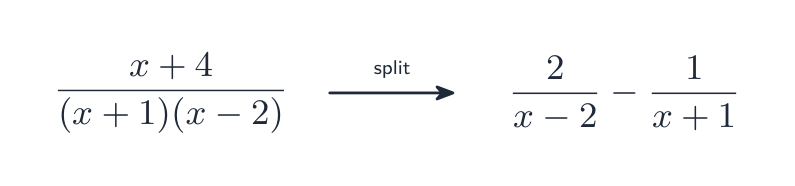
Worked example. Express $\dfrac{x+4}{(x+1)(x-2)}$ in partial fractions.
Write $\dfrac{x+4}{(x+1)(x-2)} = \dfrac{A}{x+1} + \dfrac{B}{x-2}$, so $x + 4 = A(x-2) + B(x+1)$. Put $x = 2$: $6 = 3B$, so $B = 2$. Put $x = -1$: $3 = -3A$, so $A = -1$. Hence
$$\frac{x+4}{(x+1)(x-2)} = \frac{2}{x-2} - \frac{1}{x+1}.$$
The binomial expansion for a rational power
The binomial expansion 二项展开式 also works when the power is a fraction or is negative, as long as $|x| < 1$:
$$(1 + x)^n = 1 + nx + \frac{n(n-1)}{2!}x^2 + \frac{n(n-1)(n-2)}{3!}x^3 + \cdots$$
For example $(1 + x)^{1/2} = 1 + \tfrac12 x - \tfrac18 x^2 + \cdots$ for $|x| < 1$.
Explore
Reciprocal curves
y = a/(x − b) + c
Partial fractions split a hard fraction into simple reciprocal pieces — each with a vertical and a horizontal asymptote.
Vocabulary
Train
| English |
|---|
| Pure Mathematics/pjʊə ˌmæθɪˈmætɪks/ |
| partial fractions/ˈpɑːʃl ˈfrækʃnz/ |
| rational function/ˈræʃənl ˈfʌŋkʃn/ |
| quotient/ˈkwəʊʃənt/ |
| remainder/rɪˈmeɪndə/ |
| binomial expansion/baɪˈnəʊmɪəl ekˈspænʃn/ |
3.2 3.3 3.6
Logarithms, trigonometry and numerical methods (from Pure 2)
Syllabus
| Candidates should be able to: | Notes and examples |
|---|---|
| understand the relationship between logarithms and indices, and use the laws of logarithms (excluding change of base) | |
| understand the definition and properties of $e^x$ and $\ln x$, including their relationship as inverse functions and their graphs | Including knowledge of the graph of $y = e^{kx}$ for both positive and negative values of $k$. |
| use logarithms to solve equations and inequalities in which the unknown appears in indices | e.g. $2^x < 5$, $3 \times 2^{3x-1} < 5$, $3^{x+1} = 4^{2x-1}$. |
| use logarithms to transform a given relationship to linear form, and hence determine unknown constants by considering the gradient and/or intercept. | e.g. $y = kx^n$ gives $\ln y = \ln k + n \ln x$ which is linear in $\ln x$ and $\ln y$. $y = k(a^x)$ gives $\ln y = \ln k + x \ln a$ which is linear in $x$ and $\ln y$. |
| Candidates should be able to: | Notes and examples |
|---|---|
| understand the relationship of the secant, cosecant and cotangent functions to cosine, sine and tangent, and use properties and graphs of all six trigonometric functions for angles of any magnitude | |
| use trigonometrical identities for the simplification and exact evaluation of expressions, and in the course of solving equations, and select an identity or identities appropriate to the context, showing familiarity in particular with the use of: – $\sec^2 \theta \equiv 1 + \tan^2 \theta$ and $\cosec^2 \theta \equiv 1 + \cot^2 \theta$ – the expansions of $\sin(A \pm B)$, $\cos(A \pm B)$ and $\tan(A \pm B)$ – the formulae for $\sin 2A$, $\cos 2A$ and $\tan 2A$ – the expression of $a \sin \theta + b \cos \theta$ in the forms $R \sin(\theta \pm \alpha)$ and $R \cos(\theta \pm \alpha)$. | e.g. simplifying $\cos(x - 30^\circ) - 3 \sin(x - 60^\circ)$. e.g. solving $\tan \theta + \cot \theta = 4$, $2 \sec^2 \theta - \tan \theta = 5$, $3 \cos \theta + 2 \sin \theta = 1$. |
| Candidates should be able to: | Notes and examples |
|---|---|
| • locate approximately a root of an equation, by means of graphical considerations and/or searching for a sign change | e.g. finding a pair of consecutive integers between which a root lies. |
| • understand the idea of, and use the notation for, a sequence of approximations which converges to a root of an equation | |
| • understand how a given simple iterative formula of the form $x_{n+1} = \text{F}(x_n)$ relates to the equation being solved, and use a given iteration, or an iteration based on a given rearrangement of an equation, to determine a root to a prescribed degree of accuracy. | Knowledge of the condition for convergence is not included, but an understanding that an iteration may fail to converge is expected. |
Source: Cambridge International syllabus
Subtopics 3.2, 3.3 and 3.6 are the same skills you met in Pure 2: the laws of logarithms with $e^x$ and $\ln x$; the identities $\sec^2\theta \equiv 1 + \tan^2\theta$ and $\csc^2\theta \equiv 1 + \cot^2\theta$, the compound- and double-angle formulae, and the $R$-form of $a\sin\theta + b\cos\theta$; and solving an equation numerically by a sign change 变号 and an iterative formula 迭代公式 $x_{n+1} = F(x_n)$. Use them exactly as before.
The three new trig functions are the reciprocals 倒数 of the familiar ones: the secant 正割 $\sec\theta = \dfrac{1}{\cos\theta}$, the cosecant 余割 $\csc\theta = \dfrac{1}{\sin\theta}$, and the cotangent 余切 $\cot\theta = \dfrac{1}{\tan\theta} = \dfrac{\cos\theta}{\sin\theta}$. (Memory aid: match the third letter — sec goes with cosine.) The two Pythagorean identities above come straight from dividing $\sin^2\theta + \cos^2\theta \equiv 1$ by $\cos^2\theta$ or $\sin^2\theta$. For a numerical method, an iteration $x_{n+1}=F(x_n)$ converges 收敛 to the root when successive values get closer together.
Explore
The unit circle
(cos θ, sin θ)
The R-formula rewrites a sin θ + b cos θ as one wave — and it all lives on this circle.
Vocabulary
Train
| English |
|---|
| sign change/saɪn tʃeɪndʒ/ |
| iterative formula/ˈɪtərətɪv ˈfɔːmjʊlə/ |
| reciprocals/rɪˈsɪprəklz/ |
| secant/ˈsiːkənt/ |
| cosecant/ˈkəʊsekənt/ |
| cotangent/ˈkəʊtændʒənt/ |
| converges/kənˈvɜːdʒɪz/ |
3.4
Differentiation
Syllabus
| Candidates should be able to: | Notes and examples |
|---|---|
| use the derivatives of $e^x$, $\ln x$, $\sin x$, $\cos x$, $\tan x$, $\tan^{-1} x$, together with constant multiples, sums, differences and composites | Derivatives of $\sin^{-1} x$ and $\cos^{-1} x$ are not required. |
| differentiate products and quotients | e.g. $\frac{2x - 4}{3x + 2}$, $x^2 \ln x$, $x e^{1-x^2}$. |
| find and use the first derivative of a function which is defined parametrically or implicitly. | e.g. $x = t - e^{2t}$, $y = t + e^{2t}$. e.g. $x^2 + y^2 = xy + 7$. Including use in problems involving tangents and normals. |
Source: Cambridge International syllabus
The methods are those of Pure 2 (the product, quotient and chain rules, with parametric and implicit curves). One derivative is added — the inverse tangent 反正切:
$$\frac{d}{dx}\tan^{-1} x = \frac{1}{1 + x^2}.$$
Worked example. Differentiate $y = \tan^{-1}(3x)$.
Use the chain rule with the result above: $\dfrac{dy}{dx} = \dfrac{1}{1 + (3x)^2} \times 3 = \dfrac{3}{1 + 9x^2}.$
Explore
The gradient at a point
gradient = dy/dx
Implicit or not, the derivative is still the slope of the tangent — slide the point to see it.
Vocabulary
Train
| English |
|---|
| inverse tangent/ɪnˈvɜːs ˈtændʒənt/ |
3.5
Integration
Syllabus
| Candidates should be able to: | Notes and examples |
|---|---|
| extend the idea of 'reverse differentiation' to include the integration of $e^{ax + b}$, $\frac{1}{ax + b}$, $\sin(ax + b)$, $\cos(ax + b)$, $\sec^2(ax + b)$ and $\frac{1}{x^2 + a^2}$ | Including examples such as $\frac{1}{2 + 3x^2}$. |
| use trigonometrical relationships in carrying out integration | e.g. use of double-angle formulae to integrate $\sin^2 x$ or $\cos^2(2x)$. |
| integrate rational functions by means of decomposition into partial fractions | Restricted to types of partial fractions as specified in topic 3.1 above. |
| recognise an integrand of the form $\frac{k f'(x)}{f(x)}$, and integrate such functions | e.g. integration of $\frac{x}{x^2 + 1}$, $\tan x$. |
| recognise when an integrand can usefully be regarded as a product, and use integration by parts | e.g. integration of $x \sin 2x$, $x^2 e^{-x}$, $\ln x$, $x \tan^{-1} x$. |
| use a given substitution to simplify and evaluate either a definite or an indefinite integral. | e.g. to integrate $\sin^2 2x \cos x$ using the substitution $u = \sin x$. |
Source: Cambridge International syllabus
Pure 3 adds several powerful methods.
- A new standard integral: $\displaystyle\int \frac{1}{x^2 + a^2}\,dx = \frac{1}{a}\tan^{-1}\frac{x}{a} + C$.
- Partial fractions: split a rational function first, then integrate each piece as a logarithm.
- The pattern $\dfrac{k\,f'(x)}{f(x)}$: this integrates to $k\ln|f(x)| + C$. For example $\displaystyle\int \frac{2x}{x^2 + 1}\,dx = \ln(x^2 + 1) + C$.
- Integration by parts 分部积分, used for a product: $\displaystyle\int u\,\frac{dv}{dx}\,dx = uv - \int v\,\frac{du}{dx}\,dx$.
- Integration by substitution 换元积分: a given change of variable turns a hard integral into an easy one.
Worked example. Find $\displaystyle\int x\cos x\,dx$.
Use integration by parts with $u = x$ and $\dfrac{dv}{dx} = \cos x$, so $\dfrac{du}{dx} = 1$ and $v = \sin x$:
$$\int x\cos x\,dx = x\sin x - \int \sin x\,dx = x\sin x + \cos x + C.$$
Explore
The area under the curve
area = ∫ f(x) dx
Every integration method just measures this area — drag the limits to total it.
Vocabulary
Train
| English |
|---|
| Integration by parts/ˌɪntɪˈɡreɪʃn baɪ pɑːts/ |
| Integration by substitution/ˌɪntɪˈɡreɪʃn baɪ ˌsʌbstɪˈtjuːʃn/ |
3.7
Vectors

Syllabus
| Candidates should be able to: | Notes and examples |
|---|---|
| • use standard notations for vectors, i.e. $\begin{pmatrix} x \\ y \end{pmatrix}$, $x\mathbf{i} + y\mathbf{j}$, $\begin{pmatrix} x \\ y \\ z \end{pmatrix}$, $x\mathbf{i} + y\mathbf{j} + z\mathbf{k}$, $\overrightarrow{AB}$, $\mathbf{a}$ | |
| • carry out addition and subtraction of vectors and multiplication of a vector by a scalar, and interpret these operations in geometrical terms | e.g. ‘$OABC$ is a parallelogram’ is equivalent to $\overrightarrow{OB} = \overrightarrow{OA} + \overrightarrow{OC}$. The general form of the ratio theorem is not included, but understanding that the midpoint of $AB$ has position vector $\frac{1}{2}(\overrightarrow{OA} + \overrightarrow{OB})$ is expected. |
| • calculate the magnitude of a vector, and use unit vectors, displacement vectors and position vectors | In 2 or 3 dimensions. |
| • understand the significance of all the symbols used when the equation of a straight line is expressed in the form $\mathbf{r} = \mathbf{a} + t\mathbf{b}$, and find the equation of a line, given sufficient information | e.g. finding the equation of a line given the position vector of a point on the line and a direction vector, or the position vectors of two points on the line. |
| • determine whether two lines are parallel, intersect or are skew, and find the point of intersection of two lines when it exists | Calculation of the shortest distance between two skew lines is not required. Finding the equation of the common perpendicular to two skew lines is also not required. |
| • use formulae to calculate the scalar product of two vectors, and use scalar products in problems involving lines and points. | e.g. finding the angle between two lines, and finding the foot of the perpendicular from a point to a line; questions may involve 3D objects such as cuboids, tetrahedra (pyramids), etc. Knowledge of the vector product is not required. |
Source: Cambridge International syllabus
A vector 向量 has both size and direction. Write it as a column, or as $x\mathbf{i} + y\mathbf{j} + z\mathbf{k}$, or as $\overrightarrow{AB}$.
- The magnitude 模长 (length) of $\mathbf{v} = x\mathbf{i} + y\mathbf{j} + z\mathbf{k}$ is $|\mathbf{v}| = \sqrt{x^2 + y^2 + z^2}$.
- A unit vector 单位向量 has magnitude $1$; divide a vector by its magnitude to make one.
- A position vector 位置向量 gives a point's place from the origin; a displacement vector 位移向量 $\overrightarrow{AB} = \mathbf{b} - \mathbf{a}$ goes from one point to another. Multiplying by a scalar 标量 (a plain number) stretches a vector.
Lines and the scalar product
A straight line through point $\mathbf{a}$ in direction $\mathbf{b}$ has vector equation $\mathbf{r} = \mathbf{a} + t\mathbf{b}$. Two lines may be parallel 平行, may intersect 相交 at a point, or may be skew lines 异面直线 (not parallel and never meeting).

The scalar product 数量积 (dot product) of $\mathbf{a}$ and $\mathbf{b}$ is
$$\mathbf{a}\cdot\mathbf{b} = a_1 b_1 + a_2 b_2 + a_3 b_3 = |\mathbf{a}|\,|\mathbf{b}|\cos\theta,$$
where $\theta$ is the angle between them. So $\mathbf{a}\cdot\mathbf{b} = 0$ means the vectors are perpendicular.

Worked example. Find the angle between $\mathbf{a} = \mathbf{i} + 2\mathbf{j} + 2\mathbf{k}$ and $\mathbf{b} = 2\mathbf{i} + 2\mathbf{j} + \mathbf{k}$.
$$\mathbf{a}\cdot\mathbf{b} = (1)(2) + (2)(2) + (2)(1) = 8, \qquad |\mathbf{a}| = |\mathbf{b}| = 3.$$
So $\cos\theta = \dfrac{8}{3\times 3} = \dfrac{8}{9}$, giving $\theta = 27.3^\circ$.
Explore
Adding vectors and the dot product
Drag the two vectors. See the resultant (tip-to-tail) and the dot product, which is zero when they are perpendicular.
Vocabulary
Train
| English |
|---|
| vector/ˈvektə/ |
| magnitude/ˈmæɡnɪtjuːd/ |
| unit vector/ˈjuːnɪt ˈvektə/ |
| position vector/pəˈzɪʃn ˈvektə/ |
| displacement vector/dɪˈspleɪsmənt ˈvektə/ |
| scalar/ˈskeɪlə/ |
| parallel/ˈpærəlel/ |
| intersect/ˌɪntəˈsekt/ |
| skew lines/skjuː laɪnz/ |
| scalar product/ˈskeɪlə ˈprɒdʌkt/ |
3.8
Differential equations

Syllabus
| Candidates should be able to: | Notes and examples |
|---|---|
| formulate a simple statement involving a rate of change as a differential equation | The introduction and evaluation of a constant of proportionality, where necessary, is included. |
| find by integration a general form of solution for a first order differential equation in which the variables are separable | Including any of the integration techniques from topic 3.5 above. |
| use an initial condition to find a particular solution | |
| interpret the solution of a differential equation in the context of a problem being modelled by the equation. | Where a differential equation is used to model a 'real-life' situation, no specialised knowledge of the context will be required. |
Source: Cambridge International syllabus
A differential equation 微分方程 links a quantity to its rate of change. To solve a first-order equation whose variables are separable 可分离变量, put all the $y$ terms on one side and all the $x$ terms on the other, then integrate both sides. This gives the general solution 通解, which contains a constant. An initial condition 初始条件 (a known value) fixes the constant and gives the particular solution 特解.
Worked example. Solve $\dfrac{dy}{dx} = xy$, given that $y = 1$ when $x = 0$.
Separate the variables and integrate:
$$\int \frac{1}{y}\,dy = \int x\,dx \;\Rightarrow\; \ln y = \tfrac12 x^2 + c \;\Rightarrow\; y = A e^{x^2/2}.$$
Using $y = 1$ at $x = 0$ gives $A = 1$, so $y = e^{x^2/2}$.
Explore
A slope field
Each little line shows the gradient $\frac{dy}{dx}$ there. A solution curve follows the arrows — change the starting point to see a different one.
Vocabulary
Train
| English |
|---|
| differential equation/ˌdɪfəˈrenʃl ɪˈkweɪʒn/ |
| separable/ˈsepərəbl/ |
| general solution/ˈdʒenərəl səˈluːʃn/ |
| initial condition/ɪˈnɪʃl kənˈdɪʃn/ |
| particular solution/pəˈtɪkjʊlə səˈluːʃn/ |
3.9
Complex numbers

Syllabus
| Candidates should be able to: | Notes and examples |
|---|---|
| understand the idea of a complex number, recall the meaning of the terms real part, imaginary part, modulus, argument, conjugate, and use the fact that two complex numbers are equal if and only if both real and imaginary parts are equal | Notations $\text{Re } z$, $\text{Im } z$, $|z|$, $\arg z$, $z^*$ should be known. The argument of a complex number will usually refer to an angle $\theta$ such that $-\pi < \theta \leqslant \pi$, but in some cases the interval $0 \leqslant \theta < 2\pi$ may be more convenient. Answers may use either interval unless the question specifies otherwise. |
| carry out operations of addition, subtraction, multiplication and division of two complex numbers expressed in Cartesian form $x + \text{i}y$ | For calculations involving multiplication or division, full details of the working should be shown. |
| use the result that, for a polynomial equation with real coefficients, any non-real roots occur in conjugate pairs | e.g. in solving a cubic or quartic equation where one complex root is given. |
| represent complex numbers geometrically by means of an Argand diagram | |
| carry out operations of multiplication and division of two complex numbers expressed in polar form $r(\cos \theta + \text{i}\sin \theta) \equiv r\text{e}^{\text{i}\theta}$ | Including the results $|z_1 z_2| = |z_1||z_2|$ and $\arg(z_1 z_2) = \arg(z_1) + \arg(z_2)$, and corresponding results for division. |
| find the two square roots of a complex number | e.g. the square roots of $5 + 12\text{i}$ in exact Cartesian form. Full details of the working should be shown. |
| understand in simple terms the geometrical effects of conjugating a complex number and of adding, subtracting, multiplying and dividing two complex numbers | |
| illustrate simple equations and inequalities involving complex numbers by means of loci in an Argand diagram | e.g. $|z - a| < k$, $|z - a| = |z - b|$, $\arg(z - a) = \alpha$. |
Source: Cambridge International syllabus
A complex number 复数 has the form $z = x + iy$, where $i^2 = -1$. Here $x$ is the real part 实部 and $y$ is the imaginary part 虚部. This $x + iy$ is the Cartesian form 直角坐标形式. Two complex numbers are equal only when their real parts match and their imaginary parts match.
- The conjugate 共轭 of $z = x + iy$ is $z^* = x - iy$. For a polynomial with real coefficients, any non-real roots come in conjugate pairs.
- The modulus 模 is $|z| = \sqrt{x^2 + y^2}$ (its distance from the origin) and the argument 辐角 is the angle the point makes, measured from the positive real axis.
- You can plot $z$ as a point on an Argand diagram 阿干图 (the complex plane).
- The polar form 极坐标形式 is $z = r(\cos\theta + i\sin\theta) = re^{i\theta}$, where $r = |z|$ and $\theta$ is the argument. Multiplying multiplies the moduli and adds the arguments.
- The loci of points satisfying a condition on $z$ are drawn on the Argand diagram — e.g. $|z - a| = r$ is a circle, $|z - a| = |z - b|$ a perpendicular bisector, and $\arg(z - a) = \theta$ a half-line. The square roots of a complex number come from solving $w^2 = z$.

To divide, multiply top and bottom by the conjugate of the bottom.
Worked example. Write $\dfrac{3 + i}{1 - i}$ in the form $x + iy$.
$$\frac{3 + i}{1 - i} = \frac{(3 + i)(1 + i)}{(1 - i)(1 + i)} = \frac{3 + 3i + i + i^2}{1 + 1} = \frac{2 + 4i}{2} = 1 + 2i.$$
An equation or inequality in $z$ describes a locus 轨迹 (a path or region) on the Argand diagram. For example $|z - a| = r$ is a circle of radius $r$ centred at $a$.

Explore
The Argand diagram
Drag the point. A complex number $a + bi$ is a point on the plane; its modulus is the distance from the origin and its argument is the angle.
Vocabulary
Train
| English |
|---|
| complex number/ˈkɒmpleks ˈnʌmbə/ |
| real part/rɪəl pɑːt/ |
| imaginary part/ɪˈmædʒɪnəri pɑːt/ |
| Cartesian form/kɑːˈtiːzɪən fɔːm/ |
| conjugate/ˈkɒndʒuːɡeɪt/ |
| modulus/ˈmɒdjʊləs/ |
| argument/ˈɑːɡjuːmənt/ |
| Argand diagram/ˈɑːɡænd ˈdaɪəɡræm/ |
| polar form/ˈpəʊlə fɔːm/ |
| locus/ˈləʊkəs/ |
3.9
Exam tips
- Split a rational function into partial fractions before integrating or expanding.
- Choose the right integration technique (substitution, by parts, or partial fractions) from the form of the integrand.
- Use the scalar (dot) product for the angle between vectors and to test for perpendicularity; write a line as $\mathbf{r} = \mathbf{a} + t\mathbf{b}$.
- Give complex numbers in the form asked for (Cartesian or modulus-argument) and show them on an Argand diagram.
Interactive lessons on this topic
Work through it step by step, with instant-check exercises.