This handout covers Topic 2: Pure Mathematics 纯数学 2. It adds the modulus and polynomial algebra, logarithms 对数 and the exponential function 指数函数, more trigonometry, and new ways to differentiate and integrate.
Pure Mathematics 2
A-Level Mathematics · Topic 2
 12:32
12:32
Pure Mathematics 2
In two thousand eleven, an earthquake off Japan measured nine on the Richter scale. A smaller quake might measure six. Only three points apart — yet the first…
English narration · English + 中文 subtitles burned in
2.1
Algebra
Syllabus
| Candidates should be able to: | Notes and examples |
|---|---|
| understand the meaning of $|x|$, sketch the graph of $y = |ax + b|$ and use relations such as $|a| = |b| \iff a^2 = b^2$ and $|x - a| < b \iff a - b < x < a + b$ when solving equations and inequalities | Graphs of $y = |f(x)|$ and $y = f(|x|)$ for non-linear functions $f$ are not included. e.g. $|3x - 2| = |2x + 7|$, $2x + 5 < |x + 1|$ |
| divide a polynomial, of degree not exceeding 4, by a linear or quadratic polynomial, and identify the quotient and remainder (which may be zero) | |
| use the factor theorem and the remainder theorem. | e.g. to find factors and remainders, solve polynomial equations or evaluate unknown coefficients. Including factors of the form $(ax + b)$ in which the coefficient of $x$ is not unity, and including calculation of remainders. |
Source: Cambridge International syllabus
The modulus
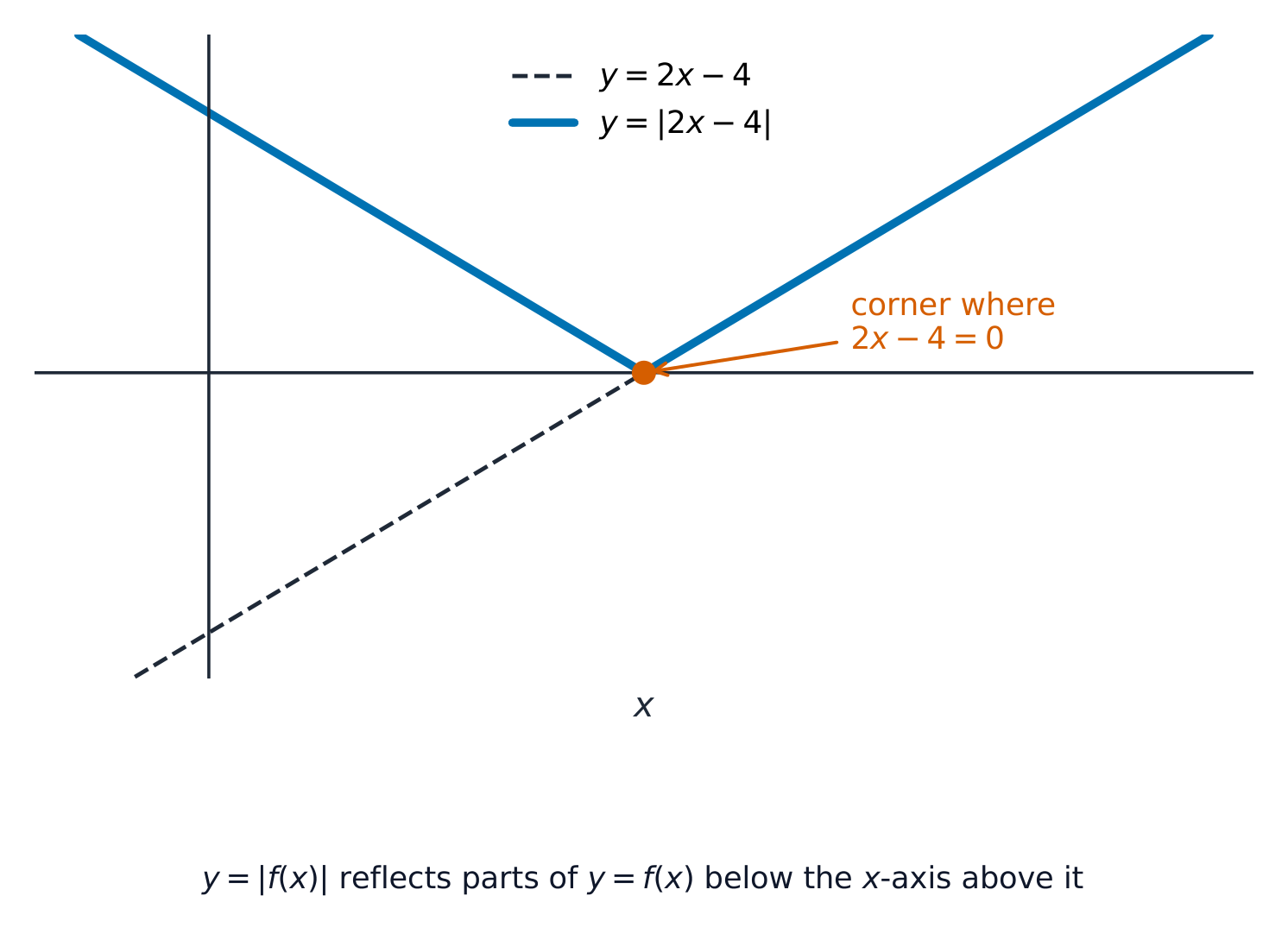
The modulus 绝对值 $|x|$ is the size of a number with its sign removed, so $|x| \geqslant 0$ always. The graph of $y = |ax + b|$ is a "V" shape that bounces off the $x$-axis. Two useful rules for solving equations and inequalities are
$$|a| = |b| \;\Leftrightarrow\; a^2 = b^2, \qquad |x - a| < b \;\Leftrightarrow\; a - b < x < a + b.$$
Worked example. Solve $|3x + 8| < 9$.
Using the second rule with the inequality written as $-9 < 3x + 8 < 9$:
$$-9 < 3x + 8 < 9 \;\Rightarrow\; -17 < 3x < 1 \;\Rightarrow\; -\tfrac{17}{3} < x < \tfrac13.$$
Polynomial division and the factor and remainder theorems
A polynomial 多项式 is a sum of powers of $x$, such as $2x^4 + 3x^2 - 5$. Its degree 次数 is the highest power. When you divide one polynomial by another you get a quotient 商 and a remainder 余数.
- Remainder theorem 余数定理: the remainder when $p(x)$ is divided by $(x - a)$ is $p(a)$.
- Factor theorem 因式定理: $(x - a)$ is a factor of $p(x)$ exactly when $p(a) = 0$.
Worked example. The polynomial $p(x) = 2x^4 + kx^3 + kx^2 + 17x + 18$ has factor $(x + 2)$. Find $k$.
By the factor theorem $p(-2) = 0$:
$$2(16) + k(-8) + k(4) + 17(-2) + 18 = 0 \;\Rightarrow\; 16 - 4k = 0 \;\Rightarrow\; k = 4.$$
Explore
The modulus function
y = a|x − b| + c
The modulus makes a V-shape. Move its vertex with b and c; change how steep the arms are with a.
Vocabulary
Train
| English |
|---|
| modulus/ˈmɒdjʊləs/ |
| polynomial/ˌpɒlɪˈnəʊmɪəl/ |
| degree/dɪˈɡriː/ |
| quotient/ˈkwəʊʃənt/ |
| remainder/rɪˈmeɪndə/ |
| remainder theorem/rɪˈmeɪndə ˈθɪərəm/ |
| factor theorem/ˈfæktə ˈθɪərəm/ |
2.2
Logarithmic and exponential functions

Syllabus
| Candidates should be able to: | Notes and examples |
|---|---|
| understand the relationship between logarithms and indices, and use the laws of logarithms (excluding change of base) | |
| understand the definition and properties of $e^x$ and $\ln x$, including their relationship as inverse functions and their graphs | Including knowledge of the graph of $y = e^{kx}$ for both positive and negative values of $k$. |
| use logarithms to solve equations and inequalities in which the unknown appears in indices | e.g. $2^x < 5$, $3 \times 2^{3x-1} < 5$, $3^{x+1} = 4^{2x-1}$ |
| use logarithms to transform a given relationship to linear form, and hence determine unknown constants by considering the gradient and/or intercept. | e.g. $y = kx^n$ gives $\ln y = \ln k + n \ln x$ which is linear in $\ln x$ and $\ln y$ $y = k(a^x)$ gives $\ln y = \ln k + x \ln a$ which is linear in $x$ and $\ln y$. |
Source: Cambridge International syllabus

A logarithm answers the question "what power?". If $a^x = y$ then $x = \log_a y$. Logarithms and indices 指数 (powers) are reverse ideas. The laws of logarithms 对数定律 are
$$\log(mn) = \log m + \log n, \qquad \log\!\frac{m}{n} = \log m - \log n, \qquad \log(m^k) = k\log m.$$
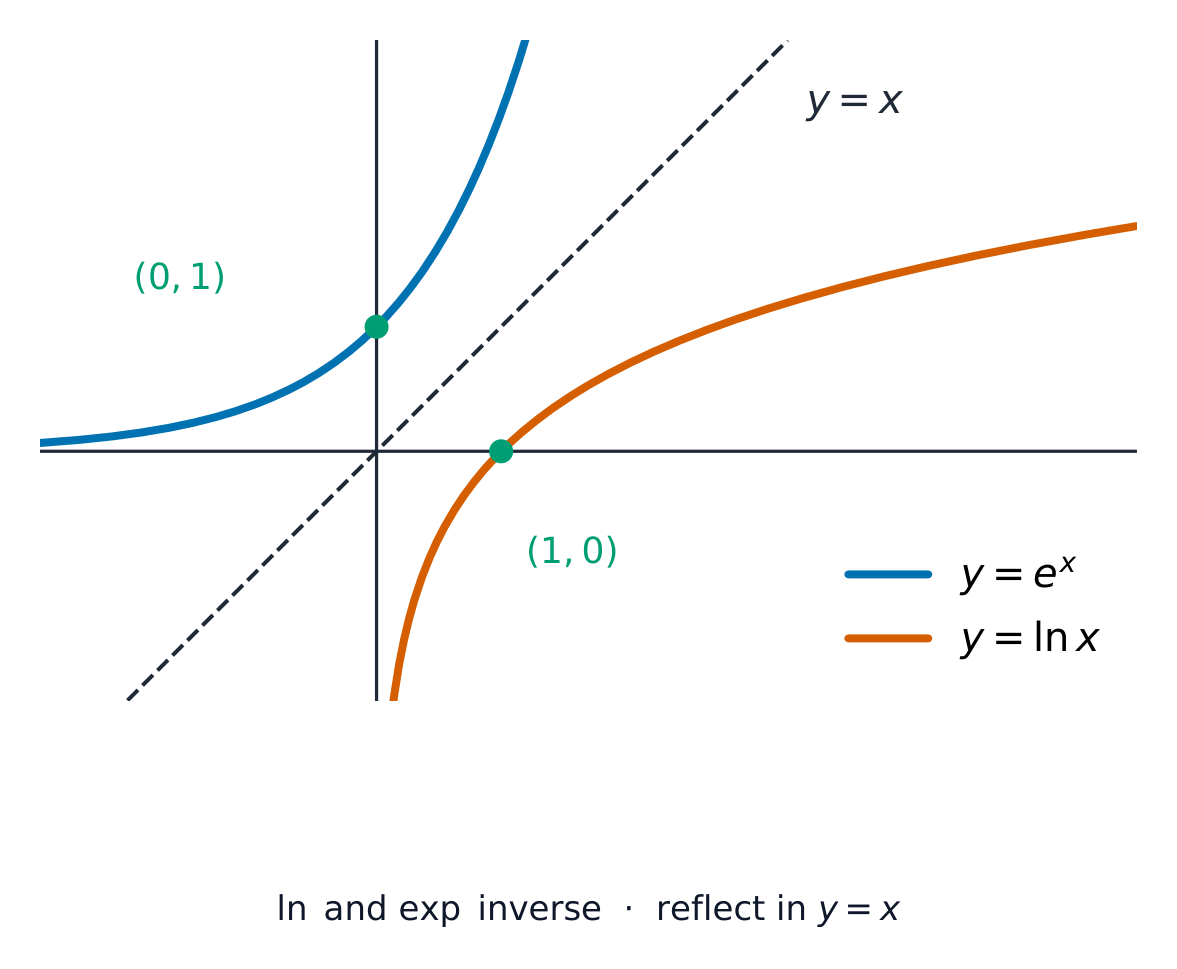
The exponential function $e^x$ and the natural logarithm 自然对数 $\ln x$ are inverse functions, so $\ln(e^x) = x$ and $e^{\ln x} = x$. When the unknown is in the power, take logs of both sides.
Worked example. Solve $4^x < 0.05$.
$$4^x < 0.05 \;\Rightarrow\; x\ln 4 < \ln 0.05 \;\Rightarrow\; x < \frac{\ln 0.05}{\ln 4} = -2.16 \ (\text{3 s.f.}).$$
Linear form 线性形式: a relationship like $y = Ax^n$ becomes a straight line if you take logs: $\ln y = \ln A + n\ln x$. Plotting $\ln y$ against $\ln x$ gives a line with gradient $n$ and intercept $\ln A$, so you can find the unknown constants.
Explore
Exponential growth
y = a·bˣ
Change the base b: when b > 1 the curve grows, when 0 < b < 1 it decays — and it always passes through (0, a).
Vocabulary
Train
| English |
|---|
| Pure Mathematics/pjʊə ˌmæθɪˈmætɪks/ |
| logarithms/ˈlɒɡərɪθəmz/ |
| exponential function/ˌekspəˈnenʃl ˈfʌŋkʃn/ |
| indices/ˈɪndɪsiːz/ |
| laws of logarithms/lɔːz ɒv ˈlɒɡərɪθəmz/ |
| natural logarithm/ˈnætʃərəl ˈlɒɡərɪθəm/ |
| linear form/ˈlɪnɪə fɔːm/ |
2.3
Trigonometry

Syllabus
| Candidates should be able to: | Notes and examples |
|---|---|
| understand the relationship of the secant, cosecant and cotangent functions to cosine, sine and tangent, and use properties and graphs of all six trigonometric functions for angles of any magnitude | |
| use trigonometrical identities for the simplification and exact evaluation of expressions, and in the course of solving equations, and select an identity or identities appropriate to the context, showing familiarity in particular with the use of: – $\sec^2 \theta \equiv 1 + \tan^2 \theta$ and $\csc^2 \theta \equiv 1 + \cot^2 \theta$ – the expansions of $\sin(A \pm B)$, $\cos(A \pm B)$ and $\tan(A \pm B)$ – the formulae for $\sin 2A$, $\cos 2A$ and $\tan 2A$ – the expression of $a \sin \theta + b \cos \theta$ in the forms $R \sin(\theta \pm \alpha)$ and $R \cos(\theta \pm \alpha)$. | e.g. simplifying $\cos(x - 30^\circ) - 3 \sin(x - 60^\circ)$. e.g. solving $\tan \theta + \cot \theta = 4$, $2 \sec^2 \theta - \tan \theta = 5$, $3 \cos \theta + 2 \sin \theta = 1$. |
Source: Cambridge International syllabus
There are three more functions, each the reciprocal of one you know: the secant 正割 $\sec\theta = \dfrac{1}{\cos\theta}$, the cosecant 余割 $\csc\theta = \dfrac{1}{\sin\theta}$, and the cotangent 余切 $\cot\theta = \dfrac{1}{\tan\theta}$.
You must know these trigonometric identities 三角恒等式 and choose the right one for each problem:
$$\sec^2\theta \equiv 1 + \tan^2\theta, \qquad \csc^2\theta \equiv 1 + \cot^2\theta.$$
You also use the compound angle 复合角 formulae for $\sin(A \pm B)$, $\cos(A \pm B)$, $\tan(A \pm B)$, the double angle 二倍角 formulae
$$\sin 2A = 2\sin A\cos A, \quad \cos 2A = 2\cos^2 A - 1, \quad \tan 2A = \frac{2\tan A}{1 - \tan^2 A},$$
and the R-formula 辅助角公式 $a\sin\theta + b\cos\theta = R\sin(\theta + \alpha)$, where $R = \sqrt{a^2 + b^2}$ and $\tan\alpha = \dfrac{b}{a}$.
Worked example. Solve $2\tan^2\theta + 3\sec\theta = 18$ for $-180^\circ < \theta < 180^\circ$.
Replace $\tan^2\theta$ with $\sec^2\theta - 1$ to get one function:
$$2(\sec^2\theta - 1) + 3\sec\theta = 18 \;\Rightarrow\; 2\sec^2\theta + 3\sec\theta - 20 = 0 \;\Rightarrow\; (2\sec\theta - 5)(\sec\theta + 4) = 0.$$
So $\sec\theta = \tfrac52$ or $\sec\theta = -4$, giving $\cos\theta = \tfrac25$ or $\cos\theta = -\tfrac14$. The solutions are $\theta = \pm 66.4^\circ$ and $\theta = \pm 104.5^\circ$.
Explore
The unit circle
Drag the angle to see how $\sin$, $\cos$ and $\tan$ relate — the key to solving trig equations.
Vocabulary
Train
| English |
|---|
| secant/ˈsiːkənt/ |
| cosecant/ˈkəʊsekənt/ |
| cotangent/ˈkəʊtændʒənt/ |
| trigonometric identities/ˌtrɪɡənəʊˈmetrɪk aɪˈdentɪtiz/ |
| compound angle/ˈkɒmpaʊnd ˈæŋɡl/ |
| double angle/ˈdʌbl ˈæŋɡl/ |
| R-formula/ɑː ˈfɔːmjʊlə/ |
2.4
Differentiation
Syllabus
| Candidates should be able to: | Notes and examples |
|---|---|
| use the derivatives of $e^x$, $\ln x$, $\sin x$, $\cos x$, $\tan x$, together with constant multiples, sums, differences and composites | |
| differentiate products and quotients | e.g. $\frac{2x - 4}{3x + 2}$, $x^2 \ln x$, $x e^{1 - x^2}$. |
| find and use the first derivative of a function which is defined parametrically or implicitly. | e.g. $x = t - e^{2t}$, $y = t + e^{2t}$. e.g. $x^2 + y^2 = xy + 7$. Including use in problems involving tangents and normals. |
Source: Cambridge International syllabus
Learn these standard derivatives:
$$\frac{d}{dx}e^x = e^x, \quad \frac{d}{dx}\ln x = \frac{1}{x}, \quad \frac{d}{dx}\sin x = \cos x, \quad \frac{d}{dx}\cos x = -\sin x, \quad \frac{d}{dx}\tan x = \sec^2 x.$$
For a product or a quotient of two functions, use:
- the product rule 乘积法则: $(uv)' = u'v + uv'$;
- the quotient rule 商法则: $\left(\dfrac{u}{v}\right)' = \dfrac{u'v - uv'}{v^2}$.
When a curve is given by parametric equations 参数方程 $x = x(t)$, $y = y(t)$, the gradient is $\dfrac{dy}{dx} = \dfrac{dy/dt}{dx/dt}$. When $y$ is defined implicitly 隐式 (not made the subject), differentiate every term with respect to $x$, using the chain rule on the $y$ terms, then solve for $\dfrac{dy}{dx}$.
Worked example. Given $y = 6x\cos(x^2 + 1)$, find $\dfrac{dy}{dx}$.
Use the product rule with $u = 6x$ and $v = \cos(x^2 + 1)$ (and the chain rule for $v$):
$$\frac{dy}{dx} = 6\cos(x^2 + 1) + 6x\cdot\big(-2x\sin(x^2 + 1)\big) = 6\cos(x^2 + 1) - 12x^2\sin(x^2 + 1).$$
Explore
Tangent and gradient
y = ax³ + bx² + cx + d
Move the point: the tangent line is the derivative at that x. Where the curve turns, the gradient is zero.
Vocabulary
Train
| English |
|---|
| product rule/ˈprɒdʌkt ruːl/ |
| quotient rule/ˈkwəʊʃənt ruːl/ |
| parametric equations/ˌpærəˈmetrɪk ɪˈkweɪʒnz/ |
| implicitly/ɪmˈplɪsɪtli/ |
2.5
Integration
Syllabus
| Candidates should be able to: | Notes and examples |
|---|---|
| • extend the idea of ‘reverse differentiation’ to include the integration of $e^{ax + b}$, $\frac{1}{ax + b}$, $\sin(ax + b)$, $\cos(ax + b)$ and $\sec^2(ax + b)$ | Knowledge of the general method of integration by substitution is not required. |
| • use trigonometrical relationships in carrying out integration | e.g. use of double-angle formulae to integrate $\sin^2 x$ or $\cos^2(2x)$. |
| • understand and use the trapezium rule to estimate the value of a definite integral. | Including use of sketch graphs in simple cases to determine whether the trapezium rule gives an over-estimate or an under-estimate. |
Source: Cambridge International syllabus
Integration is reverse differentiation — reverse each new derivative; harder integrals may need integration by substitution 换元积分 (developed in Pure 3). For a linear inside function $(ax + b)$:
$$\int e^{ax+b}\,dx = \frac{1}{a}e^{ax+b} + C, \qquad \int \frac{1}{ax+b}\,dx = \frac{1}{a}\ln|ax + b| + C,$$
$$\int \sin(ax+b)\,dx = -\frac{1}{a}\cos(ax+b) + C, \qquad \int \cos(ax+b)\,dx = \frac{1}{a}\sin(ax+b) + C, \qquad \int \sec^2(ax+b)\,dx = \frac{1}{a}\tan(ax+b) + C.$$
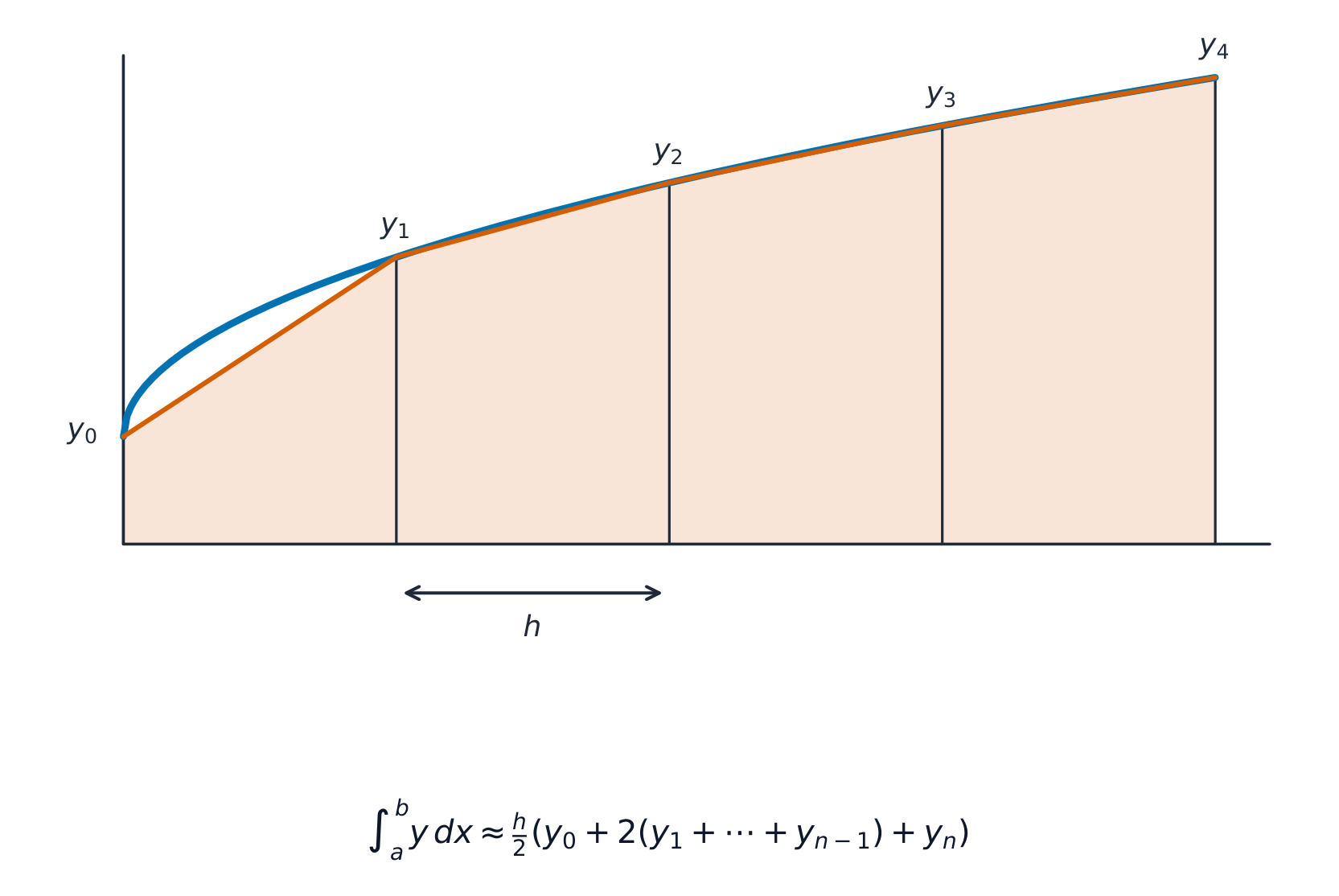
To integrate a power of $\sin$ or $\cos$, first use an identity to remove the power. When you cannot integrate exactly, the trapezium rule 梯形法则 estimates a definite integral:
$$\int_a^b y\,dx \approx \tfrac{h}{2}\big[y_0 + y_n + 2(y_1 + y_2 + \cdots + y_{n-1})\big].$$
Worked example. Find $\displaystyle\int 6\sin^2 x\,dx$.
Use $\sin^2 x = \tfrac12(1 - \cos 2x)$:
$$\int 6\sin^2 x\,dx = \int (3 - 3\cos 2x)\,dx = 3x - \tfrac32\sin 2x + C.$$
Explore
The area under the curve
area = ∫ f(x) dx
The integral still measures area — drag a and b to total the strip under the curve.
Vocabulary
Train
| English |
|---|
| trapezium rule/trəˈpiːzɪəm ruːl/ |
| integration by substitution/ˌɪntɪˈɡreɪʃn baɪ ˌsʌbstɪˈtjuːʃn/ |
2.6
Numerical solution of equations
Syllabus
| Candidates should be able to: | Notes and examples |
|---|---|
| • locate approximately a root of an equation, by means of graphical considerations and/or searching for a sign change | e.g. finding a pair of consecutive integers between which a root lies. |
| • understand the idea of, and use the notation for, a sequence of approximations which converges to a root of an equation | |
| • understand how a given simple iterative formula of the form $x_{n + 1} = \text{F}(x_n)$ relates to the equation being solved, and use a given iteration, or an iteration based on a given rearrangement of an equation, to determine a root to a prescribed degree of accuracy. | Knowledge of the condition for convergence is not included, but an understanding that an iteration may fail to converge is expected. |
Source: Cambridge International syllabus
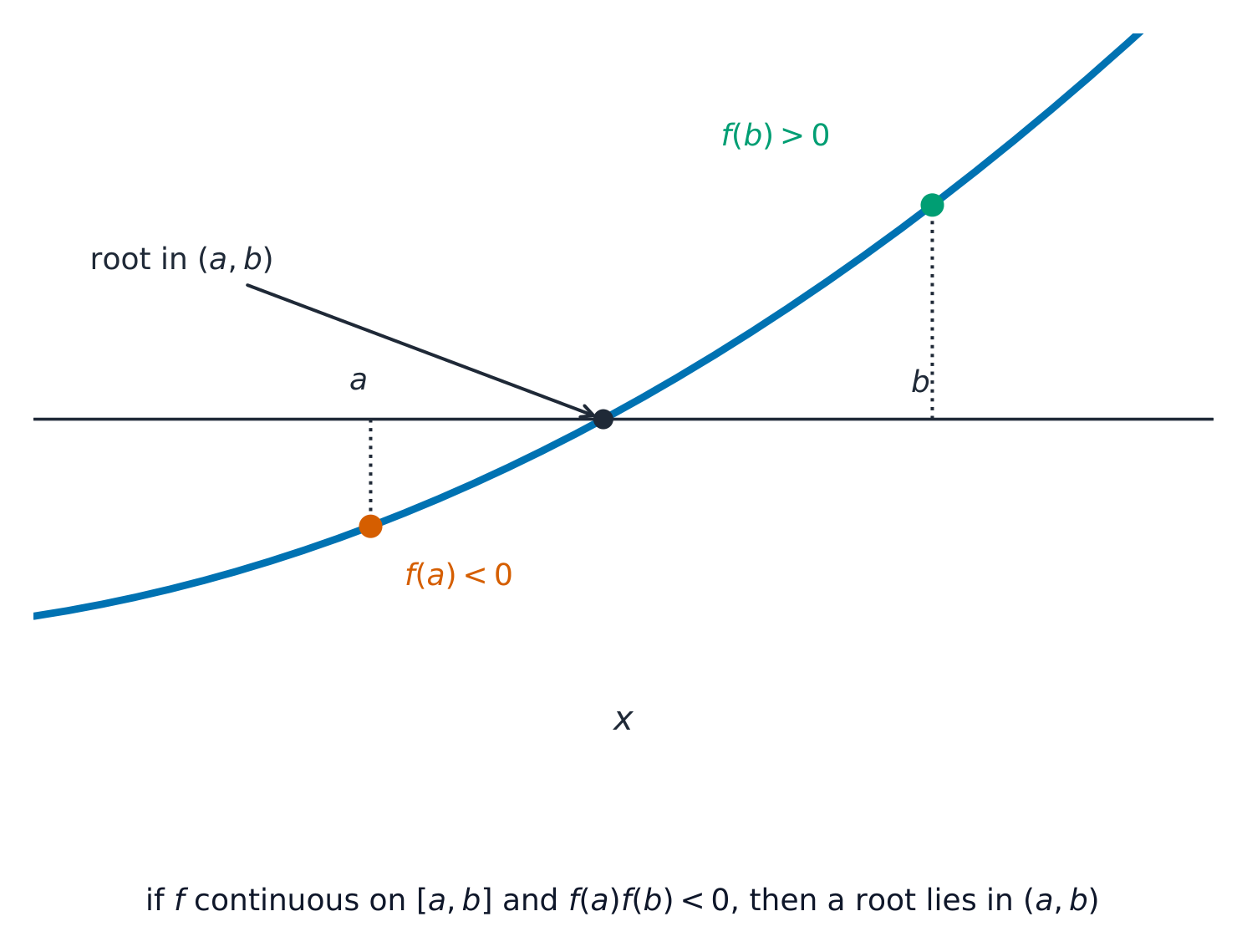
Many equations cannot be solved exactly. Two ideas help you find a root 根 (a solution).
- Sign change 变号: if $f(a)$ and $f(b)$ have opposite signs (and the graph has no break between them), a root lies between $a$ and $b$.
- Iteration 迭代: rearrange the equation into the form $x = F(x)$, then use the iterative formula 迭代公式 $x_{n+1} = F(x_n)$. Start from a first guess $x_0$ and repeat. If the values are convergent they settle down and converge 收敛 to a root. Keep going until the answer is steady to the accuracy asked for.
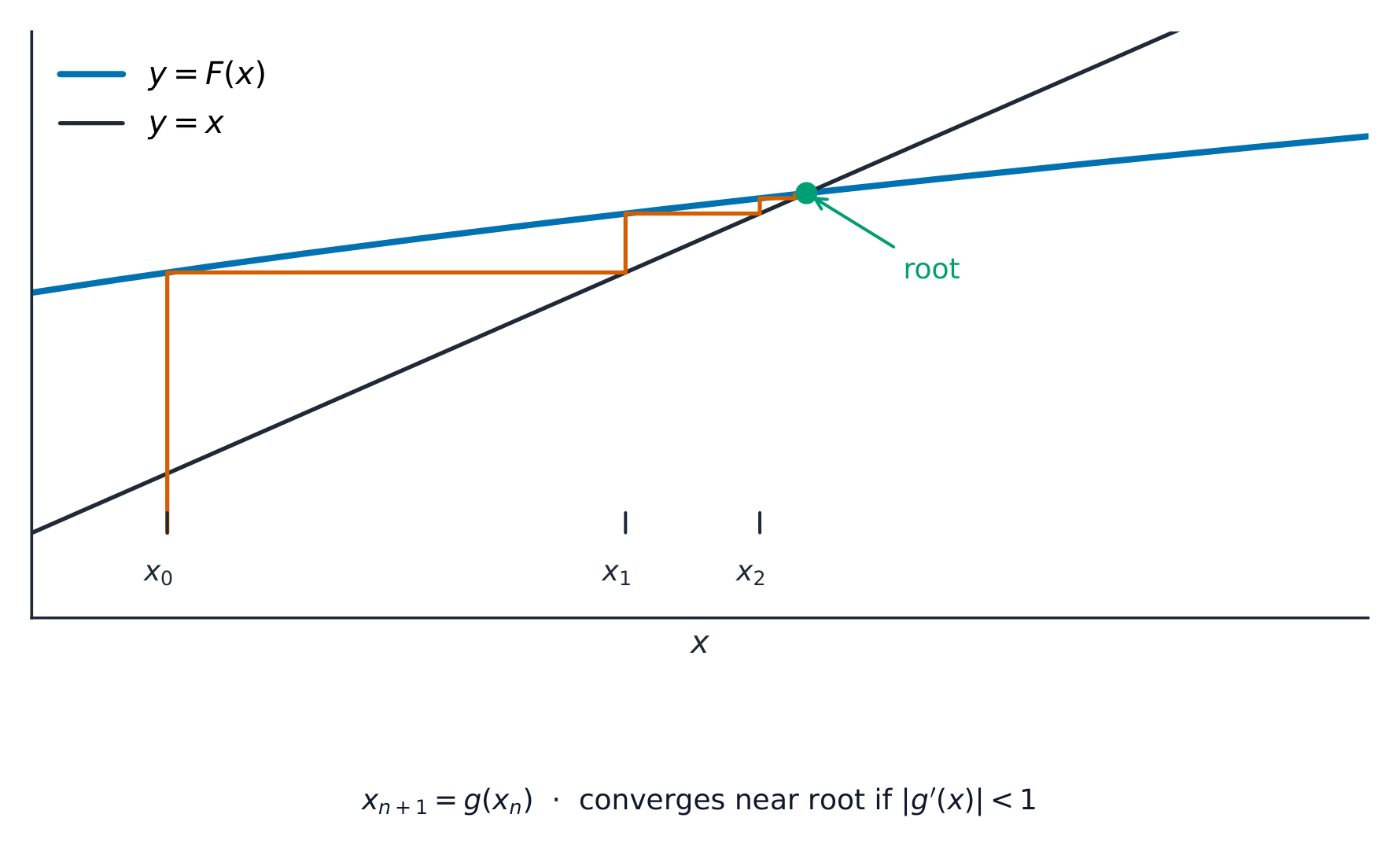
Worked example. A root $\beta$ of an equation satisfies $x = \sqrt[3]{-2x - 4.5}$, and $-1.4 < \beta < -1.0$. Use the iteration $x_{n+1} = \sqrt[3]{-2x_n - 4.5}$ with $x_0 = -1.2$.
$$x_1 = \sqrt[3]{-2(-1.2) - 4.5} = \sqrt[3]{-2.1} = -1.281, \qquad x_2 = \sqrt[3]{-2(-1.281) - 4.5} = -1.247, \quad \ldots$$
The values settle near $-1.26$, so $\beta = -1.26$ (3 s.f.).
Explore
Where is the root?
y = ax³ + bx² + cx + d
A root is where the curve crosses zero. A sign change in f(x) traps a root between two x-values.
Vocabulary
Train
| English |
|---|
| root/ruːt/ |
| sign change/saɪn tʃeɪndʒ/ |
| iteration/ˌɪtəˈreɪʃn/ |
| iterative formula/ˈɪtərətɪv ˈfɔːmjʊlə/ |
| converge/kənˈvɜːdʒ/ |
2.6
Exam tips
- Use the laws of logarithms to solve equations; remember $\ln$ and $e^x$ are inverses.
- For numerical methods, show a sign change to locate a root, set out the iteration clearly, and give the answer to the stated accuracy.
- Learn the chain, product and quotient rules and identify which the function needs.
- Solve modulus equations $|f(x)| = g(x)$ by considering both the positive and negative cases, and sketch to check.
Interactive lessons on this topic
Work through it step by step, with instant-check exercises.