This handout covers Topic 1: Pure Mathematics 纯数学 1. It is the algebra 代数 and calculus 微积分 core of the course. Each ## section is one syllabus subtopic.
Pure Mathematics 1
A-Level Mathematics · Topic 1
 28:42
28:42
Pure Mathematics 1
Look at a great suspension bridge. Its huge cable is not a random shape — it hangs in a perfect parabola, a curve you can write with a single equation. The…
English narration · English + 中文 subtitles burned in
1.1
Quadratics

Syllabus
| Candidates should be able to: | Notes and examples |
|---|---|
| carry out the process of completing the square for a quadratic polynomial $ax^2 + bx + c$ and use a completed square form | e.g. to locate the vertex of the graph of $y = ax^2 + bx + c$ or to sketch the graph |
| find the discriminant of a quadratic polynomial $ax^2 + bx + c$ and use the discriminant | e.g. to determine the number of real roots of the equation $ax^2 + bx + c = 0$. Knowledge of the term ‘repeated root’ is included. |
| solve quadratic equations, and quadratic inequalities, in one unknown | By factorising, completing the square and using the formula. |
| solve by substitution a pair of simultaneous equations of which one is linear and one is quadratic | e.g. $x + y + 1 = 0$ and $x^2 + y^2 = 25$, $2x + 3y = 7$ and $3x^2 = 4 + 4xy$. |
| recognise and solve equations in $x$ which are quadratic in some function of $x$. | e.g. $x^4 - 5x^2 + 4 = 0$, $6x + \sqrt{x} - 1 = 0$, $\tan^2 x = 1 + \tan x$. |
Source: Cambridge International syllabus
A quadratic 二次式 is an expression of the form $ax^2 + bx + c$, where $a \neq 0$. The letters $a$, $b$, $c$ are the coefficients 系数 (the fixed numbers). Much of this section is about solving the equation $ax^2 + bx + c = 0$.
Completing the square
To complete the square 配方 means to write the quadratic in the form
$$a(x + p)^2 + q.$$
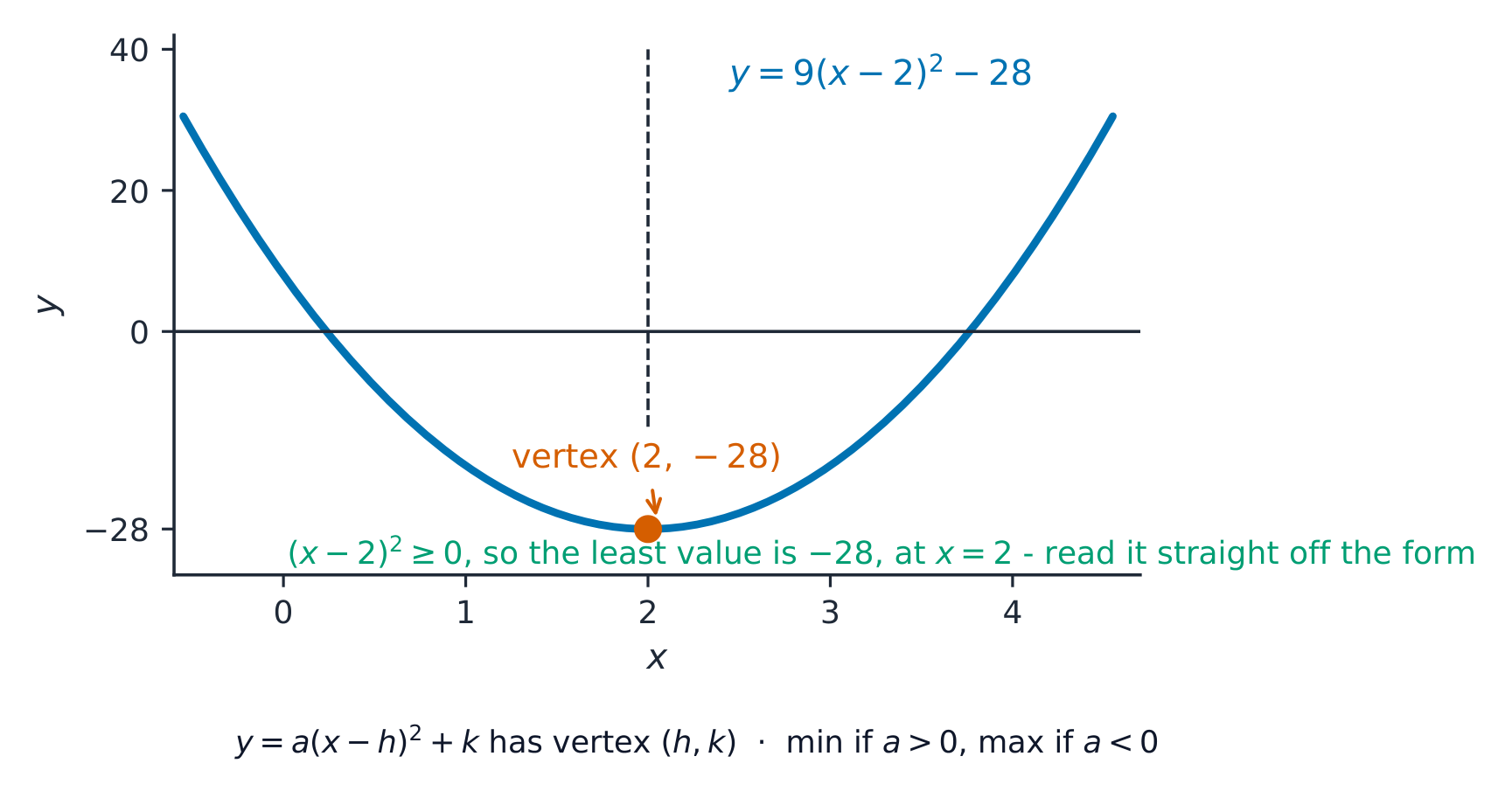
This form is useful: it shows the vertex 顶点 (turning point) of the curve at $(-p,\ q)$, and it gives a quick way to solve the equation.
Worked example. Write $9x^2 - 36x + 8$ in the form $p(x + q)^2 + r$.
Take the factor $9$ out of the first two terms, then complete the square inside:
$$\begin{aligned}
9x^2 - 36x + 8 &= 9\left(x^2 - 4x\right) + 8 \\
&= 9\left((x - 2)^2 - 4\right) + 8 \\
&= 9(x - 2)^2 - 36 + 8 = 9(x - 2)^2 - 28.
\end{aligned}$$
So $p = 9$, $q = -2$, $r = -28$.
The discriminant
The discriminant 判别式 of $ax^2 + bx + c$ is
$$\Delta = b^2 - 4ac.$$
It tells you how many real roots 实根 (real solutions) the equation $ax^2 + bx + c = 0$ has:
| Discriminant | Roots |
|---|---|
| $b^2 - 4ac > 0$ | two distinct 相异 real roots |
| $b^2 - 4ac = 0$ | one repeated real root |
| $b^2 - 4ac < 0$ | no real roots |

Worked example. Find the values of the constant $k$ for which $3kx^2 + (k + 8)x + 3 = 0$ has two distinct real roots.
Here $a = 3k$, $b = k + 8$, $c = 3$. For two distinct real roots you need $b^2 - 4ac > 0$:
$$(k + 8)^2 - 4(3k)(3) > 0 \;\Rightarrow\; k^2 + 16k + 64 - 36k > 0 \;\Rightarrow\; k^2 - 20k + 64 > 0.$$
Factorise: $(k - 4)(k - 16) > 0$, so $k < 4$ or $k > 16$. You also need $a \neq 0$, so $k \neq 0$.
Quadratic equations and inequalities
To solve a quadratic equation 二次方程, factorise, complete the square, or use the formula
$$x = \frac{-b \pm \sqrt{b^2 - 4ac}}{2a}.$$
To solve a quadratic inequality 二次不等式 such as $(k - 4)(k - 16) > 0$, find the two roots, then decide which side of each root makes the statement true. A sketch of the parabola 抛物线 helps: the curve is above the $x$-axis (positive) outside the roots and below it (negative) between them.
Simultaneous equations
To solve a pair of simultaneous equations 联立方程 where one is linear and one is quadratic, use substitution 代入: rearrange the linear equation for one letter, then put that into the quadratic. This gives a single quadratic to solve.
Equations that are quadratic in disguise
Some equations are quadratic in some function of $x$. For example $x^4 - 5x^2 + 4 = 0$ is quadratic in $x^2$: let $u = x^2$, solve $u^2 - 5u + 4 = 0$, then go back to $x$. You will use this idea again in trigonometry.
Explore
The shape of a quadratic
y = ax² + bx + c
Drag a, b and c. Watch the vertex, the line of symmetry and the roots (where it cuts the x-axis) move as the coefficients change.
Vocabulary
Train
| English |
|---|
| Pure Mathematics/pjʊə ˌmæθɪˈmætɪks/ |
| quadratic/kwɒˈdrætɪk/ |
| complete the square/kəmˈpliːt ðə skweə/ |
| vertex/ˈvɜːteks/ |
| discriminant/dɪˈskrɪmɪnənt/ |
| real roots/rɪəl ruːts/ |
| distinct/dɪˈstɪŋkt/ |
| quadratic equation/kwɒˈdrætɪk ɪˈkweɪʒn/ |
| quadratic inequality/kwɒˈdrætɪk ɪniːˈkwɒlɪti/ |
| simultaneous equations/ˌsɪməlˈteɪnɪəs ɪˈkweɪʒnz/ |
| substitution/ˌsʌbstɪˈtjuːʃn/ |
| coefficient/ˌkəʊɪˈfɪʃənt/ |
| parabola/pəˈræbələ/ |
1.2
Functions
Syllabus
| Candidates should be able to: | Notes and examples |
|---|---|
| understand the terms function, domain, range, one-one function, inverse function and composition of functions | |
| identify the range of a given function in simple cases, and find the composition of two given functions | e.g. range of $f : x \mapsto \frac{1}{x}$ for $x \geqslant 1$ and range of $g : x \mapsto x^2 + 1$ for $x \in \mathbb{R}$. Including the condition that a composite function $gf$ can only be formed when the range of $f$ is within the domain of $g$. |
| determine whether or not a given function is one-one, and find the inverse of a one-one function in simple cases | e.g. finding the inverse of $h : x \mapsto (2x + 3)^2 - 4$ for $x < -\frac{3}{2}$. |
| illustrate in graphical terms the relation between a one-one function and its inverse | Sketches should include an indication of the mirror line $y = x$. |
| understand and use the transformations of the graph of $y = f(x)$ given by $y = f(x) + a$, $y = f(x + a)$, $y = af(x)$, $y = f(ax)$ and simple combinations of these. | Including use of the terms ‘translation’, ‘reflection’ and ‘stretch’ in describing transformations. Questions may involve algebraic or trigonometric functions, or other graphs with given features. |
Source: Cambridge International syllabus
A function 函数 is a rule that sends each input to exactly one output. Write it as $f(x)$. The composition of functions 复合函数 $fg(x)$ means apply $g$ first, then apply $f$ to the result.
- The domain 定义域 is the set of allowed inputs $x$.
- The range 值域 is the set of outputs the function actually produces.
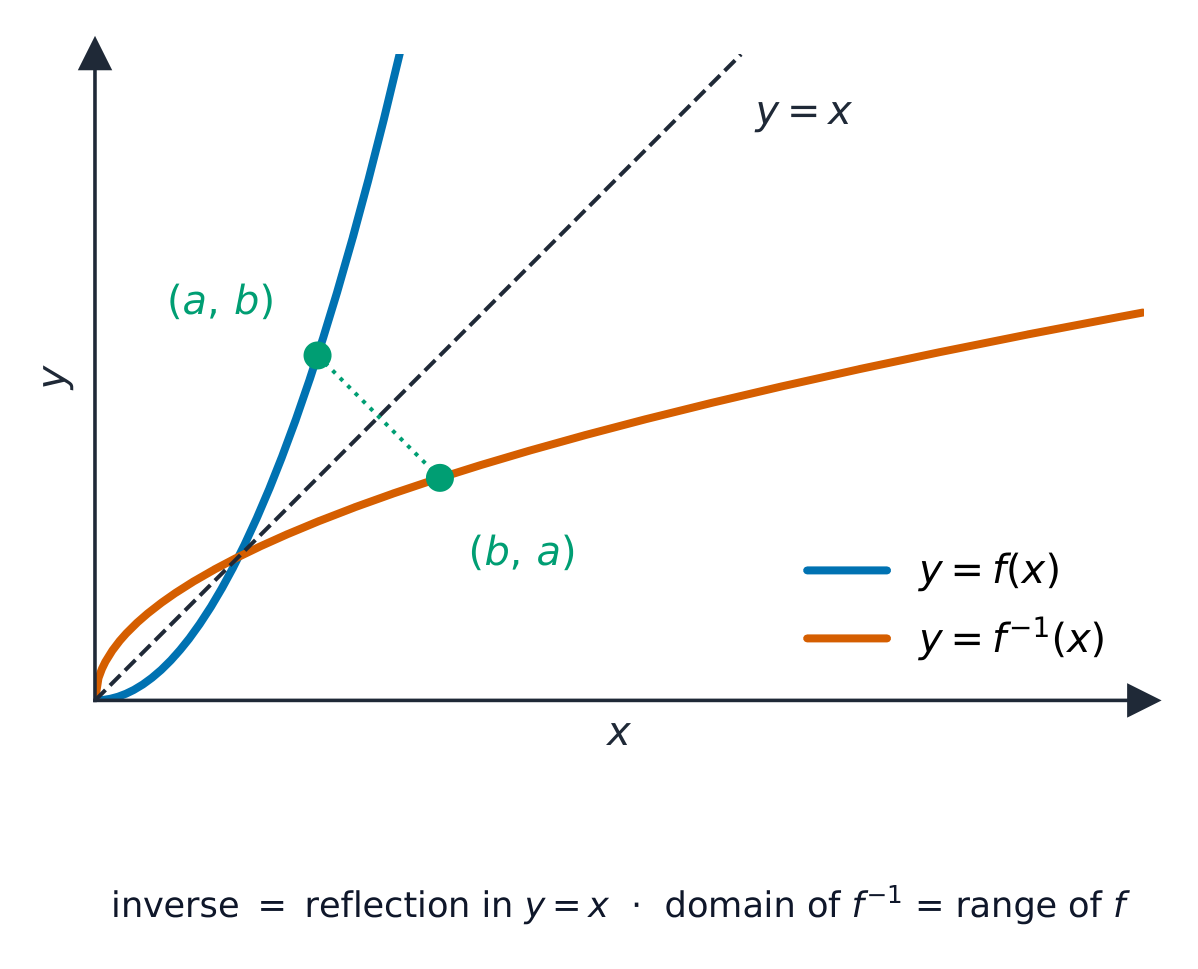
A function is one-one 一一对应 if different inputs always give different outputs. (No output is repeated.) Only a one-one function has an inverse function 反函数 $f^{-1}$, which reverses the rule.
The composition 复合 of two functions means doing one after the other. $fg(x)$ means "do $g$ first, then $f$": $fg(x) = f(g(x))$. The composite function $fg$ exists only when the range of $g$ lies inside the domain of $f$.
Finding an inverse
To find $f^{-1}$: write $y = f(x)$, make $x$ the subject, then swap letters.
Worked example. The function $f(x) = (x + 3)^2 - 12$ is defined for $x \geqslant 0$. Find $f^{-1}(x)$.
Write $y = (x + 3)^2 - 12$ and solve for $x$:
$$(x + 3)^2 = y + 12 \;\Rightarrow\; x + 3 = \sqrt{y + 12} \;\Rightarrow\; x = \sqrt{y + 12} - 3.$$
You take the positive square root because $x \geqslant 0$ means $x + 3 \geqslant 3 > 0$. So
$$f^{-1}(x) = \sqrt{x + 12} - 3.$$
Graphs of inverses and transformations
The graph of $y = f^{-1}(x)$ is the reflection 反射 of $y = f(x)$ in the line $y = x$.
You should know these transformations 变换 of $y = f(x)$:
| New equation | Effect on the graph |
|---|---|
| $y = f(x) + a$ | translation 平移 up by $a$ |
| $y = f(x + a)$ | translation left by $a$ |
| $y = a\,f(x)$ | stretch 伸缩 in the $y$-direction, scale factor $a$ |
| $y = f(ax)$ | stretch in the $x$-direction, scale factor $\tfrac{1}{a}$ |
When two transformations are combined, the order can matter. State each one fully (type, direction, and amount).

Explore
Explore a function
y = ax³ + bx² + cx + d
A function turns each input into exactly one output — drag the coefficients and watch where the curve rises and falls.
Vocabulary
Train
| English |
|---|
| function/ˈfʌŋkʃn/ |
| composition of functions/ˌkɒmpəˈzɪʃn ɒv ˈfʌŋkʃnz/ |
| domain/dəˈmeɪn/ |
| range/reɪndʒ/ |
| one-one/wʌn wʌn/ |
| inverse function/ɪnˈvɜːs ˈfʌŋkʃn/ |
| composition/ˌkɒmpəˈzɪʃn/ |
| reflection/rɪˈflekʃn/ |
| transformations/trænsfɔːˈmeɪʃnz/ |
| translation/trænˈsleɪʃn/ |
| stretch/stretʃ/ |
1.3
Coordinate geometry

Syllabus
| Candidates should be able to: | Notes and examples |
|---|---|
| find the equation of a straight line given sufficient information | e.g. given two points, or one point and the gradient. |
| interpret and use any of the forms $y = mx + c$, $y - y_1 = m(x - x_1)$, $ax + by + c = 0$ in solving problems | Including calculations of distances, gradients, midpoints, points of intersection and use of the relationship between the gradients of parallel and perpendicular lines. |
| understand that the equation $(x - a)^2 + (y - b)^2 = r^2$ represents the circle with centre $(a, b)$ and radius $r$ | Including use of the expanded form $x^2 + y^2 + 2gx + 2fy + c = 0$. |
| use algebraic methods to solve problems involving lines and circles | Including use of elementary geometrical properties of circles, e.g. tangent perpendicular to radius, angle in a semicircle, symmetry. Implicit differentiation is not included. |
| understand the relationship between a graph and its associated algebraic equation, and use the relationship between points of intersection of graphs and solutions of equations. | e.g. to determine the set of values of $k$ for which the line $y = x + k$ intersects, touches or does not meet a quadratic curve. |
Source: Cambridge International syllabus
Coordinate geometry 坐标几何 studies lines and circles using their equations.
Straight lines
The gradient 斜率 (steepness) of the line joining $(x_1, y_1)$ and $(x_2, y_2)$ is
$$m = \frac{y_2 - y_1}{x_2 - x_1}.$$
You can write the equation of a straight line 直线方程 in any of these forms:
$$y = mx + c, \qquad y - y_1 = m(x - x_1), \qquad ax + by + c = 0.$$
Two lines are parallel 平行 when their gradients are equal, and perpendicular 垂直 (at right angles) when the product of their gradients is $-1$.
Circles
The circle 圆 with centre 圆心 $(a, b)$ and radius 半径 $r$ has equation
$$(x - a)^2 + (y - b)^2 = r^2.$$
An expanded form like $x^2 + y^2 - 6x + 10y - 27 = 0$ is the same circle: complete the square in $x$ and in $y$ to find the centre and radius.
A tangent 切线 to a circle touches it at one point and is perpendicular to the radius at that point. This right-angle fact solves most circle problems.
Worked example. The points $P(1, 1)$ and $Q(7, 11)$ are the ends of a diameter 直径 of a circle. Find the equation of the circle.
The centre is the midpoint of $PQ$:
$$\left(\frac{1 + 7}{2},\ \frac{1 + 11}{2}\right) = (4, 6).$$
The radius is half the length of $PQ$:
$$r = \tfrac12\sqrt{(7 - 1)^2 + (11 - 1)^2} = \tfrac12\sqrt{36 + 100} = \tfrac12\sqrt{136} = \sqrt{34}.$$
So the circle is $(x - 4)^2 + (y - 6)^2 = 34$.
Explore
The straight line
y = ax + b
The gradient a tilts the line; the intercept b slides it up and down.
Vocabulary
Train
| English |
|---|
| Coordinate geometry/kəʊˈɔːdɪnət dʒiˈɒmətri/ |
| gradient/ˈɡreɪdɪənt/ |
| equation of a straight line/ɪˈkweɪʒn əvə streɪt laɪn/ |
| parallel/ˈpærəlel/ |
| perpendicular/ˌpɜːpənˈdɪkjʊlə/ |
| circle/ˈsɜːkl/ |
| centre/ˈsentə/ |
| radius/ˈreɪdɪəs/ |
| tangent/ˈtændʒənt/ |
| diameter/daɪˈæmɪtə/ |
1.4
Circular measure

Syllabus
| Candidates should be able to: | Notes and examples |
|---|---|
| understand the definition of a radian, and use the relationship between radians and degrees | |
| use the formulae $s = r\theta$ and $A = \frac{1}{2}r^2\theta$ in solving problems concerning the arc length and sector area of a circle. | Including calculation of lengths and angles in triangles and areas of triangles. |
Source: Cambridge International syllabus
Radians
A radian 弧度 is another way to measure angles. One radian is the angle at the centre of a circle that cuts off an arc 弧 equal in length to the radius. The link between radians and degrees 度 is
$$\pi \text{ radians} = 180^\circ.$$
So to change degrees to radians, multiply by $\dfrac{\pi}{180}$; to change radians to degrees, multiply by $\dfrac{180}{\pi}$.
Arc length and sector area
For a sector 扇形 with radius $r$ and angle $\theta$ in radians:
$$\text{arc length} = s = r\theta, \qquad \text{sector area} = A = \tfrac12 r^2 \theta.$$
A chord 弦 cuts the sector into a triangle and a segment 弓形. The segment area is the sector minus the triangle:
$$\text{segment} = \tfrac12 r^2 \theta - \tfrac12 r^2 \sin\theta = \tfrac12 r^2(\theta - \sin\theta).$$

Worked example. A sector has centre $O$ and the angle at $O$ is $\tfrac{2}{3}\pi$ radians. Show that the segment cut off by the chord has area about $0.614 r^2$.
$$\text{segment} = \tfrac12 r^2\left(\tfrac{2}{3}\pi - \sin\tfrac{2}{3}\pi\right) = \tfrac12 r^2(2.0944 - 0.8660) = \tfrac12 r^2(1.2284) \approx 0.614 r^2.$$
Explore
Radians, arcs and sectors
Change the angle (in radians) and radius. See the arc length $s = r\theta$ and the sector area $\tfrac12 r^2\theta$ update.
Vocabulary
Train
| English |
|---|
| radian/ˈreɪdɪən/ |
| arc/ɑːk/ |
| degrees/dɪˈɡriːz/ |
| sector/ˈsektə/ |
| chord/kɔːd/ |
| segment/ˈseɡmənt/ |
1.5
Trigonometry

Syllabus
| Candidates should be able to: | Notes and examples |
|---|---|
| sketch and use graphs of the sine, cosine and tangent functions (for angles of any size, and using either degrees or radians) | Including e.g. $y = 3 \sin x$, $y = 1 - \cos 2x$, $y = \tan(x + \frac{1}{4}\pi)$. |
| use the exact values of the sine, cosine and tangent of $30^\circ$, $45^\circ$, $60^\circ$, and related angles | e.g. $\cos 150^\circ = -\frac{1}{2}\sqrt{3}$, $\sin \frac{3}{4}\pi = \frac{1}{\sqrt{2}}$. |
| use the notations $\sin^{-1} x$, $\cos^{-1} x$, $\tan^{-1} x$ to denote the principal values of the inverse trigonometric relations | No specialised knowledge of these functions is required, but understanding of them as examples of inverse functions is expected. |
| use the identities $\frac{\sin \theta}{\cos \theta} \equiv \tan \theta$ and $\sin^2 \theta + \cos^2 \theta \equiv 1$ | e.g. in proving identities, simplifying expressions and solving equations. |
| find all the solutions of simple trigonometrical equations lying in a specified interval (general forms of solution are not included). | e.g. solve $3 \sin 2x + 1 = 0$ for $-\pi < x < \pi$, $3 \sin^2 \theta - 5 \cos \theta - 1 = 0$ for $0^\circ \leqslant \theta \leqslant 360^\circ$. |
Source: Cambridge International syllabus
Graphs and exact values
You must know the shape of the graphs of the sine 正弦, cosine 余弦 and tangent function 正切 (written $\sin$, $\cos$, $\tan$). The sine and cosine graphs wave between $-1$ and $1$ and repeat every $360^\circ$ ($2\pi$). Learn these exact values:
| $\theta$ | $30^\circ$ | $45^\circ$ | $60^\circ$ |
|---|---|---|---|
| $\sin\theta$ | $\tfrac12$ | $\tfrac{1}{\sqrt2}$ | $\tfrac{\sqrt3}{2}$ |
| $\cos\theta$ | $\tfrac{\sqrt3}{2}$ | $\tfrac{1}{\sqrt2}$ | $\tfrac12$ |
| $\tan\theta$ | $\tfrac{1}{\sqrt3}$ | $1$ | $\sqrt3$ |

The notations $\sin^{-1}x$, $\cos^{-1}x$, $\tan^{-1}x$ mean the inverse angle (the principal value 主值).
Identities
An identity 恒等式 is true for every value of the angle. The two you must know are
$$\tan\theta \equiv \frac{\sin\theta}{\cos\theta}, \qquad \sin^2\theta + \cos^2\theta \equiv 1.$$
Use them to rewrite an equation so it contains only one trig function.
Solving trigonometric equations
To solve a trigonometric equation 三角方程, first reduce it to one function, then find every solution in the given interval.
Worked example. Solve $6\sin\theta = 1 + \dfrac{2}{\sin\theta}$ for $-180^\circ < \theta < 180^\circ$.
Multiply through by $\sin\theta$ to clear the fraction. This makes a quadratic in $\sin\theta$:
$$6\sin^2\theta - \sin\theta - 2 = 0 \;\Rightarrow\; (3\sin\theta - 2)(2\sin\theta + 1) = 0.$$
So $\sin\theta = \tfrac23$ or $\sin\theta = -\tfrac12$.
- $\sin\theta = \tfrac23$: $\theta = 41.8^\circ$ or $\theta = 180^\circ - 41.8^\circ = 138.2^\circ$.
- $\sin\theta = -\tfrac12$: $\theta = -30^\circ$ or $\theta = -150^\circ$.
The four solutions are $\theta = -150^\circ,\ -30^\circ,\ 41.8^\circ,\ 138.2^\circ$.
Explore
Sine & cosine graphs
Drag the amplitude, period and shifts of y = a·sin(bx + c) + d and watch the curve change against the base wave.
Explore
Sine and cosine on the unit circle
Drag the angle round the unit circle. The height is $\sin\theta$, the across-distance is $\cos\theta$ — that's where the graphs come from.
Vocabulary
Train
| English |
|---|
| sine/saɪn/ |
| cosine/ˈkəʊsaɪn/ |
| tangent function/ˈtændʒənt ˈfʌŋkʃn/ |
| principal value/ˈprɪnsɪpl ˈvæljuː/ |
| identity/aɪˈdentɪti/ |
| trigonometric equation/ˌtrɪɡənəʊˈmetrɪk ɪˈkweɪʒn/ |
1.6
Series

Syllabus
| Candidates should be able to: | Notes and examples |
|---|---|
| use the expansion of $(a + b)^n$, where $n$ is a positive integer | Including the notations $\begin{pmatrix} n \\ r \end{pmatrix}$ and $n!$ Knowledge of the greatest term and properties of the coefficients are not required. |
| recognise arithmetic and geometric progressions | |
| use the formulae for the $n$th term and for the sum of the first $n$ terms to solve problems involving arithmetic or geometric progressions | Including knowledge that numbers $a$, $b$, $c$ are 'in arithmetic progression' if $2b = a + c$ (or equivalent) and are 'in geometric progression' if $b^2 = ac$ (or equivalent). Questions may involve more than one progression. |
| use the condition for the convergence of a geometric progression, and the formula for the sum to infinity of a convergent geometric progression. |
Source: Cambridge International syllabus
The binomial expansion
For a positive integer $n$, the binomial expansion 二项展开式 is
$$(a + b)^n = a^n + \binom{n}{1}a^{n-1}b + \binom{n}{2}a^{n-2}b^2 + \cdots + b^n,$$
where $\binom{n}{r} = \dfrac{n!}{r!\,(n - r)!}$ is a binomial coefficient 二项式系数.
Worked example. Find the first three terms, in ascending powers of $x$, of $(2 - px)^5$.
$$(2 - px)^5 = 2^5 + \binom{5}{1}2^4(-px) + \binom{5}{2}2^3(-px)^2 + \cdots = 32 - 80px + 80p^2x^2 + \cdots$$
Arithmetic and geometric progressions
A progression 数列 (sequence) is a list of terms following a rule.
- An arithmetic progression 等差数列 (AP) adds a fixed common difference 公差 $d$ each step. The $n$th term 项 is $u_n = a + (n - 1)d$, and the sum of the first $n$ terms is $S_n = \tfrac{n}{2}\big(2a + (n - 1)d\big)$.
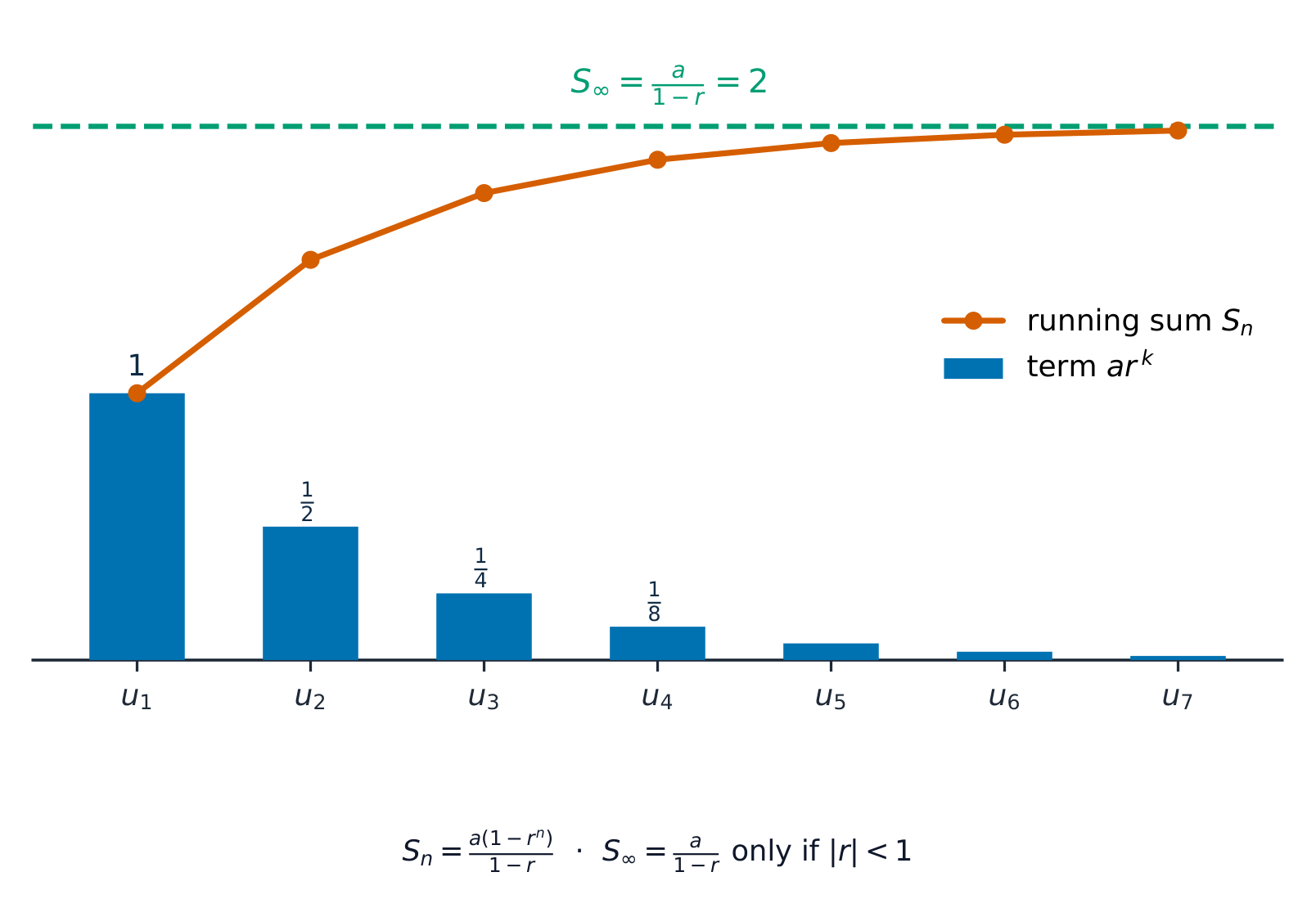
- A geometric progression 等比数列 (GP) multiplies by a fixed common ratio 公比 $r$ each step. The $n$th term is $u_n = ar^{\,n-1}$, and $S_n = \dfrac{a(1 - r^n)}{1 - r}$.
A GP is convergent — it converges 收敛 (settles to a limit) — when $|r| < 1$. Then it has a sum to infinity 无穷和
$$S_\infty = \frac{a}{1 - r}.$$
Worked example. The third term of a GP is $18$ and the sum of the first three terms is $26$. The common ratio is negative. Find the sum to infinity.
From $ar^2 = 18$ you get $a = \dfrac{18}{r^2}$. Put this into $a(1 + r + r^2) = 26$:
$$18(1 + r + r^2) = 26r^2 \;\Rightarrow\; 8r^2 - 18r - 18 = 0 \;\Rightarrow\; (4r + 3)(r - 3) = 0.$$
The ratio is negative, so $r = -\tfrac34$ and $a = \dfrac{18}{(3/4)^2} = 32$. Then
$$S_\infty = \frac{32}{1 - (-\tfrac34)} = \frac{32}{\tfrac74} = \frac{128}{7}.$$
Explore
Arithmetic and geometric sequences
Switch between an arithmetic (add d) and a geometric (multiply by r) sequence and watch the terms and their sum build up.
Vocabulary
Train
| English |
|---|
| binomial expansion/baɪˈnəʊmɪəl ekˈspænʃn/ |
| binomial coefficient/baɪˈnəʊmɪəl ˌkəʊɪˈfɪʃənt/ |
| progression/prəˈɡreʃn/ |
| arithmetic progression/əˈrɪθmətɪk prəˈɡreʃn/ |
| common difference/ˈkɒmən ˈdɪfrəns/ |
| term/tɜːm/ |
| geometric progression/ˌdʒiːəʊˈmetrɪk prəˈɡreʃn/ |
| common ratio/ˈkɒmən ˈreɪʃɪəʊ/ |
| converges/kənˈvɜːdʒɪz/ |
| sum to infinity/sʌm tʊ ɪnˈfɪnɪti/ |
1.7
Differentiation
Syllabus
| Candidates should be able to: | Notes and examples |
|---|---|
| understand the gradient of a curve at a point as the limit of the gradients of a suitable sequence of chords, and use the notations $f'(x)$, $f''(x)$, $\frac{\text{d}y}{\text{d}x}$, and $\frac{\text{d}^2y}{\text{d}x^2}$ for first and second derivatives | Only an informal understanding of the idea of a limit is expected. e.g. includes consideration of the gradient of the chord joining the points with $x$ coordinates $2$ and $(2 + h)$ on the curve $y = x^3$. Formal use of the general method of differentiation from first principles is not required. |
| use the derivative of $x^n$ (for any rational $n$), together with constant multiples, sums and differences of functions, and of composite functions using the chain rule | e.g. find $\frac{\text{d}y}{\text{d}x}$, given $y = \sqrt{2x^3 + 5}$. |
| apply differentiation to gradients, tangents and normals, increasing and decreasing functions and rates of change | Including connected rates of change, e.g. given the rate of increase of the radius of a circle, find the rate of increase of the area for a specific value of one of the variables. |
| locate stationary points and determine their nature, and use information about stationary points in sketching graphs. | Including use of the second derivative for identifying maxima and minima; alternatives may be used in questions where no method is specified. Knowledge of points of inflexion is not included. |
Source: Cambridge International syllabus
Differentiation 微分 finds the gradient of a curve 曲线斜率 at each point. The gradient is the limit 极限 of the gradients of shorter and shorter chords, called the derivative 导数.
The rules
Write the derivative as $f'(x)$ or $\dfrac{dy}{dx}$. The basic rule is
$$\frac{d}{dx}\left(x^n\right) = n x^{n-1} \quad \text{for any rational } n.$$
Differentiate sums term by term, and use the chain rule 链式法则 for a function inside a function:
$$\frac{d}{dx}\,f(g(x)) = f'(g(x)) \cdot g'(x).$$
Differentiating again gives the second derivative 二阶导数 $f''(x)$ or $\dfrac{d^2y}{dx^2}$.
Using the derivative
- Tangent and normal. The gradient of the curve at a point is the gradient of the tangent there. The normal 法线 is perpendicular to the tangent, so its gradient is $-\dfrac{1}{\text{(tangent gradient)}}$.
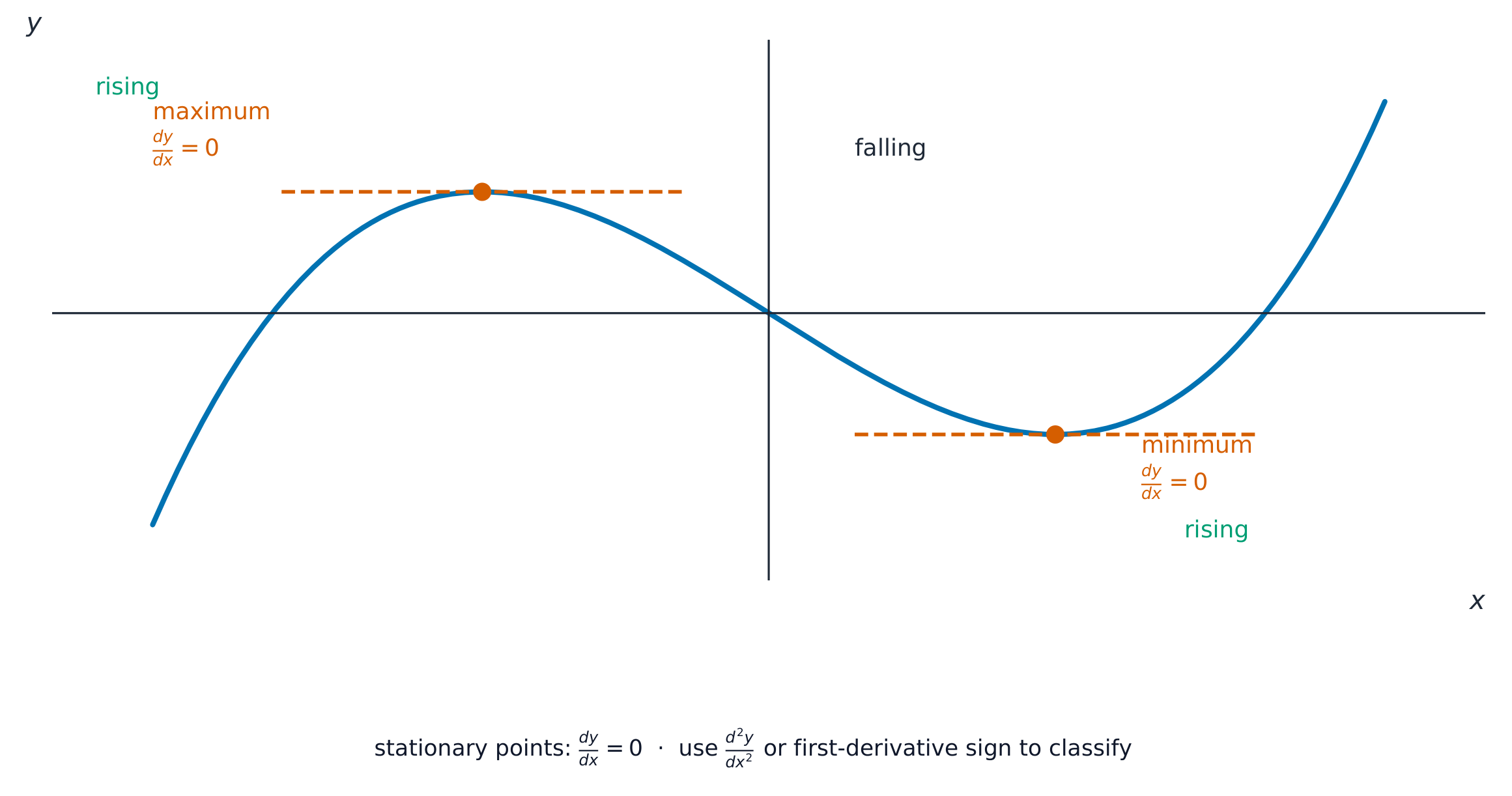
- Increasing or decreasing. The function is an increasing function 增函数 where $\dfrac{dy}{dx} > 0$, and a decreasing function 减函数 where $\dfrac{dy}{dx} < 0$.
- Rate of change. A derivative is a rate of change 变化率. Linked rates use the chain rule, e.g. $\dfrac{dy}{dt} = \dfrac{dy}{dx}\cdot\dfrac{dx}{dt}$.
Stationary points
A stationary point 驻点 is where $\dfrac{dy}{dx} = 0$. Test its nature with the second derivative: $f''(x) > 0$ gives a minimum point 极小值点, and $f''(x) < 0$ gives a maximum point 极大值点. When $f''(x) = 0$ the test is inconclusive: the point may be a point of inflexion 拐点, where the curve changes concavity (the way it bends) – check the sign of $\dfrac{dy}{dx}$ just before and after to decide.
Worked example. The curve $y = 4x^{1/2} - x$ has a maximum point at $x = a$. Find $a$.
$$\frac{dy}{dx} = 2x^{-1/2} - 1 = 0 \;\Rightarrow\; \frac{2}{\sqrt{x}} = 1 \;\Rightarrow\; \sqrt{x} = 2 \;\Rightarrow\; x = 4.$$
So $a = 4$.
Explore
The gradient at a point
y = ax³ + bx² + cx + d
Slide the point along the curve. The tangent shows the gradient $\frac{dy}{dx}$ there — steeper where the curve bends more.
Vocabulary
Train
| English |
|---|
| Differentiation/ˌdɪfəˌrenʃɪˈeɪʃn/ |
| gradient of a curve/ˈɡreɪdɪənt əvə kɜːv/ |
| limit/ˈlɪmɪt/ |
| derivative/dɪˈrɪvətɪv/ |
| chain rule/tʃeɪn ruːl/ |
| second derivative/ˈsekənd dɪˈrɪvətɪv/ |
| normal/ˈnɔːml/ |
| increasing function/ɪnˈkriːsɪŋ ˈfʌŋkʃn/ |
| decreasing function/ˈdiːkriːsɪŋ ˈfʌŋkʃn/ |
| rate of change/reɪt ɒv tʃeɪndʒ/ |
| stationary point/ˈsteɪʃənəri pɔɪnt/ |
| minimum point/ˈmɪnɪməm pɔɪnt/ |
| maximum point/ˈmæksɪməm pɔɪnt/ |
| point of inflexion/pɔɪnt ɒv ɪnˈflekʃn/ |
1.8
Integration
Syllabus
| Candidates should be able to: | Notes and examples |
|---|---|
| understand integration as the reverse process of differentiation, and integrate $(ax + b)^n$ (for any rational $n$ except $-1$), together with constant multiples, sums and differences | e.g. $\int (2x^3 - 5x + 1) \text{d}x$, $\int \frac{1}{(2x + 3)^2} \text{d}x$. |
| solve problems involving the evaluation of a constant of integration | e.g. to find the equation of the curve through $(1, -2)$ for which $\frac{\text{d}y}{\text{d}x} = \sqrt{2x + 1}$. |
| evaluate definite integrals | Including simple cases of 'improper' integrals, such as $\int_{0}^{1} x^{-\frac{1}{2}} \text{d}x$ and $\int_{1}^{\infty} x^{-2} \text{d}x$. |
| use definite integration to find: - the area of a region bounded by a curve and lines parallel to the axes, or between a curve and a line or between two curves - a volume of revolution about one of the axes. | A volume of revolution may involve a region not bounded by the axis of rotation, e.g. the region between $y = 9 - x^2$ and $y = 5$ rotated about the $x$-axis. |
Source: Cambridge International syllabus
Integration 积分 is the reverse of differentiation. Reversing the power rule gives
$$\int (ax + b)^n \, dx = \frac{(ax + b)^{n+1}}{a(n + 1)} + C \quad (n \neq -1).$$
The $+\,C$ is the constant of integration 积分常数. If you know one point on the curve, substitute it to find $C$.
Definite integrals and area
A definite integral 定积分 has limits and gives a number:
$$\int_p^q f(x)\, dx = \big[F(x)\big]_p^q = F(q) - F(p).$$
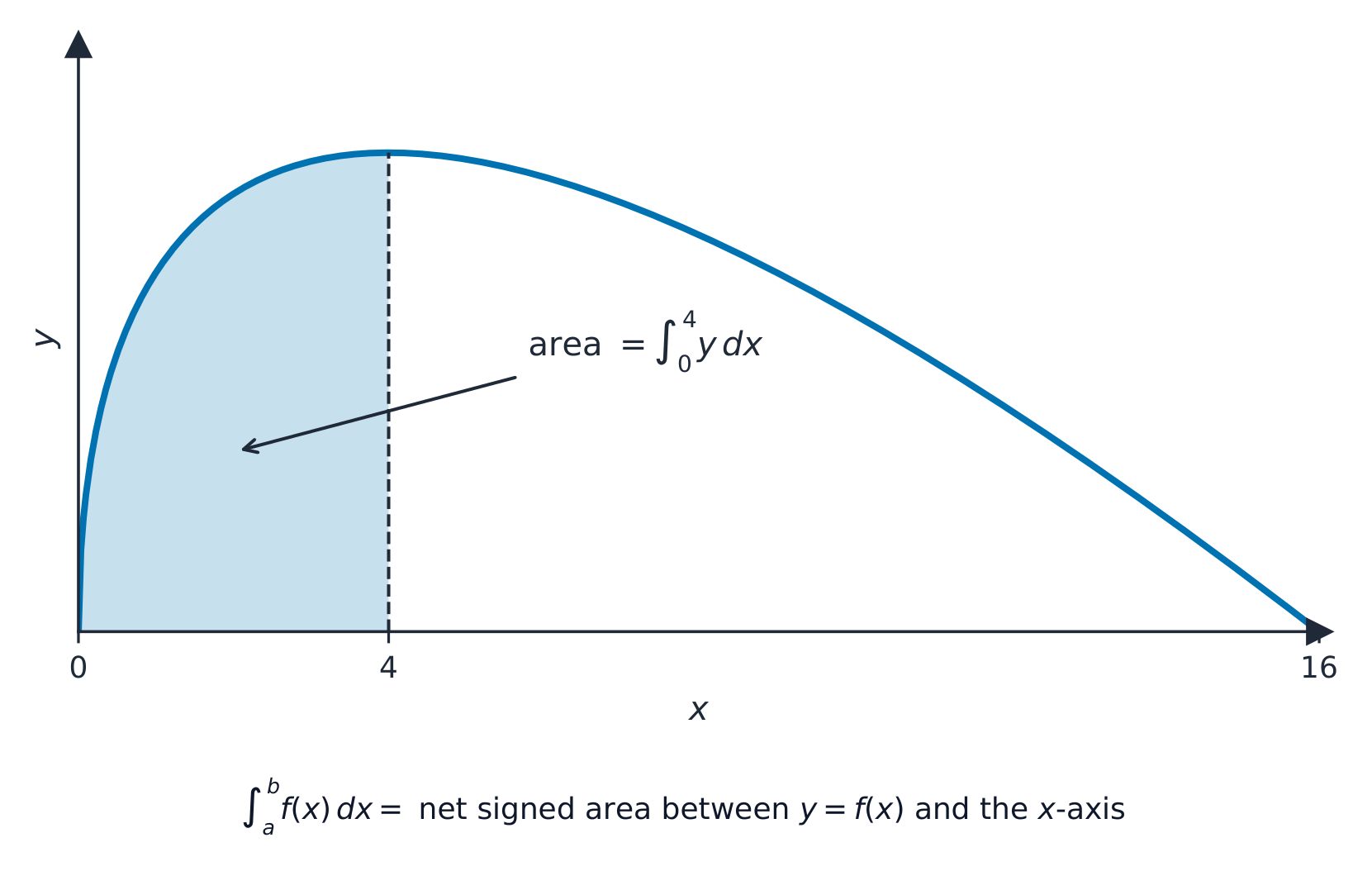
The area of the region 区域 between a curve and the $x$-axis, from $x = p$ to $x = q$, is $\displaystyle\int_p^q y \, dx$. For the area between two curves, integrate (top curve $-$ bottom curve).
Worked example. The curve $y = 4x^{1/2} - x$ meets the $x$-axis again at $x = 16$. Find the area between the curve and the $x$-axis from $x = 0$ to $x = 4$.
$$\int_0^4 \left(4x^{1/2} - x\right) dx = \left[\frac{8}{3}x^{3/2} - \frac{x^2}{2}\right]_0^4 = \frac{8}{3}(8) - \frac{16}{2} = \frac{64}{3} - 8 = \frac{40}{3}.$$
An improper integral 广义积分 has an infinite limit or an endpoint where the integrand is undefined; evaluate it as a limit. For example,
$$\int_1^{\infty}x^{-2}\, dx=\lim_{b\to\infty}\left[-\frac1x\right]_1^{b}=\lim_{b\to\infty}\left(1-\frac1b\right)=1,$$
and $\displaystyle\int_0^{1}x^{-1/2}\, dx=\left[2x^{1/2}\right]_0^{1}=2$, which is finite even though the integrand blows up at $x=0$.
Volume of revolution
When a region is turned all the way around an axis it sweeps out a solid. The volume of revolution 旋转体体积 about the $x$-axis is
$$V = \pi \int_p^q y^2 \, dx,$$
and about the $y$-axis it is $V = \pi \displaystyle\int x^2 \, dy$. For example, the region under $y = \sqrt{x}$ from $x = 0$ to $x = 4$, turned about the $x$-axis, has volume $\pi\displaystyle\int_0^4 x\, dx = \pi\big[\tfrac{x^2}{2}\big]_0^4 = 8\pi$.

Explore
Area under a curve
y = ax³ + bx² + cx + d
Drag the limits. The definite integral is the shaded area between the curve and the x-axis.
Vocabulary
Train
| English |
|---|
| Integration/ˌɪntɪˈɡreɪʃn/ |
| constant of integration/ˈkɒnstənt ɒv ˌɪntɪˈɡreɪʃn/ |
| definite integral/ˈdefɪnət ˈɪntɪɡrəl/ |
| region/ˈriːdʒn/ |
| improper integral/ɪmˈprɒpə ˈɪntɪɡrəl/ |
| volume of revolution/ˈvɒljuːm ɒv ˌrevəˈluːʃn/ |
1.8
Exam tips
- Show every line of algebra — method marks are lost by jumping steps; use the discriminant $b^2 - 4ac$ to decide the number of real roots.
- Work in radians for circular measure (arc $= r\theta$, sector area $= \frac{1}{2}r^2\theta$) and for calculus of trig functions.
- For differentiation, set $\frac{dy}{dx} = 0$ for stationary points and use the second derivative to classify them.
- For integration, add $+ c$ to an indefinite integral and use limits for area; an area below the axis gives a negative integral.
Vocabulary
Train
| English |
|---|
| algebra/ˈældʒɪbrə/ |
| calculus/ˈkælkjʊləs/ |
Interactive lessons on this topic
Work through it step by step, with instant-check exercises.