Source: Cambridge International syllabus · แหล่งที่มา: หลักสูตร Cambridge International
English
Economics as a social science
Economics is a social science 社会科学. It studies how people behave when they make choices. Like other sciences, it builds models 模型 (simple pictures of the real world) and tests them with data.
The real world is complex, so economists change one thing at a time and keep everything else fixed. This is the idea of ceteris paribus 其他条件不变 — a Latin phrase meaning "all other things stay the same". For example: "if the price of coffee rises, people buy less coffee, ceteris paribus".
Positive and normative statements
a positive statement 实证表述 is about fact. It can be tested as true or false. Example: "a higher price of petrol reduces the amount people buy."
a normative statement 规范表述 is about opinion. It says what should happen, and it cannot be tested as true or false. Example: "the government should make petrol cheaper."
Normative statements rest on a value judgement 价值判断 — a personal view about what is good or fair. Two people can agree on the facts and still disagree about what should be done.
Microeconomics and macroeconomics
microeconomics 微观经济学 studies single parts of the economy: one market, one firm, one consumer.
macroeconomics 宏观经济学 studies the whole economy together: total output 产出, jobs, and rising prices.
Source: Cambridge International syllabus · แหล่งที่มา: หลักสูตร Cambridge International
English
The factors of production 生产要素 are the four kinds of resource used to make goods and services. Each one earns a reward 报酬.
Factor
What it is
Its reward
land 土地
natural resources (fields, water, oil, minerals)
rent 地租
labour 劳动
human work, both physical and mental
wages 工资
capital 资本
man-made things used to produce, like machines, tools and factories
interest 利息
enterprise 企业家才能
the skill of bringing the other three together and taking the risk
profit 利润
Land includes some non-renewable resources 不可再生资源 (like oil and coal) that can run out. Enterprise is supplied by the entrepreneur 企业家, the person who has the business idea and risks their own money.
Specialisation and division of labour
specialisation 专业化 is when a worker, firm or country makes only the things it is best at, then trades for the rest.
Inside a workplace, specialisation leads to the division of labour 劳动分工: a big job is split into small tasks, and each worker 工人 does one task again and again.
Advantages
Disadvantages
workers get faster and better at one task
doing one task is boring, so workers may quit
less time wasted moving between jobs
if one worker is absent, the whole line can stop
output per worker rises, so costs fall
workers learn only one narrow skill
Mobility of factors
mobility 流动性 means how easily a factor can move to a new use.
occupational mobility 职业流动性 — how easily a factor moves from one job or use to another. A teacher who retrains as a nurse is occupationally mobile.
geographical mobility 地理流动性 — how easily a factor moves from one place to another. Land cannot move at all, so it has no geographical mobility.
Labour is often not very mobile. Family ties, the cost of housing, and missing skills all make it hard for workers to move.
Source: Cambridge International syllabus · แหล่งที่มา: หลักสูตร Cambridge International
English
An economic system is the way a country decides how to allocate 配置 (share out) its scarce resources. There are three types.
a market economy 市场经济 — firms and people own resources, and prices decide what is made. The government does little.
a planned economy 计划经济 (also called a command economy 指令经济) — the government owns resources and decides what is made, how, and for whom.
a mixed economy 混合经济 — a blend of the two. The private sector 私营部门 (firms and households) and the public sector 公共部门 (the government) both make decisions. Almost every real country is mixed.
The price mechanism
In a market economy, resources are guided by the price mechanism 价格机制. Prices do three jobs:
signalling 信号传递 — a price tells buyers and sellers where resources are wanted. A rising price says "this is wanted — make more".
incentive 激励 — a higher price rewards producers, so they want to supply more of that good.
rationing 配给 — when a good is scarce, a higher price shares it out to those who are willing and able to pay.
Comparing the systems
System
Strengths
Weaknesses
market
choice, low prices, strong incentive to work and invent
large gap between rich and poor; some goods not supplied
planned
smaller gap between rich and poor; key goods provided for all
weak incentive; shortages and surpluses; slow to change
mixed
tries to keep the good points of both
the right balance is hard to find
In practice no country sits at a pure extreme. China's economy, for instance, is officially a socialist market economy, where markets set most prices while the government guides key sectors and owns major enterprises. Every real system mixes the two and sits somewhere on the spectrum below.
Source: Cambridge International syllabus · แหล่งที่มา: หลักสูตร Cambridge International
English
The PPF and opportunity cost
A production possibility curve 生产可能性曲线 (PPC) is a line showing the largest combinations of two goods an economy can make when all its resources are fully and well used.
Imagine an economy that makes only food and machines. The PPC is drawn with food on one axis and machines on the other.
a point on the curve: all resources are used with full efficiency 效率.
a point inside the curve: resources are wasted (for example, unemployment 失业 of workers). The economy could do better.
a point outside the curve: impossible today, because there are not enough resources. This shows scarcity.
Moving along the curve shows opportunity cost: to make more food, you must move resources away from machines, so you make fewer machines. This is the trade-off 取舍 between the two goods.
The shape of the curve shows how opportunity cost behaves:
a straight-line PPC means constant opportunity cost — each extra unit of food costs the same number of machines.
a curve that bows outwards means increasing opportunity cost — each extra unit of food costs more and more machines, because resources are not equally good at making both goods.
Shifts and growth
When the PPC moves outward (to the right), the economy can make more of both goods. This is economic growth 经济增长. It happens when there are more resources, or better ones (new technology 技术, a bigger or more skilled workforce). War or disaster can move the PPC inward — this is economic decline 经济衰退.
A country must also choose between two kinds of good now:
capital goods 资本品 — goods used to make other goods (machines, factories).
consumer goods 消费品 — goods people use directly (food, clothes).
Making more capital goods today means fewer consumer goods today. But more capital goods help the economy grow faster, so the PPC shifts out by more in the future.
Worked example. Why is a production possibility curve usually drawn concave (bowed outwards) rather than as a straight line? A straight line would mean the opportunity cost of each extra unit stays constant. The curve bows out because factors of production are not perfectly substitutable - they are specialised. Starting from all-food production, the first factors moved into making cars are the ones least suited to farming, so very little food is given up for a lot of cars. Keep going and you must move factors that are increasingly good at farming and increasingly bad at making cars, so each extra car costs more and more food. That rising cost is increasing opportunity cost, and the bowed shape is simply its picture. A straight-line PPC is not wrong - it just assumes factors are perfectly substitutable, and naming that assumption is what earns the mark.
ไทย
The PPF and opportunity cost
production possibility curve (PPC) คือเส้นที่แสดงชุดผสมผสานสูงสุดของสองสินค้าที่เศรษฐกิจสามารถผลิตได้เมื่อใช้ทรัพยากรทั้งหมดอย่าง fully และ well
The production possibility frontier · แนว frontier ของความเป็นไปได้ในการผลิต
Producing more of one good means giving up some of the other — that trade-off is the opportunity cost, shown by the slope of the frontier. · การผลิตสินค้าหนึ่งเพิ่มขึ้น หมายความว่าต้องสละสินค้าอีกชนิดหนึ่ง — การแลกเปลี่ยนนี้คือ ต้นทุนโอกาส, แสดงโดยความชันของ frontier
An economy can't have more of everything: making more of one good means giving up some of another — the frontier's slope is that opportunity cost. · เศรษฐกิจไม่สามารถมีทุกสิ่งทุกอย่างให้มากขึ้นได้: การผลิตสินค้าอย่างหนึ่งเพิ่มขึ้น讽must give up some of another — ความชันของแนวขอบเขตคือโอกาสเสีย (opportunity cost) นั้นเอง
Explore · สำรวจ
The production possibility curve · เส้นโค้งความเป็นไปได้ในการผลิต
Move along the curve. Producing more of one good means producing less of the other — the curve shows opportunity cost and scarcity. · เลื่อนไปตามเส้นโค้ง การผลิตสินค้าอย่างหนึ่งมากขึ้นหมายถึงการผลิตอีกอย่างหนึ่ง น้อยลง — เส้นโค้งนี้แสดงถึง โอกาสที่เสียไป และความขาดแคลน
Source: Cambridge International syllabus · แหล่งที่มา: หลักสูตร Cambridge International
English
Free goods and economic goods
a free good 免费物品 has no opportunity cost. Its supply is unlimited, so it has no price (for example, air or sunlight).
an economic good 经济物品 (also called a private good 私人物品) is scarce. Making it has an opportunity cost, so it has a price.
A private good has two features. It has rivalry 竞争性 (if I eat the apple, you cannot) and excludability 排他性 (the seller can stop you using it unless you pay).
Public goods
A public good 公共物品 is the opposite of a private good. It has two features:
non-rivalry 非竞争性 — one person using it does not reduce the amount left for others.
non-excludability 非排他性 — you cannot stop people who do not pay from using it.
Because of non-excludability, public goods suffer from the free-rider problem 搭便车问题: people enjoy the good without paying for it. So private firms cannot make a profit and will not supply it. The government must provide public goods instead — for example, street lighting and national defence 国防.
Merit and demerit goods
a merit good 优值品 is better for you (and for society) than you realise, so people buy too little of it. Examples: education and health care.
a demerit good 劣值品 is worse for you than you realise, so people buy too much of it. Examples: cigarettes and alcohol.
People misjudge these goods because of information failure 信息失灵 — they do not have, or do not use, the full facts about the benefit or harm.
Deciding what counts as a merit or demerit good is partly a value judgement, so people may disagree about which goods belong on each list.
Source: Cambridge International syllabus · แหล่งที่มา: หลักสูตร Cambridge International
English
Demand shifts right: P and Q rise
demand 需求 is the quantity of a good that buyers are willing and able to buy at each price 价格 in a period of time. It is not just a wish — buyers must also be able to pay.
The law of demand says: when the price rises, the quantity demanded 需求量 falls; when the price falls, the quantity demanded rises. Price and quantity move in opposite directions.
So the demand curve 需求曲线 slopes downward, from top-left to bottom-right.
What shifts the demand curve
A change in the good's own price is shown as a movement along the demand curve. A change in any other cause shifts the whole curve to a new position — this is a shift 移动 of demand. The main causes (the determinants 决定因素) are:
income 收入 — for most goods, higher income raises demand.
the price of a substitute 替代品 — a good you can use instead (tea for coffee). If the substitute's price rises, demand for this good rises.
the price of a complement 互补品 — a good used together with this one (cars and petrol). If the complement's price rises, demand for this good falls.
tastes and fashion, the size of the population, and advertising.
Individual and market demand
One consumer 消费者 has an individual demand. The market demand 市场需求 is found by adding up the quantity that all consumers want at each price (adding the curves sideways).
Marginal utility and demand
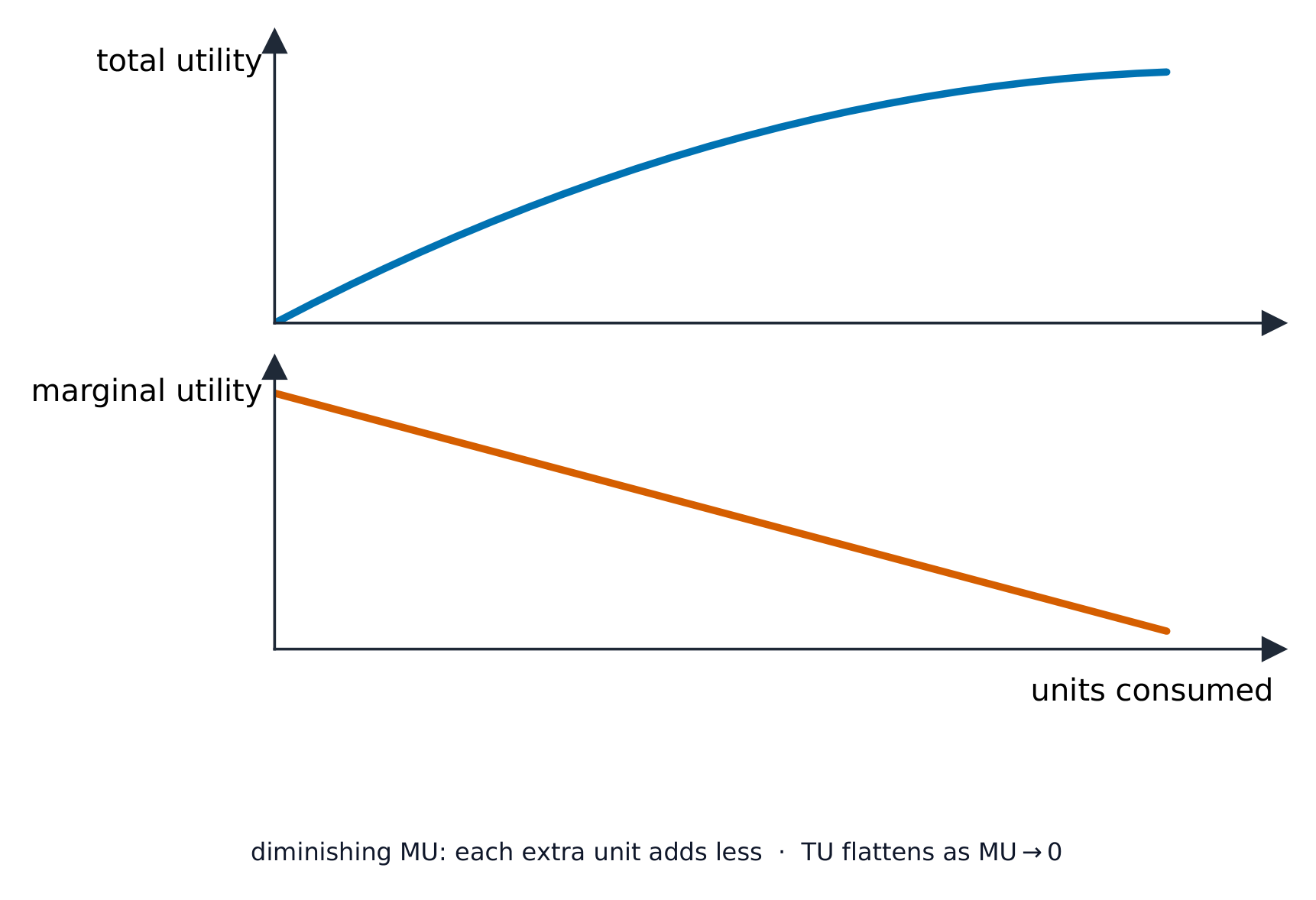
utility 效用 is the satisfaction you get from consuming a good. marginal utility 边际效用 is the extra utility from one more unit.
The law of diminishing marginal utility 边际效用递减 says each extra unit gives less extra satisfaction than the one before. Because later units are worth less to you, you will only buy them at a lower price. This is why the demand curve slopes downward.
supply 供给 is the quantity of a good that producers 生产者 are willing and able to sell at each price in a period of time.
The law of supply says: when the price rises, the quantity supplied 供给量 rises. Higher prices mean more profit 利润, so firms make more. So the supply curve 供给曲线 slopes upward.
What shifts the supply curve
A change in the good's own price is a movement along the supply curve. Other causes shift the whole curve:
costs of production 生产成本 — if wages, raw materials or rent get dearer, supply falls.
technology — better machines raise supply.
a subsidy 补贴 (government payment to producers) raises supply; an indirect tax lowers it.
the number of firms 企业 in the market, and weather (for farm goods).
Individual and market supply
The market supply 市场供给 is found by adding up the quantity all firms will sell at each price.
Source: Cambridge International syllabus · แหล่งที่มา: หลักสูตร Cambridge International
English
Supply shifts right: P falls, Q rises
price elasticity of demand 需求价格弹性 (PED) measures how much the quantity demanded responds when the price changes.
$$\text{PED} = \frac{\%\ \text{change in quantity demanded}}{\%\ \text{change in price}}$$
PED is normally negative (because of the law of demand), but we usually look at the size and drop the minus sign.
Worked example. The price of a good rises by 10% and the quantity demanded falls by 25%. Find the PED and classify the demand.
$$\text{PED} = \frac{-25}{10} = -2.5$$
Ignoring the minus sign, $2.5 > 1$, so demand is elastic — quantity responded much more than the price did.
Value
Name
Meaning
more than 1
elastic 富有弹性
quantity responds a lot
less than 1
inelastic 缺乏弹性
quantity responds a little
equal to 1
unit elastic 单位弹性
quantity changes by the same % as price
0
perfectly inelastic 完全无弹性
quantity does not change at all
infinity
perfectly elastic 完全有弹性
any price rise sends demand to zero
What makes demand elastic or inelastic
the number and closeness of substitutes (more substitutes → more elastic).
whether the good is a necessity 必需品 (inelastic) or a luxury 奢侈品 (elastic).
the share of income spent on the good (a large share → more elastic).
time — demand is more elastic in the long run, when buyers can find other options.
habit or addiction makes demand inelastic.
PED and total revenue
total revenue 总收益 is the money a firm earns: $\text{TR} = \text{price} \times \text{quantity}$. PED tells a firm what happens to revenue when it changes the price:
If demand is…
price rises
price falls
inelastic
total revenue rises
total revenue falls
elastic
total revenue falls
total revenue rises
unit elastic
total revenue stays the same
total revenue stays the same
This is useful to firms (how to price for more revenue) and to governments 政府 (a tax on an inelastic good, like petrol, raises a lot of revenue without cutting sales much).
Source: Cambridge International syllabus · แหล่งที่มา: หลักสูตร Cambridge International
English
Equilibrium
The market is in equilibrium 均衡 where the demand curve crosses the supply curve. Here demand equals supply. This gives the equilibrium price 均衡价格 and the equilibrium quantity 均衡数量. There is no pressure for the price to change.
Disequilibrium
When the price is not at equilibrium, the market is in disequilibrium 非均衡:
if the price is too low, there is excess demand 超额需求 (a shortage 短缺). Buyers compete, so the price is pushed up.
if the price is too high, there is excess supply 超额供给. Sellers cannot sell everything, so the price is pushed down.
In both cases the price moves back to equilibrium. This shows the price mechanism doing its jobs of signalling, rationing and giving an incentive.
How shifts change the equilibrium
Change
Effect on price
Effect on quantity
demand rises (shifts right)
rises
rises
demand falls (shifts left)
falls
falls
supply rises (shifts right)
falls
rises
supply falls (shifts left)
rises
falls
Demand and supply in different markets
The same analysis works in many markets:
in product markets 产品市场, demand and supply set the price of goods and services.
in factor markets 要素市场, they set the price of factors — for example, the demand for and supply of labour set the wage 工资.
in the foreign exchange market 外汇市场, the demand for and supply of a currency set the exchange rate 汇率 (the price of one currency in terms of another).
Where demand meets supply sets the equilibrium price and quantity. · จุดที่ อุปสงค์ ตัดกับ อุปทาน จะกำหนดราคาและปริมาณดุลยภาพ
Explore · สำรวจ
Finding the equilibrium price · หาจุดดุลยภาพของราคา
Shift demand or supply and watch the equilibrium price and quantity move to where the two lines cross. · ย้าย Demand หรือ Supply แล้วดูว่า ดุลยภาพ ราคาและปริมาณเคลื่อนที่ไปที่จุดตัดกันของเส้นทั้งสอง
Source: Cambridge International syllabus · แหล่งที่มา: หลักสูตร Cambridge International
English
consumer surplus 消费者剩余 is the gain to buyers. It is the difference between the most a consumer was willing to pay and the price actually paid. On a diagram it is the area below the demand curve and above the price line.
producer surplus 生产者剩余 is the gain to sellers. It is the difference between the price a producer receives and the lowest price the producer would have accepted. On a diagram it is the area above the supply curve and below the price line.
How they change:
if demand rises, the price and quantity rise, so producer surplus rises and consumer surplus usually rises too.
if supply rises, the price falls and quantity rises, so consumer surplus rises.
a higher price (with the curves fixed) raises producer surplus but lowers consumer surplus.
Together, consumer surplus plus producer surplus is the total welfare 福利 (gain to society) from the market. It is largest at the free-market equilibrium.
Source: Cambridge International syllabus · แหล่งที่มา: หลักสูตร Cambridge International
English
A free market often gives a good result, but not always. market failure 市场失灵 is when the market does not allocate 配置 (share out) resources efficiently — too much or too little of a good is made. Then the government may step in.
There are several reasons for market failure.
Externalities
An externality 外部性 is a cost or a benefit that falls on a third party 第三方 — someone who is not the buyer or the seller.
a negative externality 负外部性 is an external cost 外部成本 paid by others, like the pollution from a factory. The social cost 社会成本 (the cost to all of society) is bigger than the private cost 私人成本 (the cost to the producer). When people ignore the external cost, the market makes too much of the good.
a positive externality 正外部性 is an external benefit 外部收益 enjoyed by others, like the protection that vaccination gives to everyone. Here the market makes too little, because buyers ignore the benefit to others.
Public goods
A public good 公共物品 (like street lighting or national defence) has non-rivalry 非竞争性 and non-excludability 非排他性. Because non-payers cannot be shut out, there is a free-rider problem 搭便车问题, so private firms make no profit and supply none. The market fails completely.
Merit and demerit goods
A merit good 优值品 (like education) is under-consumed; a demerit good 劣值品 (like cigarettes) is over-consumed. People misjudge them because of information failure 信息失灵 — they do not know, or do not use, the true benefit or harm.
Monopoly power
monopoly 垄断 means one firm dominates a market. A firm with monopoly power 垄断势力 can cut output and raise the price above the competitive level. This wastes resources and harms consumers.
Inequality and asymmetric information
the market rewards people who own resources, so it can produce great inequality 不平等 — some people are left with too little to live on.
asymmetric information 信息不对称 is when one side of a deal knows more than the other (a used-car seller knows the faults; the buyer does not). This leads to poor decisions and unfair deals.
The market and where it fails · ตลาดและจุดที่มันล้มเหลว
Supply and demand set the market price and quantity at their intersection. Market failure is when this free-market outcome is not the best one for society. · อุปทานและอุปสงค์กำหนดราคาและปริมาณในตลาดที่จุดตัด ความล้มเหลวของตลาดคือเมื่อผลลัพธ์ของตลาดเสรีนี้ไม่ใช่สิ่งที่ดีที่สุดสำหรับสังคม
Source: Cambridge International syllabus · แหล่งที่มา: หลักสูตร Cambridge International
English
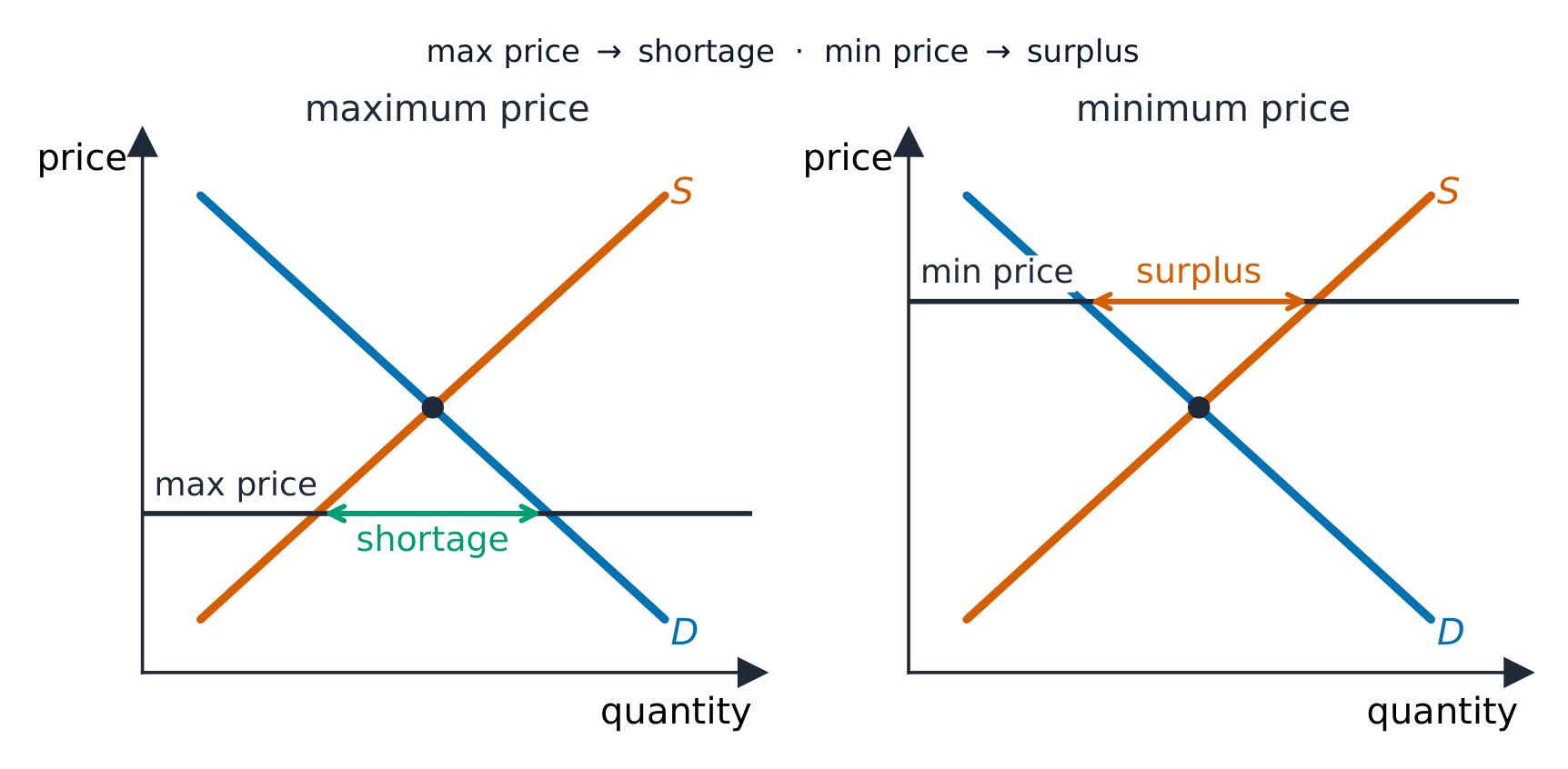
A maximum price creates a shortage
Indirect taxes
An indirect tax 间接税 is a tax on spending. It raises a firm's costs, shifts the supply curve to the left, and so raises the price and cuts the quantity. Governments tax demerit goods (like tobacco) and goods with negative externalities to make people use less.
The incidence of a tax 税收归宿 is who really pays it. This depends on elasticity:
if demand is inelastic 缺乏弹性, consumers pay most of the tax (the price rises by nearly the full tax).
if demand is elastic 富有弹性, producers pay most of the tax (they cannot pass it on).
Subsidies
A subsidy 补贴 is a government payment to producers. It lowers their costs, shifts the supply curve to the right, and so lowers the price and raises the quantity. Subsidies are used for merit goods and goods with positive externalities.
Maximum and minimum prices
a maximum price 最高限价 is a legal top price, set below equilibrium (for example, rent control). Because the price is held down, quantity demanded is greater than quantity supplied, so there is a shortage 短缺.
a minimum price 最低限价 is a legal bottom price, set above equilibrium (for example, a minimum wage, or a floor for farm prices). Because the price is held up, quantity supplied is greater than quantity demanded, so there is excess supply 超额供给.
Buffer stocks
A buffer stock 缓冲库存 is used to steady the price of farm goods. The government buys and stores the good when the price is low, and sells from the store when the price is high. This keeps the price inside a target band.
Regulation, provision and permits
regulation 管制 means rules and laws — bans, age limits, safety standards, or pollution limits.
state provision 政府提供 means the government 政府 supplies a good directly, often free at the point of use (public goods and merit goods like schools and hospitals).
tradable permits 可交易许可证 set a total cap on pollution and give firms permits to pollute. Firms that pollute less can sell spare permits to firms that pollute more. This caps total pollution at the lowest cost.
Government failure
Intervention does not always help. government failure 政府失灵 is when the government's action makes the use of resources worse, not better. Common causes:
poor information, so the government sets the wrong tax or subsidy.
high cost of running the policy.
unintended results — for example, a maximum price can create an illegal black market 黑市.
decisions made for political reasons rather than for efficiency.
Worked example. A government puts a £2 per-packet tax on cigarettes, whose demand is very price-inelastic. Who really pays it, and what does that mean for the policy's two aims? The incidence falls mainly on whichever side is less able to respond - the more inelastic one. Because smokers keep buying almost the same quantity as the price rises, producers can pass most of the tax on, so consumers bear most of the incidence: the price might rise by about £1.80, with producers absorbing only about £0.20. That creates the tension the question is really testing. As a revenue raiser the tax succeeds: quantity barely falls, so revenue is large and steady. As a way of cutting consumption it largely fails - for exactly the same reason. And because poorer smokers spend a larger share of their income on it, the tax is regressive. Argue from elasticity to incidence, then judge each aim separately.
Governments step into markets when the free-market equilibrium isn't the best outcome for society. · รัฐบาลเข้าไปแทรกแซงตลาดเมื่อจุดดุลยภาพของตลาดเสรีไม่ใช่ผลลัพธ์ที่ดีที่สุดสำหรับสังคม
Source: Cambridge International syllabus · แหล่งที่มา: หลักสูตร Cambridge International
English
It helps to separate two ideas:
income 收入 is a flow 流量 — money received over a period, such as wages, rent and interest.
wealth 财富 is a stock 存量 — the value of assets owned at a point in time, such as houses, shares and savings.
Wealth produces income (savings earn interest), and income can be saved to build wealth, so the two are linked. Inequality has many causes: differences in skills and wages, the ownership of wealth, inheritance, and unemployment.
Policies to reduce inequality
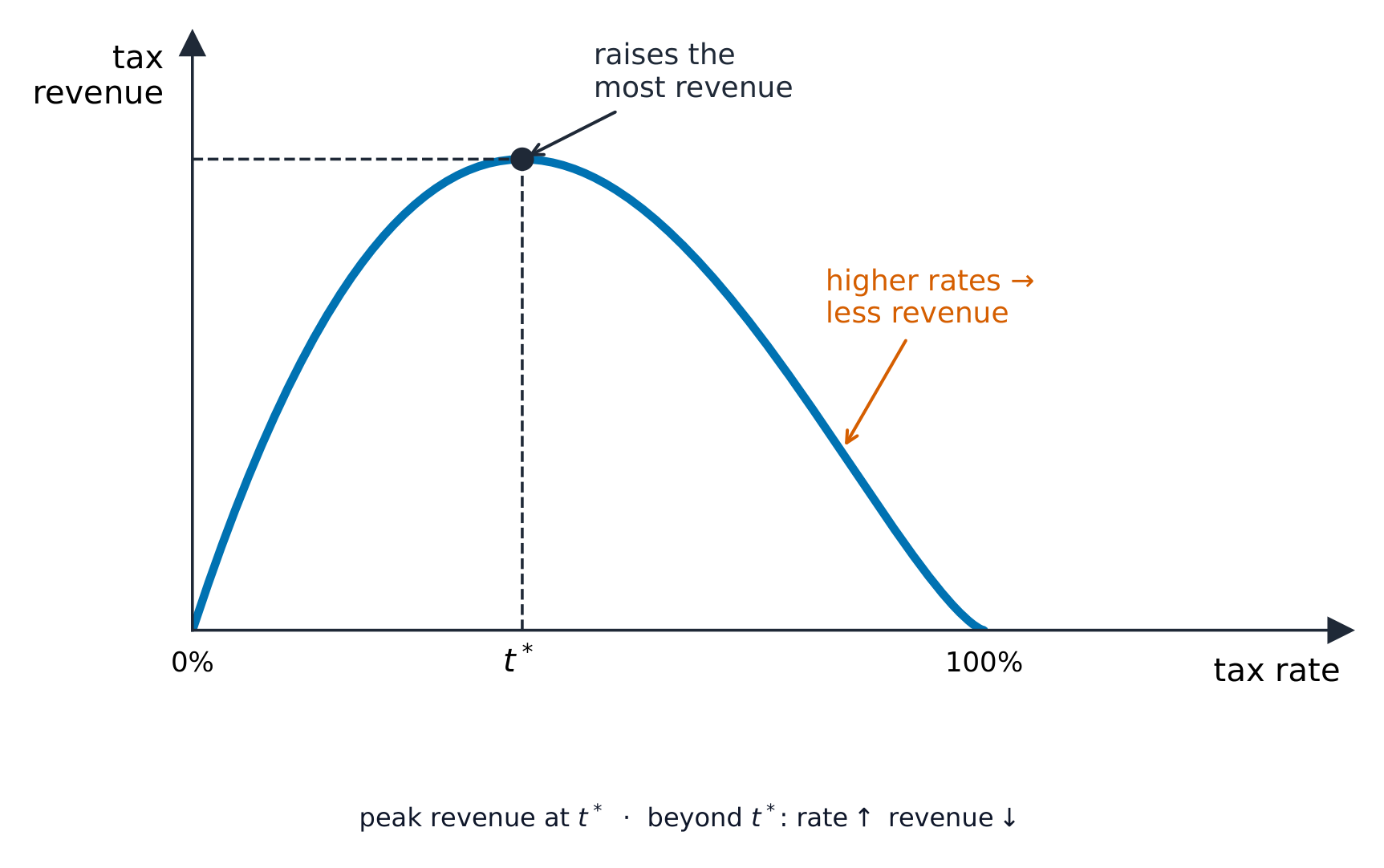
a progressive tax 累进税 takes a larger percentage 百分比 from higher incomes than from lower incomes. This narrows the gap after tax.
benefits 福利金 (also called transfer payments 转移支付) are money paid by the government to the poor, the old, and the unemployed.
state provision of free services, like education and health care, raises the real living standards of poorer people.
Together these policies bring about redistribution 再分配 — moving income and wealth from richer to poorer people. But there is a trade-off 取舍: very high taxes and large benefits may weaken the incentive 激励 to work and to invest.
Macroeconomics 宏观经济学 looks at the whole economy at once: its total output, its jobs, and its prices. This handout covers how we measure the economy and the main problems it can face.
Source: Cambridge International syllabus · แหล่งที่มา: หลักสูตร Cambridge International
English
To judge how an economy is doing, we measure its national income 国民收入 — the total value of everything it produces in a year.
gross domestic product 国内生产总值 (GDP) is the value of all goods and services made inside a country in a year.
gross national income 国民总收入 (GNI) is GDP plus the income a country's people and firms earn abroad, minus income foreigners earn inside it.
Two important differences:
nominal 名义 values are measured at current prices. real 实际 values are adjusted to remove the effect of rising prices, so they show the true change in output. Always compare real values over time.
total values cover the whole country. per capita 人均 values are divided by the population, so they show the average per person.
Uses and limitations
National income is used to measure the standard of living 生活水平 and to compare countries. But it has limits:
it ignores the distribution 分配 of income — a high average can hide great inequality.
it leaves out unpaid work (housework) and the informal economy 非正规经济 (hidden, untaxed activity).
it says nothing about pollution, leisure time, or health.
So a higher GDP per capita usually means a better life, but not always.
ไทย
เพื่อประเมินสถานะของเศรษฐกิจ เราใช้วัด national income (รายได้แห่งชาติ) ซึ่งเป็นมูลค่ารวมของสิ่งที่ประเทศนั้นๆ ผลิตได้ในหนึ่งปี
National income (GDP) คือมูลค่าของสินค้าและบริการทั้งหมดที่ประเทศผลิตได้ในหนึ่งปี
Source: Cambridge International syllabus · แหล่งที่มา: หลักสูตร Cambridge International
English
The circular flow of income
The circular flow of income 收入循环流 shows money moving around the economy. Households 家庭 supply factors of production to firms 企业 and receive income (wages, rent, interest, profit). They spend that income on goods and services, and the money flows back to firms.
Money also leaves and enters this flow:
leakages 漏出 take money out of the flow: saving 储蓄, taxation 税收, and spending on imports 进口.
injections 注入 put money into the flow: investment 投资, government spending 政府支出, and exports 出口.
The flow is in equilibrium 均衡 when total injections equal total leakages. If injections are greater, the economy grows; if leakages are greater, it shrinks.
A closed economy 封闭经济 has no trade with other countries. An open economy 开放经济 trades, so it has exports and imports.
ไทย
The circular flow of income
circular flow of income (การไหลเวียนของรายได้) แสดงการหมุนเวียนของเงินในระบบเศรษฐกิจ Households (ครัวเรือน) จัดหาปัจจัยการผลิตให้กับ firms (กิจการ) และรับรายได้ (ค่าจ้าง, ค่าเช่า, ดอกเบี้ย, กำไร) พวกเขาใช้จ่ายรายได้นั้นบนสินค้าและบริการ และเงินก็ไหลกลับไปยังกิจการ
closed economy (เศรษฐกิจปิด) ไม่มีการค้ากับประเทศอื่น open economy (เศรษฐกิจเปิด) มีการค้า จึงมีทั้งการส่งออกและการนำเข้า
Explore · สำรวจ
Injections & leakages · injections & leakages
Money loops between households and firms. Injections grow national income, leakages shrink it; they are equal at equilibrium. · เงินวนระหว่างครัวเรือนและกิจการ Injections เพิ่มรายได้แห่งชาติ Leakages ลดรายได้;它们在 Equilibrium相等的
Explore · สำรวจ
The circular flow of income · วงจรไหลเวียนของรายได้
Money flows in a loop: households earn income from firms, then spend it back on the firms' goods. Step round the cycle. · เงินไหลเป็นวง: ครัวเรือนได้รับรายได้จากกิจการ แล้วใช้จ่ายกลับไปในสินค้าของกิจการ รอบวงจร
Source: Cambridge International syllabus · แหล่งที่มา: หลักสูตร Cambridge International
English
Aggregate demand and supply
Aggregate demand
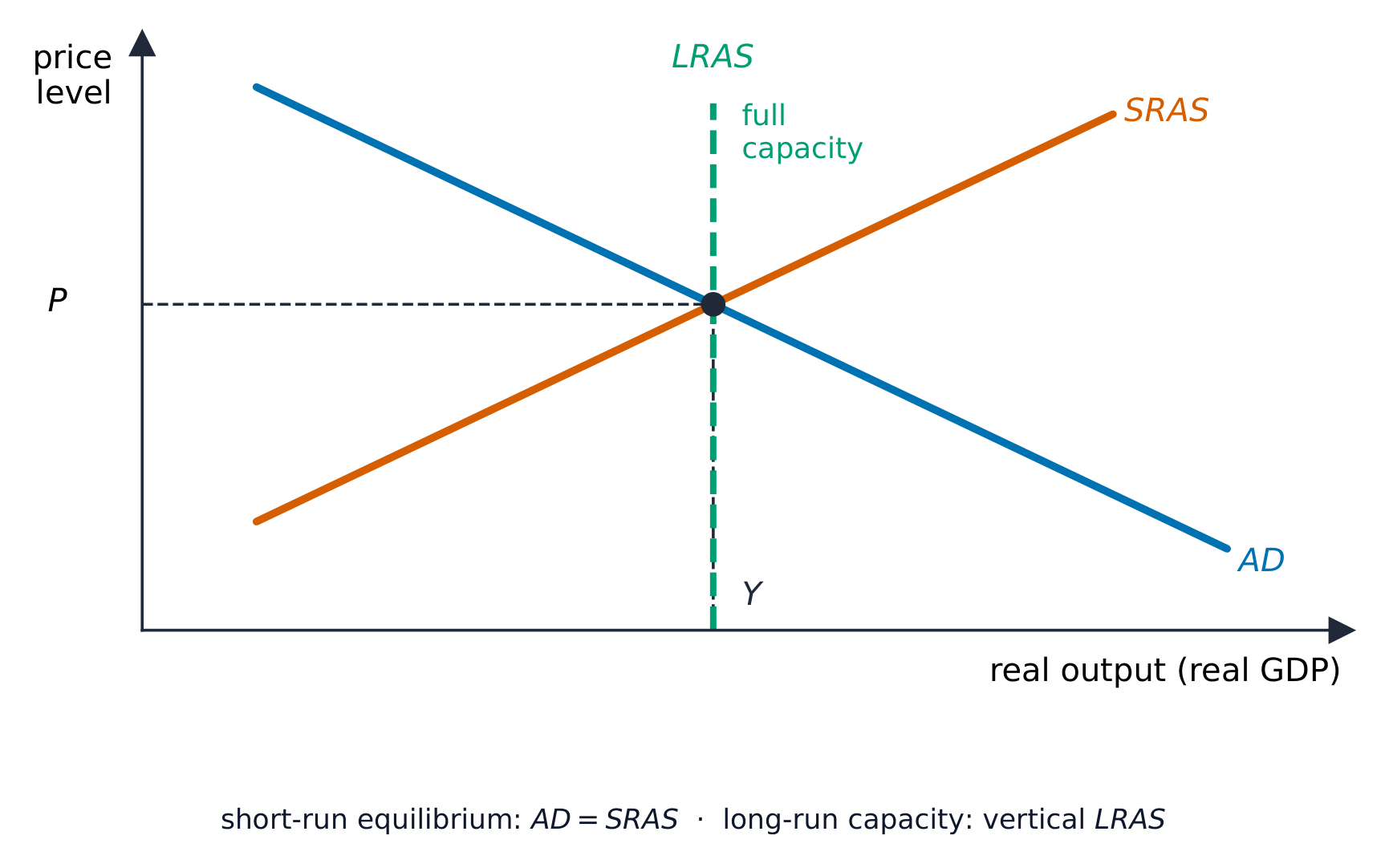
aggregate demand 总需求 (AD) is the total spending on a country's goods and services at each price level. It has four parts:
$$AD = C + I + G + (X - M)$$
C is consumption 消费 — spending by households.
I is investment — spending by firms on capital.
G is government spending.
(X − M) is net exports 净出口 — exports minus imports.
The AD curve slopes downward: a lower price level means higher real spending, so a greater real output is demanded. AD shifts when any of its four parts changes (for example, a tax cut raises C).
Aggregate supply
aggregate supply 总供给 (AS) is the total output firms are willing to make at each price level.
short-run aggregate supply 短期总供给 (SRAS) slopes upward. In the short run, higher prices make production more profitable, so firms supply more. SRAS shifts when costs change (wages, raw materials, taxes).
long-run aggregate supply 长期总供给 (LRAS) shows the economy's full productive capacity 生产能力. It shifts only when the quantity or quality of factors changes.
Macroeconomic equilibrium
macroeconomic equilibrium 宏观经济均衡 is where AD crosses AS. It sets the price level 价格水平 and the real output 实际产出 of the economy. A shift in AD or AS changes both.
เส้น AD ลาดลง: ระดับราคาลดลงทำให้การใช้จ่ายจริงสูงขึ้น ดังนั้นความต้องการผลผลิตจริงจึงเพิ่มขึ้น AD เลื่อนเมื่อส่วนประกอบใดส่วนหนึ่งเปลี่ยนไป (เช่น การลดภาษีทำให้ C เพิ่มขึ้น)
macroeconomic equilibrium (สมดุลทางเศรษฐศาสตร์มหภาค) คือจุดที่ AD ตัดกับ AS จุดนี้กำหนด price level (ระดับราคา) และ real output (ผลผลิตจริง) ของเศรษฐกิจ การเลื่อนของ AD หรือ AS จะส่งผลต่อทั้งสองอย่าง
Source: Cambridge International syllabus · แหล่งที่มา: หลักสูตร Cambridge International
English
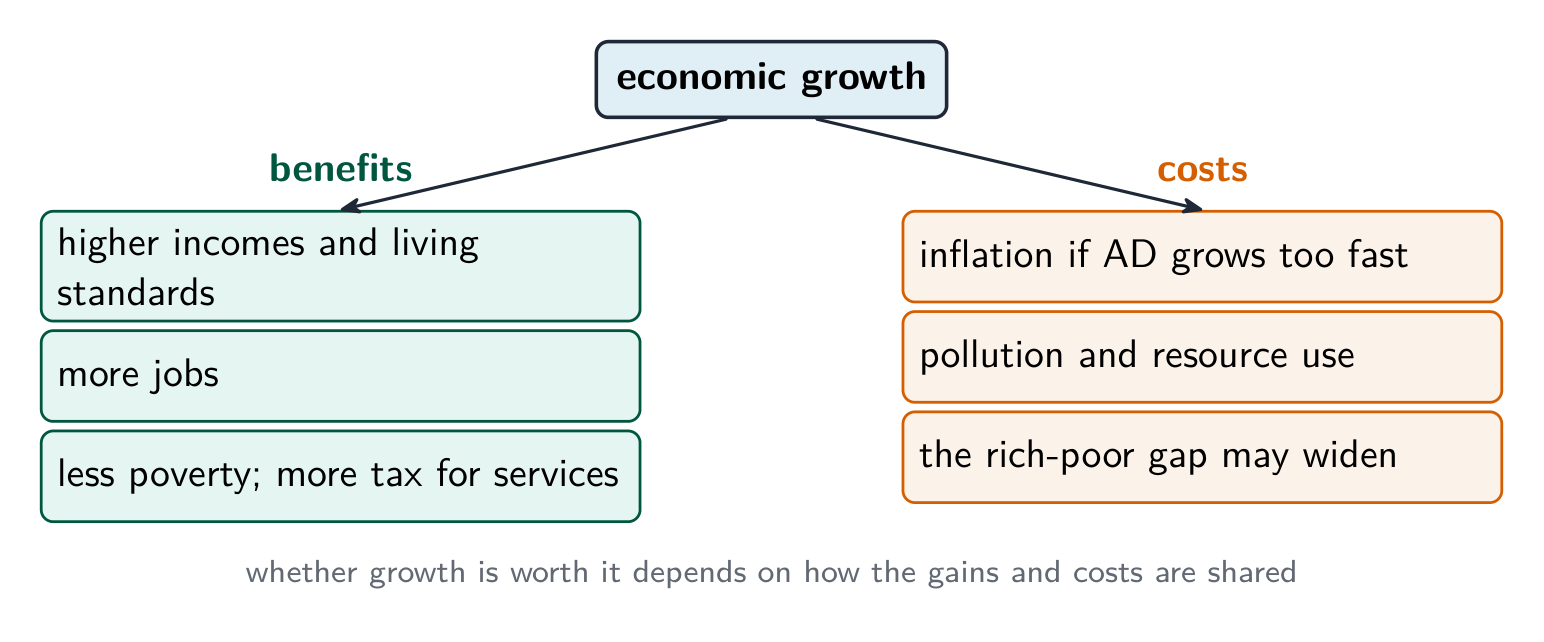
economic growth 经济增长 is a rise in a country's real output (real GDP) over time.
actual growth 实际增长 is the rise in output that really happens (a movement to a point further out, or from inside the LRAS towards it).
potential growth 潜在增长 is the rise in the economy's capacity (the LRAS shifting outward).
Growth is caused by more or better factors of production: a bigger or more skilled workforce, more investment in capital, new technology, and higher productivity 生产率 (output per worker).
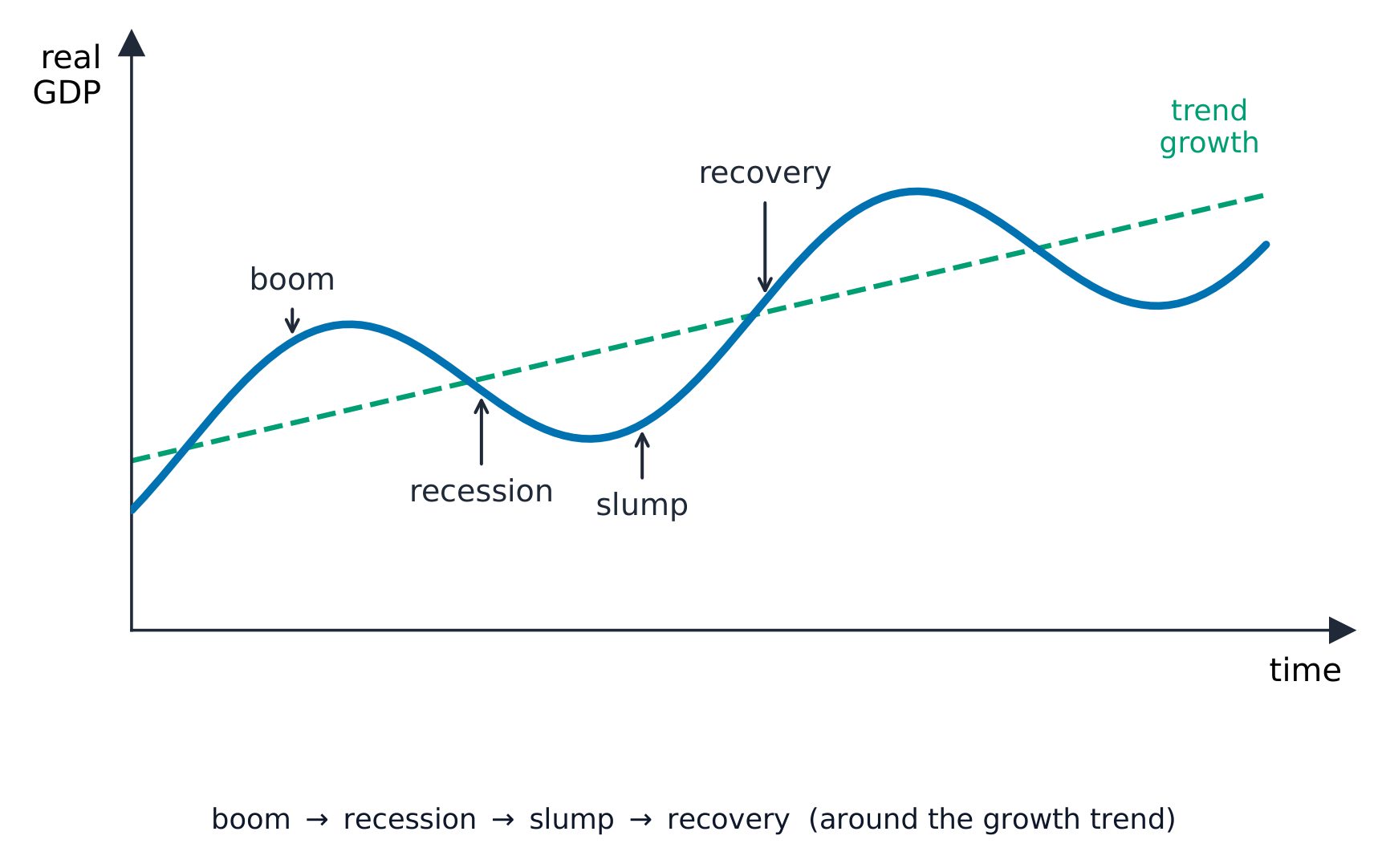
The business cycle
Real output does not grow smoothly. The business cycle 经济周期 (also called the trade cycle) is the up-and-down pattern of output over the years. It has four phases: boom 繁荣 (fast growth), recession 衰退 (falling output), slump 萧条 (the low point), and recovery 复苏.
Economic growth shifts the frontier out · การเติบโตทางเศรษฐกิจทำให้เส้น PPF ขยับออกด้านนอก
Growth means the economy can produce more of BOTH goods — the whole frontier moves outward as resources or technology improve. · การเติบโตหมายถึงเศรษฐกิจสามารถผลิตสินค้าทั้งสองชนิดได้มากขึ้น – เส้นโค้งทั้งหมดเคลื่อนย้ายออกเมื่อทรัพยากรหรือเทคโนโลยีดีขึ้น
Source: Cambridge International syllabus · แหล่งที่มา: หลักสูตร Cambridge International
English
unemployment 失业 means people who are able and willing to work, and are looking for a job, but cannot find one.
Measuring unemployment
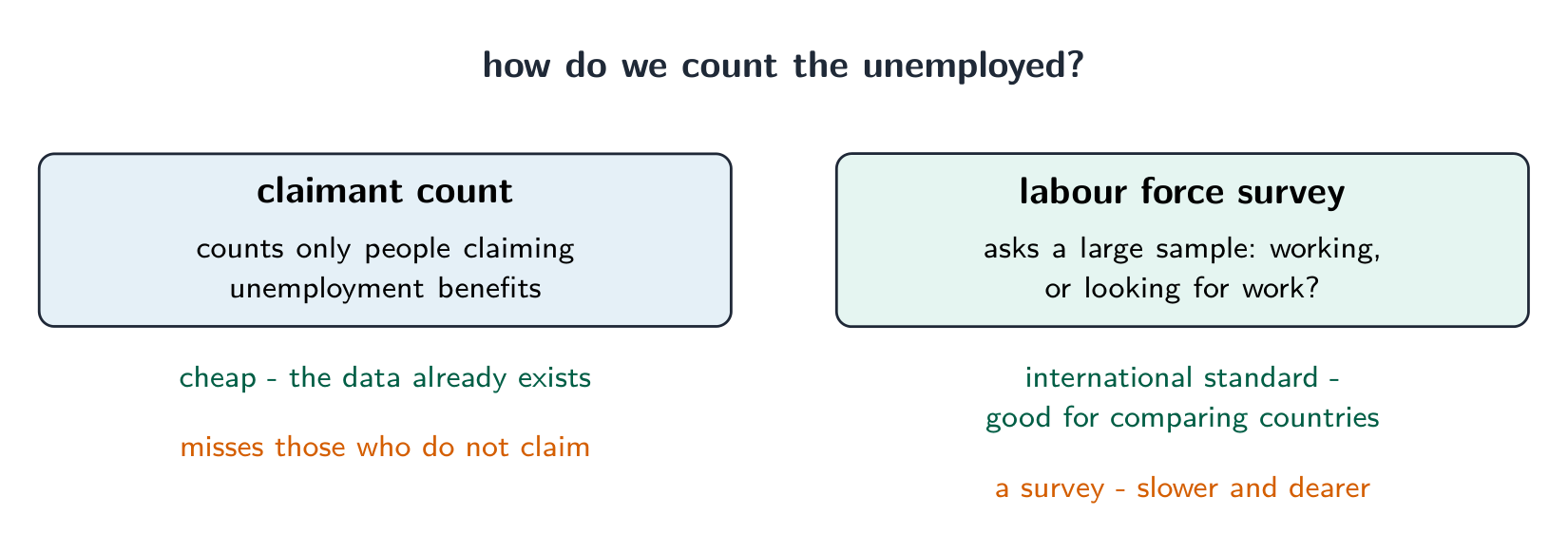
the claimant count 申领救济人数 counts only people claiming unemployment benefits. It is cheap but misses those who do not claim.
the labour force survey 劳动力调查 asks a large sample whether they are working or seeking work. It follows an international standard, so it is better for comparing countries. The labour force 劳动力 is everyone working or looking for work.
Types and causes
frictional unemployment 摩擦性失业 — short-term, while people move between jobs.
structural unemployment 结构性失业 — when an industry declines and workers' skills no longer match the jobs available.
cyclical unemployment 周期性失业 — caused by low AD in a recession. This is usually the largest type.
seasonal unemployment 季节性失业 — when work is only available at certain times of the year (such as farming or tourism).
Consequences
Unemployment wastes output (the economy produces inside its PPC), lowers incomes, and costs the government (more benefits, less tax). It also harms families and can raise crime and ill health.
Unemployment in the labour market · การว่างงานในตลาดแรงงาน
If the wage is stuck ABOVE the equilibrium, more workers want jobs than firms will hire — that gap is unemployment. · หากค่าจ้างติดอยู่เหนือจุดสมดุล มีคนต้องการงานมากกว่าที่บริษัทรับเข้า – ช่องว่างนี้คือการว่างงาน
Source: Cambridge International syllabus · แหล่งที่มา: หลักสูตร Cambridge International
English
Inflation, deflation and disinflation
inflation 通货膨胀 is a sustained rise in the general price level. Money then buys less, so its purchasing power 购买力 falls.
deflation 通货紧缩 is a sustained fall in the general price level.
disinflation 反通货膨胀 is when inflation is still positive but is slowing down (prices rise, but more slowly).
The price level is measured with the consumer price index 消费者价格指数 (CPI). A typical household's spending is used to build a "basket" of goods. Each good is given a weight 权重 for how much is spent on it, and the change in the basket's cost from year to year is the inflation rate:
$$\text{inflation rate} = \frac{\text{change in index}}{\text{starting index}} \times 100\%.$$
Worked example. A country's CPI rises from $100$ to $104$ over one year, then to $107$ the year after. Find the inflation rate in each year.
Year 1: $\dfrac{104 - 100}{100} \times 100\% = 4\%$. Year 2: $\dfrac{107 - 104}{104} \times 100\% = 2.9\%$.
Notice that prices are still rising in year 2, just more slowly — this fall in the inflation rate (from $4\%$ to $2.9\%$) is disinflation, not deflation.
Worked example. A worker's wage rises from $\text{\pounds} 500$ to $\text{\pounds} 520$ a week (a $4\%$ rise) while the CPI rises by $4\%$. What happens to the real wage?
Money (nominal) pay is up $4\%$, but prices are also up $4\%$, so the real wage — what the pay can actually buy — is unchanged. A pay rise only raises living standards if it beats inflation.
Causes of inflation
demand-pull inflation 需求拉动型通货膨胀 — AD rises faster than AS, so "too much money chases too few goods".
cost-push inflation 成本推动型通货膨胀 — firms' costs rise (wages or raw materials), so they raise prices, shifting SRAS to the left.
Consequences
Inflation lowers purchasing power, especially for people on fixed incomes. It creates uncertainty, can make a country's exports dearer, and helps borrowers but harms savers. Deflation sounds good but can be harmful: people delay buying (waiting for lower prices), so AD falls, firms cut output, and unemployment rises.
Aggregate demand and supply · อุปสงค์รวมและอุปทานรวม
The overall price level sits where aggregate demand meets aggregate supply — a shock to either moves prices and output. · ระดับราคารวมอยู่ที่จุดที่อุปสงค์รวมตัดกับอุปทานรวม – การกระแทก (shock) ต่อ任何一方จะส่งผลต่อราคาและผลผลิต
state the macroeconomic policy objectives: stable low inflation, full employment, economic growth, balance of payments stability, redistribution of income
Source: Cambridge International syllabus · แหล่งที่มา: หลักสูตร Cambridge International
English
A government usually has five main aims:
price stability 物价稳定 — low and steady inflation 通货膨胀 (often a target of about 2% a year).
full employment 充分就业 — jobs for almost everyone who wants to work.
economic growth 经济增长 — a rising real output over time.
balance of payments 国际收支 stability — not importing far more than the country exports for years on end.
redistribution of income 收入再分配 — narrowing the gap between rich and poor.
Conflicts between objectives
The aims can conflict 冲突 — reaching one can hurt another:
growth versus inflation: fast growth raises aggregate demand 总需求, which can pull prices up.
growth versus the balance of payments: as incomes rise, people buy more imports, worsening the trade balance.
unemployment versus inflation: cutting unemployment by raising demand can cause more inflation.
growth versus the environment: more output often means more pollution.
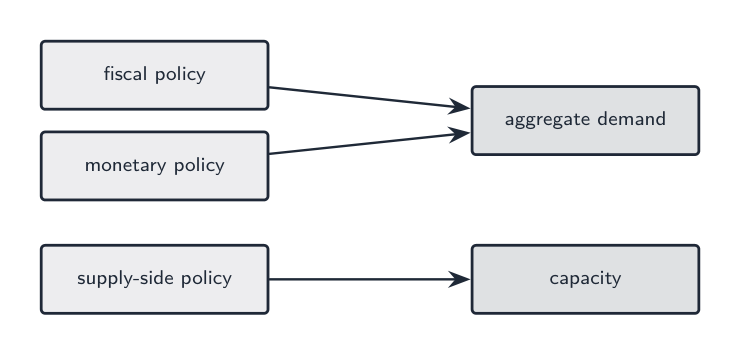
The government has three sets of tools. Fiscal and monetary policy are demand-side policies 需求侧政策 (they work on AD). Supply-side policy works on aggregate supply 总供给.
Source: Cambridge International syllabus · แหล่งที่มา: หลักสูตร Cambridge International
English
fiscal policy 财政政策 is the use of government spending and taxation to influence the economy.
The budget 预算 compares the two:
a budget deficit 预算赤字 is when spending is greater than tax revenue. The government must borrow, adding to the national debt 国债.
a budget surplus 预算盈余 is when tax revenue is greater than spending.
Types of tax
a direct tax 直接税 is paid straight to the government on income or profit (income tax, corporation tax).
an indirect tax 间接税 is a tax on spending (added to the price of goods).
Taxes are also grouped by how the rate changes with income:
Type
How it works
progressive tax 累进税
the rate rises as income rises (the rich pay a larger share)
proportional tax 比例税
the rate stays the same at every income
regressive tax 累退税
the rate falls as income rises (the poor pay a larger share)
Using fiscal policy
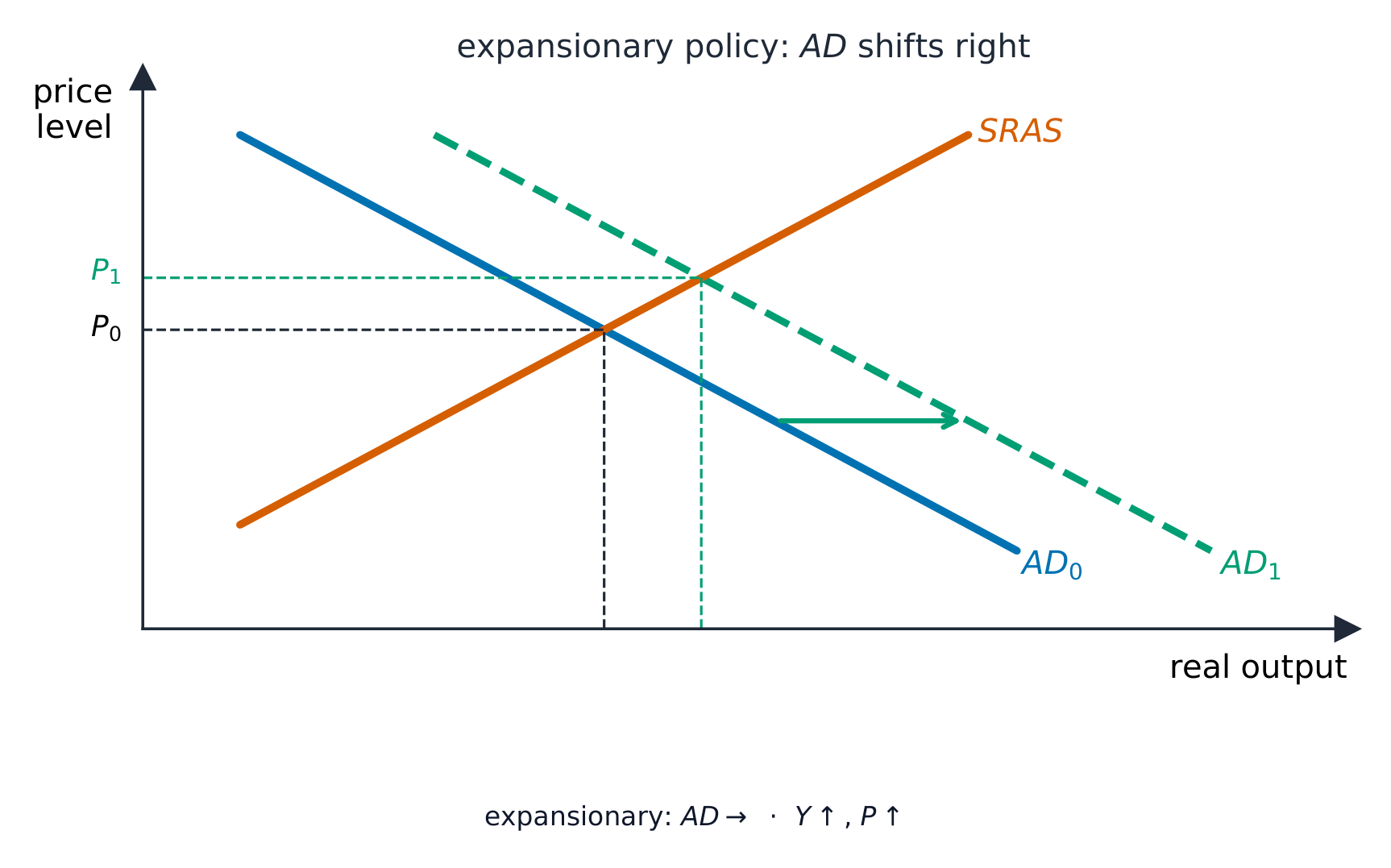
expansionary 扩张性 fiscal policy raises government spending or cuts taxes. This raises AD, to fight a recession and unemployment.
contractionary 紧缩性 fiscal policy cuts spending or raises taxes. This lowers AD, to fight inflation.
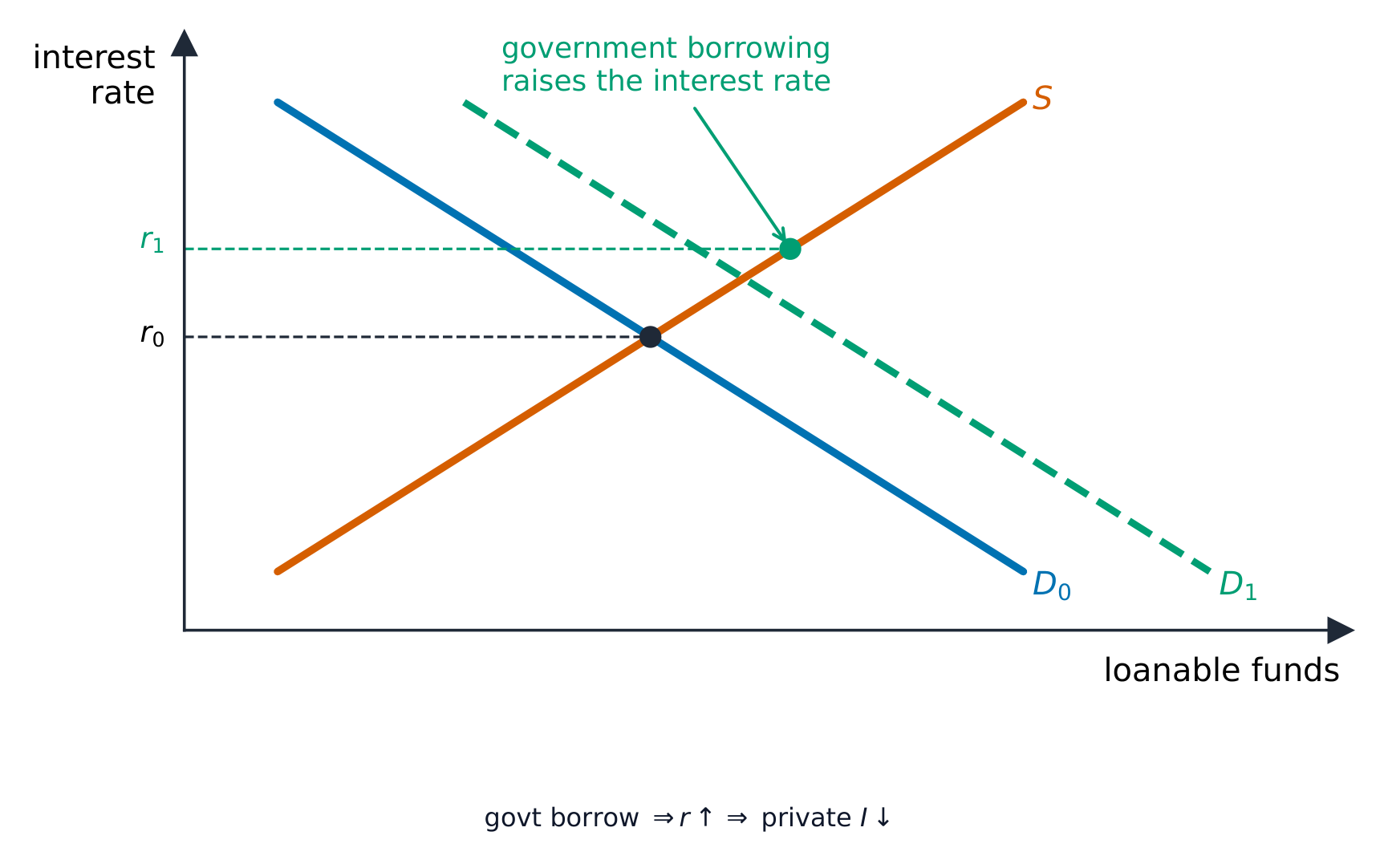
Effectiveness. Fiscal policy can act fast on AD, but it has problems: time lags (a budget is set once a year), large deficits and debt, and crowding out 挤出效应 — when heavy government borrowing pushes up interest rates and reduces private investment.
นโยบายการเงินแบบขยายตัว เพิ่มการใช้จ่ายของรัฐบาลหรือลดภาษี สิ่งนี้จะเพิ่ม AD เพื่อต่อต้านภาวะ recession และการว่างงาน.
นโยบายการเงินแบบหดตัว ลดการใช้จ่ายหรือเพิ่มภาษี สิ่งนี้จะลด AD เพื่อต่อต้านเงินเฟ้อ.
นโยบายการเงินหรือการคลังแบบขยายตัวจะเลื่อน AD ไปทางขวา เพิ่มผลผลิตและระดับราคา; นโยบายแบบหดตัวจะทำในทางตรงกันข้าม.
ประสิทธิภาพ. นโยบายการเงินสามารถกระทำต่อ AD ได้รวดเร็ว แต่มีปัญหา: ช่วงเวลาตอบสนอง (งบประมาณกำหนดปีละครั้ง), ขาดทุนและหนี้สูง, และการ crowding out — เมื่อการกู้ยืมของรัฐบาลหนักหน่วงดันอัตราดอกเบี้ยสูงขึ้นและลดการลงทุนภาคเอกชน.
Explore · สำรวจ
Fiscal policy shifts AD · นโยบายการคลังทำให้ AD เปลี่ยนแปลง
Government spending and taxes move aggregate demand (AD). Drag AD to see real output and the price level change. · ค่าใช้จ่ายของรัฐบาลและภาษีทำให้ อุปสงค์รวม (AD) เคลื่อนไหว ลาก AD เพื่อดูผลผลิตจริงและระดับราคาเปลี่ยนแปลงอย่างไร
Source: Cambridge International syllabus · แหล่งที่มา: หลักสูตร Cambridge International
English
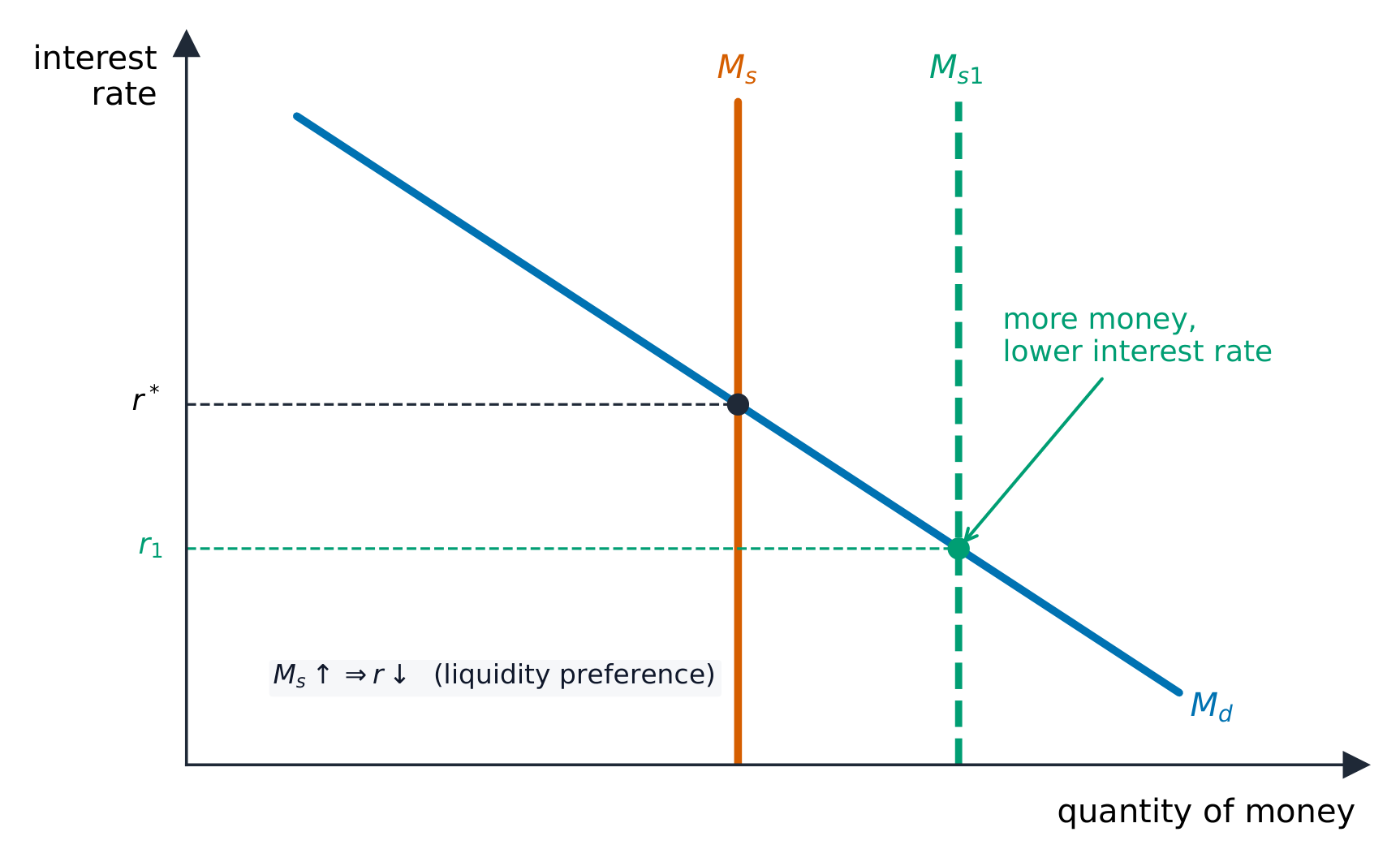
monetary policy 货币政策 is run by the central bank 中央银行. Its main tool is the interest rate 利率, but it can also change the money supply 货币供给 or influence the exchange rate 汇率.
The transmission mechanism
The transmission mechanism 传导机制 is how a change in the interest rate reaches the wider economy. If the central bank raises the interest rate:
borrowing becomes dearer, so households and firms spend and invest less.
saving is rewarded, so people spend less.
the currency tends to rise, so exports fall.
All of these lower AD, which slows inflation. A cut in the interest rate does the opposite, raising AD.
Effectiveness. Monetary policy is flexible (the rate can change at any time), but it works with a time lag of a year or more. In a deep slump, even very low rates may not make worried firms and households borrow.
Source: Cambridge International syllabus · แหล่งที่มา: หลักสูตร Cambridge International
English
supply-side policy 供给侧政策 tries to raise the economy's productive capacity 生产能力 — to shift long-run aggregate supply to the right. It aims to make markets work better and raise productivity 生产率.
There are two kinds.
Market-based policies let markets work more freely:
cutting income tax and benefits to strengthen the incentive 激励 to work.
privatisation 私有化 — selling state firms to private owners, who run them for profit.
deregulation 放松管制 — removing rules that block competition.
Interventionist policies use the government directly:
spending on education and training 培训 to raise workers' skills.
spending on infrastructure 基础设施 — roads, ports and broadband.
support for research and new technology.
Effectiveness. Supply-side policy is powerful because it can raise growth and lower inflation at the same time, with no trade-off. But it is slow (education takes years to pay off), costly, and some measures, like cutting benefits, can widen inequality.
Worked example. An economy is in a deep recession with a large output gap, and interest rates are already near zero. Which policy should the government use, and why is the other one weak here? Monetary policy is weak: with the base rate already near zero there is almost no room to cut further, and even cheap credit will not make firms invest when they expect no demand. Fiscal policy is stronger: government spending raises aggregate demand directly, without waiting for anyone to choose to borrow, and the multiplier means each pound spent raises national income by more than a pound as it is re-spent. Weigh the costs against it - a bigger budget deficit and rising debt, plus time lags on large projects. Match the policy to the constraint named in the question: here it is the zero lower bound, and that is precisely what makes fiscal policy the answer.
Source: Cambridge International syllabus · แหล่งที่มา: หลักสูตร Cambridge International
English
international trade 国际贸易 lets countries buy and sell with each other. Trade lets each country specialise 专业化 in what it makes best, so the world makes more in total.
Absolute and comparative advantage
a country has an absolute advantage 绝对优势 in a good if it can make more of it with the same resources than another country.
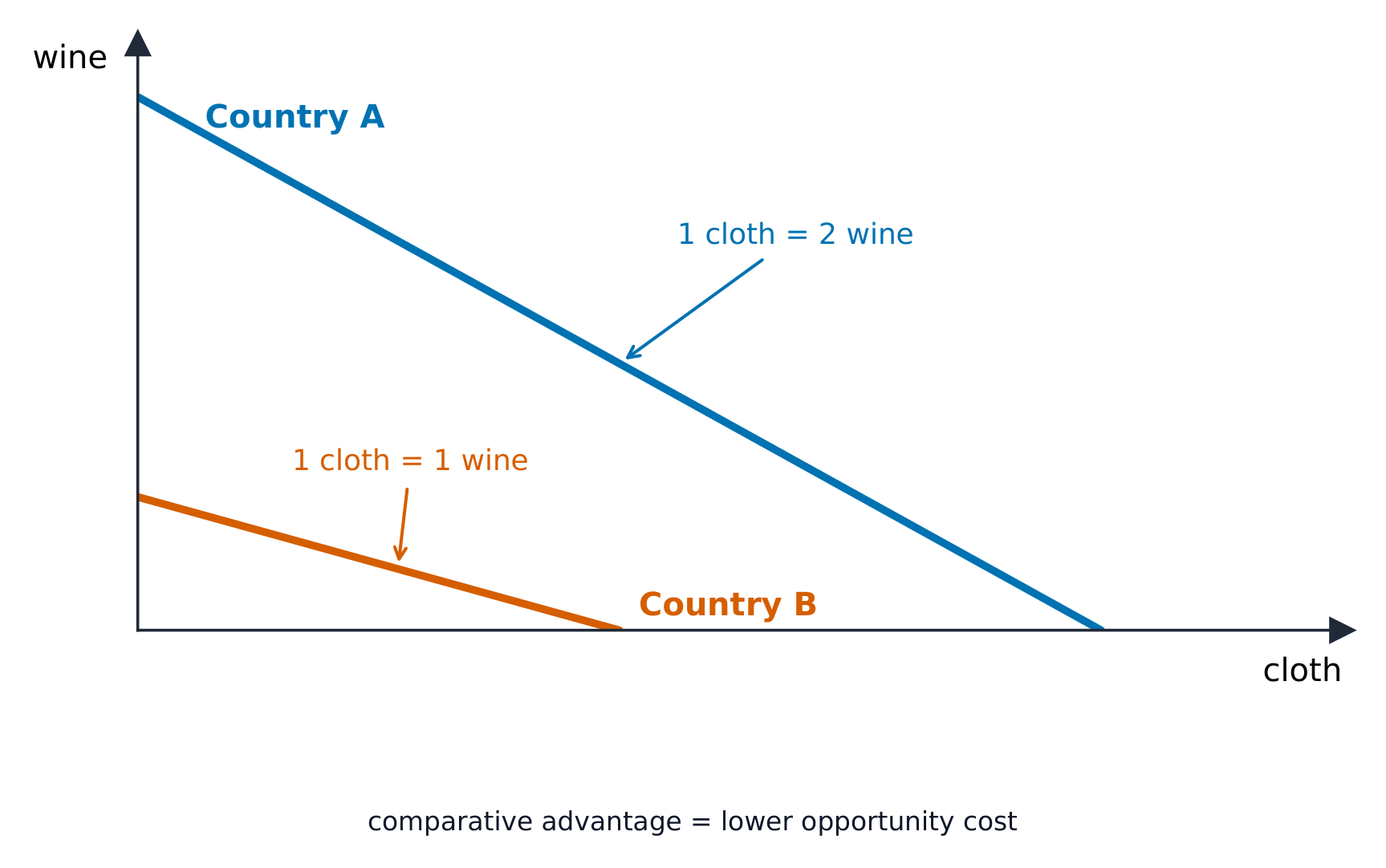
a country has a comparative advantage 比较优势 in a good if it can make it at a lower opportunity cost 机会成本 than another country.
Comparative advantage is the key idea: a country should make the goods it gives up least to produce, and trade for the rest. Look at this example, where each country uses the same resources:
Country
Wine (units)
Cloth (units)
Country A
20
10
Country B
5
5
Country A is better at both (absolute advantage in both). But think about opportunity cost:
in A, making 1 cloth means giving up 2 wine.
in B, making 1 cloth means giving up 1 wine.
So B gives up less to make cloth — B has the comparative advantage in cloth. A has it in wine. If A makes only wine and B makes only cloth, and they trade, both can end up with more than before.
Terms of trade
The terms of trade 贸易条件 measure the price of a country's exports compared with the price of its imports. It is worked out as an index:
$$\text{terms of trade} = \frac{\text{index of export prices}}{\text{index of import prices}} \times 100.$$
If export prices rise faster than import prices, the terms of trade "improve" — the country can buy more imports for the same exports.
Worked example. Over a year, a country's export price index rises from $100$ to $110$, while its import price index rises from $100$ to $105$. Find the new terms of trade.
$$\text{terms of trade} = \frac{110}{105} \times 100 = 104.8.$$
The figure is above $100$, so the terms of trade have improved: each unit of exports now buys about $4.8\%$ more imports than before.
Limits of the theory
The gains are real, but the simple theory assumes no transport costs, no trade barriers, and that costs do not change with output. In the real world these do not fully hold, and specialising in one good is risky if its price falls.
ไทย
international trade อนุญาตให้ประเทศซื้อและขายกัน Trade ทำให้แต่ละประเทศ specialise ในสิ่งที่ผลิตได้ดีที่สุด ดังนั้นโลกจึงผลิตได้มากกว่าในภาพรวม
Country A ดีกว่าในทั้งสองอย่าง (absolute advantage ในทั้งสอง) แต่พิจารณา opportunity cost:
ใน A, การผลิต 1 unit ของผ้าต้องสละ 2 wine
ใน B, การผลิต 1 unit ของผ้าต้องสละ 1 wine
ดังนั้น B สละน้อยกว่าในการผลิตผ้า — B มี comparative advantage ในผ้า A มีในไวน์ หาก A ผลิตไวน์เท่านั้น และ B ผลิตผ้าเท่านั้น แล้วค้าขายกัน ทั้งสอง สามารถมีมากกว่าเดิมได้
Country A ผลิตได้มากกว่าทั้งสองอย่าง แต่ PPC ของมันชันกว่า: สละ 2 wine ต่อ cloth ในขณะที่ B สละเพียง 1, ดังนั้น B จึงมี comparative advantage ในผ้า
Terms of trade
The terms of trade วัดราคาของ exports เทียบกับราคาของ imports. คำนวณเป็น index:
$$\text{terms of trade} = \frac{\text{index of export prices}}{\text{index of import prices}} \times 100.$$
ตัวอย่างวิธีทำ. ในช่วงหนึ่งปี, country's export price index เพิ่มขึ้นจาก $100$ เป็น $110$,与此同时 import price index เพิ่มขึ้นจาก $100$ เป็น $105$. หา new terms of trade
$$\text{terms of trade} = \frac{110}{105} \times 100 = 104.8.$$
ค่าดังกล่าวสูงกว่า $100$, ดังนั้น terms of trade ได้ improved: Each unit of exports ตอนนี้ซื้อได้ประมาณ $4.8\%$ more imports กว่าเดิม
Limits of the theory
Gains นั้นมีจริง nhưng simple theory assumes ไม่มี transport costs, ไม่มี trade barriers, และ costs ไม่เปลี่ยนแปลงตาม output. ในความเป็นจริงสิ่งเหล่านี้ไม่ได้เกิดขึ้น fully, และการ specialising ในสินค้าเดียวมีความเสี่ยงถ้าราคาตก
Explore · สำรวจ
Why countries trade · ทำไมประเทศถึงมีการค้าขาย
Each country specialises where its opportunity cost is lowest, then trades — both can consume beyond their own frontier. · แต่ละประเทศเชี่ยวชาญในพื้นที่ที่มี opportunity cost ต่ำที่สุด แล้วทำการค้า — ทั้งสองฝ่ายสามารถบริโภคเหนือ frontier ของตนเองได้
Source: Cambridge International syllabus · แหล่งที่มา: หลักสูตร Cambridge International
English
protectionism 贸易保护主义 means a government protecting home producers from foreign competition. The main tools:
a tariff 关税 — a tax on imports, which raises their price.
a quota 配额 — a legal limit on the quantity of a good that may be imported.
a subsidy 补贴 to home producers, so they can sell more cheaply than foreign rivals.
an embargo 禁运 — a complete ban on trade with a country or in a good.
administrative barriers 行政壁垒 — extra paperwork and tough standards that make importing hard.
For and against
Arguments for protection include protecting an infant industry 幼稚产业 (a young industry that needs time to grow), saving jobs, and stopping dumping 倾销 (foreign firms selling below cost to destroy local rivals).
Arguments against are strong: protection raises prices for consumers, protects weak firms so they stay inefficient, and can lead to retaliation 报复 — other countries hitting back with their own barriers.
Effects on stakeholders
A tariff affects each stakeholder 利益相关者 differently: home producers gain, the government gains tariff revenue, but consumers lose (higher prices, less choice) and foreign producers lose sales.
ไทย
protectionism หมายถึง รัฐบาลปกป้อง home producers จาก foreign competition. เครื่องมือหลัก:
Protectionism in the market · Protectionism ในตลาด
A tariff or quota shifts effective supply and raises the domestic price, protecting home producers but costing consumers. Shift the lines to see it. · อากรหรือโควตาจะเปลี่ยนเส้นอุปทานที่มีประสิทธิภาพและเพิ่มราคาในประเทศ ทำให้ผู้ผลิตภายในประเทศได้รับประโยชน์แต่ผู้บริโภคเสียค่าใช้จ่าย เลื่อนเส้นกราฟเพื่อดูผล
describe the structure of the balance of payments and the components of the current account (trade in goods and services, primary and secondary income)
explain the causes and consequences of current account deficits and surpluses
อธิบายสาเหตุและผลกระทบของ บัญชี جاری gaining deficits and surpluses
Source: Cambridge International syllabus · แหล่งที่มา: หลักสูตร Cambridge International
English
The balance of payments 国际收支 is a record of all money flows between one country and the rest of the world. Its most-studied part is the current account 经常账户, which has four parts:
trade in goods 货物贸易 — exports and imports of physical goods.
trade in services 服务贸易 — exports and imports of services (tourism, banking).
primary income 初次收入 — income from work and investment abroad (wages, profit, interest).
secondary income 二次收入 — transfers with nothing given back, like foreign aid.
A current account deficit 经常账户赤字 means a country buys more from abroad than it sells. A current account surplus 经常账户盈余 is the opposite. A long deficit can mean rising debt to other countries; a large surplus can mean the country saves a lot but consumes little.
explain the determination of floating exchange rates by demand and supply of currency, and fixed and managed systems
explain the causes and effects of appreciation and depreciation on the economy
ไทย
อธิบายการกำหนด floating exchange rates by demand and supply of currency, and fixed and managed systems
อธิบายสาเหตุและผลกระทบของ appreciation and depreciation on the economy
Source: Cambridge International syllabus · แหล่งที่มา: หลักสูตร Cambridge International
English
Exchange rates: appreciation
An exchange rate 汇率 is the price of one currency in terms of another. There are three main systems.
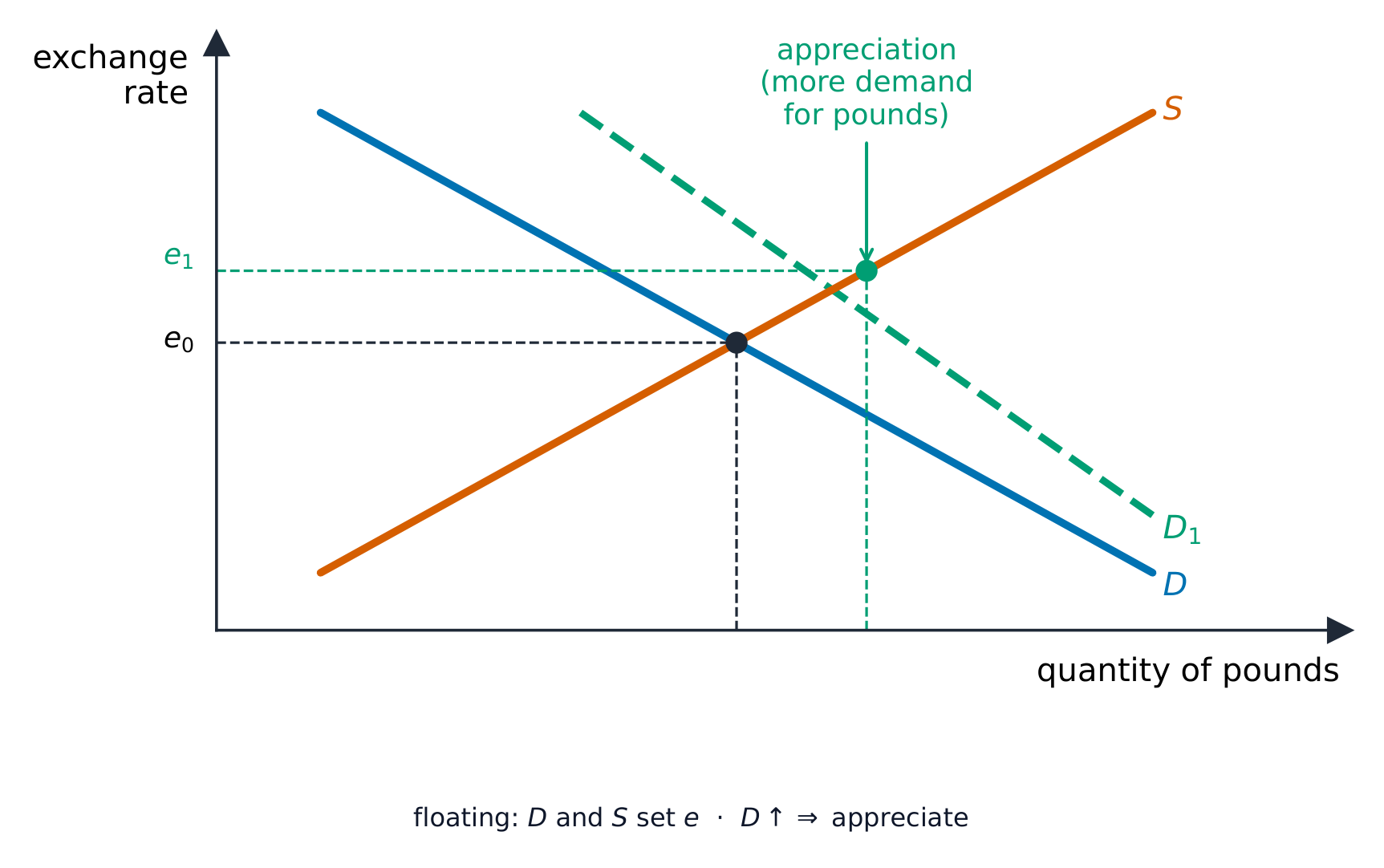
a floating exchange rate 浮动汇率 is set freely by the demand for and supply of the currency. If more people want a currency (to buy its exports), its value rises.
a fixed exchange rate 固定汇率 is held at a set value by the central bank, which buys and sells the currency to keep it there.
a managed exchange rate 管理浮动汇率 mostly floats, but the central bank steps in now and then to steady it.
Appreciation and depreciation
Under floating rates:
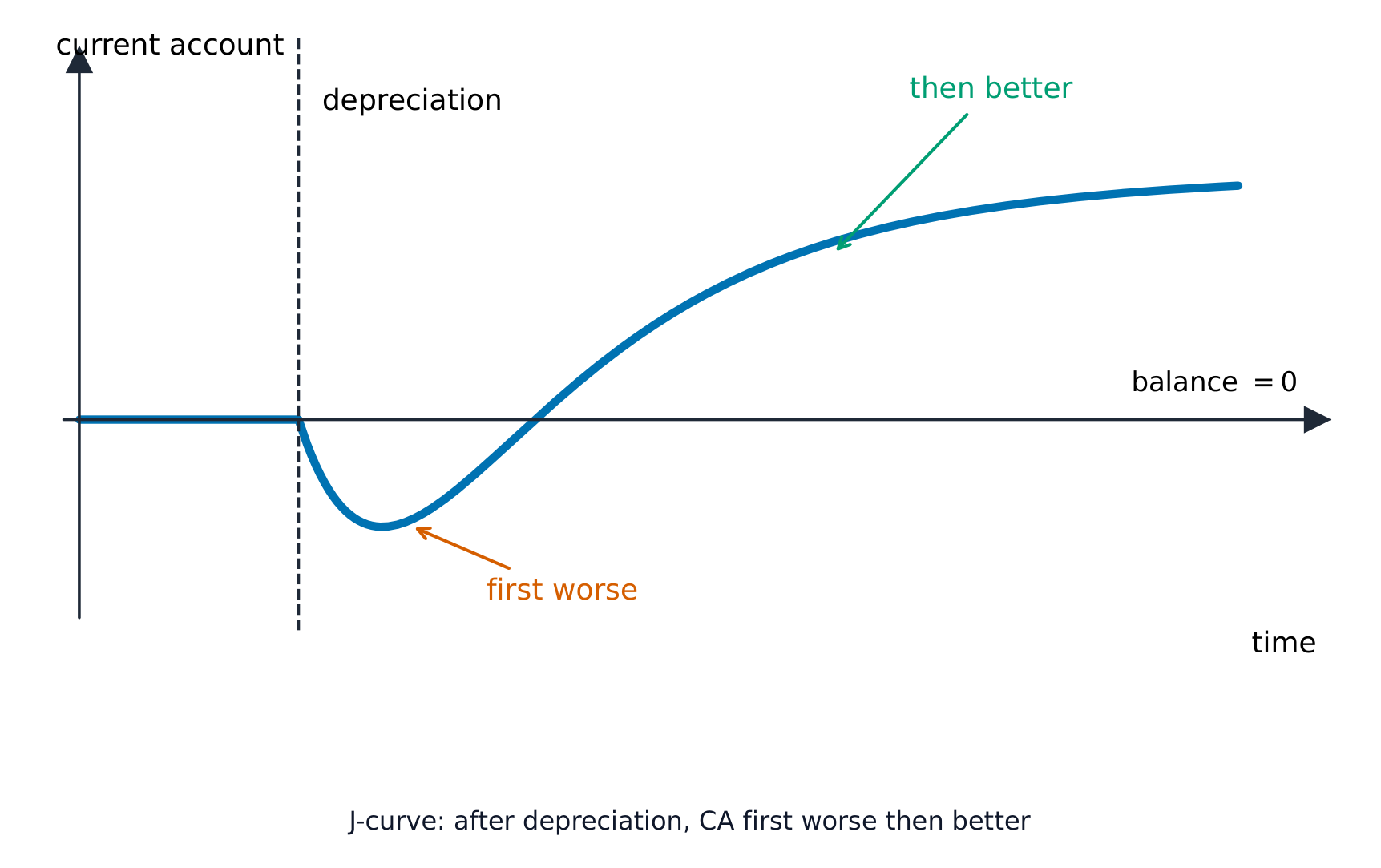
appreciation 升值 is a rise in the currency's value. Exports become dearer for foreigners, and imports become cheaper.
depreciation 贬值 is a fall in the currency's value. Exports become cheaper, and imports become dearer.
A depreciation can therefore raise export sales and cut imports, helping the current account — but it can also raise inflation, because imports cost more.
Worked example. Suppose the exchange rate is $\text{\pounds} 1 = \$1.40$.
A UK exporter's $\text{\pounds} 200$ machine costs an American buyer $\text{\pounds} 200 \times 1.40 = \$280$. If the pound then appreciates to $\text{\pounds} 1 = \$1.60$, the same machine costs $\text{\pounds} 200 \times 1.60 = \$320$ — dearer for the American, so fewer are sold. Going the other way, a $\$700$ invoice from a US supplier costs a UK firm $\$700 \div 1.40 = \text{\pounds} 500$.
เครื่องจักร $\text{\pounds} 200$ ของผู้ส่งออกในสหราชอาณาจักร มีราคาต่อผู้ซื้อในสหรัฐอเมริกา $\text{\pounds} 200 \times 1.40 = \$280$. If the pound then appreciates to $\text{\pounds} 1 = \$1.60$, เครื่องจักรรุ่นเดียวกันมีราคา $\text{\pounds} 200 \times 1.60 = \$320$ — dearer for the American, so fewer are sold. Going the other way, a $\$700$ จากซัพพลายเออร์ในสหรัฐฯ มีค่าใช้จ่ายสำหรับบริษัทในสหราชอาณาจักร $\$700 \div 1.40 = \text{\pounds} 500$.
Explore · สำรวจ
The foreign-exchange market · ตลาด foreign-exchange
A currency has its own market. More demand for £ (or less supply) pushes the exchange rate up — it appreciates. · สกุลเงินแต่ละชนิดมีตลาดของตัวเอง ความต้องการ £ (หรืออุปทานที่ลดลง) ผลักดันอัตราแลกเปลี่ยนขึ้น → It appreciates
Correcting a current account deficit · การแก้ไขขาดดุลบัญชี جاری
Syllabus · หลักสูตร
English
explain expenditure-switching and expenditure-reducing policies and supply-side measures to correct a deficit
evaluate the effectiveness of these policies
ไทย
อธิบาย expenditure-switching and expenditure-reducing policies and supply-side measures to correct a deficit
ประเมินประสิทธิภาพของนโยบายเหล่านี้
Source: Cambridge International syllabus · แหล่งที่มา: หลักสูตร Cambridge International
English
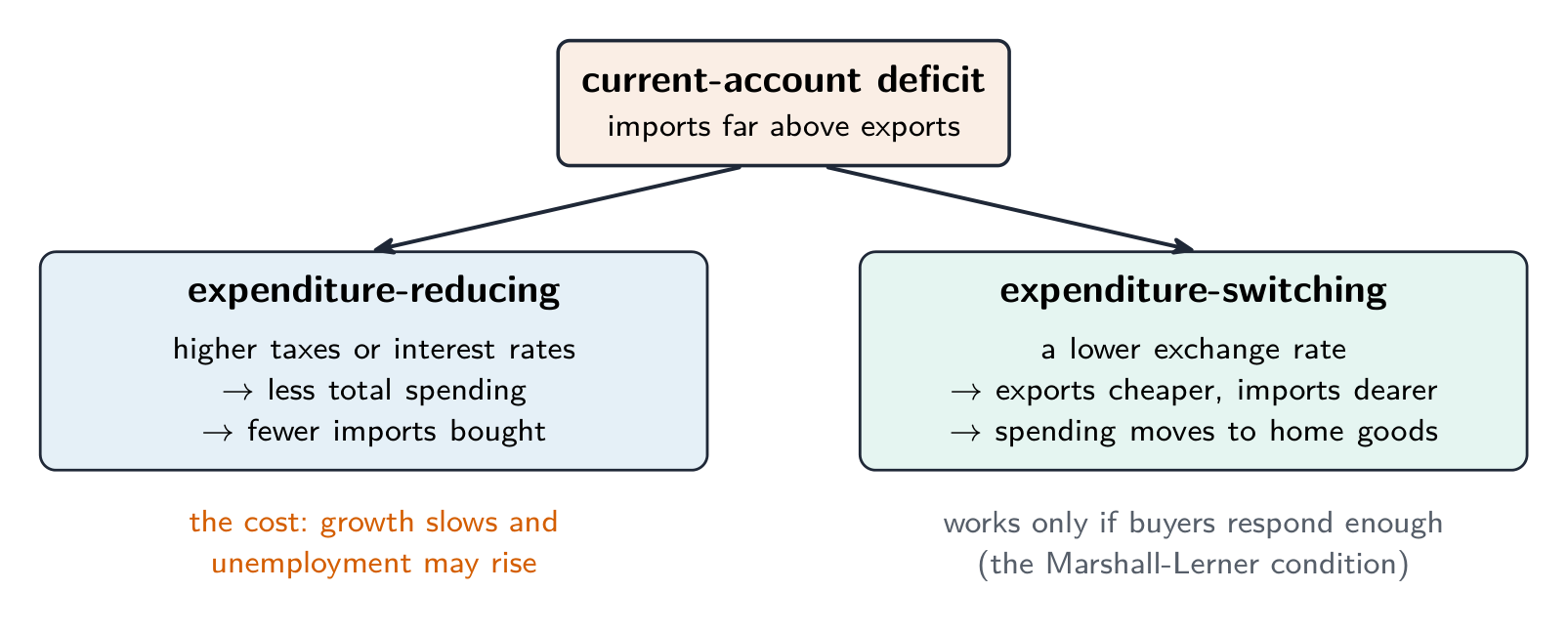
A government can use three kinds of policy to cut a deficit:
expenditure-reducing 支出减少 policies lower total demand (higher taxes or interest rates), so people buy fewer imports. But they also slow growth and raise unemployment.
expenditure-switching 支出转换 policies move spending away from imports towards home goods (a tariff, or a lower exchange rate). But they can cause retaliation or inflation.
supply-side policies raise the competitiveness 竞争力 of home firms (better skills and technology), so exports rise. These work best in the long run but are slow.
Source: Cambridge International syllabus · แหล่งที่มา: หลักสูตร Cambridge International
English
utility 效用 is the satisfaction a consumer gets from a good.
total utility 总效用 is the satisfaction from all the units consumed.
marginal utility 边际效用 is the extra satisfaction from one more unit.
The law of diminishing marginal utility 边际效用递减 says each extra unit gives less extra satisfaction. Total utility still rises, but more and more slowly.
The equi-marginal principle
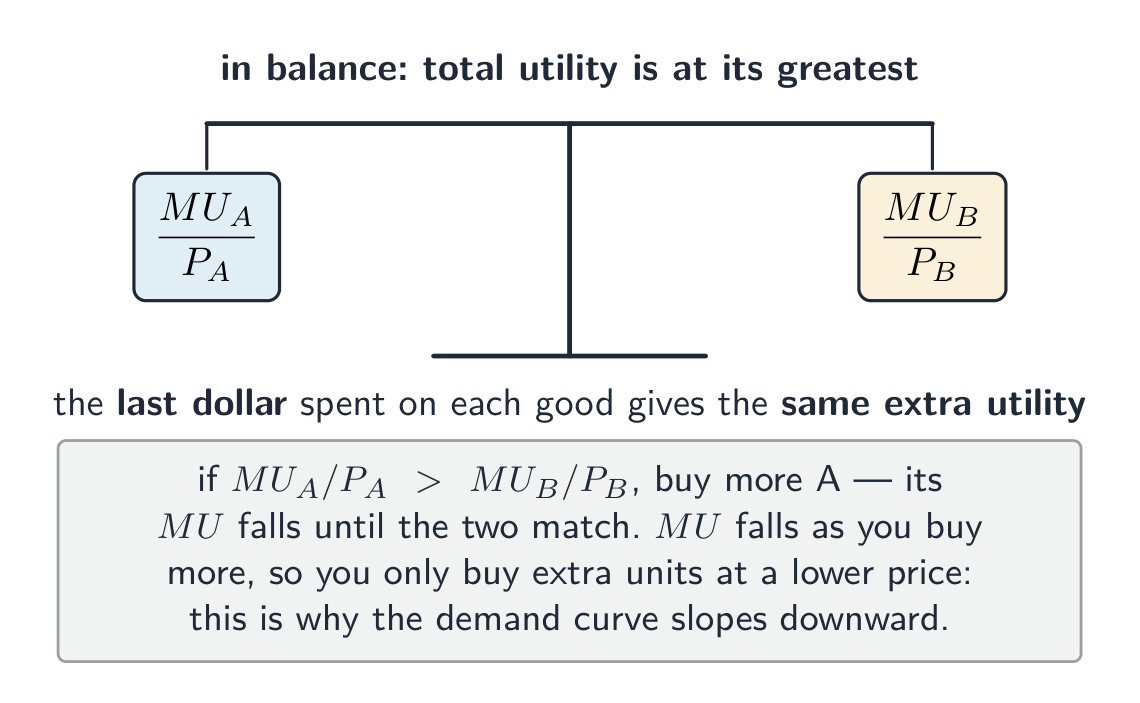
A consumer with a fixed budget gets the most total utility when the last dollar spent on each good gives the same extra utility. This is the equi-marginal principle 等边际原则:
$$\frac{MU_A}{P_A} = \frac{MU_B}{P_B}$$
Because marginal utility falls as you buy more, you only buy extra units when the price falls. This is why the demand curve 需求曲线 slopes downward.
Limitations
The approach is hard to use in practice: utility cannot really be measured in numbers, and people do not calculate like this. It also ignores habit and advertising.
ผู้บริโภคที่มีงบประมาณจำกัดจะได้ total utility สูงสุดเมื่อ dollar สุดท้ายที่ใช้จ่ายต่อสินค้าแต่ละชนิดให้ extra utility เท่ากัน นี่คือ หลักการ equi-marginal:
Source: Cambridge International syllabus · แหล่งที่มา: หลักสูตร Cambridge International
English
An indifference curve 无差异曲线 shows all the combinations of two goods that give a consumer the same total utility. It slopes downward (more of one good means less of the other) and bows in towards the origin.
A budget line 预算线 shows all the combinations the consumer can just afford with their income, at the current prices.
consumer equilibrium 消费者均衡 is the best the consumer can do: the point where the budget line just touches the highest possible indifference curve.
Income and substitution effects
When the price of a good falls, the consumer buys more for two reasons:
the substitution effect 替代效应 — the good is now cheaper than others, so the consumer switches towards it.
the income effect 收入效应 — the consumer's money now buys more, so real income has risen.
These effects work differently for different goods:
for a normal good 正常品, both effects raise the quantity bought.
for an inferior good 低档品, the income effect works the other way (higher real income lowers demand), but it is usually weaker, so demand still rises when price falls.
a Giffen good 吉芬品 is a rare, very inferior good where the income effect is so strong that demand actually falls when the price falls. Its demand curve slopes upward.
ไทย
เส้น indifference curve แสดง所有的 combinations ของสินค้าสองชนิดที่ให้ consumer same total utility เท่ากัน ลาดลง (มีสินค้าชนิดหนึ่งมาก berarti มีอีกชนิดน้อยลง) และโค้งเข้าหาจุดกำเนิด
เส้น budget line แสดง all combinations ที่consumer สามารถซื้อได้พอดีกับรายได้ของตน ในราคาปัจจุบัน
Source: Cambridge International syllabus · แหล่งที่มา: หลักสูตร Cambridge International
English
Economists judge how well resources are used.
productive efficiency 生产效率 — making goods at the lowest possible cost (using the fewest resources).
allocative efficiency 配置效率 — making the goods people most want, where price equals marginal cost.
Pareto optimality 帕累托最优 — a point where no one can be made better off without making someone else worse off.
dynamic efficiency 动态效率 — improving over time through new technology and better products.
market failure 市场失灵 happens when the free market does not reach an efficient result. The main causes are monopoly power, externalities 外部性, public goods 公共物品, information failure 信息失灵, and factor immobility 要素不流动性 (factors cannot move quickly to where they are needed).
The market is allocatively efficient where supply meets demand — price equals marginal cost. Market failure pushes it away from that point. · ตลาดมีประสิทธิภาพในการจัดสรรเมื่อ_supply_ตัด_demand_ — ราคาเท่ากับต้นทุนส่วนเพิ่ม ความล้มเหลวของตลาดทำให้ห่างจากจุดนั้น
Source: Cambridge International syllabus · แหล่งที่มา: หลักสูตร Cambridge International
English
Some costs and benefits fall on people outside the deal. We separate three levels:
a private cost 私人成本 or private benefit 私人收益 falls on the buyer or seller.
an external cost 外部成本 or external benefit 外部收益 falls on a third party.
the social cost 社会成本 is private cost plus external cost; the social benefit 社会收益 is private benefit plus external benefit.
Marginal analysis
We study externalities with marginal analysis 边际分析, using these curves:
marginal private cost 边际私人成本 (MPC) and marginal social cost 边际社会成本 (MSC).
marginal private benefit 边际私人收益 (MPB) and marginal social benefit 边际社会收益 (MSB).
The best outcome for society is where MSC = MSB. But the market produces where MPC = MPB. The gap between these creates lost welfare.
a negative externality 负外部性 (like pollution) means MSC is above MPC. The market makes too much.
a positive externality 正外部性 (like education) means MSB is above MPB. The market makes too little.
The lost welfare from making too much or too little is the deadweight welfare loss 无谓损失 — the triangle on the diagram between the social and private curves.
lost welfare จากการผลิตมากเกินไปหรือน้อยเกินไปคือ deadweight welfare loss — รูปสามเหลี่ยมในแผนภาพระหว่างเส้นทางสังคมและเส้นส่วนตัว
มลพิษอุตสาหกรรม: negative externality ที่ social cost สูงกว่า private cost
Explore · สำรวจ
Externalities shift the social curve · ผลภายนอกทำให้เส้นทางสังคมเลื่อน
A negative externality means the social cost is above the private supply curve; the free-market quantity is then too high. · ผลภายนอกเชิงลบหมายความว่าต้นทุนทางสังคมสูงกว่าเส้นBundle_ส่วนตัว ปริมาณในตลาดเสรีจะสูงเกินไป
Source: Cambridge International syllabus · แหล่งที่มา: หลักสูตร Cambridge International
English
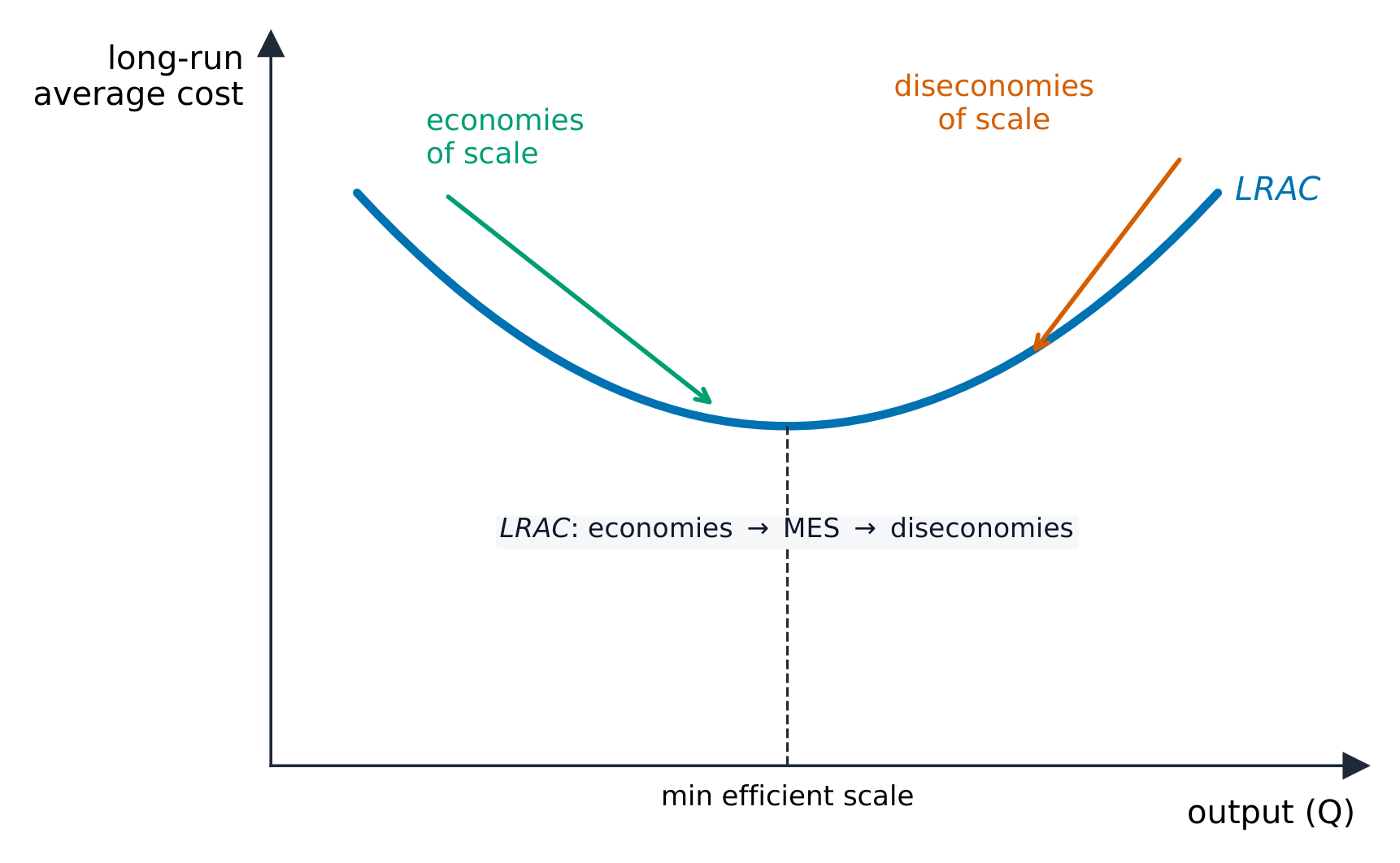
Economies of scale: average cost falls
Costs
In the short run 短期, at least one factor is fixed; in the long run 长期, all factors can change.
Cost
Meaning
fixed cost 固定成本
does not change with output (rent on a factory)
variable cost 可变成本
changes with output (raw materials)
total cost 总成本
fixed cost plus variable cost
average cost 平均成本
total cost per unit: $AC = TC / Q$
marginal cost 边际成本
the cost of one more unit: $MC = \Delta TC / \Delta Q$
Worked example. Making $10$ units costs £500 in total; making $11$ units costs £540. Find the average cost at $10$ units and the marginal cost of the 11th unit.
Here $MC$ ($\text{\pounds} 40$) is below $AC$ ($\text{\pounds} 50$), so making the 11th unit pulls the average cost down — whenever marginal cost is below average cost, average cost falls.
In the short run, output is limited by the law of diminishing returns 边际报酬递减: as you add more of a variable factor (workers) to a fixed factor (machines), each extra worker eventually adds less output. This makes marginal cost rise.
In the long run, all factors vary, so we look at returns to scale 规模报酬. As a firm grows, it can gain economies of scale 规模经济 (lower average cost from buying in bulk, using big machines, and specialising). If it grows too big, it may suffer diseconomies of scale 规模不经济 (poor communication and control), and average cost rises.
Revenue
Revenue
Meaning
total revenue 总收益
all money from sales: $TR = P \times Q$
average revenue 平均收益
revenue per unit, which equals the price
marginal revenue 边际收益
the revenue from one more unit: $MR = \Delta TR / \Delta Q$
Worked example. A firm sells $10$ units at £50 each. To sell an 11th unit it must lower the price to £48 on every unit. Find the total revenue at each output and the marginal revenue of the 11th unit.
The marginal revenue ($\text{\pounds} 28$) is well below the £48 price, because the lower price applies to all $11$ units, not just the extra one.
Profit
Profit is total revenue minus total cost. Economists include the opportunity cost of the owner's resources in cost, so:
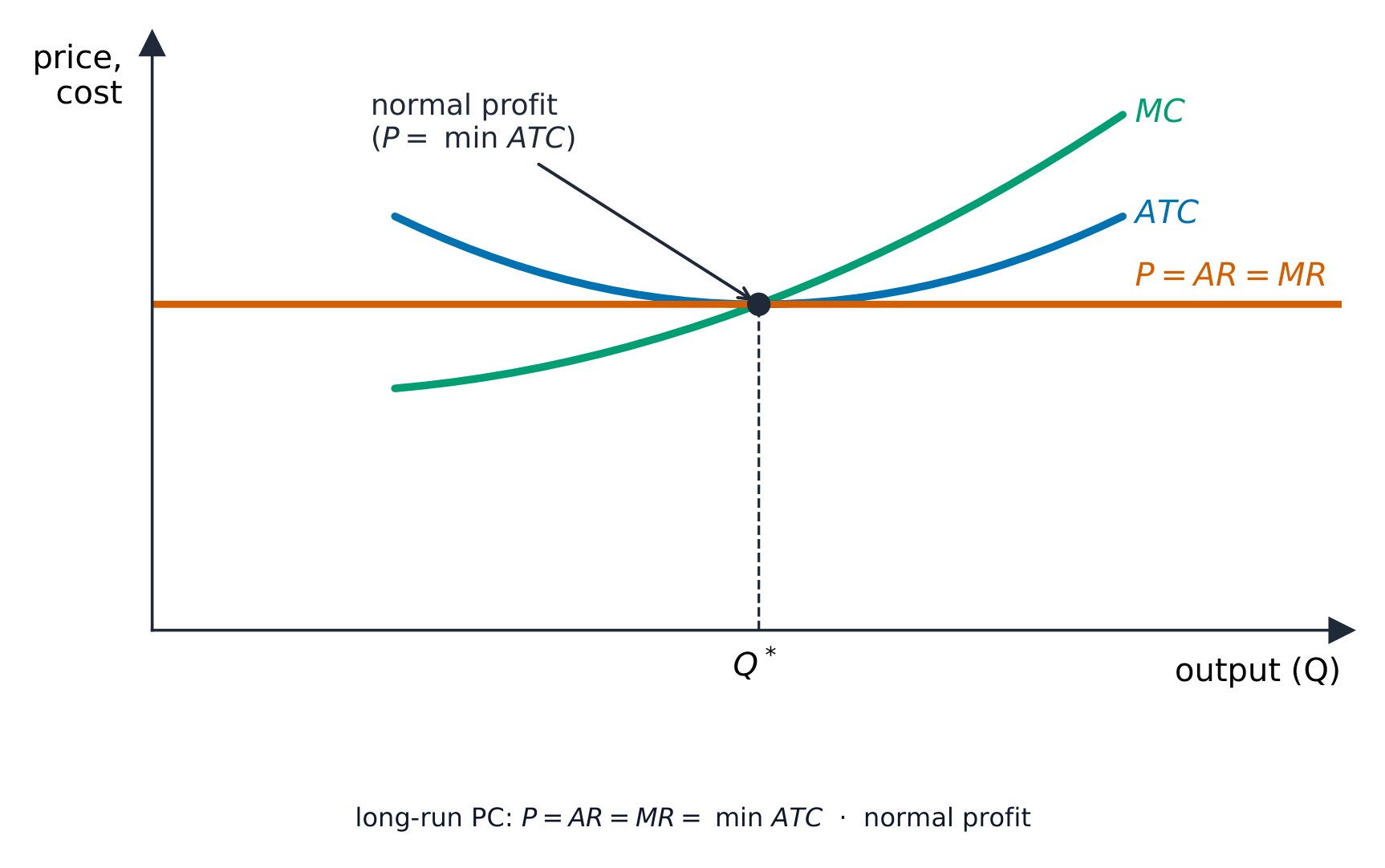
normal profit 正常利润 is just enough profit to keep the firm in the industry. It counts as a cost.
supernormal profit 超常利润 (also called abnormal profit) is profit above normal.
subnormal profit 次正常利润 is profit below normal — the firm may leave in the long run.
A firm makes the most profit at the output where $MR = MC$.
Worked example. At its best output a firm makes $100$ units, sells each for £12 (its average revenue), and has an average cost of £9. Find the supernormal profit.
Because average revenue (£12) is above average cost (£9), the firm earns supernormal profit. If instead $AR = AC$, it would make only normal profit; if $AR < AC$, it would make a loss.
ในระยะสั้น ปริมาณการผลิตถูกจำกัดโดยกฎของ ผลลดทอน: เมื่อเพิ่มปัจจัยแปรผันมากขึ้น (แรงงาน) เข้ากับปัจจัยคงที่ (เครื่องจักร) แรงงานแต่ละคนเพิ่มมา后会会产生 less output. This makes marginal cost rise.
ต้นทุน边际, ต้นทุนเฉลี่ยรวม และต้นทุนเฉลี่ยแปรผันทั้งหมดมีรูปตัว U; MC ตัดเส้นโค้งเฉลี่ยทั้งสองที่จุดต่ำสุด.
Total revenue rises then falls as price changes. · รายได้รวม เพิ่มขึ้นแล้วลดลง เมื่อราคาเปลี่ยนแปลง
Explore · สำรวจ
Costs and the firm · ต้นทุนและบริษัท
Average cost is U-shaped; marginal cost cuts it at the minimum. Different market structures price relative to these curves. · ต้นทุนเฉลี่ยมีรูปตัว U; ต้นทุนส่วนเพิ่มตัดผ่านที่จุดต่ำสุด โครงสร้างตลาดที่แตกต่างกันกำหนดราคาเทียบกับโค้งเหล่านี้
Explore · สำรวจ
Average and marginal cost · ต้นทุนเฉลี่ยและต้นทุนส่วนเพิ่ม
Change output. Marginal cost cuts average cost at its lowest point — the heart of the theory of the firm. · เปลี่ยนปริมาณการผลิต ต้นทุนส่วนเพิ่ม ตัด ต้นทุนเฉลี่ย ที่จุดต่ำสุด — ซึ่งเป็นหัวใจของทฤษฎีบริษัท
Source: Cambridge International syllabus · แหล่งที่มา: หลักสูตร Cambridge International
English
A market structure 市场结构 describes a market by the number of firms, the barriers to entry, and the type of product.
Structure
Firms
Barriers
Product
Long-run profit
perfect competition 完全竞争
very many
none
identical
normal only
monopolistic competition 垄断竞争
many
low
slightly different
normal
oligopoly 寡头垄断
a few
high
varies
often supernormal
monopoly 垄断
one
very high
unique
supernormal
in perfect competition, each firm is a tiny price taker 价格接受者 — it must accept the market price. Firms make only normal profit in the long run, and the market is both productively and allocatively efficient.
in monopolistic competition, many firms sell slightly different products (product differentiation 产品差异化), so each has a little price-setting power, but free entry competes profit away.
in an oligopoly, a few large firms dominate. They watch each other closely. They may compete hard on price, or they may agree to fix prices — this is collusion 合谋, and a group that does so is a cartel 卡特尔.
a monopoly is a single seller protected by high barriers to entry 进入壁垒. It can earn supernormal profit for a long time but is usually inefficient.
Price and non-price competition
price competition 价格竞争 means cutting prices to win customers.
non-price competition 非价格竞争 means competing in other ways — advertising, quality, branding and service.
Price discrimination
price discrimination 价格歧视 is charging different consumers different prices for the same good (for example, cheaper train tickets for students). It needs price-setting power, groups with different elasticities, and a way to stop resale between groups. It raises the firm's profit.
Pricing and competition · การตั้งราคาและการแข่งขัน
How a firm prices depends on demand and supply; with market power it can charge above the competitive level. · การตั้งราคาของบริษัทขึ้นอยู่กับอุปสงค์และอุปทาน; เมื่อมีอำนาจตลาด สามารถตั้งราคาเหนือระดับการแข่งขันได้
Source: Cambridge International syllabus · แหล่งที่มา: หลักสูตร Cambridge International
English
Firms grow in two ways:
internal growth 内部增长 (organic) — growing bigger by selling more.
external growth 外部增长 — joining with another firm through a merger 合并 or takeover. Types:
horizontal integration 横向一体化 — joining a firm at the same stage of the same industry (two car makers).
vertical integration 纵向一体化 — joining a firm at a different stage (a car maker buys a tyre maker).
conglomerate integration 混合一体化 — joining a firm in a different industry, to spread risk.
Why some firms stay small
Many firms stay small because the market is small (local services), the owner wants to keep control, or there are few economies of scale. They survive by offering personal service or filling a niche 利基市场.
Firms also face barriers to entry and barriers to exit 退出壁垒 (such as costly machines that cannot be sold). High exit barriers can trap a firm in a loss-making market.
Source: Cambridge International syllabus · แหล่งที่มา: หลักสูตร Cambridge International
English
Not every firm simply chases the most profit.
profit maximisation 利润最大化 — producing where MR = MC. The traditional aim.
revenue maximisation 收益最大化 — producing where MR = 0, perhaps to grow market share.
sales maximisation 销售最大化 — selling as much as possible while still making normal profit.
satisficing 满意化 — aiming for "good enough" results that keep owners, workers and customers all reasonably happy.
Divorce of ownership from control
In large companies the owners (shareholders) are not the managers. This divorce of ownership from control 所有权与控制权分离 creates the principal-agent problem 委托代理问题: managers (the agents) may pursue their own aims — bigger salaries or an easier life — instead of the owners' aim of maximum profit.
ไทย
ไม่ใช่ทุกบริษัทจะมุ่งเน้นเพียงกำไรสูงสุดเท่านั้น
การเพิ่มกำไรสูงสุด — การผลิตในระดับที่ MR = MC ซึ่งเป็นเป้าหมายแบบดั้งเดิม
Calculate AC, MC, TR and MR, and remember a firm maximises profit where $MR = MC$.
Distinguish the market structures (perfect competition, monopolistic competition, oligopoly, monopoly) by number of firms, barriers and price-setting power.
Distinguish normal from supernormal profit and link long-run entry and exit to it.
On a cost diagram, note that MC cuts AC at the minimum of AC.
Source: Cambridge International syllabus · แหล่งที่มา: หลักสูตร Cambridge International
English
A government has many tools to push a market towards a better use of resources.
an indirect tax 间接税 on a good with a negative externality (like fuel) raises its price and cuts the quantity used.
a subsidy 补贴 for a good with a positive externality (like solar panels) lowers its price and raises the quantity.
a price control 价格管制 sets a legal maximum or minimum price.
tradable permits 可交易许可证 cap total pollution and let firms buy and sell the right to pollute.
regulation 管制 uses rules and laws, such as bans, safety standards and pollution limits.
state provision 政府提供 means the government supplies a good directly, often free (schools, hospitals, defence).
nationalisation 国有化 is taking an industry into government ownership; privatisation 私有化 is selling a state industry to private owners.
Competition policy
A firm with monopoly power 垄断势力 can raise prices and cut output. competition policy 竞争政策 is the set of laws used to protect competition — for example, blocking mergers that create too much power, banning price-fixing, and fining firms that abuse their position.
Government failure
Intervention can backfire. government failure 政府失灵 is when the government's action leads to a worse use of resources than before — through poor information, high costs, long time lags, or unintended effects (such as a black market caused by a price control).
An externality (like pollution) means the market price ignores a real cost — output ends up above the efficient level. Add the external cost to see the gap. · 外部性 (เช่น มลพิษ) หมายถึง ราคาในตลาดละเลยต้นทุนที่แท้จริง — ผลผลิตจึงเกินระดับที่มีประสิทธิภาพ นำต้นทุนภายนอกมาบวกเพื่อดูช่องว่างนั้น
Equity and redistribution · ความเสมอภาคและการจัดสรรใหม่
Syllabus · หลักสูตร
English
distinguish equity, equality, and the difference between income and wealth
explain the Lorenz curve and Gini coefficient and policies to redistribute income and wealth (taxation, benefits, the difficulty of redistributing wealth)
Source: Cambridge International syllabus · แหล่งที่มา: หลักสูตร Cambridge International
English
It is important to separate two words that sound alike:
equity 公平 means fairness — people getting what is fair, which may not be an equal share.
equality 平等 means everyone getting the same.
A fair (equitable) outcome is not always an equal one. Most governments worry about too much inequality 不平等.
Remember the difference between the two things being shared:
income 收入 is a flow received over time (wages, rent, interest).
wealth 财富 is a stock of assets owned (houses, shares, savings).
Measuring inequality
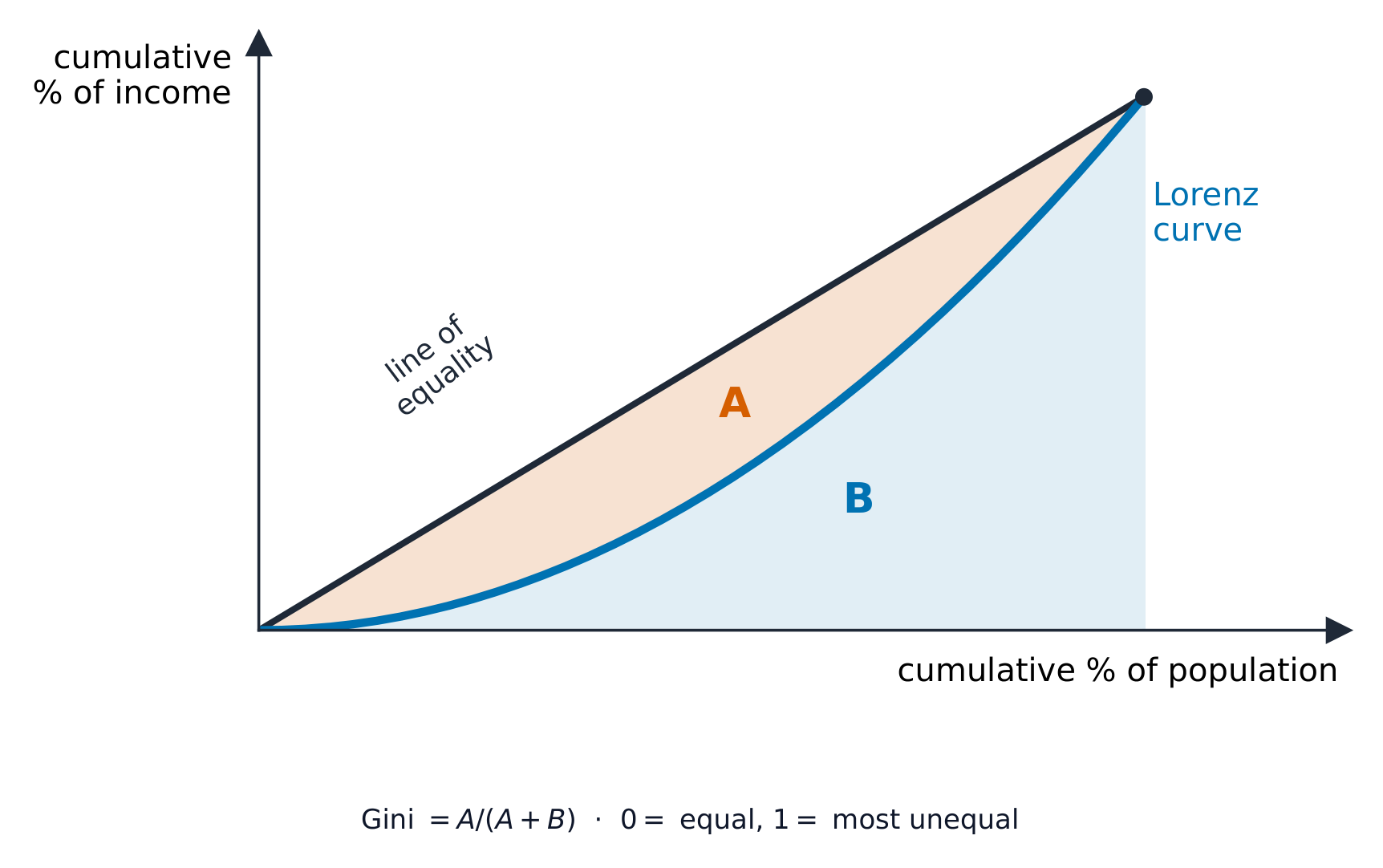
the Lorenz curve 洛伦兹曲线 is a graph. It plots the share of total income against the share of the population, from poorest to richest. A straight diagonal line would mean perfect equality. The further the curve bends below the line, the more unequal the country.
the Gini coefficient 基尼系数 turns this into one number between 0 and 1. Zero means perfect equality; one means one person has everything. A higher number means more inequality.
Policies to redistribute
a progressive tax 累进税 takes a larger share from higher incomes.
benefits 福利金 (also called transfer payments 转移支付) give money to the poor, the old and the unemployed.
free state services (education, health care) raise the real living standards of the poor.
These bring about redistribution 再分配 — moving income from richer to poorer people. Wealth is harder to redistribute than income, because the rich can hide assets or move them abroad, and wealth taxes are hard to collect.
Worked example. Country X has a Gini coefficient of 0.25 and country Y one of 0.48. What does that mean, and what does each Lorenz curve look like? The Gini runs from 0 (perfect equality) to 1 (one person has everything), so a higher number means more unequal: country Y at 0.48 is markedly more unequal than X at 0.25. On the graph, Y's Lorenz curve sags further below the 45° line of equality, while X's hugs it more closely. The Gini is exactly the area between the line of equality and the Lorenz curve, as a fraction of the whole triangle beneath that line - which is why a bigger sag gives a bigger number. One caution is worth stating: the Gini measures relative inequality only. It says nothing about absolute living standards, so a poor country and a rich one can share the same Gini.
Follow how policy can change disposable income and opportunity. · ติดตามว่านโยบายสามารถเปลี่ยนรายได้สุทธิและโอกาสได้อย่างไร
Explore · สำรวจ
Bend the Lorenz curve · ปรับโค้งโลเรนซ์
Drag each economy's top-20% income share — the curve that hugs the line of equality has the lower Gini, and the quintile chips give the exam-table numbers. · ลากสัดส่วนรายได้สูงสุด 20% ของแต่ละเศรษฐกิจ — เส้นโค้งที่แนบชิดเส้นสมมาตรจะมีค่า Gini ต่ำกว่า และชิ้นส่วนควินไทล์จะให้ตัวเลขสำหรับตารางข้อสอบ
Source: Cambridge International syllabus · แหล่งที่มา: หลักสูตร Cambridge International
English
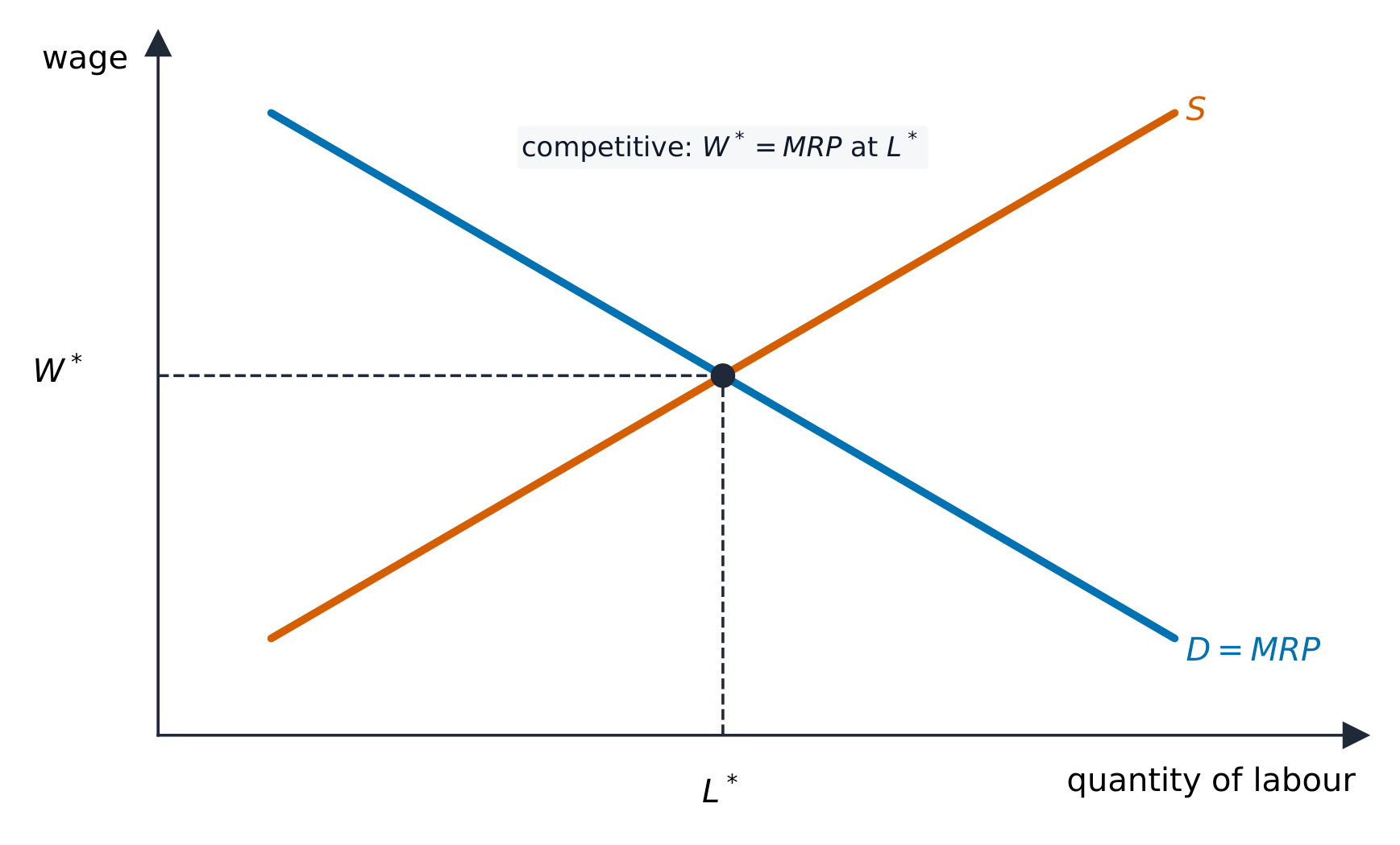
A wage is just a price — the price of labour — so we use demand and supply to study the labour market 劳动力市场.
The demand for labour
The demand for labour 劳动力需求 is a derived demand 派生需求: firms want workers not for their own sake, but to make goods that sell. So labour demand depends on the marginal revenue product 边际收益产品 (MRP) — the extra revenue one more worker brings in. A worker is worth hiring while the MRP is at least as big as the wage.
The supply of labour
The supply of labour 劳动力供给 to a job rises when the wage 工资 rises, and also depends on training needed, working conditions, and how many people have the right skills.
In a competitive labour market, the wage settles where the demand for labour equals the supply of labour.
When the market is not competitive
a monopsony 买方垄断 is a single, dominant buyer of labour (for example, the only large employer in a town). It can pay a wage below the competitive level and hire fewer workers.
a trade union 工会 is an organised group of workers that bargains for higher pay. A union can push the wage above the competitive level, but this may reduce the number of jobs.
a national minimum wage 全国最低工资 is a legal lowest wage. Set above the market wage, it raises low pay but may cause some unemployment. Interestingly, in a monopsony it can raise both the wage and employment.
Wage differentials and discrimination
Wages differ between jobs — this is a wage differential 工资差异. The main reasons are differences in MRP (skilled work is more productive), the training and qualifications needed, and the risk or unpleasantness of the work.
Some wage gaps come from discrimination 歧视 — paying people differently because of gender, race or age rather than their productivity. Governments use equal-pay laws and anti-discrimination laws to reduce this.
Wages are a price. The demand for labour (from firms) and the supply of labour (from workers) set the equilibrium wage. · ค่าจ้างเป็นราคา ความต้องการแรงงาน (จากบริษัท) และอุปทานแรงงาน (จากแรงงาน) กำหนดค่าจ้างสมดุล
Source: Cambridge International syllabus · แหล่งที่มา: หลักสูตร Cambridge International
English
The multiplier effect
The circular flow of income 收入循环流 shows money passing between households and firms. injections 注入 add money to the flow (investment, government spending, exports); leakages 漏出 take it out (saving, taxation, imports).
The multiplier
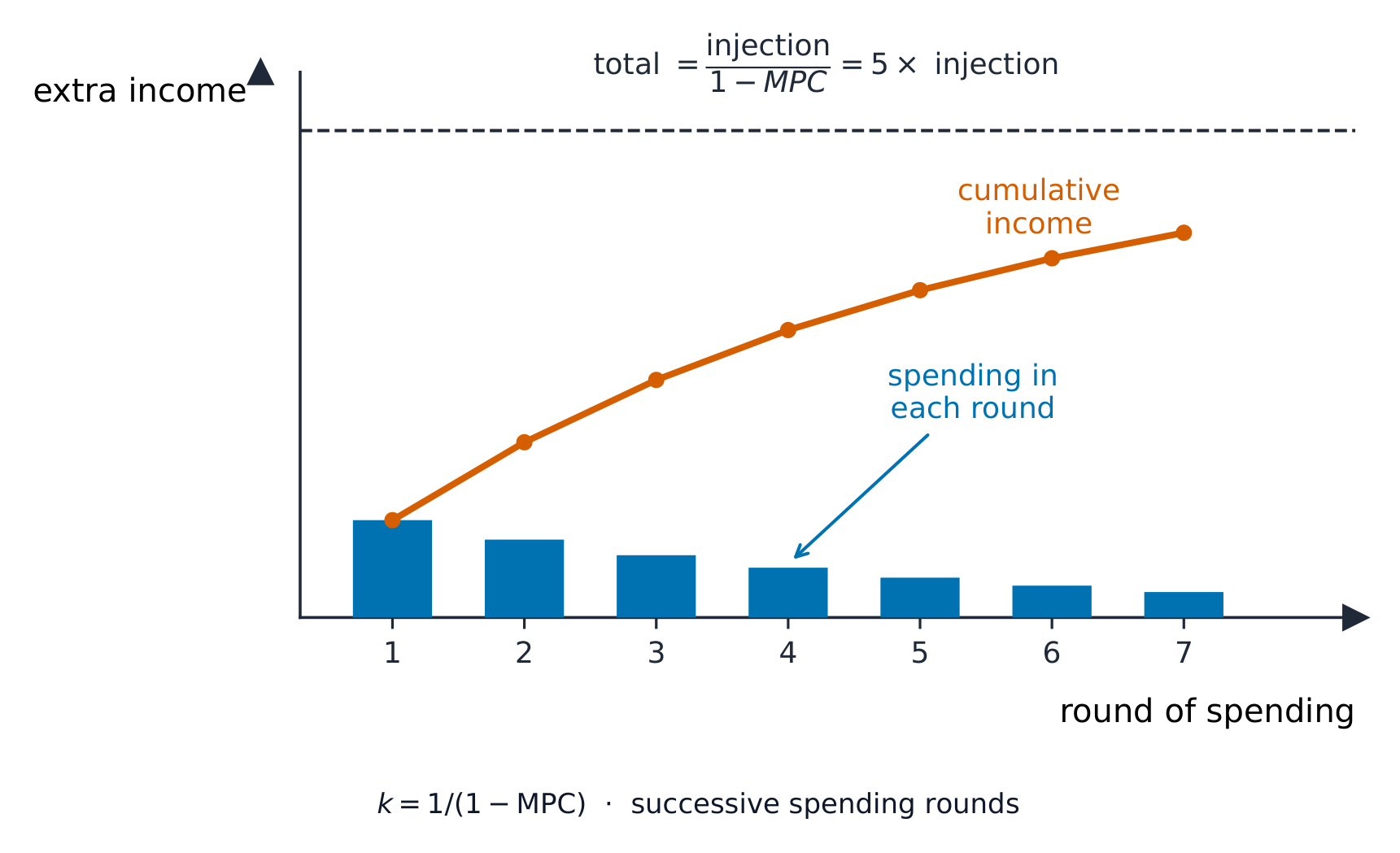
An injection raises income by more than the first amount. This is the multiplier 乘数. When a firm builds a factory, the builders earn income, and they spend part of it, which becomes someone else's income, and so on.
How much is spent again depends on the marginal propensity to consume 边际消费倾向 (MPC) — the fraction of extra income that people spend on home goods. The rest leaks out. In a simple model:
$$\text{multiplier} = \frac{1}{1 - MPC}$$
A bigger MPC (smaller leakages) gives a bigger multiplier. The main leakages are measured by the marginal propensity to save 边际储蓄倾向 (MPS) and the marginal propensity to import 边际进口倾向 (MPM).
Worked example. In an economy the MPC is $0.8$. Find the multiplier, then the effect of a $\text{\pounds} 10$ billion rise in investment.
National income therefore rises by $5 \times \text{\pounds} 10\text{ billion} = \text{\pounds} 50\text{ billion}$ — five times the original injection. (Because all income is either spent or saved, $\text{MPC} + \text{MPS} = 1$, so here $\text{MPS} = 0.2$ and the multiplier is also $1/\text{MPS}$.)
The accelerator
The accelerator 加速数 says that investment 投资 depends on the rate of change of output. When demand is rising quickly, firms need lots of new capital, so investment jumps. When demand merely stays high, investment falls back.
What drives consumption, saving and investment
consumption 消费 and saving 储蓄 depend on disposable income 可支配收入 (income after tax), wealth, interest rates, and confidence.
investment depends on interest rates, expected profit, technology, and business confidence.
Injection เพิ่มรายได้ มากกว่า จำนวนแรก kali This is the multiplier. เมื่อบริษัทสร้างโรงงาน ผู้ก่อสร้างได้รับรายได้ และพวกเขาใช้จ่ายบางส่วน ซึ่งกลายเป็นรายได้ของคนอื่น และ seterusnya
The circular flow and the multiplier · วงจรไหลเวียนและตัวคูณ
Income circles between households and firms. An injection (e.g. investment) is re-spent again and again — the multiplier effect. · รายได้หมุนระหว่างครัวเรือนและบริษัท การฉีด注入 (เช่น การลงทุน) ถูกใช้จ่ายซ้ำแล้วซ้ำอีก — ผลกระทบของตัวคูณ
Explore · สำรวจ
The multiplier, round by round · ตัวคูณ รอบต่อรอบ
Drag the injection and the MPC, then press Play — each spending round is MPC times the last, and the total settles at k × the injection. · ลากการแทรกเข้าและ MPC แล้วกด Play — แต่ละรอบการใช้จ่ายจะเป็น MPC คูณด้วยรอบก่อนหน้า และผลรวมจะคงที่ที่ k × การแทรกเข้า
Source: Cambridge International syllabus · แหล่งที่มา: หลักสูตร Cambridge International
English
economic growth 经济增长 is a rise in real output.
actual growth 实际增长 is the real rise in output that happens.
potential growth 潜在增长 is the rise in the economy's capacity.
The output gap 产出缺口 is the difference between actual output and potential output. A positive gap (actual above potential) tends to cause inflation; a negative gap (actual below potential) means spare capacity and unemployment.
Sustainability
sustainable growth 可持续增长 is growth that meets today's needs without harming the ability of future generations to meet theirs. Fast growth can use up non-renewable resources and cause pollution, which threatens sustainability 可持续性. So a country must weigh growth today against the environment and resources of tomorrow.
Source: Cambridge International syllabus · แหล่งที่มา: หลักสูตร Cambridge International
English
unemployment 失业 is measured in two ways: the claimant count 申领救济人数 (people claiming benefits) and the wider labour force survey 劳动力调查 (a sample asked about work).
Types
frictional unemployment 摩擦性失业 — short spells between jobs.
structural unemployment 结构性失业 — skills no longer match the jobs, as industries decline.
cyclical unemployment 周期性失业 — caused by low demand in a recession.
seasonal unemployment 季节性失业 — work only at certain times of year.
The natural rate and the Phillips curve
The natural rate of unemployment 自然失业率 is the unemployment left when the labour market is in balance (mainly frictional and structural). It cannot be removed just by raising demand.
The Phillips curve 菲利普斯曲线 shows the link between unemployment and inflation:
in the short run, there is a trade-off: lower unemployment comes with higher inflation, because strong demand pushes up wages and prices.
in the long run, the curve is vertical at the natural rate. Once people expect inflation, there is no lasting trade-off — pushing unemployment below the natural rate only speeds up inflation.
Source: Cambridge International syllabus · แหล่งที่มา: หลักสูตร Cambridge International
English
What money does
money 货币 is anything widely accepted in payment. It has four jobs:
a medium of exchange 交换媒介 — used to buy and sell, avoiding barter.
a store of value 价值储藏 — it keeps its worth over time, so you can save it.
a unit of account 记账单位 — a common way to measure and compare prices.
a standard of deferred payment 延期支付标准 — it lets people borrow and repay later.
Good money is durable, easy to carry, easy to divide, hard to fake, and limited in supply.
Banks
the central bank 中央银行 issues notes, runs monetary policy, holds the country's reserves, and acts as lender of last resort 最后贷款人 to banks in trouble.
commercial banks 商业银行 take deposits and make loans. By lending out most of what is deposited, the banking system creates money.
The demand for money and interest rates
People hold money rather than other assets for its liquidity 流动性 (it can be spent at once). The demand for money 货币需求 — also called liquidity preference 流动性偏好 — comes from the need to make everyday payments, to keep a safety buffer, and to be ready to buy assets.
The interest rate 利率 is the price of borrowing money. It is set where the demand for money meets the money supply 货币供给. A larger money supply tends to lower the interest rate.
Moral hazard
moral hazard 道德风险 is the danger that banks take bigger risks because they expect to be rescued if things go wrong. If a bank believes the government will bail it out, it may lend recklessly — knowing it keeps the gains but passes losses to others.
Source: Cambridge International syllabus · แหล่งที่มา: หลักสูตร Cambridge International
English
Governments aim at several macroeconomic objectives 宏观经济目标 at once:
Objective
How it is measured
economic growth 经济增长
the % change in real GDP
price stability 物价稳定 (low inflation 通货膨胀)
the % change in the consumer price index
full employment 充分就业
the unemployment rate
balance of payments 国际收支 stability
the current account balance
To reach these goals, the government uses three sets of tools:
fiscal policy 财政政策 — changing government spending and taxes.
monetary policy 货币政策 — changing the interest rate 利率 and the money supply.
supply-side policy 供给侧政策 — raising the economy's capacity and productivity.
Fiscal and monetary policy mainly work on aggregate demand 总需求, so they are quick but can cause inflation. Supply-side policy works on capacity, so it is slow but lasting.
Links and trade-offs between objectives · ความเชื่อมโยงและความขัดแย้งระหว่างวัตถุประสงค์
Syllabus · หลักสูตร
English
explain the links and trade-offs between macroeconomic problems (e.g. growth and inflation, unemployment and inflation, growth and the balance of payments)
analyse the interrelatedness of macroeconomic objectives
Source: Cambridge International syllabus · แหล่งที่มา: หลักสูตร Cambridge International
English
The objectives are interrelated — reaching one can move another. Often there is a trade-off 取舍, a conflict 冲突 where gaining on one goal costs you on another.
unemployment versus inflation. Raising demand to cut unemployment tends to push prices up. The Phillips curve 菲利普斯曲线 shows this short-run trade-off. (In the long run it may disappear.)
growth versus inflation. Fast demand-led growth can overheat the economy and cause inflation.
growth versus the balance of payments. As incomes rise, people buy more imports, so the current account can worsen.
growth versus the environment. More output often means more pollution and use of resources.
growth versus equality. Growth does not always reach everyone, so the income gap can widen.
Because the goals are linked, a government must often accept "second best" on one aim to protect another. A clever policy mix tries to ease the trade-offs — for example, supply-side policy can raise growth and lower inflation, easing the usual clash.
Source: Cambridge International syllabus · แหล่งที่มา: หลักสูตร Cambridge International
English
Each tool has strengths and weaknesses.
Fiscal policy
It can act directly and powerfully on demand, and it can target particular groups or regions. But:
it suffers time lags 时滞 — a budget is set once a year, and the effects take time.
large deficits add to the national debt 国债.
it can cause crowding out 挤出效应 — heavy government borrowing raises interest rates and reduces private investment.
The Laffer curve 拉弗曲线 is a useful warning. It shows that as the tax rate rises, tax revenue 税收收入 first rises but then falls: very high rates discourage work and encourage tax avoidance, so revenue drops. There is a tax rate that raises the most revenue, and going above it is self-defeating.
Monetary policy
It is flexible — the interest rate can be changed at any time. But it also works with a long time lag, and in a deep slump even very low rates may fail to make worried firms and households borrow.
Supply-side policy
It is the only tool that can raise growth and lower inflation together, with no trade-off. But it is slow (education and training take years), it is costly, and some measures (like cutting benefits) can widen inequality.
Putting it together
No single policy can hit every target. The objectives conflict, the effects come with delays, and the future is uncertain. So governments usually combine demand-side policies 需求侧政策 (fiscal and monetary) for the short term with supply-side policy for the long term, and accept that some goals must be traded against others.
Worked example. A government cuts interest rates to reduce unemployment. Which other objective is put at risk, and why? Lower rates make borrowing cheaper and saving less attractive, so consumption and investment rise: aggregate demand rises, output rises, and unemployment falls. But that same rise in demand pulls prices up, especially as the economy nears full capacity - so the objective at risk is low inflation. This is the classic Phillips curve trade-off: lower unemployment bought at the price of higher inflation. It also tends to worsen the current account, because richer consumers buy more imports. Name the objective at risk and the mechanism joining the two - and remember that a supply-side policy is the one tool that can improve both objectives at once, which is usually the evaluation the question is fishing for.
Source: Cambridge International syllabus · แหล่งที่มา: หลักสูตร Cambridge International
English
A country with a large balance of payments 国际收支 problem — usually a deficit on the current account 经常账户 — can use two kinds of policy.
expenditure-reducing 支出减少 policies cut total demand (higher taxes or interest rates). With less spending, people buy fewer imports. But growth slows and unemployment may rise.
expenditure-switching 支出转换 policies move spending away from imports towards home goods. The main tool is a lower exchange rate 汇率 — a depreciation 贬值 under floating rates, or a devaluation 法定贬值 under a fixed system — which makes exports cheaper and imports dearer.
The Marshall–Lerner condition and the J-curve
A lower exchange rate only improves the current account if buyers respond enough. The Marshall-Lerner condition 马歇尔勒纳条件 says the sum of the price elasticities of demand for exports and imports must be greater than one:
Worked example. After a depreciation, the demand for a country's exports has $PED = 0.6$ and its demand for imports has $PED = 0.7$. Will the current account improve?
$$0.6 + 0.7 = 1.3 > 1,$$
so the Marshall-Lerner condition is met, and the depreciation should improve the current account in the long run. (If the two elasticities had summed to less than $1$ — for example $0.3 + 0.4 = 0.7$ — a depreciation would make the deficit worse.)
Even when this holds, the gain takes time. The J-curve effect J曲线效应 describes what happens: just after a depreciation, the current account first gets worse (imports cost more straight away, but trade volumes are slow to change), then later improves as buyers adjust — tracing the shape of a letter J.
Source: Cambridge International syllabus · แหล่งที่มา: หลักสูตร Cambridge International
English
Exchange rates: appreciation
An exchange rate is the price of one currency in terms of another. There is more than one way to measure it:
the nominal exchange rate 名义汇率 is the everyday market rate between two currencies.
the real exchange rate 实际汇率 adjusts the nominal rate for differences in prices between the countries, so it shows true competitiveness.
the trade-weighted exchange rate 贸易加权汇率, also called the effective exchange rate 有效汇率, is an average of a currency's value against all its trading partners, weighted by how much trade is done with each.
The three systems
a floating exchange rate 浮动汇率 is set by the demand for and supply of the currency.
a fixed exchange rate 固定汇率 is held at a set value by the central bank.
a managed exchange rate 管理浮动汇率 mostly floats, with the central bank stepping in at times.
Under floating rates, a rise in value is an appreciation 升值 and a fall is a depreciation. Under a fixed system, a deliberate rise is a revaluation 法定升值 and a deliberate fall is a devaluation. A weaker currency tends to raise exports and inflation; a stronger currency does the opposite.
Exchange rates in the FX market · อัตราแลกเปลี่ยนในตลาด FX
The exchange rate is set by the demand for and supply of the currency. Shift either to see the rate appreciate or depreciate. · อัตราแลกเปลี่ยนกำหนดโดยแรงdemandและsupplyของสกุลเงิน เลื่อนทั้งสองเพื่อให้เห็นการ appreciation หรือ depreciation
Source: Cambridge International syllabus · แหล่งที่มา: หลักสูตร Cambridge International
English
It is important not to confuse two ideas:
economic growth 经济增长 is simply a rise in real output.
economic development 经济发展 is wider. It is about people's standard of living 生活水平 — their health, education, and freedom of choice, not just their income.
A country can grow without developing much (if the extra income goes to a few people). Development usually means rising incomes plus better health, more schooling, and less poverty.
Measuring development
The best-known measure is the Human Development Index 人类发展指数 (HDI). It combines three things into one number between 0 and 1:
income (GNI per person),
health (life expectancy 预期寿命 at birth),
education (mean and expected years of schooling 受教育年限).
Other useful signs of development include access to clean water, the number of doctors per person, and mobile-phone and internet use.
Development chain lab · ห้องปฏิบัติการห่วงโซ่การพัฒนา
Follow how policy and resources can change living standards. · ติดตามว่านโยบายและทรัพยากรสามารถเปลี่ยนแปลงมาตรฐานการใช้ชีวิตได้อย่างไร
11.4
Comparing countries at different levels of development · เปรียบเทียบประเทศในระดับการพัฒนาต่างกัน
Syllabus · หลักสูตร
English
compare the economic and demographic characteristics of countries at different levels of development (income, population, employment structure, education, health)
explain the factors that influence the level of development
Source: Cambridge International syllabus · แหล่งที่มา: หลักสูตร Cambridge International
English
We often compare a developed country 发达国家 (high income, like Germany) with a developing country 发展中国家 (lower income, like Kenya). They differ in clear ways:
Feature
Developed
Developing
income per person
high
low
birth rate 出生率 and population growth
low
often high
life expectancy
high
lower
share of workers in farming
small
large
The employment structure 就业结构 also differs. As a country develops, workers move out of the primary sector 第一产业 (farming and mining), into the secondary sector 第二产业 (making goods), and later into the tertiary sector 第三产业 (services).
Many things shape development: savings and investment, the quality of education and health, infrastructure, stable government and law, and access to world markets.
Relationships between countries · ความสัมพันธ์ระหว่างประเทศ
Syllabus · หลักสูตร
English
explain the relationship between developed and developing countries through trade, aid, debt, foreign direct investment and multinationals, and migration/remittances
evaluate the impact of these relationships on development
Source: Cambridge International syllabus · แหล่งที่มา: หลักสูตร Cambridge International
English
Richer and poorer countries are linked in several ways, each with good and bad sides.
trade can raise incomes, but many developing countries rely on a few primary exports whose prices swing sharply.
foreign aid 援助 can fund schools and roads, but it may create dependency or be wasted.
debt 债务 owed to other countries can pay for development, but repaying it can drain a poor country's budget.
foreign direct investment 外国直接投资 (FDI) by a multinational corporation 跨国公司 brings money, jobs and technology, but profits may flow back abroad and workers may be poorly treated.
migration 移民 of workers can ease unemployment and bring in remittances 侨汇 (money sent home), but it can also drain a country of its most skilled people.
Source: Cambridge International syllabus · แหล่งที่มา: หลักสูตร Cambridge International
English
globalisation 全球化 is the growing links between countries — in trade, money, technology and people — so that the world acts more like one market. Its causes include cheaper transport and communication, free trade 自由贸易 agreements, and the spread of multinational firms.
Countries often join a trade bloc 贸易集团 — a group that trades freely among themselves (like the European Union).
Benefits and costs
Benefits
Costs
lower prices and more choice
some industries and jobs are lost to cheaper countries
faster growth and technology transfer
the gap between rich and poor can widen
larger markets for firms
more pollution and use of resources
poorer countries can industrialise
powerful multinationals may avoid tax and dodge protectionism 贸易保护主义 rules
Globalisation helps developed and developing economies in different ways, but the gains are not shared evenly, which is why it remains so argued about.
Pick one and the site follows you — notes, papers, videos and practice all open on it. · เลือกหนึ่งตัว และเว็บจะติดตามคุณ — หมายเหตุ, ใบงาน, วิดีโอ และการฝึกฝนจะเปิดอยู่ที่นั้น
Type to search notes, lessons, code, vocabulary and past-paper questions across every subject. · พิมพ์เพื่อค้นหาบันทึก, บทเรียน, โค้ด, คำศัพท์ และคำถามข้อสอบเก่าในทุกวิชา

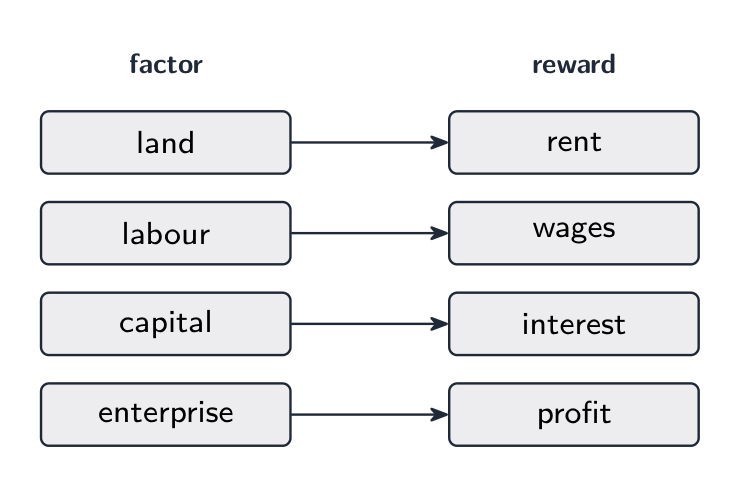
 เหมืองทองแดงแบบเปิด: ที่ดินรวมถึงทรัพยากรธรรมชาติ (แร่, น้ำมัน, น้ำ) ที่บริษัท Extraction.


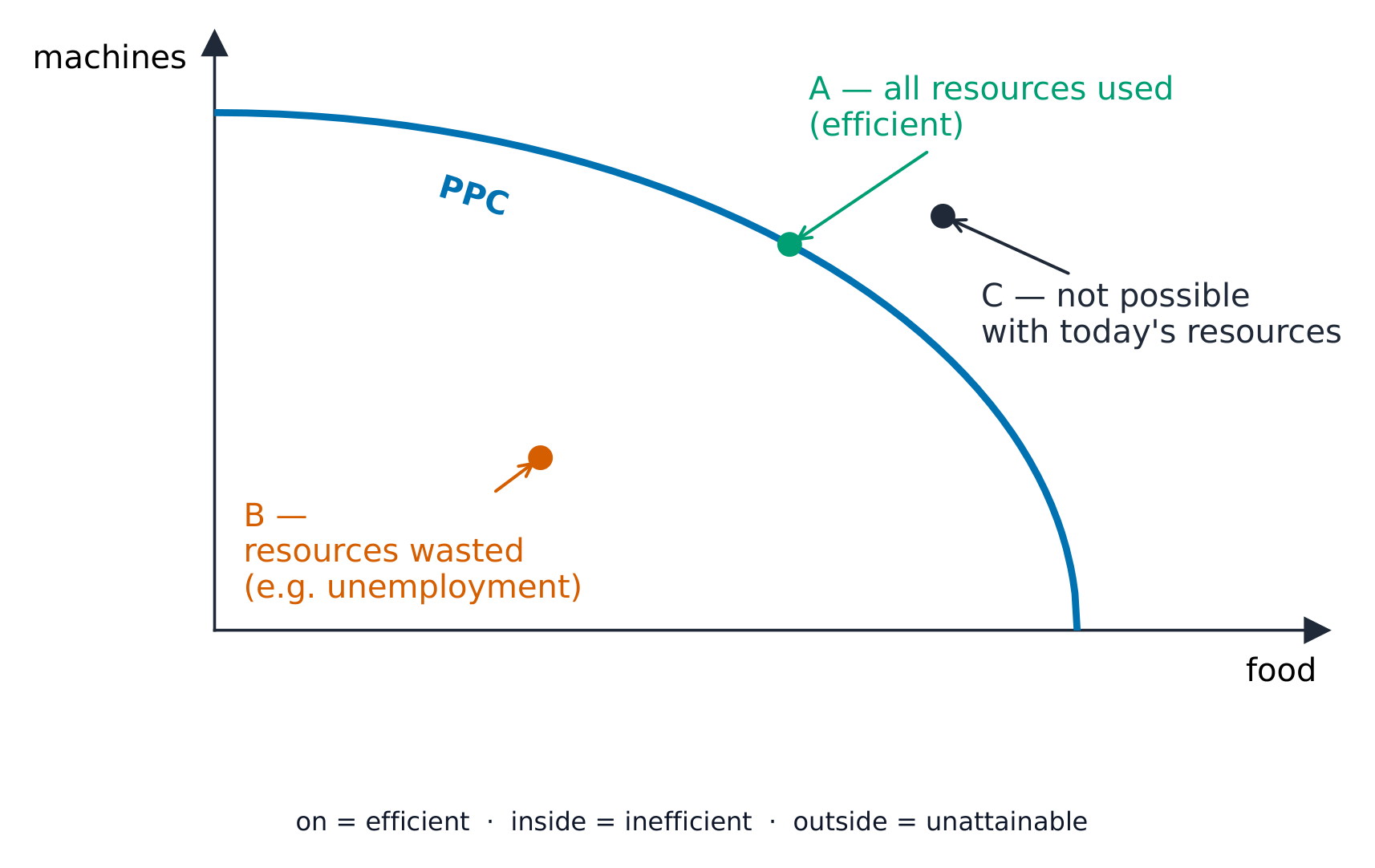


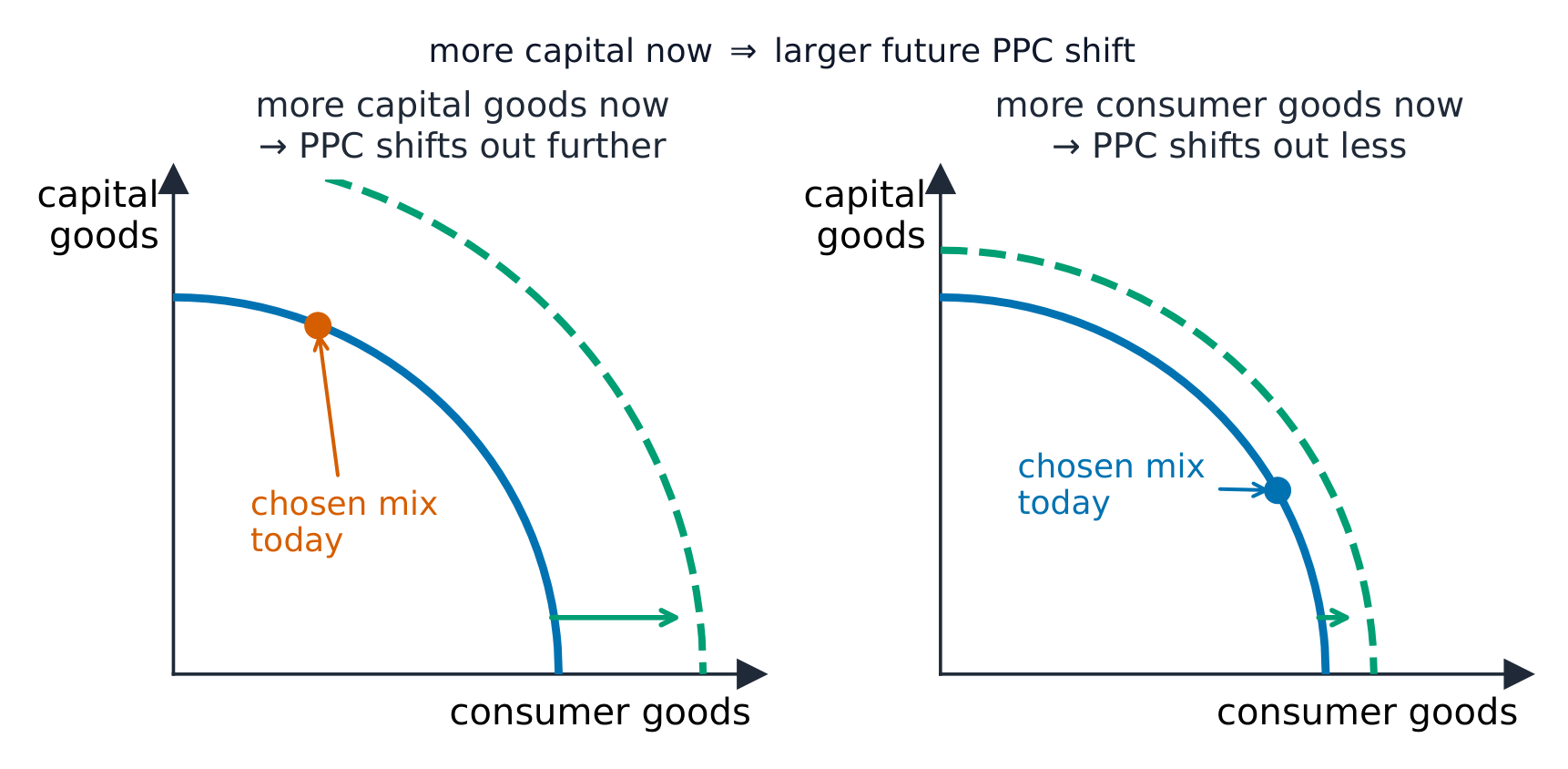

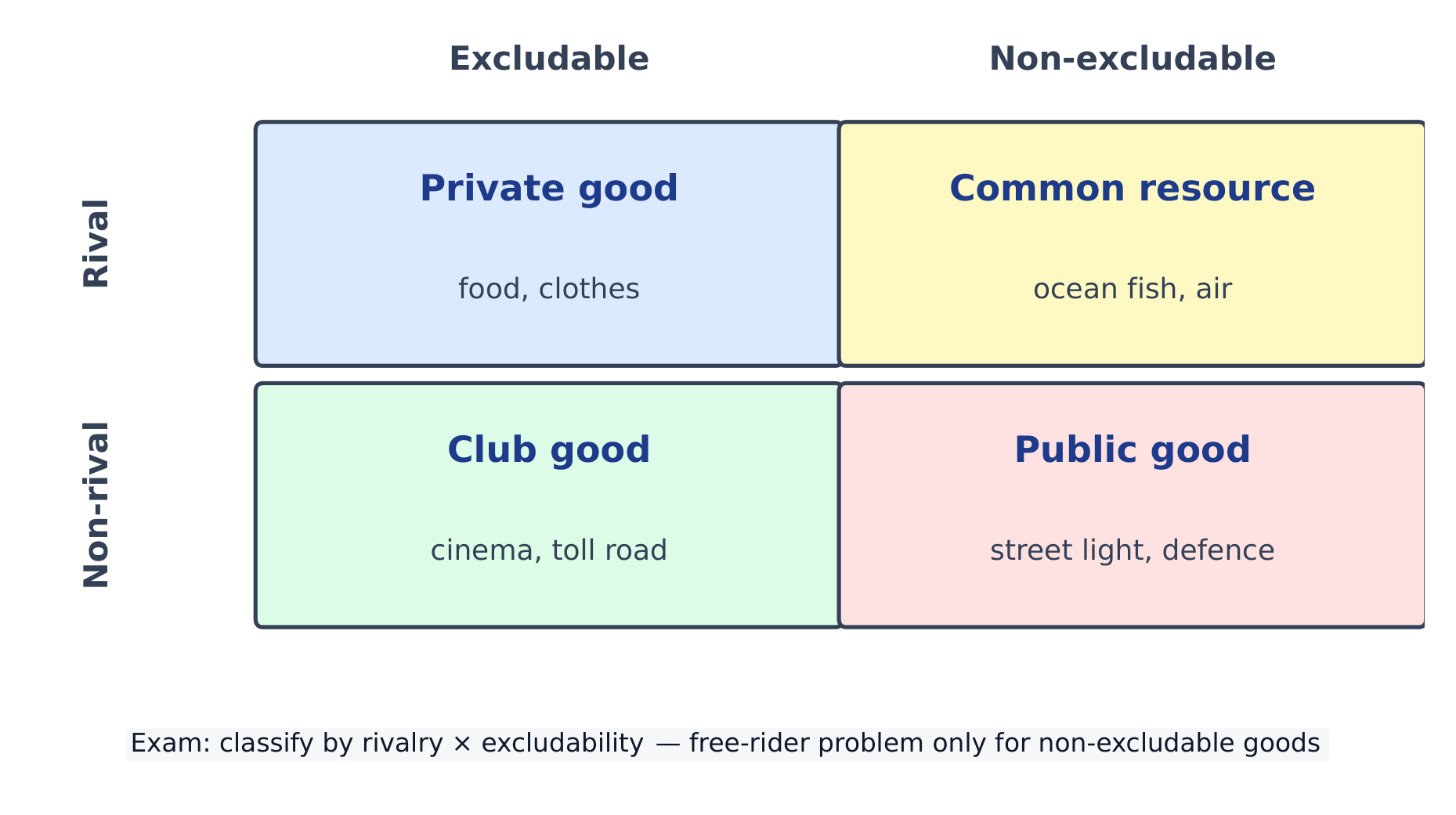


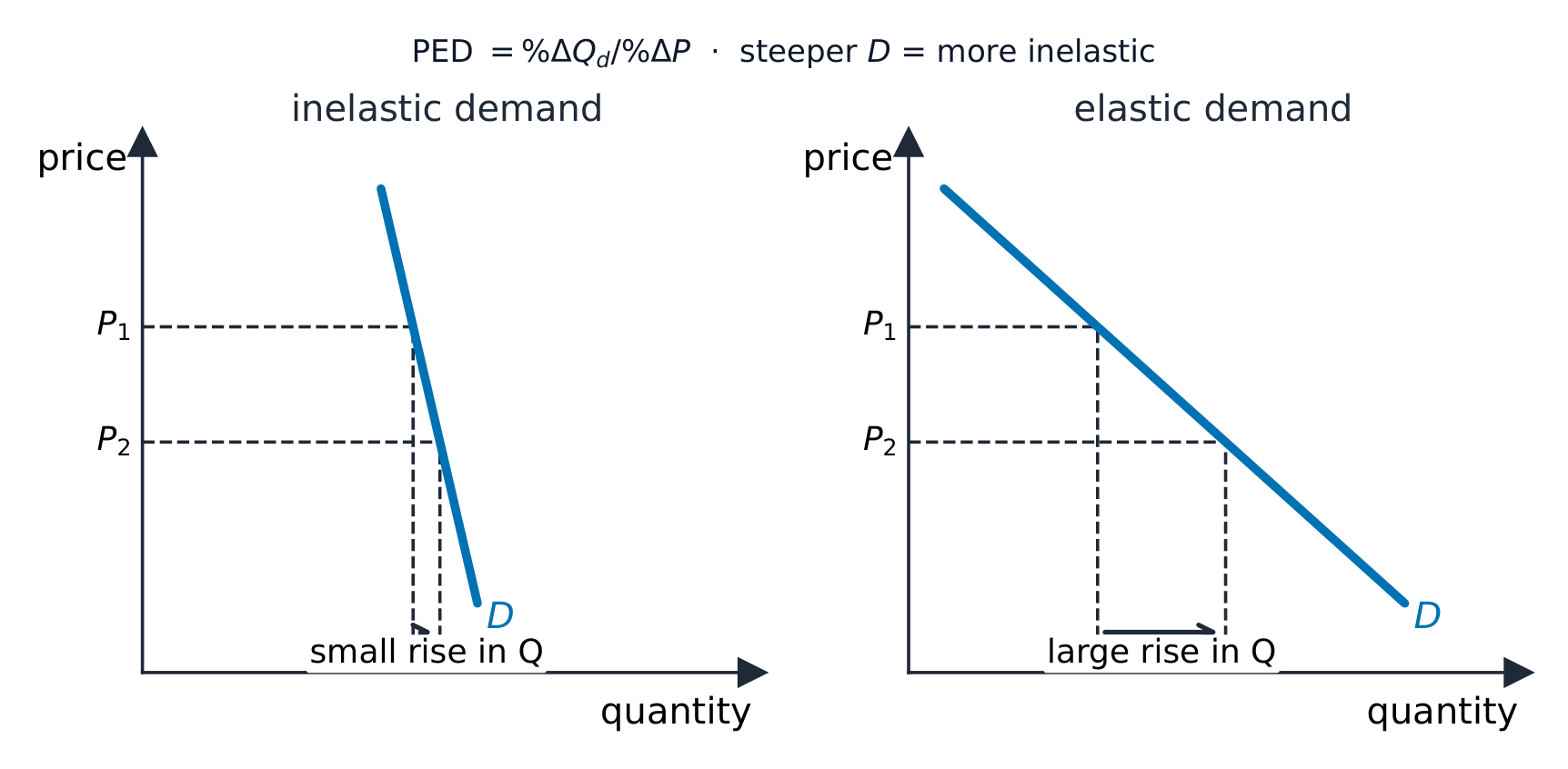


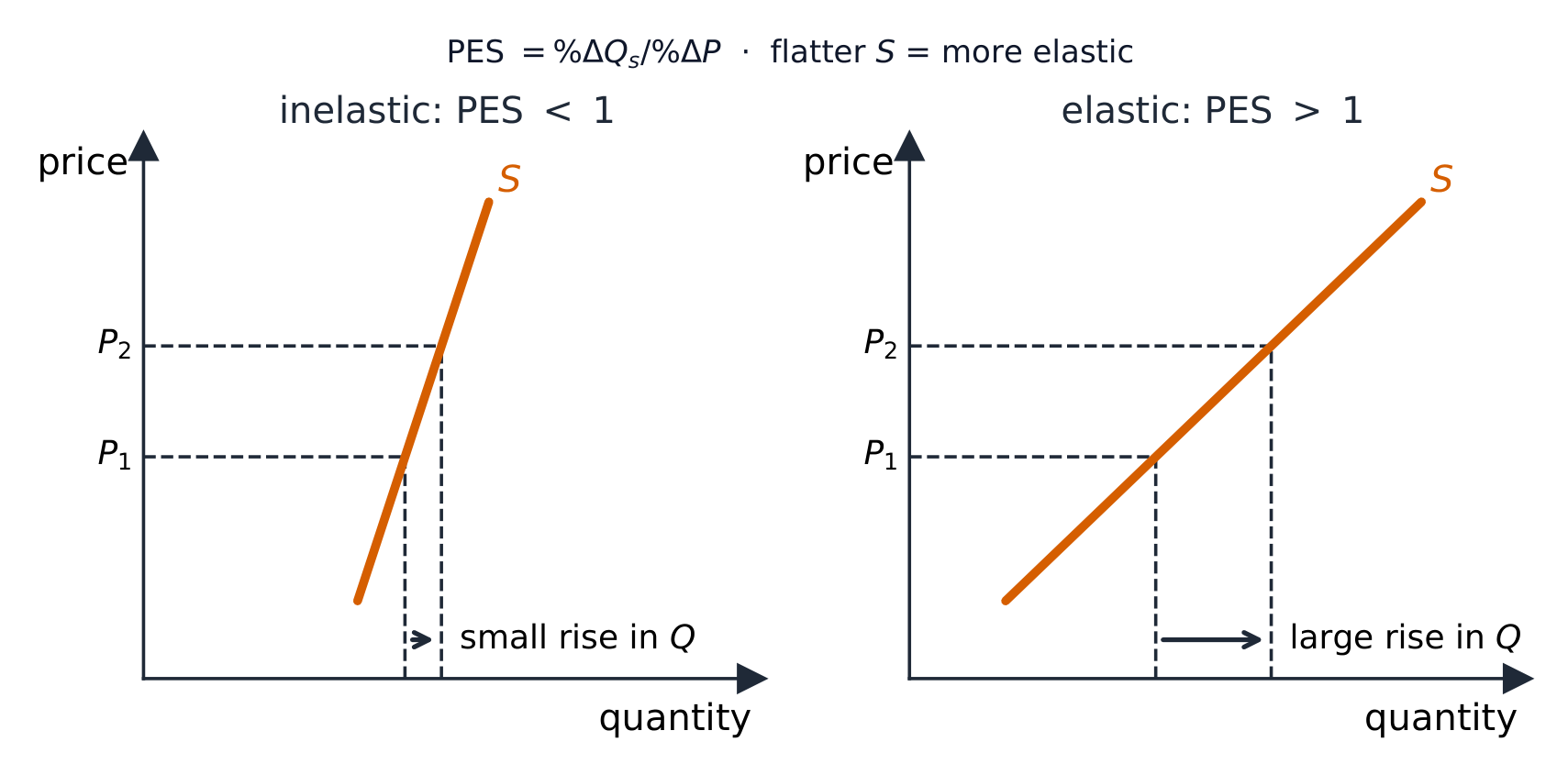

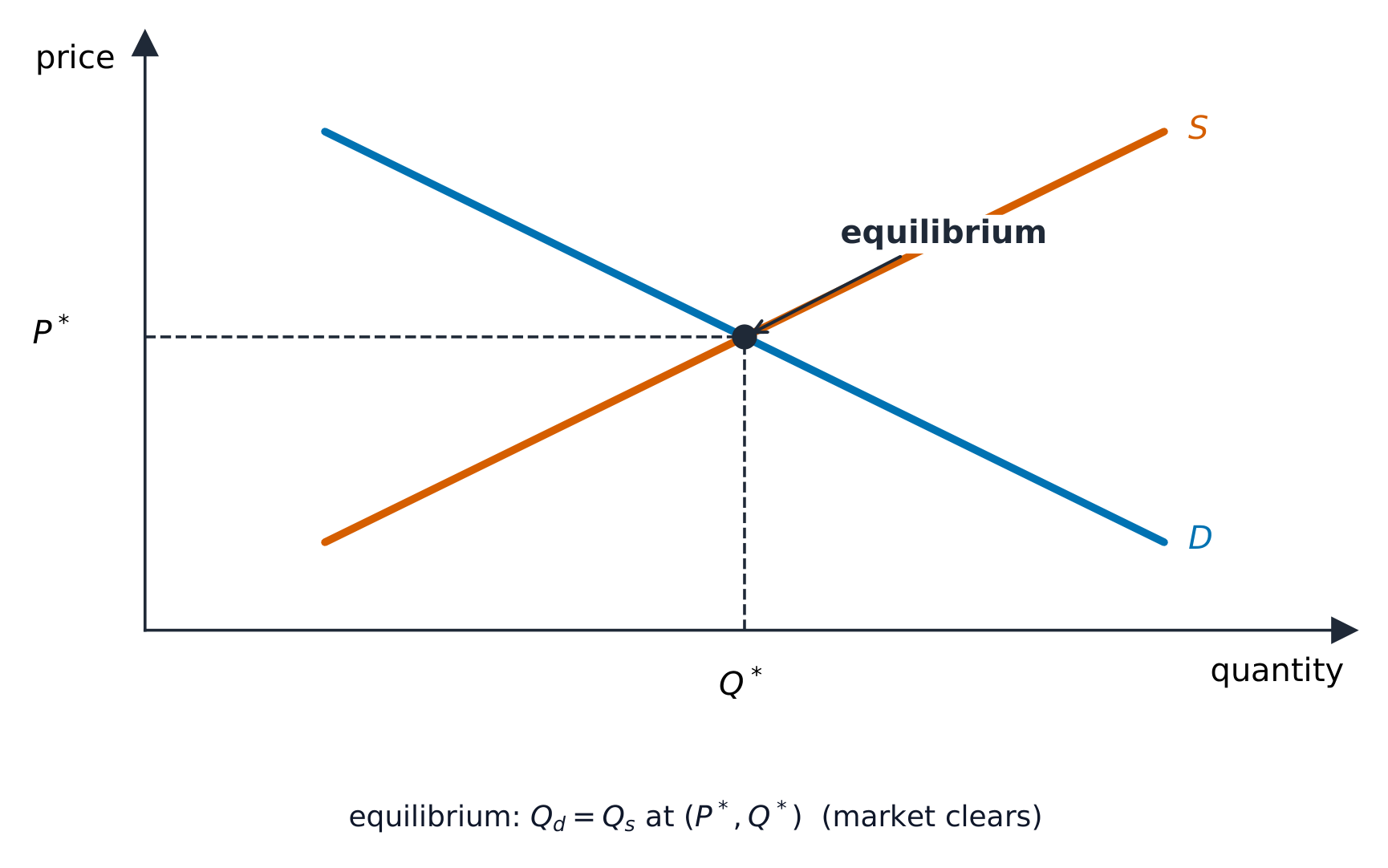
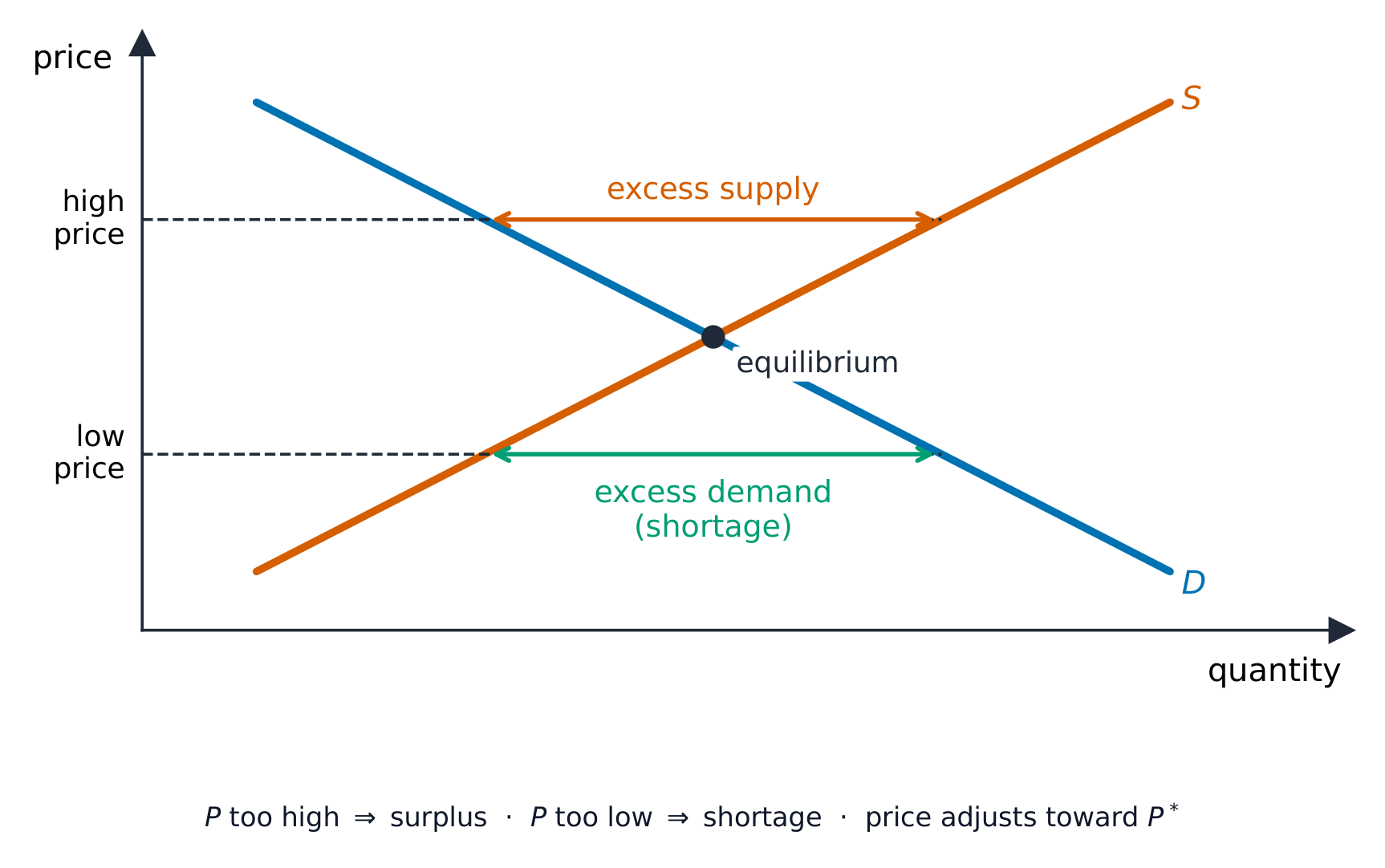
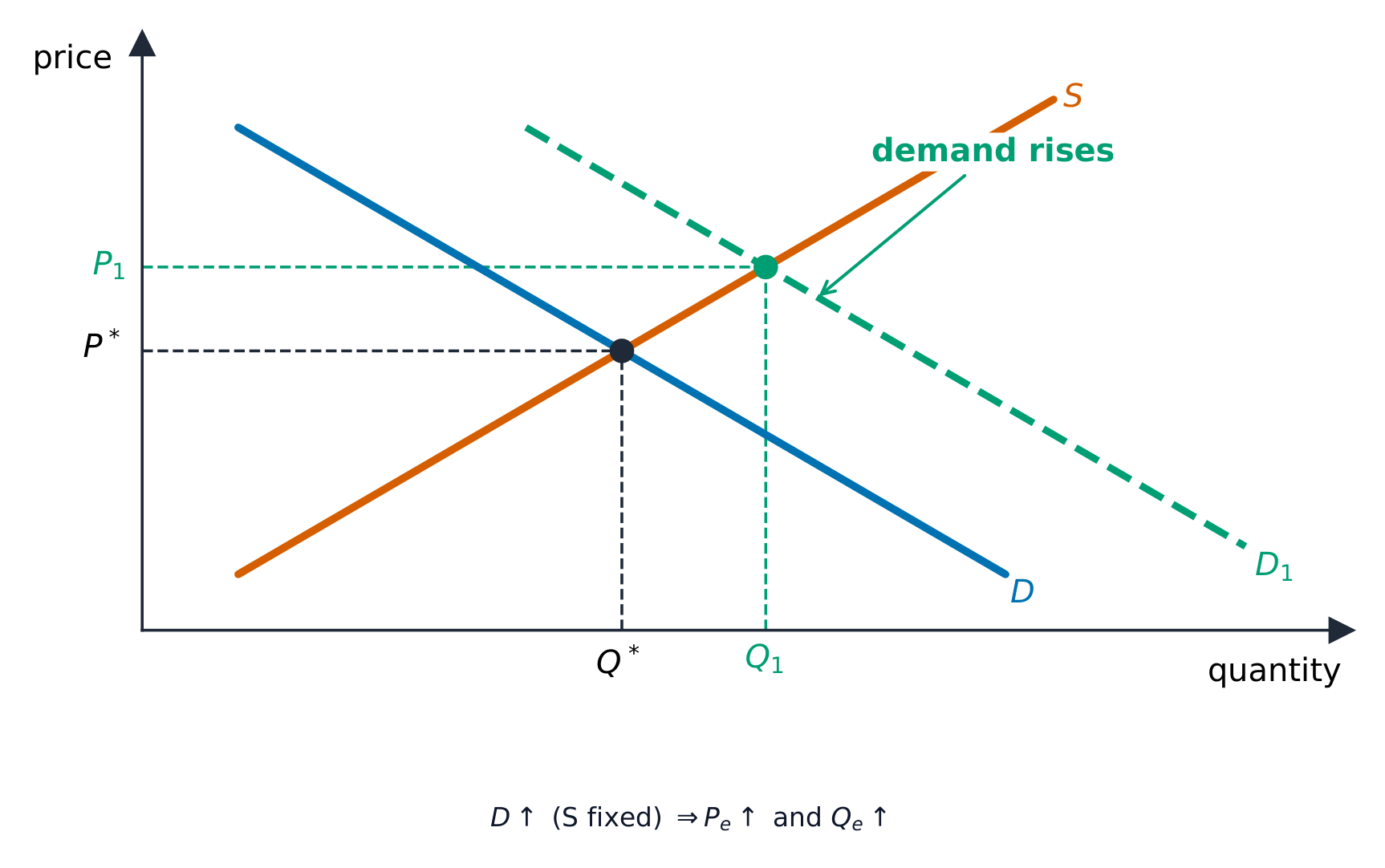
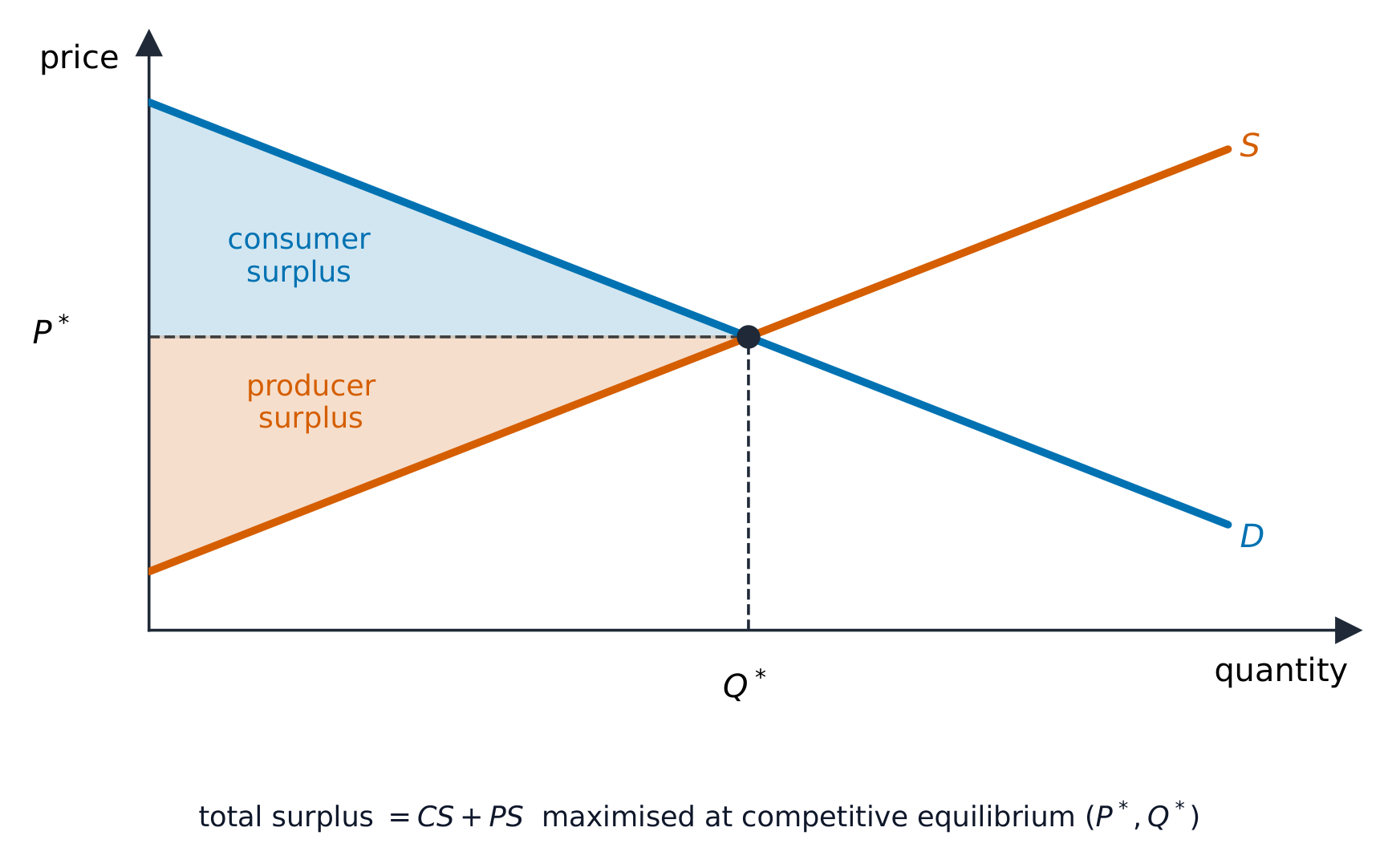

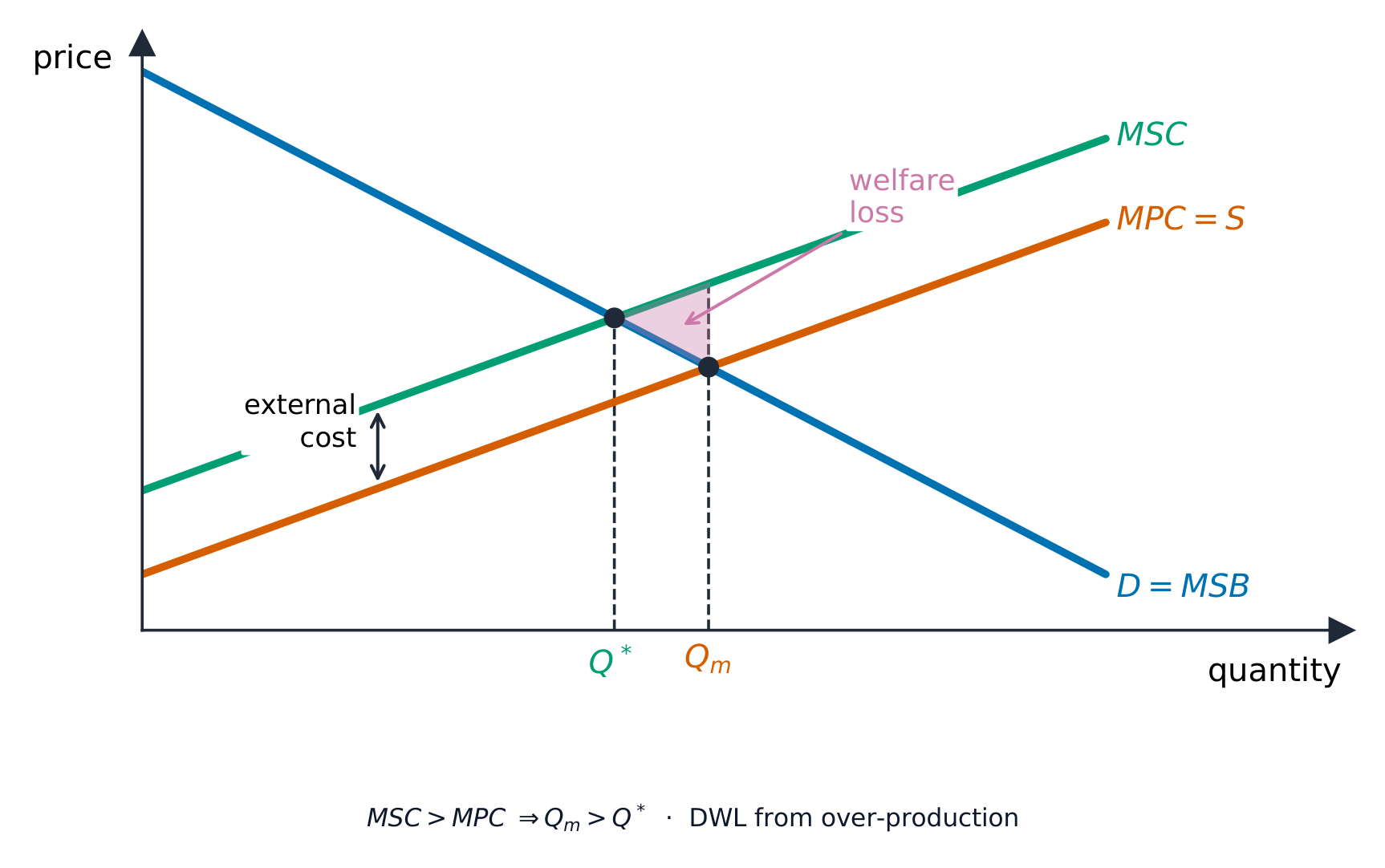


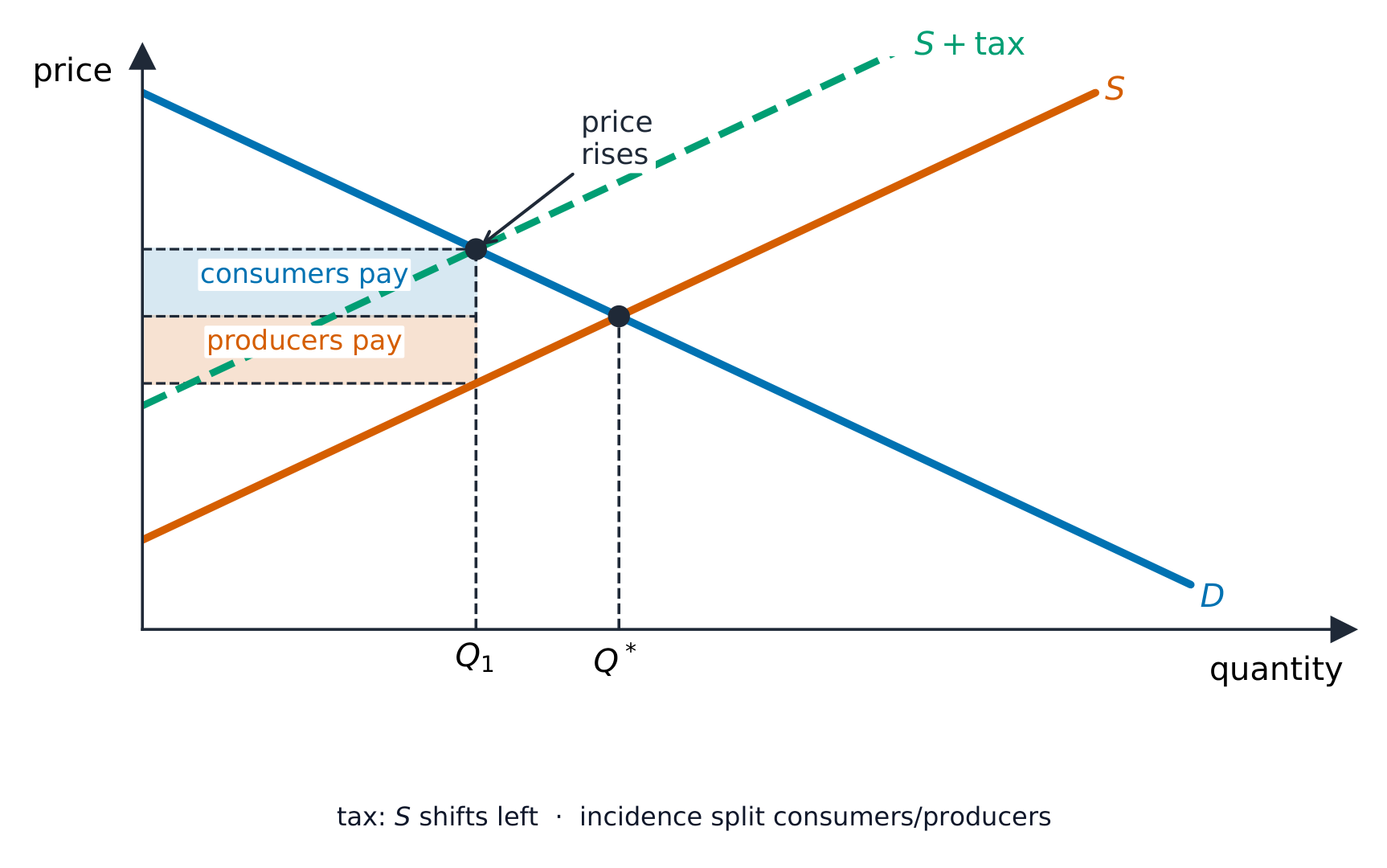 ภาษีทางอ้อมทำให้_supply เลื่อนขึ้นที่