Skip to content · ⁨ข้ามไปยังเนื้อหา⁩

Reaction kinetics · ⁨จลนศาสตร์ของปฏิกิริยา⁩

A-Level Chemistry · ⁨Chemistry A-Level⁩ · Topic 8 · ⁨หัวข้อ 8⁩

Video lesson for this topic · ⁨บทเรียนวิดีโอสำหรับหัวข้อนี้⁩ Open the video page · ⁨เปิดหน้าวิดีโอ⁩
7:13

จลนศาสตร์ของปฏิกิริยา

เหล็กทิ้งไว้ภายนอกต้องใช้เวลาหลายปีจึงจะสนิมหาย การจุดไฟแช็ก ใช้เคมีที่ใกล้เคียงกันมาก — ออกซิเจนโจมตีเชื้อเพลิง — เสร็จสิ้นในน้อยกว่าหนึ่งวินาที …

English narration · English + 中文 subtitles burned in · ⁨การบรรยายภาษาอังกฤษ · คำบรรยายภาษาอังกฤษ + 中文 ลอยตัวบนภาพ⁩

8.1

Rate of reaction · ⁨อัตราการเกิดปฏิกิริยา⁩

Syllabus · ⁨หลักสูตร⁩
English
  1. explain and use the term rate of reaction, frequency of collisions, effective collisions and non-effective collisions
  2. explain qualitatively, in terms of frequency of effective collisions, the effect of concentration and pressure changes on the rate of a reaction
  3. use experimental data to calculate the rate of a reaction
ไทย
  1. อธิบายและใช้คำว่า อัตราการเกิดปฏิกิริยา, ความถี่ของการชนกัน, การชนที่มีประสิทธิภาพ และการชนที่ไม่มีประสิทธิภาพ
  2. อธิบายเชิงคุณภาพ ในแง่ของความถี่ของการชนที่มีประสิทธิภาพ ผลของการเปลี่ยนแปลงความเข้มข้นและความดันต่ออัตราการเกิดปฏิกิริยา
  3. ใช้ข้อมูลจากการทดลองเพื่อคำนวณอัตราการเกิดปฏิกิริยา

Source: Cambridge International syllabus · ⁨แหล่งที่มา: หลักสูตร Cambridge International⁩

English
Collision theory: energy and orientation

The rate of reaction 反应速率 is how fast reactants turn into products. We measure it as the change in concentration (or amount) in each unit of time.

To react, particles must collide 碰撞. The collision frequency 碰撞频率 is how often the particles hit each other. But not every collision leads to a reaction:

  • an effective collision 有效碰撞 has enough energy and the correct direction, so a reaction happens.
  • a non-effective collision 无效碰撞 does not have enough energy, or the particles hit at the wrong angle, so nothing happens.

So the rate depends on the frequency of effective collisions — how many useful collisions happen each second.

Concentration and pressure

If you increase the concentration of a solution (or the pressure of a gas), the particles are packed closer together. They collide more often, so there are more effective collisions each second, and the rate goes up.

You can calculate a rate from experimental data — for example, the volume of gas made divided by the time taken.

Worked example. A reaction gives off carbon dioxide. In the first $30\ \text{s}$, $48\ \text{cm}^3$ of gas is collected. Find the average rate of reaction over this time.

$$\text{average rate} = \frac{\text{volume of gas}}{\text{time}} = \frac{48}{30} = 1.6\ \text{cm}^3\,\text{s}^{-1}.$$

The rate is fastest at the start (the graph is steepest there) because the reactants are most concentrated, then it slows as they are used up.

ไทย
ทฤษฎีการชน: พลังงานและการจัดวางตำแหน่ง

อัตราการเกิดปฏิกิริยา คือความเร็วที่สารตั้งต้นเปลี่ยนเป็นผลผลิต เราวัด它以การเปลี่ยนแปลงของความเข้มข้น (หรือปริมาณ) ในหน่วยเวลา

เพื่อให้ทำปฏิกิริยาได้อนุภาคต้อง ชนกัน ความถี่ของการชน คือจำนวนครั้งที่อนุภาคชนกัน แต่ไม่ใช่ทุกการชนจะนำไปสู่การเกิดปฏิกิริยา:

  • การชนที่มีประสิทธิภาพ มีพลังงาน และ ทิศทางที่ถูกต้องพอ ทำให้เกิดการเกิดปฏิกิริยา
  • การชนที่ไม่มีประสิทธิภาพ ไม่มีพลังงานเพียงพอ หรืออนุภาคชนกันที่มุมผิด จึงไม่เกิดอะไรขึ้น

ดังนั้นอัตราจึงขึ้นอยู่กับ ความถี่ของการชนที่มีประสิทธิภาพ — จำนวนการชนที่เป็นประโยชน์ต่อวินาที

โมเลกุลสองตัวชนกัน: เมื่อปลายที่มีปฏิกิริยาตรงกันจะเกิดปฏิกิริยาขึ้น แต่หากทิศทางไม่ถูกต้องจะไม่เกิดปฏิกิริยา
การชนจะเกิดปฏิกิริยากับการจัดวางตำแหน่งที่ถูกต้องและมีพลังงานเพียงพอ (ปลายสี = ส่วนที่ทำปฏิกิริยา)

ความเข้มข้นและความดัน

หากคุณเพิ่มความเข้มข้นของสารละลาย (หรือความดันของแก๊ส) อนุภาคจะถูกอัดแน่นเข้าหากันมากขึ้น พวกมันชนกันบ่อยขึ้น ส่งผลให้มีการชนที่มีประสิทธิภาพมากขึ้นต่อวินาที และอัตราเร็วเพิ่มขึ้น

กล่องสองใบขนาดเท่ากัน โดยกล่องที่สองมีอนุภาคมากกว่า จึงเกิดการชนกันบ่อยกว่า
เมื่อมีอนุภาคมากขึ้นในพื้นที่เท่าเดิม จะชนกันบ่อยขึ้น ทำให้อัตราเพิ่มขึ้น

คุณสามารถคำนวณอัตราจากข้อมูลการทดลอง — ตัวอย่างเช่น ปริมาตรของแก๊สที่เกิดขึ้นหารด้วยเวลาที่ใช้เวลา

ตัวอย่างวิธีทำ. ปฏิกิริยานี้ปล่อยคาร์บอนไดออกไซด์ ใน $30\ \text{s}$ แรกแรก ได้แก๊ส $48\ \text{cm}^3$ มาเก็บไว้ หาอัตราเฉลี่ยของปฏิกิริยาระหว่างเวลานี้

$$\text{average rate} = \frac{\text{volume of gas}}{\text{time}} = \frac{48}{30} = 1.6\ \text{cm}^3\,\text{s}^{-1}.$$

อัตราเร็วที่สุดคือตอนเริ่มต้น (กราฟชันที่สุดที่นั่น) เพราะสารตั้งต้นมีความเข้มข้นมากที่สุด จากนั้นจะช้าลงเมื่อถูกใช้ไป

Explore · ⁨สำรวจ⁩

Rate of reaction · ⁨อัตราการเกิดปฏิกิริยา⁩

[A] = [A]₀·bᵗ

Reactant concentration falls over time as it's used up. · ⁨ความเข้มข้นของสารตั้งต้น ลดลง ตามเวลาเมื่อถูกใช้ไป⁩

Vocabulary · ⁨คำศัพท์⁩ Train · ⁨ฝึกฝน⁩
English ไทย
rate of reaction/reɪt ɒv rɪˈækʃn/ อัตราของปฏิกิริยา
collide/kəˈlaɪd/ ชนกัน
collision frequency/kəˈlɪʒn ˈfriːkwənsi/ ความถี่การชน
effective collision/ɪˈfektɪv kəˈlɪʒn/ การชนที่มีประสิทธิภาพ
non-effective collision/nɒn ɪˈfektɪv kəˈlɪʒn/ การชนที่ไม่เกิดผล
activation energy/ˌæktɪˈveɪʃn ˈenədʒi/ พลังงานก่อกวน (activation energy)
Watch lesson · ⁨ดูบทเรียน⁩
8.2

Temperature and activation energy · ⁨อุณหภูมิและพลังงานก่อกวน⁩

Syllabus · ⁨หลักสูตร⁩
English
  1. define activation energy, $E_A$, as the minimum energy required for a collision to be effective
  2. sketch and use the Boltzmann distribution to explain the significance of activation energy
  3. explain qualitatively, in terms both of the Boltzmann distribution and of frequency of effective collisions, the effect of temperature change on the rate of a reaction
ไทย
  1. นิยาม พลังงานก่อกวน, $E_A$, ว่าคือพลังงานขั้นต่ำที่ต้องการให้การชนมีประสิทธิภาพ
  2. วาดและใช้ การแจกแจงของโบลต์ซมันน์ เพื่ออธิบายความสำคัญของพลังงานก่อกวน
  3. อธิบายเชิงคุณภาพ ในแง่ของการแจกแจงของโบลต์ซมันน์และความถี่ของการชนที่มีผล ผลของการเปลี่ยนแปลงอุณหภูมิต่ออัตราการเกิดปฏิกิริยา

Source: Cambridge International syllabus · ⁨แหล่งที่มา: หลักสูตร Cambridge International⁩

English
Maxwell-Boltzmann distribution

The activation energy 活化能 ($E_A$) is the minimum energy a collision needs in order to be effective.

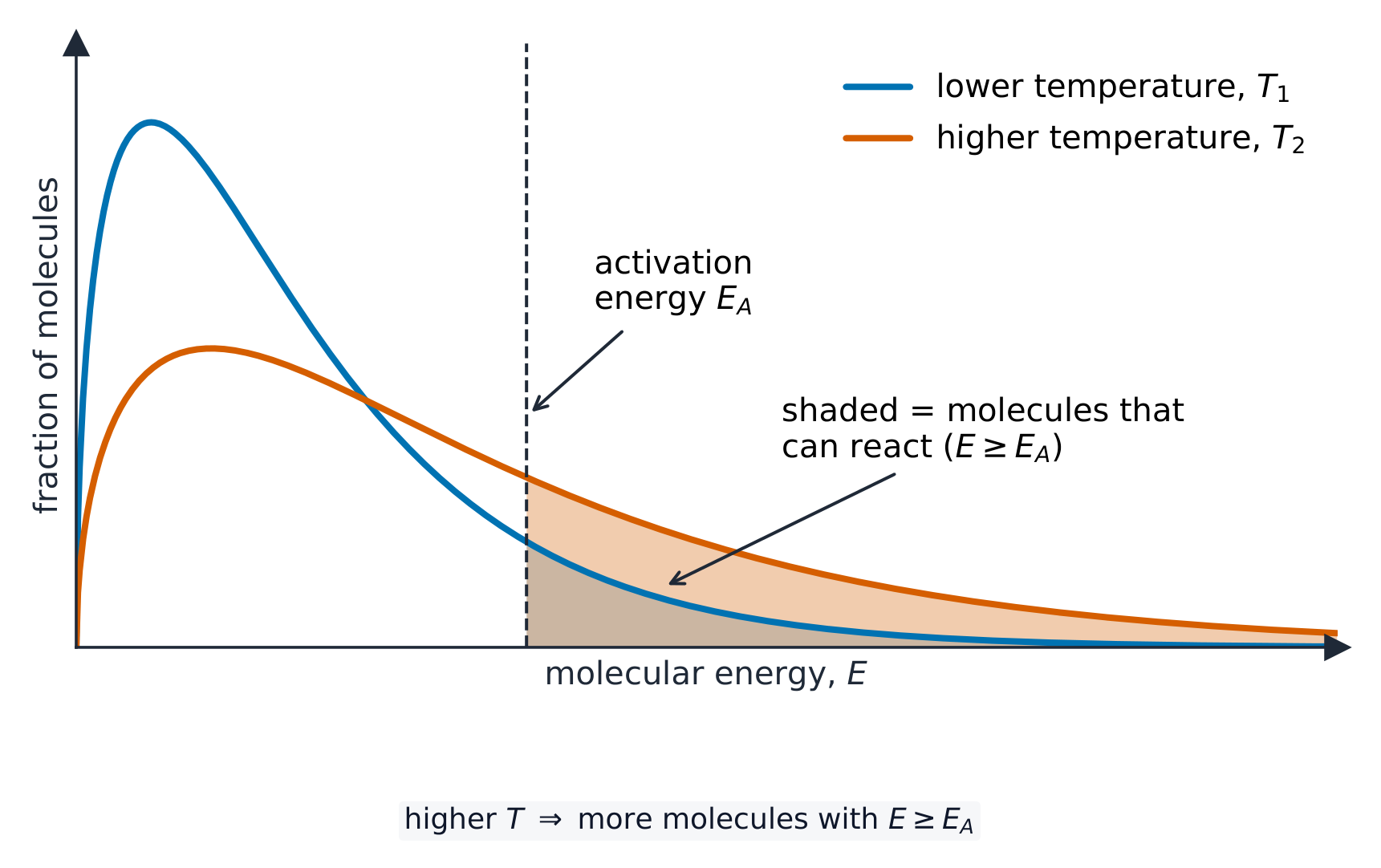
The Boltzmann distribution 玻尔兹曼分布 is a graph showing how the energies of the molecules are spread out at one temperature. The curve starts at the origin, rises to a peak, then falls away in a long tail. The total area under the curve is the total number of molecules. Only the molecules to the right of $E_A$ have enough energy to react.

When you raise the temperature:

  • the curve flattens and spreads to the right, so a much larger fraction of molecules now have energy greater than $E_A$.
  • the molecules also move faster and collide more often.

The first effect is the bigger one. This is why a small rise in temperature gives a large rise in rate.

ไทย
การแจกแจงแม็กซ์เวลล์-โบลต์ซมานน์

พลังงานก่อกวน ($E_A$) คือพลังงานขั้นต่ำที่การชนต้องการเพื่อให้มีประสิทธิภาพ

การแจกแจงโบลต์ซมานน์ เป็นกราฟแสดงการกระจายตัวของพลังงานโมเลกุลที่อุณหภูมิหนึ่ง เส้นโค้งเริ่มจากจุดกำเนิด ขยับขึ้นไปสูงสุด แล้วลดลงเป็นหางยาว พื้นที่รวมใต้เส้นโค้งคือจำนวนโมเลกุลทั้งหมด เฉพาะโมเลกุลทางขวาของ $E_A$ เท่านั้นที่มีพลังงานเพียงพอที่จะทำปฏิกิริยา

เมื่อคุณเพิ่มอุณหภูมิ:

  • เส้นโค้งแบนลงและแผ่ออกไปทางขวา ทำให้ สัดส่วนของโมเลกุลที่มีพลังงานมากกว่า $E_A$ มากขึ้นอย่างมีนัยสำคัญ
  • โมเลกุลยังเคลื่อนที่เร็วขึ้นและชนกันบ่อยขึ้น

ผลกระทบแรกมีขนาดใหญ่กว่า นี่คือเหตุผลที่การเพิ่มขึ้นเล็กน้อยของอุณหภูมิทำให้ معدلReaction เพิ่มขึ้นอย่างมาก

กราฟการกระจายของโบลต์ซมานน์ที่อุณหภูมิต่ำและสูง โดยมีการระบุพลังงานกระตุ้นและพื้นที่ที่แสดงสัดส่วนสารที่ทำปฏิกิริยา
ที่อุณหภูมิสูงขึ้น กราฟจะขยายไปทางขวา ทำให้มีสัดส่วนโมเลกุล能做ปฏิกิริยาได้มากขึ้น
Explore · ⁨สำรวจ⁩

Why heat speeds up reactions · ⁨为什么热加速反应⁩

Raise the temperature: the curve spreads right, so more molecules have at least the activation energy and can react. · ⁨提高温度:曲线向右扩展,所以 更多分子 至少具有活化能并能反应。⁩

Vocabulary · ⁨คำศัพท์⁩ Train · ⁨ฝึกฝน⁩
English ไทย
Boltzmann distribution/ˈbɒltsmən ˌdɪstrɪˈbjuːʃn/ การแจกแจงแบบโบลต์ซมันน์
Watch lesson · ⁨ดูบทเรียน⁩
8.3

Catalysts · ⁨ตัวเร่งปฏิกิริยา⁩

Syllabus · ⁨หลักสูตร⁩
English
  1. explain and use the terms catalyst and catalysis: (a) explain that, in the presence of a catalyst, a reaction has a different mechanism, i.e. one of lower activation energy (b) explain this catalytic effect in terms of the Boltzmann distribution (c) construct and interpret a reaction pathway diagram, for a reaction in the presence and absence of an effective catalyst
ไทย
  1. อธิบายและใช้คำว่า ตัวเร่งปฏิกิริยา และ การเร่งปฏิกิริยา: (ก) อธิบายว่า ในpresenceของตัวเร่งปฏิกิริยา ปฏิกิริยามีกลไกที่แตกต่างกัน นั่นคือมีพลังงานก่อกวนต่ำลง (ข) อธิบายผลนี้ด้วยตัวเร่งปฏิกิริยาในแง่ของการแจกแจงของโบลต์ซมันน์ (ค) สร้างและตีความแผนภาพเส้นทางปฏิกิริยา สำหรับปฏิกิริยาที่มีและไม่มีตัวเร่งปฏิกิริยาที่มีประสิทธิภาพ

Source: Cambridge International syllabus · ⁨แหล่งที่มา: หลักสูตร Cambridge International⁩

English
Reaction profile: a catalyst's lower-energy route

A catalyst 催化剂 speeds up a reaction but is not used up itself. Catalysis 催化作用 is the name for this action.

A catalyst works by giving the reaction a different reaction mechanism 反应机理 — a new route with a lower activation energy. On the Boltzmann distribution, lowering $E_A$ moves the line to the left, so more molecules now have enough energy. This means more effective collisions each second, and a faster rate.

On a reaction pathway diagram 反应路径图, the catalysed route has a lower energy "hill". The enthalpy change of the reaction, $\Delta H$, is not changed by the catalyst.

There are two types:

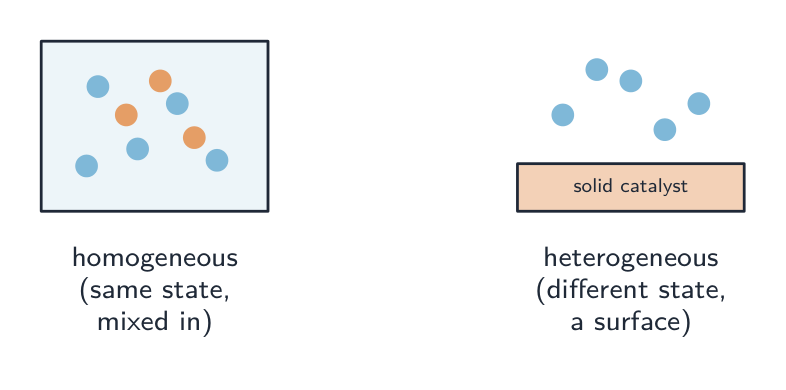
  • a homogeneous catalyst 均相催化剂 is in the same physical state as the reactants — for example, an acid catalyst dissolved in a solution of liquids.
  • a heterogeneous catalyst 多相催化剂 is in a different state from the reactants — for example, solid iron speeding up the reaction of gases in the Haber process.
ไทย
โปรไฟล์ปฏิกิริยา: เส้นทางที่มีพลังงานต่ำกว่าของตัวเร่งปฏิกิริยา

ตัวเร่งปฏิกิริยา ช่วยเร่งปฏิกิริยาแต่ตัวเองไม่ถูกใช้สิ้น การเร่งปฏิกิริยา คือชื่อเรียกการกระทำนี้

ตัวเร่งปฏิกิริยาทำงานโดยให้ปฏิกิริยามี กลไกการเกิดปฏิกิริยา ที่แตกต่างออกไป — เส้นทางใหม่ที่มี พลังงานก่อกวนต่ำ กว่า บนกราฟการแจกแจงโบลต์ซมานน์ การลด $E_A$ จะย้ายเส้นไปทางซ้าย ทำให้มีโมเลกุลที่มีพลังงานเพียงพอมากขึ้น นั่นหมายถึงการชนที่มีประสิทธิภาพมากขึ้นต่อวินาที และอัตราเร็วที่เร็วขึ้น

บน แผนภาพเส้นทางปฏิกิริยา เส้นทางที่ถูกเร่งมี "ภูเขา" พลังงานต่ำกว่า การเปลี่ยนแปลงเอนทาลปีของปฏิกิริยา, $\Delta H$, ไม่ เปลี่ยนแปลงโดยตัวเร่งปฏิกิริยา

แผนภาพเส้นทางการทำปฏิกิริยาคอยเปรียบเทียบเส้นทางที่ใช้ตัวเร่งปฏิกิริยากับไม่ใช้ โดยแสดงภูเขาพลังงานกระตุ้นที่ต่ำกว่าสำหรับเส้นทางที่ใช้ตัวเร่ง และค่าเอนทาลปีเปลี่ยนแปลงเท่าเดิม
ตัวเร่งปฏิกิริยาให้เส้นทางที่มีพลังงานกระตุ้นต่ำกว่า; การเปลี่ยนแปลงเอนทาลปีไม่เปลี่ยน

มีสองประเภท:

  • ตัวเร่งปฏิกิริยาแบบเดียวกัน อยู่ใน สถานะ ทางกายภาพเดียวกับสารตั้งต้น — ตัวอย่างเช่น ตัวเร่งปฏิกิริยากรดที่ละลายอยู่ในสารละลายของเหลว
  • ตัวเร่งปฏิกิริยาแบบ heterogeneous อยู่ใน สถานะที่ต่าง จากสารตั้งต้น — เช่น เหล็กแข็งตัวเร่งปฏิกิริยาของแก๊สในกระบวนการ Haber
สองภาพ: ตัวเร่งปฏิกิริยาแบบ homogeneous ผสมอยู่กับอนุภาคสารตั้งต้นในสถานะเดียวกัน และตัวเร่งปฏิกิริยาแบบ heterogeneous เป็นพื้นผิวแข็งแยกต่างหากที่มีสารตั้งต้นอยู่ด้านบน
ตัวเร่งปฏิกิริยาแบบ homogeneous ผสมกับสารตั้งต้น (สถานะเดียวกัน); ตัวเร่งปฏิกิริยาแบบ heterogeneous เป็นพื้นผิวแยกต่างหาก (สถานะต่างกัน) ซึ่งเป็นจุดที่สารตั้งต้นมาพบกันและทำปฏิกิริยา
บล็อกตัวเปลี่ยนสภาพทางเคมีรูปทรงกระบอกที่มีพื้นผิวรังผึ้งละเอียด — ตัวเร่งปฏิกิริยาแบบ heterogeneous จริง
ตัวเปลี่ยนสภาพทางเคมีในรถยนต์เป็นตัวเร่งปฏิกิริยาแบบ heterogeneous; โครงสร้างรังผึ้งให้พื้นที่ผิวมหาศาล
Explore · ⁨สำรวจ⁩

Catalysts · ⁨ตัวเร่งปฏิกิริยา⁩

a catalyst lowers Ea · ⁨ตัวเร่งปฏิกิริยาลด Ea⁩

A catalyst lowers Ea, so a bigger fraction of molecules can react — without heating. · ⁨ตัวเร่งปฏิกิริยาลด Eₐ ลง ทำให้ สัดส่วนที่กว้างขึ้น ของโมเลกุลสามารถทำปฏิกิริยาได้ — โดยไม่ต้องให้ความร้อน⁩

Explore · ⁨สำรวจ⁩

How a catalyst works · ⁨催化剂如何工作⁩

Add a catalyst and watch the activation-energy barrier drop — it gives an easier route, without changing ΔH. · ⁨添加催化剂并看到 activation-energy barrier 下降——它提供了一条更容易的路径,不改变ΔH。⁩

Vocabulary · ⁨คำศัพท์⁩ Train · ⁨ฝึกฝน⁩
English ไทย
catalyst/ˈkætəlɪst/ ตัวเร่งปฏิกิริยา
catalysis/kæˈtæləsɪs/ การเร่งปฏิกิริยา
reaction mechanism/rɪˈækʃn ˈmekənɪzəm/ กลไกของปฏิกิริยา
reaction pathway diagram/rɪˈækʃn ˈpæθweɪ ˈdaɪəɡræm/ แผนภาพเส้นทางปฏิกิริยาเคมี
homogeneous catalyst/həˈməʊdʒnɪəs ˈkætəlɪst/ ตัวเร่งปฏิกิริยาแบบ homogeneous
heterogeneous catalyst/ˌhetrəˈdʒiːnɪəs ˈkætəlɪst/ ตัวเร่งปฏิกิริยาแบบ heterogeneous
Watch lesson · ⁨ดูบทเรียน⁩
8.3

Exam tips · ⁨ข้อแนะนำสำหรับการสอบ⁩

English
  • Explain rate changes with collision theory — more frequent and/or more energetic effective collisions.
  • On a Boltzmann distribution mark $E_A$, shade to its right, and show the curve flatten and shift right at higher temperature; it starts at the origin and never touches the axis.
  • A catalyst gives an alternative route with lower $E_A$ and does not change $\Delta H$.
  • Say why a small temperature rise gives a large rate rise: a much greater proportion of molecules now exceed $E_A$ (the main effect).
ไทย
  • อธิบายการเปลี่ยนแปลงอัตราด้วย ทฤษฎีการชน — การชนที่มีประสิทธิภาพ (effective collisions) ที่ถี่ขึ้นและ/หรือมีพลังงานสูงขึ้น
  • บน กราฟการกระจายของโบลต์ซมันน์ ชี้ $E_A$, ทาเงาไปทางขวา และแสดงให้กราฟ แบนลงและเลื่อนไปทางขวา ที่อุณหภูมิสูงกว่า; กราฟเริ่มจากจุดกำเนิดและไม่สัมผัสแกน
  • ตัวเร่งปฏิกิริยา ให้เส้นทางทางเลือกที่มี พลังงานกัมเน็ตรัง更低 $E_A$ และ ไม่ เปลี่ยน $\Delta H$.
  • อธิบายว่าทำไมอุณหภูมิเพิ่มขึ้นเพียงเล็กน้อยจึงทำให้อัตราการเกิดปฏิกิริยาเพิ่มขึ้นอย่างมาก: มี สัดส่วนของโมเลกุลที่สูงกว่ามาก ที่ kini มีพลังงานเกิน $E_A$ (เป็นผลหลัก).

Interactive lessons on this topic · ⁨บทเรียนเชิงโต้ตอบสำหรับหัวข้อนี้⁩

Work through it step by step, with instant-check exercises. · ⁨ทำทีละขั้นตอน พร้อมแบบฝึกหัดตรวจสอบผลทันที⁩

Past Papers · ⁨ข้อสอบย้อนหลัง⁩

More topics in A-Level Chemistry · ⁨Chemistry A-Level⁩ · ⁨หัวข้อเพิ่มเติมใน A-Level Chemistry · ⁨Chemistry A-Level⁩⁩

Log in or create account · ⁨เข้าสู่ระบบหรือสร้างบัญชี⁩

IGCSE, A-Level & AP