Skip to content · ⁨ข้ามไปยังเนื้อหา⁩

Energy and respiration · ⁨พลังงานและการหายใจระดับเซลล์⁩

A-Level Biology · ⁨Biology A-Level⁩ · Topic 12 · ⁨หัวข้อ 12⁩

Video lesson for this topic · ⁨บทเรียนวิดีโอสำหรับหัวข้อนี้⁩ Open the video page · ⁨เปิดหน้าวิดีโอ⁩
9:49

การหายใจระดับเซลล์

ในเวลาใดเวลาหนึ่ง ร่างกายของคุณมี ATP เพียงประมาณ 50 กรัม. แต่ในวันเดียวคุณจะสร้างและใช้ไปประมาณน้ำหนักตัวของคุณเอง. …

English narration · English + 中文 subtitles burned in · ⁨การบรรยายภาษาอังกฤษ · คำบรรยายภาษาอังกฤษ + 中文 ลอยตัวบนภาพ⁩

12.1

Why living things need energy · ⁨ทำไมสิ่งมีชีวิตจึงต้องการพลังงาน⁩

Syllabus · ⁨หลักสูตร⁩
English
  1. outline the need for energy in living organisms, as illustrated by active transport, movement and anabolic reactions, such as those occurring in DNA replication and protein synthesis
  2. describe the features of ATP that make it suitable as the universal energy currency
  3. state that ATP is synthesised by: • transfer of phosphate in substrate-linked reactions • chemiosmosis in membranes of mitochondria and chloroplasts
  4. explain the relative energy values of carbohydrates, lipids and proteins as respiratory substrates
  5. state that the respiratory quotient (RQ) is the ratio of the number of molecules of carbon dioxide produced to the number of molecules of oxygen taken in, as a result of respiration
  6. calculate RQ values of different respiratory substrates from equations for respiration
  7. describe and carry out investigations, using simple respirometers, to determine the RQ of germinating seeds or small invertebrates (e.g. blowfly larvae)
ไทย
  1. อธิบายความจำเป็นของพลังงานในสิ่งมีชีวิต โดยยกตัวอย่างการขนส่งแบบแอคทีฟ การเคลื่อนไหว และปฏิกิริยา anabolic เช่นที่เกิดขึ้นในการจำลอง DNA และการสังเคราะห์โปรตีน
  2. อธิบายคุณสมบัติของ ATP ที่ทำให้เหมาะสำหรับการทำหน้าที่เป็น สกุลเงินพลังงานสากล
  3. ระบุว่า ATP ถูกสังเคราะห์โดย: • การถ่ายโอนหมู่ phosphate ใน substrate-linked reactions • chemiosmosis บนเยื่อหุ้มของไมโทคอนเดรียและคลอโรพลาสต์
  4. อธิบายค่าพลังงานสัมพัทธ์ของคาร์โบไฮเดรต.train และโปรตีนในฐานะ respiratory substrates
  5. ระบุว่า respiratory quotient (RQ) คืออัตราส่วนระหว่างจำนวนโมเลกุลของคาร์บอนไดออกไซด์ที่เกิดจากการหายใจ จำนวนโมเลกุลของออกซิเจนที่ถูกดูดซึมเข้าไป
  6. คำนวณค่า RQ ของ respiratory substrates ต่างๆ จากสมการการหายใจ
  7. อธิบายและดำเนินการสืบเสาะหาข้อมูล โดยใช้ respirometers แบบง่าย เพื่อหา RQ ของเมล็ดพันธุ์ที่กำลังงอกหรือสัตว์ไม่มีกระดูกสันหลังขนาดเล็ก (เช่น larva ของ blowfly)

Source: Cambridge International syllabus · ⁨แหล่งที่มา: หลักสูตร Cambridge International⁩

English

Cells need a steady supply of energy 能量, which they get from respiration 呼吸作用. Energy is needed for:

  • active transport 主动运输 (moving substances against a gradient),
  • movement (for example muscle contraction),
  • anabolic 合成代谢 reactions — the building of large molecules, such as in DNA replication and protein synthesis.
ไทย

เซลล์ต้องการแหล่งจ่าย พลังงาน ที่ต่อเนื่อง ซึ่งได้รับจากการ หายใจระดับเซลล์ พลังงานจำเป็นสำหรับ:

  • การขนส่งแบบแอคทีฟ (การเคลื่อนย้ายสารทวนความแตกต่างของความเข้มข้น),
  • การเคลื่อนไหว (เช่น การหดตัวของกล้ามเนื้อ),
  • ปฏิกิริยาอะนาลิติก — การสร้างโมเลกุลขนาดใหญ่ เช่น ในการจำลอง DNA และการสังเคราะห์โปรตีน
นักกีฬาวิ่งบนสนามวิ่ง
ระหว่างการออกกำลังกาย กล้ามเนื้อต้องการพลังงานอย่างต่อเนื่องที่ปลดปล่อยออกมาจากการหายใจระดับเซลล์
12.1

ATP — the energy currency · ⁨ATP — เงินตราแห่งพลังงาน⁩

English

ATP is the molecule that carries energy to where it is needed. It is made from ADP and a phosphate group; when it loses that phosphate again, it releases a small, usable burst of energy. ATP suits this job well, so we call it the universal energy currency:

  • it releases energy quickly, in small amounts that match a cell's needs.
  • it is easily made and re-made, again and again.
  • it is small and soluble, so it moves easily around the cell.

ATP is made in two ways: by direct transfer of a phosphate group in phosphorylation 磷酸化 reactions, and by chemiosmosis 化学渗透 across the membranes of mitochondria 线粒体 and chloroplasts.

ไทย

ATP เป็นโมเลกุลที่ขนส่งพลังงานไปยังจุดที่ต้องการ สร้างจาก ADP และหมู่ฟอสเฟต เมื่อสูญเสียหมู่ฟอสเฟตออกไปอีกครั้งจะปลดปล่อยพลังงานในปริมาณเล็กน้อยที่ใช้ได้จริง ATP เหมาะสมกับหน้าที่นี้ดี เราจึงเรียกว่า เงินตราพลังงานสากล :

  • ปลดปล่อยพลังงานได้รวดเร็ว ในปริมาณเล็กที่ตรงกับความต้องการของเซลล์
  • สร้างใหม่และใช้ซ้ำได้ง่าย往复
  • ขนาดเล็กและละลายน้ำได้ดี จึงเคลื่อนที่ภายในเซลล์ได้อย่างสะดวก

วงจรแสดง ADP บวกกับหมู่ฟอสเฟตเปลี่ยนเป็น ATP โดยใช้พลังงานจากการหายใจระดับเซลล์ และ ATP กลับกลายเป็น ADP บวกกับหมู่ฟอสเฟตเมื่อปลดปล่อยพลังงานให้เซลล์ *การหายใจระดับเซลล์เพิ่มหมู่ฟอสเฟตเพื่อสร้าง ATP; เซลล์ตัดออกเพื่อปลดปล่อยพลังงาน

ATP สร้างได้สองวิธี: โดยการถ่ายโอนหมู่ฟอสเฟตโดยตรงในปฏิกิริยา ฟอสโฟรีเลชัน และผ่าน เคมีโอสมోซิส ผ่านเยื่อหุ้มของ ไมโทคอนเดรีย และคลอโรพลาสต์

Explore · ⁨สำรวจ⁩

The ATP cycle · ⁨วงจร ATP⁩

Step around the loop. ATP is split to release a small burst of energy, then rebuilt by respiration — over and over. · ⁨ขั้นตอนรอบวง: ATP ถูกแตกเพื่อปลดปล่อยพลังงานเล็กน้อย แล้วสร้างใหม่ด้วยการหายใจ — ทำซ้ำไปเรื่อยๆ⁩

12.1

Respiratory substrates and RQ · ⁨วัสดุสำหรับการหายใจและค่า RQ⁩

English

A respiratory substrate 呼吸底物 is a molecule that is broken down to release energy. Per gram, lipids release the most energy (they have the most hydrogen), proteins are next, and carbohydrates the least.

The respiratory quotient 呼吸商 (RQ) compares the gases exchanged:

$$\text{RQ} = \frac{\text{molecules of carbon dioxide produced}}{\text{molecules of oxygen taken in}}$$

You can work out the RQ from a respiration equation. Carbohydrates give an RQ of about 1.0, lipids about 0.7 and proteins about 0.9.

Worked example. Find the RQ for the aerobic respiration of glucose: $\text{C}_6\text{H}_{12}\text{O}_6 + 6\text{O}_2 \rightarrow 6\text{CO}_2 + 6\text{H}_2\text{O}$.

$$\text{RQ} = \frac{\text{CO}_2 \text{ produced}}{\text{O}_2 \text{ taken in}} = \frac{6}{6} = 1.0.$$

This is why an RQ near $1.0$ suggests the organism is respiring carbohydrate; a lower RQ (about $0.7$) suggests it is using lipid, which needs more oxygen per molecule of $\text{CO}_2$.

A respirometer 呼吸计 measures the oxygen 氧气 taken in by living things, such as germinating 萌发 seeds or small invertebrates 无脊椎动物, and is used to find their RQ.

ไทย

สารตั้งต้นของการหายใจ (respiratory substrate) คือโมเลกุลที่ถูกย่อยสลายเพื่อปล่อยพลังงาน เมื่อพิจารณาต่อหนึ่งกรัม ไขมัน จะปล่อยพลังงานมากที่สุด (มีไฮโดรเจนมากสุด) โปรตีนอยู่ถัดไป และคาร์โบไฮเดรตปล่อยน้อยที่สุด

กราฟแท่ง:.trainoid ปล่อยพลังงานต่อกรัมมากที่สุด ตามด้วยโปรตีน และคาร์โบไฮเดรต
ไขมันปล่อยพลังงานมากที่สุดต่อกรัม ตามด้วยโปรตีน แล้วจึงเป็นคาร์โบไฮเดรต

ตัวชี้วัดการหายใจ (RQ) เปรียบเทียบปริมาณก๊าซที่แลกเปลี่ยนกัน:

$$\text{RQ} = \frac{\text{molecules of carbon dioxide produced}}{\text{molecules of oxygen taken in}}$$

คุณสามารถคำนวณค่า RQ จากสมการการหายใจ คาร์โบไฮเดรตให้ค่า RQ ประมาณ 1.0 ไขมันประมาณ 0.7 และโปรตีนประมาณ 0.9

ตัวอย่างวิธีทำ หา RQ สำหรับการหายใจแบบใช้ออกซิเจนของกลูโคส: $\text{C}_6\text{H}_{12}\text{O}_6 + 6\text{O}_2 \rightarrow 6\text{CO}_2 + 6\text{H}_2\text{O}$

$$\text{RQ} = \frac{\text{CO}_2 \text{ produced}}{\text{O}_2 \text{ taken in}} = \frac{6}{6} = 1.0.$$

นี่คือเหตุผลว่าทำไมค่า RQ ที่ใกล้เคียง $1.0$ จึงบ่งบอกว่าสิ่งมีชีวิตกำลังหายใจโดยใช้คาร์โบไฮเดรต ส่วนค่า RQ ที่ต่ำกว่า (ประมาณ $0.7$) บ่งบอกว่าใช้ไขมัน ซึ่งต้องใช้氧量ต่อโมเลกุลของ $\text{CO}_2$ มากกว่า

เครื่องวัดอัตราการหายใจ (respirometer) วัดปริมาณ ออกซิเจน ที่สิ่งมีชีวิต เช่น เมล็ดพืชที่กำลังงอก หรือ สัตว์ไม่มีกระดูกสันหลังขนาดเล็ก นำเข้า เพื่อหาค่า RQ ของสิ่งมีชีวิตเหล่านั้น

เครื่องวัดอัตราการหายใจ: ขวดใส่เมล็ดพืชที่กำลังงอกวางอยู่บนโซดาไลม์ เชื่อมต่อกับท่อแคปิลลารีที่มีเม็ดสีบนสเกล; เม็ดสีจะเคลื่อนที่เข้าหาขวดเมื่อออกซิเจนถูกใช้ไป
โซดาไลม์ดูดซับ CO₂ ที่คายออกมา ทำให้ปริมาตรแก๊สลดลงเพียงเท่าที่ออกซิเจนถูกใช้ไป — และเม็ดสีจะเคลื่อนที่เข้ามาตามปริมาณนั้น
Explore · ⁨สำรวจ⁩

Respiratory quotient lab · ⁨ห้องปฏิบัติการค่าสัมประสิทธิ์การหายใจ (RQ)⁩

RQ = CO2 produced / O2 used · ⁨RQ = CO2 ที่ผลิต / O2 ที่ใช้⁩

Change oxygen use and see how RQ compares fuels. · ⁨เปลี่ยนการใช้ออกซิเจนเพื่อดูว่า RQ เปรียบเทียบเชื้อเพลิงอย่างไร⁩

Vocabulary · ⁨คำศัพท์⁩ Train · ⁨ฝึกฝน⁩
English ไทย
energy/ˈenədʒi/ พลังงาน
respiratory substrate/rɪˈspɪrətəri ˈsʌbstreɪt/ สารตั้งต้นในการหายใจ
respiratory quotient/rɪˈspɪrətəri ˈkwəʊʃənt/ ค่าสัมประสิทธิ์การหายใจ
respirometer/rɪspɪˈrɒmɪtə/ เครื่องวัดอัตราการหายใจ
oxygen/ˈɒksɪdʒn/ ออกซิเจน
germinate/ˈdʒɜːmɪneɪt/ งอก
invertebrate/ɪnˈvɜːtɪbreɪt/ สัตว์ไม่มีกระดูกสันหลัง
carbon dioxide/ˈkɑːbən daɪˈɒksaɪd/ คาร์บอนไดออกไซด์
acetyl/ˈæsɪtaɪl/ อะเซทิล
coenzyme A/ˌkəʊˈenzaɪm eɪ/ coenzyme A
12.2

Aerobic respiration: the four stages · ⁨การหายใจแบบใช้ออกซิเจน: สี่ขั้นตอน⁩

Syllabus · ⁨หลักสูตร⁩
English
  1. State where each of the four stages in aerobic respiration occurs in eukaryotic cells: • glycolysis in the cytoplasm • link reaction in the mitochondrial matrix • Krebs cycle in the mitochondrial matrix • oxidative phosphorylation on the inner membrane of mitochondria
  2. outline glycolysis as phosphorylation of glucose and the subsequent splitting of fructose 1,6-bisphosphate (6C) into two triose phosphate molecules (3C), which are then further oxidised to pyruvate (3C), with the production of ATP and reduced NAD
  3. explain that, when oxygen is available, pyruvate enters mitochondria to take part in the link reaction
  4. describe the link reaction, including the role of coenzyme A in the transfer of acetyl (2C) groups
  5. outline the Krebs cycle, explaining that oxaloacetate (4C) acts as an acceptor of the 2C fragment from acetyl coenzyme A to form citrate (6C), which is converted back to oxaloacetate in a series of small steps
  6. explain that reactions in the Krebs cycle involve decarboxylation and dehydrogenation and the reduction of the coenzymes NAD and FAD
  7. describe the role of NAD and FAD in transferring hydrogen to carriers in the inner mitochondrial membrane
  8. explain that during oxidative phosphorylation: • hydrogen atoms split into protons and energetic electrons • energetic electrons release energy as they pass through the electron transport chain (details of carriers are not expected) • the released energy is used to transfer protons across the inner mitochondrial membrane • protons return to the mitochondrial matrix by facilitated diffusion through ATP synthase, providing energy for ATP synthesis (details of ATP synthase are not expected) • oxygen acts as the final electron acceptor to form water
  9. describe the relationship between the structure and function of mitochondria using diagrams and electron micrographs
  10. outline respiration in anaerobic conditions in mammals (lactate fermentation) and in yeast cells (ethanol fermentation)
  11. explain why the energy yield from respiration in aerobic conditions is much greater than the energy yield from respiration in anaerobic conditions (a detailed account of the total yield of ATP from the aerobic respiration of glucose is not expected)
  12. explain how rice is adapted to grow with its roots submerged in water, limited to the development of aerenchyma in roots, ethanol fermentation in roots and faster growth of stems
  13. describe and carry out investigations using redox indicators, including DCPIP and methylene blue, to determine the effects of temperature and substrate concentration on the rate of respiration of yeast
  14. describe and carry out investigations using simple respirometers to determine the effect of temperature on the rate of respiration
ไทย
  1. ระบุว่าแต่ละขั้นตอนสี่ขั้นตอนใน aerobic respiration เกิดขึ้นที่ไหนในเซลล์ยูคาริโอต: • glycolysis发生在 cytoplasm • link reaction发生在 mitochondrial matrix • Krebs cycle发生在 mitochondrial matrix • oxidative phosphorylation发生在 inner membrane of mitochondria
  2. อธิบาย glycolysis ว่าเป็นการเพิ่มหมู่ phosphate ให้กับ glucose และการแตกตัวของ fructose 1,6-bisphosphate (6C) ต่อมาเป็น two triose phosphate molecules (3C) ซึ่งจะถูกออกซิไดซ์ต่อไปเป็น pyruvate (3C) พร้อมกับการผลิต ATP และ reduced NAD
  3. อธิบายว่าเมื่อมีออกซิเจน pyruvate จะเข้าสู่ไมโทคอนเดรียเพื่อเข้าทำ link reaction
  4. อธิบาย link reaction รวมถึงบทบาทของ coenzyme A ในการถ่ายโอนกลุ่ม acetyl (2C)
  5. อธิบาย Krebs cycle โดยอธิบายว่า oxaloacetate (4C) ทำหน้าที่เป็นผู้รับ фрагเมนต์ 2C จาก acetyl coenzyme A เพื่อสร้าง citrate (6C) ซึ่งจะถูกเปลี่ยนกลับเป็น oxaloacetate ผ่านขั้นตอนเล็กๆ หลายขั้นตอน
  6. อธิบายว่าปฏิกิริยาใน Krebs cycle เกี่ยวข้องกับ decarboxylation และ dehydrogenation และการลดสถานะของ coenzymes NAD และ FAD
  7. อธิบายบทบาทของ NAD และ FAD ในการส่งผ่านไฮโดรเจนไปยัง carriers บนเยื่อหุ้มภายในของไมโทคอนเดรีย
  8. อธิบายว่าในกระบวนการออกซิเดทีฟฟอสโฟริเลชัน: • ไฮโดรเจนอะตอมแยกเป็นโปรตอนและอิเล็กตรอนที่มีพลังงานสูง • อิเล็กตรอนที่มีพลังงานสูงจะปล่อยพลังงานขณะเคลื่อนที่ผ่าน ห่วงโซ่การส่งต่ออิเล็กตรอน (รายละเอียดของตัวพาไม่จำเป็นต้องรู้) • พลังงานที่ถูกปล่อยออกมาจะถูกใช้เพื่อเคลื่อนย้ายโปรตอนข้ามเยื่อหุ้มภายในของไมโทคอนเดรีย • โปรตอนจะกลับเข้าสู่แมทริกซ์ของไมโทคอนเดรียโดยการแพร่แบบช่วยด้วยเอนไซม์ผ่าน ATP synthase ซึ่งให้พลังงานสำหรับการสังเคราะห์ ATP (รายละเอียดของ ATP synthase ไม่จำเป็นต้องรู้) • ออกซิเจนทำหน้าที่เป็นตัวรับอิเล็กตรอนสุดท้ายเพื่อสร้างน้ำ
  9. อธิบายความสัมพันธ์ระหว่างโครงสร้างและหน้าที่ของไมโทคอนเดรีย โดยใช้แผนภาพและภาพถ่ายจากกล้องจุลทรรศน์อิเล็กตรอน
  10. สรุปกระบวนการหายใจใน สภาวะไร้ออกซิเจน ในสัตว์มีกระดูกสันหลัง (การหมักแลคเตต) และในเซลล์ยีสต์ (การหมักเอทานอล)
  11. อธิบายเหตุผลที่ว่าผลผลิตพลังงานจากการหายใจในสภาวะ有氧比ในสภาวะไร้ออกซิเจนสูงกว่ามาก (ไม่จำเป็นต้องระบุรายละเอียดของผลผลิต ATP รวมจากการหายใจแบบ有氧ของกลูโคส)
  12. อธิบายการปรับตัวของข้าวในการเจริญเติบโตโดยมีรากจมน้ำ โดยเน้นการพัฒนาของ เนื้อเยื่ออากาศ ในราก การหมักเอทานอลในราก และการเจริญเติบโตของลำต้นที่เร็วขึ้น
  13. อธิบายและดำเนินการสืบเสาะหาข้อมูลโดยใช้ ตัวบ่งชี้รีด็อกซ์ รวมถึง DCPIP และ เมเทนบลู เพื่อตรวจสอบผลกระทบของอุณหภูมิและความเข้มข้นของสารตั้งต้นต่ออัตราการหายใจของยีสต์
  14. อธิบายและดำเนินการสืบเสาะหาข้อมูลโดยใช้เครื่องวัดอัตราการหายใจแบบง่ายเพื่อตรวจสอบผลกระทบของอุณหภูมิต่ออัตราการหายใจ

Source: Cambridge International syllabus · ⁨แหล่งที่มา: หลักสูตร Cambridge International⁩

English

Aerobic 有氧 respiration (with oxygen) has four stages, each in a set place in the cell:

Stage Where it happens
glycolysis 糖酵解 the cytoplasm 细胞质
link reaction 连接反应 the matrix 基质 of the mitochondria
Krebs cycle 克雷布斯循环 the matrix of the mitochondria
oxidative phosphorylation 氧化磷酸化 the inner membrane of the mitochondria

Glycolysis

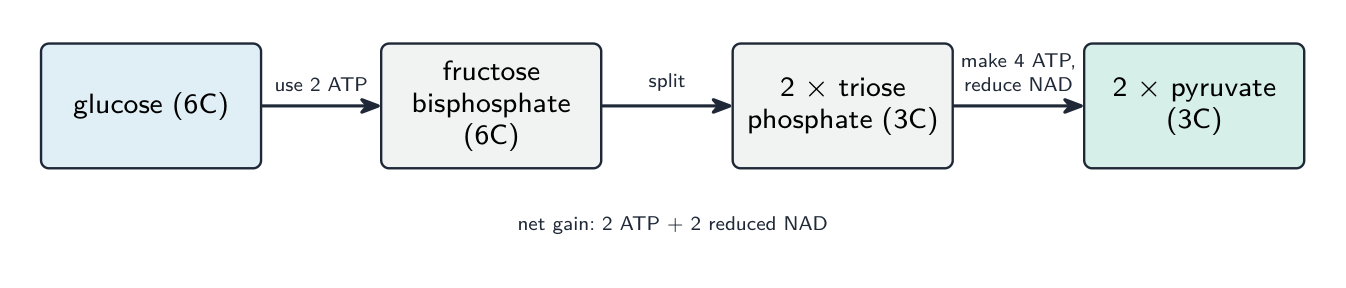
Glucose 葡萄糖 (6 carbons) is first phosphorylated, using 2 ATP, to form fructose bisphosphate (6C). This 6C molecule is split into two triose phosphate molecules (3C each). These are then oxidised 氧化 to pyruvate 丙酮酸 (3C). Glycolysis makes a net gain of 2 ATP and some reduced 还原 NAD (NAD is a coenzyme 辅酶, a helper molecule).

The link reaction

When oxygen is available, pyruvate enters the mitochondria. There each pyruvate loses a carbon dioxide 二氧化碳 and is turned into a 2-carbon acetyl 乙酰基 group. This group is carried by coenzyme A 辅酶A to form acetyl coenzyme A. Some carbon dioxide is released and NAD is reduced.

The Krebs cycle

The 2C acetyl group joins a 4-carbon molecule, oxaloacetate 草酰乙酸, to make a 6-carbon molecule, citrate 柠檬酸. Citrate is then changed back to oxaloacetate in a series of small steps, ready to accept the next acetyl group. During these steps:

  • decarboxylation 脱羧 removes carbon as carbon dioxide.
  • dehydrogenation 脱氢 removes hydrogen, which reduces the coenzymes NAD and FAD.

The reduced NAD and FAD then carry the hydrogen to the carriers in the inner mitochondrial membrane.

Oxidative phosphorylation

This stage makes most of the ATP:

  1. the hydrogen atoms split into protons 质子 and energetic electrons 电子.
  2. the electrons pass along the electron transport chain 电子传递链, releasing energy as they go.
  3. this energy is used to pump protons across the inner membrane.
  4. the protons flow back into the matrix through a channel called ATP synthase ATP合酶. This flow provides the energy to make ATP (this is chemiosmosis).
  5. oxygen is the final electron acceptor: it joins with electrons and protons to form water.

The structure of mitochondria

The inner membrane is folded into cristae 嵴, giving a large surface for the electron transport chain and ATP synthase. The matrix inside holds the substances and helpers for the link reaction and the Krebs cycle.

ไทย

การหายใจแบบใช้ออกซิเจน (aerobic respiration) มีสี่ขั้นตอน แต่ละขั้นตอนเกิดขึ้นในตำแหน่งเฉพาะภายในเซลล์:

ขั้นตอน สถานที่เกิด
ไกลโคไลซิส ไซโตพลาซึม
ปฏิกิริยาลิงก์ เมทริกซ์ ของไมโทคอนเดรีย
รอบครีบส์ (Krebs cycle) มาทริกซ์ของไมโทคอนเดรีย
ฟอสโฟริเลชันแบบออกซิเดชัน (oxidative phosphorylation) เมมเบรนด้านในของไมโทคอนเดรีย
แผนภาพการไหลของการหายใจแบบใช้ออกซิเจน: กลูโคสผ่านไกลโคไลซิสในไซโตพลาซึมไปยังไพรูเวท จากนั้นปฏิกิริยาเชื่อมโยงและรอบครีบส์ในมาทริกซ์ แล้วจึงเป็นการฟอสโฟริเลชันแบบออกซิเดชันบนเมมเบรนด้านในเพื่อสร้าง ATP ส่วนใหญ่
สี่ขั้นตอนและสถานที่ที่เกิดขึ้นแต่ละขั้นตอน; NAD และ FAD ที่ถูกลด (reduced) จะนำไฮโดรเจนไปยังเมมเบรนด้านในซึ่งสร้าง ATP ส่วนใหญ่

ไกลโคไลซิส (Glycolysis)

กลูโคส (6 คาร์บอน) ถูกฟอสโฟริเลตก่อน โดยใช้ ATP 2 โมเลกุล เพื่อสร้างฟรุกโตสไดฟอสเฟต (6C) โมเลกุล 6C นี้จะถูกแยกออกเป็นโมเลกุลไตรโอสฟอสเฟตสองโมเลกุล (อย่างละ 3C) จากนั้นจะถูก ออกซิเดชัน เป็น ไพรูเวท (3C) ไกลโคไลซิสสร้าง ATP ได้สุทธิ 2 โมเลกุล และมี NAD ที่ถูกลด (reduced NAD)些许 NAD เป็น เอนไซม์ช่วย (coenzyme) หรือโมเลกุลผู้ช่วย

กลูโคสถูกฟอสโฟริเลตโดยใช้ ATP 2 โมเลกุลเป็นฟรุกโตสไดฟอสเฟต แยกเป็นไตรโอสฟอสเฟตสองโมเลกุล แล้วออกซิเดชันเป็นไพรูเวทสองโมเลกุล โดยสร้าง ATP ได้สุทธิ 2 โมเลกุลและมี NAD ที่ถูกลด
ไกลโคไลซิสใช้ ATP 2 โมเลกุลในการเริ่มต้น แต่สร้างได้ 4 โมเลกุล ดังนั้นผลสุทธิจึงเป็น ATP 2 โมเลกุล (บวกกับ NAD ที่ถูกลด) — และไม่จำเป็นต้องใช้ออกซิเจน

ปฏิกิริยาเชื่อมโยง (The link reaction)

เมื่อมีออกซิเจน ไพรูเวทจะเข้าสู่ไมโทคอนเดรีย ในนั้น ไพรูเวทแต่ละโมเลกุลจะสูญเสีย คาร์บอนไดออกไซด์ และเปลี่ยนเป็นกลุ่ม อะเซไทล์ ที่มี 2 คาร์บอน กลุ่มนี้จะถูกพาโดย โคเอนไซม์ A เพื่อสร้างอะเซไทล์โคเอนไซม์ A มีการคายคาร์บอนไดออกไซด์บางส่วนและ NAD ถูกลด (reduced)

รอบครีบส์ (The Krebs cycle)

กลุ่มอะเซไทล์ 2C เข้ากับโมเลกุล 4 คาร์บอน ออกซาโลเอ塞เตต (oxaloacetate) เพื่อสร้างโมเลกุล 6 คาร์บอน ไซเตรท (citrate) ไซเตรทจะถูกเปลี่ยนกลับเป็นออกซาโลเอ塞เตต melalui ขั้นตอนเล็กๆ หลายขั้นตอน พร้อมที่จะรับกลุ่มอะเซไทล์ถัดไป ระหว่างขั้นตอนเหล่านี้:

  • การกำจัดคาร์บอกซิล (decarboxylation) กำจัดคาร์บอนในรูปของคาร์บอนไดออกไซด์
  • การกำจัดไฮโดรเจน (dehydrogenation) กำจัดไฮโดรเจน ซึ่งทำให้เอนไซม์ช่วย NAD และ FAD ถูกลด (reduce)

NAD และ FAD ที่ถูกลดแล้วจะนำไฮโดรเจนไปยังตัวขนส่งในเมมเบรนด้านในของไมโทคอนเดรีย

รอบครีบส์วาดเป็นวงกลม: อะเซไทล์ CoA เข้ากับออกซาโลเอ塞เตตเพื่อสร้างไซเตรท ซึ่งถูกเปลี่ยนกลับเป็นออกซาโลเอ塞เตต คายคาร์บอนไดออกไซด์และเอนไซม์ช่วยที่ถูกลด
ทุกหมุนจะคายคาร์บอนไดออกไซด์ (การกำจัดคาร์บอกซิล) และมี NAD และ FAD ที่ถูกลด (การกำจัดไฮโดรเจน)

ฟอสโฟริเลชันแบบออกซิเดชัน (Oxidative phosphorylation)

ขั้นตอนนี้สร้าง ATP ส่วนใหญ่:

  1. อะตอมไฮโดรเจนแยกออกเป็น โปรตอน และ อิเล็กตรอน ที่มีพลังงานสูง
  2. อิเล็กตรอนเคลื่อนที่ไปตาม สายการลำเลียงอิเล็กตรอน (electron transport chain) ปล่อยพลังงานออกมาขณะเคลื่อนที่
  3. พลังงานนี้ถูกใช้ในการปั๊มโปรตอนข้ามเมมเบรนด้านใน
  4. โปรตอนไหลกลับเข้าสู่มาทริกซ์ผ่านช่องทางที่เรียกว่า ATP synthase การไหลนี้ให้พลังงานในการสร้าง ATP (กระบวนการนี้เรียกว่า chemiosmosis)
  5. ออกซิเจน เป็นตัวรับอิเล็กตรอนสุดท้าย:它将เข้า分别与electrons and protons to form water.
ไมโทคอนเดรียที่มีเมมเบรนด้านในพับเป็นคริสตาե alongside close-up of the inner membrane where electron carriers pump protons out and ATP synthase makes ATP as they flow back
อิเล็กตรอนปั๊มโปรตอน (H⁺) เข้าไปในช่องระหว่างเมมเบรน;它们ไหลกลับผ่าน ATP synthase เพื่อสร้าง ATP (chemiosmosis)

โครงสร้างของไมโทคอนเดรีย

เมมเบรนด้านในพับเป็น คริสตาเอ (cristae) เพื่อเพิ่มพื้นที่ผิวสำหรับสายการลำเลียงอิเล็กตรอนและ ATP synthase มาทริกซ์ด้านในเก็บสารตั้งต้นและผู้ช่วยสำหรับปฏิกิริยาเชื่อมโยงและรอบครีบส์

ภาพจุลทรรศน์อิเล็กตรอนของไมโทคอนเดรียสองตัว แต่ละตัวมีเมมเบรนด้านนอกเรียบและเมมเบรนด้านในพับเป็นแถบสีเข้ม พร้อมสเกล 50 nm
ไมโทคอนเดรียจริงสองตัว ถ่ายภาพด้วยกล้องจุลทรรศน์อิเล็กตรอน แถบสีเข้มที่ตัดผ่านด้านในคือคริสตาเอ — การพับทั้งหมดนี้คือสิ่งที่ทำให้พื้นที่ผิวสำหรับสายการลำเลียงอิเล็กตรอนกว้างมาก
Explore · ⁨สำรวจ⁩

Glycolysis · ⁨ไกลโคไลซิส⁩

Step through it. Glucose is split in the cytoplasm into two pyruvate, for a small net gain of ATP and reduced NAD. · ⁨ขั้นตอนของกระบวนการ: กลูโคสแตกตัวในไซโทพลาซึมเป็นไพรูเวต 2 โมเลกุล เพื่อสร้าง ATP และ NAD ที่ถูกลดได้เล็กน้อยสุทธิ⁩

Explore · ⁨สำรวจ⁩

The four stages of respiration · ⁨呼吸作用的四个阶段⁩

Step through where ATP comes from. Glucose is broken down in stages; most ATP is made at the last stage. · ⁨逐步浏览ATP的来源。葡萄糖分阶段分解;大部分ATP在最后阶段生成。⁩

Vocabulary · ⁨คำศัพท์⁩ Train · ⁨ฝึกฝน⁩
English ไทย
respiration/ˌrespɪˈreɪʃn/ การหายใจ
active transport/ˈæktɪv ˈtrænspɔːt/ การขนส่งแบบแอคทีฟ
anabolic/ˌænəˈbɒlɪk/ สร้างสังเคราะห์
phosphorylation/ˌfɒsfɔːrɪˈleɪʃn/ การเพิ่มหมู่ฟอสเฟต
chemiosmosis/ˌkemɪəzˈməʊsɪs/ เคมิโอสมోซิส
mitochondria/ˌmaɪtəˈkɒndrɪə/ ไมโทคอนเดรีย
aerobic/eəˈrəʊbɪk/ ใช้ออกซิเจน (aerobic)
glycolysis/ɡlaɪˈkɒləsɪs/ 糖酵解
link reaction/lɪŋk rɪˈækʃn/ ปฏิกิริยาลิงก์
Krebs cycle/krebz ˈsaɪkl/ วัฏจักรเครบส์
oxidative phosphorylation/ˈɒksɪdətɪv ˌfɒsfɔːrɪˈleɪʃn/ 氧化磷酸化
glucose/ˈɡluːkəʊs/ กลูโคส
oxidise/ˈɒksɪdaɪz/ ออกซิไดซ์
reduce/rɪˈdjuːs/ ลดการใช้
coenzyme/ˌkəʊˈenzaɪm/ โคเอนไซม์
oxaloacetate/ˈɒksələʊsɪteɪt/ ออกซาโลอะซีเตท
citrate/ˈsɪtreɪt/ 柠檬酸
decarboxylation/dɪˌkɑːbəksɪˈleɪʃn/ decarboxylation
dehydrogenation/ˌdiːhaɪˈdrɒdʒəneɪʃn/ dehydrogenation
electron/ɪˈlektrɒn/ อิเล็กตรอน
electron transport chain/ɪˈlektrɒn ˈtrænspɔːt tʃeɪn/ ระบบลำเลียงอิเล็กตรอน
proton/ˈprəʊtɒn/ โปรตอน
ATP synthase/ˌeɪ tiː ˈpiː ˈsɪnθeɪs/ ATP synthase
cristae/ˈkrɪstiː/ คริสตี
12.2

Anaerobic respiration · ⁨การหายใจแบบไม่ใช้ออกซิเจน⁩

English

When there is no oxygen, only glycolysis can run. To keep glycolysis going, the cell must use up the reduced NAD. This happens by fermentation 发酵:

  • in mammals, pyruvate is turned into lactate 乳酸 (lactate fermentation). The lactate is later broken down when oxygen returns.
  • in yeast 酵母, pyruvate is turned into ethanol 乙醇 and carbon dioxide (ethanol fermentation).

Anaerobic 无氧 respiration gives far less energy than aerobic respiration. Aerobic respiration also runs the Krebs cycle and oxidative phosphorylation, which release a lot more ATP, while anaerobic respiration gains only the small amount from glycolysis.

ไทย

เมื่อไม่มีออกซิเจน จะมีเพียงไกลโคไลซิสเท่านั้นที่ทำงานได้ เพื่อรักษาการดำเนินของไกลโคไลซิส เซลล์ต้องนำ NAD ที่ถูกลดไปใช้ กระบวนการนี้เกิดขึ้นโดยการ หมัก (fermentation):

  • ในสัตว์มีกระดูกสันหลัง(Pyruvate)被转化为แลคเตท (lactate fermentation)。แลคเตทจะถูกย่อยสลายต่อไปเมื่อออกซิเจนกลับมา
  • ใน ยีสต์,Pyruvate被转化为เอทานอล和二氧化碳 (ethanol fermentation)
เมื่อไม่มีออกซิเจน Glycolysis จะสร้าง Pyruvate ซึ่งจะกลายเป็น Lactate ในสัตว์มีกระดูกสันหลัง หรือเอทานอลและคาร์บอนไดออกไซด์ในยีสต์
เมื่อไม่มีออกซิเจน Pyruvate จะเปลี่ยนเป็น Lactate (ในสัตว์มีกระดูกสันหลัง) หรือเอทานอล (ในยีสต์); กระบวนการนี้ช่วยคืน NAD เพื่อใช้ต่อใน Glycolysis

Anaerobic respiration ให้พลังงานน้อยกว่า Aerobic respiration มาก Aerobic respiration ยังมีการทำ Krebs cycle และ oxidative phosphorylation ซึ่งปลดปล่อย ATP มากกว่ามาก ในขณะที่ anaerobic respiration ได้พลังงานเพียงเล็กน้อยจาก glycolysis เท่านั้น

Explore · ⁨สำรวจ⁩

Why fermentation matters · ⁨ความสำคัญของการหมัก⁩

Step through it. Without oxygen, fermentation regenerates NAD so glycolysis can keep making a little ATP. · ⁨ขั้นตอนของกระบวนการ: โดยไม่มีออกซิเจน การหมักจะช่วยสร้าง NAD กลับมาเพื่อให้ไกลโคไลซิสสามารถสร้าง ATP เล็กน้อยต่อไปได้⁩

Vocabulary · ⁨คำศัพท์⁩ Train · ⁨ฝึกฝน⁩
English ไทย
pyruvate/ˈpaɪruːveɪt/ พิรูเวท
fermentation/fɜːmənˈteɪʃn/ การหมัก
lactate/ˈlækteɪt/ 乳酸
yeast/jiːst/ yeast
ethanol/ˈeθənɒl/ เอทานอล
anaerobic/ˌæneəˈrəʊbɪk/ ไม่ใช้ออกซิเจน (anaerobic)
12.2

Rice and waterlogged roots · ⁨ข้าวและรากที่จมน้ำ⁩

English

Rice can grow with its roots under water, where there is little oxygen. It is adapted in three ways: it develops aerenchyma 通气组织 (air-filled spaces) in the roots to carry air down; the roots use ethanol fermentation to keep making some ATP; and the stems grow faster to reach the air above the water.

ไทย

ข้าวสามารถเจริญเติบโตได้โดยมีรากอยู่ใต้ผิวน้ำซึ่งมีออกซิเจนน้อย มันปรับตัวด้วยวิธีสามอย่าง: พัฒนา aerenchyma (ช่องว่างที่มีอากาศ) ในรากเพื่อส่งอากาศลงไปที่ราก; รากใช้การหมักเอทานอลเพื่อสร้าง ATP ต่อเนื่อง; และลำต้นเจริญเติบโตเร็วขึ้นเพื่อให้ถึงอากาศเหนือผิวน้ำ

ภาพส่วนขวางของรากในพื้นที่ชุ่มน้ำภายใต้กล้องจุลทรรศน์: แกนกลางสีเข้มล้อมรอบด้วยเซลล์ทรงกลมที่มีช่องว่างสีขาวขนาดใหญ่ระหว่างกัน
รากของพืชที่เจริญเติบโตในน้ำ เห็นจากส่วนขวาง ช่องสีขาวขนาดใหญ่คือ aerenchyma — ช่องทางอากาศที่เชื่อมต่อกันเพื่อให้氧气แพร่กระจายลงไปถึงรากที่จมอยู่ในโคลนที่มีออกซิเจนต่ำ
Vocabulary · ⁨คำศัพท์⁩ Train · ⁨ฝึกฝน⁩
English ไทย
aerenchyma/ˈeərəntʃɪmə/ เนื้อเยื่อแอเรียนคา
indicator/ˈɪndɪkeɪtə/ อินดิเคเตอร์
12.2

Investigating the rate of respiration · ⁨การศึกษาอัตราการหายใจ⁩

English

A redox indicator 指示剂 such as DCPIP or methylene blue loses its colour when it gains hydrogen from respiring cells. The faster the colour is lost, the faster the yeast is respiring, so you can test the effect of temperature or substrate concentration. A respirometer can also be used to measure how temperature changes the rate of oxygen uptake.

ไทย

สารบ่งชี้ redox เช่น DCPIP หรือ methylene blue จะสูญเสียสีเมื่อได้รับไฮโดรเจนจากเซลล์ที่กำลังหายใจ ยิ่งสีหายไปเร็ว แสดงว่ายีสต์หายใจเร็วขึ้น ดังนั้นจึงสามารถทดสอบผลของอุณหภูมิหรือความเข้มข้นของสารตั้งต้นได้ เครื่อง respirometer ยังสามารถใช้วัดว่าอุณหภูมิเปลี่ยนแปลงอัตราการดูดซับออกซิเจนได้อย่างไร

12.2

Exam tips · ⁨ข้อแนะนำสำหรับการสอบ⁩

English
  • State where each stage happens and its ATP yield: glycolysis (cytoplasm), link reaction + Krebs (matrix), oxidative phosphorylation (inner membrane, most ATP).
  • Explain the roles of NAD/FAD (carry hydrogen to the electron transport chain) and of oxygen (the final electron acceptor).
  • RQ $=$ CO2 produced $\div$ O2 used ($\approx 1.0$ carbohydrate, $0.7$ lipid); know how a respirometer measures it.
  • Anaerobic respiration gives lactate (animals) or ethanol + CO2 (yeast/plants) and far less ATP (glycolysis only).
ไทย
  • ระบุ ตำแหน่ง ที่แต่ละขั้นตอนเกิดขึ้นและผลผลิต ATP: glycolysis (cytoplasm), link reaction + Krebs (matrix), oxidative phosphorylation (เยื่อหุ้มชั้นใน, ผลิต ATP มากที่สุด)
  • อธิบายบทบาทของ NAD/FAD (พาไฮโดรเจนไปยัง electron transport chain) และของออกซิเจน (ผู้รับอิเล็กตรอนสุดท้าย)
  • RQ $=$ CO2 ที่เกิดขึ้น $\div$ O2 ที่ใช้ไป ($\approx 1.0$ คาร์โบไฮเดรต, $0.7$.trainoid); รู้วิธีการที่ respirometer ใช้วัดค่านี้
  • การหายใจแบบไม่ใช้ออกซิเจนให้แลคเตท (สัตว์) หรือเอทานอล + CO2 (ยีสต์/พืช) และ ATP น้อยมาก (เกิดจากการ glycolysis เท่านั้น)
Vocabulary · ⁨คำศัพท์⁩ Train · ⁨ฝึกฝน⁩
English ไทย
cytoplasm/ˈsaɪtəplæzəm/ ไซโทพลาซึม
matrix/ˈmeɪtrɪks/ เมทริกซ์

Interactive lessons on this topic · ⁨บทเรียนเชิงโต้ตอบสำหรับหัวข้อนี้⁩

Work through it step by step, with instant-check exercises. · ⁨ทำทีละขั้นตอน พร้อมแบบฝึกหัดตรวจสอบผลทันที⁩

Past Papers · ⁨ข้อสอบย้อนหลัง⁩

More topics in A-Level Biology · ⁨Biology A-Level⁩ · ⁨หัวข้อเพิ่มเติมใน A-Level Biology · ⁨Biology A-Level⁩⁩

Log in or create account · ⁨เข้าสู่ระบบหรือสร้างบัญชี⁩

IGCSE, A-Level & AP