A or或者 B (or — in statements)
Form: A or或者 B (statements) · or或者 A,or或者 B
- Saturday星期六or或者Sunday星期天all / both都can / may可以。 Xīngqīliù huòzhě xīngqītiān dōu kěyǐ. – Saturday or Sunday are both fine.
- you你can / may可以付现金or或者to use a credit card (or…刷卡。 – You can pay in cash or by card.
- weekend周末I / me我often常常to read看书,or或者to go去park公园to go for a walk散步。 – At weekends I often read, or go for a walk in the park.
- or或者you你to come来,or或者I / me我to go去,都行。 – Either you come or I go; either is fine.
How it works. or或者 huòzhě is "or" in statements, offers and suggestions. It joins nouns, verbs or clauses. all / both都can / may可以 or also也can / may可以 often follows.
| or或者 | or / still还是 | and / with和 |
|---|---|---|
| "or" in a statement | "or" in a question | "and" |
| tea茶or或者coffee咖啡all / both都can / may可以 | you你want / will / need要tea茶or / still还是coffee咖啡? | I / me我to buy买(completed / change)了apple苹果and / with和banana香蕉 |
Watch out
- wrong: you你to drink tea喝茶or或者coffee咖啡? → you你to drink tea喝茶or / still还是coffee咖啡?

like that那么 … (then / in that case)
Form: (A says something.) like that那么 / that那 + suggestion or question · if如果……,like that那么(then / just就)……
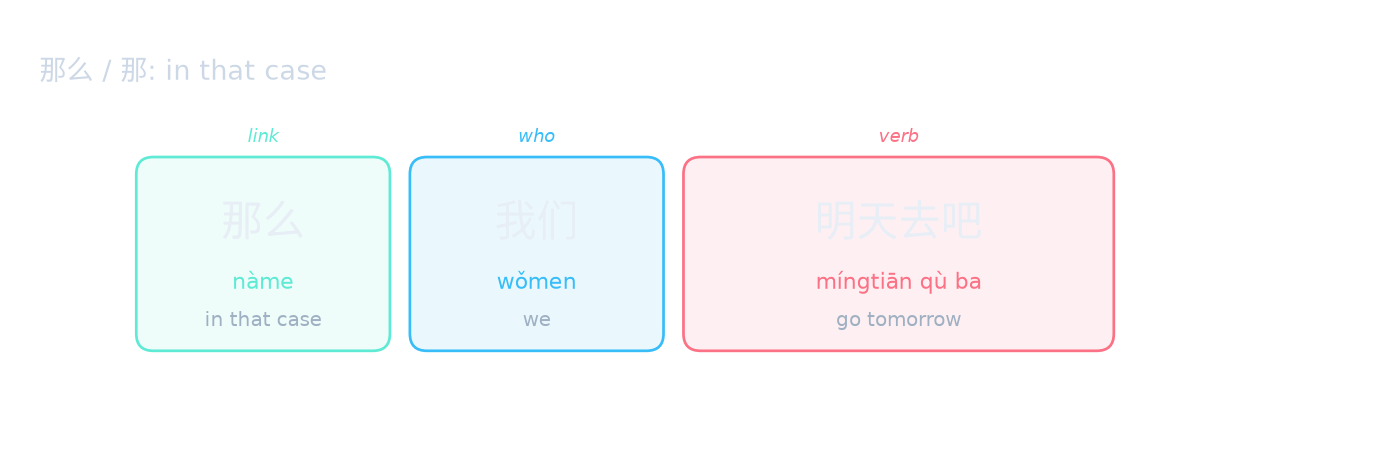
- like that那么,we / us我们tomorrow明天to go去(suggestion)吧。 Nàme, wǒmen míngtiān qù ba. – In that case, let's go tomorrow.
- A: I / me我not不too太hungry饿。 B: that那we / us我们喝杯咖啡吧。 – "I'm not very hungry." "Then let's just have a coffee."
- if如果you你not不to like喜欢,like that那么then / just就to exchange换一个(suggestion)吧。 – If you don't like it, then change it.
How it works. At the start of a reply, like that那么 (spoken: that那) means "then, in that case". It draws a conclusion from what was just said, and leads to a suggestion or a question: that那you你to plan打算what's to be done怎么办?
| like that那么 at the start | like that那么 before an adjective |
|---|---|
| then, in that case | so |
| like that那么we / us我们别去了 | 这件clothes衣服like that那么expensive贵 |
| like that那么 | so / therefore所以 |
|---|---|
| responds to what someone else said | gives the result of a cause |
| A: to rain下雨(completed / change)了。B: like that那么we / us我们别去了。 | to rain下雨(completed / change)了,so / therefore所以I / me我not / haven't没to go去。 |
with / and跟 + Person + Verb (with someone)
Form: subject + with / and跟 / and / with和 + person + (together一起) + verb
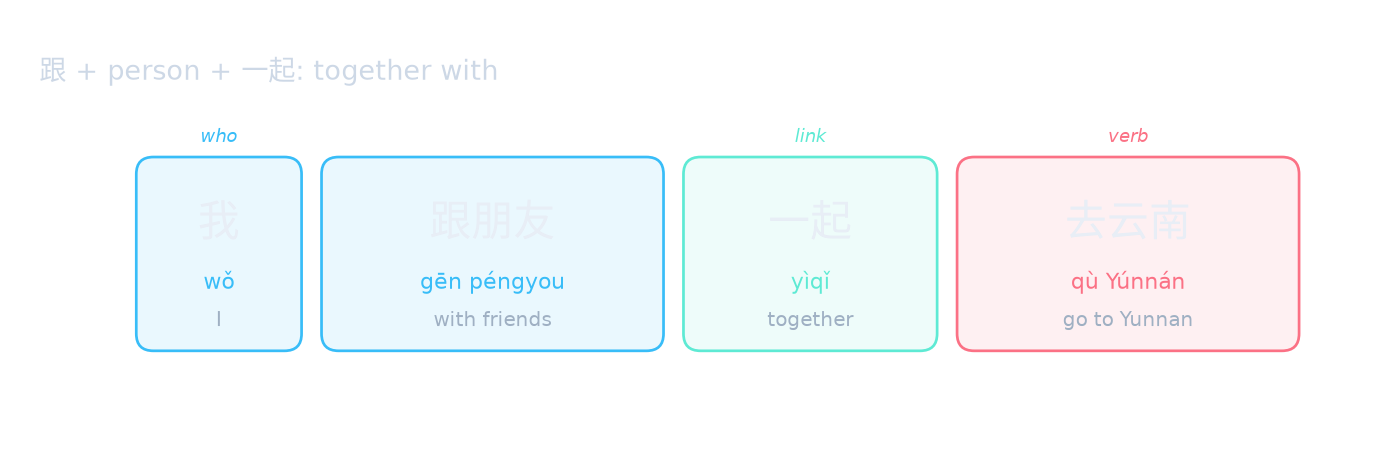
- I / me我with / and跟friend朋友together一起to go去Yunnan province in…云南。 Wǒ gēn péngyou yìqǐ qù Yúnnán. – I'm going to Yunnan with friends.
- I / me我want / think / miss想with / and跟you你to speak说一件matter事。 Wǒ xiǎng gēn nǐ shuō yí jiàn shì. – I want to tell you something.
- you你with / and跟teacher老师to speak说(completed / change)了(yes/no ?)吗? – Have you told the teacher?
- I / me我with / and跟he / him他all / both都to be / is是student学生。 – He and I are both students.
How it works. with / and跟 + person goes before the verb and means "with". together一起 often follows: with / and跟he / him他together一起to have a meal吃饭. With to speak说, with / and跟 marks who you talk to. Between two nouns, with / and跟 simply means "and".
Negatives. not不 or not / haven't没 go before with / and跟.
| I / me我not不with / and跟he / him他to go去。 | I / me我with / and跟he / him他not不to go去。 |
|---|---|
| I won't go with him. | He and I are not going. |
Watch out
- wrong: to go去with / and跟friend朋友 → with / and跟friend朋友to go去.
A or / still还是 B? (or — in questions)
Form: (to be / is是) A or / still还是 B? · not不to know知道 + A or / still还是 B
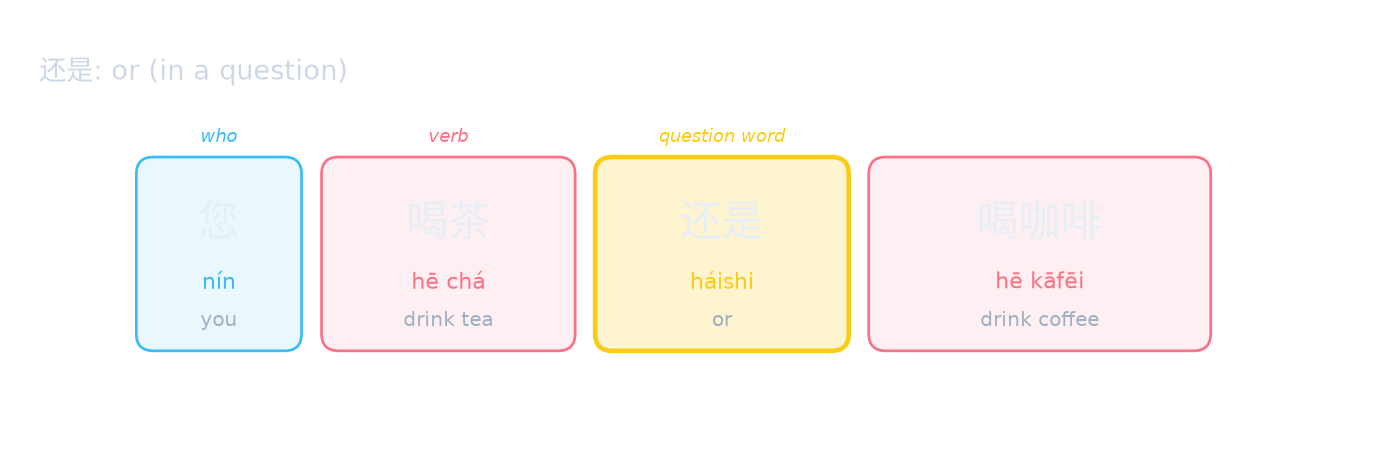
- you (polite)您to drink tea喝茶or / still还是喝咖啡? Nín hē chá háishi hē kāfēi? – Would you like tea or coffee?
- you你to be / is是teacher老师or / still还是student学生? Nǐ shì lǎoshī háishi xuésheng? – Are you a teacher or a student?
- we / us我们坐地铁or / still还是to take a taxi (in town)打车? – Shall we take the subway or a taxi?
- I / me我not不to know知道他来or / still还是not不to come来。 – I don't know whether he's coming or not.
How it works. A or / still还是 B? asks someone to choose. It joins nouns, verbs or whole clauses: you你today今天to go去or / still还是tomorrow明天to go去? After not不to know知道 or to decide / decision决定, it means "whether … or". or / still还是 on its own before a verb can also mean "had better": or / still还是to walk / to leave走(suggestion)吧 (we'd better go).
Watch out
- or / still还是 already makes the question: wrong: you你to drink tea喝茶or / still还是coffee咖啡(yes/no ?)吗? → no (yes/no ?)吗.
- In a statement, "or" is or或者: tea茶or或者coffee咖啡all / both都can / may可以.
Practice without the models
Cover the teaching sections before you answer. The answers follow.
A or或者 B (or – in statements)
1. Complete: “You can pay in cash or by card.” you你can / may可以付现金…………to use a credit card (or…刷卡。
2. Which asks “Do you want tea or coffee?”
- A. you你want / will / need要tea茶or或者coffee咖啡?
- B. you你want / will / need要tea茶and / with和coffee咖啡?
- C. you你want / will / need要tea茶or或者coffee咖啡(yes/no ?)吗or / still还是?
- D. you你want / will / need要tea茶or / still还是coffee咖啡?
3. Build: “Call me tomorrow or the day after.”
Put in order: to / for / give给I / me我 / tomorrow明天or或者the day after tomorrow后天 / you你 / to make a telephone call打电话(suggestion)吧。
4. True or false? I / me我to buy买(completed / change)了apple苹果or或者banana香蕉 means “I bought apples and bananas.” If false, correct it.
5. A friend wants to meet this weekend and asks which day suits you. Both are free. Use A or或者 B. Write your answer in Chinese, then say it aloud.
like that那么 … (then / in that case)
6. A: “I'm not free today.” B: “Then let's meet tomorrow.” …………we / us我们tomorrow明天to see / meet见(suggestion)吧。
7. In 这件clothes衣服like that那么expensive贵, what does like that那么 mean?
- A. or
- B. because
- C. then
- D. so
8. Build: “If you don't like it, then change it.”
Put in order: then / just就to exchange换 / ,like that那么 / 一个(suggestion)吧。 / if如果you你not不to like喜欢
9. True or false? like that那么 at the start of a reply usually responds to what someone else has just said. If false, correct it.
10. A friend says the cinema is fully booked tonight. You quickly suggest another plan. Use like that那么 …. Write your answer in Chinese, then say it aloud.
with / and跟 + Person + Verb (with someone)
11. Complete: “I play basketball with my brother.” I / me我…………older brother哥哥together一起to play basketball打篮球。
12. Which says “I won't go with him.”?
- A. I / me我with / and跟he / him他not不to go去。
- B. I / me我to go去not不with / and跟he / him他。
- C. I / me我not不with / and跟he / him他to go去。
- D. I / me我with / and跟not不he / him他to go去。
13. Build: “I want to tell you something.”
Put in order: I / me我want / think / miss想 / to speak说 / with / and跟you你 / 一件matter事。
14. True or false? In I / me我with / and跟he / him他all / both都to be / is是student学生, with / and跟 means “and”. If false, correct it.
15. Your mum asks about your plans for the holiday. Use with / and跟 + Person + Verb. Write your answer in Chinese, then say it aloud.
A or / still还是 B? (or – in questions)
16. Ask: “Are you going today or tomorrow?” you你today今天to go去…………tomorrow明天to go去?
17. Which question is correct?
- A. you你to be / is是China中国person人or或者South Korea (Republic of…韩国person人?
- B. you你to be / is是China中国person人or / still还是South Korea (Republic of…韩国person人?
- C. you你to be / is是China中国person人or / still还是South Korea (Republic of…韩国person人(yes/no ?)吗?
- D. you你to be / is是China中国person人(yes/no ?)吗or / still还是South Korea (Republic of…韩国person人?
18. Build: “Shall we take the subway or a taxi?”
Put in order: 坐地铁 / or / still还是 / to take a taxi (in town)打车? / we / us我们
19. True or false? I / me我not不to know知道他来or / still还是not不to come来 is correct. If false, correct it.
20. A waiter asks what you would like to drink. Use A or / still还是 B?. Write your answer in Chinese, then say it aloud.
Answers and explanations
A or或者 B (or – in statements)
1. or或者
A statement offering alternatives uses or或者.
2. D. you你want / will / need要tea茶or / still还是coffee咖啡?
An “A or B?” question uses or / still还是.
3. you你tomorrow明天or或者the day after tomorrow后天to / for / give给I / me我to make a telephone call打电话(suggestion)吧。
Time A or或者 time B + verb phrase.
4. False.
or或者 is “or”; “and” is and / with和.
5. Model answer: Saturday星期六or或者Sunday星期天all / both都can / may可以。
Check your answer:
- To ask "A or B?", use or / still还是: you你to drink tea喝茶or / still还是coffee咖啡?, not you你to drink tea喝茶or或者coffee咖啡?
- or或者 does not mean "and": I / me我to buy买(completed / change)了apple苹果and / with和banana香蕉 (both), not apple苹果or或者banana香蕉.
like that那么 … (then / in that case)
6. that那
that那(suffix, used to form…么) at the start of a reply = in that case.
7. D. so
Before an adjective, like that那么 = so.
8. if如果you你not不to like喜欢,like that那么then / just就to exchange换一个(suggestion)吧。
if如果…,like that那么then / just就….
9. True.
It draws a conclusion from the situation just described.
10. Model answer: like that那么,we / us我们tomorrow明天to go去(suggestion)吧。
Check your answer:
- At the start of a clause, like that那么 = "then, in that case".
- Before an adjective, like that那么 = "so": like that那么expensive贵. Check its position.
with / and跟 + Person + Verb (with someone)
11. with / and跟
with / and跟 + person + together一起 + verb.
12. C. I / me我not不with / and跟he / him他to go去。
The negative goes before with / and跟. I / me我with / and跟he / him他not不to go去 means “he and I are not going”, a different message.
13. I / me我want / think / miss想with / and跟you你to speak说一件matter事。
with / and跟 + person + to speak说.
14. True.
Between two nouns, with / and跟 joins them.
15. Model answer: I / me我with / and跟friend朋友together一起to go去Yunnan province in…云南。
Check your answer:
- "With friends" comes before the verb: with / and跟friend朋友to go去, not to go去with / and跟friend朋友 (unless with / and跟 means "and" between two nouns).
- Put not不 or not / haven't没 before with / and跟: I / me我not不with / and跟he / him他to go去 – "I won't go with him" – not I / me我with / and跟he / him他not不to go去, which means "he and I are not going".
A or / still还是 B? (or – in questions)
16. or / still还是
or / still还是 joins the choices in a question.
17. B. you你to be / is是China中国person人or / still还是South Korea (Republic of…韩国person人?
or / still还是 questions take no (yes/no ?)吗.
18. we / us我们坐地铁or / still还是to take a taxi (in town)打车?
A or / still还是 B?
19. True.
After not不to know知道, or / still还是 means “whether … or”.
20. Model answer: you (polite)您to drink tea喝茶or / still还是喝咖啡?
Check your answer:
- or / still还是 already makes a question: you你to drink tea喝茶or / still还是coffee咖啡?, not you你to drink tea喝茶or / still还是coffee咖啡(yes/no ?)吗?
- In a statement, "or" is or或者: tea茶or或者coffee咖啡all / both都can / may可以.