Original teaching practice. Read one pattern, cover its model and try the questions before checking the separate answer section. Examples adapted from Chinese Grammar Wiki (AllSet Learning, CC BY-NC-SA) retain the course-reference provenance.
seemingly看起来 (looks / seems)
Judging by appearance
- A cake in the bakery window has thick cream and fresh strawberries. You haven't tasted it yet.
- this这个cake蛋糕seemingly看起来degree / adjective linker很to be fond of eating好吃。 — "This cake looks delicious."
Subject + seemingly看起来 + Adjective
- seemingly看起来 = "looks, seems (from what I can see)". It goes before the description, and degree / adjective linker很 often follows it.
- It reports an impression, not a fact you have checked.
he他looks看起来very很tired累。

Other senses: to listen to听(after a verb) indicating…起来, variant of 吃吃(after a verb) indicating…起来, to use / with用(after a verb) indicating…起来
- Sound: this这个plan主意to listen to听(after a verb) indicating…起来correct不错。 — "That idea sounds good."
- Taste and use: this这个vegetable菜variant of 吃吃(after a verb) indicating…起来a little有点hot (spicy)辣 — "This dish tastes a bit spicy." this这个cell phone手机to use / with用(after a verb) indicating…起来degree / adjective linker很convenient方便 — "This phone is easy to use."
this这个idea主意sounds听起来good不错。
An impression from the senses
- seemingly看起来 gives what you see, so it does not prove the cake tastes good; tasting is variant of 吃吃(after a verb) indicating…起来.
- For a guess that is not based on looks (he seems to have left), use as if好像: he / him他as if好像to walk走(completed / change)了.
seemingly看起来 versus it would appear看上去 and as if好像
- it would appear看上去 means almost the same as seemingly看起来 and is common for people's appearance: she / her她it would appear看上去degree / adjective linker很young年轻.
- as if好像 is a guess or a comparison: he / him他as if好像to fall ill生病(completed / change)了。 — "He seems to be ill (I suspect)."
he他seems好像be ill生病了。
Recap
- seemingly看起来 + Adj = looks …; to listen to听(after a verb) indicating…起来 = sounds …; variant of 吃吃(after a verb) indicating…起来 = tastes …; to use / with用(after a verb) indicating…起来 = is … to use.
- These give a first impression from one sense. A general guess uses as if好像.
Practise this pattern step by step.
not / haven't没(to have / there is有) comparisons (not as … as)
Not as tall as his brother
- Two brothers stand back to back. The younger one is shorter, and he does not like it.
- younger brother弟弟not have / haven't没有older brother哥哥high高。 — "The younger brother isn't as tall as the older one."
A + not / haven't没(to have / there is有) + B + Adjective
- A not have / haven't没有 B + Adj = "A is not as Adj as B". It is the usual negative of a than / compared to比 comparison.
- The adjective stays bare: not have / haven't没有he / him他high高, not have / haven't没有yesterday昨天cold冷.
today今天not as没有yesterday昨天cold冷。

Add like that那么 or so much这么 for force
- I / me我(modifier / structural particle)的Chinese language中文not have / haven't没有you你like that那么good好。 — "My Chinese isn't as good as yours."
- so much这么 for something here: that那个city城市not have / haven't没有Beijing, capital of the…北京so much这么see 大夫大。 — "That city isn't as big as Beijing (here)."
my我的Chinese中文not as没有you你so那么good好。
No degree / adjective linker很, and not have / haven't没有 not not不
- No degree / adjective linker很 or very非常 before the adjective: not have / haven't没有he / him他high高, not not have / haven't没有he / him他degree / adjective linker很high高.
- unlike不比 is a different idea ("not more … than", often in an argument); the plain negative of than / compared to比 is not have / haven't没有.
than / compared to比 versus not have / haven't没有
- Positive: older brother哥哥than / compared to比younger brother弟弟high高。 — "The older brother is taller than the younger."
- Negative: younger brother弟弟not have / haven't没有older brother哥哥high高。 Flip the order, use not have / haven't没有, keep the same adjective.
older brother哥哥than比younger brother弟弟tall高。
Recap
- A not have / haven't没有 B (like that那么) + Adj = A is not as Adj as B.
- It is the negative of A than / compared to比 B + Adj. Bare adjective, no degree / adjective linker很.
Practise this pattern step by step.
to let / make让 / variant of 叫叫 / to ask请 / to make使 (make / let / ask someone do)
Who decides?
- You want to go out tonight, but your parents have other ideas.
- mama妈妈不让I / me我evening晚上to go out出去。 — "Mum won't let me go out in the evening."
A + to let / make让 / variant of 叫叫 / to ask请 + B + Verb
- A to let / make让 B + Verb: A lets or makes B do something. A variant of 叫叫 B + Verb: A tells B to do it (spoken). A to ask请 B + Verb: A politely invites or asks B.
- The person B is both the object of to let / make让 and the doer of the next verb.
the teacher老师made让us我们write写homework作业。

Telling, inviting, causing
- Telling: mama妈妈variant of 叫叫I / me我to go去买菜。 — "Mum told me to go and buy vegetables."
- Inviting: I / me我want / think / miss想to ask请you你to have a meal吃饭。 — "I'd like to treat you to a meal." Causing a feeling: this这个news消息to let / make让I / me我degree / adjective linker很happy高兴。 — "This news made me very happy."
this这个news消息made让me我very很happy高兴。
Order and negation
- Keep the order A + to let / make让 + B + Verb: mama妈妈to let / make让I / me我to go去, not mama妈妈to let / make让to go去I / me我.
- Negate the first verb to refuse permission: 不让I / me我to go去 = "won't let me go"; to let / make让I / me我not不to go去 changes the meaning to "tell me not to go".
to make使 for formal causes
- to make使 = "to cause, make", mainly in writing, with an abstract cause and a change of state: to move运动使人health健康。 — "Exercise makes people healthy."
- In speech, to let / make让 covers most of this: to move运动to let / make让person人degree / adjective linker很health健康.
exercise运动makes使people人healthy健康。
Recap
- A to let / make让/variant of 叫叫/to ask请 B + Verb: to let / make让 = let/make, variant of 叫叫 = tell (spoken), to ask请 = invite/ask politely.
- to let / make让 + person + feeling = make someone feel; to make使 is the formal written "cause". Refuse with 不让.
Practise this pattern step by step.
to pass经过 (after going through)
After three years of training
- A runner who trained every morning for three years has just won her first marathon.
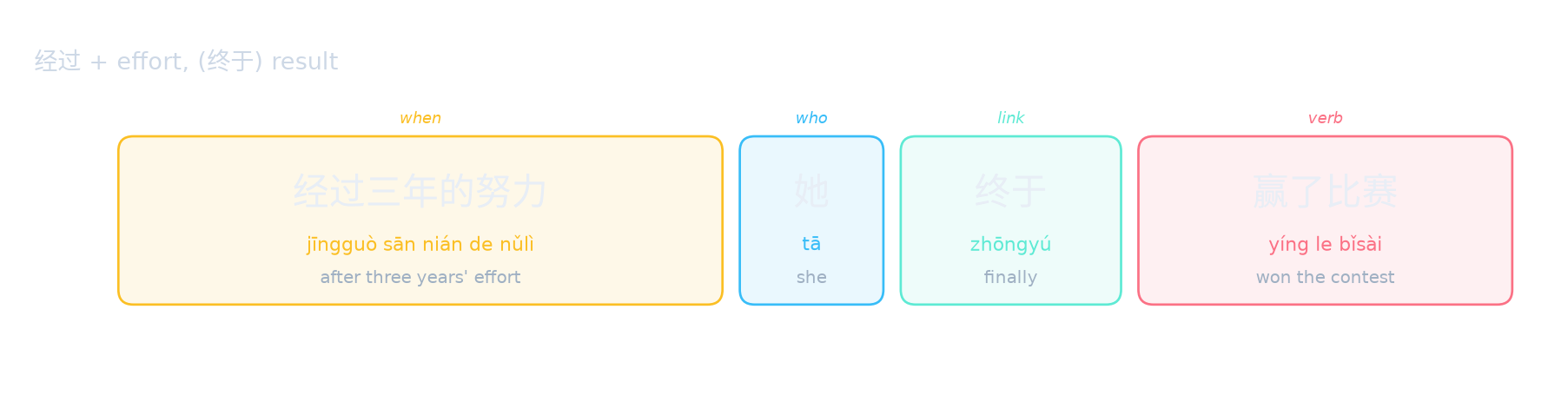
- to pass经过三年(modifier / structural particle)的to make an effort努力,she / her她finally终于to beat赢(completed / change)了competition (sports etc)比赛。 — "After three years of hard work, she finally won the race."
to pass经过 + process, result
- to pass经过 + a process (effort, discussion, time), then the result in the second clause.
- The process is usually a noun phrase: to pass经过一年(modifier / structural particle)的to learn学习, to pass经过everyone大家(modifier / structural particle)的to discuss讨论, to pass经过doctor医生(modifier / structural particle)的inspection检查.
after经过everyone's大家的discussion讨论,we我们decided决定go to去Shanghai上海。
to pass经过 as "pass by, go through"
- It is also a plain verb of movement: I / me我every day每天to go to work上班all / both都to pass经过this这个park (for public recreation)公园。 — "I pass this park every day on the way to work."
- 这趟war chariot (archaic)车to pass经过Beijing, capital of the…北京(yes/no ?)吗? — "Does this train go through Beijing?"
I我every day每天pass经过this这个park公园。
A process before a result
- to pass经过 needs a process that leads somewhere; for a simple "after (a time)", use after以后: to finish class下课after以后, not to pass经过to finish class下课.
- Put to pass经过 + process first and the result second: to pass经过inspection检查,doctor医生variant of 说说not / haven't没question问题.
to pass经过 versus to pass through通过
- to pass经过 stresses going through the process: to pass经过many times多次experiment试验 — "after many experiments".
- to pass through通过 stresses the means used to reach the goal: to pass through通过friend朋友,I / me我to find找到(completed / change)了to work工作 — "Through a friend, I found a job."
through通过a friend朋友,I我found找到了a job工作。
Recap
- to pass经过 + process, result = after going through …, …
- As a verb, to pass经过 = pass by / go through a place. For a plain "after", use after以后; for "by means of", to pass through通过.
Practise this pattern step by step.
Practice without the models
seemingly看起来 (looks / seems)
0301.1 Complete: “You look very happy today.” you你today今天…………degree / adjective linker很happy高兴。
0301.2 Your friend describes a plan on the phone. You say: “That sounds interesting.” Which fits?
- A. to listen to听(after a verb) indicating…起来degree / adjective linker很interesting有意思。
- B. to use / with用(after a verb) indicating…起来degree / adjective linker很interesting有意思。
- C. seemingly看起来degree / adjective linker很interesting有意思。
- D. variant of 吃吃(after a verb) indicating…起来degree / adjective linker很interesting有意思。
0301.3 Match each sense verb to its meaning.
-
- seemingly看起来
-
- to listen to听(after a verb) indicating…起来
-
- variant of 吃吃(after a verb) indicating…起来
-
- to use / with用(after a verb) indicating…起来
-
A. tastes
-
B. sounds
-
C. is … to use
-
D. looks
0301.4 Build: “This cake looks delicious.”
Arrange all chunks: degree / adjective linker很 / to be fond of eating好吃。 / this这个cake蛋糕 / seemingly看起来
0301.5 A cake in the bakery window has thick cream and fresh strawberries. You haven't tasted it yet. Close the examples. Say a Mandarin response, then write it in Chinese. Explain briefly in English what the lesson’s pattern adds. Compare with the model, then change one detail and try again.
Write or say your own response before reading the key.
not / haven't没(to have / there is有) comparisons (not as … as)
0401.1 Complete: “The subway isn't as fast as the high-speed train.” underground railway地铁…………high speed rail高铁rapid快。
0401.2 Which sentence is correct?
- A. I / me我not have / haven't没有busy忙he / him他。
- B. I / me我not have / haven't没有he / him他degree / adjective linker很busy忙。
- C. I / me我not have / haven't没有he / him他like that那么busy忙。
- D. I / me我not不to have / there is有he / him他busy忙。
0401.3 Build: “My Chinese isn't as good as yours.”
Arrange all chunks: you你 / like that那么good好。 / I / me我(modifier / structural particle)的Chinese language中文 / not have / haven't没有
0401.4 older brother哥哥than / compared to比younger brother弟弟high高 and younger brother弟弟not have / haven't没有older brother哥哥high高 describe the same situation.
True or false? Explain or repair the statement.
0401.5 Two brothers stand back to back. The younger one is shorter, and he does not like it. Close the examples. Say a Mandarin response, then write it in Chinese. Explain briefly in English what the lesson’s pattern adds. Compare with the model, then change one detail and try again.
Write or say your own response before reading the key.
to let / make让 / variant of 叫叫 / to ask请 / to make使 (make / let / ask someone do)
0302.1 Complete: “My dad doesn't let me play games.” (coll.) father爸爸not不…………I / me我玩游戏。
0302.2 You invite your teacher to dinner. Which verb is most polite? I / me我want / think / miss想__teacher老师to have a meal吃饭。
- A. variant of 叫叫
- B. to make使
- C. to let / make让
- D. to ask请
0302.3 Build: “This news made me very happy.”
Arrange all chunks: to let / make让 / I / me我 / degree / adjective linker很happy高兴。 / this这个news消息
0302.4 mama妈妈不让I / me我to go去 and mama妈妈to let / make让I / me我not不to go去 mean exactly the same.
True or false? Explain or repair the statement.
0302.5 You want to go out tonight, but your parents have other ideas. Close the examples. Say a Mandarin response, then write it in Chinese. Explain briefly in English what the lesson’s pattern adds. Compare with the model, then change one detail and try again.
Write or say your own response before reading the key.
to pass经过 (after going through)
0303.1 Complete: “After a check-up, the doctor said it was nothing serious.” …………inspection检查,doctor医生variant of 说说nothing没什么see 大夫大question问题。
0303.2 Which word fits? “After class, let's play basketball.” to finish class下课____,we / us我们to go去打篮球(suggestion)吧。
- A. finally终于
- B. to pass经过
- C. to pass through通过
- D. after以后
0303.3 Build: “I pass this park every day.”
Arrange all chunks: every day每天 / to pass经过 / this这个park (for public recreation)公园。 / I / me我
0303.4 to pass through通过friend朋友,I / me我to find找到(completed / change)了to work工作 stresses the means (a friend) rather than a long process.
True or false? Explain or repair the statement.
0303.5 A runner who trained every morning for three years has just won her first marathon. Close the examples. Say a Mandarin response, then write it in Chinese. Explain briefly in English what the lesson’s pattern adds. Compare with the model, then change one detail and try again.
Write or say your own response before reading the key.
Answers and explanations
seemingly看起来 (looks / seems)
0301.1 seemingly看起来
seemingly看起来 + Adj reports how someone looks.
0301.2 A. to listen to听(after a verb) indicating…起来degree / adjective linker很interesting有意思。
You heard the plan, so to listen to听(after a verb) indicating…起来.
0301.3 1–D: seemingly看起来 = looks; 2–B: to listen to听(after a verb) indicating…起来 = sounds; 3–A: variant of 吃吃(after a verb) indicating…起来 = tastes; 4–C: to use / with用(after a verb) indicating…起来 = is … to use
Sense verb + (after a verb) indicating…起来 = comes across as … to that sense.
0301.4 this这个cake蛋糕seemingly看起来degree / adjective linker很to be fond of eating好吃。
Subject + seemingly看起来 + degree / adjective linker很 + Adj.
0301.5 One possible response: this这个cake蛋糕seemingly看起来degree / adjective linker很to be fond of eating好吃。
Check meaning and form:
- My response conveys a message that fits the opening situation.
- I can explain the meaning of the pattern, rather than only naming it.
- seemingly看起来 gives what you see, so it does not prove the cake tastes good; tasting is variant of 吃吃(after a verb) indicating…起来.
- For a guess that is not based on looks (he seems to have left), use as if好像: he / him他as if好像to walk走(completed / change)了.
- I tried a second response with a name, time, place, or description changed.
This is supported productive practice. Compare meaning and structure; your answer need not copy the model. A partner or teacher must hear the spoken response to comment on pronunciation.
not / haven't没(to have / there is有) comparisons (not as … as)
0401.1 not have / haven't没有
A not have / haven't没有 B + Adj = A is not as Adj as B.
0401.2 C. I / me我not have / haven't没有he / him他like that那么busy忙。
I / me我not have / haven't没有he / him他like that那么busy忙 is right: A not have / haven't没有 B (like that那么) + bare adjective. degree / adjective linker很 cannot go in a comparison, 不有 is never used, and the adjective must follow B.
0401.3 I / me我(modifier / structural particle)的Chinese language中文not have / haven't没有you你like that那么good好。
A + not have / haven't没有 + B + like that那么 + Adj.
0401.4 True.
Both say the older brother is taller.
0401.5 One possible response: younger brother弟弟not have / haven't没有older brother哥哥high高。
Check meaning and form:
- My response conveys a message that fits the opening situation.
- I can explain the meaning of the pattern, rather than only naming it.
- No degree / adjective linker很 or very非常 before the adjective: not have / haven't没有he / him他high高, not not have / haven't没有he / him他degree / adjective linker很high高.
- unlike不比 is a different idea ("not more … than", often in an argument); the plain negative of than / compared to比 is not have / haven't没有.
- I tried a second response with a name, time, place, or description changed.
This is supported productive practice. Compare meaning and structure; your answer need not copy the model. A partner or teacher must hear the spoken response to comment on pronunciation.
to let / make让 / variant of 叫叫 / to ask请 / to make使 (make / let / ask someone do)
0302.1 to let / make让
不让 + person + verb = not allow someone to do something.
0302.2 D. to ask请
to ask请 is the polite “invite / treat”.
0302.3 this这个news消息to let / make让I / me我degree / adjective linker很happy高兴。
Cause + to let / make让 + person + feeling.
0302.4 False.
不让I / me我to go去 refuses permission; to let / make让I / me我not不to go去 tells me not to go. The focus differs.
0302.5 One possible response: mama妈妈不让I / me我evening晚上to go out出去。
Check meaning and form:
- My response conveys a message that fits the opening situation.
- I can explain the meaning of the pattern, rather than only naming it.
- Keep the order A + to let / make让 + B + Verb: mama妈妈to let / make让I / me我to go去, not mama妈妈to let / make让to go去I / me我.
- Negate the first verb to refuse permission: 不让I / me我to go去 = "won't let me go"; to let / make让I / me我not不to go去 changes the meaning to "tell me not to go".
- I tried a second response with a name, time, place, or description changed.
This is supported productive practice. Compare meaning and structure; your answer need not copy the model. A partner or teacher must hear the spoken response to comment on pronunciation.
to pass经过 (after going through)
0303.1 to pass经过
to pass经过 + process (the check-up), then the result.
0303.2 D. after以后
A simple point in time takes after以后; to pass经过 needs a process.
0303.3 I / me我every day每天to pass经过this这个park (for public recreation)公园。
As a verb, to pass经过 takes the place as its object.
0303.4 True.
to pass through通过 = by means of; to pass经过 = after going through a process.
0303.5 One possible response: to pass经过三年(modifier / structural particle)的to make an effort努力,she / her她finally终于to beat赢(completed / change)了competition (sports etc)比赛。
Check meaning and form:
- My response conveys a message that fits the opening situation.
- I can explain the meaning of the pattern, rather than only naming it.
- to pass经过 needs a process that leads somewhere; for a simple "after (a time)", use after以后: to finish class下课after以后, not to pass经过to finish class下课.
- Put to pass经过 + process first and the result second: to pass经过inspection检查,doctor医生variant of 说说not / haven't没question问题.
- I tried a second response with a name, time, place, or description changed.
This is supported productive practice. Compare meaning and structure; your answer need not copy the model. A partner or teacher must hear the spoken response to comment on pronunciation.