Original teaching practice. Read one pattern, cover its model and try the questions before checking the separate answer section. Examples adapted from Chinese Grammar Wiki (AllSet Learning, CC BY-NC-SA) retain the course-reference provenance.
Time / Verb + before以前 (before …)
Before you go to bed
- Your doctor gives you advice about a good night's sleep.
- to go to bed睡觉before以前don't be fooled by the fact…别看cell phone手机。 — "Don't look at your phone before going to bed."
Time / Verb phrase + before以前
- X + before以前 = "before X". Unlike English, before以前 comes after the time or action: 八点before以前, to go to class上课before以前.
- The whole phrase usually comes before the main verb: you你八点before以前to come来(suggestion)吧.
you你eight o'clock八点before以前come来吧。

Deadlines and order
- Friday星期五before以前要交school assignment作业。 — "The homework must be handed in before Friday."
- to have a meal吃饭before以前want / will / need要to wash one's hands洗手。 — "Wash your hands before you eat." front前 alone can replace before以前 in short phrases: 饭前, 睡前.
eat吃饭before以前must要wash hands洗手。
before以前 comes last
- Put before以前 after what it refers to: to go to class上课before以前, not before以前to go to class上课 (which means "in the past, I attended class").
- The before以前 phrase goes before the main verb, not at the end: I / me我十点before以前to return home回家, not I / me我to return home回家十点before以前.
before以前 versus front前
- before以前 works after any time or action: 三天before以前, to go abroad出国before以前.
- front前 is shorter and fixed in some phrases: 三天front前, 睡前, 饭前. Both mean "before" here.
I我three days三天ago前arrived in到Beijing北京。
Recap
- Time / action + before以前 = before …; it follows what it refers to.
- The phrase sits before the main verb. front前 is a shorter form: 三天front前, 睡前.
Practise this pattern step by step.
before以前,… (in the past, …)
How things used to be
- Your grandmother looks at old photos of her village with dirt roads and no cars.
- before以前here这儿not have / haven't没有road路,now现在to have / there is有很多war chariot (archaic)车(completed / change)了。 — "There used to be no road here; now there are lots of cars."
before以前,… = "in the past, …"
- before以前 at the start of the sentence (or after the subject) = "before, in the past", often contrasted with now现在.
- It describes a past habit or state: I / me我before以前to live住at / in在Shanghai municipality…上海 — "I used to live in Shanghai."
I我used to以前live住in在Shanghai上海。

Then and now
- he / him他before以前not不to like喜欢variant of 吃吃hot (spicy)辣(modifier / structural particle)的,now现在degree / adjective linker很to like喜欢。 — "He didn't use to like spicy food; now he loves it."
- The contrast with now现在 is very common; often no (completed / change)了 is needed for a past habit.
he他used to以前not不like喜欢eat吃spicy辣food的。
Which before以前 is it?
- Alone at the front or after the subject, before以前 = "in the past": before以前I / me我improbable不会to prepare a meal做饭.
- After a time or action, it = "before": to go to class上课before以前 — "before class". Check what comes before it.
before以前 versus (verb suffix)过去 and original原来
- (verb suffix)过去 also means "in the past", a little more formal: (verb suffix)过去here这里to be / is是一个小村子。
- original原来 = "originally", stressing that it later changed: he / him他original原来to be / is是teacher老师,afterwards后来at or in the very same...当(completed / change)了author作家。
he他originally原来was是a teacher老师。
Recap
- before以前,… = in the past, used to …; often contrasted with now现在.
- X + before以前 = before X. (verb suffix)过去 = in the past (formal); original原来 = originally.
Practise this pattern step by step.
just now (variant of 刚才)刚才 (a moment ago)
A missed call
- You come back from the shower and see your roommate pointing at your phone.
- just now (variant of 刚才)刚才someone有人to / for / give给you你to make a telephone call打电话(completed / change)了。 — "Someone called you a moment ago."
just now (variant of 刚才)刚才 is a time word
- just now (variant of 刚才)刚才 = "just now, a moment ago". Like yesterday昨天 or today今天, it can stand before or after the subject.
- just now (variant of 刚才)刚才I / me我at / in在to bathe洗澡 / I / me我just now (variant of 刚才)刚才at / in在to bathe洗澡 — "I was in the shower just now."
I我just now刚才(ongoing)在take a shower洗澡。

Actions, states and the negative
- Action: you你just now (variant of 刚才)刚才to go去where哪儿(completed / change)了? — "Where did you go just now?"
- State or negative: just now (variant of 刚才)刚才degree / adjective linker很quiet安静 — "It was quiet a moment ago." just now (variant of 刚才)刚才I / me我not / haven't没to hear听见 — "I didn't hear just now."
you你just now刚才go去where哪儿了?
just now (variant of 刚才)刚才 is only minutes ago
- Use just now (variant of 刚才)刚才 for a moment ago in the same situation; for "recently" over days, use recently最近 or just now刚.
- just now (variant of 刚才)刚才 can go first in the sentence; just now刚 cannot: just now (variant of 刚才)刚才他来(completed / change)了 ✓, just now刚he / him他to come来(completed / change)了 ✗.
just now (variant of 刚才)刚才 versus just now刚
- just now刚 is an adverb before the verb: he / him他just now刚to walk走 — "He has just left."
- just now (variant of 刚才)刚才 is a time word: he / him他just now (variant of 刚才)刚才to walk走(completed / change)了 — "He left a moment ago." Both are common; only just now (variant of 刚才)刚才 works with adjectives and not / haven't没.
he他just刚leave走。
Recap
- just now (variant of 刚才)刚才 = a moment ago; a time word that can start the sentence.
- It works with actions, adjectives and not / haven't没. just now刚 is the adverb "just" before a verb.
Practise this pattern step by step.
Time / Verb + o'clock时 (when …)
When I was little
- You are telling a friend a story from your childhood about learning to swim.
- I / me我small小(modifier / structural particle)的time时候often常常to go去river bank河边swimming游泳。 — "When I was little, I often went swimming by the river."
Time / Verb phrase + o'clock时 ((modifier / structural particle)的time时候)
- X + (modifier / structural particle)的time时候 = "when X". The spoken form is (modifier / structural particle)的time时候; the shorter o'clock时 is more written: 上课时, to rain下雨o'clock时.
- Like before以前, o'clock时 comes after what it refers to.
in class上课when时,please请turn off关your phone手机。

Spoken (modifier / structural particle)的time时候
- I / me我to / arrive到home家(modifier / structural particle)的time时候,he / him他already已经to sleep睡(completed / change)了。 — "When I got home, he was already asleep."
- you你to have time (to do sth)有空(modifier / structural particle)的time时候to / for / give给I / me我to make a telephone call打电话。 — "Call me when you have time."
I我arrive到home家when的时候,he他already已经sleep睡了。
Order and the right word
- o'clock时 / (modifier / structural particle)的time时候 goes after the clause: to rain下雨(modifier / structural particle)的time时候, not time时候to rain下雨.
- In a "when" clause, do not use what什么time时候 (that asks "when?"): I / me我to / arrive到home家(modifier / structural particle)的time时候, not I / me我what什么time时候perfect到家.
o'clock时 versus (modifier / structural particle)的time时候
- Use (modifier / structural particle)的time时候 in conversation: to have a meal吃饭(modifier / structural particle)的time时候don't别to speak说话.
- o'clock时 suits signs, writing and short fixed phrases: to eat a meal用餐o'clock时No smoking请勿吸烟 — "No smoking while dining."
eat吃饭when的时候don't别talk说话。
Recap
- X + (modifier / structural particle)的time时候 / o'clock时 = when X; it follows the clause it belongs to.
- (modifier / structural particle)的time时候 is spoken, o'clock时 is more written. what什么time时候 asks a question; it is not "when" in a statement.
Practise this pattern step by step.
after以后 (after / in the future)
After graduation
- A friend in her final year asks what you plan to do once you finish university.
- 大学毕业after以后,I / me我want / think / miss想to go去abroad国外to work工作。 — "After I graduate, I want to work abroad."
Time / Verb phrase + after以后
- X + after以后 = "after X": to finish class下课after以后, 吃了饭after以后, 三天after以后.
- Like before以前, it follows what it refers to, and the phrase comes before the main verb.
class ends下课after以后,we我们go to去the canteen食堂吧。

after以后 alone: from now on, in the future
- At the start of a sentence, after以后 = "in the future, from now on": after以后I / me我not不to arrive late迟到(completed / change)了。 — "I won't be late again from now on."
- after以后 here refers to time after now, not after a past event.
from now on以后I我not不be late迟到了。
After what?
- Put after以后 after the event: to have a meal吃饭after以后, not after以后to have a meal吃饭 (which would mean "eat in the future").
- For the next step in a past story, prefer afterwards后来 or then / after然后, not a bare after以后: I / me我early先to go去(completed / change)了bank银行,then / after然后to go去(completed / change)了supermarket (abbr. for 超级市场)超市.
after以后 versus back后
- back后 is the shorter form in fixed phrases: 饭后, 三天back后, graduation毕业back后.
- after以后 is more common in speech and after longer clauses: you你to / arrive到(completed / change)了after以后to / for / give给I / me我to make a telephone call打电话。
you你arrive到了after以后to给me我make打a call电话。
Recap
- X + after以后 = after X; after以后,… alone = in the future, from now on.
- For "and then" in a past story, use then / after然后 or afterwards后来.
Practise this pattern step by step.
… ,afterwards后来 … (afterwards / later — past)
How the story ended
- You are telling a friend about a classmate who moved to Shenzhen two years ago.
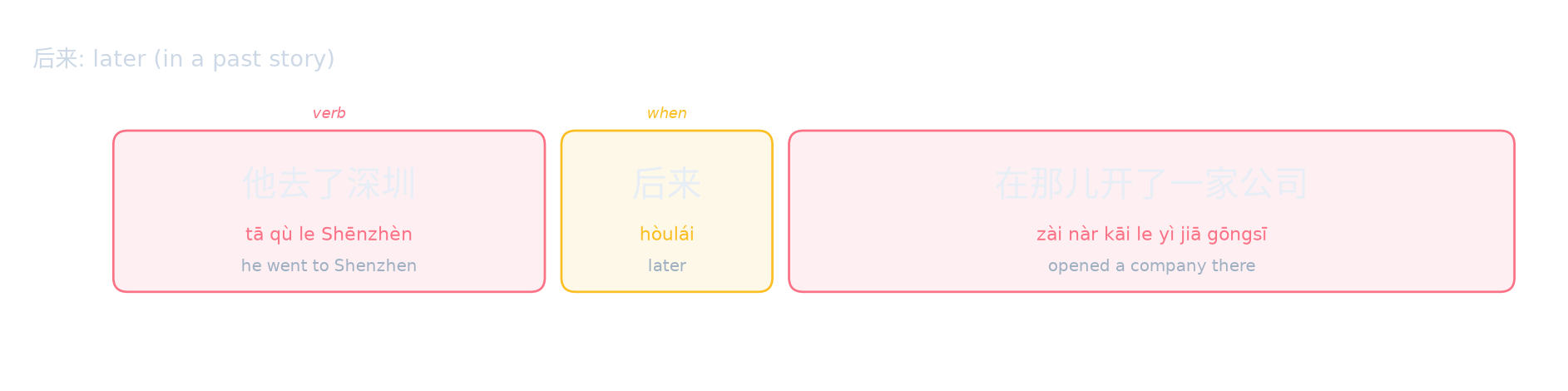
- he / him他to go去(completed / change)了Shenzhen subprovincial city…深圳,afterwards后来at / in在there那儿to open (transitive or…开(completed / change)了the whole family一家company公司。 — "He went to Shenzhen, and later he started a company there."
…,afterwards后来 … (afterwards, later on)
- afterwards后来 = "afterwards, later on", for what happened next in a past story.
- It starts the second clause, after a comma: we / us我们先是to study at the same school同学,afterwards后来to succeed成(completed / change)了good好friend朋友.
we我们first先were是classmates同学,later后来became成了good friends好朋友。
Asking what happened next
- afterwards后来(and …? / softener)呢? — "And then what happened?" A natural way to keep a story going.
- afterwards后来how about怎么样(completed / change)了? — "How did it turn out in the end?"
later后来how怎么样了?
Past stories only
- afterwards后来 is only for the past. For "later" in a plan, use after以后 or then / after然后: we / us我们after以后to say again再说.
- It stands alone as a time word; it is not added after an event: graduation毕业after以后, not graduation毕业afterwards后来.
afterwards后来 versus then / after然后
- then / after然后 links steps closely, one after another, in the past or future: early先to wash one's hands洗手,then / after然后to have a meal吃饭。
- afterwards后来 jumps forward in a story, often with a gap of time: he / him他in one's childhood小时候很瘦,afterwards后来长胖(completed / change)了。
he他as a child小时候very很thin瘦,later后来grow长fat胖了。
Recap
- …,afterwards后来 … = afterwards, later on, in a past story; afterwards后来(and …? / softener)呢? = And then?
- Not for plans (use after以后 / then / after然后), not after an event (graduation毕业after以后).
Practise this pattern step by step.
Practice without the models
Time / Verb + before以前 (before …)
0501.1 Complete: “Please come back before ten.” to ask请十点…………to return回来。
0501.2 Which says “Turn off the light before you leave.”?
- A. to walk走before以前关灯。
- B. to walk走关灯before以前。
- C. before以前to walk走关灯。
- D. 关灯to walk走before以前。
0501.3 Build: “The homework must be handed in before Friday.”
Arrange all chunks: before以前 / Friday星期五 / school assignment作业。 / 要交
0501.4 三天front前 and 三天before以前 both mean “three days ago”.
True or false? Explain or repair the statement.
0501.5 Your doctor gives you advice about a good night's sleep. Close the examples. Say a Mandarin response, then write it in Chinese. Explain briefly in English what the lesson’s pattern adds. Compare with the model, then change one detail and try again.
Write or say your own response before reading the key.
before以前,… (in the past, …)
0502.1 Complete: “I used to be very shy.” I / me我…………degree / adjective linker很shy害羞。
0502.2 Match each sentence to its meaning.
-
- before以前I / me我not不喝咖啡。
-
- 喝咖啡before以前,I / me我early先variant of 吃吃breakfast早饭。
-
A. Before drinking coffee I eat breakfast.
-
B. I didn't use to drink coffee.
0502.3 Build: “He didn't use to like spicy food.”
Arrange all chunks: not不to like喜欢 / variant of 吃吃hot (spicy)辣(modifier / structural particle)的。 / he / him他 / before以前
0502.4 original原来 stresses that the situation later changed.
True or false? Explain or repair the statement.
0502.5 Your grandmother looks at old photos of her village with dirt roads and no cars. Close the examples. Say a Mandarin response, then write it in Chinese. Explain briefly in English what the lesson’s pattern adds. Compare with the model, then change one detail and try again.
Write or say your own response before reading the key.
just now (variant of 刚才)刚才 (a moment ago)
0503.1 Complete: “It was raining just now; now it has stopped.” …………at / in在to rain下雨,now现在to stop停(completed / change)了。
0503.2 Which sentence is correct?
- A. just now (variant of 刚才)刚才he / him他degree / adjective linker很busy忙。
- B. he / him他degree / adjective linker很刚忙。
- C. he / him他busy忙just now (variant of 刚才)刚才degree / adjective linker很。
- D. just now刚he / him他degree / adjective linker很busy忙。
0503.3 Build: “Where did you go just now?”
Arrange all chunks: to go去where哪儿 / (completed / change)了? / just now (variant of 刚才)刚才 / you你
0503.4 just now (variant of 刚才)刚才 is a good choice for “I moved house recently.”
True or false? Explain or repair the statement.
0503.5 You come back from the shower and see your roommate pointing at your phone. Close the examples. Say a Mandarin response, then write it in Chinese. Explain briefly in English what the lesson’s pattern adds. Compare with the model, then change one detail and try again.
Write or say your own response before reading the key.
Time / Verb + o'clock时 (when …)
0504.1 Complete: “When I got home, he was already asleep.” I / me我to / arrive到home家…………,he / him他already已经to sleep睡(completed / change)了。
0504.2 Which says “Call me when you have time.”?
- A. you你what什么time时候to have time (to do sth)有空to / for / give给I / me我to make a telephone call打电话。
- B. you你to have time (to do sth)有空(modifier / structural particle)的time时候to / for / give给I / me我to make a telephone call打电话。
- C. you你to / for / give给I / me我to make a telephone call打电话to have time (to do sth)有空(modifier / structural particle)的time时候。
- D. time时候you你to have time (to do sth)有空to / for / give给I / me我to make a telephone call打电话。
0504.3 Build: “In class, please turn off your phone.”
Arrange all chunks: 请关 / cell phone手机。 / , / 上课时
0504.4 o'clock时 is more common than (modifier / structural particle)的time时候 in everyday conversation.
True or false? Explain or repair the statement.
0504.5 You are telling a friend a story from your childhood about learning to swim. Close the examples. Say a Mandarin response, then write it in Chinese. Explain briefly in English what the lesson’s pattern adds. Compare with the model, then change one detail and try again.
Write or say your own response before reading the key.
after以后 (after / in the future)
0505.1 Complete: “Call me after you arrive.” you你to / arrive到(completed / change)了…………to / for / give给I / me我to make a telephone call打电话。
0505.2 What does after以后我会早点儿to sleep睡 mean?
- A. I used to go to bed early.
- B. I went to bed early afterwards.
- C. From now on I'll go to bed earlier.
- D. I went to bed after eating.
0505.3 Build: “After I graduate from university, I want to work abroad.”
Arrange all chunks: 大学毕业 / to go去abroad国外to work工作。 / ,I / me我want / think / miss想 / after以后
0505.4 after以后to have a meal吃饭 means “after eating”.
True or false? Explain or repair the statement.
0505.5 A friend in her final year asks what you plan to do once you finish university. Close the examples. Say a Mandarin response, then write it in Chinese. Explain briefly in English what the lesson’s pattern adds. Compare with the model, then change one detail and try again.
Write or say your own response before reading the key.
… ,afterwards后来 … (afterwards / later – past)
0506.1 Complete the story: “At first I didn't like him, but later we became friends.” to start开始I / me我not不to like喜欢he / him他,…………we / us我们to succeed成(completed / change)了friend朋友。
0506.2 Which fits a plan? “Let's eat first, then go shopping.”
- A. we / us我们afterwards后来to have a meal吃饭,early先to go去to buy买thing东西。
- B. we / us我们early先to have a meal吃饭,then / after然后to go去to buy买thing东西。
- C. we / us我们early先to have a meal吃饭,afterwards后来to go去to buy买thing东西。
- D. we / us我们to have a meal吃饭afterwards后来,to go去to buy买thing东西。
0506.3 Ask to continue a story: “And how did it turn out?”
Arrange all chunks: how about怎么样 / afterwards后来 / (completed / change)了?
0506.4 he / him他in one's childhood小时候很瘦,afterwards后来长胖(completed / change)了 describes a change with a gap of time.
True or false? Explain or repair the statement.
0506.5 You are telling a friend about a classmate who moved to Shenzhen two years ago. Close the examples. Say a Mandarin response, then write it in Chinese. Explain briefly in English what the lesson’s pattern adds. Compare with the model, then change one detail and try again.
Write or say your own response before reading the key.
Answers and explanations
Time / Verb + before以前 (before …)
0501.1 before以前
Time + before以前 = before that time.
0501.2 A. to walk走before以前关灯。
Action + before以前, then the main verb.
0501.3 Friday星期五before以前要交school assignment作业。
Time + before以前 + verb phrase.
0501.4 True.
front前 is a shorter form of before以前 after a time.
0501.5 One possible response: to go to bed睡觉before以前don't be fooled by the fact…别看cell phone手机。
Check meaning and form:
- My response conveys a message that fits the opening situation.
- I can explain the meaning of the pattern, rather than only naming it.
- Put before以前 after what it refers to: to go to class上课before以前, not before以前to go to class上课 (which means "in the past, I attended class").
- The before以前 phrase goes before the main verb, not at the end: I / me我十点before以前to return home回家, not I / me我to return home回家十点before以前.
- I tried a second response with a name, time, place, or description changed.
This is supported productive practice. Compare meaning and structure; your answer need not copy the model. A partner or teacher must hear the spoken response to comment on pronunciation.
before以前,… (in the past, …)
0502.1 before以前
Subject + before以前 + description = used to be.
0502.2 1–B: before以前I / me我not不喝咖啡。 = I didn't use to drink coffee.; 2–A: 喝咖啡before以前,I / me我early先variant of 吃吃breakfast早饭。 = Before drinking coffee I eat breakfast.
Alone, before以前 means “in the past”; after an action it means “before”.
0502.3 he / him他before以前not不to like喜欢variant of 吃吃hot (spicy)辣(modifier / structural particle)的。
Subject + before以前 + verb phrase.
0502.4 True.
original原来 = originally (and then it changed).
0502.5 One possible response: before以前here这儿not have / haven't没有road路,now现在to have / there is有很多war chariot (archaic)车(completed / change)了。
Check meaning and form:
- My response conveys a message that fits the opening situation.
- I can explain the meaning of the pattern, rather than only naming it.
- Alone at the front or after the subject, before以前 = "in the past": before以前I / me我improbable不会to prepare a meal做饭.
- After a time or action, it = "before": to go to class上课before以前 – "before class". Check what comes before it.
- I tried a second response with a name, time, place, or description changed.
This is supported productive practice. Compare meaning and structure; your answer need not copy the model. A partner or teacher must hear the spoken response to comment on pronunciation.
just now (variant of 刚才)刚才 (a moment ago)
0503.1 just now (variant of 刚才)刚才
just now (variant of 刚才)刚才 is a time word that can start the sentence.
0503.2 A. just now (variant of 刚才)刚才he / him他degree / adjective linker很busy忙。
just now (variant of 刚才)刚才 can describe a state a moment ago; just now刚 cannot go before an adjective.
0503.3 you你just now (variant of 刚才)刚才to go去where哪儿(completed / change)了?
Subject + just now (variant of 刚才)刚才 + verb phrase.
0503.4 False.
just now (variant of 刚才)刚才 is only a moment ago; recently is recently最近 (or just now刚to move house搬家).
0503.5 One possible response: just now (variant of 刚才)刚才someone有人to / for / give给you你to make a telephone call打电话(completed / change)了。
Check meaning and form:
- My response conveys a message that fits the opening situation.
- I can explain the meaning of the pattern, rather than only naming it.
- Use just now (variant of 刚才)刚才 for a moment ago in the same situation; for "recently" over days, use recently最近 or just now刚.
- just now (variant of 刚才)刚才 can go first in the sentence; just now刚 cannot: just now (variant of 刚才)刚才他来(completed / change)了 ✓, just now刚he / him他to come来(completed / change)了 ✗.
- I tried a second response with a name, time, place, or description changed.
This is supported productive practice. Compare meaning and structure; your answer need not copy the model. A partner or teacher must hear the spoken response to comment on pronunciation.
Time / Verb + o'clock时 (when …)
0504.1 (modifier / structural particle)的time时候
Clause + (modifier / structural particle)的time时候 = when.
0504.2 B. you你to have time (to do sth)有空(modifier / structural particle)的time时候to / for / give给I / me我to make a telephone call打电话。
The (modifier / structural particle)的time时候 clause comes first; what什么time时候 asks “when?”.
0504.3 上课时,请关cell phone手机。
Clause + o'clock时, then the request.
0504.4 False.
(modifier / structural particle)的time时候 is the usual spoken form; o'clock时 is more written.
0504.5 One possible response: I / me我small小(modifier / structural particle)的time时候often常常to go去river bank河边swimming游泳。
Check meaning and form:
- My response conveys a message that fits the opening situation.
- I can explain the meaning of the pattern, rather than only naming it.
- o'clock时 / (modifier / structural particle)的time时候 goes after the clause: to rain下雨(modifier / structural particle)的time时候, not time时候to rain下雨.
- In a "when" clause, do not use what什么time时候 (that asks "when?"): I / me我to / arrive到home家(modifier / structural particle)的time时候, not I / me我what什么time时候perfect到家.
- I tried a second response with a name, time, place, or description changed.
This is supported productive practice. Compare meaning and structure; your answer need not copy the model. A partner or teacher must hear the spoken response to comment on pronunciation.
after以后 (after / in the future)
0505.1 after以后
Event + after以后 = after that event.
0505.2 C. From now on I'll go to bed earlier.
after以后 alone at the start refers to the future.
0505.3 大学毕业after以后,I / me我want / think / miss想to go去abroad国外to work工作。
Event + after以后, then the main clause.
0505.4 False.
After eating is to have a meal吃饭after以后; after以后to have a meal吃饭 means “eat in the future”.
0505.5 One possible response: 大学毕业after以后,I / me我want / think / miss想to go去abroad国外to work工作。
Check meaning and form:
- My response conveys a message that fits the opening situation.
- I can explain the meaning of the pattern, rather than only naming it.
- Put after以后 after the event: to have a meal吃饭after以后, not after以后to have a meal吃饭 (which would mean "eat in the future").
- For the next step in a past story, prefer afterwards后来 or then / after然后, not a bare after以后: I / me我early先to go去(completed / change)了bank银行,then / after然后to go去(completed / change)了supermarket (abbr. for 超级市场)超市.
- I tried a second response with a name, time, place, or description changed.
This is supported productive practice. Compare meaning and structure; your answer need not copy the model. A partner or teacher must hear the spoken response to comment on pronunciation.
… ,afterwards后来 … (afterwards / later – past)
0506.1 afterwards后来
afterwards后来 introduces what happened later in a past story.
0506.2 B. we / us我们early先to have a meal吃饭,then / after然后to go去to buy买thing东西。
afterwards后来 is only for past stories; a plan uses then / after然后.
0506.3 afterwards后来how about怎么样(completed / change)了?
afterwards后来how about怎么样(completed / change)了?
0506.4 True.
afterwards后来 jumps forward in a past story.
0506.5 One possible response: he / him他to go去(completed / change)了Shenzhen subprovincial city…深圳,afterwards后来at / in在there那儿to open (transitive or…开(completed / change)了the whole family一家company公司。
Check meaning and form:
- My response conveys a message that fits the opening situation.
- I can explain the meaning of the pattern, rather than only naming it.
- afterwards后来 is only for the past. For "later" in a plan, use after以后 or then / after然后: we / us我们after以后to say again再说.
- It stands alone as a time word; it is not added after an event: graduation毕业after以后, not graduation毕业afterwards后来.
- I tried a second response with a name, time, place, or description changed.
This is supported productive practice. Compare meaning and structure; your answer need not copy the model. A partner or teacher must hear the spoken response to comment on pronunciation.