Original teaching practice. Read one pattern, cover its model and try the questions before checking the separate answer section. Examples adapted from Chinese Grammar Wiki (AllSet Learning, CC BY-NC-SA) retain the course-reference provenance.
Direction complement to come来 / to go去 (toward / away)
Come in, go out
- A friend knocks at your door; later your little brother runs off to play outside.
- 请进来! — "Please come in!" he / him他to go out出去(completed / change)了。 — "He's gone out." to come来 is towards the speaker, to go去 is away.
Verb + to come来 / to go去
- to come来 = movement towards the speaker; to go去 = movement away from the speaker.
- Combine with direction verbs: to come in进来/to go in进去, (after a verb, indicates…出来/to go out出去, to come up上来/to go up上去, to come down下来/to go down下去, to return回来/to return回去, see 过来过来/(verb suffix)过去.
you你quickly快come down下来吧!

A place goes before to come来 / to go去
- Verb + place + to come来/to go去: he / him他to return home回家to go去(completed / change)了。 — "He has gone back home." fast-forward (media player)快进classroom教室to come来! — "Come into the classroom, quick!"
- A thing you carry can come after: he / him他to bring带来(completed / change)了one / a一本书 / he / him他band带(completed / change)了one / a一本书to come来.
he他return回home家(away)去了。
The speaker decides to come来 or to go去
- Choose by where the speaker is: you are upstairs → to come up上来 (come up); you are downstairs → to go up上去 (go up).
- A place word never comes after to come来/to go去: to go forward进classroom教室to come来, not to come in进来classroom教室.
to bring拿来, band带to go去, 送来
- Bringing and taking work the same way: to ask请(把: marks the object)把book书to bring拿来。 — "Please bring the book (here)."
- I / me我to / for / give给he / him他to send送to go去(completed / change)了some一些fruit水果。 — "I took some fruit over to him."
please请把the book书bring拿(here)来。
Recap
- Verb + to come来 = towards the speaker; Verb + to go去 = away from the speaker.
- A place goes before to come来/to go去 (to return home回家to go去, to go forward进classroom教室to come来); to bring拿来/band带to go去 work the same way.
Practise this pattern step by step.
Potential complement (degree marker)得 / not不 (can / can't do it)
Can you understand him?
- Your teacher speaks quickly at the start of a new course, and your friend wonders if you follow.
- teacher老师variant of 说说(degree marker)得太快,I / me我unable to make sense of…听不懂。 — "The teacher talks too fast; I can't understand."
Verb + (degree marker)得 / not不 + result
- Verb + (degree marker)得 + result = can (manage to) do it; Verb + not不 + result = can't: to understand (by hearing)听得懂 / unable to make sense of…听不懂, can see看得见 / cannot see看不见.
- It says whether the result is possible, not whether you are allowed.
I我listen听(can)得understand懂Chinese中文。

Common pairs
- cannot see看不见 (can't see), 买不到 (can't get hold of), 吃不完 (can't finish eating), to have enough time来得及 (there's still time).
- so much这么多菜,we / us我们吃不完。 — "This much food — we can't finish it."
so这么much多food菜,we我们eat吃(cannot)不finish完。
Where not不 goes
- not不 goes between the verb and the result: unable to make sense of…听不懂, not not不to understand (on hearing)听懂.
- Ask with both forms: you你to understand (by hearing)听得懂unable to make sense of…听不懂? or you你to understand (by hearing)听得懂(yes/no ?)吗?
unable to make sense of…听不懂 versus not / haven't没to understand (on hearing)听懂
- unable to make sense of…听不懂 = can't understand (it is beyond me): he / him他(modifier / structural particle)的Shanghai municipality…上海old variant of 话话I / me我unable to make sense of…听不懂.
- not / haven't没to understand (on hearing)听懂 = didn't understand (this time): I'm sorry对不起,I / me我not / haven't没to understand (on hearing)听懂,to ask请to say again再说one time (all the way…一遍。
sorry对不起,I我did not没understand听懂。
Recap
- Verb + (degree marker)得 + result = can; Verb + not不 + result = can't (can see看得见 / cannot see看不见).
- not不 sits between verb and result. not / haven't没 + verb + result = it did not happen this time.
Practise this pattern step by step.
Verb + to go down下去 (keep …-ing)
Don't stop now
- You are halfway through a story and your listener is hooked.
- variant of 说说to go down下去,afterwards后来how about怎么样(completed / change)了? — "Keep going — what happened next?"
Verb + to go down下去
- Verb + to go down下去 = keep on doing, continue from now into the future: variant of 说说to go down下去, to read out读to go down下去, to live住to go down下去.
- It is often used with to continue继续, want / will / need要, want / think / miss想 or can / be able to能: I / me我want / think / miss想at / in在here这儿to live住to go down下去.
please请continue继续speak说(keep on)下去。

Perseverance
- to learn学Chinese language中文not不easy容易,but但是you你want / will / need要to press on坚持下去。 — "Learning Chinese isn't easy, but you must keep going."
- this way / so这样to go down下去won't do不行。 — "It can't go on like this." this way / so这样to go down下去 = if things continue this way.
like this这样(go on)下去not不OK行。
Continuing, not going down
- In this pattern to go down下去 means "continue", not physical movement down: to read out读to go down下去 = keep reading.
- With not不 for "can't go on": I / me我to listen to听not不to go down下去(completed / change)了 — "I can't bear to listen any more."
to go down下去 versus (after a verb) indicating…起来
- to go down下去 continues something already going: to sing唱to go down下去 — "keep singing".
- (after a verb) indicating…起来 starts something new: 唱起来 — "start singing": everyone大家all / both都唱起来(completed / change)了。
everyone大家all都sing唱(start)起来了。
Recap
- Verb + to go down下去 = keep on doing it, carry on (variant of 说说to go down下去, to press on坚持下去).
- this way / so这样to go down下去 = if this continues; to listen to听not不to go down下去 = can't bear to go on. (after a verb) indicating…起来 = start.
Practise this pattern step by step.
Result complements good好 / to finish完 / mistake错 (how it turned out)
Finished or not?
- Your mum asks about your homework before you go out to play.
- school assignment作业I / me我to make做to finish完(completed / change)了! — "I've finished my homework!" to finish完 tells the result of the action: it is finished.
Verb + result complement
- Verb + good好 / to finish完 / mistake错 tells how the action ended: 做好 (done properly), variant of 吃吃to finish完 (eaten up), 写错 (written wrongly).
- (completed / change)了 normally follows the result: I / me我to write写to finish完(completed / change)了, he / him他to see看mistake错(completed / change)了.
I我write写wrongly错了one一个character字。
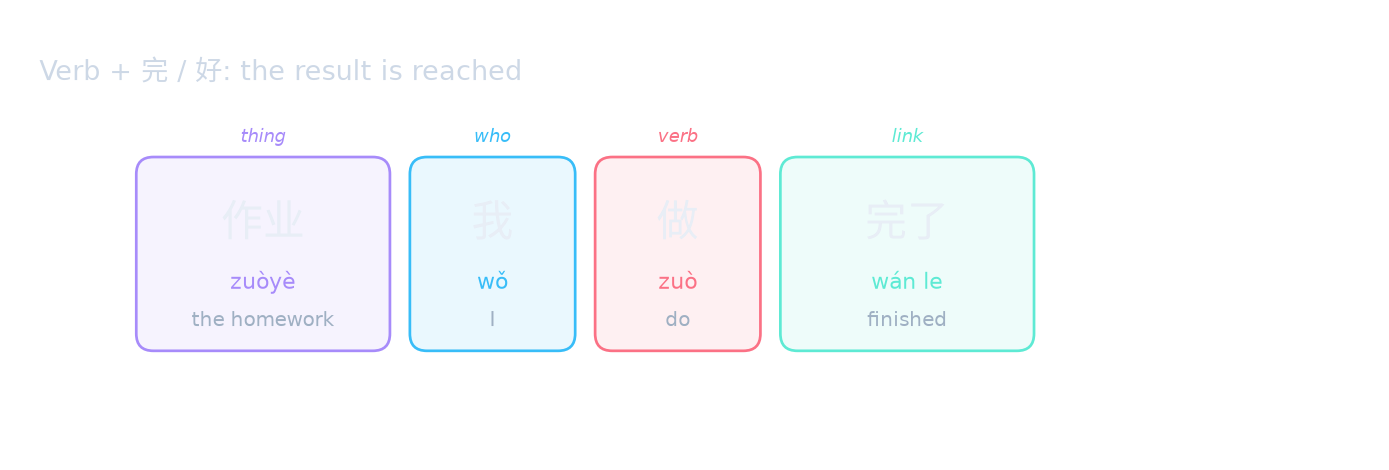
Ready, finished, wrong
- good好 = done and ready: cooked rice饭做好(completed / change)了,rapid快to come来variant of 吃吃(suggestion)吧! — "Dinner's ready, come and eat!"
- to finish完 = finished, nothing left: this这本书I / me我to see看to finish完(completed / change)了. mistake错 = wrong: I'm sorry对不起,I / me我to err打错telephone电话(completed / change)了。
dinner饭make做ready好了,quickly快come来eat吃吧!
Negate with not / haven't没, keep the pair together
- Negate with not / haven't没 and drop (completed / change)了: I / me我still / also还not / haven't没to make做to finish完, not I / me我not不to make做to finish完(completed / change)了.
- Nothing comes between the verb and its result: 做完作业, not 做作业to finish完.
to make做to finish完 versus 做好
- to make做to finish完 = finished, the job is over (maybe not well done).
- 做好 = done properly, ready to use: you你preparation准备好了吗? — "Are you ready?"
you你prepare准备ready好了吗?
Recap
- Verb + good好 / to finish完 / mistake错 (+ (completed / change)了) = done properly / finished / done wrongly.
- Negative: not / haven't没 + Verb + result (still / also还not / haven't没to make做to finish完). The result follows the verb directly.
Practise this pattern step by step.
Practice without the models
Direction complement to come来 / to go去 (toward / away)
0311.1 You are inside the room and call to your friend at the door: “Come in!” to go forward进…………!
0311.2 You are on the ground floor talking about your friend upstairs: “He went up.” Which fits?
- A. 他来(bound form) up上(completed / change)了。
- B. he / him他to go up上去(completed / change)了。
- C. he / him他to come up上来(completed / change)了。
- D. he / him他to go去(bound form) up上(completed / change)了。
0311.3 Build: “Come into the classroom, quick!”
Arrange all chunks: rapid快 / to come来! / classroom教室 / to go forward进
0311.4 he / him他to come in进来classroom教室(completed / change)了 is correct.
True or false? Explain or repair the statement.
0311.5 A friend knocks at your door; later your little brother runs off to play outside. Close the examples. Say a Mandarin response, then write it in Chinese. Explain briefly in English what the lesson’s pattern adds. Compare with the model, then change one detail and try again.
Write or say your own response before reading the key.
Potential complement (degree marker)得 / not不 (can / can't do it)
0312.1 The words on the board are too small: “I can't see clearly.” I / me我to see看…………clear清楚。
0312.2 Which says “I can't understand Cantonese.”?
- A. I / me我not不to understand (on hearing)听懂Cantonese language广东话。
- B. I / me我not / haven't没to understand (by hearing)听得懂Cantonese language广东话。
- C. I / me我to understand (on hearing)听懂not不Cantonese language广东话。
- D. I / me我unable to make sense of…听不懂Cantonese language广东话。
0312.3 Match each form to its meaning.
-
- 买不到
-
- 吃不完
-
- to have enough time来得及
-
- can see看得见
-
A. there's still time
-
B. can't finish eating
-
C. can't get hold of
-
D. can see
0312.4 Build: “This much food – we can't finish it.”
Arrange all chunks: so much这么多菜 / we / us我们 / , / 吃不完。
0312.5 Your teacher speaks quickly at the start of a new course, and your friend wonders if you follow. Close the examples. Say a Mandarin response, then write it in Chinese. Explain briefly in English what the lesson’s pattern adds. Compare with the model, then change one detail and try again.
Write or say your own response before reading the key.
Verb + to go down下去 (keep …-ing)
0313.1 Encourage: “Keep reading!” to read out读…………!
0313.2 Everyone suddenly started laughing. Which fits? everyone大家all / both都to laugh笑____(completed / change)了。
- A. (verb suffix)过去
- B. to go down下去
- C. to go up上去
- D. (after a verb) indicating…起来
0313.3 Build: “It can't go on like this.”
Arrange all chunks: to go down下去 / won't do不行。 / this way / so这样
0313.4 In variant of 说说to go down下去, to go down下去 means the speaker walks downstairs.
True or false? Explain or repair the statement.
0313.5 You are halfway through a story and your listener is hooked. Close the examples. Say a Mandarin response, then write it in Chinese. Explain briefly in English what the lesson’s pattern adds. Compare with the model, then change one detail and try again.
Write or say your own response before reading the key.
Result complements good好 / to finish完 / mistake错 (how it turned out)
0314.1 Complete: “I've eaten up all the dumplings.” dumpling饺子I / me我all / both都variant of 吃吃…………(completed / change)了。
0314.2 Which says “I haven't finished reading this book yet.”?
- A. this这本书I / me我still / also还not / haven't没to see看to finish完。
- B. this这本书I / me我still / also还to see看没完。
- C. this这本书I / me我still / also还not / haven't没to see看to finish完(completed / change)了。
- D. this这本书I / me我still / also还not不to see看to finish完(completed / change)了。
0314.3 Match each phrase to its meaning.
-
- 做好(completed / change)了
-
- to make做to finish完(completed / change)了
-
- 写错(completed / change)了
-
A. written wrongly
-
B. finished
-
C. done and ready
0314.4 Build: “Are you ready?”
Arrange all chunks: preparation准备good好 / (completed / change)了 / (yes/no ?)吗? / you你
0314.5 Your mum asks about your homework before you go out to play. Close the examples. Say a Mandarin response, then write it in Chinese. Explain briefly in English what the lesson’s pattern adds. Compare with the model, then change one detail and try again.
Write or say your own response before reading the key.
Answers and explanations
Direction complement to come来 / to go去 (toward / away)
0311.1 to come来
Movement towards the speaker takes to come来.
0311.2 B. he / him他to go up上去(completed / change)了。
He moved away from you (upwards), so to go up上去.
0311.3 fast-forward (media player)快进classroom教室to come来!
Verb + place + to come来.
0311.4 False.
The place goes before to come来: 他进classroom教室to come来(completed / change)了.
0311.5 One possible response: 请进来!
Check meaning and form:
- My response conveys a message that fits the opening situation.
- I can explain the meaning of the pattern, rather than only naming it.
- Choose by where the speaker is: you are upstairs → to come up上来 (come up); you are downstairs → to go up上去 (go up).
- A place word never comes after to come来/to go去: to go forward进classroom教室to come来, not to come in进来classroom教室.
- I tried a second response with a name, time, place, or description changed.
This is supported productive practice. Compare meaning and structure; your answer need not copy the model. A partner or teacher must hear the spoken response to comment on pronunciation.
Potential complement (degree marker)得 / not不 (can / can't do it)
0312.1 not不
Verb + not不 + result = can't. 看不清楚 = can't see clearly.
0312.2 D. I / me我unable to make sense of…听不懂Cantonese language广东话。
not不 goes between the verb and the result.
0312.3 1–C: 买不到 = can't get hold of; 2–B: 吃不完 = can't finish eating; 3–A: to have enough time来得及 = there's still time; 4–D: can see看得见 = can see
Verb + (degree marker)得/not不 + result says whether the result is possible.
0312.4 so much这么多菜,we / us我们吃不完。
Verb + not不 + to finish完 = can't finish.
0312.5 One possible response: teacher老师variant of 说说(degree marker)得太快,I / me我unable to make sense of…听不懂。
Check meaning and form:
- My response conveys a message that fits the opening situation.
- I can explain the meaning of the pattern, rather than only naming it.
- not不 goes between the verb and the result: unable to make sense of…听不懂, not not不to understand (on hearing)听懂.
- Ask with both forms: you你to understand (by hearing)听得懂unable to make sense of…听不懂? or you你to understand (by hearing)听得懂(yes/no ?)吗?
- I tried a second response with a name, time, place, or description changed.
This is supported productive practice. Compare meaning and structure; your answer need not copy the model. A partner or teacher must hear the spoken response to comment on pronunciation.
Verb + to go down下去 (keep …-ing)
0313.1 to go down下去
Verb + to go down下去 = continue doing it.
0313.2 D. (after a verb) indicating…起来
Starting a new action takes (after a verb) indicating…起来; to go down下去 continues an action already going.
0313.3 this way / so这样to go down下去won't do不行。
this way / so这样to go down下去 + won't do不行.
0313.4 False.
Here to go down下去 means “continue”.
0313.5 One possible response: variant of 说说to go down下去,afterwards后来how about怎么样(completed / change)了?
Check meaning and form:
- My response conveys a message that fits the opening situation.
- I can explain the meaning of the pattern, rather than only naming it.
- In this pattern to go down下去 means "continue", not physical movement down: to read out读to go down下去 = keep reading.
- With not不 for "can't go on": I / me我to listen to听not不to go down下去(completed / change)了 – "I can't bear to listen any more."
- I tried a second response with a name, time, place, or description changed.
This is supported productive practice. Compare meaning and structure; your answer need not copy the model. A partner or teacher must hear the spoken response to comment on pronunciation.
Result complements good好 / to finish完 / mistake错 (how it turned out)
0314.1 to finish完
variant of 吃吃to finish完 = eaten up, finished.
0314.2 A. this这本书I / me我still / also还not / haven't没to see看to finish完。
not / haven't没 + verb + result, with no (completed / change)了.
0314.3 1–C: 做好(completed / change)了 = done and ready; 2–B: to make做to finish完(completed / change)了 = finished; 3–A: 写错(completed / change)了 = written wrongly
The result word tells how the action ended.
0314.4 you你preparation准备好了吗?
preparation准备 + good好 + (completed / change)了 + (yes/no ?)吗.
0314.5 One possible response: school assignment作业I / me我to make做to finish完(completed / change)了!
Check meaning and form:
- My response conveys a message that fits the opening situation.
- I can explain the meaning of the pattern, rather than only naming it.
- Negate with not / haven't没 and drop (completed / change)了: I / me我still / also还not / haven't没to make做to finish完, not I / me我not不to make做to finish完(completed / change)了.
- Nothing comes between the verb and its result: 做完作业, not 做作业to finish完.
- I tried a second response with a name, time, place, or description changed.
This is supported productive practice. Compare meaning and structure; your answer need not copy the model. A partner or teacher must hear the spoken response to comment on pronunciation.