Original teaching practice. Read one pattern, cover its model and try the questions before checking the separate answer section. Examples adapted from Chinese Grammar Wiki (AllSet Learning, CC BY-NC-SA) retain the course-reference provenance.
after以后 vs then / after然后 vs afterwards后来 (then / after)
Telling your day in order
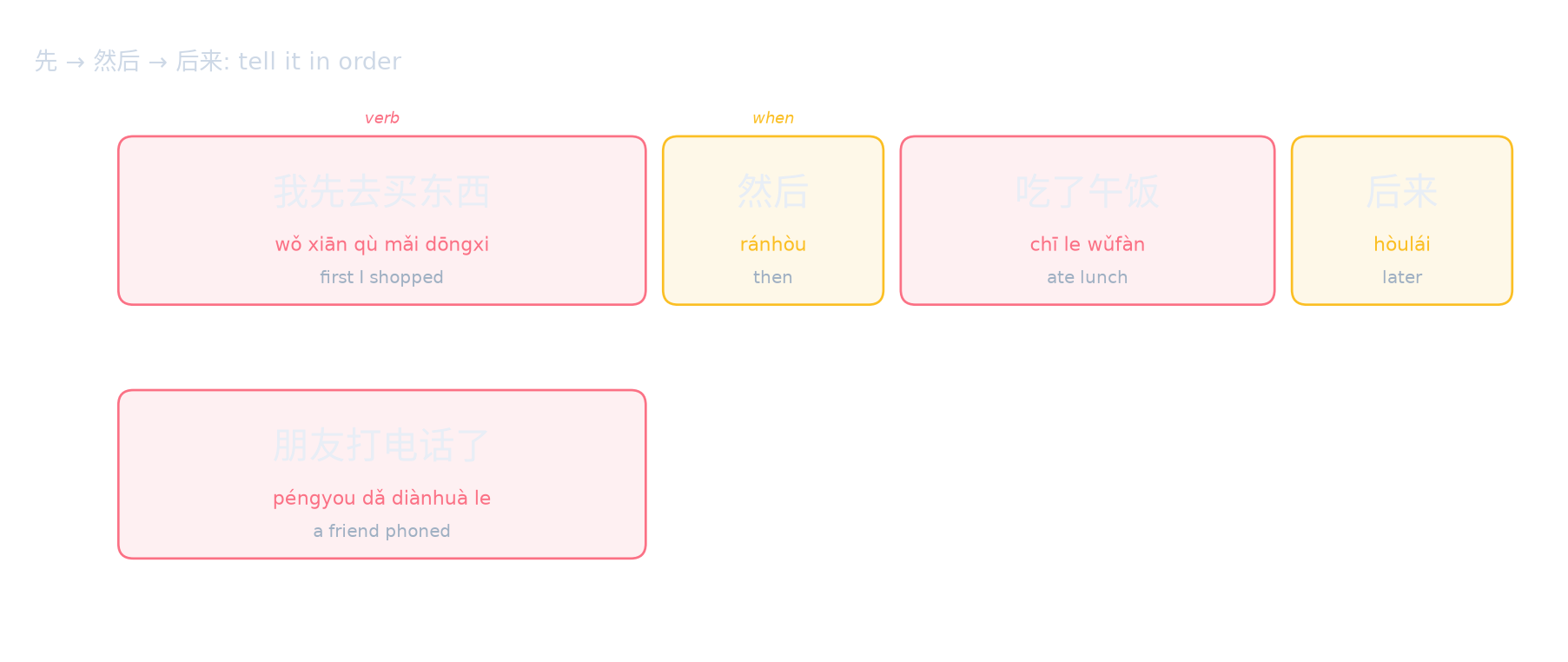
- You describe last Saturday: shopping, then lunch, and much later a surprise phone call.
- I / me我early先to go去to buy买thing东西,then / after然后variant of 吃吃(completed / change)了lunch午饭。afterwards后来,I / me我(modifier / structural particle)的old friend老朋友to / for / give给I / me我to make a telephone call打电话(completed / change)了。 — "First I went shopping, then I had lunch. Later on, an old friend phoned me."
Three words for "after"
- after以后 follows an event (to have a meal吃饭after以后) or, alone, means "in the future" (after以后to say again再说).
- then / after然后 links the next step, in the past or future (early先to wash one's hands洗手,then / after然后to have a meal吃饭). afterwards后来 jumps forward in a past story only.
first先wash hands洗手,then然后eat吃饭。
Choosing by the situation
- Plan: we / us我们early先to have a meal吃饭,then / after然后to go去to see看movie电影。 — "Let's eat first, then see a film." (after以后 / then / after然后, not afterwards后来)
- Story: we / us我们to be / is是university大学to study at the same school同学,afterwards后来to marry结婚(completed / change)了。 — "We were classmates at university, and later we got married."
we我们were是university大学classmates同学,later后来marry结婚了。
Two common slips
- afterwards后来 is never for the future: we / us我们after以后to appear见, not we / us我们afterwards后来to appear见.
- afterwards后来 is never added after an event: to finish class下课after以后, not to finish class下课afterwards后来.
after以后 after a clause
- I / me我to / arrive到(completed / change)了after以后to / for / give给you你to make a telephone call打电话。 — "I'll call you after I arrive."
- then / after然后 cannot do this job: it starts the next clause instead: I / me我to / arrive到(completed / change)了,then / after然后to / for / give给you你to make a telephone call打电话。
I我arrive到了after以后to给you你make打a call电话。
Recap
- after以后 = after X / in the future; then / after然后 = and then (next step, any time); afterwards后来 = later on (past stories only).
- Plans use then / after然后 or after以后, never afterwards后来.
Practise this pattern step by step.
Practice without the models
after以后 vs then / after然后 vs afterwards后来 (then / after)
0517.1 A recipe: “Wash the vegetables, then cut them.” early先洗菜,…………切菜。
0517.2 Which says “See you later” (in the future)?
- A. we / us我们to appear见afterwards后来。
- B. we / us我们afterwards后来to appear见。
- C. we / us我们then / after然后to appear见after以后。
- D. we / us我们after以后to appear见。
0517.3 Match each word to its use.
-
- after以后
-
- then / after然后
-
- afterwards后来
-
A. the next step
-
B. later on in a past story
-
C. after an event / in the future
0517.4 Build: “I'll call you after I arrive.”
Arrange all chunks: to / arrive到(completed / change)了after以后 / to make a telephone call打电话。 / to / for / give给you你 / I / me我
0517.5 You describe last Saturday: shopping, then lunch, and much later a surprise phone call. Close the examples. Say a Mandarin response, then write it in Chinese. Explain briefly in English what the lesson’s pattern adds. Compare with the model, then change one detail and try again.
Write or say your own response before reading the key.
Answers and explanations
after以后 vs then / after然后 vs afterwards后来 (then / after)
0517.1 then / after然后
then / after然后 links the next step.
0517.2 D. we / us我们after以后to appear见。
afterwards后来 is only for past stories; after以后 can refer to the future.
0517.3 1–C: after以后 = after an event / in the future; 2–A: then / after然后 = the next step; 3–B: afterwards后来 = later on in a past story
Each “after” word has its own job.
0517.4 I / me我to / arrive到(completed / change)了after以后to / for / give给you你to make a telephone call打电话。
Clause + after以后 + main clause.
0517.5 One possible response: I / me我early先to go去to buy买thing东西,then / after然后variant of 吃吃(completed / change)了lunch午饭。afterwards后来,I / me我(modifier / structural particle)的old friend老朋友to / for / give给I / me我to make a telephone call打电话(completed / change)了。
Check meaning and form:
- My response conveys a message that fits the opening situation.
- I can explain the meaning of the pattern, rather than only naming it.
- afterwards后来 is never for the future: we / us我们after以后to appear见, not we / us我们afterwards后来to appear见.
- afterwards后来 is never added after an event: to finish class下课after以后, not to finish class下课afterwards后来.
- I tried a second response with a name, time, place, or description changed.
This is supported productive practice. Compare meaning and structure; your answer need not copy the model. A partner or teacher must hear the spoken response to comment on pronunciation.