Original teaching practice. Read one pattern, cover its model and try the questions before checking the separate answer section. Examples adapted from Chinese Grammar Wiki (AllSet Learning, CC BY-NC-SA) retain the course-reference provenance.
Verb + (ongoing -ing)着 (ongoing state)
The door is open
- You come home and notice the door open and the lights on.
- 门开(ongoing -ing)着,lamp灯also也bright亮(ongoing -ing)着。 — "The door is open, and the lights are on too." (ongoing -ing)着 describes a state that continues.
Verb + (ongoing -ing)着 = an ongoing state
- Verb + (ongoing -ing)着 describes a state that lasts: 开着 (is open), attire穿着 (is wearing), to sit坐(ongoing -ing)着 (is sitting).
- Negate with not / haven't没: gate门not / haven't没to open (transitive or…开(ongoing -ing)着 — "The door isn't open."
she她wear穿(ongoing)着a一(measure word)件red红top衣服。

Doing one thing while in a state
- Verb1 + (ongoing -ing)着 + Verb2: the first state goes on while the second action happens: he / him他to laugh笑(ongoing -ing)着variant of 说说:"it doesn't matter没关系。" — "He said with a smile, 'It doesn't matter.'"
- we / us我们to sit坐(ongoing -ing)着to chat聊天。 — "We sat and chatted."
he他smile笑(while)着say说:it doesn't matter没关系。
State, not progress
- (ongoing -ing)着 describes a state; for an action in progress, use at / in在: he / him他at / in在to open a door (lit. and…开门 (he is opening the door) vs 门开(ongoing -ing)着 (the door is open).
- Negate with not / haven't没, not not不: lamp灯not / haven't没bright亮(ongoing -ing)着.
(ongoing -ing)着 versus at / in在
- at / in在 + Verb = in the middle of doing: he / him他at / in在穿衣服 — "He's getting dressed."
- Verb + (ongoing -ing)着 = the resulting state: he / him他attire穿着一件白衬衫 — "He's wearing a white shirt."
he他(in progress)在put on穿clothes衣服。
Recap
- Verb + (ongoing -ing)着 = an ongoing state (门开(ongoing -ing)着); V1(ongoing -ing)着 + V2 = do V2 while in state V1.
- at / in在 + Verb = action in progress. Negate (ongoing -ing)着 with not / haven't没.
Practise this pattern step by step.
Sentence-final (completed / change)了 (change of state)
It's started raining
- You were about to go out, but you look out of the window and see rain.
- to rain下雨(completed / change)了! — "It's raining (now)!" The final (completed / change)了 says the situation has changed.
Sentence + (completed / change)了 = something has changed
- (completed / change)了 at the end of a sentence announces a new situation: it's cold (weather)天冷(completed / change)了 (it has turned cold), I / me我to be hungry饿(completed / change)了 (I'm hungry now).
- It is not a past tense; it marks a change from before.
the weather天cold冷了。
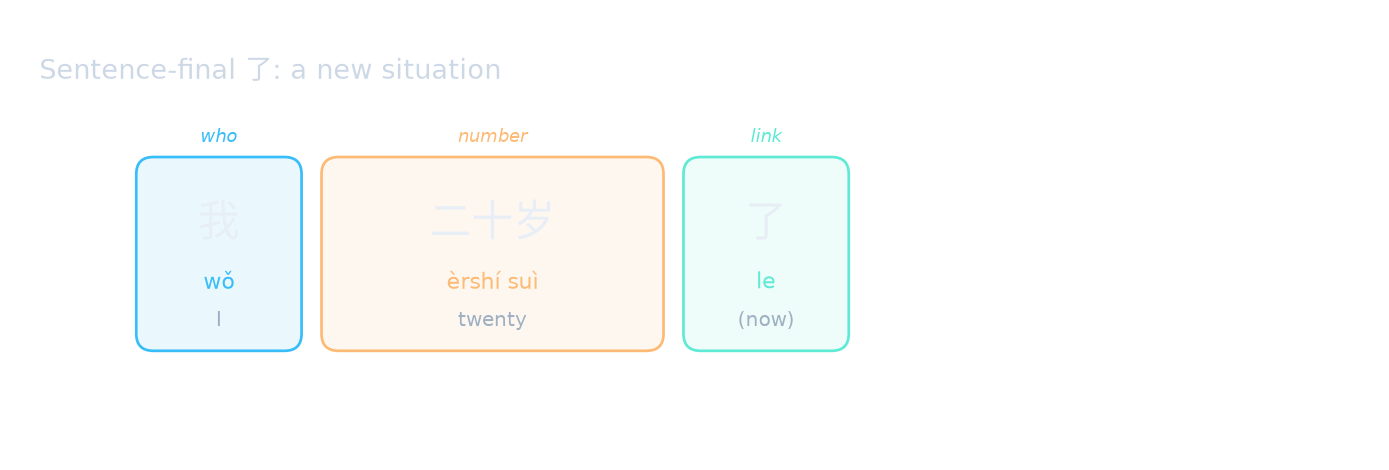
New facts, new plans, new ages
- I / me我二十岁(completed / change)了。 — "I'm twenty now." he / him他not不to come来(completed / change)了。 — "He's not coming any more."
- With rapid快 or want / will / need要: 快到(completed / change)了。 — "We're almost there."
he他not不come来了。
Not just "past"
- A past habit with no change takes no (completed / change)了: I / me我before以前often常常to go去, not I / me我before以前often常常to go去(completed / change)了.
- not不…(completed / change)了 = no longer: I / me我not不喝咖啡(completed / change)了 means "I've stopped drinking coffee", not "I didn't drink coffee".
Final (completed / change)了 versus verb (completed / change)了
- Verb + (completed / change)了 marks a completed action: I / me我variant of 吃吃(completed / change)了一个apple苹果 — "I ate an apple."
- Final (completed / change)了 marks a change: I / me我not不to be hungry饿(completed / change)了 — "I'm not hungry any more." Some sentences have both.
I我eat吃了an一个apple苹果。
Recap
- Sentence-final (completed / change)了 = a new situation, a change: to rain下雨(completed / change)了, I / me我to be hungry饿(completed / change)了, he / him他not不to come来(completed / change)了.
- not不…(completed / change)了 = no longer; rapid快…(completed / change)了 = soon. It is not a simple past tense.
Practise this pattern step by step.
Questions with (and …? / softener)呢 (and you? / where?)
Meeting a new classmate
- A new classmate tells you she comes from Chengdu, then waits for you to say where you are from.
- I / me我to be / is是Chengdu subprovincial city…成都person人,you你(and …? / softener)呢? — "I'm from Chengdu. And you?"
Noun + (and …? / softener)呢? = "What about …?"
- X + (and …? / softener)呢? asks the same question again about X: I / me我degree / adjective linker很good好,you你(and …? / softener)呢? — "I'm fine, and you?"
- The question is understood from what was just said, so it can be very short.
I我very很well好,you你(and …?)呢?

Where is it? (and …? / softener)呢 on its own
- With no context, Noun + (and …? / softener)呢? asks where something is: I / me我(modifier / structural particle)的key钥匙(and …? / softener)呢? — "Where are my keys?"
- (and …? / softener)呢 also softens a question-word question: you你at / in在what are you doing?干什么(and …? / softener)呢? — "What are you up to?"
my我的keys钥匙(where?)呢?
(and …? / softener)呢 and (yes/no ?)吗 are different
- Do not put (and …? / softener)呢 on a yes-no question: you你to be / is是teacher老师(yes/no ?)吗?, not you你to be / is是teacher老师(and …? / softener)呢?
- Do not add (yes/no ?)吗 to a question-word question: you你to go去where哪儿? or you你to go去where哪儿(and …? / softener)呢?, not you你to go去where哪儿(yes/no ?)吗?
(and …? / softener)呢 for an ongoing action
- At the end of a statement, (and …? / softener)呢 can mark something still going on: he / him他at / in在to go to bed睡觉(and …? / softener)呢。 — "He's sleeping (right now)."
- It often goes with at / in在 or (ongoing -ing)着: outside (also pr. for this…外面下着雨(and …? / softener)呢 — "It's raining out."
he他(in progress)在sleep睡觉呢。
Recap
- X + (and …? / softener)呢? = and X? / what about X?; with no context, where is X?
- Not on yes-no questions (use (yes/no ?)吗). After at / in在 + verb, (and …? / softener)呢 marks an ongoing action.
Practise this pattern step by step.
(modifier / structural particle)的 / (degree marker)得 / (adverb -ly)地 (the three “de”)
Three characters, one sound
- A friend texts you about a classmate who runs fast, but writes the wrong "de" and the sentence looks odd.
- he / him他to run跑(degree marker)得很快。 — "He runs fast." (modifier / structural particle)的, (degree marker)得 and (adverb -ly)地 are all read de, but each has its own job.
(modifier / structural particle)的 before a noun
- (modifier / structural particle)的 links a description or owner to a noun: I / me我(modifier / structural particle)的book书, pretty漂亮(modifier / structural particle)的clothes衣服, yesterday昨天to buy买(modifier / structural particle)的thing东西.
- Test: is the next word a noun (or is the noun left out)? Then it is (modifier / structural particle)的.
this这is是my我yesterday昨天bought买(that)的book书。
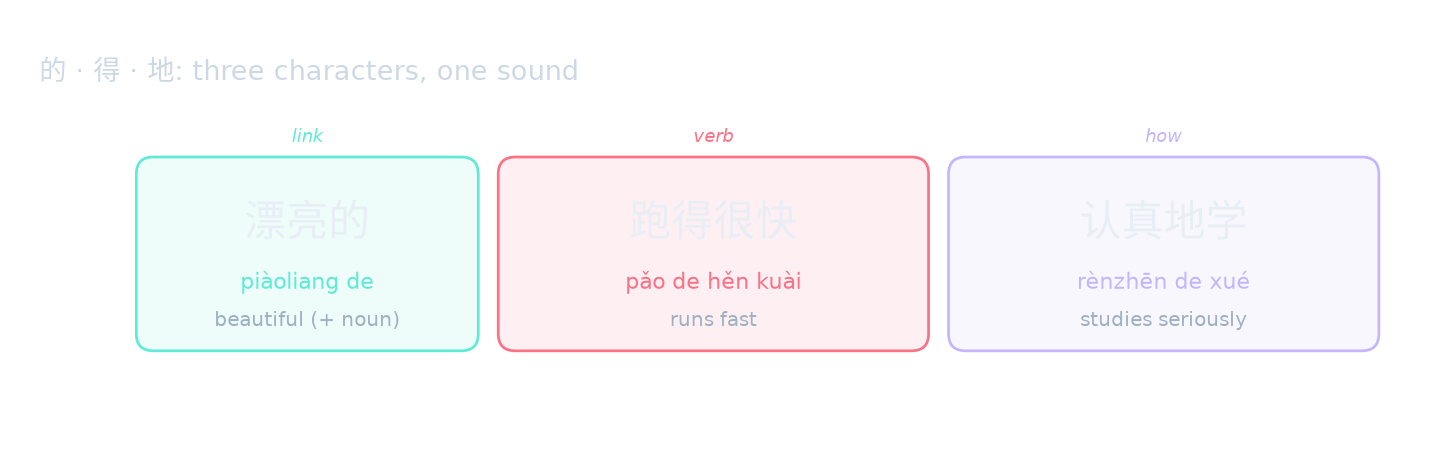
(adverb -ly)地 before a verb, (degree marker)得 after a verb
- (adverb -ly)地 links a manner to the verb that follows: conscientious认真(adverb -ly)地to learn学习, slowly慢慢(adverb -ly)地to walk走.
- (degree marker)得 follows a verb and introduces how well or how much: to run跑(degree marker)得很快, variant of 说说(degree marker)得degree / adjective linker很good好, rope累(degree marker)得unexpectedly不想(of sth) to move动.
she她speaks说得very很fluently流利。
The quick test
- Look at what follows: a noun → (modifier / structural particle)的; a verb → (adverb -ly)地; and after a verb, a description of the result → (degree marker)得.
- Typing tip: in to run跑(degree marker)得很快 the verb to run跑 is before the particle, so it must be (degree marker)得, not (modifier / structural particle)的.
One sentence, two particles
- he / him他happy高兴地说,he / him他考得degree / adjective linker很good好。 — "He said happily that he had done well in the exam."
- I / me我to like喜欢variant of 吃吃mama妈妈to make做(modifier / structural particle)的vegetable菜。 — "I love the food my mum makes." Here the (modifier / structural particle)的 phrase describes vegetable菜.
he他happily高兴地said说,he他test考得very很well好。
Recap
- (modifier / structural particle)的 + noun (I / me我(modifier / structural particle)的book书), (adverb -ly)地 + verb (conscientious认真地学), verb + (degree marker)得 + result (to run跑(degree marker)得很快).
- All are read de; choose by what comes before and after.
Practise this pattern step by step.
Practice without the models
Verb + (ongoing -ing)着 (ongoing state)
0511.1 Complete: “The window is open.” window窗户to open (transitive or…开…………。
0511.2 Which says “He is opening the door” (the action in progress)?
- A. he / him他at / in在to open a door (lit. and…开门。
- B. 他开(ongoing -ing)着gate门(completed / change)了。
- C. gate门at / in在开着。
- D. 门开(ongoing -ing)着。
0511.3 Build: “He said with a smile...”
Arrange all chunks: to laugh笑(ongoing -ing)着 / variant of 说说。 / he / him他
0511.4 The negative of 门开(ongoing -ing)着 is 门不开(ongoing -ing)着.
True or false? Explain or repair the statement.
0511.5 You come home and notice the door open and the lights on. Close the examples. Say a Mandarin response, then write it in Chinese. Explain briefly in English what the lesson’s pattern adds. Compare with the model, then change one detail and try again.
Write or say your own response before reading the key.
Sentence-final (completed / change)了 (change of state)
0512.1 The light turns green: “It's green now, let's go.” green light (traffic signal)绿灯…………,to walk走(suggestion)吧。
0512.2 What does I / me我not不to smoke (a cigarette…抽烟(completed / change)了 mean?
- A. I've quit smoking.
- B. I don't want to smoke.
- C. I'm smoking now.
- D. I didn't smoke.
0512.3 Build: “We're almost there.”
Arrange all chunks: to / arrive到 / rapid快 / we / us我们 / (completed / change)了。
0512.4 I / me我before以前often常常to go去(completed / change)了 is correct for a past habit.
True or false? Explain or repair the statement.
0512.5 You were about to go out, but you look out of the window and see rain. Close the examples. Say a Mandarin response, then write it in Chinese. Explain briefly in English what the lesson’s pattern adds. Compare with the model, then change one detail and try again.
Write or say your own response before reading the key.
Questions with (and …? / softener)呢 (and you? / where?)
0513.1 Complete: “I like tea. What about you?” I / me我to like喜欢to drink tea喝茶,you你…………?
0513.2 Which question is correct?
- A. you你to go去where哪儿(yes/no ?)吗?
- B. you你to be / is是student学生(and …? / softener)呢?
- C. you你to be / is是student学生(yes/no ?)吗(and …? / softener)呢?
- D. you你to be / is是student学生(yes/no ?)吗?
0513.3 Said while searching your bag, I / me我(modifier / structural particle)的cell phone手机(and …? / softener)呢? means “Where's my phone?”
True or false? Explain or repair the statement.
0513.4 Build: “He's sleeping right now.”
Arrange all chunks: (and …? / softener)呢。 / at / in在 / he / him他 / to go to bed睡觉
0513.5 A new classmate tells you she comes from Chengdu, then waits for you to say where you are from. Close the examples. Say a Mandarin response, then write it in Chinese. Explain briefly in English what the lesson’s pattern adds. Compare with the model, then change one detail and try again.
Write or say your own response before reading the key.
(modifier / structural particle)的 / (degree marker)得 / (adverb -ly)地 (the three “de”)
0514.1 Complete: “She sings very well.” she / her她to sing唱…………degree / adjective linker很good好。
0514.2 Fill the gaps: I / me我__friend朋友slowly慢慢__to walk走see 过来过来。
- A. (adverb -ly)地 … (degree marker)得
- B. (degree marker)得 … (modifier / structural particle)的
- C. (modifier / structural particle)的 … (adverb -ly)地
- D. (modifier / structural particle)的 … (degree marker)得
0514.3 Match each phrase to its particle.
-
- pretty漂亮__clothes衣服
-
- conscientious认真__to work工作
-
- to write写__degree / adjective linker很good好
-
A. (degree marker)得
-
B. (adverb -ly)地
-
C. (modifier / structural particle)的
0514.4 In mama妈妈to make做(modifier / structural particle)的vegetable菜, (modifier / structural particle)的 is correct because vegetable菜 is a noun.
True or false? Explain or repair the statement.
0514.5 A friend texts you about a classmate who runs fast, but writes the wrong "de" and the sentence looks odd. Close the examples. Say a Mandarin response, then write it in Chinese. Explain briefly in English what the lesson’s pattern adds. Compare with the model, then change one detail and try again.
Write or say your own response before reading the key.
Answers and explanations
Verb + (ongoing -ing)着 (ongoing state)
0511.1 (ongoing -ing)着
Verb + (ongoing -ing)着 describes the continuing state.
0511.2 A. he / him他at / in在to open a door (lit. and…开门。
An action in progress takes at / in在 + Verb; 门开(ongoing -ing)着 is the state.
0511.3 he / him他to laugh笑(ongoing -ing)着variant of 说说。
V1 + (ongoing -ing)着 + V2.
0511.4 False.
(ongoing -ing)着 is negated with not / haven't没: gate门not / haven't没to open (transitive or…开(ongoing -ing)着.
0511.5 One possible response: 门开(ongoing -ing)着,lamp灯also也bright亮(ongoing -ing)着。
Check meaning and form:
- My response conveys a message that fits the opening situation.
- I can explain the meaning of the pattern, rather than only naming it.
- (ongoing -ing)着 describes a state; for an action in progress, use at / in在: he / him他at / in在to open a door (lit. and…开门 (he is opening the door) vs 门开(ongoing -ing)着 (the door is open).
- Negate with not / haven't没, not not不: lamp灯not / haven't没bright亮(ongoing -ing)着.
- I tried a second response with a name, time, place, or description changed.
This is supported productive practice. Compare meaning and structure; your answer need not copy the model. A partner or teacher must hear the spoken response to comment on pronunciation.
Sentence-final (completed / change)了 (change of state)
0512.1 (completed / change)了
Final (completed / change)了 announces the change.
0512.2 A. I've quit smoking.
not不…(completed / change)了 = no longer.
0512.3 we / us我们快到(completed / change)了。
rapid快 + verb + (completed / change)了 = about to.
0512.4 False.
A past habit with no change takes no (completed / change)了.
0512.5 One possible response: to rain下雨(completed / change)了!
Check meaning and form:
- My response conveys a message that fits the opening situation.
- I can explain the meaning of the pattern, rather than only naming it.
- A past habit with no change takes no (completed / change)了: I / me我before以前often常常to go去, not I / me我before以前often常常to go去(completed / change)了.
- not不…(completed / change)了 = no longer: I / me我not不喝咖啡(completed / change)了 means "I've stopped drinking coffee", not "I didn't drink coffee".
- I tried a second response with a name, time, place, or description changed.
This is supported productive practice. Compare meaning and structure; your answer need not copy the model. A partner or teacher must hear the spoken response to comment on pronunciation.
Questions with (and …? / softener)呢 (and you? / where?)
0513.1 (and …? / softener)呢
X + (and …? / softener)呢 repeats the question about X.
0513.2 D. you你to be / is是student学生(yes/no ?)吗?
Yes-no questions take (yes/no ?)吗; (and …? / softener)呢 does not make a yes-no question.
0513.3 True.
With no earlier question, Noun + (and …? / softener)呢 asks where something is.
0513.4 he / him他at / in在to go to bed睡觉(and …? / softener)呢。
at / in在 + verb + (and …? / softener)呢 marks an action in progress.
0513.5 One possible response: I / me我to be / is是Chengdu subprovincial city…成都person人,you你(and …? / softener)呢?
Check meaning and form:
- My response conveys a message that fits the opening situation.
- I can explain the meaning of the pattern, rather than only naming it.
- Do not put (and …? / softener)呢 on a yes-no question: you你to be / is是teacher老师(yes/no ?)吗?, not you你to be / is是teacher老师(and …? / softener)呢?
- Do not add (yes/no ?)吗 to a question-word question: you你to go去where哪儿? or you你to go去where哪儿(and …? / softener)呢?, not you你to go去where哪儿(yes/no ?)吗?
- I tried a second response with a name, time, place, or description changed.
This is supported productive practice. Compare meaning and structure; your answer need not copy the model. A partner or teacher must hear the spoken response to comment on pronunciation.
(modifier / structural particle)的 / (degree marker)得 / (adverb -ly)地 (the three “de”)
0514.1 (degree marker)得
After a verb, (degree marker)得 introduces how well.
0514.2 C. (modifier / structural particle)的 … (adverb -ly)地
I / me我(modifier / structural particle)的friend朋友 (before a noun) and slowly慢慢(adverb -ly)地to walk走 (before a verb).
0514.3 1–C: pretty漂亮__clothes衣服 = (modifier / structural particle)的; 2–B: conscientious认真__to work工作 = (adverb -ly)地; 3–A: to write写__degree / adjective linker很good好 = (degree marker)得
Noun → (modifier / structural particle)的; following verb → (adverb -ly)地; after a verb → (degree marker)得.
0514.4 True.
The (modifier / structural particle)的 phrase describes the noun vegetable菜.
0514.5 One possible response: he / him他to run跑(degree marker)得很快。
Check meaning and form:
- My response conveys a message that fits the opening situation.
- I can explain the meaning of the pattern, rather than only naming it.
- Look at what follows: a noun → (modifier / structural particle)的; a verb → (adverb -ly)地; and after a verb, a description of the result → (degree marker)得.
- Typing tip: in to run跑(degree marker)得很快 the verb to run跑 is before the particle, so it must be (degree marker)得, not (modifier / structural particle)的.
- I tried a second response with a name, time, place, or description changed.
This is supported productive practice. Compare meaning and structure; your answer need not copy the model. A partner or teacher must hear the spoken response to comment on pronunciation.