only then / not until才 vs then / just就 (late vs early)
Form: time / effort + then / just就 + verb + (completed / change)了 · time / effort + only then / not until才 + verb
- 小李八点半then / just就to / arrive / (result: get)到(completed / change)了,小王九点半only then / not until才to / arrive / (result: get)到。 Xiǎo Lǐ bā diǎn bàn jiù dào le, Xiǎo Wáng jiǔ diǎn bàn cái dào. – Li was there by 8.30; Wang didn't arrive until 9.30.
- he / him他to look at; to watch; to read看(completed / change)了one time (all the way…一遍then / just就to understand懂(completed / change)了。 Tā kànle yí biàn jiù dǒng le. – He understood after reading it once.
- I / me我to look at; to watch; to read看(completed / change)了三遍only then / not until才to understand懂。 Wǒ kànle sān biàn cái dǒng. – I only understood after reading it three times.
How it works. Both words follow the time or effort and stand before the verb. They show how the speaker judges it.
| then / just就 jiù | only then / not until才 cái |
|---|---|
| earlier, sooner, easier than expected | later, slower, harder than expected |
| past sentences usually end with (completed / change)了 | the simple late model has no final (completed / change)了 |
| he / him他六点then / just就to get up起床(completed / change)了 | he / him他九点only then / not until才to get up起床 |
It depends on the expectation. A pupil who usually gets up at eight: he / him他七点then / just就to get up起床(completed / change)了. A farmer who usually gets up at five: he / him他七点only then / not until才to get up起床.
Watch out
- The time comes first: wrong: then / just就六点to get up起床(completed / change)了 → 六点then / just就to get up起床(completed / change)了.

just now刚 vs just now刚才 (just now: adverb vs time-word)
Form: subject + just now刚 + verb · just now刚才 (time word) + clause
- 我刚to / arrive / (result: get)到home / family / (measure: shops)家。 Wǒ gāng dào jiā. – I've just got home.
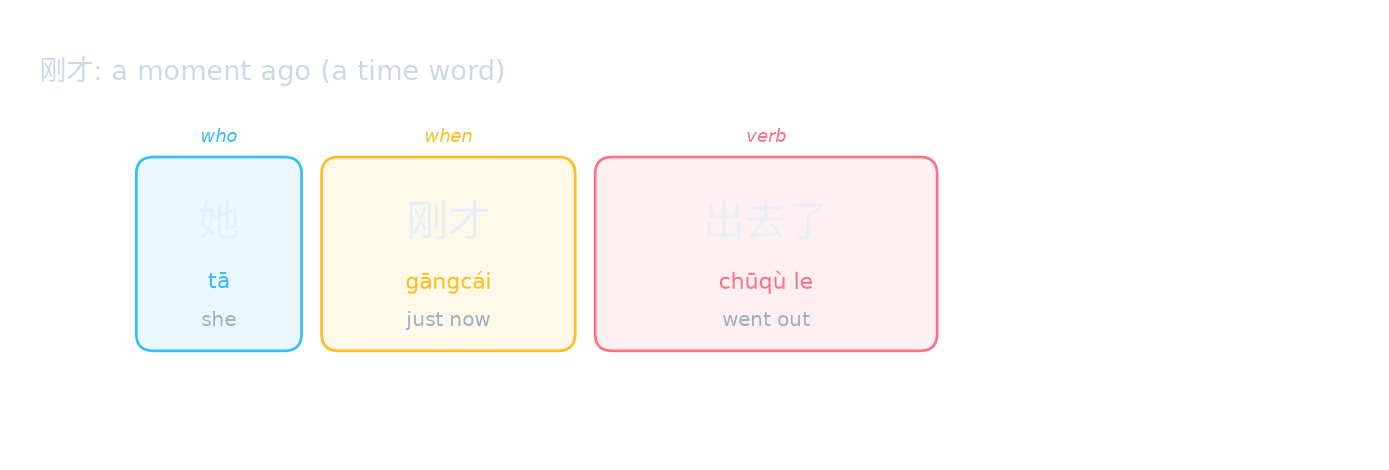
- she / her她just now刚才to go out出去(completed / change)了。 Tā gāngcái chūqu le. – She went out a moment ago.
- just now刚才someone有人to / for / give给you你to make a telephone call打电话。 – Someone called you just now.
- just now刚才degree / adjective linker很hot热,now现在many好多(completed / change)了。 – It was hot a moment ago; it's much better now.
How it works. The two words look alike but do different jobs.
| just now刚 gāng | just now刚才 gāngcái |
|---|---|
| adverb: right before the verb | time word, like yesterday昨天 |
| cannot start the sentence | can start the sentence |
| "just": can stretch (just now刚to come来Beijing北京一个月) | only a few minutes ago |
| usually no (completed / change)了: 我刚to / arrive / (result: get)到 | (completed / change)了 as normal: he / him他just now刚才to walk / to leave走(completed / change)了 |
| actions only | also states and negatives: just now刚才degree / adjective linker很busy忙 |
Watch out
- wrong: just now刚I / me我to have a meal吃饭 → 我刚to have a meal吃饭 or just now刚才I / me我to have a meal吃饭(completed / change)了.
- wrong: just now刚degree / adjective linker很hot热 → just now刚才degree / adjective linker很hot热.
a little有点 vs a bit一点 (a bit too… vs a little …er)
Form: a little有点(child儿) + adjective · adjective + a bit一点(child儿)
- 这双鞋a little有点small小,有大a bit一点(modifier / structural particle)的(yes/no ?)吗? Zhè shuāng xié yǒudiǎn xiǎo, yǒu dà yìdiǎn de ma? – These shoes are a bit small; do you have a slightly bigger pair?
- this这个a little有点expensive贵,can / be able to能cheap便宜a bit一点(yes/no ?)吗? – It's a bit expensive; could you make it a little cheaper?
- you你to speak说(degree marker)得a little有点fast; soon快,please; to invite请to speak说slow慢a bit一点。 – You speak a bit fast; please speak a little more slowly.
How it works. A natural pattern is to complain with a little有点, then ask for a change with a bit一点.
| a little有点 + adjective | adjective + a bit一点 |
|---|---|
| "a bit (too) …": a complaint | "a little more …": compare or request |
| a little有点expensive贵, 有点累, a little有点not不comfortable舒服 | cheap便宜a bit一点, fast; soon快a bit一点, big大a bit一点(modifier / structural particle)的 |
a bit一点 before a noun means "a little of": a bit一点water水.
Watch out
- wrong: expensive贵a little有点 → a little有点expensive贵; wrong: a bit一点cheap便宜 → cheap便宜a bit一点.
- a little有点 + a pleasant word sounds odd: wrong: she / her她a little有点pretty漂亮 → she / her她很漂亮.

again / then / (再…也) however再 vs again又 (again: future vs past)
Form: again又 + verb + (completed / change)了 (again, done) · again / then / (再…也) however再 + verb (again, still to come)
- I / me我this year今年again又to go去(completed / change)了the Great Wall长城,next year明年still / also / even还want / think / miss想again / then / (再…也) however再to go去。 Wǒ jīnnián yòu qùle Chángchéng, míngnián hái xiǎng zài qù. – I went to the Great Wall again this year, and I want to go again next year.
- please; to invite请talk later / besides再说one time (all the way…一遍。 Qǐng zài shuō yí biàn. – Please say it again.
- to welcome欢迎you你next time下次again / then / (再…也) however再to come来! – Come again next time!
- he / him他last week上个星期again又to catch cold感冒(completed / change)了,doctor医生to speak说next month下个月again / then / (再…也) however再to come来to check检查。 – He caught a cold again last week; the doctor said to come back for a check next month.
How it works.
| again又 yòu | again / then / (再…也) however再 zài |
|---|---|
| a repeat that has happened | a repeat still to come |
| he / him他again又to arrive late迟到(completed / change)了 | tomorrow明天again / then / (再…也) however再to come来 |
| also a certain repeat: tomorrow明天again又to be / is是weekend周末(completed / change)了! | plans, requests, suggestions |
again / then / (再…也) however再 can also mean "then, later": we / us我们tomorrow明天again / then / (再…也) however再to discuss讨论(suggestion)吧. still / also / even还want / think / miss想again / then / (再…也) however再 shows a wish to repeat: I / me我still / also / even还want / think / miss想again / then / (再…也) however再to eat吃一碗.
Watch out
- wrong: he / him他yesterday昨天again / then / (再…也) however再to come来(completed / change)了 → he / him他yesterday昨天again又to come来(completed / change)了.
- For a plan or request: wrong: tomorrow明天again又to come来 → tomorrow明天again / then / (再…也) however再to come来.

Practice without the models
Cover the teaching sections before you answer. The answers follow.
only then / not until才 vs then / just就 (late vs early)
1. The train was due at ten but arrived at eleven. train火车十一点…………to / arrive / (result: get)到。
2. Build: “He got up as early as six.”
Put in order: he / him他 / then / just就 / to get up起床(completed / change)了。 / 六点
3. Class starts at 8:00. Your classmate, usually late, arrived at 7:30 today. What do you say?
- A. he / him他today今天only then / not until才七点半到(completed / change)了。
- B. he / him他today今天七点half半then / just就to / arrive / (result: get)到。
- C. he / him他today今天七点半才to / arrive / (result: get)到。
- D. he / him他today今天七点half半then / just就to / arrive / (result: get)到(completed / change)了。
4. “I asked three times before he agreed.” Which word fits? I / me我to ask问(completed / change)了three times三次he / him他____to agree同意。
- A. all / both都
- B. only then / not until才
- C. then / just就
- D. also也
5. Match each sentence to its meaning.
-
(1) she / her她十七岁then / just就up / on / last; to get on, attend上university大学(completed / change)了。
-
(2) he / him他三十五岁talent and learning才学to drive a car开车。
-
(3) he / him他to look at; to watch; to read看(completed / change)了one time (all the way…一遍then / just就to understand懂(completed / change)了。
-
(4) I / me我to look at; to watch; to read看(completed / change)了三遍only then / not until才to understand懂。
-
A. He didn't learn to drive until thirty-five.
-
B. She went to university at only seventeen.
-
C. I only understood after three readings.
-
D. He understood after one reading.
6. True or false? he / him他十点only then / not until才to get up起床(completed / change)了 is the normal way to say “He didn't get up until ten.” If false, correct it.
7. The meeting starts at nine. Li arrived at 8:30; Wang strolled in at 9:30. Use only then / not until才 or then / just就. Write your answer in Chinese, then say it aloud.
just now刚 vs just now刚才 (just now: adverb vs time-word)
8. Complete: “What did you say just now?” …………you你to speak说what什么?
9. Which sentence is correct?
- A. just now刚I / me我to / arrive / (result: get)到home / family / (measure: shops)家。
- B. I / me我to / arrive / (result: get)到家刚。
- C. 我刚to / arrive / (result: get)到home / family / (measure: shops)家。
- D. just now刚degree / adjective linker很cold冷。
10. True or false? just now刚才degree / adjective linker很busy忙 is correct, but just now刚degree / adjective linker很busy忙 is not. If false, correct it.
11. Build: “Someone called you just now.”
Put in order: just now刚才 / to / for / give给you你 / someone有人 / to make a telephone call打电话。
12. You knock on your friend's door; her roommate says she left a few minutes ago. Use just now刚 or just now刚才. Write your answer in Chinese, then say it aloud.
a little有点 vs a bit一点 (a bit too… vs a little …er)
13. Complain: “The soup is a bit salty.” soup汤…………salty咸。
14. Ask for change: “Could you walk a little faster?”
- A. you你can / be able to能a bit一点fast; soon快to walk / to leave走(yes/no ?)吗?
- B. you你can / be able to能to walk / to leave走a little有点fast; soon快(yes/no ?)吗?
- C. you你can / be able to能to walk / to leave走fast; soon快a bit一点(yes/no ?)吗?
- D. you你can / be able to能a little有点fast; soon快to walk / to leave走(yes/no ?)吗?
15. Build: “It's a bit expensive; can you make it a little cheaper?”
Put in order: can / be able to能cheap便宜 / a bit一点(yes/no ?)吗? / this这个a little有点expensive贵 / ,
16. True or false? she / her她a little有点pretty漂亮 is a natural compliment. If false, correct it.
17. The shoes fit badly and you want to ask for another size. Use a little有点 or a bit一点. Write your answer in Chinese, then say it aloud.
again / then / (再…也) however再 vs again又 (again: future vs past)
18. Ask politely: “Please try again.” please; to invite请…………to try试once / one time一次。
19. Build: “Don't forget your keys again!”
Put in order: again / then / (再…也) however再 / to forget忘(completed / change)了 / to bring带key钥匙! / don't别
20. You look out of the window, annoyed: “It's raining again!” …………to rain下雨(completed / change)了!
21. Build: “Come again next time!”
Put in order: next time下次 / again / then / (再…也) however再 / to welcome欢迎you你 / to come来!
22. What does we / us我们吃了饭again / then / (再…也) however再to walk / to leave走 mean?
- A. We ate and left again.
- B. Let's eat first, then go.
- C. We will eat again before we go.
- D. We left without eating.
23. True or false? tomorrow明天again又to be / is是Friday星期五(completed / change)了 is correct. If false, correct it.
24. Fill both gaps: he / him他last week上个星期__to catch cold感冒(completed / change)了,doctor医生to speak说next month下个月__to come来to check检查。
- A. again / then / (再…也) however再 … again / then / (再…也) however再
- B. again又 … again又
- C. again / then / (再…也) however再 … again又
- D. again又 … again / then / (再…也) however再
25. You visited the Great Wall last year. This year you went again, and next year you want to go once more. Use again / then / (再…也) however再 or again又. Write your answer in Chinese, then say it aloud.
Answers and explanations
only then / not until才 vs then / just就 (late vs early)
1. only then / not until才
Eleven is later than the expected ten, so only then / not until才 (and no (completed / change)了).
2. he / him他六点then / just就to get up起床(completed / change)了。
Time + then / just就 + verb + (completed / change)了.
3. D. he / him他today今天七点half半then / just就to / arrive / (result: get)到(completed / change)了。
Earlier than expected → then / just就 … (completed / change)了.
4. B. only then / not until才
Three requests means more effort than expected, so only then / not until才.
5. (1) B: she / her她十七岁then / just就up / on / last; to get on, attend上university大学(completed / change)了。 = She went to university at only seventeen.; (2) A: he / him他三十五岁talent and learning才学to drive a car开车。 = He didn't learn to drive until thirty-five.; (3) D: he / him他to look at; to watch; to read看(completed / change)了one time (all the way…一遍then / just就to understand懂(completed / change)了。 = He understood after one reading.; (4) C: I / me我to look at; to watch; to read看(completed / change)了三遍only then / not until才to understand懂。 = I only understood after three readings.
then / just就 = early / easy; only then / not until才 = late / hard.
6. False.
In this simple sentence only then / not until才 takes no (completed / change)了: he / him他十点only then / not until才to get up起床。
7. Model answer: 小李八点半then / just就to / arrive / (result: get)到(completed / change)了,小王九点半only then / not until才to / arrive / (result: get)到。
Check your answer:
- I can explain that then / just就 / only then / not until才 show the speaker's expectation, not only the time.
- My then / just就 sentence ends with (completed / change)了; my only then / not until才 sentence has no (completed / change)了.
- then / just就 and only then / not until才 stand after the time word and before the verb.
just now刚 vs just now刚才 (just now: adverb vs time-word)
8. just now刚才
Only the time word just now刚才 can start the sentence.
9. C. 我刚to / arrive / (result: get)到home / family / (measure: shops)家。
just now刚 stands right before the verb; it cannot start the sentence, and it is not used for a past state like degree / adjective linker很busy忙.
10. True.
just now刚才 can describe a state a moment ago; just now刚 usually goes before a verb and is not used for a past state like degree / adjective linker很busy忙.
11. just now刚才someone有人to / for / give给you你to make a telephone call打电话。
just now刚才 + someone有人 + to / for / give给 + person + to make a telephone call打电话.
12. Model answer: she / her她just now刚才to go out出去(completed / change)了。
Check your answer:
- just now刚 never starts the sentence: 我刚to have a meal吃饭, not just now刚I / me我to have a meal吃饭. just now刚才 may come first: just now刚才I / me我to have a meal吃饭(completed / change)了.
- just now刚 + verb usually has no (completed / change)了: 我刚to / arrive / (result: get)到. just now刚才 sentences take (completed / change)了 normally: he / him他just now刚才to walk / to leave走(completed / change)了.
a little有点 vs a bit一点 (a bit too… vs a little …er)
13. a little有点
a little有点 + Adj for something slightly unwelcome.
14. C. you你can / be able to能to walk / to leave走fast; soon快a bit一点(yes/no ?)吗?
Verb + Adj + a bit一点 asks for “a little more …”.
15. this这个a little有点expensive贵,can / be able to能cheap便宜a bit一点(yes/no ?)吗?
a little有点 + Adj (complaint), then Adj + a bit一点 (request).
16. False.
a little有点 usually goes with unwelcome qualities. Say she / her她很漂亮.
17. Model answer: 这双鞋a little有点small小,有大a bit一点(modifier / structural particle)的(yes/no ?)吗?
Check your answer:
- a little有点 goes before the adjective: a little有点expensive贵, not expensive贵a little有点.
- a bit一点 goes after the adjective: cheap便宜a bit一点, not a bit一点cheap便宜 (a bit一点 before a noun means "a little of": a bit一点water水).
again / then / (再…也) however再 vs again又 (again: future vs past)
18. again / then / (再…也) however再
A request for a future repeat takes again / then / (再…也) however再.
19. don't别again / then / (再…也) however再to forget忘(completed / change)了to bring带key钥匙!
A warning about the future: don't别 + again / then / (再…也) however再 + verb.
20. again又
It has already started again, and you are tired of it: again又 … (completed / change)了.
21. to welcome欢迎you你next time下次again / then / (再…也) however再to come来!
Time word + again / then / (再…也) however再 + verb for a future repeat.
22. B. Let's eat first, then go.
Here again / then / (再…也) however再 means "then, after that", not "again".
23. True.
again又 can look ahead for a repeat that is certain to come.
24. D. again又 … again / then / (再…也) however再
The cold already came back (again又); the check-up is still to come (again / then / (再…也) however再).
25. Model answer: I / me我this year今年again又to go去(completed / change)了the Great Wall长城,next year明年still / also / even还want / think / miss想again / then / (再…也) however再to go去。
Check your answer:
- Past repetition: again又, not again / then / (再…也) however再: he / him他yesterday昨天again又to come来(completed / change)了, not he / him他yesterday昨天again / then / (再…也) however再to come来(completed / change)了.
- Future plan or request: again / then / (再…也) however再, not again又: tomorrow明天again / then / (再…也) however再to come来, not tomorrow明天again又to come来 (unless it is a predictable repeat).