Direction complement to come来 / to go去 (toward / away)
Form: verb + to come来 / to go去 · verb + place + to come来 / to go去
- 请进来! Qǐng jìnlai! – Please come in!
- he / him他to go out出去(completed / change)了。 Tā chūqu le. – He's gone out.
- fast-forward (media player)快进classroom教室to come来! – Come into the classroom, quick!
- please; to invite请(把: marks the object)把book书to bring拿来。 – Please bring the book here.
How it works. to come来 means movement towards the speaker; to go去 means away from the speaker. They combine with direction verbs.
| Towards the speaker | Away from the speaker |
|---|---|
| to come in进来, come out / (result: see, think up)出来, to come up上来, come down / (write down, stop)下来 | to go in进去, to go out出去, to go up上去, go down / (keep on)下去 |
| to return回来, to come over过来 | to return回去, past过去 |
The speaker's position decides. If you are upstairs, your friend to come up上来 (comes up). If you are downstairs, your friend to go up上去 (goes up).
Places and things. A place goes between the verb and to come来 / to go去: to return home回家to go去, to enter; to come in进classroom教室to come来. A thing can go after: to bring带来(completed / change)了one / a一本书 / to bring带(completed / change)了one / a一本书to come来.
Watch out
- wrong: to come in进来classroom教室 → to enter; to come in进classroom教室to come来.

Potential complement (degree marker)得 / not不 (can / can't do it)
Form: verb + (degree marker)得 + result (can) · verb + not不 + result (can't)
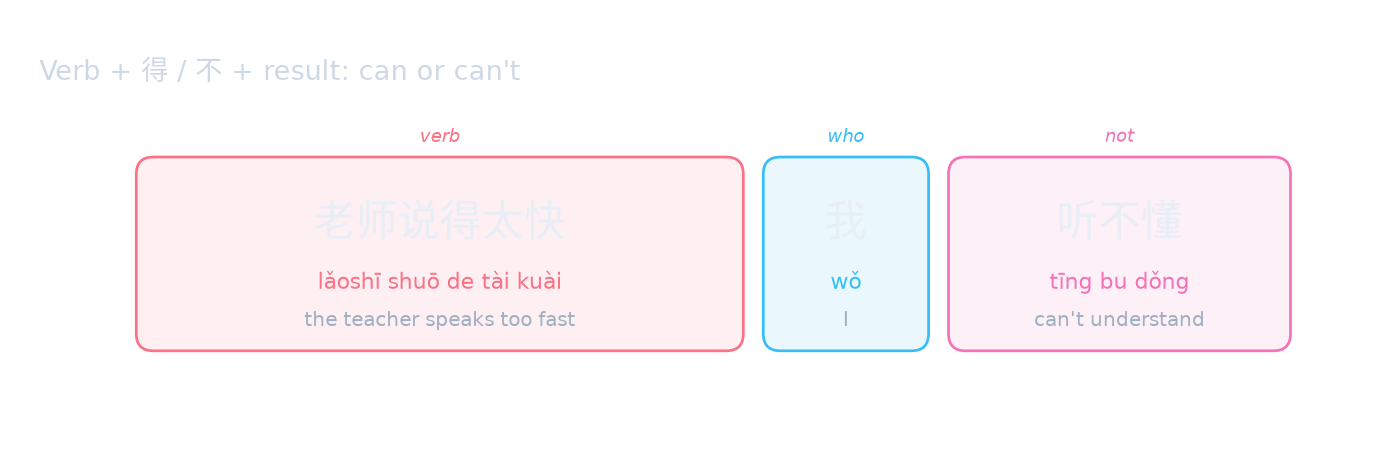
- teacher老师to speak说(degree marker)得太快,I / me我unable to make sense of…听不懂。 Lǎoshī shuō de tài kuài, wǒ tīng bu dǒng. – The teacher talks too fast; I can't understand.
- Chinese character字太小(completed / change)了,I / me我看不清楚。 Zì tài xiǎo le, wǒ kàn bu qīngchu. – The writing is too small; I can't see it clearly.
- so much这么多菜,we / us我们吃不完。 – With this much food, we can't finish it.
- you你to understand (by hearing)听得懂(yes/no ?)吗? – Can you understand?
How it works. (degree marker)得 or not不 between a verb and its result says whether the result is possible. It is about ability or circumstances, not permission.
| Can | Can't | Meaning |
|---|---|---|
| to understand (by hearing)听得懂 | unable to make sense of…听不懂 | (can't) understand by listening |
| can see看得见 | cannot see看不见 | (can't) see |
| to buy买to get得到 | 买不到 | (can't) get hold of |
| 吃得完 | 吃不完 | (can't) finish eating |
| to have enough time来得及 | there's not enough time来不及 | there is (no) time |
Questions. you你to understand (by hearing)听得懂(yes/no ?)吗? or you你to understand (by hearing)听得懂unable to make sense of…听不懂?
Watch out
- wrong: not不to understand (on hearing)听懂 → unable to make sense of…听不懂: not不 goes between the verb and the result.
- unable to make sense of…听不懂 = can't understand (it is beyond me); not / haven't没to understand (on hearing)听懂 = didn't understand this time: I / me我not / haven't没to understand (on hearing)听懂,please; to invite请talk later / besides再说one time (all the way…一遍.
Verb + go down / (keep on)下去 (keep …-ing)
Form: verb + go down / (keep on)下去 (keep going) · verb + not不go down / (keep on)下去 (can't go on)
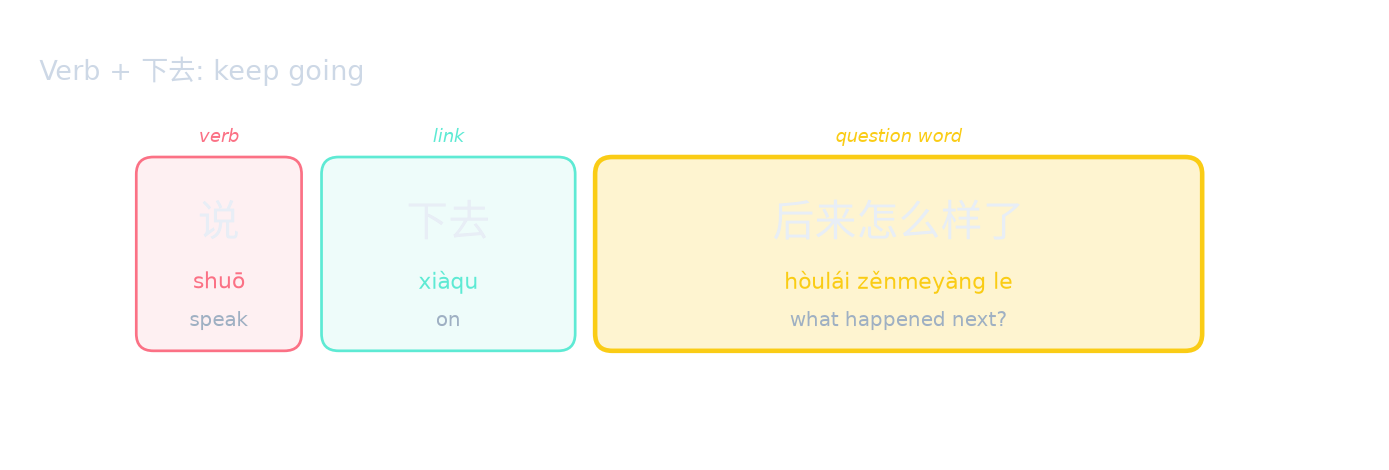
- to speak说go down / (keep on)下去,later; afterwards后来how about怎么样(completed / change)了? Shuō xiaqu, hòulái zěnmeyàng le? – Keep going: what happened next?
- to learn学Chinese language中文not不easy容易,but但是you你want / will / need要to press on坚持下去。 – Learning Chinese isn't easy, but you must keep going.
- this way / so这样go down / (keep on)下去won't do不行。 Zhèyàng xiaqu bù xíng. – It can't go on like this.
- I / me我to listen to听not不go down / (keep on)下去(completed / change)了。 – I can't bear to listen any more.
How it works. After a verb, go down / (keep on)下去 means "continue from now on". It is not about moving down: to read (aloud); to study读go down / (keep on)下去 = keep reading. It often comes with to continue继续, want / will / need要, want / think / miss想 or can / be able to能: I / me我want / think / miss想at / in在here这儿to live (somewhere)住go down / (keep on)下去.
| go down / (keep on)下去 | get up / (start, become)起来 |
|---|---|
| continues something already going | starts something new |
| to sing唱go down / (keep on)下去 (keep singing) | 唱起来 (start singing) |
| to press on坚持下去 | everyone大家all / both都to laugh笑get up / (start, become)起来(completed / change)了 |
Watch out
- When everyone suddenly starts laughing, it is to laugh笑get up / (start, become)起来, not to laugh笑go down / (keep on)下去.
Result complements to finish完 / good好 / wrong; mistake错 / to see / meet见 / to understand懂 / to / arrive / (result: get)到 (how it turned out)
Form: verb + good好 / to finish完 / wrong; mistake错 (+ (completed / change)了) · not / haven't没 + verb + result
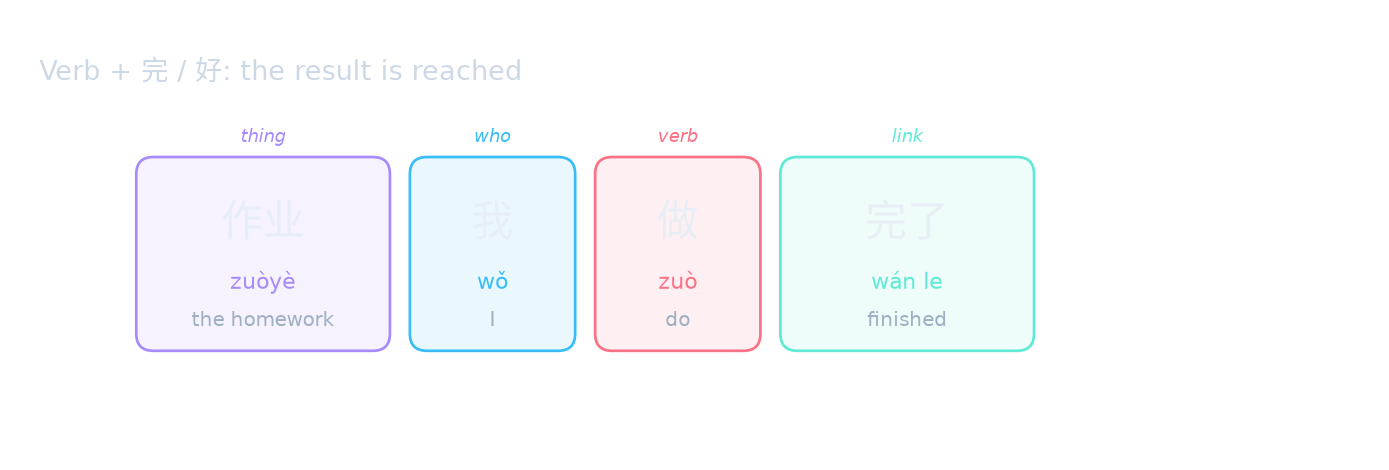
- school assignment作业I / me我to do; to make做to finish完(completed / change)了! Zuòyè wǒ zuòwán le! – I've finished my homework!
- cooked rice饭做好(completed / change)了,fast; soon快to come来to eat吃(suggestion)吧! Fàn zuòhǎo le, kuài lái chī ba! – Dinner's ready, come and eat!
- I'm sorry对不起,I / me我to err打错telephone电话(completed / change)了。 – Sorry, I dialled the wrong number.
- this这本书I / me我still / also / even还not / haven't没to look at; to watch; to read看to finish完。 – I haven't finished reading this book yet.
How it works. A result word after the verb tells how the action ended. (completed / change)了 normally follows the pair.
| Result | Meaning | Example |
|---|---|---|
| to finish完 | finished, nothing left | to eat吃to finish完(completed / change)了 |
| good好 | done properly, ready | to prepare; to plan to准备好了吗? |
| wrong; mistake错 | done wrongly | 写错(completed / change)了, to misinterpret what one…看错(completed / change)了 |
to do; to make做to finish完 says the job is over (maybe badly); 做好 says it is done well and ready.
Watch out
- Negate with not / haven't没 and drop (completed / change)了: wrong: I / me我not不to do; to make做to finish完(completed / change)了 → I / me我still / also / even还not / haven't没to do; to make做to finish完.
- Nothing comes between the verb and its result: wrong: 做作业to finish完 → 做完作业.
Practice without the models
Cover the teaching sections before you answer. The answers follow.
Direction complement to come来 / to go去 (toward / away)
1. You are inside the room and call to your friend at the door: “Come in!” to enter; to come in进…………!
2. Build: “Come into the classroom, quick!”
Put in order: fast; soon快 / to come来! / classroom教室 / to enter; to come in进
3. You are in the classroom. A student runs in. Which sentence fits?
- A. 一个student学生进跑to come来(completed / change)了。
- B. 一个student学生to run跑to come来to enter; to come in进(completed / change)了。
- C. 一个student学生to run跑to come in进来(completed / change)了。
- D. 一个student学生to run跑to go in进去(completed / change)了。
4. You are on the ground floor talking about your friend upstairs: “He went up.” Which fits?
- A. 他来up / on / last; to get on, attend上(completed / change)了。
- B. he / him他to go up上去(completed / change)了。
- C. he / him他to come up上来(completed / change)了。
- D. he / him他to go去up / on / last; to get on, attend上(completed / change)了。
5. True or false? he / him他to come in进来classroom教室(completed / change)了 is correct. If false, correct it.
6. A friend knocks at your door; later your little brother runs off to play outside. Use Direction complement to come来 / to go去. Write your answer in Chinese, then say it aloud.
Potential complement (degree marker)得 / not不 (can / can't do it)
7. The words on the board are too small: “I can't see clearly.” I / me我to look at; to watch; to read看…………distinct清楚。
8. Match each form to its meaning.
-
(1) to look for; to give change找not reach / less than不到
-
(2) to do; to make做(degree marker)得to finish完
-
(3) unable to make sense of…听不懂
-
(4) can see看得见
-
A. can't understand
-
B. can finish
-
C. can't find
-
D. can see
9. You forgot your key: “I can't get in.” 我进…………to go去。
10. The museum guard says photos are not allowed. Which fits?
- A. here这里cannot不能拍照片。
- B. here这里to pat; to take (a photo)拍to get得到photograph照片。
- C. here这里to pat; to take (a photo)拍not see / missing不见photograph照片。
- D. here这里not不to pat; to take (a photo)拍(degree marker)得photograph照片。
11. Build: “I can't understand what he says.”
Put in order: I / me我 / he / him他to speak说if (coming after a…的话。 / unable to make sense of…听不懂
12. You missed one word your friend just said. What do you say?
- A. I'm sorry对不起,I / me我unable to make sense of…听不懂,please; to invite请talk later / besides再说one time (all the way…一遍。
- B. I'm sorry对不起,I / me我to understand (on hearing)听懂not不,please; to invite请talk later / besides再说one time (all the way…一遍。
- C. I'm sorry对不起,I / me我not不to understand (on hearing)听懂,please; to invite请talk later / besides再说one time (all the way…一遍。
- D. I'm sorry对不起,I / me我not / haven't没to understand (on hearing)听懂,please; to invite请talk later / besides再说one time (all the way…一遍。
13. True or false? I / me我to listen to听he / him他if (coming after a…的话not不to understand懂 is correct. If false, correct it.
14. Your teacher speaks quickly at the start of a new course, and your friend wonders if you follow. Use Potential complement (degree marker)得 / not不. Write your answer in Chinese, then say it aloud.
Verb + go down / (keep on)下去 (keep …-ing)
15. Encourage: “Keep reading!” to read (aloud); to study读…………!
16. Everyone suddenly started laughing. Which fits? everyone大家all / both都to laugh笑____(completed / change)了。
- A. past过去
- B. go down / (keep on)下去
- C. to go up上去
- D. get up / (start, become)起来
17. Build: “It can't go on like this.”
Put in order: go down / (keep on)下去 / won't do不行。 / this way / so这样
18. True or false? In to speak说go down / (keep on)下去, go down / (keep on)下去 means the speaker walks downstairs. If false, correct it.
19. Match each sentence to its meaning.
-
(1) you你seemingly看起来很累。
-
(2) this这个idea; plan主意to listen to听get up / (start, become)起来degree / adjective linker很good好。
-
(3) I / me我want / think / miss想get up / (start, become)起来he / him他(modifier / structural particle)的name名字(completed / change)了。
-
(4) you你to speak说go down / (keep on)下去(suggestion)吧。
-
A. This idea sounds good.
-
B. I have remembered his name.
-
C. Go on, keep talking.
-
D. You look tired.
20. You are halfway through a story and your listener is hooked. Use Verb + go down / (keep on)下去. Write your answer in Chinese, then say it aloud.
Result complements to finish完 / good好 / wrong; mistake错 / to see / meet见 / to understand懂 / to / arrive / (result: get)到 (how it turned out)
21. True or false? I / me我to look for; to give change找(completed / change)了I / me我(modifier / structural particle)的key钥匙 tells you that I found my keys. If false, correct it.
22. Complete: “I've eaten up all the dumplings.” dumpling饺子I / me我all / both都to eat吃…………(completed / change)了。
23. Match each phrase to its meaning.
-
(1) to understand (on hearing)听懂(completed / change)了
-
(2) to see看见(completed / change)了
-
(3) to buy买to / arrive / (result: get)到(completed / change)了
-
(4) 写错(completed / change)了
-
A. understood it
-
B. wrote it wrongly
-
C. managed to buy it
-
D. saw it
24. Your essay is not perfect, but you have written the last sentence. Which fits best?
- A. I / me我(modifier / structural particle)的essay; to write an essay作文not / haven't没to write写to finish完。
- B. I / me我(modifier / structural particle)的essay; to write an essay作文to write写to finish完(completed / change)了,but但是not so good不太好。
- C. I / me我(modifier / structural particle)的essay; to write an essay作文写错(completed / change)了。
- D. I / me我(modifier / structural particle)的essay; to write an essay作文to write写good好(completed / change)了,can / may可以交了。
25. Which says “I haven't finished reading this book yet.”?
- A. this这本书I / me我still / also / even还not / haven't没to look at; to watch; to read看to finish完。
- B. this这本书I / me我still / also / even还to look at; to watch; to read看没完。
- C. this这本书I / me我still / also / even还not / haven't没to look at; to watch; to read看to finish完(completed / change)了。
- D. this这本书I / me我still / also / even还not不to look at; to watch; to read看to finish完(completed / change)了。
26. Build: “Are you ready?”
Put in order: to prepare; to plan to准备good好 / (completed / change)了 / (yes/no ?)吗? / you你
27. Which is correct?
- A. I / me我to finish完做作业(completed / change)了。
- B. I / me我做作业(completed / change)了to finish完。
- C. I / me我做作业to finish完(completed / change)了。
- D. I / me我做完作业(completed / change)了。
28. Your mum asks about your homework before you go out to play. Use Result complements to finish完 / good好 / wrong; mistake错 / to see / meet见 / to understand懂 / to / arrive / (result: get)到. Write your answer in Chinese, then say it aloud.
Answers and explanations
Direction complement to come来 / to go去 (toward / away)
1. to come来
Movement towards the speaker takes to come来.
2. fast-forward (media player)快进classroom教室to come来!
Verb + place + to come来.
3. C. 一个student学生to run跑to come in进来(completed / change)了。
How (to run跑) + which way (to enter; to come in进) + to come来, because the student comes towards you.
4. B. he / him他to go up上去(completed / change)了。
He moved away from you (upwards), so to go up上去.
5. False.
The place goes before to come来: 他进classroom教室to come来(completed / change)了.
6. Model answer: 请进来!
Check your answer:
- Choose by where the speaker is: you are upstairs → to come up上来 (come up); you are downstairs → to go up上去 (go up).
- A place word never comes after to come来/to go去: to enter; to come in进classroom教室to come来, not to come in进来classroom教室.
Potential complement (degree marker)得 / not不 (can / can't do it)
7. not不
Verb + not不 + result = can't. 看不清楚 = can't see clearly.
8. (1) C: to look for; to give change找not reach / less than不到 = can't find; (2) B: to do; to make做(degree marker)得to finish完 = can finish; (3) A: unable to make sense of…听不懂 = can't understand; (4) D: can see看得见 = can see
Verb + (degree marker)得/not不 + result says whether the result is possible.
9. not不
to go in进去 → 进不去 = can't get in.
10. A. here这里cannot不能拍照片。
A rule (not allowed) → cannot不能 + verb. Vnot不R is for a result you can't reach.
11. I / me我unable to make sense of…听不懂he / him他to speak说if (coming after a…的话。
The object follows the whole phrase unable to make sense of…听不懂.
12. D. I'm sorry对不起,I / me我not / haven't没to understand (on hearing)听懂,please; to invite请talk later / besides再说one time (all the way…一遍。
This time only → not / haven't没to understand (on hearing)听懂. unable to make sense of…听不懂 would mean you can't understand them at all.
13. False.
The object comes after the whole phrase: I / me我unable to make sense of…听不懂he / him他if (coming after a…的话。
14. Model answer: teacher老师to speak说(degree marker)得太快,I / me我unable to make sense of…听不懂。
Check your answer:
- not不 goes between the verb and the result: unable to make sense of…听不懂, not not不to understand (on hearing)听懂.
- Ask with both forms: you你to understand (by hearing)听得懂unable to make sense of…听不懂? or you你to understand (by hearing)听得懂(yes/no ?)吗?
Verb + go down / (keep on)下去 (keep …-ing)
15. go down / (keep on)下去
Verb + go down / (keep on)下去 = continue doing it.
16. D. get up / (start, become)起来
Starting a new action takes get up / (start, become)起来; go down / (keep on)下去 continues an action already going.
17. this way / so这样go down / (keep on)下去won't do不行。
this way / so这样go down / (keep on)下去 + won't do不行.
18. False.
Here go down / (keep on)下去 means “continue”.
19. (1) D: you你seemingly看起来很累。 = You look tired.; (2) A: this这个idea; plan主意to listen to听get up / (start, become)起来degree / adjective linker很good好。 = This idea sounds good.; (3) B: I / me我want / think / miss想get up / (start, become)起来he / him他(modifier / structural particle)的name名字(completed / change)了。 = I have remembered his name.; (4) C: you你to speak说go down / (keep on)下去(suggestion)吧。 = Go on, keep talking.
seemingly看起来 = looks, to listen to听get up / (start, become)起来 = sounds, want / think / miss想get up / (start, become)起来 = remember, go down / (keep on)下去 = keep on.
20. Model answer: to speak说go down / (keep on)下去,later; afterwards后来how about怎么样(completed / change)了?
Check your answer:
- In this pattern go down / (keep on)下去 means "continue", not physical movement down: to read (aloud); to study读go down / (keep on)下去 = keep reading.
- With not不 for "can't go on": I / me我to listen to听not不go down / (keep on)下去(completed / change)了 – "I can't bear to listen any more."
Result complements to finish完 / good好 / wrong; mistake错 / to see / meet见 / to understand懂 / to / arrive / (result: get)到 (how it turned out)
21. False.
to look for; to give change找 is only the action (look for). Found = to find找到: I / me我to find找到(completed / change)了I / me我(modifier / structural particle)的key钥匙。
22. to finish完
to eat吃to finish完 = eaten up, finished.
23. (1) A: to understand (on hearing)听懂(completed / change)了 = understood it; (2) D: to see看见(completed / change)了 = saw it; (3) C: to buy买to / arrive / (result: get)到(completed / change)了 = managed to buy it; (4) B: 写错(completed / change)了 = wrote it wrongly
The result word tells how the action ended.
24. B. I / me我(modifier / structural particle)的essay; to write an essay作文to write写to finish完(completed / change)了,but但是not so good不太好。
to finish完 = finished, nothing left, even if it is not good. to write写good好 would mean done properly.
25. A. this这本书I / me我still / also / even还not / haven't没to look at; to watch; to read看to finish完。
not / haven't没 + verb + result, with no (completed / change)了.
26. you你to prepare; to plan to准备好了吗?
to prepare; to plan to准备 + good好 + (completed / change)了 + (yes/no ?)吗.
27. D. I / me我做完作业(completed / change)了。
The result follows the verb directly; the object comes after: 做完作业.
28. Model answer: school assignment作业I / me我to do; to make做to finish完(completed / change)了!
Check your answer:
- Negate with not / haven't没 and drop (completed / change)了: I / me我still / also / even还not / haven't没to do; to make做to finish完, not I / me我not不to do; to make做to finish完(completed / change)了.
- Nothing comes between the verb and its result: 做完作业, not 做作业to finish完.