English narration · English + 中文 subtitles burned in · 英語ナレーション・英語+中文字幕 burning-in
1.1
Measurement 测量 · 測定
Syllabus · シラバス
English
Core
Supplement
1 Describe the use of rulers and measuring cylinders to find a length or a volume
2 Describe how to measure a variety of time intervals using clocks and digital timers
3 Determine an average value for a small distance and for a short interval of time by measuring multiples (including the period of oscillation of a pendulum)
4 Understand that a scalar quantity has magnitude (size) only and that a vector quantity has magnitude and direction
5 Know that the following quantities are scalars: distance, speed, time, mass, energy and temperature
6 Know that the following quantities are vectors: force, weight, velocity, acceleration, momentum, electric field strength and gravitational field strength
7 Determine, by calculation or graphically, the resultant of two vectors at right angles, limited to forces or velocities only
日本語
コア
サプリメント
1 定規やメジャーシリンダーを使用して長さや体積を求める使い方を説明する
2 クロックやデジタルタイマーを用いて様々な時間間隔を測る方法を説明する
3 複数の測定(単振動の周期などを含む)によって短い距離および短い時間の平均値を求める
4 スカラー量 が大きさ(サイズ)のみを持ち、ベクトル量 が大きさと方向を持つことを理解する
5 以下の物理量がスカラー量であることを知る: 距離、速さ、時間、質量、エネルギー、温度
6 以下の物理量がベクトルであることを知る:力、重量、速度、加速度、運動量、電場強度、重力場強度
7 2つの垂直なベクトルの合成ベクトルを計算または図示によって求める。対象は力と速度に限定する
Source: Cambridge International syllabus · 出典: Cambridge International シラバス
English
Resolving a vector into components
Length and volume
Use a ruler 直尺 to measure length. Read the scale with your eye straight in front of the mark to avoid a reading error.
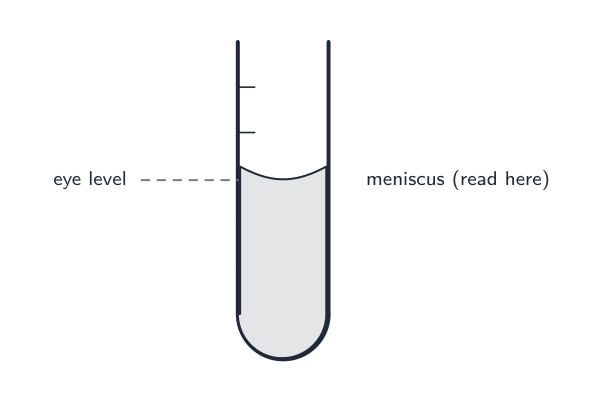
Use a measuring cylinder 量筒 to measure the volume of a liquid. Read the scale at the bottom of the curved surface (the meniscus 弯月面), with your eye level with it.
Measuring time
Use a stopwatch 秒表 or a digital timer 数字计时器 to measure a time interval. A clock is fine for long times (minutes or hours). A stopwatch is started and stopped by hand, so each reading has a reaction time 反应时间 error of about 0.2 s. To make this error matter less, time a long interval, or time many repeats and divide (see below).
Measuring small amounts
A single small length or a short time is hard to measure well. The trick is to measure many and divide 测多个再相除:
To find the thickness of one page, measure 100 pages and divide by 100.
To find the time for one swing of a pendulum 摆, measure the time for 20 swings and divide by 20. One full swing is called the period 周期.
This makes the uncertainty 不确定度 (the size of the error) much smaller.
Scalars and vectors
A scalar quantity 标量 has size (magnitude 大小) only. A vector quantity 矢量 has size and direction.
Scalars: distance, speed, time, mass 质量, energy 能量, temperature 温度.
Vectors: force 力, weight 重力, velocity 速度, acceleration 加速度, momentum 动量, electric field strength 电场强度, gravitational field strength 重力场强度.
To add two vectors at right angles (90°), draw them as two sides of a rectangle. The resultant 合矢量 is the diagonal. Find its size with Pythagoras and its direction with trigonometry.
1 Define speed as distance travelled per unit time; recall and use the equation
$$v = \frac{s}{t}$$
2 Define velocity as speed in a given direction
3 Recall and use the equation
$$\text{average speed} = \frac{\text{total distance travelled}}{\text{total time taken}}$$
9 Define acceleration as change in velocity per unit time; recall and use the equation
$$a = \frac{\Delta v}{\Delta t}$$
4 Sketch, plot and interpret distance–time and speed–time graphs
5 Determine, qualitatively, from given data or the shape of a distance–time graph or speed–time graph when an object is: (a) at rest (b) moving with constant speed (c) accelerating (d) decelerating
10 Determine from given data or the shape of a speed–time graph when an object is moving with: (a) constant acceleration (b) changing acceleration
6 Calculate speed from the gradient of a straight-line section of a distance–time graph
11 Calculate acceleration from the gradient of a speed–time graph
7 Calculate the area under a speed–time graph to determine the distance travelled for motion with constant speed or constant acceleration
12 Know that a deceleration is a negative acceleration and use this in calculations
8 State that the acceleration of free fall $g$ for an object near to the surface of the Earth is approximately constant and is approximately $9.8\text{ m/s}^2$
13 Describe the motion of objects falling in a uniform gravitational field with and without air/ liquid resistance, including reference to terminal velocity
日本語
コア
サプリメント
1 速さを単位時間あたりに移動した距離として定義し、式
$$v = \frac{s}{t}$$
を思い出し用いる
2 速度を特定の方向を持つ速さとして定義する
3 式
$$\text{average speed} = \frac{\text{total distance travelled}}{\text{total time taken}}$$
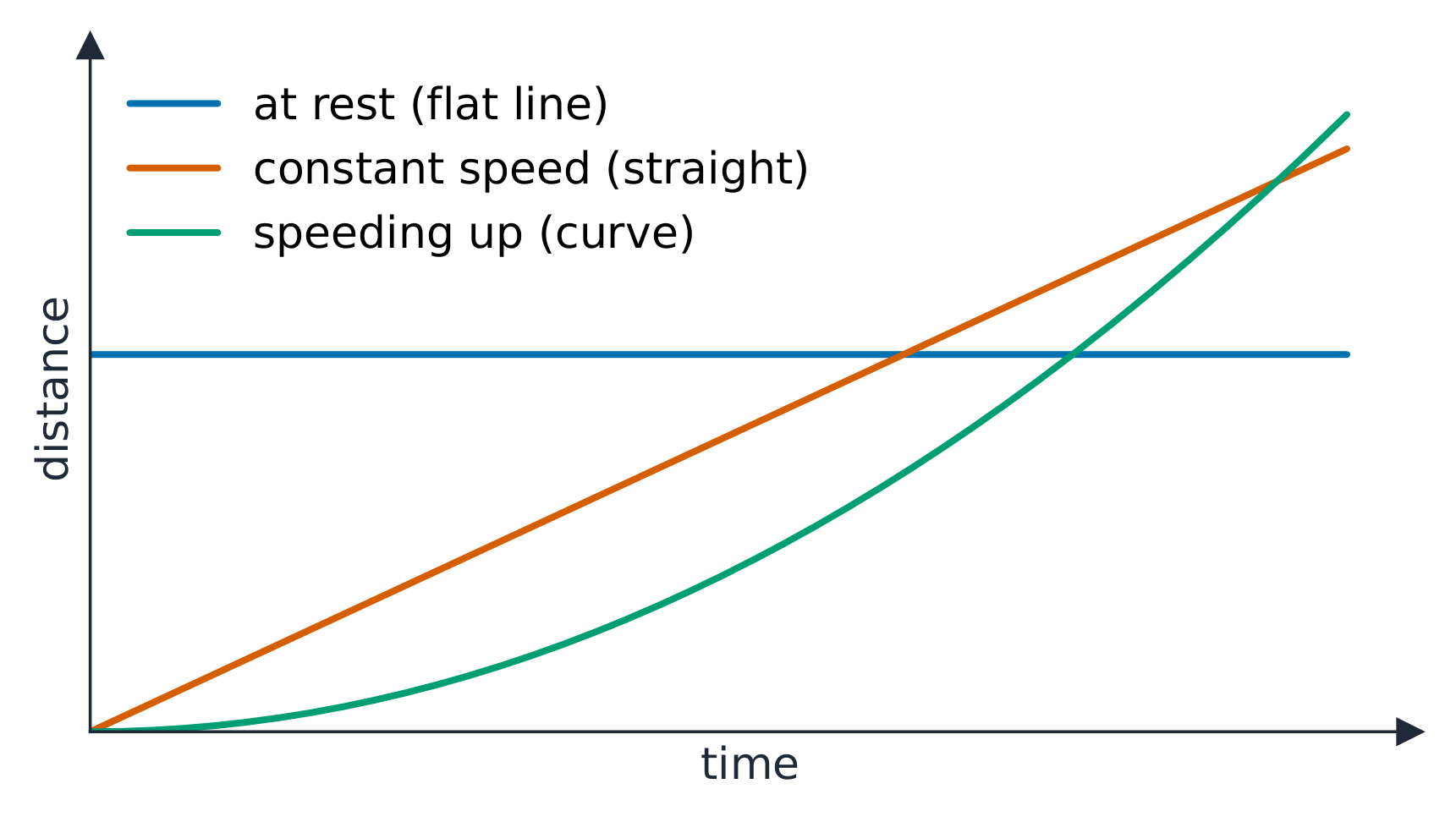
A distance–time graph 距离-时间图 shows how far an object has gone:
A flat (horizontal) line means the object is at rest 静止.
A straight slope means constant speed. The gradient 斜率 (steepness) is the speed.
A curve that gets steeper means the object is speeding up.
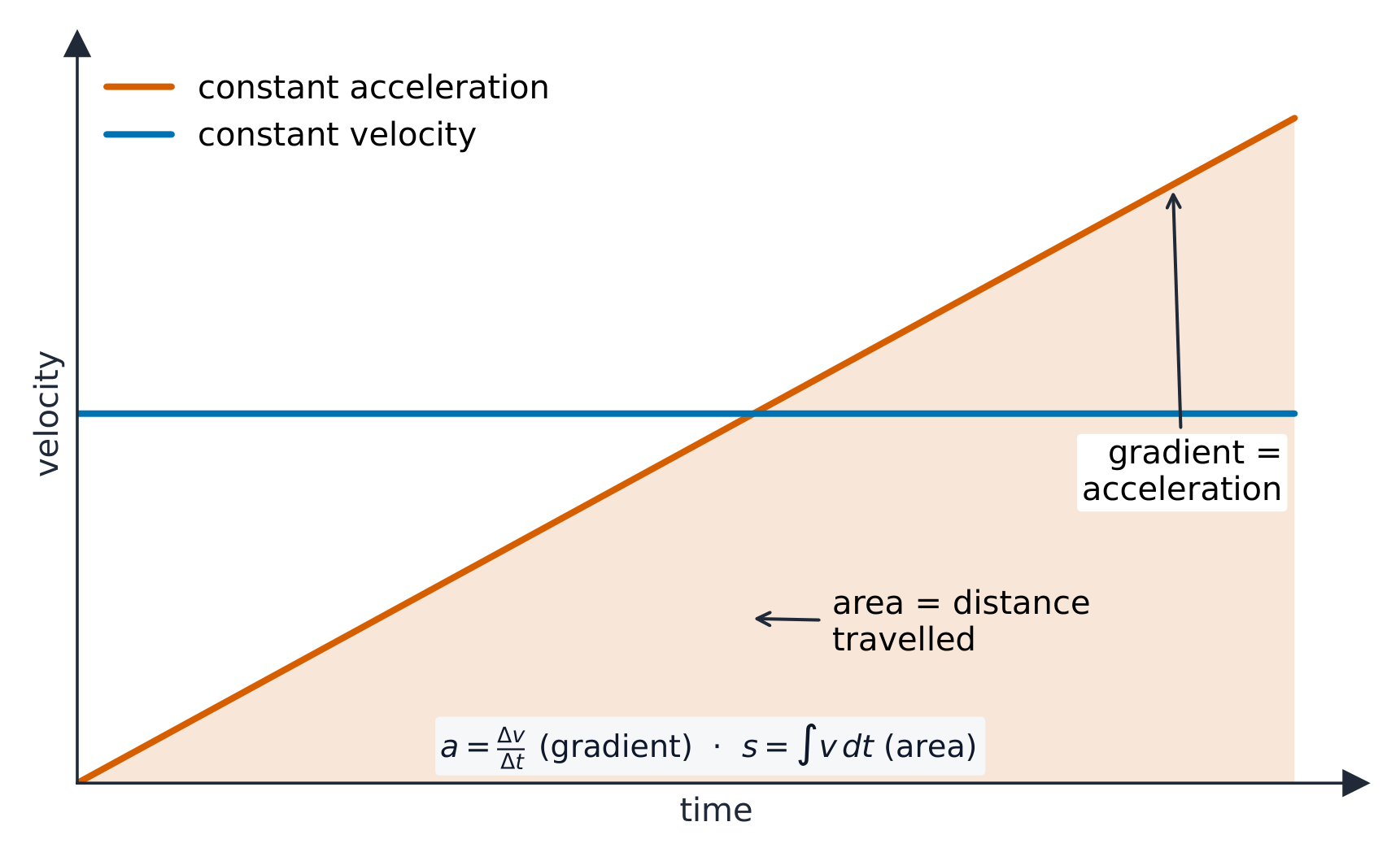
A speed–time graph 速度-时间图 shows how fast an object is going:
A flat line means constant speed.
A straight slope means constant acceleration. The gradient is the acceleration.
The area under the line 线下面积 is the distance travelled.
Falling objects
Near the Earth the gravitational field is uniform 均匀 (the same strength everywhere), so all objects speed up as they fall at the same rate. This is the acceleration of free fall 自由落体加速度, $g \approx 9.8\ \text{m/s}^2$.
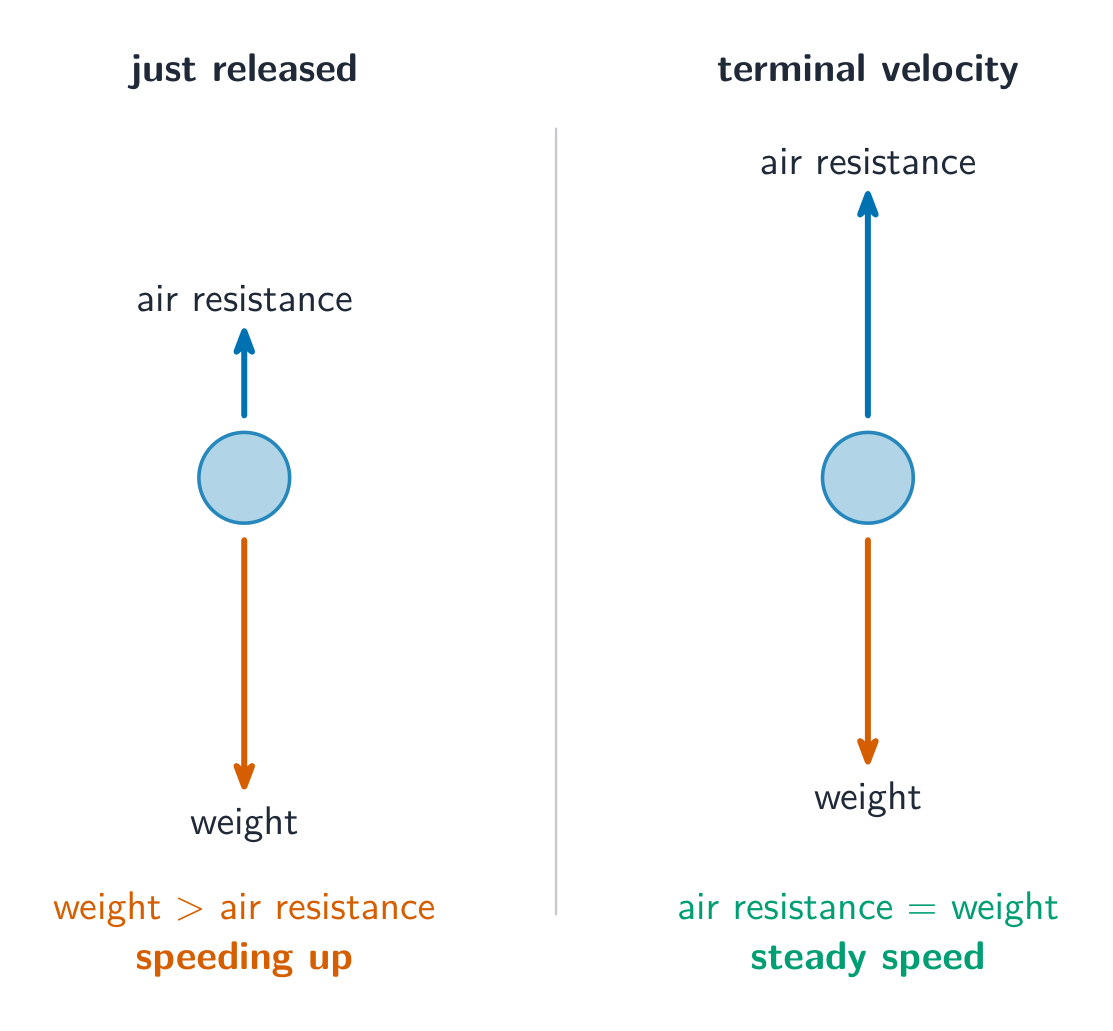
When an object falls through air, air resistance 空气阻力 (a drag force) acts upward. As it speeds up, air resistance grows. When air resistance equals the weight, the resultant force is zero and the object stops speeding up. It then falls at a steady terminal velocity 收尾速度.
acceleration of free fall/əkˌseləˈreɪʃn ɒv friː fɔːl/
自由落下加速度
air resistance/eə rɪˈzɪstəns/
空気抵抗によるもの
terminal velocity/ˈtɜːmɪnl vəˈlɒsɪti/
終末速度
matter/ˈmætə/
物質
1.3
Mass and weight · 質量と重さ
Syllabus · シラバス
English
Core
Supplement
1 State that mass is a measure of the quantity of matter in an object at rest relative to the observer
2 State that weight is a gravitational force on an object that has mass
5 Describe, and use the concept of, weight as the effect of a gravitational field on a mass
3 Define gravitational field strength as force per unit mass; recall and use the equation
$$g = \frac{W}{m}$$
and know that this is equivalent to the acceleration of free fall
4 Know that weights (and masses) may be compared using a balance
日本語
コア
サプリメント
1 質量が、観測者に対して静止している物体に含まれる物質の量を表す指標であることを述べる
2 重さが、質量を持つ物体に働く重力であることを述べる
5 重さを、重力場が質量に及ぼす効果として概念を用いて説明する
3 重力場強度を単位質量あたりの力として定義し、式
$$g = \frac{W}{m}$$
を思い出し用いること、およびこれが自由落下の加速度と等価であることを知る
4 重量(および質量)を天平を用いて比較できることを知る
Source: Cambridge International syllabus · 出典: Cambridge International シラバス
English
Mass is the amount of matter 物质 in an object. It is measured in kilograms (kg) and does not change when you move the object.
Weight is the force of gravity on a mass. It is measured in newtons (N). Weight can change: it is smaller on the Moon because the Moon's gravity is weaker.
Gravitational field strength is the force per unit mass:
$$g = \frac{W}{m}$$
This $g$ has the same value as the acceleration of free fall ($\approx 9.8\ \text{N/kg}$). You can compare masses with a balance 天平.
Weight is proportional to mass — the gradient is the gravitational field strength g (about 10 N/kg on Earth). · 重力は質量に比例する — 傾きは重力場強度 g (地球では約 10 N/kg)。
1 Define density as mass per unit volume; recall and use the equation
$$\rho = \frac{m}{V}$$
2 Describe how to determine the density of a liquid, of a regularly shaped solid and of an irregularly shaped solid which sinks in a liquid (volume by displacement), including appropriate calculations
3 Determine whether an object floats based on density data
4 Determine whether one liquid will float on another liquid based on density data given that the liquids do not mix
Source: Cambridge International syllabus · 出典: Cambridge International シラバス
English
Density is the mass per unit volume.
$$\rho = \frac{m}{V}$$
The symbol $\rho$ is the Greek letter "rho". The unit is $\text{kg/m}^3$ or $\text{g/cm}^3$.
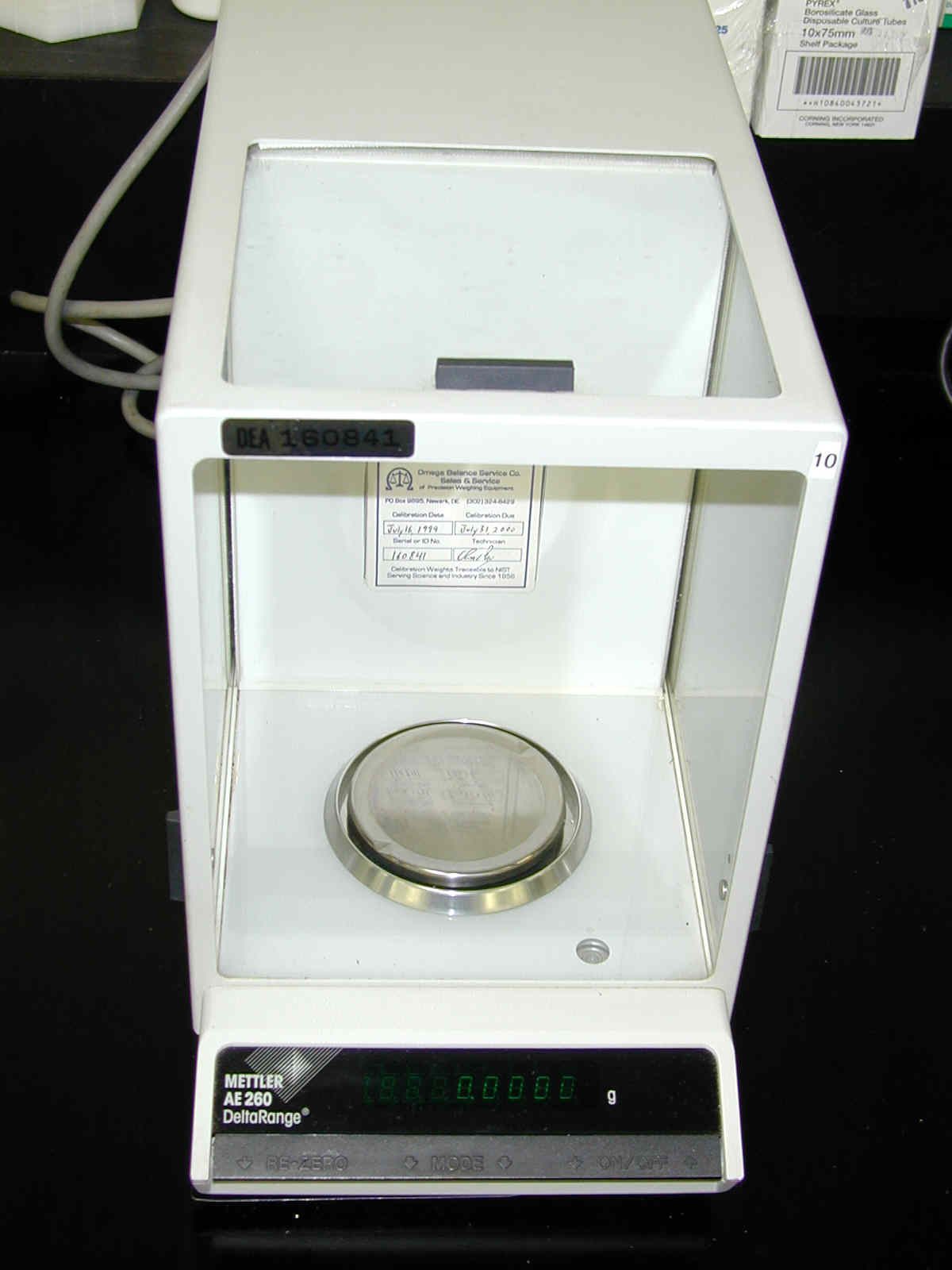
To find density: measure the mass with a balance, find the volume, then divide.
Regular solid 规则固体 (like a box): measure the sides and calculate the volume.
Irregular solid 不规则固体 (a strange shape): lower it into water in a measuring cylinder. The rise in water level is its volume. This is the displacement method 排水法.
Liquid: put an empty measuring cylinder on the balance and read its mass. Pour in the liquid, read the volume on the cylinder, and read the mass again. The mass of the liquid is the difference between the two mass readings.
An object floats 漂浮 if its density is less than the density of the liquid. It sinks if its density is greater. In the same way, one liquid floats on top of another (if the two do not mix) when its density is lower: oil floats on water.
Worked example. A stone of mass $54\ \text{g}$ is lowered into a measuring cylinder. The water level rises from $20\ \text{cm}^3$ to $40\ \text{cm}^3$. Find the density of the stone.
The volume of the stone is the rise in water level, $40 - 20 = 20\ \text{cm}^3$, so
Change the object's density and the liquid: it floats if it's less dense, and the denser it is the more sits underwater. Iron sinks in water but floats on mercury. · 物体と液体の密度を変えると、密度が小さい場合は浮き、大きいほど水中に沈む部分が増える。鉄は水に沈むが水銀上には浮く。
limit of proportionality/ˈlɪmɪt ɒv prəˌpɔːʃəˈnælɪti/
比例限度
spring constant/sprɪŋ ˈkɒnstənt/
バネ定数
resultant force/rɪˈzʌltənt fɔːs/
合力
circular motion/ˈsɜːkjʊlə ˈməʊʃn/
円運動
radius/ˈreɪdɪəs/
半径
friction/ˈfrɪkʃn/
摩擦力
1.5
Forces · 力
Syllabus · シラバス
English
1.5.1 Effects of forces
Core
Supplement
1 Know that forces may produce changes in the size and shape of an object
9 Define the spring constant as force per unit extension; recall and use the equation
$$k = \frac{F}{x}$$
2 Sketch, plot and interpret load–extension graphs for an elastic solid and describe the associated experimental procedures
10 Define and use the term ‘limit of proportionality’ for a load–extension graph and identify this point on the graph (an understanding of the elastic limit is not required)
3 Determine the resultant of two or more forces acting along the same straight line
11 Recall and use the equation $F = ma$ and know that the force and the acceleration are in the same direction
4 Know that an object either remains at rest or continues in a straight line at constant speed unless acted on by a resultant force
5 State that a resultant force may change the velocity of an object by changing its direction of motion or its speed
12 Describe, qualitatively, motion in a circular path due to a force perpendicular to the motion as: (a) speed increases if force increases, with mass and radius constant (b) radius decreases if force increases, with mass and speed constant (c) an increased mass requires an increased force to keep speed and radius constant ($F = \frac{mv^2}{r}$ is not required)
6 Describe solid friction as the force between two surfaces that may impede motion and produce heating
7 Know that friction (drag) acts on an object moving through a liquid
8 Know that friction (drag) acts on an object moving through a gas (e.g. air resistance)
1.5.2 Turning effect of forces
Core
Supplement
1 Describe the moment of a force as a measure of its turning effect and give everyday examples
2 Define the moment of a force as $\text{moment} = \text{force} \times \text{perpendicular distance from the pivot}$; recall and use this equation
3 Apply the principle of moments to situations with one force each side of the pivot, including balancing of a beam
5 Apply the principle of moments to other situations, including those with more than one force each side of the pivot
4 State that, when there is no resultant force and no resultant moment, an object is in equilibrium
6 Describe an experiment to demonstrate that there is no resultant moment on an object in equilibrium
1.5.3 Centre of gravity
Core
Supplement
1 State what is meant by centre of gravity
2 Describe an experiment to determine the position of the centre of gravity of an irregularly shaped plane lamina
3 Describe, qualitatively, the effect of the position of the centre of gravity on the stability of simple objects
2 力のモーメントを $\text{moment} = \text{force} \times \text{perpendicular distance from the pivot}$ と定義し、この式を思い出し用いる
3 支点の両側にそれぞれ1つの力が働く状況、ビームの釣り合いを含む力のモーメントの原理を適用する
5 支点の両側に複数の力が働く他の状況も含め、力のモーメントの原理を適用する
4 合成力がゼロで合成モーメントもゼロの場合、物体は**釣合(平衡)**状態にあると述べる
6 釣合状態にある物体には合成モーメントが働かないことを示す実験を説明する
1.5.3 重心
コア
サプリメント
1 重心の意味を述べる
2 不規則な形状の平面板の重心の位置を求める実験を説明する
3 重心の位置が単純な物体の安定性に与える影響を定性的に説明する
Source: Cambridge International syllabus · 出典: Cambridge International シラバス
English
The principle of momentsHooke's law & the elastic limit
A force is a push or a pull. A force can change the shape 形状, the speed, or the direction of an object.
Stretching (Hooke's law)
When you hang a load on a spring, it stretches. The stretch is called the extension 伸长量.
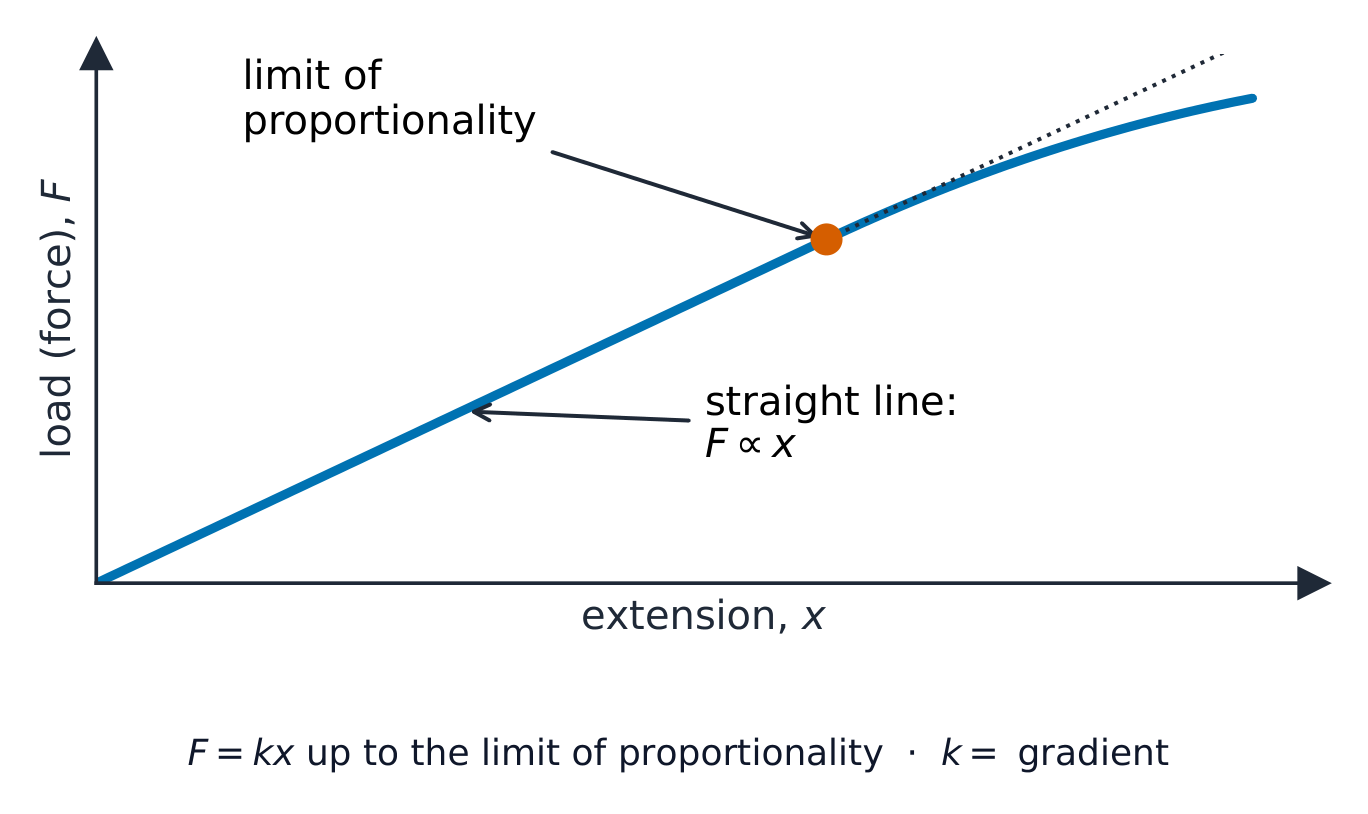
On a load–extension graph 载荷-伸长图 the line is straight at first: extension is proportional to load. The point where the line stops being straight is the limit of proportionality 比例极限.
The experiment. Hang the spring from a clamp and stand a ruler beside it. Read the position of the bottom of the spring with no load: this is the original length. Add loads one at a time (for example 1 N each) and record the new length each time. The extension is the new length minus the original length. Plot load on the y-axis against extension on the x-axis.
The spring constant 弹簧常数 is the force per unit extension:
$$k = \frac{F}{x}$$
A large $k$ means a stiff spring.
Resultant force and Newton's laws
Add forces on a straight line to get the resultant force 合力 (forces one way are positive, the other way negative).
If the resultant force is zero, the object stays at rest or keeps moving in a straight line at constant speed. (Newton's first law.)
If the resultant force is not zero, the object accelerates in the direction of the force:
$$F = ma$$
Worked example. A $1200\ \text{kg}$ car has a $3000\ \text{N}$ driving force and $600\ \text{N}$ of friction. Find its acceleration.
First find the resultant force: $3000 - 600 = 2400\ \text{N}$. Then
A resultant force at right angles to the motion does not change the speed. It changes the direction, so the object moves in a circle at a steady speed. This is circular motion 圆周运动. The force always points towards the centre of the circle: the pull of the string on a whirling ball, or the gravity of the Sun on a planet.
For an object moving in a circle:
a bigger force is needed to keep the same mass moving at a higher speed in a circle of the same radius 半径;
a bigger force makes the same mass at the same speed move in a smaller circle (a smaller radius);
a bigger mass needs a bigger force to keep the same speed and the same radius.
Friction
Friction 摩擦力 is the force between two surfaces that touch. It tries to stop motion and makes things heat up. Drag (friction in a liquid or gas, like air resistance) also slows objects down.
Moments — the turning effect
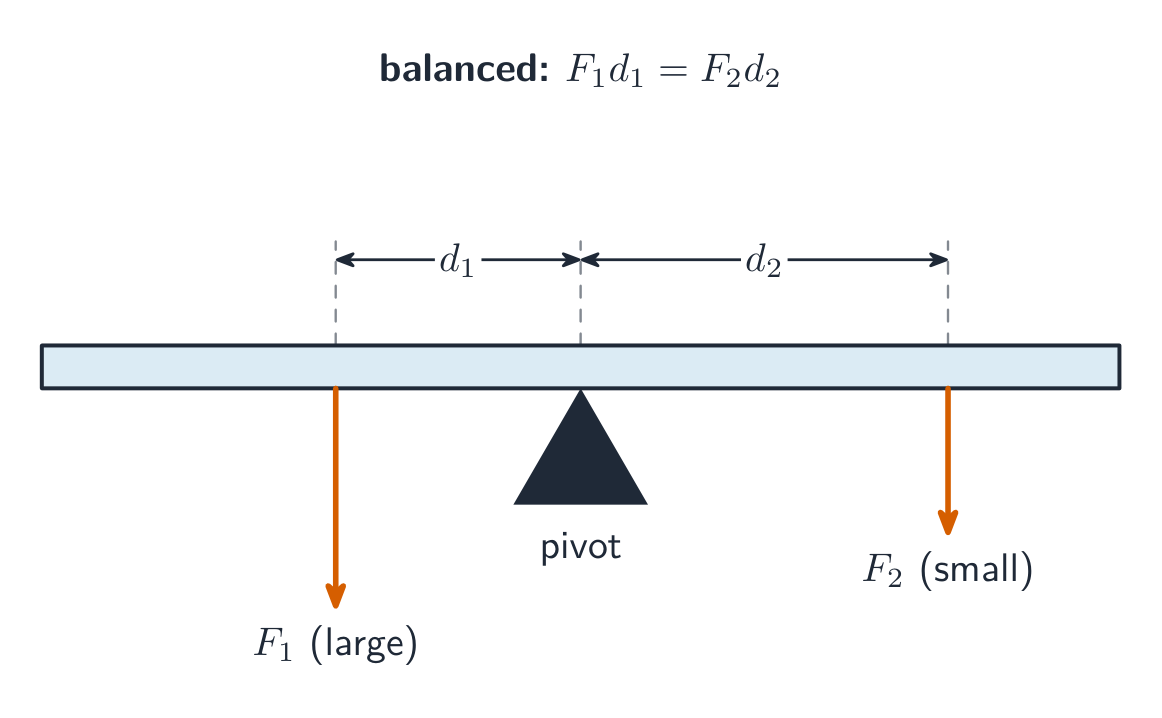
The moment 力矩 of a force is its turning effect about a pivot 支点.
$$\text{moment} = \text{force} \times \text{perpendicular distance from the pivot}$$
The unit is the newton metre (N m).
Principle of moments 力矩原理: when an object is balanced (in equilibrium 平衡),
An object is in equilibrium when there is no resultant force and no resultant moment.
Worked example. A $30\ \text{N}$ weight sits $0.20\ \text{m}$ to the left of a pivot. How far to the right must a $20\ \text{N}$ weight sit to balance the beam?
Balanced, so anticlockwise moment $=$ clockwise moment:
$$30 \times 0.20 = 20 \times d \quad\Rightarrow\quad d = \frac{6.0}{20} = 0.30\ \text{m}$$
Checking the principle by experiment. Balance a metre rule at its centre on a pivot. Hang a known weight on each side and move them until the rule balances again. Measure each distance from the pivot. Force × distance on the left equals force × distance on the right, within the small errors of measurement, so there is no resultant moment on a balanced object.
Centre of gravity
The centre of gravity 重心 is the single point where all the weight of an object seems to act.
For a flat shape (lamina 薄片), hang it from a pin and let it settle; draw a vertical line down from the pin using a plumb line. Repeat from another point. The centre of gravity is where the lines cross.
The stability 稳定性 of an object depends on where its centre of gravity is. An object is more stable 稳定 when its centre of gravity is low and its base is wide. It tips over when a vertical line down from the centre of gravity passes outside the base.
1 Define momentum as mass $\times$ velocity; recall and use the equation $p = mv$
2 Define impulse as force $\times$ time for which force acts; recall and use the equation $\text{impulse} = F\Delta t = \Delta(mv)$
3 Apply the principle of the conservation of momentum to solve simple problems in one dimension
4 Define resultant force as the change in momentum per unit time; recall and use the equation $F = \frac{\Delta p}{\Delta t}$
Source: Cambridge International syllabus · 出典: Cambridge International シラバス
English
Conservation of momentum in a collision
Momentum is mass times velocity. It is a vector.
$$p = mv$$
Impulse 冲量 is the force times the time it acts, and it equals the change in momentum:
$$\text{impulse} = F\,\Delta t = \Delta(mv)$$
So the resultant force is the change in momentum per unit time:
$$F = \frac{\Delta p}{\Delta t}$$
Conservation of momentum 动量守恒: when objects collide and no outside force acts, the total momentum before equals the total momentum after.
$$m_1 u_1 + m_2 u_2 = m_1 v_1 + m_2 v_2$$
(Here $u$ is a velocity before and $v$ is a velocity after.)
Worked example. A $2.0\ \text{kg}$ trolley moving at $3.0\ \text{m/s}$ hits a stationary $1.0\ \text{kg}$ trolley and they stick together. Find their common velocity afterwards.
gravitational field strength/ˌɡrævɪˈteɪʃənl fiːld streŋθ/
重力場の強さ
resultant/rɪˈzʌltənt/
合力
motion/ˈməʊʃn/
運動
impulse/ˈɪmpʌls/
lv ra
conservation of momentum/ˌkɒnsəˈveɪʃn ɒv məʊˈmentəm/
運動量の保存
stored/stɔːd/
存储的
kinetic/kɪˈnetɪk/
運動エネルギー
gravitational potential/ˌɡrævɪˈteɪʃənl pəˈtenʃl/
重力ポテンシャル
chemical/ˈkemɪkl/
化学エネルギー
elastic (strain)/ɪˈlæstɪk/
弾性(ひずみ)
nuclear/ˈnjuːklɪə/
原子核
electrostatic/ɪˌlektrəʊˈstætɪk/
静電気的
internal (thermal)/ɪnˈtɜːnl/
内部(熱)エネルギー
transferred/trænsˈfɜːd/
移る(transferred)
principle of conservation of energy/ˈprɪnsɪpl ɒv ˌkɒnsəˈveɪʃn ɒv ˈenədʒi/
エネルギー保存の法則
Sankey diagram/ˈsæŋki ˈdaɪəɡræm/
サンキー図
wasted/ˈweɪstɪd/
無駄
work done/wɜːk dʌn/
気体が行う仕事
joule/dʒuːl/
ジュール
1.7
Energy, work and power · エネルギー、仕事、出力
Syllabus · シラバス
English
1.7.1 Energy
Core
Supplement
1 State that energy may be stored as kinetic, gravitational potential, chemical, elastic (strain), nuclear, electrostatic and internal (thermal)
2 Describe how energy is transferred between stores during events and processes, including examples of transfer by forces (mechanical work done), electrical currents (electrical work done), heating, and by electromagnetic, sound and other waves
4 Recall and use the equation for kinetic energy $E_k = \frac{1}{2}mv^2$
5 Recall and use the equation for the change in gravitational potential energy $\Delta E_p = mg\Delta h$
3 Know the principle of the conservation of energy and apply this principle to simple examples including the interpretation of simple flow diagrams
6 Know the principle of the conservation of energy and apply this principle to complex examples involving multiple stages, including the interpretation of Sankey diagrams
1.7.2 Work
Core
Supplement
1 Understand that mechanical or electrical work done is equal to the energy transferred
2 Recall and use the equation for mechanical working $W = Fd = \Delta E$
1.7.3 Energy resources
Core
Supplement
1 Describe how useful energy may be obtained, or electrical power generated, from: (a) chemical energy stored in fossil fuels (b) chemical energy stored in biofuels (c) water, including the energy stored in waves, in tides and in water behind hydroelectric dams (d) geothermal resources (e) nuclear fuel (f) light from the Sun to generate electrical power (solar cells) (g) infrared and other electromagnetic waves from the Sun to heat water (solar panels) and be the source of wind energy including references to a boiler, turbine and generator where they are used
4 Know that radiation from the Sun is the main source of energy for all our energy resources except geothermal, nuclear and tidal
2 Describe advantages and disadvantages of each method in terms of renewability, availability, reliability, scale and environmental impact
5 Know that energy is released by nuclear fusion in the Sun
6 Know that research is being carried out to investigate how energy released by nuclear fusion can be used to produce electrical energy on a large scale
3 Understand, qualitatively, the concept of efficiency of energy transfer
7 Define efficiency as: (a) $(\%) \text{ efficiency} = \frac{\text{(useful energy output)}}{\text{(total energy input)}} (\times 100\%)$ (b) $(\%) \text{ efficiency} = \frac{\text{(useful power output)}}{\text{(total power input)}} (\times 100\%)$ recall and use these equations
1.7.4 Power
Core
Supplement
1 Define power as work done per unit time and also as energy transferred per unit time; recall and use the equations (a) $P = \frac{W}{t}$ (b) $P = \frac{\Delta E}{t}$
Source: Cambridge International syllabus · 出典: Cambridge International シラバス
English
Energy stores
Energy can be stored 储存 in different ways: kinetic 动能, gravitational potential 重力势能, chemical 化学能, elastic (strain) 弹性势能, nuclear 核能, electrostatic 静电能, and internal (thermal) 内能.
Energy is transferred 转移 between stores by forces (mechanical work), by electric currents, by heating, and by waves (such as light and sound).
Kinetic and potential energy
Kinetic energy is the energy of a moving object:
$$E_k = \frac{1}{2}mv^2$$
The change in gravitational potential energy when an object goes up or down by a height $\Delta h$:
$$\Delta E_p = mg\,\Delta h$$
Conservation of energy
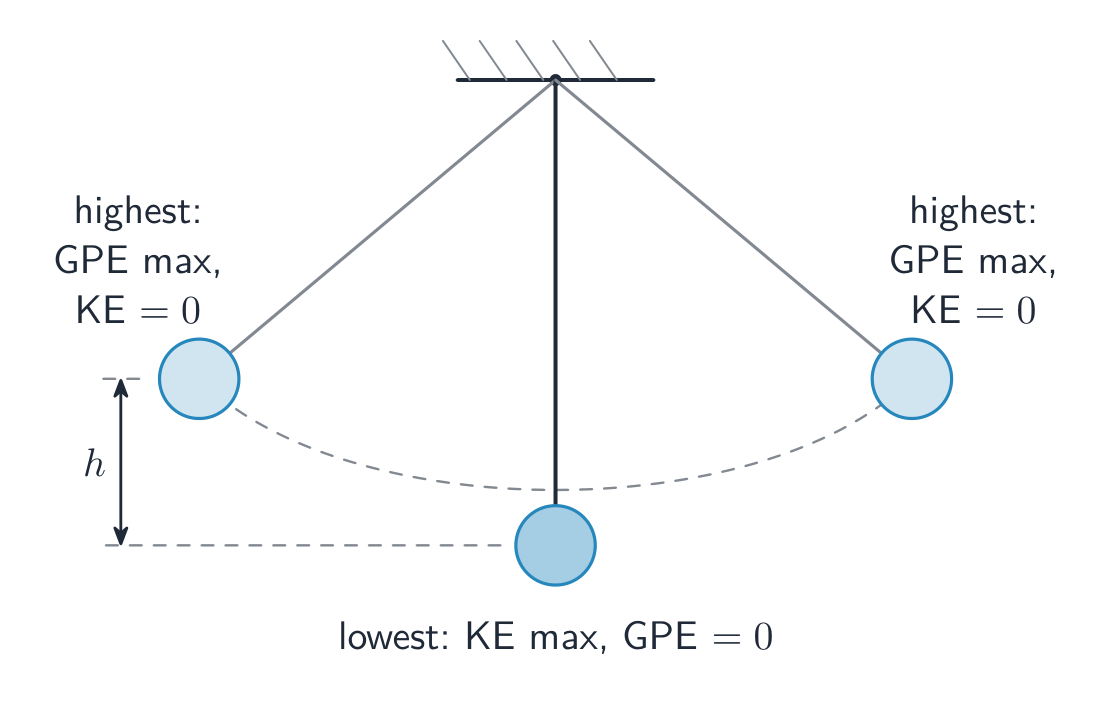
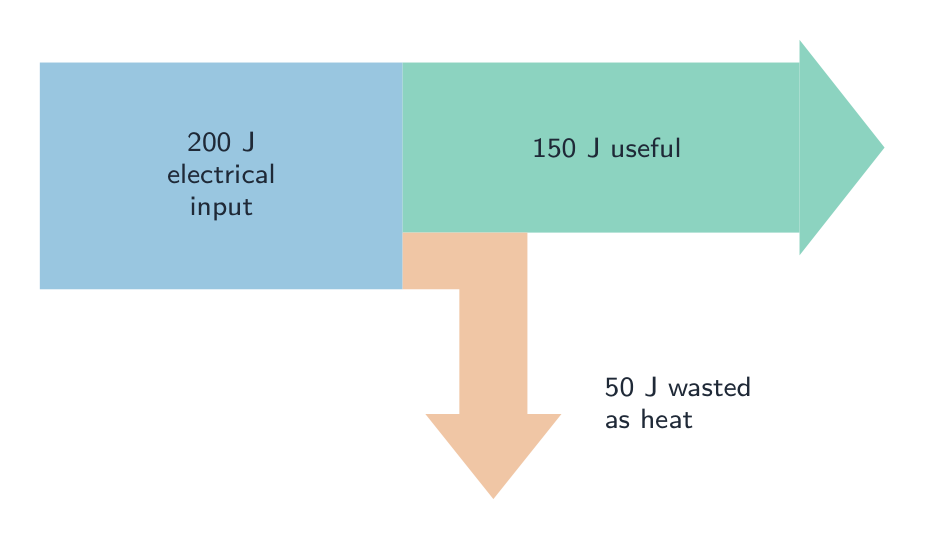
The principle of conservation of energy 能量守恒定律 says energy is never made or destroyed; it only moves between stores. A falling object turns gravitational potential energy into kinetic energy. A Sankey diagram 桑基图 shows how the input energy splits into useful energy and wasted 浪费 energy.
Worked example. A $0.50\ \text{kg}$ ball is dropped from a height of $1.8\ \text{m}$. Ignoring air resistance, find its speed just before it lands. (Take $g = 10\ \text{m/s}^2$.)
All the gravitational potential energy becomes kinetic energy, so $\tfrac{1}{2}mv^2 = mg\,\Delta h$. The mass cancels, leaving $v^2 = 2g\,\Delta h$:
Because the mass cancels, every object dropped from this height would land at the same speed.
Work
Work done 做功 equals the energy transferred. When a force moves an object:
$$W = Fd = \Delta E$$
The unit of work and energy is the joule 焦耳 (J).
Power
Power 功率 is the work done (or energy transferred) per unit time.
$$P = \frac{W}{t} = \frac{\Delta E}{t}$$
The unit is the watt 瓦特 (W). $1\ \text{W} = 1\ \text{J/s}$.
Efficiency
Efficiency 效率 tells you how much of the input energy becomes useful energy.
$$\text{efficiency} = \frac{\text{useful energy output}}{\text{total energy input}} \times 100\%$$
Efficiency is always less than 100% because some energy is always wasted (usually as heat). The same idea works with power:
$$\text{efficiency} = \frac{\text{useful power output}}{\text{total power input}} \times 100\%$$
Worked example. A motor is supplied with $200\ \text{J}$ of electrical energy and lifts a load, giving it $150\ \text{J}$ of gravitational potential energy. Find its efficiency.
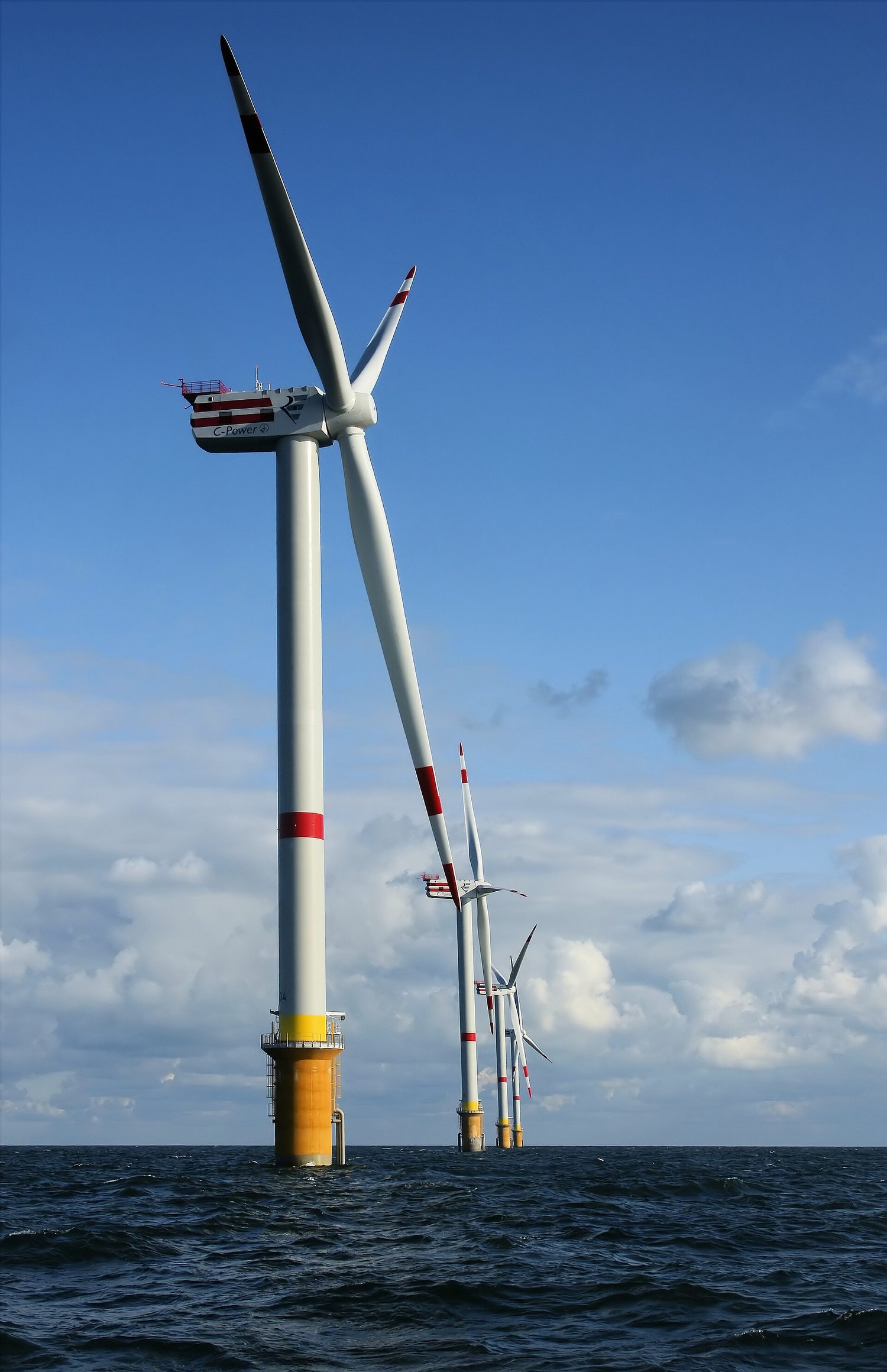
We generate electricity from many energy resources. Most spin a turbine that drives a generator – often by boiling water to make steam (fossil fuels, nuclear fuel, geothermal, biofuels), or directly by moving water or air (hydroelectric, waves, tides, wind). Solar cells make electricity from sunlight directly; solar panels heat water.
Resource
Renewable?
Notes
fossil fuels (coal, oil, gas)
no
reliable, high output, but CO₂ and pollution
nuclear fuel
no
huge output, no CO₂, but radioactive waste
biofuels
yes
roughly carbon-neutral if replanted
hydroelectric
yes
reliable, but a dam floods land
wind
yes
clean, but intermittent
solar
yes
clean, but only in daylight
geothermal / tidal
yes
reliable but limited to certain places
When you compare resources, use these five ideas: renewability 可再生性 (will it run out?), availability 可用性 (is it always there? the wind can drop and the Sun sets), reliability 可靠性 (does it give a steady output?), scale 规模 (how much energy can it supply?) and environmental impact 环境影响 (pollution, carbon dioxide, land flooded by a dam).
Most of these trace back to the Sun (fossil fuels are ancient stored sunlight; wind and waves come from solar heating) – the exceptions are geothermal, nuclear, and tidal energy. The Sun itself is powered by nuclear fusion 核聚变, joining hydrogen nuclei into helium. Scientists are researching how to use fusion in power stations on Earth, but no fusion reactor yet gives out more electrical energy than it uses.
Input energy splits into useful output and wasted energy; efficiency is the useful fraction, and the total is always conserved. · 入力エネルギーは有用な出力と散逸エネルギーに分かれ、効率は有用な割合であり、総エネルギーは常に保存される。
Explore · 探索
Conservation of energy · エネルギー保存の法則
Drop the object: GPE turns into KE, and the total stays the same when there's no friction. · 物体を落下させます:重力位置エネルギーが運動エネルギーに変換され、摩擦がない場合総エネルギーは一定です。
On a distance–time graph the gradient is the speed; on a speed–time graph the gradient is the acceleration and the area under the line is the distance travelled. Never read one graph as if it were the other.
Mass (kg) is the amount of matter and is the same everywhere; weight (N) is the force of gravity, $W = mg$. On the Moon your mass is unchanged but your weight is smaller.
Speed is a scalar; velocity is a vector. Something moving at steady speed around a curve is still accelerating, because its direction keeps changing.
In Hooke's law, load is proportional to extension only up to the limit of proportionality. Use the extension (stretched length − original length), never the whole length.
Momentum$p = mv$ is conserved in a collision. Give each velocity a $+$ or $-$ sign for its direction before you add them.
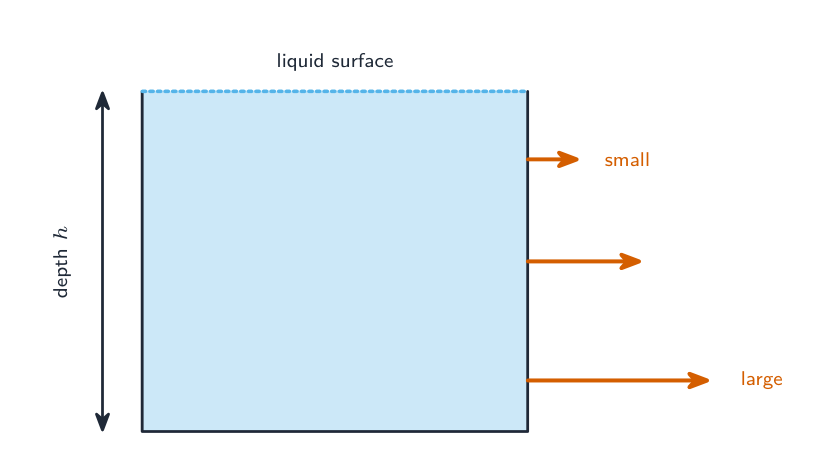
Convert units first (cm → m, g → kg). Use $p = F/A$ for a solid pressing on a surface, but $p = \rho g h$ for the pressure inside a liquid — they are different formulas.
Type to search notes, lessons, code, vocabulary and past-paper questions across every subject. · すべての科目でノートImplemented、Implemented、コード、語彙、過去問問題を検索するために入力してください。