Skip to content · ⁨コンテンツへスキップ⁩

Writing an informal email · ⁨カジュアルなメールの書き方⁩

IGCSE English · ⁨IGCSE 英語⁩ · Topic 3 · ⁨トピック 3⁩

View Slides · ⁨查看幻灯片⁩ Train · ⁨練習する⁩
Video lesson for this topic · ⁨このトピックのビデオレッスン⁩ Open the video page · ⁨動画ページを開く⁩
7:50

非公式なメールを書く

二人の生徒が同じタスクに答えています:友達への訪問地の報告メールを書く。一つ目の答えは以下の通りです:<slow>博物館に行きました。良かったです。友だちと一緒に……

English narration · English + 中文 subtitles burned in · ⁨英語ナレーション・英語+中文字幕 burning-in⁩

3.1

Why and to whom you write · ⁨誰に、なぜ書くか⁩

Syllabus · ⁨シラバス⁩
English
  1. recognise that an informal email is written to a friend or relative
  2. respond to all of the prompts given in the task
  3. use a friendly, personal tone that suits the reader
日本語
  1. 非公式なメールは友人や親族宛てに書かれていることを認識する
  2. タスクで与えられたすべてのプロンプトに応答する
  3. 読者に適した、親しみやすく個人的なトーンを使う

Source: Cambridge International syllabus · ⁨出典: Cambridge International シラバス⁩

English

The first writing task asks you to write an informal email 非正式电子邮件 to a friend or a family member.

Cover every prompt

  • The task gives you some prompts 提示 — short points you must write about.
  • You must cover every prompt. If you miss one, you lose content marks.
  • Tick each prompt as you write it, so you do not forget one.

Use a friendly tone

  • An email to a friend is informal 非正式. Use a warm, friendly tone 语气.
  • Write as if you are talking to the person. Ask them questions too.
日本語

最初の作文課題では、友人や家族へ向けた 非正式なメール を書くことが求められます。

全ての指示事項を網羅する

  • タスクにはいくつかの指示事項が与えられる:書くべき短いポイントである。
  • 全ての指示事項を網羅しなければならない。1つ見落とすと、内容の得点が失われる。
  • 書くたびに指示事項にチェックを入れ、1つ見落とさないようにする。

親しみやすいトーンを使う

  • 友人へのメールはインフォーマルである。温かく親しみやすいトーンを使おう。
  • 直接相手に話しかけるように書こう。質問も加えよう。
腕を組んで笑い合っている3人の学校の友人
これはメールの受け手である:すでにあなたを知っている人なので、話しかけるような感じで書こう
ラップトップ上で書く様子:インフォーマルなメールであっても、明確な目的、順序、そして親しみやすいトーンが必要である
Vocabulary · ⁨語彙⁩ Train · ⁨練習する⁩
English 日本語
informal email/ɪnˈfɔːml ˈiːmeɪl/ 非公式なメール
prompts/prɒmpts/ プロンプト
informal/ɪnˈfɔːml/ 非公式
tone/təʊn/ トーン
greeting/ˈɡriːtɪŋ/ 挨拶
closing/ˈkləʊzɪŋ/ 結びの言葉
paragraphs/ˈpærəɡræfz/ 段落
short forms/ʃɔːt fɔːmz/ 省略形
developed/dɪˈveləpt/ 発展
reason/ˈriːzn/ 理性
example/eɡˈzæmpl/ 具体例
detail/ˈdiːteɪl/ 細部
3.2

How to build your email · ⁨メールを構築する方法⁩

Syllabus · ⁨シラバス⁩
English
  1. open and close an informal email appropriately (for example: Hi … / Write back soon …)
  2. organise the email into short paragraphs, with one main idea per paragraph
  3. use informal language: contractions, friendly phrases and questions to the reader
日本語
  1. 非公式なメールを適切に書き始め、締めくくる(例:Hi … / Write back soon …など)
  2. メールを短い段落に分け、各段落に一つの主要な考えを入れる
  3. 非公式な表現を使う:略語、親しいフレーズ、読者への質問

Source: Cambridge International syllabus · ⁨出典: Cambridge International シラバス⁩

English

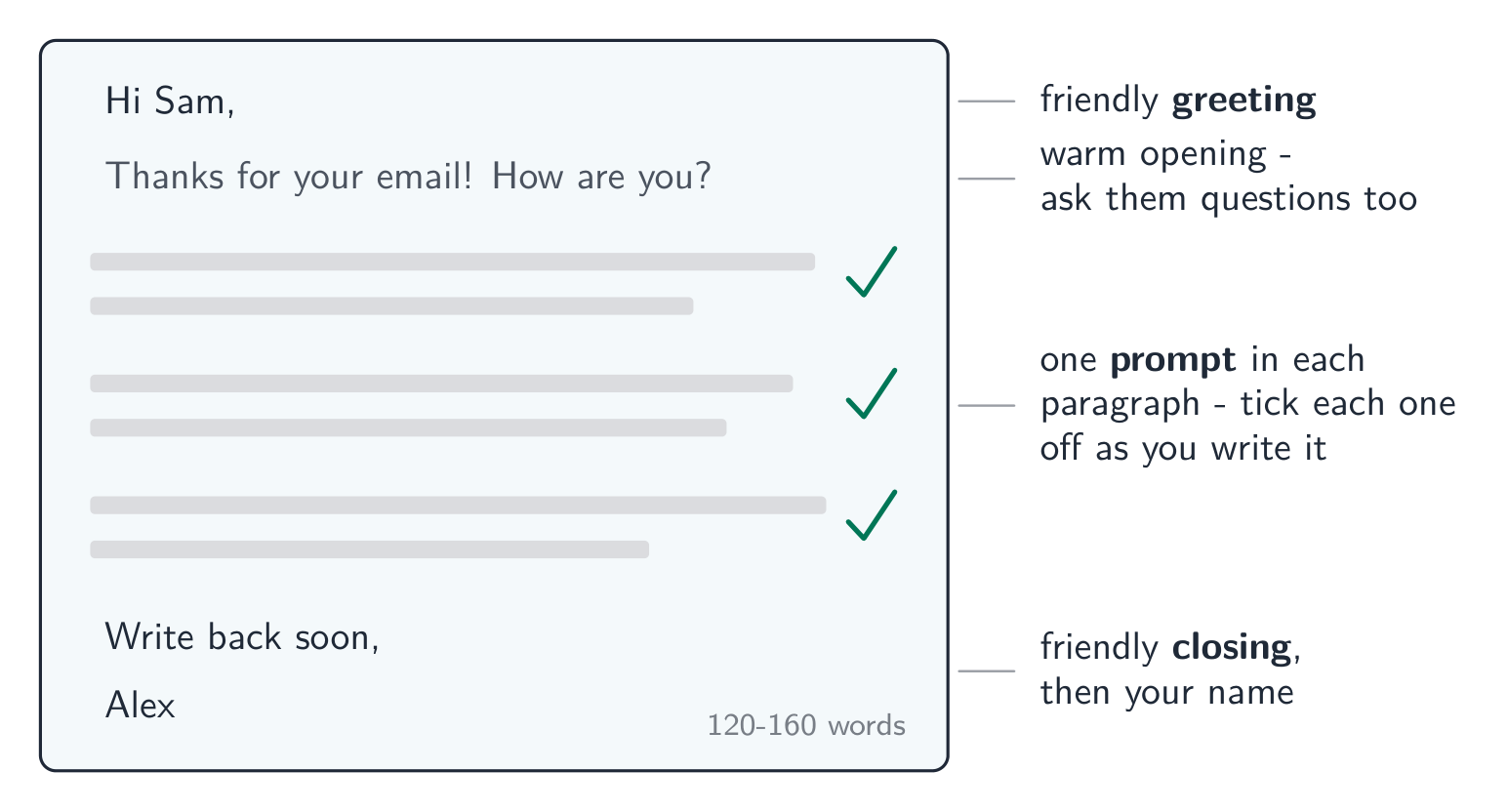
A good email has a clear shape.

Greeting and ending

  • Start with a greeting 问候语: Hi Sam, or Dear Anna,
  • End with a friendly closing 结束语: Write back soon, or See you soon, then your name.

Paragraphs

  • Use short paragraphs 段落. Put one main idea in each one.
  • Do not write one long block of text.

Useful language

  • Informal language uses short forms 缩略形式: I'm, don't, can't.
  • Friendly phrases help: Guess what! / How are you? / I can't wait to…
日本語

良いメールには、明確な構成があります。

ラベル付きのインフォーマルなメール:親しみやすい挨拶、温かい冒頭文、各指示事項に対するチェック入り段落、親しみのある締めくくり、署名、全120〜160文字程度
良好なカジュアルメールの構成

挨拶と結び

  • 挨拶 问候语で始めます: Hi Sam, または Dear Anna,
  • 親しみやすい結びの言葉 结束语で終わります: Write back soon, または See you soon, の後にあなたの名前を添えます。

段落

  • 短い段落 段落を使用します。各段落に1つの主要なアイデアを一つだけ含めます。
  • 1つの長い文章塊(block)として書かないように注意してください。

便利な表現

  • カジュアルな表現では短縮形 缩略形式を使います: I'm, don't, can't など。
  • 親しみやすいフレーズが役立ちます: Guess what! / How are you? / I can't wait to…
3.3

Making your email better · ⁨メールをより良くする⁩

Syllabus · ⁨シラバス⁩
English
  1. develop each idea with a reason, example or detail rather than just listing points
  2. vary your sentence openings and link ideas smoothly
  3. check the length (120–160 words), the tone and the accuracy before finishing
日本語
  1. 単にポイントを列挙するのではなく、理由、具体例、詳細によって考えを展開する
  2. 文の开头を変え、考えをスムーズにつなぐ
  3. 完成前に長さ(120–160語)、トーン、正確性を確認する

Source: Cambridge International syllabus · ⁨出典: Cambridge International シラバス⁩

English

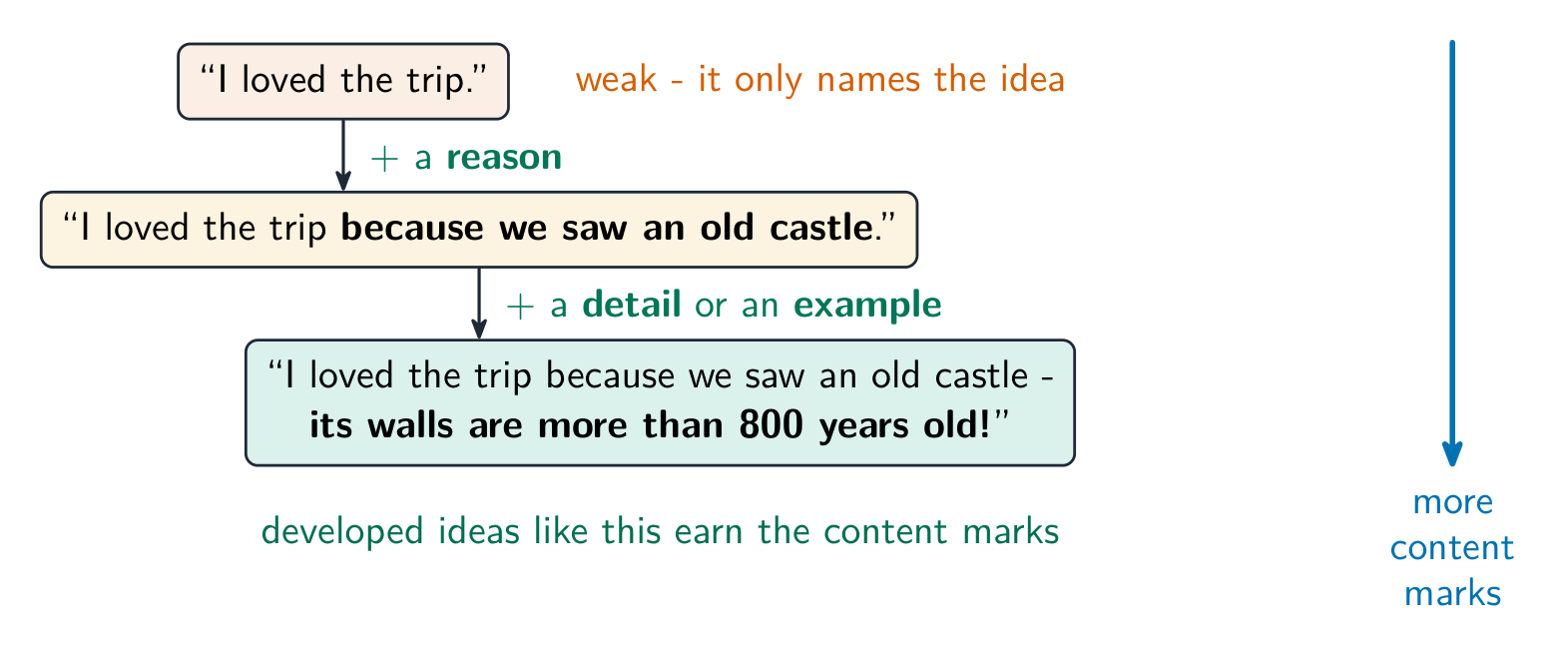
Content marks reward developed 展开的 ideas, not a list.

Develop your ideas

  • Do not just name an idea. Add a reason 原因, an example 例子, or a detail 细节.
  • "I loved the trip" is weak. "I loved the trip because we saw an old castle" is much better.

Check before you finish

  • Count your words: aim for 120 to 160 words.
  • Check the tone is friendly, then fix small grammar and spelling mistakes.

A model email

See how the friendly tone and developed ideas work together.

Hi Sam,

Guess what — I finally visited the new science museum you told me about! I loved it, especially the space room, because you can sit in a real rocket seat and feel it shake. I went with my cousin, and we stayed until it closed.

How about you? Have you been yet? We really should go together in the summer.

Write back soon, Lin

Notice the warm greeting, one developed idea with a reason, a question back to Sam, and a friendly closing. It reads like a real message to a friend — and it covers every prompt.

日本語

コンテンツ・マークは、単なるリストではなく、展開された 展开的アイデアに与えられます。

考えを展開する

  • アイディアを名指しするだけでなく、理由 原因、例 例子、または詳細 细节を追加してください。
  • "I loved the trip" は弱いです。"I loved the trip because we saw an old castle" の方が遥かに良いです。
弱い文が2段階で成長します:まず理由を追加し、次に詳細を追加することで、各段階でより多くのコンテンツ・マークを獲得します
追加される理由や詳細が、アイデアをより強固にする

提出前にチェックする

  • 文字数を数えてください:120〜160-wordを目安にしてください。
  • トーンが親しみやすいか確認し、小さな文法やスペルミスも修正してください。

参考例メール

親しみやすいトーンと展開されたアイデアがどのように機能するかを確認してください。

Hi Sam,

Guess what — I finally visited the new science museum you told me about! I loved it, especially the space room, because you can sit in a real rocket seat and feel it shake. I went with my cousin, and we stayed until it closed.

How about you? Have you been yet? We really should go together in the summer.

Write back soon, Lin

温かい挨拶、理由付きの展開されたアイデア、Samへの質問、そして親しみやすい結びの言葉に注目してください。これは本当に友人へのメッセージのように読め、プロンプトのすべての要素を網羅しています。

3.3

Exam tips · ⁨試験対策⁩

English
  • Open warmly: "Thanks for your email!" or "Great to hear from you!" sets the informal tone at once.
  • Use short forms (I'm, don't, can't). They are correct here and make you sound like a friend.
  • Give each prompt in the task its own short paragraph, and add one detail or reason to each.
  • Close like a friend: "Write back soon," plus your first name only, never a full name.
  • Keep the style informal from the first line to the last; one "Dear Sir" in the middle breaks the whole email.
日本語
  • 暖かく開きます:"Thanks for your email!" や "Great to hear from you!" で即座にカジュアルなトーンを設定します。
  • 短縮形(I'm, don't, can't)を使用します。これらは正しく、あなたを友人のように見せます。
  • タスクの各プロンプトに対して独自の短い段落を作り、それぞれに1つの詳細や理由を追加してください。
  • 友人のように結びます:"Write back soon," とあなたのファーストネームのみを書き、フルネームは使わないでください。
  • 最初から最後までスタイルをカジュアルに保ちます。真ん中に "Dear Sir" が1つあるだけで、メール全体が台無しになります。

Interactive lessons on this topic · ⁨このトピックのインタラクティブ授業⁩

Work through it step by step, with instant-check exercises. · ⁨一歩ずつ進め、即時チェック付きの問題で学習します。⁩

Past Papers · ⁨過去問⁩

More topics in IGCSE English · ⁨IGCSE 英語⁩ · ⁨IGCSE English · ⁨IGCSE 英語⁩ の他のトピック⁩

Log in or create account · ⁨ログインまたはアカウント作成⁩

IGCSE, A-Level & AP