- recognise that an article is written for a general audience to inform or entertain
- choose a title and an opening that catch the reader's interest
- keep the reader engaged with questions, examples and a clear point of view
Writing an article
IGCSE English · Topic 6
 7:49
7:49
Writing an Article
Two students write an article about sleep for the school magazine. Here is one opening: <slow>Sleep is very important for students. In this article I will…
English narration · English + 中文 subtitles burned in
6.1
What an article is for

Syllabus
Source: Cambridge International syllabus
An article 文章 is written for a magazine, a newspaper, or a website. Many people read it.
Purpose
- An article informs 告知 or entertains 娱乐 a general reader.
- You usually give your own view on a topic, with reasons.
Engage the reader
- You must engage 吸引 the reader — make them want to keep reading.
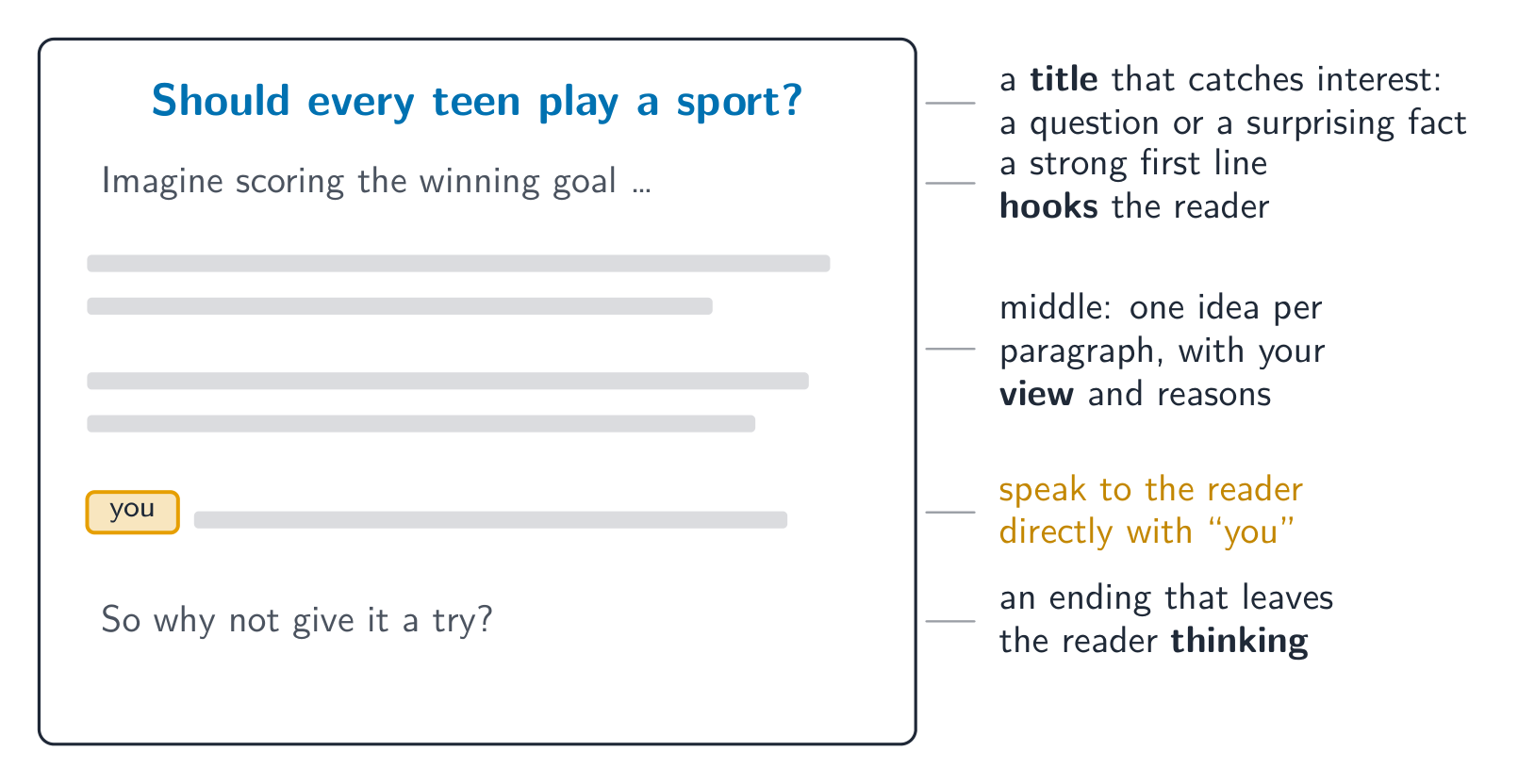
- A good title 标题 and a strong first line catch their interest 兴趣.
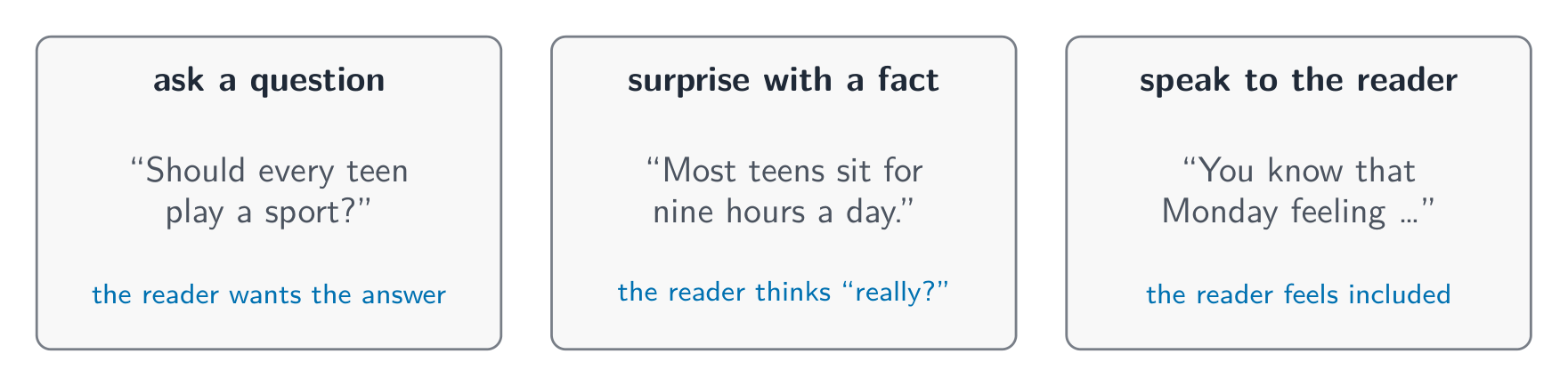
- Ask the reader a question, or start with a surprising fact.
Vocabulary
Train
| English |
|---|
| article/ˈɑːtɪkl/ |
| informs/ɪnˈfɔːmz/ |
| entertains/ˌentəˈteɪnz/ |
| engage/enˈɡeɪdʒ/ |
| title/ˈtaɪtl/ |
| interest/ˈɪntrest/ |
6.2
Writing a lively article
Syllabus
- organise the article into an introduction, development and conclusion
- use lively, varied language and a consistent tone
- address the reader directly where it suits the topic
Source: Cambridge International syllabus
An article should sound interesting, not flat.
Structure
- Begin with an introduction 引言 that names the topic.
- Develop your points in the middle, one idea in each paragraph.
- End with a short conclusion 结论 that leaves the reader thinking.
Lively language
- Use varied 多样的 words and sentence lengths to keep the energy up.
- You can speak to the reader directly with "you".
- Keep the tone friendly, but not too casual.
Useful language
A few flexible phrases 短语 let you hook the reader and glide between ideas.
- To open with energy: Have you ever…? / Imagine you… / Last week, something odd happened to me.
- To move between ideas: What's more… / On the other hand… / The truth is…
- To speak to the reader: You might think… / We all know that… / Be honest —…
- To end memorably: So next time you… / Perhaps the real question is…
Vary how you open sentences. Ten sentences that all begin "I think" feel flat 平淡; mixing your openings keeps the reader awake.
A model opening
See how one opening hooks the reader, then points forward.
Have you ever tried to sleep with a phone glowing beside your pillow? Most of us have — and most of us wake up tired. This article asks a simple question: could a good night's sleep be the cheapest way to feel happier?
The question pulls the reader in, the honest detail keeps them, and the last line promises where the article is going. That is a lot of work for three sentences.
Vocabulary
Train
| English |
|---|
| introduction/ˌɪntrəˈdʌkʃn/ |
| conclusion/kənˈkluːʒn/ |
| varied/ˈveərid/ |
| phrases/ˈfreɪzɪz/ |
| flat/flæt/ |
6.2
Exam tips
- Give the article a short, catchy title, then hook the reader with a question or surprise in the first lines.
- Talk to the reader: "Have you ever…?" An article is the one formal task where personality wins marks.
- One idea per paragraph, and make it real with a short example or a small story.
- Numbers and small facts make an article feel true: "three out of five students…".
- End with a line the reader remembers: a punchline, a question, or a call to act.
Interactive lessons on this topic
Work through it step by step, with instant-check exercises.