- recognise that a report is written for a superior or a group about an event, experience or situation
- give factual information clearly and add suggestions or recommendations
- use a neutral, factual tone
Writing a report
IGCSE English · Topic 5
 7:50
7:50
Writing a Report
A club leader has to decide whether to run the school trip again next year. Two students send her an account of it. The first says: <slow>The trip was amazing!…
English narration · English + 中文 subtitles burned in
5.1
What a report is for
Syllabus
Source: Cambridge International syllabus
A school library has two computers, and students are waiting. Should the librarian immediately buy five more? A report 报告 helps a reader understand the situation 情况 and decide how to act 行动. It connects findings, explanation and useful advice rather than jumping from a complaint to an expensive answer.
Purpose and reader
A report can describe an event 事件, experience or place. Read who will receive it and what they need to know. Cambridge’s report guide describes a mixture of fact and opinion: the reader may want what worked well, what people thought and how things could improve. A clear report can include evaluations in its findings. Do not ban opinions from every section except the ending.
In current 0510 Paper 1 Exercise 6, a report is one possible response type. The question gives the actual form, purpose and reader; write about 120–160 words. Up to 6 marks assess content and 9 language. Relevant development, audience, style, accuracy and organisation matter; a heading or particular phrase does not automatically earn a mark.
Complete original task and evidence
Original classroom task. Your librarian wants student feedback on the school library. Write a report explaining what works well and suggesting how it could improve. Use the practice notes below. Write about 120–160 words.
Fictional practice notes. You visited on Tuesday. The quiet study area helped you concentrate on science homework; there was a good choice of science books. The library opened from the end of lessons until 17:00. It had two computers; you saw a queue at 16:00. Three classmates said they could not use a computer when they needed one. You have no whole-school survey, cost figures or permission to buy equipment. Proposed actions are suggestions, not approved decisions.
Original planning attempt. Identify the reader and the two main demands. Select one positive feature and explain its value. Identify a problem and propose an action linked to it. What does the evidence fail to tell you?
Worked plan. Write for the librarian: explain the quiet area and useful books, then report limited computer access. Propose a booking trial and review waiting times. One visit and three comments do not prove that every student is unhappy or that five new computers are the best purchase.
Findings need clear support
Facts 事实 are statements about what happened or what was observed. An opinion 观点 evaluates something. Both can be relevant; make the basis and speaker clear. A factual 事实性的 tone uses accurate, specific wording rather than unsupported claims. Numbers are useful only when they are known.
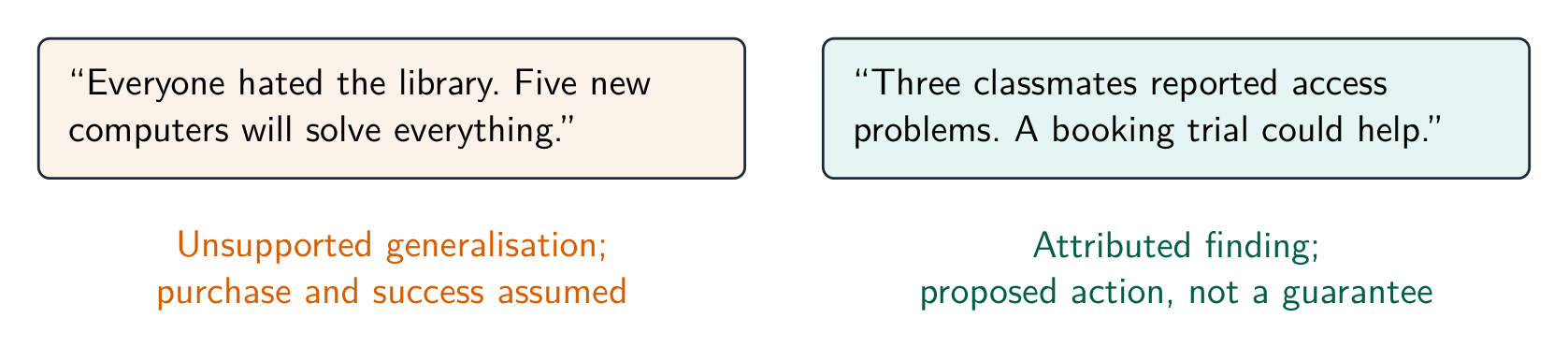
Original evidence repair. “Everyone hated the library, so five new computers will solve everything.” Rewrite it using the notes. Which words claim more than the evidence supports?
Worked revision. “Three classmates said they could not use a computer when they needed one. A booking trial could help share access.” “Everyone”, “five” and “solve everything” are unsupported. Do not invent a percentage or survey to sound convincing. In a creative exam task, plausible details may be invented as instructed; in this evidence-based classroom practice, keep the supplied facts.

Vocabulary
Train
| English |
|---|
| report/rɪˈpɔːt/ |
| act/ækt/ |
| event/ɪˈvent/ |
| situation/ˌsɪtʃuːˈeɪʃn/ |
| facts/fækts/ |
| factual/ˈfæktʃuːəl/ |
| opinion/əˈpɪnɪən/ |
5.2
How to organise a report
Syllabus
- organise a report using short headings or clearly separated sections
- separate facts from your own opinions and recommendations
- end with a clear recommendation or conclusion
Source: Cambridge International syllabus
Choose a clear order that answers the task. A title identifies the subject. Short headings 小标题 can help readers find information, but Cambridge says a report may include headings; a fixed set is not compulsory. Avoid letter greetings for this report task. To/From/Subject fields are not required by the question.
Match headings to content
A brief introduction states the purpose and, when relevant, how information was collected. Group findings by aspect, such as useful facilities and access problems. End with recommendations 建议 or a conclusion 结论 appropriate to the task. The number of paragraphs and suggestions depends on the content; do not force exactly one action.
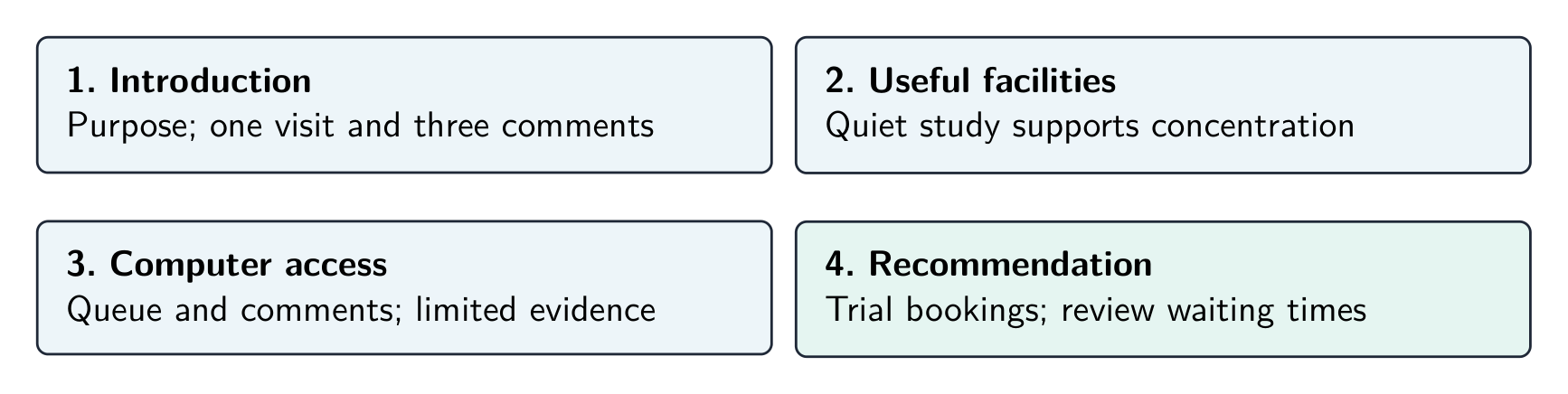
Original organisation attempt. Put these ideas in a useful order: a booking trial; three classmates reporting access problems; why the report was requested; the quiet area’s value. Choose headings that describe the paragraphs.
Worked order. Introduction: purpose and evidence. Useful facilities: quiet study and books. Computer access: observation and attributed comments. Recommendation: booking trial and review. Other coherent orders can work. “Positive points” would be misleading above a paragraph containing only access problems.
A complete original model
The model below answers our library task using only the supplied evidence and proposed actions. It has 136 body words, excluding the title and headings, by a space-separated count. It is an unmarked teaching model, not an official candidate response.
Report on the school library
Introduction
This report considers the school library and suggests improvements. It is based on my visit on Tuesday and comments from three classmates.Useful facilities
The quiet study area was useful because it allowed me to concentrate on my science homework. The library also had a good choice of science books. Its opening hours, from the end of lessons until five, gave students time to study before going home.Computer access
However, there were only two computers, and I saw a queue at four. Three classmates said they could not use a computer when they needed one. These comments suggest a problem with access, although they do not represent every student.Recommendation
I recommend trying a booking system so that computer time is shared more fairly. The librarian could review waiting times after two weeks before deciding whether more computers are needed.
Read the connections. The quiet area is evaluated and its benefit explained. The computer problem combines a direct observation with attributed comments. A limit prevents three comments becoming a claim about everyone. The proposal addresses access without promising a purchase or guaranteed success. “However” contrasts benefits with a problem; “although” qualifies the evidence. The headings describe their actual contents.
Apply useful language
Useful phrases 短语 express meaning. “The aim 目的 of this report is to…” introduces purpose; “Three classmates said…” attributes a view. A solution 解决办法 needs a link to the problem.
Original sentence choices. Complete the library sentences using the notes: “___ classmates said they could not use a computer.” “___, there were only two computers.” “I recommend ___.” Then explain why “Many students felt…” and “The best solution is to buy five computers” overstate this evidence.
Possible answers. “Three”; “However”, following a positive finding; “trying a booking system”. We know three comments, not how many students agree overall, and have not compared purchase costs or alternatives. “Best” needs stronger support than a plausible suggestion.
Use a relatively formal, informative style. “I recommend” and “my visit” can be appropriate; impersonal writing does not prohibit every first-person word. Passive voice can focus on an action, but it is not compulsory. “The library has two computers” is clearer than “Two computers are had by the library”. Replace “It was terrible!” with a precise problem and effect rather than just deleting punctuation.
Vocabulary
Train
| English |
|---|
| headings/ˈhedɪŋz/ |
| recommendations/ˌrekəmenˈdeɪʃnz/ |
| conclusion/kənˈkluːʒn/ |
| phrases/ˈfreɪzɪz/ |
| aim/eɪm/ |
| solution/səˈluːʃn/ |
5.2
Exam tips
Read the required report carefully; a memorised library model cannot answer every topic. June 2024 0510/13 Question 17 asks for a report to a teacher about an activity weekend: what was enjoyable and how it could improve. Its student comments offer ideas; the question also invites ideas of your own. A list of sports alone does not explain enjoyment, and a complaint alone does not suggest an improvement.
Original transfer task. A teacher wants feedback on a school book exchange. Write about 120–160 words explaining what was useful and how the next event could improve. Fictional notes: students could exchange books without payment; subject labels helped you find science books; some tables had no clear labels; two classmates found the queues confusing. Suggest actions but do not invent a whole-school survey. Plan and write before reading the check.
Possible plan and check. Explain affordable access and finding relevant books. Attribute the two comments rather than calling them everyone’s view. Link clearer labels and queue signs to the actual problems. Check that your report answers both demands, uses suitable tone, develops relevant ideas and keeps facts consistent. Review sentence boundaries, verb forms, spelling, word range and meaningful links. Headings, passive verbs and formal phrases are tools, not automatic marks.
Interactive lessons on this topic
Work through it step by step, with instant-check exercises.